When Time Stops Being Money: How AI Could Rewrite the Economics of Work
When Time Stops Being Money: How AI Could Rewrite the Economics of Work
- Source: SemiVision
- Author: SEMIVISION
- Published: 2026-08-23T11:38:15+08:00
- URL: https://tspasemiconductor.substack.com/p/when-time-stops-being-money-how-ai
中文翻譯與英文原文(雙語)
(2) 當時間不再是金錢:人工智慧如何改寫工作經濟學 --- (2) When Time Stops Being Money: How AI Could Rewrite the Economics of Work


When Time Stops Being Money: How AI Could Rewrite the Economics of Work
當時間不再是金錢:人工智慧如何重寫工作經濟學
Original Article By SemiVision Research [Reading time: 6 mins]
原文作者:SemiVision Research [閱讀時間:6 分鐘]

Aug 23, 2026
Share分享
When Time Stops Being Money: How AI Could Rewrite the Economics of Work
當時間不再是金錢:人工智慧如何重寫工作經濟學
For two centuries, one of capitalism’s most durable bargains has been remarkably simple: people sell their time, and employers pay them for it. Artificial intelligence may be about to complicate that arrangement.
兩百年來,資本主義最持久的契約之一向來極為簡單:人們出賣時間,雇主則為此付費。人工智慧或許即將讓這項安排變得複雜。
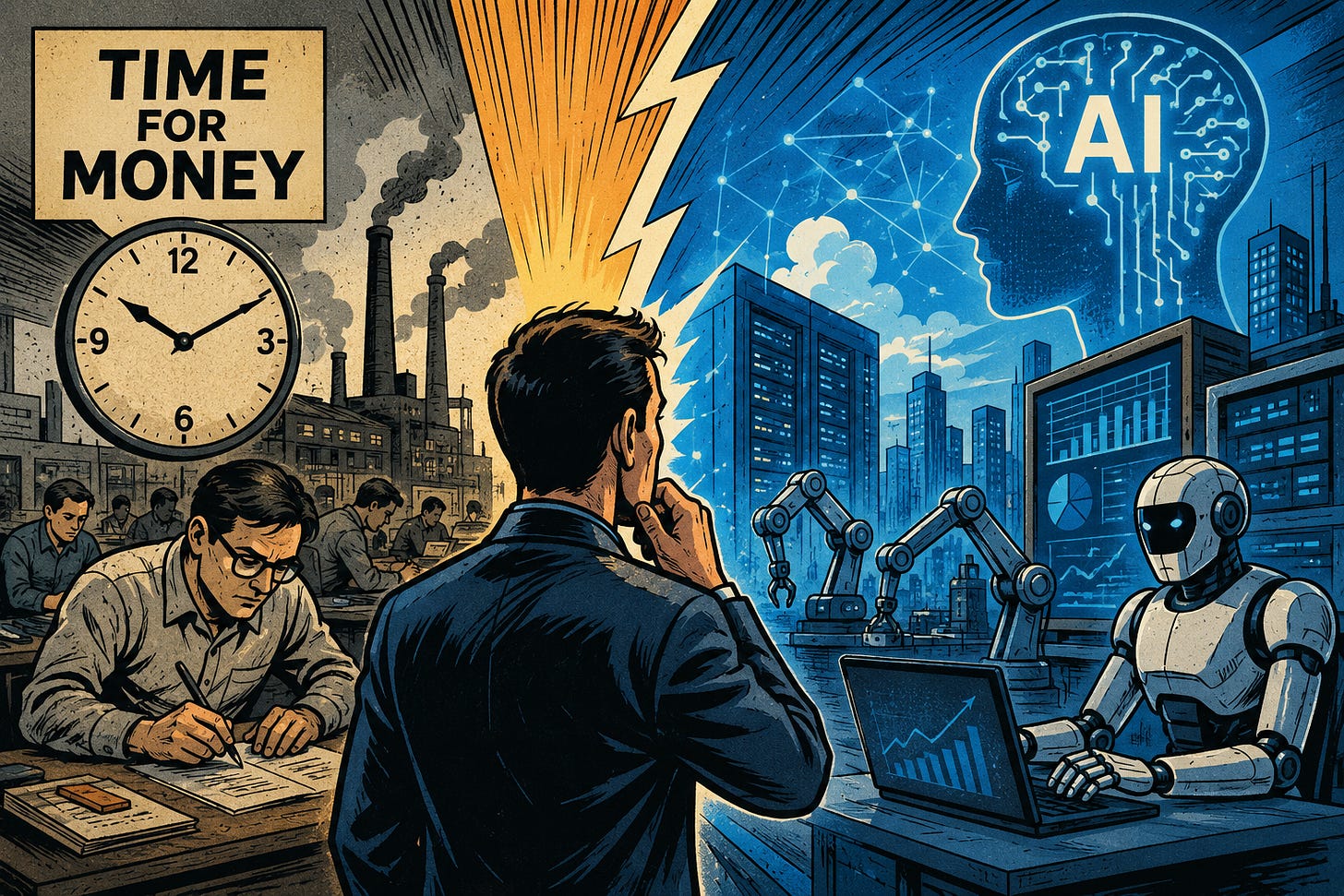
Elon Musk recently offered an especially dramatic version of this argument. Within a few years, he suggested, the idea of earning a living by selling one’s labour could begin to lose relevance as artificial intelligence assumes an ever larger share of economically useful tasks. Eventually, paying someone merely for his time may make little sense.
伊隆·馬斯克(Elon Musk)最近提出了這個論點中尤為戲劇化的一種版本。他認為,在未來幾年內,隨著人工智慧承擔越來越多具有經濟價值的任務,透過出賣勞力來謀生的概念可能開始失去其相關性。最終,僅僅因為某人的時間而支付報酬可能變得毫無意義。
The timetable is almost certainly too aggressive. The direction is harder to dismiss.
這個時程表幾乎可以肯定過於激進,但其方向卻難以否認。
The important question is not whether AI will “take all the jobs”. Technological revolutions rarely proceed so neatly. It is whether human time will remain the principal unit by which companies measure and purchase knowledge work.
重要的問題不在於人工智慧是否會「奪走所有工作」。技術革命很少如此整齊地發生。真正的關鍵在於,人類的時間是否仍將是公司衡量和購買知識工作的主要單位。
For much of modern economic history, it has been. Factory workers sell shifts; consultants bill hours; lawyers record them in six-minute increments. Engineers and analysts may earn vastly more than assembly-line workers, but the underlying transaction is similar. Their expertise is bundled with a scarce resource: their time.
在現代經濟史的絕大部分時間裡,情況確實如此。工廠工人出售輪班時間;顧問按小時計費;律師則以六分鐘為單位記錄工時。工程師和分析師的收入可能遠高於裝配線工人,但背後的交易本質相似。他們的專業知識是與一種稀缺資源綁在一起的:那就是他們的時間。
There are only so many hours in a day. That scarcity gives skilled labour much of its economic value.
一天只有這麼多小時。這種稀缺性賦予了熟練勞動力大部分的經濟價值。
AI begins to loosen the constraint.
人工智慧開始鬆動這項限制。
SEMIVISION @_@ 是一份由讀者支持的出版物。若要接收最新文章並支持我的工作,歡迎考慮成為免費或付費訂閱者。
The infinitely replicable colleague
可無限複製的同事
Consider an engineer capable of completing one complicated analysis per day. In a conventional organisation, producing 100 such analyses requires more engineers, more time or both.
試想一位工程師每天能完成一項複雜分析。在傳統組織中,若要產出 100 項此類分析,就需要更多工程師、更多時間,或兩者兼具。
AI agents operate according to a different logic. Software can, at least in principle, be copied almost without limit and deployed simultaneously. Ten agents can search ten databases while another writes code, another tests it and yet another prepares a report. The human increasingly becomes the supervisor rather than the sole producer.
AI 代理的運作遵循不同的邏輯。軟體至少在理論上可以幾乎無限複製並同時部署。十個代理可以同時搜尋十個資料庫,另一個撰寫程式碼,再一個進行測試,還有一個準備報告。人類逐漸從唯一的生產者轉變為監督者。
The old production function might be caricatured as:
舊有的生產函數可被簡化為:
Output = Humans × Time
產出 = 人力 × 時間
The emerging one looks more like:
而新興的生產函數則更像:
Output = Humans × AI × Compute × Capital
產出 = 人力 × AI × 運算 × 資本
That distinction matters. Human time is stubbornly finite. Compute is expensive, but expandable. AI inference can be purchased by the token; additional agents can be spun up in seconds. As their capabilities improve and costs fall, companies will have less reason to care how many hours an employee works and more reason to care how much useful output he can orchestrate.
這項區別至關重要。人類的時間本質上有限且難以擴張;運算資源雖然昂貴,卻具備可擴展性。AI 推論可按 token 計費購買,額外的智能體(agents)也能在數秒內啟動。隨著其能力提升且成本下降,企業將愈來愈不關心員工工作了多少小時,而更重視他們能協調產生多少有效產出。
The scarce resource shifts from labour time towards judgment.
稀缺資源正從勞動時間轉向判斷力。

5月31日5 月 31 日
Not man versus machine
並非人類與機器的對決
This also suggests that the familiar debate about “humans versus AI” is somewhat misplaced.
這也顯示,大家熟悉的「人類對抗 AI」之爭,其實有些偏離重點。
For many occupations, the more immediate contest will be between humans who use AI effectively and humans who do not.
對許多職業而言,更迫切的競爭將存在於善用 AI 的人類與未能善用 AI 的人類之間。
Imagine two financial analysts, each working eight hours. One reads documents, constructs spreadsheets and searches databases largely by hand. The other directs a collection of AI agents to screen hundreds of filings, compare historical results, examine transcripts, build preliminary models and identify anomalies. She then spends her own time deciding which conclusions actually matter.
想像兩位財務分析師,各自工作八小時。一位主要靠人工閱讀文件、製作試算表並搜尋資料庫;另一位則指揮一組 AI 代理程式,篩選數百份申報文件、比對歷史結果、檢視會議紀錄、建立初步模型並識別異常。她隨後將自己的時間用於判斷哪些結論真正重要。
Both have worked eight hours. Their output may differ by an order of magnitude.
兩人都工作了八小時,但產出可能相差一個數量級。
This is why the AI revolution could undermine the economic significance of the working hour long before it eliminates employment itself.
這正是為什麼 AI 革命可能在徹底消除就業之前,就先動搖「工時」的經濟意義。
A useful measure for the next generation of companies may therefore be something like an AI leverage ratio: how much machine intelligence, compute and automated workflow can each human employee command?
因此,對下一代企業而言,一個有用的衡量指標可能是「AI 槓桿比率」:每位人類員工能調度多少機器智慧、運算資源與自動化工作流程?
Today investors obsess over revenue per employee. Tomorrow they may also care about agents per employee, compute per employee and output per human hour.
如今,投資者痴迷於「每位員工的平均營收」;明日,他們可能也會關注「每位員工對應的代理數量」、「每位員工的運算資源」以及「每人每小時的產出」。
The most productive AI-native firm may not employ 10,000 people. It might employ 1,000 unusually capable people equipped with the digital equivalent of an enormous invisible workforce.
最具生產力的 AI 原生企業未必需要雇用一萬名員工。它可能只雇用一千位能力超凡的人才,並為他們配備相當於龐大無形勞動力的數位工具。
Capital strikes back資本的反擊
This has uncomfortable implications for the balance between labour and capital.
這對勞動力與資本之間的平衡帶來了令人不安的影響。
Industrial machinery amplified human muscle. Computers amplified calculation and communication. AI is beginning to amplify—and in some cases substitute for—cognitive labour. Robotics may eventually extend the same economics into the physical world.
工業機械放大了人類的肌肉力量,電腦放大了計算與溝通能力,而人工智慧正開始放大——在某些情況下甚至取代——認知勞動。機器人技術最終可能將同樣的經濟邏輯延伸至實體世界。
The productive assets of an AI economy will therefore increasingly consist of compute, energy, models, data, robots and capital.
因此,AI 經濟的生產性資產將日益由運算能力、能源、模型、數據、機器人與資本所構成。
Ownership matters.所有權至關重要。
If a worker’s productivity comes mainly from skills embedded in his brain, he has some bargaining power because those skills cannot easily be separated from him. But if much of that productivity migrates into a model running in a data centre, the economics change.
若勞工的生產力主要源於其大腦中內嵌的技能,由於這些技能難以與其本人分離,因此他仍具備一定的議價能力。然而,若大部分生產力轉移至資料中心運行的模型中,經濟邏輯便會隨之改變。
The person who owns the model, GPU cluster, proprietary dataset or robotic fleet may capture a larger share of the surplus.
擁有該模型、GPU 叢集、專屬數據集或機器人車隊的人,可能攫取更大比例的剩餘價值。
The defining economic question of the AI era could thus gradually shift from “Who has the best job?” to“Who owns the productive intelligence?”
因此,人工智慧時代的核心經濟問題,或許將逐漸從「誰擁有最好的工作?」轉變為「誰擁有了生產性智慧?」
That is a much more consequential question than whether ChatGPT can write an email.
這比「ChatGPT 能否撰寫電子郵件」這個問題重要得多。
The missing consumer失落的消費者
There is also an awkward macroeconomic problem hidden inside visions of near-total automation.
在近乎全面自動化的願景中,還隱藏著一個棘手的總體經濟問題。
Suppose AI and robots eventually become capable of producing an enormous quantity of goods and services with relatively little human labour. Corporate productivity would soar. Costs might collapse.
假設 AI 與機器人最終能夠以極少的人力生產出大量的商品與服務,企業生產力將大幅飆升,成本則可能崩跌。
But who buys all the output?
但誰來購買所有這些產出?
Modern consumer capitalism contains a convenient circularity. Companies pay wages; households spend those wages; that spending becomes corporate revenue. Labour is therefore both a cost of production and an important source of demand.
現代消費資本主義蘊含一種便利的循環性:企業支付薪資,家戶將這些薪資用於消費,而這些消費支出則轉化為企業營收。因此,勞動力既是生產成本,也是需求的重要來源。
If automation sharply reduces labour’s share of national income while the ownership of productive assets remains concentrated, the system may become extraordinarily good at producing things while becoming worse at distributing the purchasing power required to consume them.
若自動化大幅降低勞動在國民收入中的佔比,而生產性資產的所有權仍高度集中,該體系或許能極其高效地生產商品,卻在分配消費所需的購買力方面日趨惡化。
At that point, the AI debate ceases to be merely about productivity. It becomes a debate about distribution.
至此,關於人工智慧的辯論將不再僅限於生產力,而轉化為一場關於分配的辯論。
Governments might respond through taxes, transfers, broader capital ownership, shorter working weeks or schemes resembling universal basic income. None is economically or politically straightforward. But an economy in which machines perform much of the work would eventually require some mechanism for distributing the abundance those machines create.
政府可能透過稅制改革、轉移支付、擴大資本所有權、縮短工時,或推行類似全民基本收入的方案來因應。這些措施無論在經濟或政治層面皆非易事。然而,在一個由機器承擔大部分工作的經濟體系中,終將需要某種機制,以分配這些機器所創造的豐裕成果。
Not in three years
不是三年後
There are good reasons to be sceptical of Musk’s timetable.
有充分理由對馬斯克的時程表持懷疑態度。
The ability to perform a task in a demonstration is not the same as the ability to replace a worker inside an organisation. Companies must contend with regulation, liability, security, hallucinations, legacy systems, customer preferences and institutional inertia.
在演示中執行任務的能力,並不等同於在組織內部取代員工的能力。企業必須應對法規、責任歸屬、安全性、幻覺問題、舊有系統、客戶偏好以及組織慣性等多重挑戰。
Tacit knowledge matters too.
隱性知識同樣至關重要。
This is particularly obvious in manufacturing and semiconductors. Much of what an experienced process engineer knows is not contained in a manual. A technician may hear that a machine sounds wrong. A supply-chain manager may know that a supplier claiming its qualification is “on schedule” is actually struggling with yield. A materials engineer may recognise that a parameter technically within specification will nevertheless cause trouble in mass production.
這一點在製造業與半導體產業尤為明顯。資深製程工程師所掌握的許多知識並未記載於手冊之中。技術人員可能聽出機器運轉聲響異常;供應鏈經理可能察覺宣稱資格認證「按時進行」的供應商實際上正苦於良率問題;材料工程師則能辨識出某個雖符合規格參數、卻仍會在量產階段引發問題的潛在風險。
Such knowledge is difficult to scrape from the internet.
此類知識難以從網際網路上爬取。
The near-term equation is therefore unlikely to be:
因此,短期的方程式不太可能是:
AI + robots = no humans
AI + 機器人 = 沒有人類
It is more plausibly:更合理的推論是:
Fewer humans × much more machine intelligence = much greater output
較少的人力 × 更強大的機器智慧 = 更高的產出
That is disruptive enough.
這已經夠具顛覆性了。

2月18日2 月 18 日
The end of the hourly economy?
計時經濟的終結?
“Time is money” is usually attributed to Benjamin Franklin. For much of the industrial era it was excellent economic advice.
「時間就是金錢」這句話通常歸功於班傑明·富蘭克林。在工業時代的大部分時期,這都是極佳的經濟建議。
AI may make it less true.
人工智慧可能會讓這句話不再那麼正確。
Human time will not become worthless. Indeed, some kinds of human time—those involving exceptional judgment, trust, creativity, relationships and responsibility—may become considerably more valuable.
人類的時間不會變得毫無價值。事實上,某些類型的人類時間——涉及卓越判斷力、信任、創造力、人際關係與責任的時間——可能會變得更加珍貴。
What could lose value is undifferentiated human time: the assumption that an hour of professional labour must be purchased because an hour of human cognition is required to produce an hour’s worth of output.
可能貶值的是同質化的人類時間:亦即認為必須購買一小時的專業勞動,因為需要一小時的人類認知才能產出一小時的產出。
Machines are beginning to break that relationship.
機器正開始打破這種關係。
The most valuable workers of the AI age may therefore not be those willing to work the longest hours. They will be those who combine domain expertise, judgment, proprietary knowledge and networks with the ability to command increasingly large quantities of machine intelligence.
因此,在人工智慧時代中最具價值的勞動者,或許並非那些願意投入最長工時的人,而是能夠將領域專業、判斷力、獨有知識與人脈網絡,結合駕馭日益龐大機器智慧能力的人。
For 200 years, workers have largely been paid for what they can accomplish with their own brains and hands during a finite working day.
兩百年來,勞動者的報酬主要取決於他們在有限的每日工作時間內,憑藉自身大腦與雙手所能完成的成果。
The next economic era may reward something different: how much intelligence, capital and automation a single human can direct.
下一個經濟時代可能會獎勵截然不同的要素:單一個人所能調度的智慧、資本與自動化資源的規模。
Musk may be wrong about the three years. But he may be pointing towards a much bigger change. AI does not need to abolish work to transform capitalism. It merely needs to sever the old connection between time worked and value created.
馬斯克對於三年的預測可能有誤,但他所指出的或許是一場更為巨大的變革。人工智慧無需徹底廢除工作即可改變資本主義;它只需切斷「工作時間」與「創造價值」之間的舊有連結。

2月22日2 月 22 日


Share分享
Previous上一頁