AMD Is No Longer Just a Chip Company: How Its Full-Stack AI Strategy Is Taking Shape
AMD Is No Longer Just a Chip Company: How Its Full-Stack AI Strategy Is Taking Shape
- Source: SemiVision
- Author: SEMIVISION
- Published: 2026-08-22T11:13:19+08:00
- URL: https://tspasemiconductor.substack.com/p/amd-is-no-longer-just-a-chip-company
中文翻譯與英文原文(雙語)
(2) AMD 不再只是一家晶片公司:其全棧 AI 策略如何逐步成形 --- (2) AMD Is No Longer Just a Chip Company: How Its Full-Stack AI Strategy Is Taking Shape


AMD Is No Longer Just a Chip Company: How Its Full-Stack AI Strategy Is Taking Shape
AMD 不再只是一家晶片公司:其全棧 AI 策略如何逐步成形
Original Article By SemiVision Research [Reading time: 11 mins]
原文作者:SemiVision Research [閱讀時間:11 分鐘]

Aug 22, 2026
∙ Paid∙ 付費
Share分享
AMD Is No Longer Just a Chip Company: How Its Full-Stack AI Strategy Is Taking Shape
AMD 不再只是一家晶片公司:其全棧 AI 策略如何逐步成形
For most of its history, AMD was viewed primarily as a challenger in the CPU and GPU markets. Its competitive identity was built around offering an alternative to Intel in processors and an alternative to NVIDIA in graphics.
在 AMD 的歷史中,該公司長期被視為 CPU 與 GPU 市場的挑戰者。其競爭定位建立在提供 Intel 處理器的替代方案,以及 NVIDIA 繪圖解決方案的替代選擇之上。
That description is no longer sufficient.
這樣的描述已不再足夠。
At its Advancing AI 2026 event, AMD presented a much broader ambition: to become a full-stack computing company capable of supplying the CPUs, GPUs, networking, software and system architectures required to run artificial intelligence across cloud data centers, enterprise servers, personal computers and autonomous machines.
在「Advancing AI 2026」活動中,AMD 展現了更宏大的願景:轉型為一家全棧運算公司,能夠提供人工智慧所需的 CPU、GPU、網路解決方案、軟體及系統架構,應用範圍涵蓋雲端資料中心、企業伺服器、個人電腦與自主機器。
The key message was not simply that AMD has developed a faster AI accelerator. The company is trying to reposition itself around three strategic pillars:
關鍵訊息並非僅在於 AMD 開發出更快的 AI 加速器。該公司正試圖圍繞三大戰略支柱重新定位自身:
Compute leadership運算領導地位
Open platforms開放平台
AI everywhere.AI 無所不在。
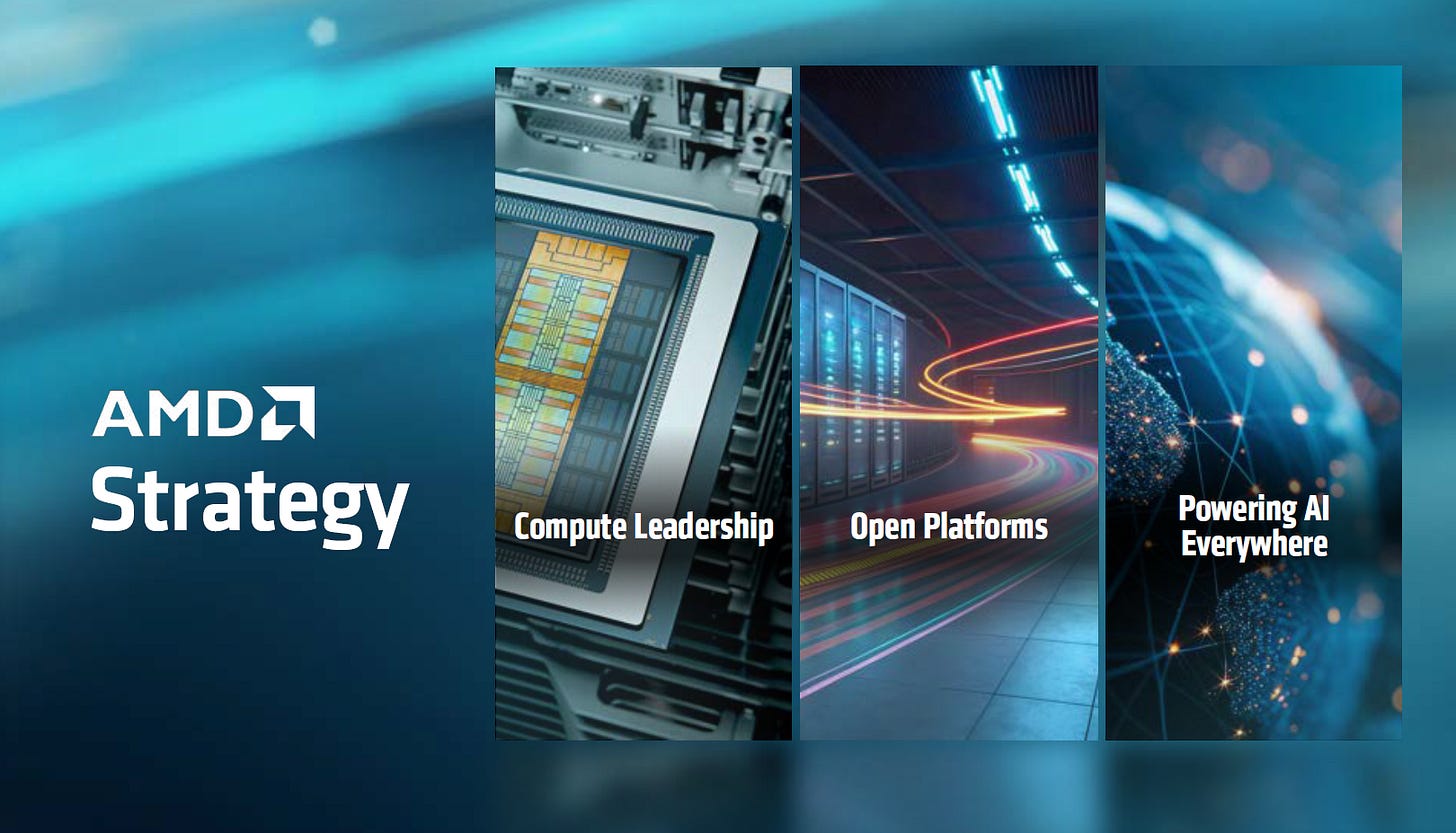
This represents a significant shift. The future competition between AMD and NVIDIA will not be decided by an isolated GPU benchmark. It will increasingly depend on whether AMD can deliver a complete, scalable and developer-friendly infrastructure platform for the agentic AI era.
這代表了一項重大轉變。AMD 與 NVIDIA 未來的競爭將不再取決於單一的 GPU 基準測試,而將越來越取決於 AMD 能否為代理式 AI(agentic AI)時代提供一個完整、可擴展且對開發者友善的基礎設施平台。
AI Demand Is Moving From Training to Inference
AI 需求正從訓練轉向推論
AMD begins its strategy with a simple observation: AI computing demand is accelerating much faster than the traditional semiconductor market.
AMD 的策略始於一個簡單的觀察:AI 運算需求的成長速度遠快於傳統半導體市場。
According to AMD’s presentation, monthly token consumption increased by approximately 158 times over the previous two years. Meanwhile, the computing power used to train leading models has been increasing at roughly five times per year since 2020.
根據 AMD 的簡報,過去兩年間,每月 token 消耗量增長了約 158 倍。與此同時,自 2020 年以來,用於訓練領先模型的運算能力每年以約五倍的速度持續攀升。
However, AMD believes that inference—not training—is becoming the largest AI workload.
然而,AMD 認為,推論(inference)而非訓練(training),正成為最大的 AI 工作負載。
The company estimates that inference represented approximately 40% of AI workloads in 2024, reached parity with training in 2025 and could account for roughly 60% in 2026. This transition matters because inference is not a single, uniform workload.
該公司估計,推論在 2024 年約佔 AI 工作負載的 40%,於 2025 年與訓練達到持平,並可能在 2026 年佔比達 60% 左右。此轉變至關重要,因為推論並非單一且同質的工作負載。
Offline research, conversational assistants, coding agents and real-time industrial systems have very different requirements for throughput, latency, memory capacity and cost per token.
離線研究、對話式助理、程式碼代理程式以及即時工業系統,對於吞吐量、延遲、記憶體容量及每 token 成本有著截然不同的需求。
Agentic AI further increases infrastructure demand. A conventional chatbot might perform one model request and generate one answer. An AI agent may call multiple models, invoke software tools, create sub-agents, search databases and repeat the reasoning process several times before completing a task.
代理型 AI(Agentic AI)進一步提升了基礎設施的需求。傳統的聊天機器人可能僅執行一次模型請求並生成一個答案;而 AI 代理程式則可能呼叫多個模型、調用軟體工具、建立子代理程式、搜尋資料庫,並在完成任務前重複進行多次推理過程。
In other words, one user request can produce dozens—or potentially hundreds—of inference operations.
換言之,單一使用者請求可能產生數十次,甚至高達數百次的推論作業。
AMD therefore expects the data-center AI accelerator market to expand from around US$200 billion in 2025 to approximately US$1.4 trillion in 2030, representing a compound annual growth rate above 45%. It also projects the data-center CPU market to grow from approximately US$26 billion to US$220 billion over the same period, driven by AI host servers, agent infrastructure and general-purpose computing.
因此,AMD 預期資料中心 AI 加速器市場將從 2025 年的約 2,000 億美元成長至 2030 年的約 1.4 兆美元,年複合成長率超過 45%。該公司亦預測,在同一期間,受惠於 AI 主機伺服器、代理基礎設施及通用運算的驅動,資料中心 CPU 市場將從約 260 億美元成長至 2,200 億美元。
These forecasts are aggressive, but they explain why AMD is expanding beyond individual processors. The company is preparing for an AI market in which the unit of competition is no longer the chip. It is the entire computing system.
這些預測雖具侵略性,卻說明了 AMD 為何要超越單一處理器的範疇。該公司正為一個競爭單位已不再是晶片、而是整個運算系統的 AI 市場做準備。
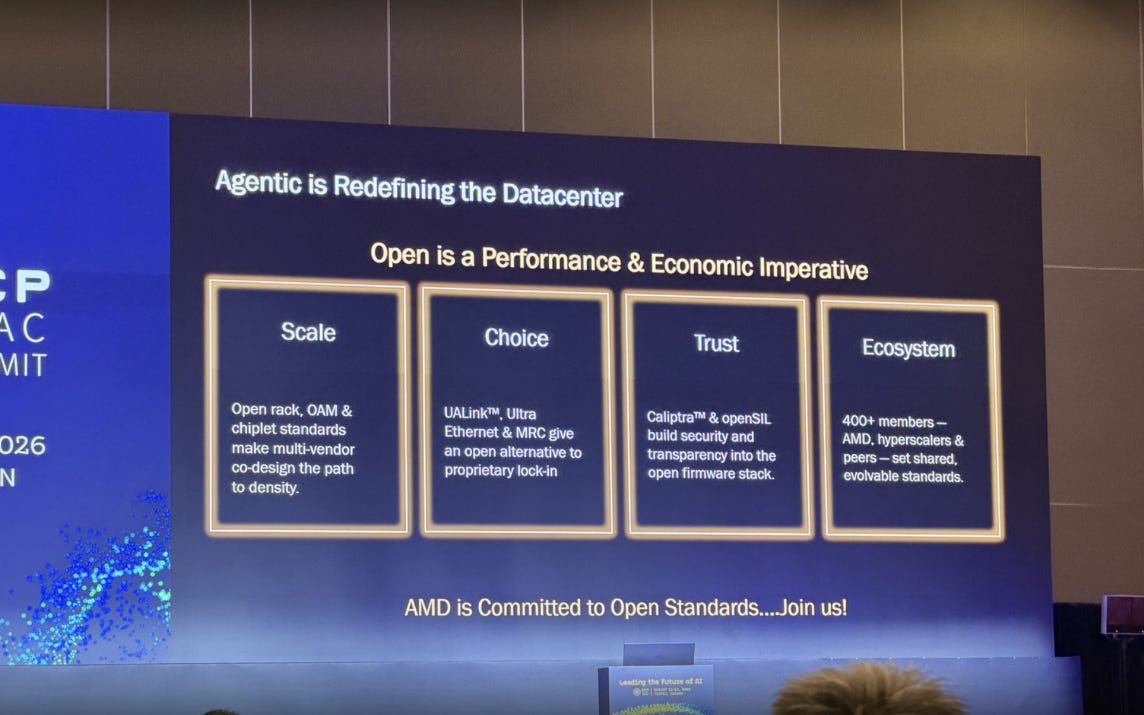
AMD is positioning open standards as a strategic foundation for next-generation AI infrastructure, working closely with the Open Compute Project (OCP) ecosystem. As agentic AI drives larger clusters, higher power density, and increasingly complex networking, no single vendor can optimize the entire data center alone.
AMD 正將開放標準定位為下一代 AI 基礎設施的戰略基石,並與開放運算計畫(OCP)生態系統緊密合作。隨著代理式 AI(agentic AI)推動更大規模的叢集、更高的功率密度以及日益複雜的網路架構,單一供應商已無法獨自優化整個資料中心。
AMD’s open approach spans multiple layers. Open Rack, OAM, and chiplet standards enable scalable multi-vendor system design; UALink, Ultra Ethernet, and MRC provide alternatives to proprietary scale-up and scale-out interconnects; while Caliptra and openSIL improve platform security, transparency, and firmware openness.
AMD 的開放方法涵蓋多個層面。Open Rack、OAM 和 chiplet 標準可實現可擴展的多供應商系統設計;UALink、Ultra Ethernet 和 MRC 提供了專有擴展(scale-up)與擴充(scale-out)互連技術的替代方案;而 Caliptra 和 openSIL 則提升了平台安全性、透明度與韌體開放性。
OCP provides the collaborative framework that makes this possible. With more than 400 members, including hyperscalers, semiconductor companies, system vendors, and infrastructure suppliers, OCP helps transform individual technologies into shared, evolving industry standards.
OCP 提供了實現此目標的協作框架。OCP 擁有超過 400 名成員,包括超大型雲端服務業者、半導體公司、系統供應商和基礎設施供應商,協助將各項獨立技術轉化為共享且持續演進的產業標準。
For AMD, openness is therefore more than philosophy—it is becoming a performance, economic, and ecosystem strategy for the AI data center.
對 AMD 而言,開放不僅是一種理念,更已成為 AI 資料中心在效能、經濟效益與生態系方面的核心策略。

8月17日8 月 17 日
Below we will share:以下我們將分享:
EPYC Gives AMD a Strategic Foundation
EPYC 為 AMD 奠定戰略基礎
AMD’s strongest foundation remains its EPYC server CPU business.
AMD 最堅實的基礎仍是其 EPYC 伺服器 CPU 業務。

The presentation claims that AMD reached approximately 46% server CPU revenue share in 2026, supported by adoption among hyperscalers, cloud providers, enterprises and AI companies. Whether that exact share is sustained will depend on market definitions and future shipments, but the broader trend is clear: EPYC has moved from being a challenger product to becoming an important data-center platform.
簡報指出,AMD 在 2026 年伺服器 CPU 營收市佔率約達 46%,此成績獲超大型資料中心、雲端服務供應商、企業及 AI 公司廣泛採用所支撐。儘管該確切市佔率能否持續將取決於市場定義與未來出貨量,但整體趨勢已十分明確:EPYC 已從挑戰者產品轉型為重要的資料中心平台。
This matters because AI servers still require CPUs.
這一點至關重要,因為 AI 伺服器仍然需要 CPU。
GPUs perform the matrix calculations behind model training and inference, but CPUs manage storage, networking, virtualization, databases, security, orchestration and the operating environment around the accelerators. Agentic AI may increase CPU demand further because every agent needs a host environment, tool access and often an isolated execution sandbox.
GPU 負責執行模型訓練與推論背後的矩陣運算,但 CPU 則管理儲存、網路、虛擬化、資料庫、安全性、編排以及加速器周圍的作業環境。代理式 AI(Agentic AI)可能會進一步增加對 CPU 的需求,因為每個代理都需要宿主環境、工具存取權限,且通常需要隔離的執行沙箱。
AMD divides the emerging infrastructure into three layers:
AMD 將新興基礎設施劃分為三個層級:
GPU host nodes that require high-frequency CPU cores and strong I/O performance.
需要高頻率 CPU 核心與強大 I/O 效能的 GPU 宿主節點。
Agent CPU servers that run large numbers of isolated agent sandboxes.
用於運行大量隔離代理沙箱的代理 CPU 伺服器。
General-purpose servers supporting gateways, caching, applications, databases and storage.
支援閘道、快取、應用程式、資料庫與儲存的一般用途伺服器。
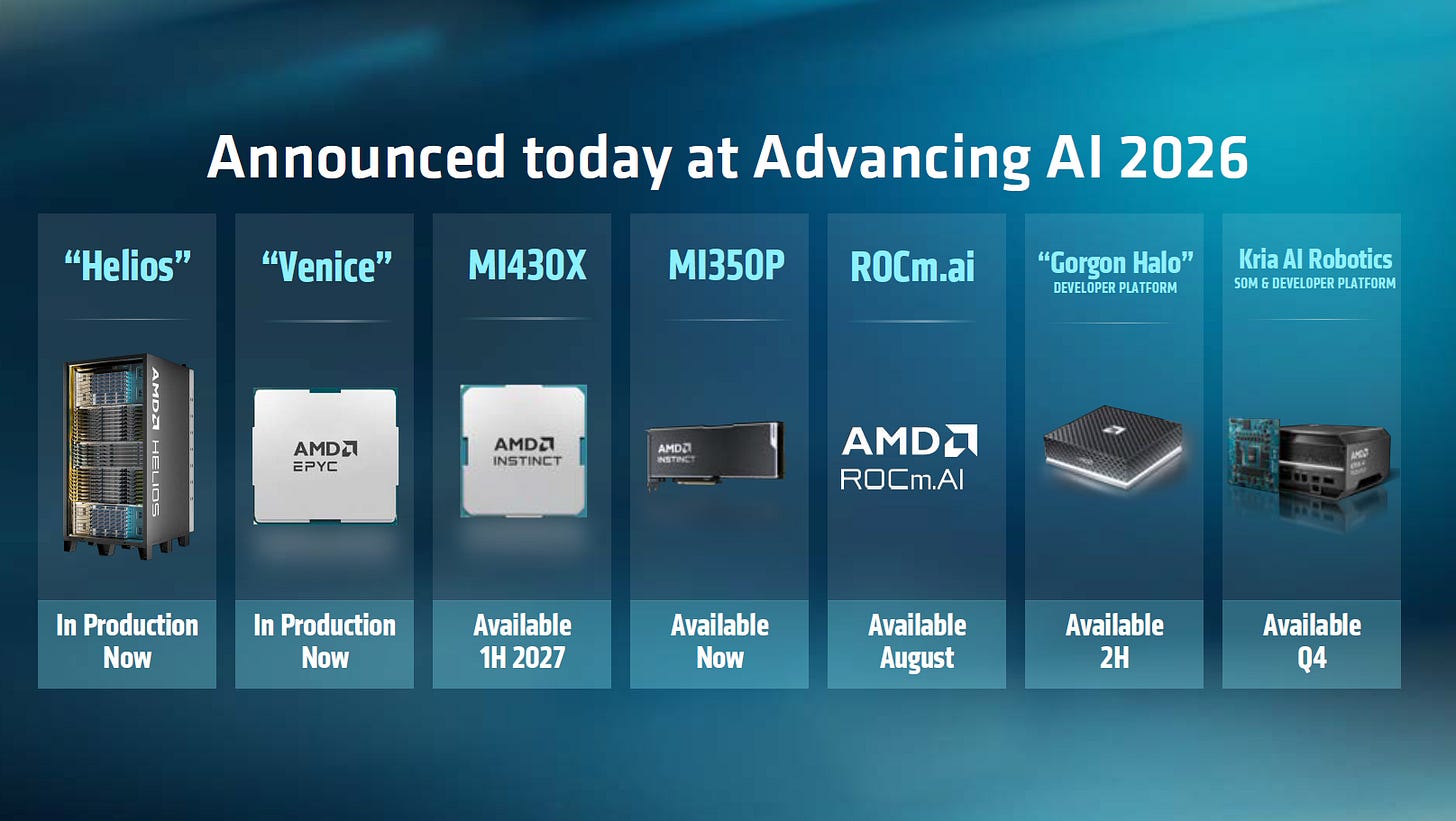
AMD’s sixth-generation EPYC processor, code-named Venice, is designed around this architecture.
AMD 第六代 EPYC 處理器(代號 Venice)即圍繞此架構設計。
The company says Venice will use the Zen 6 architecture and advanced 2-nanometer and 6-nanometer processes. The platform is expected to support as many as 512 threads, provide approximately 1.6 TB/s of memory bandwidth, and become the first x86 server processor to support PCI Express 6.0 and JEDEC MRDIMM.
該公司表示,Venice 將採用 Zen 6 架構,並運用先進的 2 奈米與 6 奈米製程。此平台預計支援高達 512 個執行緒,提供約 1.6 TB/s 的記憶體頻寬,並成為首款支援 PCI Express 6.0 與 JEDEC MRDIMM 的 x86 伺服器處理器。
AMD estimates that Venice can deliver up to 1.8 times the tokens per second for frontier-model host workloads, 2.1 times the agents per watt in sandbox infrastructure and 2.3 times the performance per watt in general-purpose workloads compared with selected competing platforms.
AMD 預估,與選定的競爭平台相比,Venice 在前緣模型主機工作負載中可提供高達 1.8 倍的每秒 token 數量、在沙盒基礎設施中實現 2.1 倍的每瓦代理數量,以及在通用工作負載中達到 2.3 倍的每瓦效能。
The strategic importance of Venice is broader than its specifications. AMD is attempting to make EPYC the CPU layer beneath the entire AI economy—not only for GPU servers, but also for the rapidly expanding orchestration, agent and enterprise-computing layers surrounding them.
Venice 的戰略重要性遠超其規格本身。AMD 正致力於讓 EPYC 成為支撐整個 AI 經濟體的 CPU 基礎層,不僅適用於 GPU 伺服器,更涵蓋周圍快速擴張的編排、代理程式及企業運算層級。

Helios Is AMD’s Answer to Rack-Scale AI
Helios 是 AMD 針對機架規模 AI 提出的解決方案
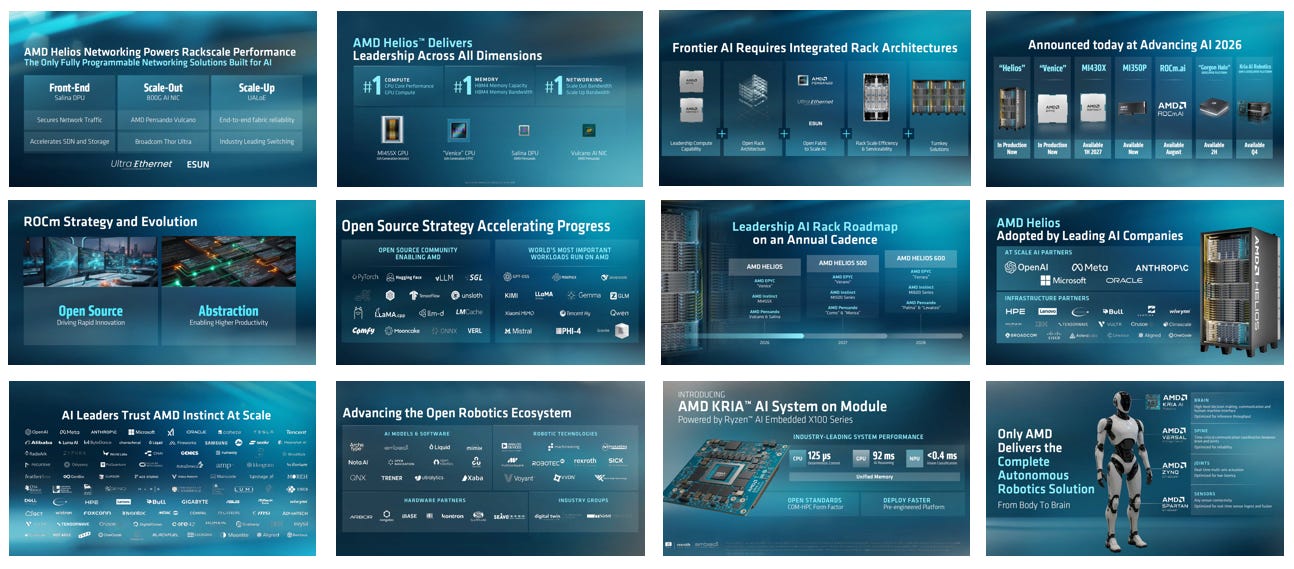
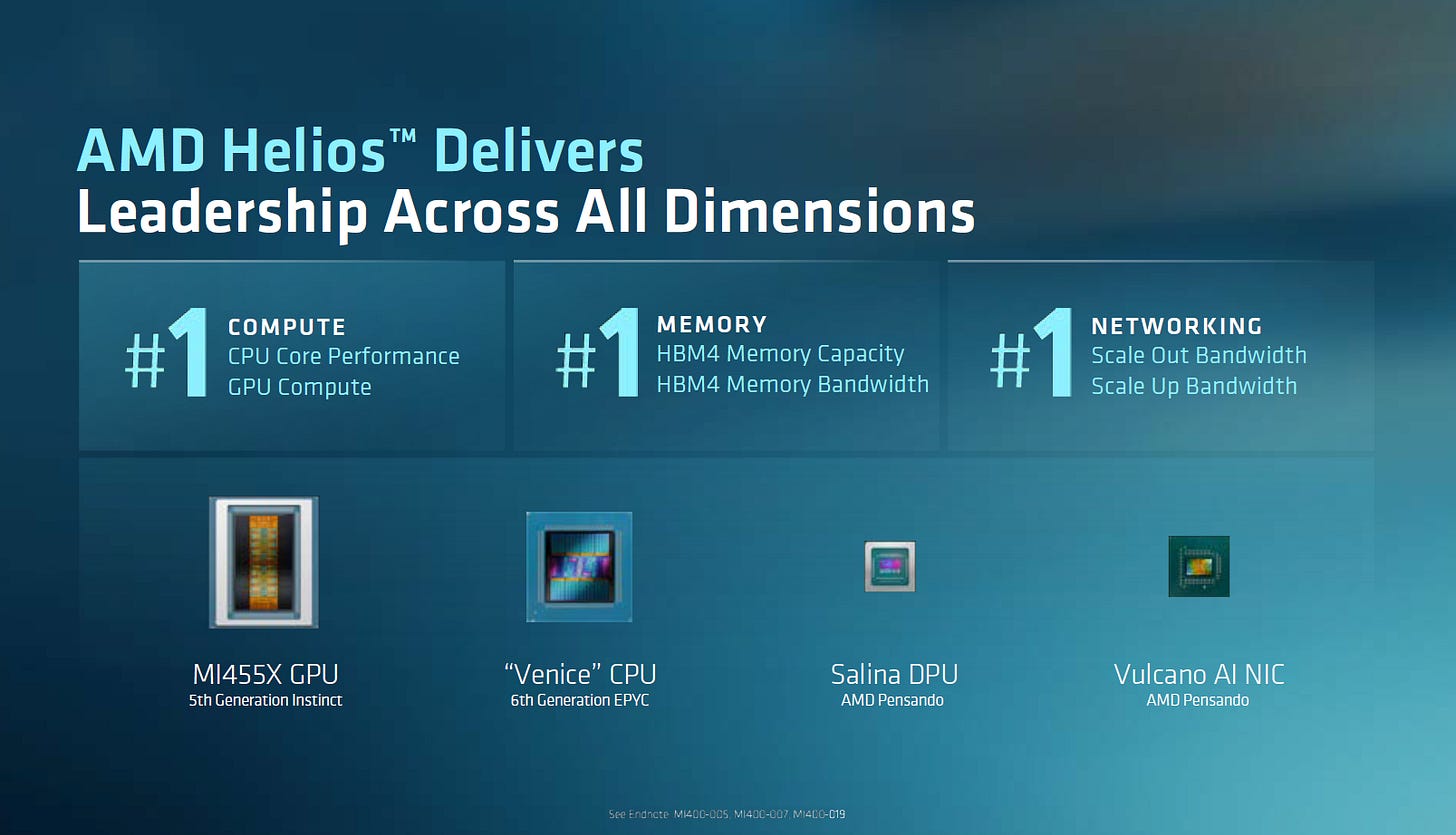
The most important hardware announcement in the presentation was AMD Helios, a rack-scale AI platform combining:
簡報中最重要的硬體發表是 AMD Helios,這是一個結合以下元件的機架規模 AI 平台:
Instinct MI455X GPUsInstinct MI455X GPU
Sixth-generation EPYC Venice CPUs
第六代 EPYC Venice CPU
AMD Pensando Salina DPUsAMD Pensando Salina DPU
AMD Pensando Vulcano 800G AI network interface cards
AMD Pensando Vulcano 800G AI 網路介面卡
ROCm softwareROCm 軟體
Open rack and networking standards
開放式機架與網路標準
This architecture shows how the AI accelerator market is changing.
此架構展現了 AI 加速器市場的變革。
A high-performance GPU is no longer enough. Frontier AI systems require hundreds or thousands of accelerators to behave like one coordinated machine. Performance therefore depends on memory capacity, memory bandwidth, scale-up connectivity, scale-out networking, software scheduling, power delivery, cooling and serviceability.
高效能 GPU 已不再足夠。前沿 AI 系統需要數百甚至數千個加速器像一台協調運作的機器般運作。因此,效能取決於記憶體容量、記憶體頻寬、向上擴展(scale-up)連接能力、向外擴展(scale-out)網路架構、軟體排程、電力供應、散熱設計以及可維護性。
The MI455X is based on AMD’s CDNA 5 architecture and uses advanced 2-nanometer and 3-nanometer manufacturing processes. AMD says the GPU contains approximately 320 billion transistors, delivers 40 petaflops of FP4 performance and 20 petaflops of FP8 performance, and integrates 432 GB of HBM4 with 23.3 TB/s of memory bandwidth.
MI455X 基於 AMD 的 CDNA 5 架構,採用先進的 2 奈米與 3 奈米製程技術。AMD 表示,該 GPU 內建約 3,200 億個電晶體,可提供 40 PFLOPS 的 FP4 運算效能與 20 PFLOPS 的 FP8 運算效能,並整合 432 GB 的 HBM4 記憶體,具備 23.3 TB/s 的記憶體頻寬。
At the full-rack level, AMD describes Helios as providing:
在整機櫃層級,AMD 將 Helios 描述為提供:
4,600 CPU cores4,600 個 CPU 核心
18,000 GPU compute units18,000 個 GPU 運算單元
2.9 exaflops of FP4 compute
2.9 EFLOPS 的 FP4 運算效能
31 TB of HBM capacity
31 TB 的 HBM 容量
260 TB/s of scale-up bandwidth
260 TB/s 的擴展頻寬
AMD directly compares Helios with NVIDIA’s Vera Rubin NVL72 platform. Based on AMD’s internal projections, Helios provides 15% more FP4 and FP8 compute, 50% more HBM capacity and 50% more scale-out bandwidth, while maintaining the same scale-up bandwidth. AMD also claims up to 30% more tokens per dollar.
AMD 直接將 Helios 與 NVIDIA 的 Vera Rubin NVL72 平台進行比較。根據 AMD 內部預測,Helios 提供多出 15% 的 FP4 與 FP8 運算能力、50% 更高的 HBM 容量以及 50% 更多的擴展外頻寬,同時維持相同的擴展內頻寬。AMD 亦宣稱其每美元可產生的 token 數量最多可提升 30%。
These figures should be interpreted cautiously because they come from AMD’s own benchmark assumptions and include products that may not yet have been independently evaluated. Nevertheless, the comparison reveals AMD’s strategic target: it no longer wants Instinct to be viewed merely as a second-source GPU. It wants Helios to compete directly with NVIDIA at the rack and data-center architecture level.
這些數據應謹慎解讀,因為它們源自 AMD 自身的基準測試假設,且包含尚未經過獨立評估的產品。然而,此比較揭示了 AMD 的戰略目標:不再希望 Instinct 僅被視為次要來源的 GPU。AMD 期望 Helios 能在機架與資料中心架構層級上,直接與 NVIDIA 競爭。
Networking Has Become Part of the Product
網路已成為產品的一部分
AMD’s acquisition of Pensando becomes increasingly important in this architecture.
在這套架構中,AMD 收購 Pensando 變得愈發重要。
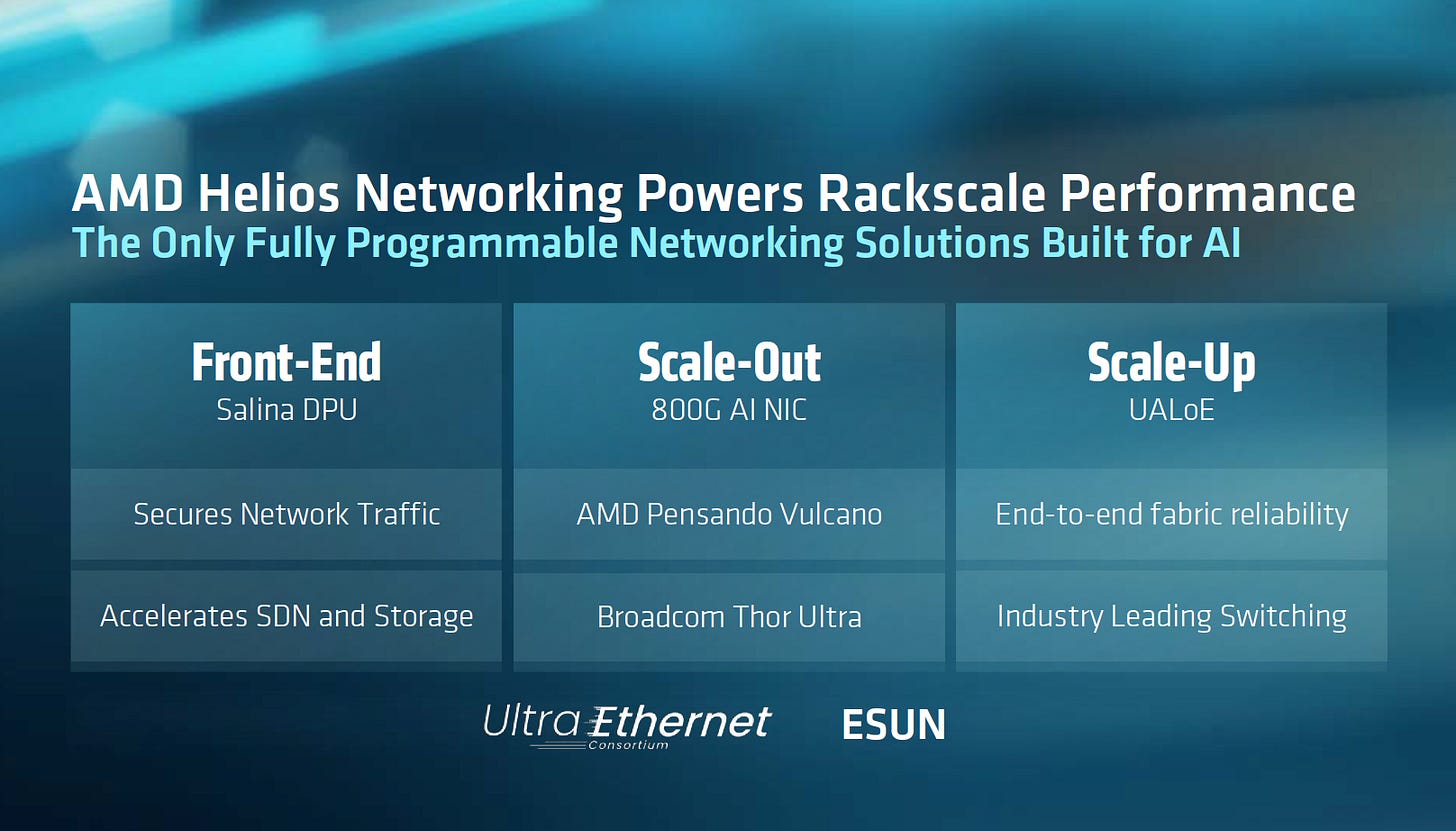
Helios integrates three networking layers. The Salina DPU manages front-end security, software-defined networking and storage acceleration. The Vulcano 800G AI NIC provides scale-out connectivity between racks. Scale-up communication uses an open fabric architecture based on UALink-over-Ethernet concepts and industry-standard switching.
Helios 整合了三層網路架構。Salina DPU 負責前端安全、軟體定義網路(SDN)與儲存加速;Vulcano 800G AI NIC 則提供機櫃間的橫向擴展(scale-out)連線能力。縱向擴展(scale-up)通訊則採用基於 UALink-over-Ethernet 概念與產業標準交換器的開放式 fabric 架構。
This is a deliberate contrast with proprietary infrastructure models.
這是與專有基礎設施模型的刻意對比。
NVIDIA has built a highly integrated ecosystem around NVLink, NVSwitch, InfiniBand, Ethernet networking, CUDA and its own rack designs. AMD is attempting to provide an alternative based on open rack architectures, Ultra Ethernet, UALink and a broader group of infrastructure partners.
NVIDIA 已圍繞 NVLink、NVSwitch、InfiniBand、乙太網路、CUDA 及其自有機架設計,建構出高度整合的生態系。AMD 則致力於提供替代方案,其基礎為開放式機架架構、Ultra Ethernet、UALink,以及更廣泛的基礎設施合作夥伴群。
The open approach may appeal to hyperscalers and sovereign AI operators that do not want to depend entirely on one supplier. However, openness creates a different challenge: AMD must demonstrate that an ecosystem involving multiple vendors can deliver the same reliability, performance optimization and deployment simplicity as a tightly controlled proprietary stack.
開放式方法可能吸引那些不希望完全依賴單一供應商的超大型雲端服務業者與主權 AI 營運商。然而,開放性也帶來了不同的挑戰:AMD 必須證明,涉及多家廠商的生態系統,能夠提供與緊密控制的專有堆疊同等級的可靠性、效能優化及部署簡易性。

4月28日4 月 28 日
ROCm May Be AMD’s Most Important Product
ROCm 可能是 AMD 最重要的產品
Hardware alone will not determine whether AMD succeeds in AI.
單靠硬體並無法決定 AMD 在 AI 領域能否成功。
NVIDIA’s deepest competitive advantage is not simply its GPUs. It is the enormous software ecosystem built around CUDA, including libraries, frameworks, developer expertise, optimized models and deployment tools.
NVIDIA 最深厚的競爭優勢不僅在於其 GPU,更在於圍繞 CUDA 建構的龐大軟體生態系,涵蓋函式庫、框架、開發者專業知識、最佳化模型與部署工具。

AMD’s answer is ROCm, its open software platform for GPU computing.
AMD 的回應是 ROCm,這是一個用於 GPU 運算的開放式軟體平台。
At Advancing AI 2026, AMD introduced ROCm.AI, which it describes as an AI-driven development platform. It combines the ROCm core software stack with framework integration, optimized libraries, programming tools and AI-assisted workload optimization.
在 Advancing AI 2026 活動中,AMD 推出了 ROCm.AI,將其描述為一個由人工智慧驅動的開發平台。該平台結合了 ROCm 核心軟體堆疊、框架整合、最佳化函式庫、程式設計工具以及 AI 輔助的工作負載最佳化功能。
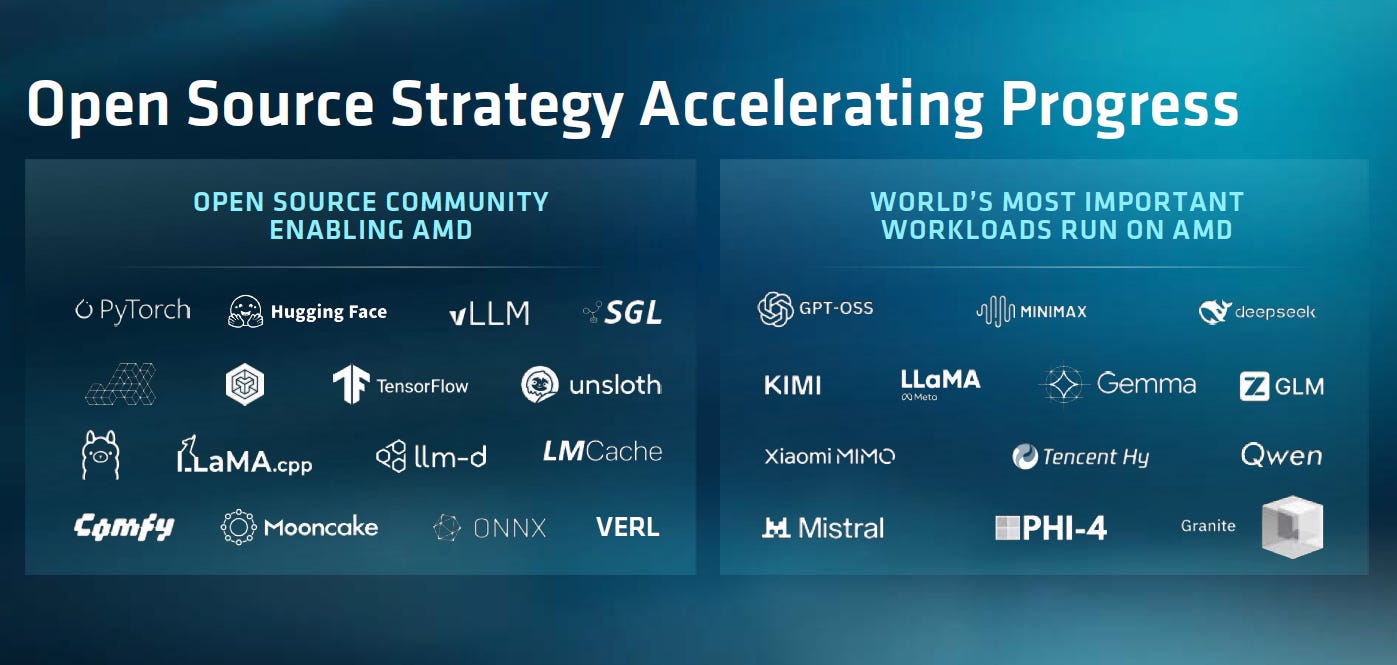
AMD says more than three million models on Hugging Face can run out of the box on its platform, the top ten open-source AI projects are natively supported, and its open-source contributions have increased by more than ten times.
AMD 表示,Hugging Face 上超過三百萬個模型可在其平台上開箱即用,前十名開源 AI 專案均獲得原生支援,且其開源貢獻量已成長十倍以上。
The company also reported substantial release-to-release improvements from ROCm.AI optimizations:
該公司亦報告指出,透過 ROCm.AI 的最佳化技術,各版本之間實現了顯著的效能提升:
An average 3.3-times performance improvement across selected inference workloads.
在選定的推論工作負載中,平均效能提升 3.3 倍。
An average 2.4-times improvement across selected training workloads.
在選定的訓練工作負載中,平均效能提升 2.4 倍。
Enhanced expert parallelism, attention scheduling and communication overlap.
強化專家並行、注意力排程與通訊重疊。
Better KV-cache management, paged attention and quantization.
更佳的 KV-cache 管理、分頁注意力機制與量化技術。
Optimized kernels for mixture-of-experts and attention workloads.
針對混合專家模型與注意力工作負載優化的核心程式。
AMD is also positioning ROCm.AI as an abstraction layer. Developers can work through frameworks, Python-based domain-specific languages and higher-level tools rather than manually optimizing every GPU kernel.
AMD 也將 ROCm.AI 定位為抽象層。開發人員可透過各種框架、以 Python 為基礎的領域專用語言(DSL)及高階工具進行開發,無需手動優化每個 GPU 核心程式碼。
Its longer-term vision is AI-assisted GPU programming: coding agents such as Claude, Codex, Cursor and Gemini could eventually become “ROCm superusers,” automatically generating and optimizing GPU code.
其長期願景是實現 AI 輔助的 GPU 程式設計:諸如 Claude、Codex、Cursor 和 Gemini 等編碼代理最終可能成為「ROCm 超級使用者」,自動生成並最佳化 GPU 程式碼。
This may prove strategically significant. If AI can reduce the complexity of porting software between accelerator platforms, NVIDIA’s software lock-in could gradually weaken. But AMD must still prove that ROCm offers consistent production reliability, debugging tools, documentation and model support across large deployments.
這可能具有戰略意義。若人工智慧能降低軟體在不同加速器平台間移植的複雜度,NVIDIA 的軟體鎖定效應或許會逐漸減弱。但 AMD 仍須證明 ROCm 能在大型部署中,提供一致的生產可靠性、除錯工具、文件資源與模型支援。

7月27日7 月 27 日
From Cloud AI to Enterprise and Personal AI
從雲端 AI 到企業與個人 AI
AMD’s strategy is not limited to hyperscale AI factories.
AMD 的策略並不限於超大規模的 AI 工廠。
The company expects AI workloads to become distributed across cloud systems, on-premise data centers and local devices. Enterprise customers may retain sensitive data on premises, route selected queries to frontier models and execute recurring inference locally to reduce token costs.
該公司預期 AI 工作負載將分散於雲端系統、本地資料中心與終端裝置之間。企業客戶可能會將敏感數據保留在本地,將特定查詢路由至前沿模型,並在本地執行重複性的推論作業,以降低 token 成本。
AMD introduced the Instinct MI350P for this market. Unlike the liquid-cooled rack systems used for frontier AI, MI350P can operate in conventional air-cooled enterprise servers. AMD says it can support models with up to 260 billion parameters at FP4 and deliver as much as 4.2 times the tokens per second per dollar compared with selected professional GPU configurations.
AMD 針對此市場推出了 Instinct MI350P。與用於前沿 AI 的液冷機架系統不同,MI350P 可在傳統的風冷企業伺服器中運作。AMD 表示,該產品在 FP4 精度下可支援高達 2600 億參數的模型,並且與選定的專業 GPU 配置相比,每美元每秒產生的 token 數量可提升多達 4.2 倍。
AMD’s internal case study describes a hybrid model-routing architecture in which requests are distributed between local Qwen and Gemma models running on EPYC and MI350P hardware and a frontier cloud model. AMD claims this approach reduced costs by 43% and produced responses 2.9 times faster than relying entirely on frontier-model tokens.
AMD 的內部案例研究描述了一種混合模型路由架構,其中請求被分發至運行於 EPYC 和 MI350P 硬體上的本地 Qwen 與 Gemma 模型,以及前沿雲端模型之間。AMD 宣稱,此方法將成本降低了 43%,且回應速度比完全依賴前沿模型 token 快了 2.9 倍。
The presentation extends the same logic to personal computers.
簡報將相同的邏輯延伸至個人電腦。
AMD 認為,較小的開放模型正迅速逼近早期前沿模型的能力。因此,本地 AI 能提供隱私保護、離線可用性,以及在購買硬體後實質上「免費」的增量推論能力。
The Ryzen AI Max platform supports up to 128 GB of unified memory and models of approximately 200 billion parameters. AMD also previewed Gorgon Halo, which increases unified memory to 192 GB and targets models as large as 300 billion parameters.
Ryzen AI Max 平台支援高達 128 GB 的統一記憶體,可運行約 2,000 億參數的模型。AMD 亦預覽了 Gorgon Halo,將統一記憶體提升至 192 GB,目標是支援高達 3,000 億參數的模型。
The objective is to allow cloud-scale AI applications to operate locally on high-end workstations and desktops.
其目標是讓雲端規模的 AI 應用能夠在高階工作站與桌上型電腦上本地運作。

Physical AI Expands AMD Into Robotics
實體人工智慧助力 AMD 進軍機器人領域
The final component of AMD’s “AI everywhere” strategy is physical AI.
AMD「AI 無所不在」策略的最後一個組成部分是實體 AI。
Robots require more than neural-network inference. They must combine sensing, deterministic control, perception, real-time communications, safety functions and high-level reasoning.
機器人所需的不僅是神經網路推論。它們必須結合感測、確定性控制、感知、即時通訊、安全功能與高階推理能力。
AMD’s response is the Kria AI System-on-Module, powered by the Ryzen AI Embedded X100 series. The platform combines CPU, GPU, AI acceleration and programmable logic, allowing it to support both agentic reasoning and real-time machine control.
AMD 的回應是 Kria AI 系統模組,由 Ryzen AI Embedded X100 系列驅動。該平台整合了 CPU、GPU、AI 加速器與可程式化邏輯,使其能夠同時支援代理式推理與即時機器控制。
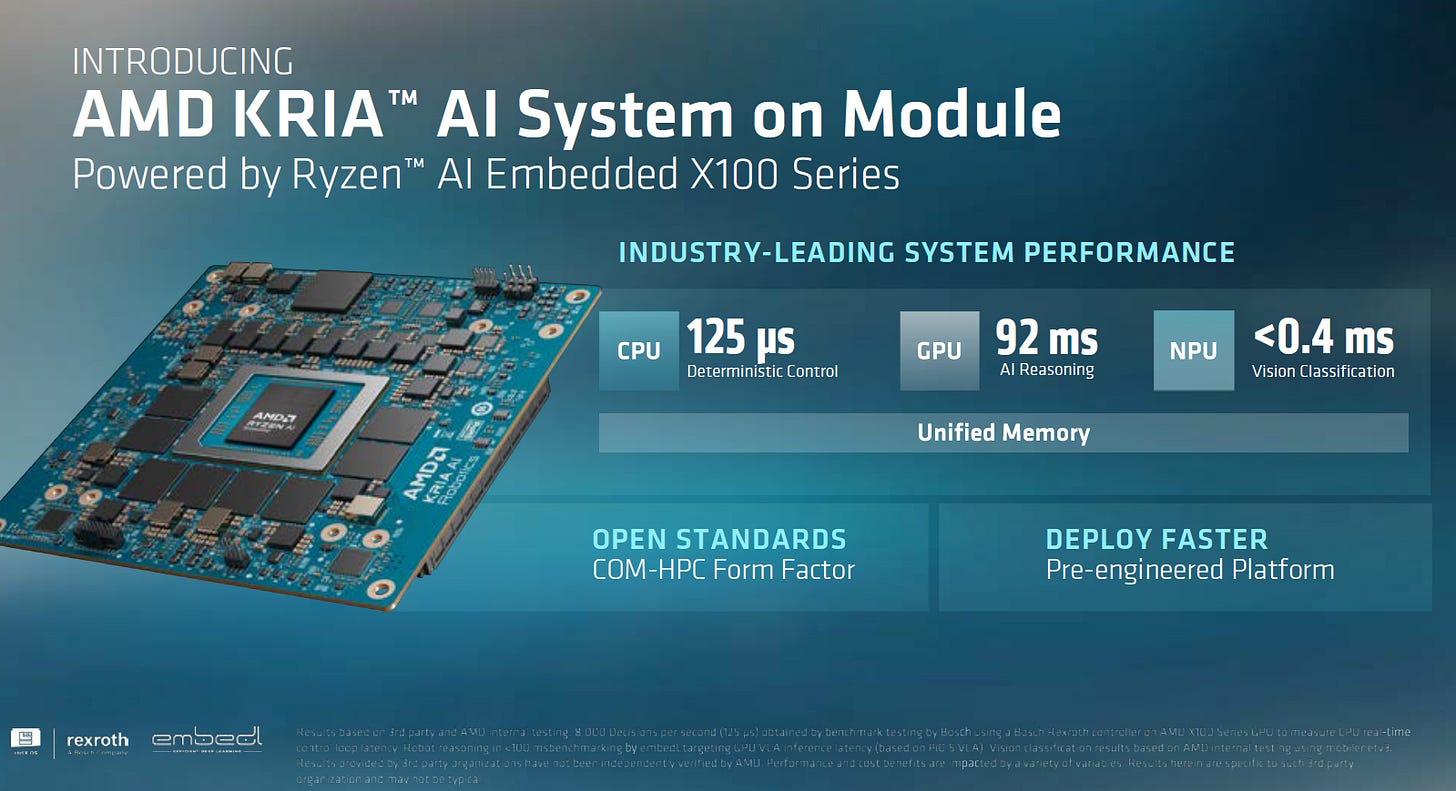
AMD describes the architecture as the complete body of an autonomous machine:
AMD 將此架構描述為自主機器的完整本體:
The “brain” performs high-level decision-making and inference.
「大腦」負責高階決策與推論。
The “spine” coordinates time-critical communications.
「脊椎」協調時間關鍵的通訊。
The “joints” control real-time actuation.
「關節」控制即時致動。
The sensor layer handles data acquisition and fusion.
感測器層負責資料擷取與融合。
This demonstrates the strategic value of AMD’s broad portfolio. Technologies inherited from Xilinx give the company capabilities in embedded computing, adaptive logic and robotics that pure GPU vendors may find more difficult to reproduce.
這凸顯了 AMD 廣泛產品組合的戰略價值。從 Xilinx 繼承的技術,賦予該公司在嵌入式運算、自適應邏輯與機器人領域的能力,這些是純 GPU 供應商較難複製的。

A Roadmap Built Around Annual Execution
以年度執行為核心的發展藍圖
AMD is also presenting investors and customers with a more predictable product cadence.
AMD 也向投資人和客戶展現了更可預測的產品推出時程。
Its server CPU roadmap progresses from Turin in 2024 to Venice in 2026, Florence in 2028 and Ravenna around 2030. Florence is expected to introduce Zen 7 and Zen 7c architectures, next-generation process technology, AI Compute Extensions and expanded support for MRDIMM and LPDDR memory.
其伺服器 CPU 產品路線圖從 2024 年的 Turin,進展至 2026 年的 Venice、2028 年的 Florence,以及約 2030 年的 Ravenna。預計 Florence 將導入 Zen 7 與 Zen 7c 架構、次世代製程技術、AI 運算擴充功能,並擴大支援 MRDIMM 與 LPDDR 記憶體。
The Instinct roadmap moves from the MI350 series in 2025 to MI400 in 2026, MI500 in 2027 and MI600 in 2028. AMD says the MI500 series could deliver more than a 2,000-times increase in inference throughput compared with its four-year-old reference platform.
Instinct 產品路線圖則從 2025 年的 MI350 系列,推進至 2026 年的 MI400、2027 年的 MI500,以及 2028 年的 MI600。AMD 表示,MI500 系列相較於其四年前的參考平台,推論吞吐量有望提升超過 2,000 倍。
At the rack level, Helios is followed by Helios 500 in 2027 and Helios 600 in 2028. Each generation combines new EPYC processors, Instinct GPUs and Pensando networking products.
在機架層級,Helios 之後將分別於 2027 年推出 Helios 500,並於 2028 年推出 Helios 600。每一世代均結合全新的 EPYC 處理器、Instinct GPU 以及 Pensando 網路產品。
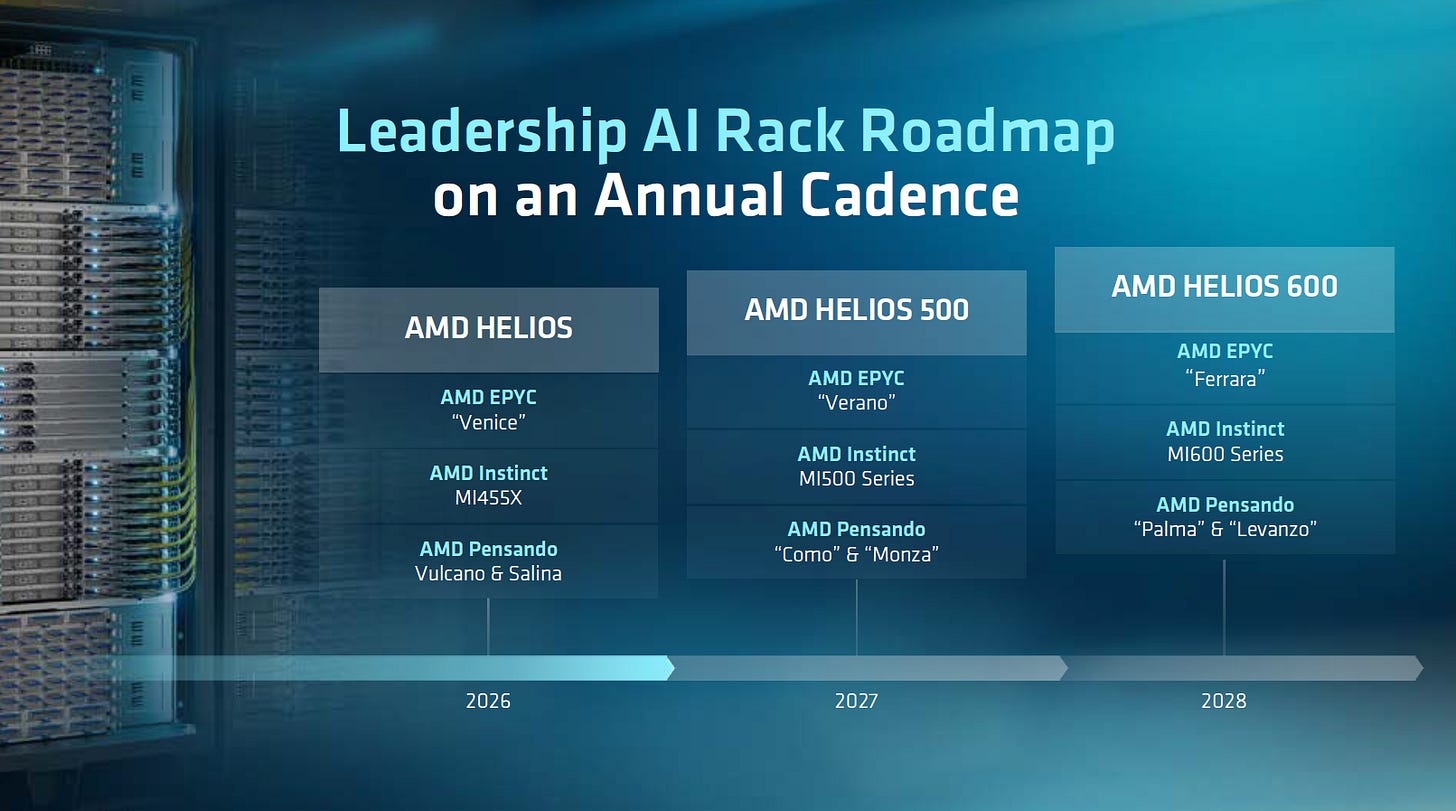
The roadmap is ambitious. It also creates execution risk. AMD must coordinate advanced process nodes, HBM supply, packaging, networking, software releases, system validation and customer deployment on an annual schedule.
該路線圖極具野心,但也帶來執行風險。AMD 必須按年度時程協調先進製程節點、HBM 供應、封裝技術、網路解決方案、軟體發布、系統驗證與客戶部署。
Missing one component could delay the entire rack platform.
缺少一個元件就可能延遲整個機架平台。
The Real Strategic Battle: An Open Alternative to NVIDIA
真正的戰略之戰:打造 NVIDIA 的開放替代方案
AMD’s strategy can ultimately be understood as an attempt to build the leading open alternative to NVIDIA.
AMD 的戰略最終可理解為試圖建立領先業界的 NVIDIA 開放替代方案。
It is not trying to replicate NVIDIA product for product. Instead, AMD is combining several assets:
AMD 並非試圖逐項複製 NVIDIA 的產品,而是整合多項核心資產:
EPYC leadership in x86 server CPUs
EPYC 在 x86 伺服器 CPU 領域的領導地位
Instinct accelerators for training and inference
Instinct 加速器,用於訓練與推論
Pensando DPUs and AI networking
Pensando DPU 與 AI 網路解決方案
ROCm open softwareROCm 開放式軟體
Xilinx adaptive and embedded computing
Xilinx 自適應與嵌入式運算
Open rack, Ethernet and scale-up architectures
開放式機架、乙太網路與擴展架構
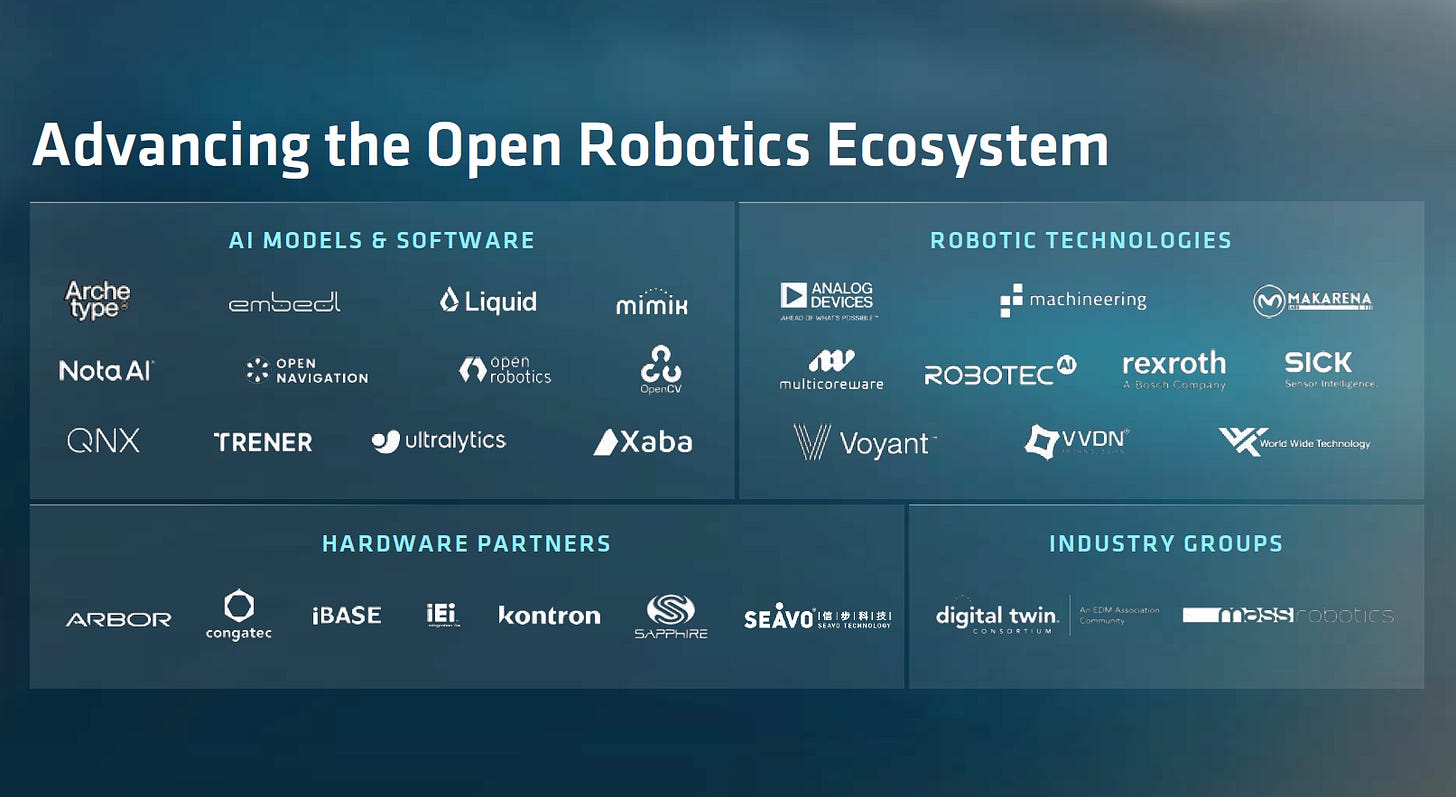
Partnerships with cloud providers, model developers, server vendors and open-source communities
與雲端服務供應商、模型開發者、伺服器廠商及開源社群的合作夥伴關係
The keynote highlights relationships with OpenAI, Meta, Anthropic, Microsoft, Oracle, Cerebras, Hugging Face, HPE, Lenovo, Dell and numerous infrastructure providers.
主題演講重點介紹了與 OpenAI、Meta、Anthropic、Microsoft、Oracle、Cerebras、Hugging Face、HPE、Lenovo、Dell 以及眾多基礎設施供應商的協力關係。
For customers, AMD’s proposition is greater architectural choice, more memory capacity, competitive token economics and less dependence on one proprietary computing ecosystem.
對客戶而言,AMD 提供的價值在於更豐富的架構選擇、更大的記憶體容量、具競爭力的代幣經濟效益,以及降低對單一專有運算生態系統的依賴。
For AMD, the opportunity is much larger than selling GPUs. By controlling more of the AI infrastructure stack, it can capture value from CPUs, accelerators, networking, software, enterprise servers, PCs and robotics.
對 AMD 而言,商機遠大於單純銷售 GPU。透過掌握更多 AI 基礎設施堆疊,AMD 能夠從 CPU、加速器、網路、軟體、企業伺服器、PC 與機器人等領域獲取價值。

5月13日5 月 13 日
SemiVision View: AMD Has Entered the Systems-Engineering Era
SemiVision 觀點:AMD 已邁入系統工程時代
The most important conclusion from Advancing AI 2026 is that AMD is no longer competing at the component level.
「Advancing AI 2026」活動最重要的結論是,AMD 不再僅於元件層級競爭。
Its future success will depend on systems engineering.
其未來的成功將取決於系統工程能力。
The company must prove that EPYC, Instinct, Pensando and ROCm can function as one coherent platform. It must also close the usability gap with CUDA, secure enough HBM and advanced-packaging capacity, and convince large customers to deploy AMD infrastructure at meaningful scale.
該公司必須證明 EPYC、Instinct、Pensando 和 ROCm 能夠作為一個連貫的平台運作。它還必須縮小與 CUDA 在易用性上的差距,確保足夠的 HBM 產能與先進封裝容量,並說服大型客戶大規模部署 AMD 基礎設施。
The opportunity is real. AI inference is becoming more distributed, memory-intensive and cost-sensitive. Hyperscalers want second-source options. Enterprises need on-premise AI. Developers increasingly favor open models and portable software. Robotics and edge AI require heterogeneous computing rather than GPUs alone.
機會確實存在。AI 推論正變得更分散、更依賴記憶體且對成本更敏感。超大型雲端服務業者需要第二貨源選項;企業需要本地部署的 AI;開發者日益青睞開放模型與可移植軟體;機器人與邊緣 AI 則需要異質運算,而非僅靠 GPU。
These trends align well with AMD’s portfolio.
這些趨勢與 AMD 的產品組合高度契合。
But the challenge is equally clear. NVIDIA has already established a powerful hardware-software-networking ecosystem and continues to move rapidly. AMD must execute across many product categories simultaneously while maintaining an annual roadmap.
但挑戰同樣明確。NVIDIA 已建立起強大的硬體-軟體-網路生態系統,並持續快速推進。AMD 必須在維持年度產品路線圖的同時,跨越多個產品類別同步執行。
Advancing AI 2026 therefore marks an important turning point. AMD is no longer presenting itself simply as the company with a competitive CPU or GPU.
因此,「Advancing AI 2026」標誌著一個重要的轉捩點。AMD 不再將自己定位為僅擁有具競爭力 CPU 或 GPU 的公司。
It is presenting itself as an open, full-stack computing platform for the agentic AI era.
該公司正將自身定位為代理式 AI 時代的開放式全端運算平台。
Whether AMD can convert that vision into sustained market share will depend not only on silicon performance, but on software maturity, rack-scale deployment, manufacturing execution and ecosystem adoption.
AMD 能否將此願景轉化為持續的市場佔有率,不僅取決於矽晶效能,更取決於軟體成熟度、機架級部署、製造執行力以及生態系採用度。
That is the real battle ahead.
這才是 предстоящая真正的戰役。

6月28日6 月 28 日


Share分享
Previous上一頁