Why Taiwan and Japan Need Each Other in the AI Age
Why Taiwan and Japan Need Each Other in the AI Age
- Source: SemiVision
- Author: SEMIVISION
- Published: 2026-08-21T14:33:42+08:00
- URL: https://tspasemiconductor.substack.com/p/why-taiwan-and-japan-need-each-other
中文翻譯與英文原文(雙語)
(2)為何在人工智慧時代,台灣與日本彼此需要 --- (2) Why Taiwan and Japan Need Each Other in the AI Age


Why Taiwan and Japan Need Each Other in the AI Age
為何在人工智慧時代,台灣與日本需要彼此
Original Article By SemiVision Research [Reading time: 8 mins]
原文作者:SemiVision Research [閱讀時間:8 分鐘]

Aug 21, 2026
∙ Paid∙ 付費
Share分享
Why Taiwan and Japan Need Each Other in the AI Age
為什麼在 AI 時代台灣與日本需要彼此
For much of the past three decades, discussions about technology in East Asia have followed a familiar script. America designed the most valuable chips. Taiwan manufactured them. South Korea supplied memory. Japan, once the dominant force in semiconductors, appeared to have been relegated to the less glamorous reaches of the supply chain.
在過去三十年間,關於東亞科技的討論往往遵循著熟悉的劇本:美國設計最具價值的晶片,台灣負責製造,南韓供應記憶體,而曾經在半導體領域佔據主導地位的日本,似乎已被邊緣化至供應鏈中較不引人注目的環節。
Artificial intelligence is changing that picture.
人工智慧正在改變這一局面。
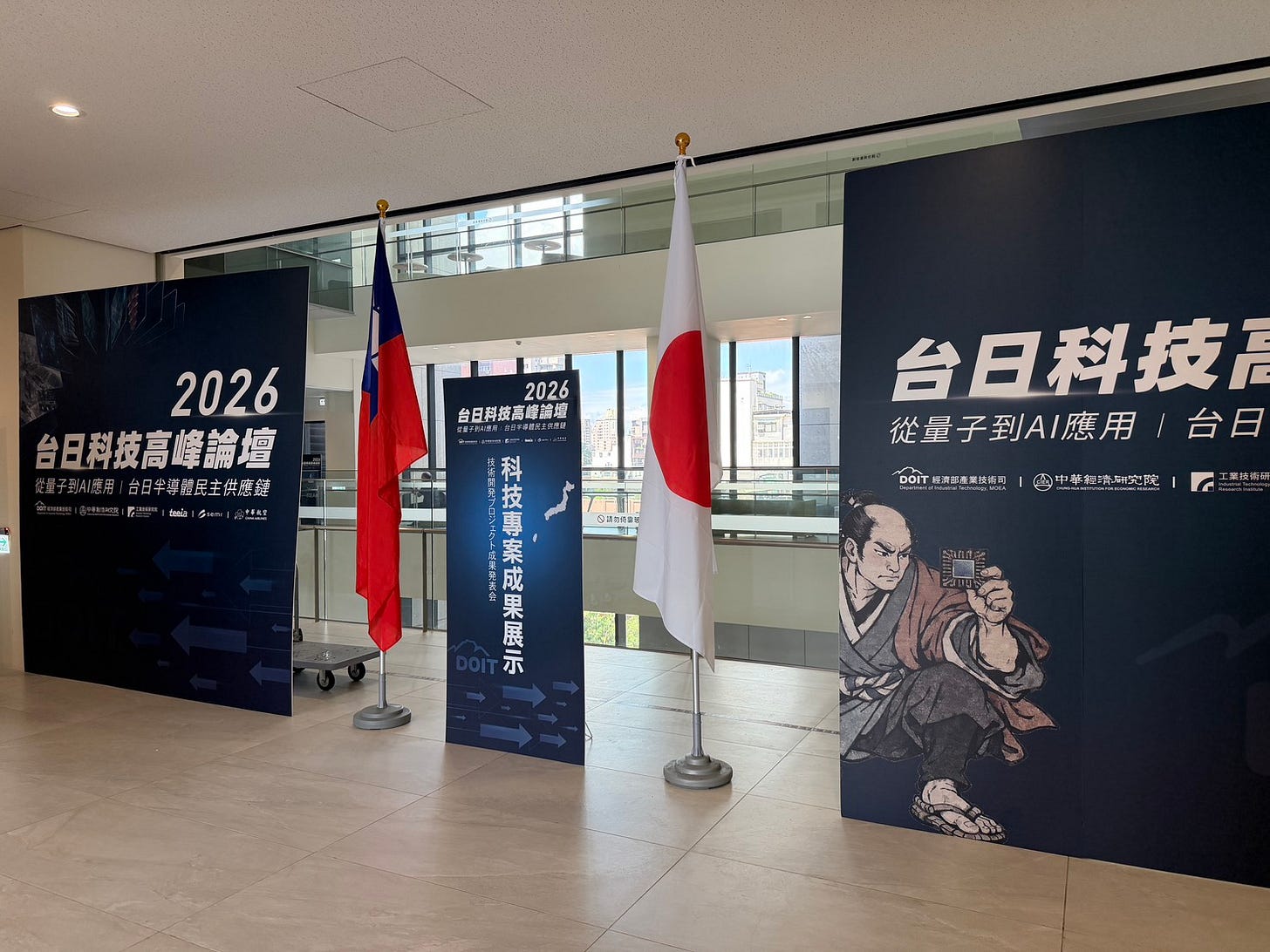
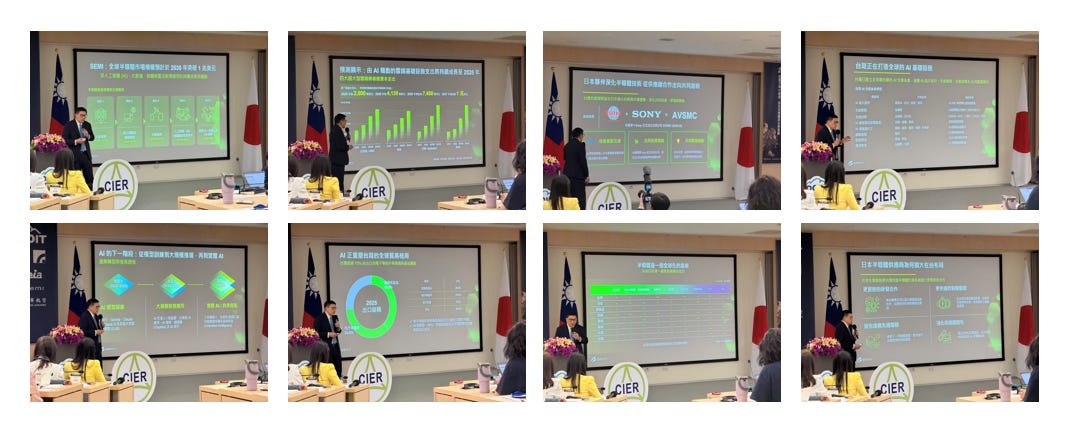
At the 2026 Taiwan-Japan Technology Summit, the discussion ranged from quantum technology and semiconductors to AI infrastructure and industrial collaboration. But the most important message was simpler:the AI boom is reshaping the division of labour between Taiwan and Japan—and making their industrial strengths more complementary than they have been for decades.
在 2026 年台日科技高峰會上,討論議題涵蓋量子技術、半導體、AI 基礎設施及產業合作。然而,最重要的訊息更為簡明:AI 熱潮正重塑台灣與日本的勞動分工,使兩國的產業優勢比過去數十年來更具互補性。
Taiwan has become indispensable to advanced semiconductor manufacturing, packaging, printed circuit boards and AI servers. Japan, meanwhile, retains commanding positions in semiconductor materials, production equipment, precision components, optical products and specialty chemicals.
台灣已成為先進半導體製造、封裝、印刷電路板及 AI 伺服器不可或缺的要角;與此同時,日本在半導體材料、生產設備、精密零組件、光學產品及特用化學品領域,仍居於領先地位。
Neither country controls the entire AI hardware stack. Together, they control an unusually large part of it.
沒有任何一國能單獨掌握完整的 AI 硬體堆疊,但兩國合力卻掌控了其中異常龐大的部分。
That matters because the next phase of AI will be less about training ever-larger models and more about building the physical infrastructure required to deploy intelligence everywhere.
這一點至關重要,因為 AI 的下一階段發展將較少著重於訓練規模日益龐大的模型,而更側重於建構將智慧部署至各處所需的實體基礎設施。

8月19日8 月 19 日
Below we will share:以下我們將分享:
From models to machines從模型到機器
Japan’s invisible empire日本隱形的帝國
Taiwan builds the machine
台灣打造機器
Why Japanese suppliers are moving closer to Taiwan
為何日本供應商正加速靠攏台灣
The Asian hardware axis亞洲硬體軸心
SEMICON Taiwan is not just a platform that connects Taiwan and global microelectronics ecosystems but also a bridge that facilitates smooth collaboration between the industry, the government, academia, and research institutions. Witnessing enormous business collaboration.
SEMICON Taiwan 不僅是連結台灣與全球微電子生態系的平台,更是促進產、官、學、研無縫協作的橋樑,見證了龐大的商業合作成果。
SEMICON Taiwan still stays true to its missions― Leading Technology Trends, Driving Technology Innovation, and Facilitating Collaboration and continues providing various channels and activities that meet the companies' marketing and promotion needs.
SEMICON Taiwan 始終堅守其使命—引領技術趨勢、驅動技術創新、促進產業協作,並持續提供符合企業行銷與推廣需求的多元管道與活動。
https://www.semicontaiwan.org/en

2025年9月16日2025 年 9 月 16 日
From models to machines
從模型到機器
The first phase of the generative-AI boom, roughly from 2023 to 2025, was dominated by model training. Companies raced to build larger clusters of GPUs and acquire more high-bandwidth memory. Nvidia became the most visible beneficiary, but the boom spread across foundries, advanced packaging and memory suppliers.
生成式人工智慧浪潮的第一階段(約 2023 年至 2025 年)以模型訓練為主導。各家企業競相建置更大規模的 GPU 叢集,並搶購更多高頻寬記憶體。Nvidia 成為最顯著的受益者,但這股熱潮也擴及晶圓代工廠、先進封裝與記憶體供應商。
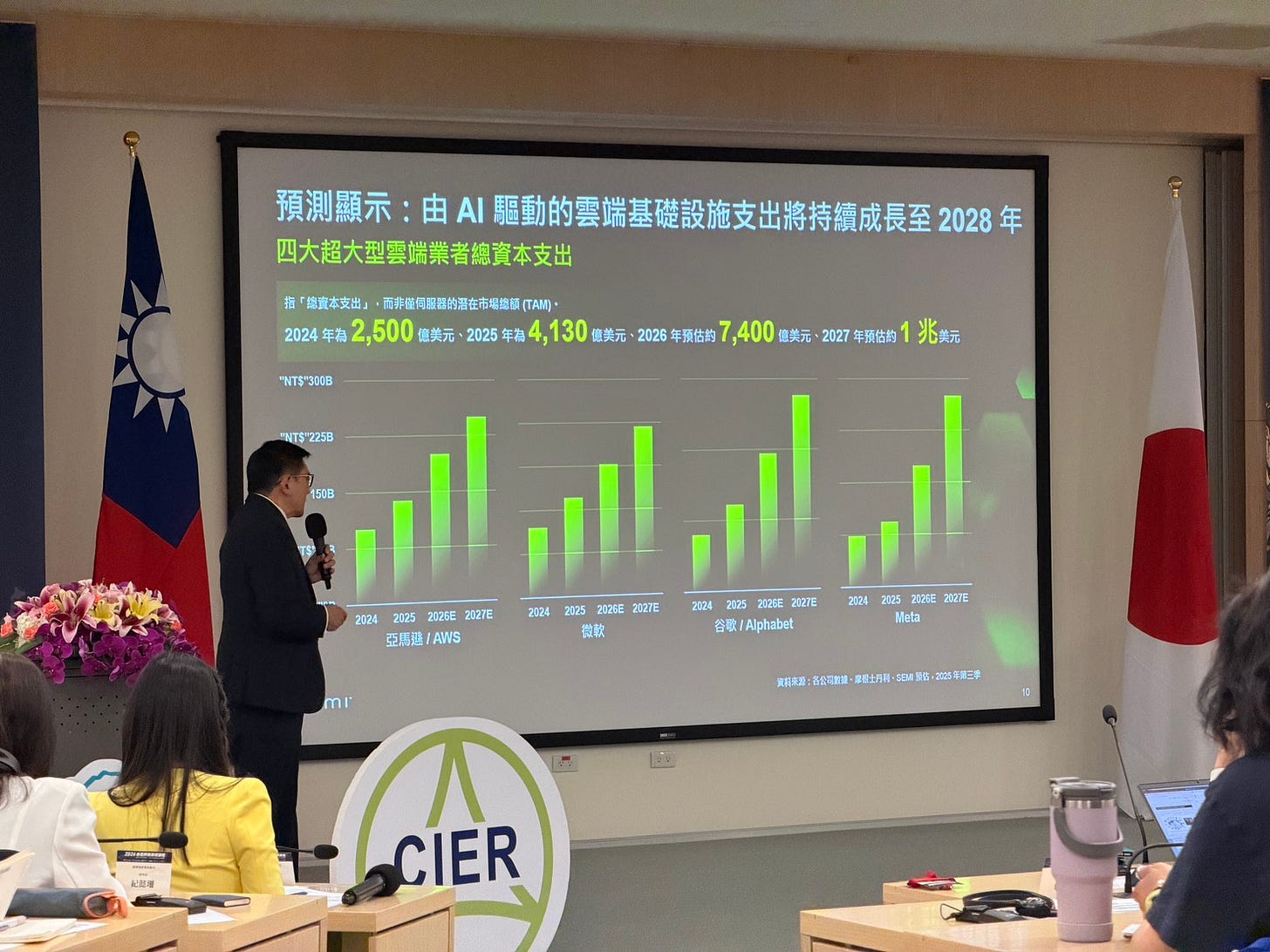
The next stage, extending through the second half of this decade, is likely to be dominated by inference.
下一個階段,將延續至本十年後半,很可能由推論(inference)主導。
AI agents, enterprise assistants, search, copilots and automated workflows will require far more computing to be deployed continuously rather than concentrated in periodic training runs. Hyperscalers will remain important, but a new group of so-called NeoCloud operators is already expanding infrastructure built specifically around GPU computing.
AI 代理、企業助理、搜尋引擎、Copilot 與自動化工作流程將需要更大量的運算資源,以支援持續部署,而非僅集中於週期性的訓練階段。超大型雲端服務供應商(Hyperscalers)仍將扮演重要角色,但一羣被稱為「NeoCloud」的新興營運商已開始擴建專為 GPU 運算打造的基礎設施。
Then comes a more physical phase.
接下來則進入更為實體化的階段。
After 2028, AI is expected increasingly to migrate from servers into robots, factories, vehicles and intelligent machines. The industry calls this “physical AI” or “embodied intelligence”.
2028 年之後,預計 AI 將日益從伺服器遷移至機器人、工廠、車輛及智慧機器中。產業界將此趨勢稱為「實體 AI」(physical AI)或「具身智能」(embodied intelligence)。
This transition greatly expands the relevant supply chain.
此一轉型將大幅擴展相關的供應鏈範疇。
A large language model can appear to be a software product. A humanoid robot cannot. It requires sensors, motors, power electronics, passive components, optical devices, controllers, batteries, communications hardware and vast amounts of precision manufacturing.
大型語言模型可能看起來像是一種軟體產品,但人形機器人則不然。它需要感測器、馬達、功率電子元件、被動元件、光學裝置、控制器、電池、通訊硬體,以及大量的精密製造能力。
Here Japan suddenly looks much more important.
在此,日本的重要性突然顯得更加突出。
Japan’s invisible empire
日本隱形的帝國
Japan no longer dominates semiconductor sales in the way it did in the 1980s. But measuring the country’s importance by chip-company revenue misses much of the point.
日本已不再像 1980 年代那樣主導半導體銷售。然而,若僅以晶片公司的營收來衡量該國的重要性,則未能掌握重點所在。

Japan remains deeply embedded in some of the hardest-to-replace parts of semiconductor manufacturing.
日本在半導體製造中一些最難以取代的環節仍深植其中。
Its strengths include silicon wafers, semiconductor materials, photoresists and specialty chemicals, manufacturing equipment, glass materials, power devices, passive components and optical parts.
其優勢涵蓋矽晶圓、半導體材料、光阻劑與特用化學品、製造設備、玻璃材料、功率元件、被動元件及光學零件。
These businesses are rarely as fashionable as GPUs. Many are more difficult to substitute.
這些產業往往不如 GPU 那般受到矚目,但許多環節更難以被取代。
As AI hardware becomes more demanding, their importance is increasing.
隨著 AI 硬體的需求日益提高,它們的重要性也與日俱增。
Higher-power accelerators require better power-management components. Faster networking requires more sophisticated optical devices. Larger advanced packages require new generations of low-expansion materials, substrates and packaging films. More complex manufacturing requires tighter process control and increasingly specialised equipment.
更高功率的加速器需要更優異的電源管理元件。更快的網路連線需要更精密的光學裝置。更大尺寸的高階封裝需要新一代的低膨脹材料、基板與封裝薄膜。更複雜的製程則需要更嚴謹的製程控制與日益專精的設備。
In other words, AI is pulling some of Japan’s traditional industrial strengths back towards the centre of the technology economy.
換言之,人工智慧正將日本傳統的產業優勢重新拉回科技經濟的核心。
Japan’s semiconductor revival therefore need not depend entirely on building leading-edge logic fabs. It can also come from strengthening its position in the materials and equipment required by everyone else.
因此,日本的半導體復興未必完全取決於建置領先邏輯晶圓廠;亦可透過強化其在他人所需之材料與設備領域的地位來實現。

6月16日6 月 16 日
Taiwan builds the machine
台灣打造機器
If Japan is unusually strong in the inputs, Taiwan is strongest in turning those inputs into finished systems.
若日本在投入要素方面表現異常突出,台灣則最擅長將這些投入轉化為成品系統。
That distinction matters.
這一區別至關重要。
Taiwan’s competitive advantage is not merely TSMC. The island hosts perhaps the world’s densest concentration of semiconductor fabrication, advanced packaging, substrates, printed circuit boards, power supplies, thermal-management systems and server manufacturing.
台灣的競爭優勢不僅在於台積電。這座島嶼擁有全球最密集的半導體製造、先進封裝、基板、印刷電路板、電源供應器、散熱管理系統及伺服器製造產業聚落。

AI has amplified this advantage.
人工智慧放大了這項優勢。
The latest accelerators are no longer simply chips mounted onto circuit boards. They are complex systems integrating GPUs or custom ASICs with HBM, advanced packaging, high-density PCB, networking, liquid cooling and increasingly sophisticated power architectures.
最新的加速器已不再只是安裝在電路板上的晶片,而是整合了 GPU 或客製化 ASIC、HBM、先進封裝、高密度 PCB、網路技術、液冷散熱以及日益複雜的電源架構的複雜系統。
Somebody has to assemble all of this at enormous scale.
必須有人以大規模將所有這些組裝起來。
That somebody is often Taiwanese.
那個人往往是台灣人。
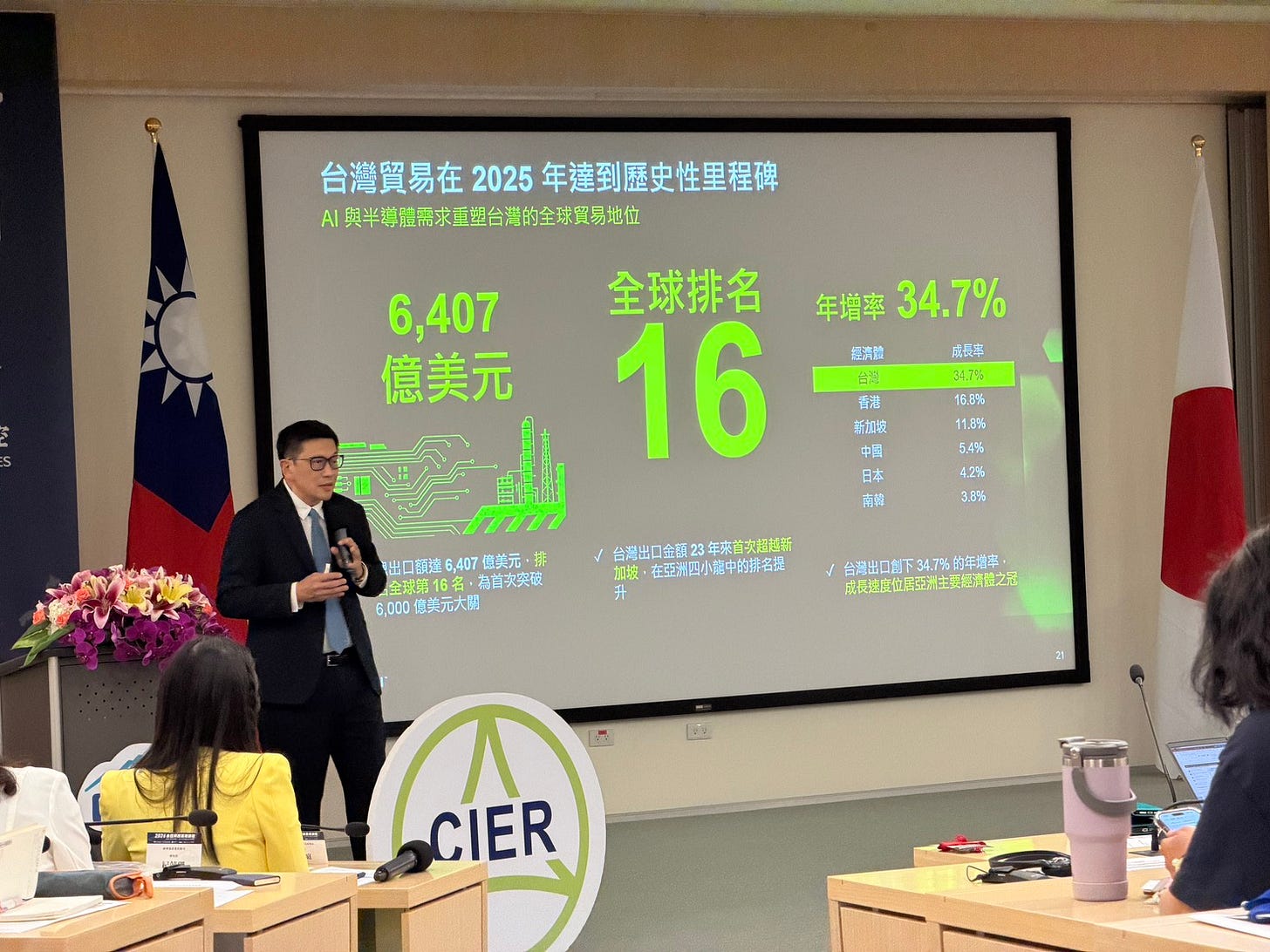
The results are beginning to appear in trade statistics. According to figures presented at the summit, Taiwan’s exports reached about $640.7bn in 2025, rising 34.7% from the previous year and lifting Taiwan to 16th place globally.
這些成果已開始反映在貿易統計數據中。根據峰會上公布的數據,台灣 2025 年的出口額達到約 6,407 億美元,較前一年成長 34.7%,使台灣躍居全球第 16 位。
Information and communications products accounted for roughly 39.2% of exports, while electronic components contributed another 34.8%.
資訊與通訊產品佔出口總額約 39.2%,電子零組件則貢獻了另外 34.8%。
Together, the two categories represented nearly three-quarters of Taiwan’s exports.
這兩大類別合計佔台灣出口總額近四分之三。
That is an extraordinary concentration. It also demonstrates how closely Taiwan’s economy has become tied to the AI infrastructure cycle.
如此高度的集中堪稱非凡,也彰顯出台灣經濟已與 AI 基礎設施週期緊密連結。

6月11日6 月 11 日
The most natural division of labour
最自然的勞動分工
One of the summit’s more useful ways of looking at Taiwan-Japan collaboration was to divide the AI supply chain into three layers.
峰會中探討台日合作較具價值的觀點之一,是將 AI 供應鏈劃分為三個層級。
Japan occupies much of the input layer: semiconductor materials, manufacturing equipment, ABF films, glass, passive components and precision materials.
日本在輸入層佔據重要地位,涵蓋半導體材料、製造設備、ABF 薄膜、玻璃、被動元件及精密材料。
Taiwan occupies much of the manufacturing core: advanced logic chips, AI accelerators, ASICs, substrates, high-density PCB and server production.
台灣佔據了製造核心:先進邏輯晶片、AI 加速器、ASIC、基板、高密度 PCB 及伺服器生產。
The two then converge at the integration layer: advanced packaging, heterogeneous integration, AI servers, power management, cooling and data-centre deployment.
兩者隨後在整合層匯聚:先進封裝、異質整合、AI 伺服器、電源管理、散熱解決方案以及資料中心部署。
This suggests a fairly simple industrial formula:
這揭示了一個相當簡單的產業公式:
Japanese materials and equipment + Taiwanese manufacturing + global AI demand.
日本的材料與設備+台灣的製造能力+全球 AI 需求。

This is more plausible than either country trying to replicate the entire semiconductor ecosystem domestically.
這比兩國各自試圖在國內複製整個半導體生態系統更為可行。
Japan does not need to become another Taiwan. Taiwan does not need to recreate Japan’s materials industry.
日本無需成為另一個台灣,台灣也無需重現日本的材料產業。
The economic logic lies in specialisation.
其經濟邏輯在於專業分工。
And the rise of AI makes that specialisation more valuable.
而人工智慧的興起,更讓這種專業分工的價值日益提升。
Why Japanese suppliers are moving closer to Taiwan
為何日本供應商正加速靠攏台灣
This also helps explain why more Japanese semiconductor suppliers are expanding their presence in Taiwan.
這也說明了為何越來越多日本半導體供應商正擴大其在台灣的佈局。
The first reason is R&D.
首要原因在於研發。
Advanced materials can no longer be developed in isolation and then shipped to a customer for testing. At 2nm and below, and especially in advanced packaging, materials increasingly have to be co-developed with the manufacturing process.
先進材料已無法再孤立開發後再運送給客戶測試;在 2 奈米及以下製程,尤其是先進封裝領域,材料必須與製造流程共同開發。
Being physically close to foundries, packaging houses and PCB suppliers speeds that process.
與晶圓廠、封裝廠及 PCB 供應商保持地理上的鄰近,能加速此過程。
The second reason is qualification.
第二個原因是資格認證。
The product cycle of AI hardware is shortening. Nvidia, AMD and hyperscaler-designed accelerators are moving through new generations at a rapid pace. Suppliers that enter the qualification process too late risk missing an entire product cycle.
AI 硬體的產品週期正不斷縮短。Nvidia、AMD 以及超大型雲端服務商自行設計的加速器正以極快速度推進新一代產品。若供應商過晚進入認證流程,將面臨錯失整個產品週期的風險。
A local application laboratory or pilot line can therefore be more strategically important than a conventional sales office.
因此,在地應用實驗室或試產線在戰略上可能比傳統銷售辦公室更為重要。
The third reason is access to future technologies.
第三個原因是取得未來技術的管道。
Processes such as gate-all-around transistors, backside power delivery, CoWoS, SoIC, HBM integration and co-packaged optics require suppliers to participate years before mass production.
諸如環繞式閘極電晶體、背面供電、CoWoS、SoIC、HBM 整合以及共封裝光學等製程,要求供應商必須在量產前數年即參與其中。
The closer a supplier is to the engineering ecosystem, the greater its chance of becoming part of the next manufacturing platform.
供應商越接近工程生態系,就越有機會成為下一代製造平台的一部分。
Finally, there is resilience.
最後,是韌性。
Local production can reduce logistics risk, shorten lead times and provide an additional manufacturing base at a time when technology companies are under pressure to diversify supply chains.
在地生產能降低物流風險、縮短交貨週期,並在科技公司面臨供應鏈多元化壓力之際,提供額外的製造基地。
This is why future Japanese investment in Taiwan is likely to involve more than commercial offices. Expect more application centres, R&D facilities, pilot production lines and, eventually, local manufacturing capacity.
這正是未來日本對台投資將不僅限於商業辦事處的原因。預期將出現更多應用中心、研發設施、試產線,並最終建立在地產能。

8月13日8 月 13 日
Globalisation has not disappeared
全球化並未消失
Governments increasingly talk about semiconductor sovereignty. The semiconductor industry itself remains stubbornly global.
各國政府日益強調半導體主權,但半導體產業本身仍堅守全球化佈局。
SEMI expects scores of new semiconductor fabs to come online globally by the end of the decade. Governments in America, Europe, Japan and elsewhere are spending heavily to localise production.
SEMI 預期,到本十年末,全球將有數十座新半導體晶圓廠陸續投產。美國、歐洲、日本等地的政府正投入鉅資,推動生產在地化。

Yet no major economy possesses every capability required to build the most advanced chips.
然而,沒有任何一個主要經濟體具備製造最先進晶片所需的所有能力。
America dominates much of chip design, EDA software and the end market. Taiwan dominates leading-edge foundry production and much advanced packaging. Japan retains major advantages in materials and equipment. South Korea is formidable in memory. Europe remains strong in lithography, power semiconductors and automotive electronics.
美國在晶片設計、EDA 軟體及終端市場佔據主導地位;台灣則領先於先進製程晶圓代工與多數先進封裝技術;日本在材料與設備領域仍保有顯著優勢;南韓在半導體記憶體方面實力雄厚;歐洲则在微影技術、功率半導體及車用電子領域持續保持強勢。
This is less a collection of self-sufficient national industries than a network of specialised industrial clusters.
這並非各自獨立的國家產業集合,而是一個由專業化產業聚落構成的網絡。
That is unlikely to change quickly.
這種情況不太可能迅速改變。
What governments can realistically achieve is not complete autonomy, but greater control over selected chokepoints.
各國政府實際能達成的目標並非完全自主,而是對關鍵瓶頸環節掌握更大的控制權。
In this respect, Taiwan and Japan are particularly complementary.
在此方面,台灣與日本特別互補。
兩者的綜合能力涵蓋了將 AI 加速器設計轉化為運作中的伺服器,乃至最終成為機器人所需要的大部分製造技術。
Beyond the trillion-dollar semiconductor market
超越兆美元半導體市場
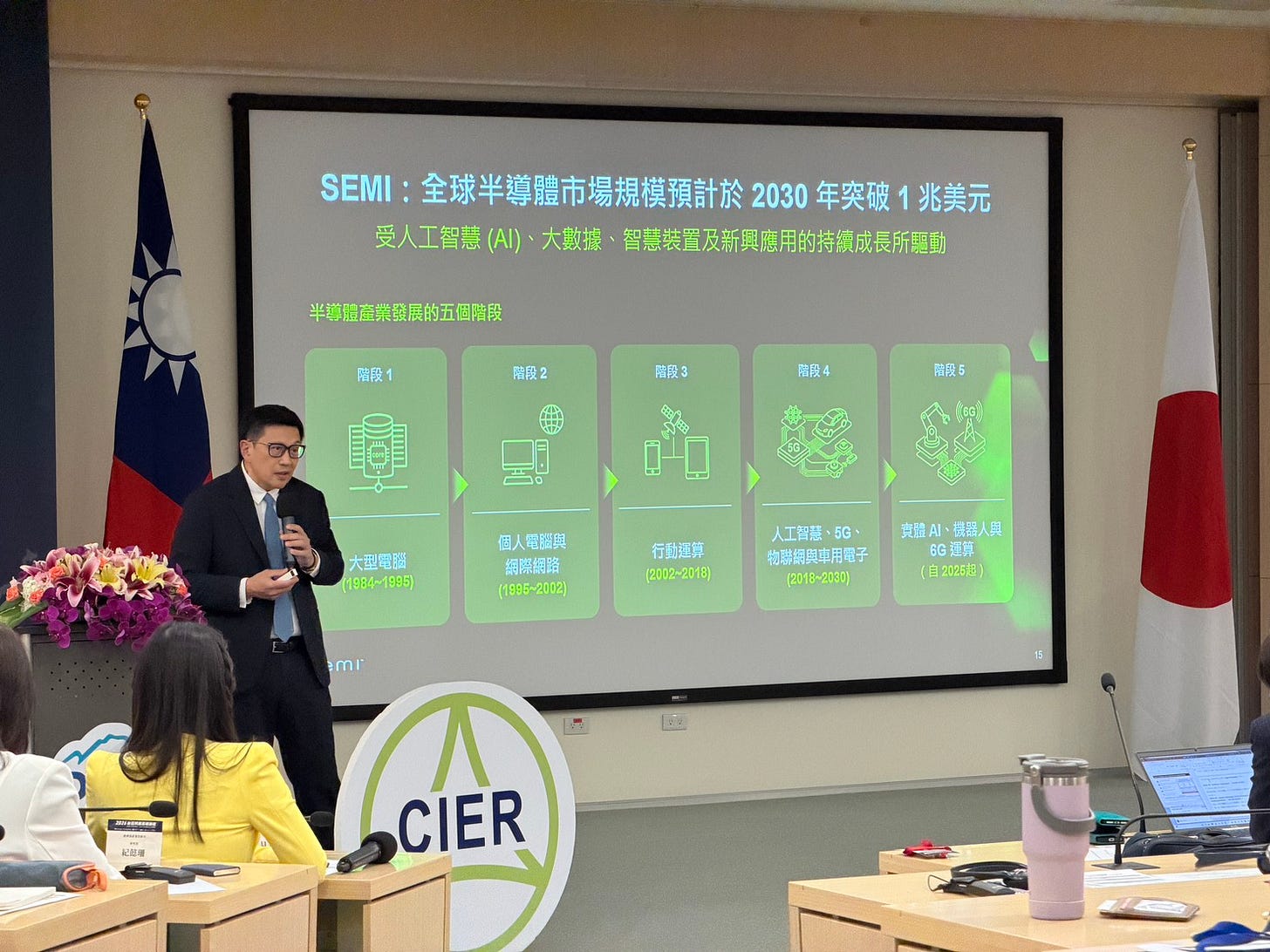
SEMI expects the global semiconductor market eventually to exceed $1trn around 2030.
SEMI 預期全球半導體市場最終將在 2030 年左右突破 1 兆美元。
Yet semiconductor revenue alone may understate the economic significance of the AI boom.
然而,僅憑半導體營收可能低估了人工智慧繁榮的經濟重要性。
The bigger opportunity lies in the infrastructure surrounding the chips.
更大的機會在於晶片周邊的基礎設施。
HBM must be manufactured. Accelerators must be packaged. Packages must be mounted onto substrates and PCBs. Servers need optical connectivity, power conversion and cooling. Racks must be installed in data centres.
HBM 必須製造,加速器必須封裝,封裝體必須安裝到基板和 PCB 上。伺服器需要光學連接、電源轉換與散熱系統,機櫃則必須部署於資料中心。
And as AI moves into the physical world, the supply chain expands again.
隨著 AI 邁向實體世界,供應鏈將再次擴張。
Sensors, motors, precision components, power devices and industrial equipment all become part of the AI economy.
感測器、馬達、精密元件、功率裝置與工業設備,皆成為 AI 經濟的一環。
This is where the Taiwan-Japan relationship becomes particularly interesting.
這正是台日關係變得格外有趣之處。
Japan supplies many of the sophisticated materials and components that make advanced manufacturing possible. Taiwan specialises in converting them into semiconductor devices, electronic systems and servers at extraordinary scale.
日本提供許多實現先進製造所需的精密材料與零組件,而台灣則專精於將這些材料與零組件轉化為半導體元件、電子系統及伺服器,並具備驚人的量產規模。
For years these capabilities were regarded as separate industries.
多年來,這些能力被視為獨立的產業。
AI is tying them together.
人工智慧正將它們緊密連結。

7月22日7 月 22 日
The Asian hardware axis
亞洲硬體軸心
The most consequential outcome of the AI boom may therefore be geopolitical as much as technological.
因此,人工智慧熱潮所帶來最深遠的影響,可能在地緣政治層面與技術層面同樣重大。
America will probably remain the centre of AI software, chip architecture and hyperscale demand. But much of the physical infrastructure supporting that intelligence will continue to be manufactured in Asia.
美國可能仍將是人工智慧軟體、晶片架構與超大型需求的核心。但支撐該智慧的實體基礎設施,大部分仍將在亞洲製造。
Within that system, Taiwan and Japan are forming an increasingly important hardware axis.
在此體系中,台灣與日本正形成日益重要的硬體軸心。
The partnership will not eliminate competition between them. Nor will it eliminate their dependence on American technology, Korean memory, European equipment or Chinese manufacturing capacity.
此夥伴關係並不會消除雙方之間的競爭,也無法消除他們對美國技術、韓國記憶體、歐洲設備或中國製造產能的依賴。
But it does create something strategically valuable: a dense, technologically sophisticated manufacturing ecosystem covering many of the bottlenecks that matter most to AI.
但這確實創造了具有戰略價值的成果:一個密集且技術先進的製造生態系統,涵蓋了對人工智慧至關重要的多項瓶頸。
The first phase of the AI boom made GPUs scarce.
人工智慧浪潮的第一階段導致 GPU 供不應求。
The next one may make materials, packaging, power, optics, cooling and manufacturing capacity just as important.
下一階段則可能讓材料、封裝、電力、光學、散熱及產能變得同等重要。
That is good news for both Taiwan and Japan.
這對台灣和日本而言都是好消息。
The race to dominate AI will not be won by the country with the best algorithm alone. It will also be won by the industrial systems capable of turning increasingly complex designs into millions of reliable machines.
贏得人工智慧主導權的競賽,不能單靠擁有最佳演算法的國家;勝出者還必須具備能將日益複雜的設計轉化為數百萬台可靠機器的產業體系。
On that measure, Taiwan and Japan may be better positioned together than either is alone.
就這一點而言,台灣與日本若攜手合作,其優勢可能遠勝於各自為戰。

8月4日8 月 4 日


Share分享
Previous上一頁