TSMC Follows the Money: More Than 75% of Its Revenue Now Comes From U.S. Customers
TSMC Follows the Money: More Than 75% of Its Revenue Now Comes From U.S. Customers
- Source: SemiVision
- Author: SEMIVISION
- Published: 2026-08-18T09:27:35+08:00
- URL: https://tspasemiconductor.substack.com/p/tsmc-follows-the-money-more-than
中文翻譯與英文原文(雙語)
台積電追隨資金動向:逾 75% 營收現來自美國客戶 --- TSMC Follows the Money: More Than 75% of Its Revenue Now Comes From U.S. Customers


TSMC Follows the Money: More Than 75% of Its Revenue Now Comes From U.S. Customers
台積電追隨資金動向:逾 75% 營收現來自美國客戶
Original Article By SemiVision Research [Reading time: 6 mins]
原文作者:SemiVision Research [閱讀時間:6 分鐘]

Aug 18, 2026
Share分享
TSMC Follows the Money: More Than 75% of Its Revenue Now Comes From U.S. Customers
台積電追隨資金動向:逾 75% 營收現來自美國客戶
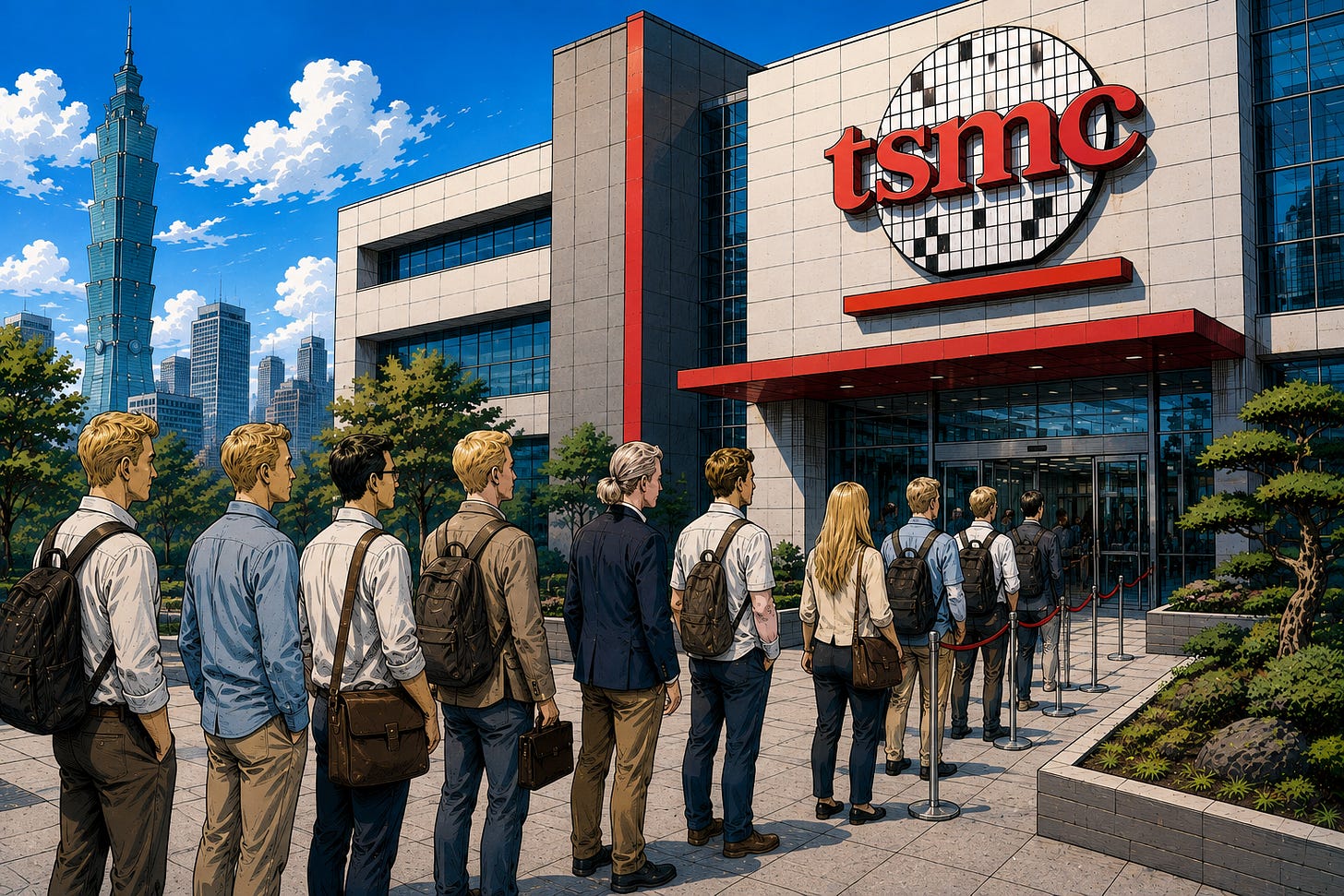
The geography of TSMC’s factories is beginning to follow the geography of its customers.
台積電的工廠佈局正開始追隨其客戶的地理分佈。
For years, the debate over Taiwan Semiconductor Manufacturing Company’s expansion in America has been framed mainly as a geopolitical one. Washington wants more advanced semiconductor production on American soil. Taiwan worries about the gradual migration of one of its most strategic industries. And critics point out, correctly, that manufacturing chips in Arizona is more expensive and cumbersome than doing so in Taiwan.
多年來,關於台灣積體電路製造公司(TSMC)在美國擴張的辯論,主要被框定在地緣政治層面。華府希望更先進的半導體生產能落地美國本土;台灣則擔憂其最具戰略意義的產業之一逐漸外移;而批評者亦正確指出,在亞利桑那州製造晶片,成本更高且作業更為繁複,遠不如在台灣生產來得有效率。
Yet this framing misses an increasingly important fact: TSMC’s customers are already overwhelmingly American.
然而,這樣的論述忽略了一個日益重要的事實:台積電的客戶早已高度集中於美國。
In the first half of 2026, customers headquartered in the United States accounted for 75.64% of TSMC’s consolidated revenue, according to the company’s financial statements. That compares with just 6.85% from Taiwan, 6.76% from China, 3.62% from Japan and 4.05% from Europe, the Middle East and Africa.
根據台積電財務報表,2026 年上半年,總部設於美國的客戶貢獻了台積電合併營收的 75.64%。相較之下,台灣僅佔 6.85%,中國為 6.76%,日本為 3.62%,而歐洲、中東與非洲合計則為 4.05%。
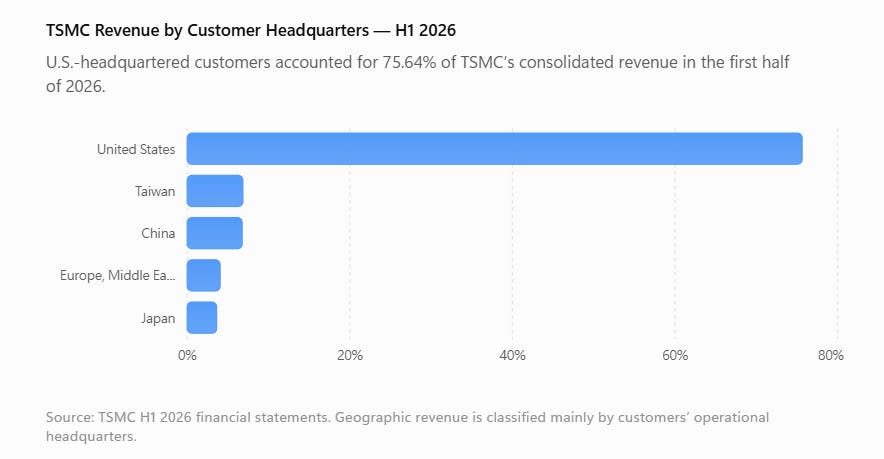
Put differently, for every NT$100 of revenue generated by TSMC, roughly NT$76 now comes from customers headquartered in America.
換言之,台積電每產生 100 元新台幣的營收,其中約有 76 元來自總部設於美國的客戶。
That makes the question of why TSMC is building fabs in Arizona rather less mysterious.
這使得台積電為何選擇在亞利桑那州興建晶圓廠的問題,變得不再那麼神秘。

4月23日4 月 23 日
Follow the customer緊跟客戶腳步
TSMC remains Taiwanese in ownership, engineering culture and manufacturing concentration. But commercially it has become deeply American.
台積電在股權、工程文化與製造集中度上仍保有台灣特質,但在商業層面上已深度美國化。
Its most important customers include the companies driving the global computing boom: Apple, Nvidia, AMD, Broadcom and a growing collection of developers of custom AI accelerators. American cloud giants are also spending extraordinary sums on data centres, networking equipment and artificial-intelligence infrastructure.
其最重要的客戶包括推動全球運算浪潮的企業:Apple、Nvidia、AMD、Broadcom,以及日益增多的自訂 AI 加速器開發商。美國雲端巨頭也正投入鉅額資金,用於資料中心、網路設備及人工智慧基礎設施。
These firms increasingly depend on TSMC not merely for chips, but for access to the world’s most sophisticated manufacturing ecosystem.
這些企業對台積電的依賴,已不僅限於晶片本身,更在於取得全球最先進的製造生態系。
The distinction matters.此區別至關重要。
A decade ago, a semiconductor company might have thought primarily about whether a foundry could offer the right transistor technology at the right cost. Today the calculation is broader. Advanced processors depend on leading-edge logic, sophisticated packaging, high-bandwidth memory and increasingly intricate supply chains.
十年前,半導體公司可能主要考慮晶圓代工廠能否以合適的成本提供正確的電晶體技術。如今,這項評估更為廣泛。先進處理器依賴最先進的邏輯製程、精密封裝、高頻寬記憶體,以及日益複雜的供應鏈。
For the largest American technology companies, TSMC has therefore become less like an ordinary supplier and more like a piece of strategic infrastructure.
因此,對美國最大的科技公司而言,台積電已不再只是普通的供應商,而更像是一項戰略基礎設施。
That changes the value of geographical diversification.
這改變了地理多元化的價值。
If more than three-quarters of a company’s revenue comes from customers headquartered in one country, establishing meaningful production capacity in that country is hardly an eccentric corporate decision. It is what many multinational manufacturers eventually do.
若一家公司超過四分之三的營收來自總部設於同一國家的客戶,在該國建立具實質意義的產能絕非特立獨行的企業決策;許多跨國製造商最終都會採取此策略。
Customers tend to pull suppliers closer.
客戶往往會促使供應商靠得更近。
The expensive desert昂貴的沙漠
There are, of course, good reasons why TSMC spent decades concentrating its most advanced manufacturing in Taiwan.
當然,台積電過去數十年將其最先進的製造集中於台灣,自有其充分理由。
Semiconductor fabrication benefits enormously from clustering. Taiwan offers experienced engineers, specialised contractors, equipment-support teams and suppliers of chemicals, gases, wafers and components within a remarkably compact geography.
半導體製造極度受益於產業聚落效應。台灣在極為緊湊的地理範圍內,提供了經驗豐富的工程師、專業承包商、設備支援團隊,以及化學品、氣體、晶圓和零組件的供應商。

3月3日3 月 3 日
Reproducing such an ecosystem in Arizona is difficult.
要在亞利桑那州複製這樣的生態系統極為困難。
Labour costs are higher. Construction is more complicated. Semiconductor workers are harder to recruit. Suppliers have to build local operations. Management practices developed over decades in Hsinchu cannot simply be transplanted into the Sonoran Desert.
勞工成本較高,營建工程更為複雜,半導體人才更難招募,供應商也必須建立在地營運據點。過去數十年在新竹發展出的管理實務,無法直接移植到索諾蘭沙漠。
This is why comparing the cost of an Arizona wafer with a Taiwanese one will almost inevitably make America look unattractive.
正因如此,若比較亞利桑那州與台灣晶圓的生產成本,幾乎必然會顯得美國缺乏吸引力。
But that is too narrow a comparison.
但這樣的比較過於狹隘。
TSMC is not merely deciding where a wafer can be manufactured most cheaply. It is deciding how to serve customers whose chips are becoming economically and politically indispensable.
台積電不僅是在決定何處能以最低成本製造晶圓,更是在思考如何服務那些其晶片已成為經濟與政治層面不可或缺要素的客戶。
For Nvidia, Apple or a hyperscale cloud provider, supply security may be worth paying for. Having some advanced production capacity in America creates an additional layer of resilience against disruptions elsewhere.
對輝達、蘋果或超大型雲端服務供應商而言,供應鏈安全或許值得付費取得。在美國擁有一部分先進產能,可為應對其他地區的供應中斷提供額外的韌性層級。
That does not make Arizona cheaper.
這並不會讓亞利桑那州變得更便宜。
It may make it valuable.
這可能使其更具價值。
And Arizona is starting to make money
而亞利桑那州也開始創造收益
The argument becomes more interesting when the factories themselves cease to look purely strategic.
當這些工廠本身不再顯得純粹出於戰略考量時,這項論點就變得更為有趣了。
TSMC Arizona reported approximatelyNT$36.1bn ($1.2bn) in profit in the first half of 2026. After adjustments including unrealised gains from intercompany transactions, TSMC recognised roughly NT$31.2bn in investment income.
台積電亞利桑那廠在 2026 年上半年獲利約新台幣 361 億元(12 億美元)。經調整未實現的公司間交易利益後,台積電認列的投資收益約為新台幣 312 億元。
One six-month period does not settle the economics of American semiconductor manufacturing. Profitability will vary with utilisation, depreciation, product mix, wafer pricing and government support.
單一半年的數據並不足以定論美國半導體製造的經濟效益。獲利能力將隨產能利用率、折舊、產品組合、晶圓定價及政府補助而波動。
But the numbers weaken the simplest criticism of TSMC’s American expansion: that Arizona is merely an expensive political project with little commercial rationale.
但這些數據削弱了對台積電赴美擴張最簡單的批評:即亞利桑那州廠不過是一項耗資龐大的政治工程,缺乏商業合理性。
Increasingly, four forces are pointing in the same direction.
越來越多的四股力量正指向同一方向。
The customers are American. The fastest-growing demand is American. The government incentives are American. And now the factories themselves are beginning to generate meaningful earnings.
客戶是美國的,成長最快的需求來自美國,政府激勵措施也是美國的。而如今,工廠本身也開始產生可觀的收益。
The alignment is difficult to ignore.
這種趨勢難以忽視。

7月14日7 月 14 日
Not simply a victim of Washington
並非華盛頓的單純受害者
None of this means politics is irrelevant.
這一切並不意味著政治無關緊要。
America has made semiconductor localisation a national priority. The CHIPS Act, export controls and the intensifying technological rivalry with China have all pushed TSMC towards greater geographical diversification.
美國已將半導體在地化列為國家優先事項。《晶片與科學法案》、出口管制措施,以及與中國日益激烈的科技競爭,皆促使台積電加速推動地理多元化佈局。
Washington plainly wants more of the semiconductor supply chain on American soil.
華府明確希望將更多半導體供應鏈移往美國本土。
But it is too simplistic to describe TSMC as merely being forced overseas by the American government.
然而,若將台積電赴美設廠單純歸因於受美國政府強迫,則過於簡化事實。
Imagine almost any global manufacturer whose largest customers are concentrated in one country and whose biggest customers are simultaneously increasing capital expenditure at an exceptional pace.
試想任何一家全球製造商,若其最大客戶群集中於單一國家,且這些主要客戶同時正以前所未有的速度大幅增加資本支出。
Would it be surprising for that manufacturer to build capacity closer to them?
該製造商將產能建置在更靠近他們的地區,會令人驚訝嗎?
Probably not.可能不是。
Indeed, the more useful question is no longer why TSMC is manufacturing in America.
事實上,更有意義的問題已不再是台積電為何要在美國製造。
It is how much manufacturing capacity TSMC should eventually put there.
而是台積電最終應在美國投入多少產能。
Those are very different questions.
這些是截然不同的問題。
Taiwan is not being replaced
台灣並未被取代
There is another important qualification.
還有一項重要的補充說明。
The fact that 75.64% of TSMC’s revenue comes from American-headquartered customers does not mean that 75.64% of its production should move to America.
台積電 75.64% 的營收來自總部設於美國的客戶,這並不意味著其 75.64% 的產能必須移往美國。
Nor does it mean that three-quarters of TSMC’s chips are currently manufactured there.
這也不代表台積電目前有四分之三的晶片是在美國製造。
TSMC classifies geographical revenue largely according to the location of a customer’s operational headquarters. An Nvidia processor fabricated in Taiwan, packaged in Asia and installed in a server elsewhere can still contribute to the company’s American customer category.
台積電主要依據客戶營運總部的所在地來劃分地理營收。因此,即便一顆由輝達(Nvidia)設計的處理器是在台灣製造、於亞洲封裝,並最終安裝在其他地區的伺服器中,其營收仍會被歸類為來自美國客戶。
The geographical distribution of customers and the geographical distribution of factories are therefore very different things.
因此,客戶的地理分佈與晶圓廠的地理分佈是截然不同的兩回事。
And Taiwan retains formidable advantages.
而台灣仍保有顯著的優勢。
The company’s leading-edge research, manufacturing expertise, supplier network and increasingly important advanced-packaging infrastructure remain concentrated there. As semiconductor technology moves towards 2nm, A16 and more complicated three-dimensional integration, the benefits of having engineers, production lines and suppliers close together may become even greater.
該公司的前沿研發、製造專業、供應商網絡,以及日益重要的先進封裝基礎設施,仍高度集中於此。隨著半導體技術邁向 2 奈米、A16 及更複雜的三維整合,將工程師、生產線與供應商緊密聚集的優勢可能會變得更加顯著。
Arizona is therefore unlikely to replace Hsinchu.
因此,亞利桑那州不太可能取代新竹。
A more plausible outcome is the emergence of a two-tier geographical structure.
更可能的結果是出現一個兩層級的地理結構。
Taiwan remains TSMC’s technological and manufacturing core. America becomes its most important overseas production base, positioned close to its largest and strategically most important customers.
台灣仍是台積電的技術與製造核心。美國則成為其最重要的海外生產基地,緊鄰其最大且最具戰略重要性的客戶。
Japan can play a similar role for automotive, industrial and speciality semiconductor demand. Europe may develop around automotive and industrial chips.
日本可在汽車、工業及特殊半導體需求方面發揮類似角色。歐洲則可能圍繞汽車與工業晶片發展。
This is not de-Taiwanisation so much as globalisation of manufacturing around a Taiwanese core.
這並非去台灣化,而是以台灣為核心的製造全球化。

7月28日7 月 28 日
The number that matters
關鍵數字
For investors, the most revealing number may therefore not be Arizona’s profit.
對投資人而言,最具啟發性的數字或許並非亞利桑那州的獲利。
It may be 75.64%.而是 75.64%。
That figure exposes how far TSMC’s commercial centre of gravity has already shifted towards America.
這個數據揭露了台積電的商業重心已大幅移向美國。
And artificial intelligence could reinforce the trend.
而人工智慧可能會強化此一趨勢。
The companies spending most aggressively on GPUs, custom accelerators, networking silicon and cloud infrastructure are overwhelmingly American. As their semiconductor requirements become larger and more strategically sensitive, pressure for more geographically diversified manufacturing is likely to increase.
在 GPU、自訂加速器、網路晶片與雲端基礎設施上投入最為積極的企業,絕大多數為美國公司。隨著其半導體需求日益龐大且更具戰略敏感性,推動製造據點地理多元化的壓力勢必隨之升高。
TSMC’s factory map is beginning, slowly, to resemble its customer map.
台積電的工廠版圖正開始緩慢地與其客戶版圖趨於一致。
That does not mean the company will abandon the enormous advantages it has built in Taiwan. Quite the opposite: preserving Taiwan as the centre of its technological ecosystem remains essential to maintaining TSMC’s competitive advantage.
這並不意味著該公司將放棄其在台灣所建立的巨大優勢。恰恰相反:維持台灣作為其技術生態系統的核心,對於保持台積電的競爭優勢至關重要。
But a company whose customers are global cannot indefinitely remain geographically concentrated to the same degree as before.
然而,一家客戶遍佈全球的公司,無法無限期地像過去那樣在地理上高度集中。
Seen in that light, Arizona is neither an aberration nor merely the price of political pressure.
從這個角度來看,亞利桑那州廠既非異常現象,也不僅僅是政治壓力下的代價。
It is part of TSMC’s evolution from a Taiwanese manufacturer serving the world into a global manufacturer whose indispensable core remains in Taiwan.
這是台積電演進歷程的一部分,從一家服務全球的台灣製造商,轉型為全球製造商,而其不可或缺的核心仍位於台灣。
When more than three-quarters of your revenue comes from American customers, building some of your most important factories in America is not particularly surprising.
當超過四分之三的營收來自美國客戶時,在美國興建部分最重要的晶圓廠也就不足為奇了。
It may simply be good business.
這可能純粹是明智的商業決策。
7月22日7 月 22 日
SEMIVISION @_@ 是一份由讀者支持的出版物。若要接收最新文章並支持我的工作,歡迎考慮成為免費或付費訂閱者。


Share分享
Previous上一頁