OCP APAC 2026: AI Infrastructure Is Moving Beyond the GPU
OCP APAC 2026: AI Infrastructure Is Moving Beyond the GPU
- Source: SemiVision
- Author: SEMIVISION
- Published: 2026-08-17T10:18:41+08:00
- URL: https://tspasemiconductor.substack.com/p/ocp-apac-2026-ai-infrastructure-is
中文翻譯與英文原文(雙語)
OCP APAC 2026:AI 基礎設施正邁向超越 GPU 的新階段 --- OCP APAC 2026: AI Infrastructure Is Moving Beyond the GPU


OCP APAC 2026: AI Infrastructure Is Moving Beyond the GPU
OCP APAC 2026:AI 基礎設施正邁向超越 GPU 的新階段
Original Article By SemiVision Reserach [Reading time: 12 mins]
原文作者:SemiVision Research [閱讀時間:12 分鐘]

Aug 17, 2026
∙ Paid∙ 付費
Share分享
OCP APAC 2026: AI Infrastructure Is Moving Beyond the GPU
OCP APAC 2026:AI 基礎設施正邁向超越 GPU 的新階段
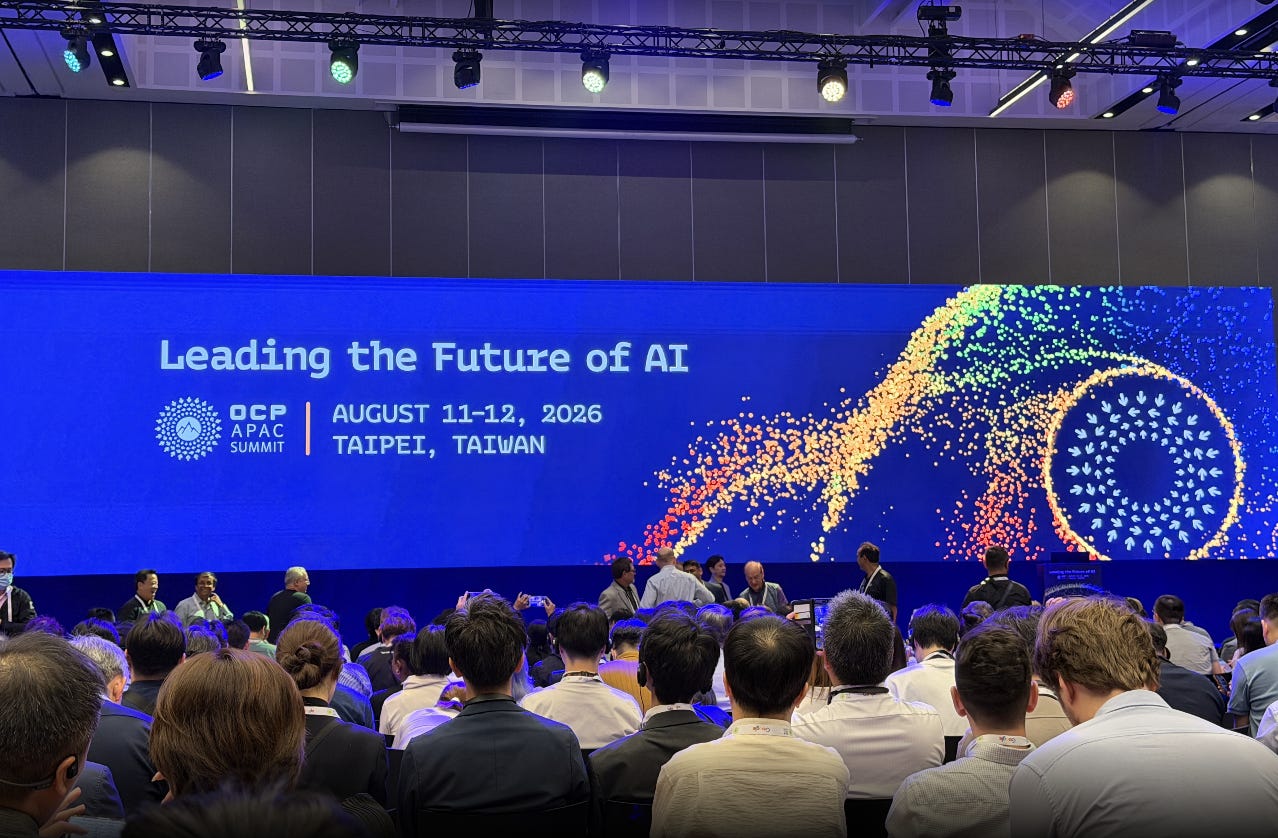
The most important takeaway from OCP APAC 2026 is not another GPU roadmap.
OCP APAC 2026 最重要的收穫並非另一份 GPU 路線圖。
It is that the AI infrastructure bottleneck is moving outward.
而是 AI 基礎設施的瓶頸正向外擴散。
For the last three years, the AI trade has been dominated by a relatively concentrated set of components: GPUs, HBM, advanced-node wafers, and advanced packaging. Those remain critical, but the next phase of deployment is exposing constraints elsewhere in the system.
過去三年,AI 產業主要由一組相對集中的元件主導:GPU、HBM、先進製程晶圓以及先進封裝。這些元件依然至關重要,但下一階段的部署正暴露出系統其他環節的限制。
Power distribution is becoming harder.
電源分配變得日益困難。
Cooling is becoming a system-level problem.
散熱已成為系統層級的問題。
Fiber density is increasing faster than data-center physical infrastructure was designed to handle.
光纖密度的增長速度,已超過資料中心實體基礎設施原本的設計負荷。
Management complexity is rising.
管理複雜度持續上升。
Packages are getting larger.
封裝尺寸日益增大。
And validation equipment increasingly needs to handle power levels that would have looked absurd for a server only a few years ago.
而且,驗證設備日益需要處理的功率等級,若在幾年前對於伺服器來說簡直是荒謬至極。
That is why OCP APAC increasingly looks less like a server conference and more like an AI infrastructure supply-chain conference.
正因如此,OCP APAC 越來越不像一場伺服器研討會,反而更像是一場 AI 基礎設施供應鏈盛會。
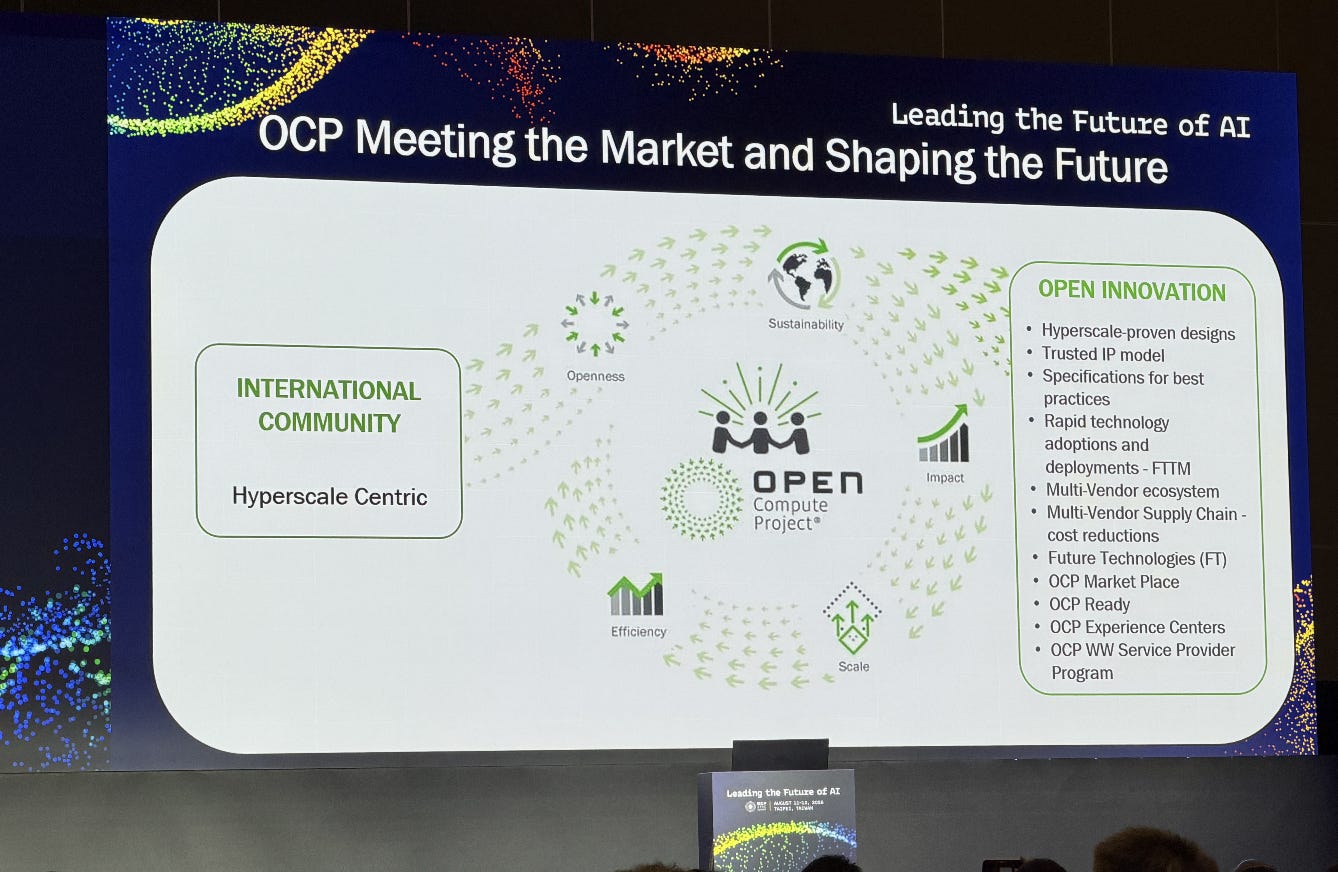
The companies worth watching are therefore not limited to NVIDIA, AMD, Broadcom, or the server ODMs.
因此,值得關注的企業不僅限於 NVIDIA、AMD、Broadcom 或伺服器 ODM 廠商。
The next layer of value creation is moving into power, thermal management, optics, system control, packaging, and test.
下一階段的價值創造正轉向電源、熱管理、光學元件、系統控制、封裝與測試等領域。
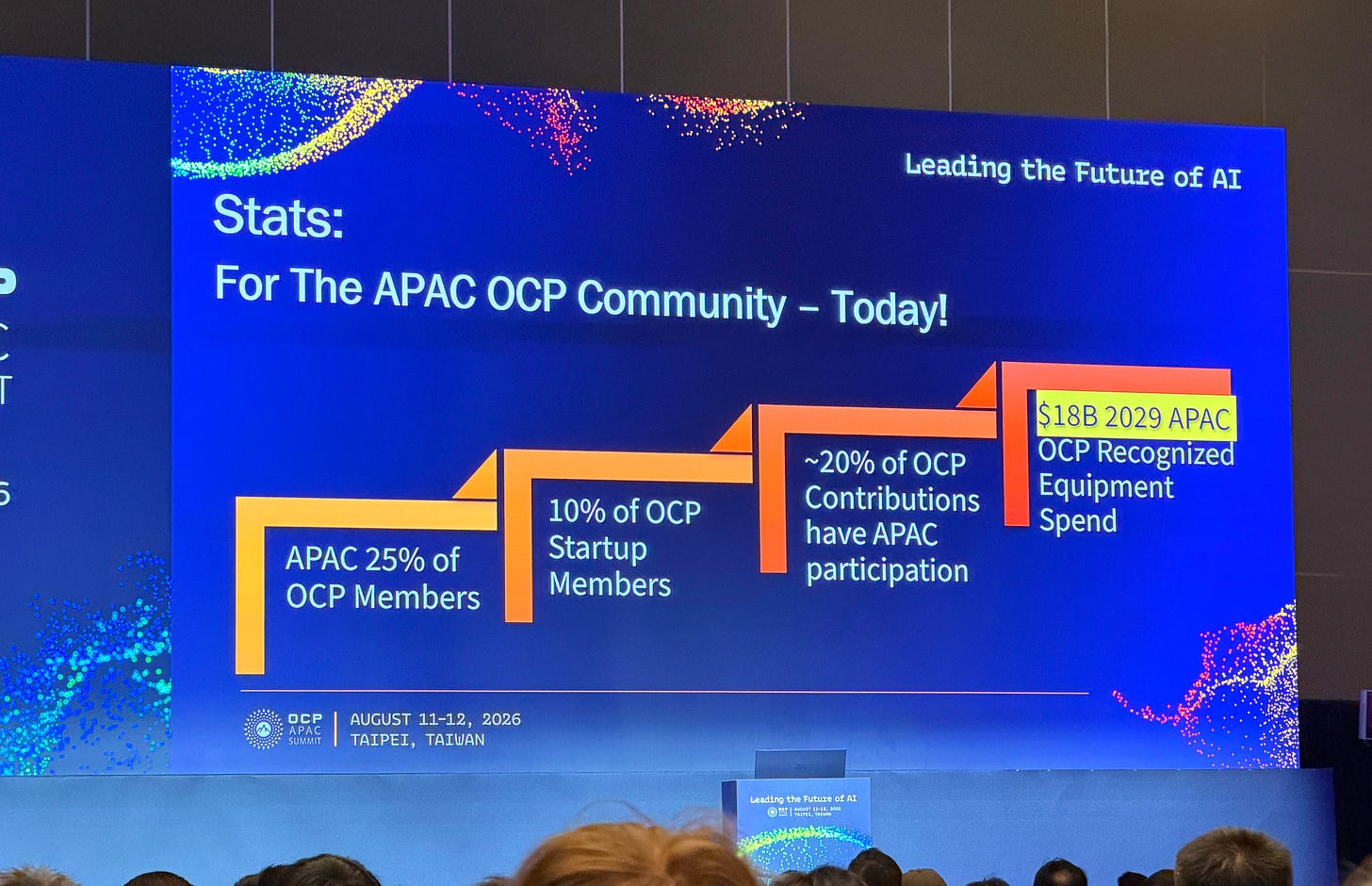
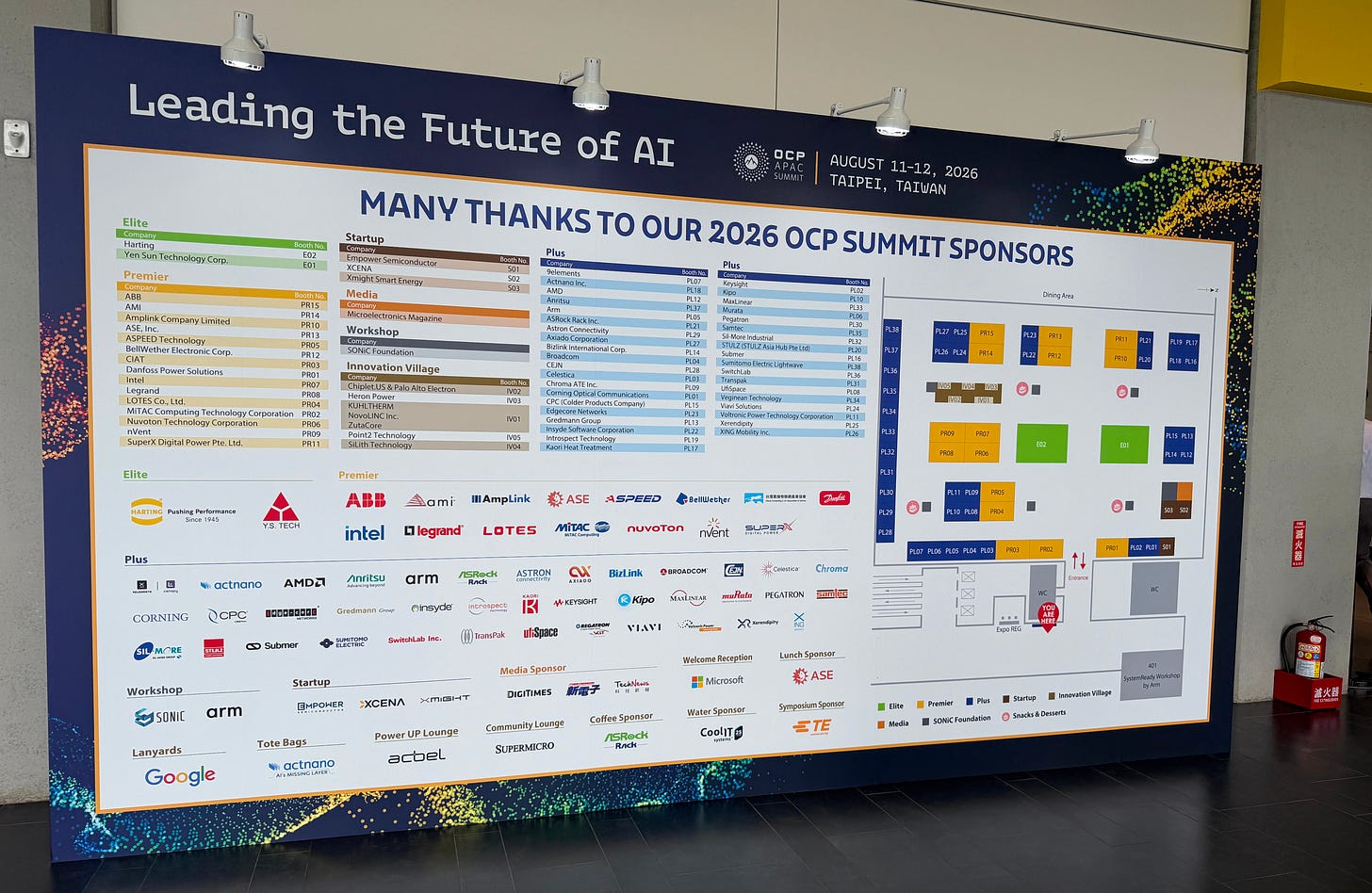
SemiVision attended the first OCP APAC Summit in Taiwan last year, and we were already impressed by the scale and quality of the event. This year, it feels even bigger. Last year, the event was mainly held on the 7th floor of Taipei Nangang Exhibition Center Hall 2; this year, the exhibition booths and dining area have expanded to the 4th floor as well.
SemiVision 去年參加了首屆在臺灣舉辦的 OCP APAC 高峰會,當時我們已對該活動的規模與品質印象深刻。今年,活動規模更顯盛大。去年展區主要位於臺北南港展覽館 2 館 7 樓;今年則擴增至 4 樓,涵蓋更多展位與用餐區域。
You can clearly feel that more companies, engineers, and industry leaders are joining the OCP community. Taiwan’s role as a critical hub for AI and semiconductors makes it a natural meeting point for global companies to visit the supply chain, exchange ideas, and build new connections. We look forward to seeing OCP APAC continue to grow bigger and stronger in Taiwan.
您可以明顯感受到,有更多企業、工程師及產業領袖正加入 OCP 社群。臺灣作為人工智慧與半導體的關鍵樞紐,自然成為全球企業走訪供應鏈、交流構想並建立新連結的匯聚之地。我們期待 OCP APAC 在臺灣持續茁壯,規模與影響力日益提升。

2025年8月17日2025 年 8 月 17 日
Below we will share:以下我們將分享:
AI Infrastructure Is Shifting From Servers to Racks
AI 基礎設施正從伺服器轉向機櫃
Power Is Becoming One of AI’s Hardest Engineering Problems
電力已成為 AI 最嚴峻的工程挑戰之一
Liquid Cooling Has Entered the Qualification Phase
液冷技術已進入驗證階段
KAORI and the Heat-Exchange Layer
KAORI 與熱交換層
AI Networking Is Running Out of Physical Space
AI 網路正面臨實體空間不足的挑戰
CPO Is an Ecosystem Problem
CPO 是一項生態系問題
AI’s Bottleneck Is Moving Through the Stack
AI 的瓶頸正沿著技術堆疊向上移動
AI Infrastructure Is Shifting From Servers to Racks
AI 基礎設施正從伺服器轉向機櫃
The first architectural shift is straightforward:
第一項架構轉變十分明確:
The server is no longer the relevant unit of deployment. The rack is.
伺服器已不再是相關的部署單位,機櫃才是。
Companies such as MiTAC are increasingly presenting AI infrastructure at the rack level rather than as individual compute nodes.
MiTAC 等公司愈來愈傾向於在機櫃層級呈現 AI 基礎設施,而非以個別運算節點為單位。
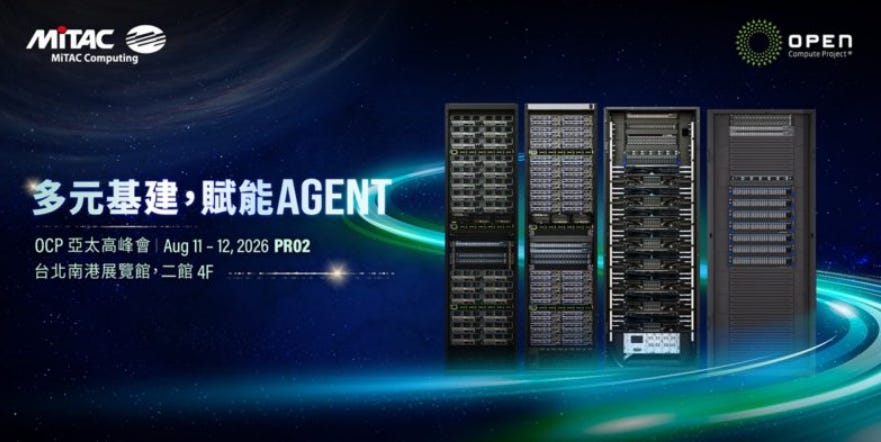
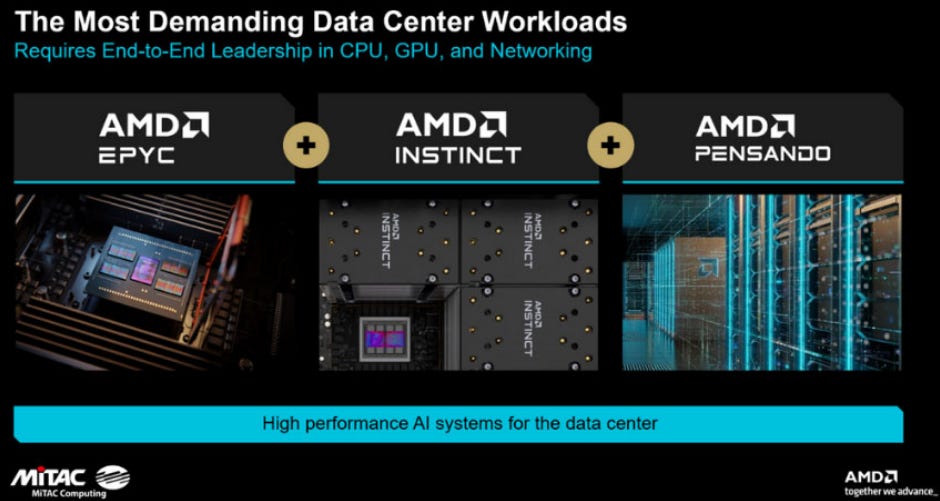
MiTAC Computing showcased new rack-scale infrastructure for Agentic AI at OCP APAC 2026, including the global debut of its C2810Z6 and C2610Z6 HPC servers. Co-developed with AMD, both systems feature 6th Gen AMD EPYC processors, SP7/SP8 platforms, and PCIe Gen 6.
MiTAC Computing 於 OCP APAC 2026 展示專為 Agentic AI 打造的全新機架級基礎設施,其中包括其 C2810Z6 與 C2610Z6 HPC 伺服器的全球首發。這兩款系統係與 AMD 共同開發,均搭載第 6 代 AMD EPYC 處理器、SP7/SP8 平台以及 PCIe Gen 6。
This matters because the economic content of an AI system changes significantly when the customer buys a rack rather than a server.
這至關重要,因為當客戶購買的是機櫃而非單一伺服器時,AI 系統的經濟內涵將發生顯著變化。
A traditional server ODM primarily integrates:
傳統伺服器 ODM 主要整合以下元件:
CPU + DRAM + storage + NIC + PSU.
CPU + DRAM + 儲存裝置 + NIC + PSU。
An AI rack requires integration across a much larger stack:
AI 機櫃則需要在更龐大的技術堆疊中進行整合:
GPU + CPU + HBM + networking + storage + power shelves + busbars + BBU + CDU + manifolds + firmware + rack management.
GPU + CPU + HBM + 網路 + 儲存 + 電源機架 + 母線排 + BBU + CDU + 歧管 + 韌體 + 機架管理。
The deployment model is effectively moving through:
部署模式正有效經歷以下演進:
Server → Rack → Cluster → AI Factory
伺服器 → 機架 → 叢集 → AI 工廠
This changes how investors should think about the ODM opportunity.
這改變了投資人評估 ODM 商機的方式。
Server unit shipments become less informative.
伺服器出貨量變得較不具參考價值。
The more useful question is:
更關鍵的問題是:
How much of the total rack-level BOM can each supplier control?
每位供應商能掌控多少比例的機架層級物料清單(BOM)總成本?
A vendor responsible only for assembling compute trays captures a very different economic opportunity from one responsible for rack integration, cooling, power validation, firmware, and deployment.
僅負責組裝運算托盤的廠商,其所掌握的经济機會,與負責機架整合、散熱、電源驗證、韌體及部署的廠商截然不同。
The winner in AI server manufacturing may therefore be the company that moves furthest upstream into system integration, not necessarily the company shipping the largest number of server boxes.
因此,AI 伺服器製造的贏家,可能是那些最深入上游、投身系統整合的公司,而不一定是出貨伺服器機箱數量最多的公司。
Power Is Becoming One of AI’s Hardest Engineering Problems
電力正成為人工智慧最艱鉅的工程挑戰之一
The next bottleneck is power.
下一個瓶頸是電力。
As rack power moves from tens of kilowatts toward hundreds of kilowatts, traditional low-voltage distribution becomes increasingly inefficient.
隨著機架功率從數十千瓦邁向數百千瓦,傳統的低壓配電變得日益低效。
The basic physics is simple.
基本物理原理很簡單。
For a given power level:
在給定功率下:
P = V × I
Increase voltage and current decreases.
提高電壓,電流則降低。
At megawatt-scale power levels, that matters enormously.
在兆瓦級的電力規模下,這一點至關重要。
Lower current reduces conductor size, busbar requirements, resistive losses, connector stress, and thermal load.
較低的電流可減小導體尺寸、母線排需求、電阻損耗、連接器應力以及熱負載。
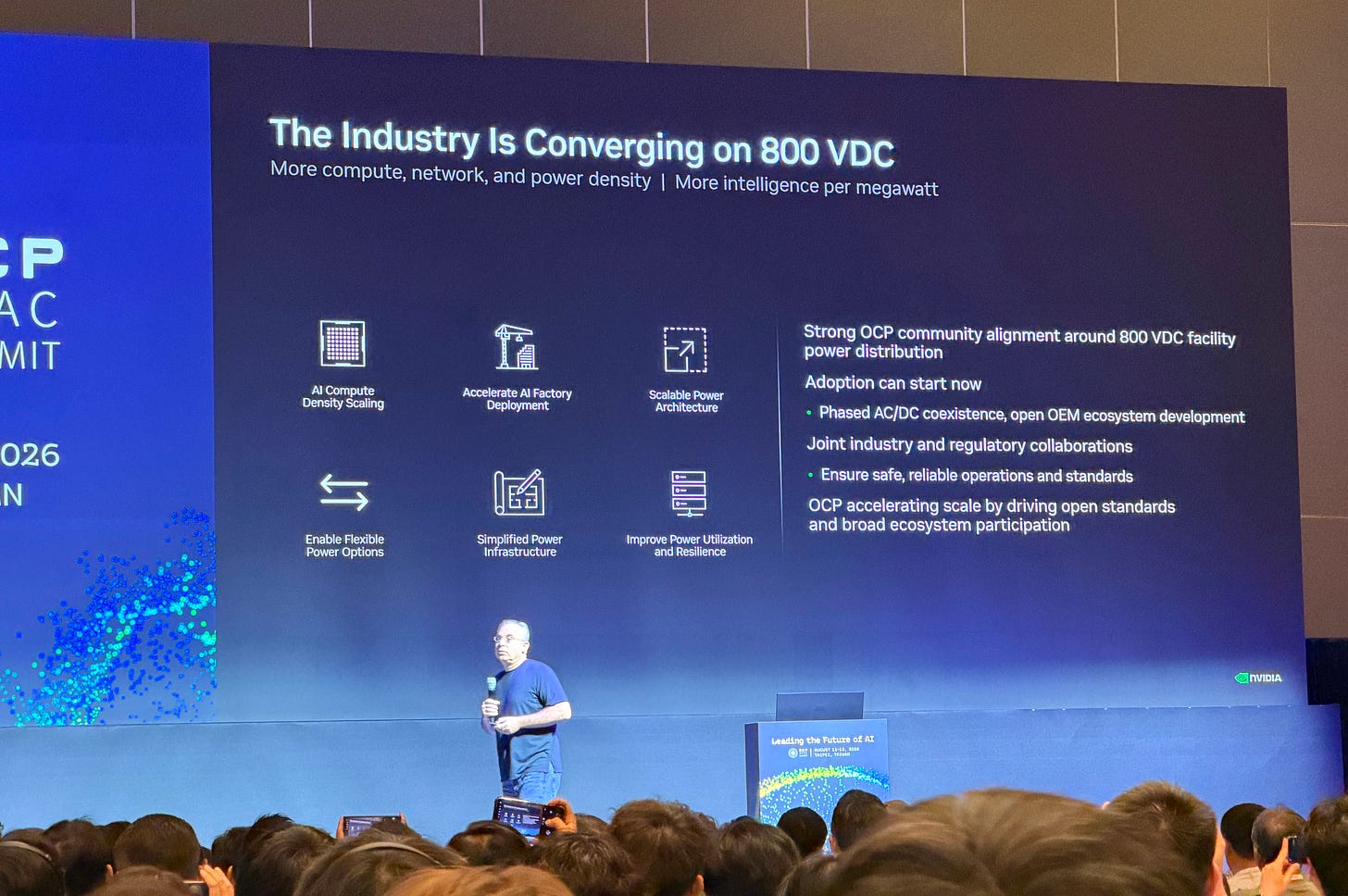
This is why 800V-class HVDC architectures are becoming strategically important.
這正是 800V 等級高壓直流(HVDC)架構變得具有戰略重要性的原因。
But there is a misunderstanding around 800V.
然而,業界對 800V 仍存在誤解。
800V does not eliminate 48V.
800V 並不會取代 48V。
The more likely architecture is hierarchical.
更可能的架構是分層式的。
Higher-voltage DC moves power efficiently across the data center and toward the rack. Conversion then happens closer to the server board or accelerator.
高壓直流電能高效地將電力輸送至資料中心並靠近機架,轉換過程則在更接近伺服器主機板或加速器的位置進行。
The emerging stack could increasingly resemble:
新興的電源架構可能日益趨向於:
Grid → MVAC → SST / Rectifier → 800V DC → 48V → Point of Load
電網 → 中壓交流電(MVAC)→ 固態變壓器(SST)/ 整流器 → 800V 直流電 → 48V → 負載點
This creates several new semiconductor and equipment opportunities.
這創造了多項新的半導體與設備商機。
But one of the least appreciated is test.
但其中最被低估的領域之一是測試。

6月3日6 月 3 日
Chroma: The Picks-and-Shovels Play Behind 800V
Chroma:800V 背後的「鏟子與鶴嘴鋤」策略
Chroma is one of the Taiwanese companies worth paying close attention to.
Chroma 是其中一家值得密切關注的台灣公司。
Most discussion around AI power focuses on Delta, Vertiv, Eaton, Schneider, or power semiconductor suppliers.
關於 AI 電力的討論,大多聚焦於 Delta、Vertiv、Eaton、Schneider 或功率半導體供應商。
But every new power architecture must be validated before deployment.
但每一項新的電源架構在部署前都必須經過驗證。
And validating an 800V architecture is materially different from validating a conventional server PSU.
而驗證 800V 架構與驗證傳統伺服器電源供應器(PSU)有著本質上的不同。
The system needs to test:
系統需要測試:
Input-voltage behavior輸入電壓行為
Output regulation輸出穩壓
Conversion efficiency轉換效率
Ripple and noise漣波與雜訊
Load transients負載瞬變
GPU power excursionsGPU 電源波動
Overvoltage and undervoltage protection
過壓與欠壓保護
Overcurrent protection過電流保護
Short-circuit behavior短路行為
Fault recovery故障復原
Hot-swap operation熱插拔作業
Communication通訊
Long-duration reliability
長時間可靠性
The test equipment also needs to handle extremely high power.
測試設備也需處理極高的功率。
This is the hidden problem.
這是隱藏的問題。
Testing a 100kW power system means the test platform itself must source or sink 100kW.
測試 100kW 電源系統意味著測試平台本身必須能夠提供或吸收 100kW 的功率。
At 1MW, the problem becomes infrastructure-scale.
在 1MW 的規模下,問題已升級至基礎設施層級。
This makes regenerative testing increasingly important because simply converting all test energy into heat becomes economically and operationally inefficient.
這使得回生式測試日益重要,因為單純將所有測試能量轉換為熱能,在經濟與營運上已變得不具效率。
The transition toward 800V therefore creates a second-order beneficiary:
因此,朝向 800V 的轉型創造了第二層受益者:
High-power programmable test equipment.
高功率可程式化測試設備。
Chroma sits directly in this layer.
Chroma 正位於此一層級。
The company is not selling GPUs.
該公司並非在銷售 GPU。
It is selling infrastructure required before next-generation power systems can safely enter mass production.
它銷售的是下一代電源系統安全進入量產前所需的基礎設施。
That is exactly the type of second-order AI supply-chain exposure investors should be looking for.
這正是投資者應尋找的第二層 AI 供應鏈投資機會。

6月27日6 月 27 日
Power Delivery Is Also Moving Toward the Silicon
電力傳輸也正朝向矽晶推進
Power is simultaneously moving in the opposite direction.
與此同時,電力傳輸正朝相反方向發展。
While data centers are increasing voltage at the facility level, chip designers are trying to deliver power closer to the compute die.
雖然資料中心正在設施層級提高電壓,但晶片設計師正致力於將電力傳輸更靠近運算裸晶。
Companies such as Empower Semiconductor are developing vertical and localized power-delivery architectures targeting high-current AI processors.
Empower Semiconductor 等公司正開發針對高電流 AI 處理器的垂直化與在地化電源傳輸架構。
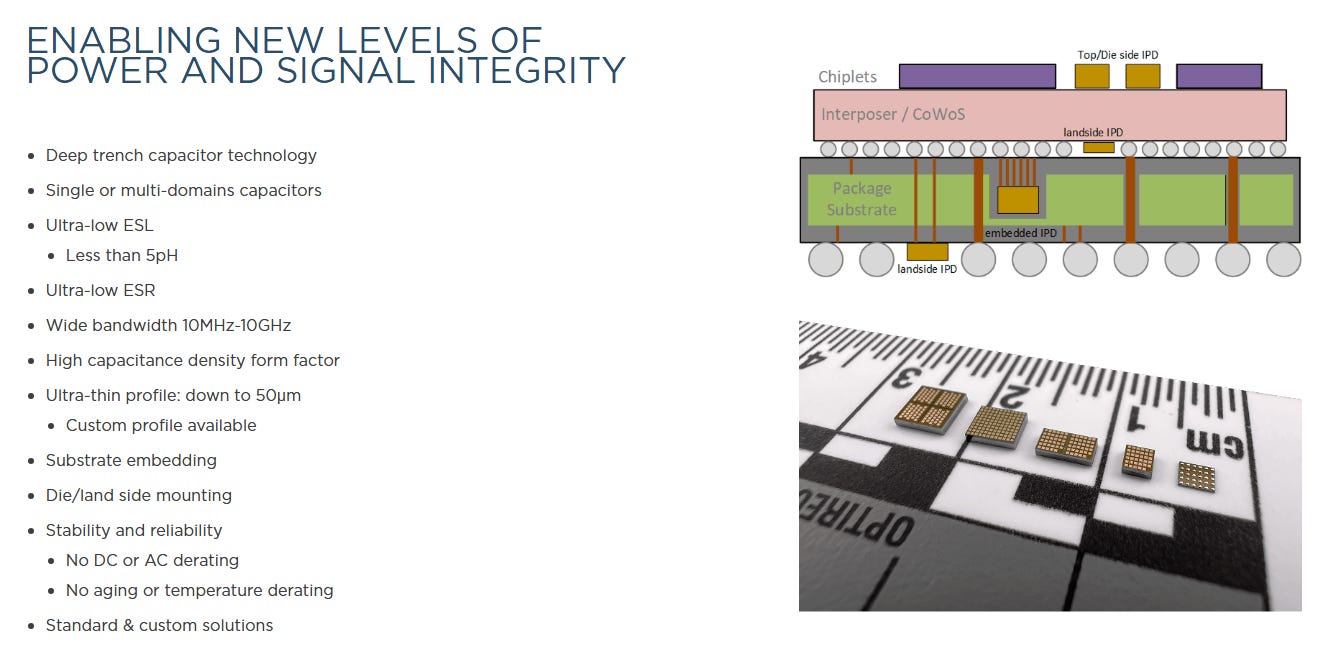
EMPOWER: POWER INTEGRITY SILICON CAPACITORS
EMPOWER:電源完整性矽電容器
This illustrates the broader problem.
這說明了更廣泛的問題。
AI power delivery increasingly spans the entire stack:
AI 電力輸送日益涵蓋整個堆疊:
Grid → Data Hall → Rack → Board → Package → Silicon
電網 → 資料大廳 → 機櫃 → 主機板 → 封裝 → 矽晶

Every layer creates a different engineering constraint.
每一層都帶來不同的工程限制。
The data-center problem is voltage and distribution efficiency.
資料中心的問題在於電壓與配電效率。
The board problem is current density.
主機板的問題在於電流密度。
The package problem is parasitics.
封裝的問題在於寄生參數。
The silicon problem is voltage droop and transient response.
矽晶層面的問題在於電壓降與瞬態響應。
As accelerator TDP continues rising, power delivery stops being a supporting function and becomes part of compute architecture itself.
隨著加速器熱設計功耗(TDP)持續攀升,電力輸送已不再僅是輔助功能,而是成為運算架構本身的一部分。
Liquid Cooling Has Entered the Qualification Phase
液冷技術已進入驗證階段
Liquid cooling is another area where the discussion has changed significantly.
液冷是另一個討論焦點發生顯著變化的領域。
The industry is no longer debating whether high-end AI racks will use liquid cooling.
產業界不再爭辯高階 AI 機櫃是否將採用液冷技術。
That decision has effectively been made.
此決策實際上已經定案。
The relevant question is now:
現在相關的問題是:
Which components become standardized and qualified?
哪些元件會成為標準化並通過認證?
This is where the economics become interesting.
這正是經濟效益變得引人入勝之處。
A liquid-cooling loop contains components such as:
液冷迴路包含如下元件:
Cold plates冷板
Pumps泵
Quick disconnects快速接頭
Hoses軟管
Manifolds歧管
Heat exchangers熱交換器
CDUs冷卻液分配單元 (CDU)
Sensors感測器
Leak detection systems洩漏偵測系統
Many of these components are inexpensive relative to the GPU.
相較於 GPU,這些元件中許多成本相對低廉。
But their failure cost is enormous.
但其故障所造成的代價極為巨大。
A $50 connector can potentially interrupt a rack containing millions of dollars of compute.
一個 50 美元的連接器,可能會導致價值數百萬美元的運算機架中斷。
This changes customer behavior.
這改變了客戶的行為模式。
Hyperscalers are therefore unlikely to optimize solely around component price.
因此,超大型雲端服務供應商不太可能僅圍繞元件價格進行最佳化。
They optimize around:他們的最佳化重點在於:
Reliability + Qualification + Serviceability + Standardization
可靠性 + 認證 + 可維護性 + 標準化
That is why suppliers such as CPC, Danfoss, nVent, and KAORI deserve attention.
這正是 CPC、Danfoss、nVent 和 KAORI 等供應商值得關注的原因。

KAORI and the Heat-Exchange Layer
KAORI 與熱交換層
Taiwan’s KAORI represents another part of the cooling chain.
台灣的 KAORI 代表了散熱鏈中的另一個環節。
Cold plates receive most investor attention because they sit directly above the GPU.
由於冷板直接位於 GPU 上方,因此獲得了投資者最多的關注。
But heat still needs to leave the loop.
但熱量仍需從迴路中排出。
This brings brazed plate heat exchangers and CDU-level components into the AI infrastructure stack.
這使得釬焊板式熱交換器與 CDU 層級元件被納入 AI 基礎設施架構之中。
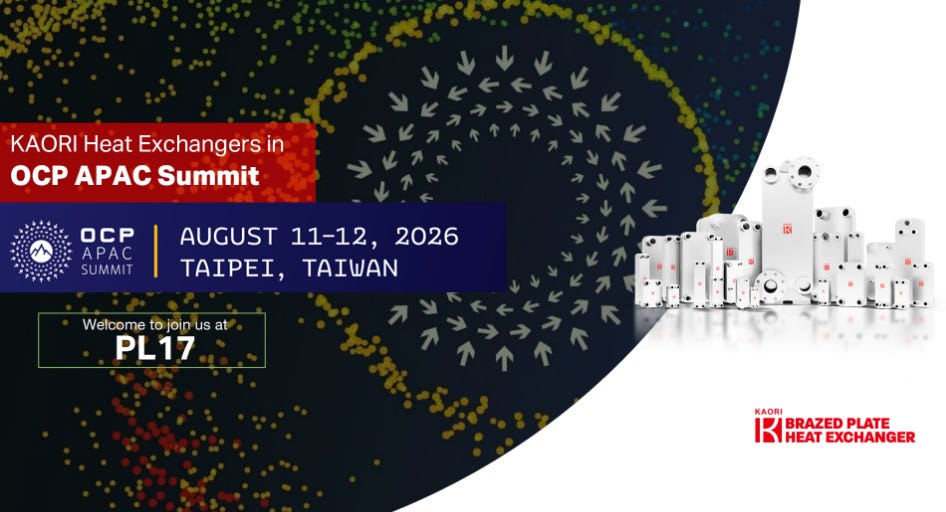
As rack power rises, heat-exchanger performance becomes increasingly important because the system must move enormous amounts of heat while minimizing pressure drop and maintaining reliability.
隨著機架功率提升,熱交換器的效能變得愈發重要,因為系統必須在最小化壓降並維持可靠性的同時,移走大量的熱能。
The liquid-cooling opportunity should therefore not be viewed as a single-product market.
因此,液冷商機不應被視為單一產品市場。
It is an entire thermal-management stack:
這是一個完整的熱管理堆疊:
GPU → Cold Plate → Manifold → CDU → Heat Exchanger → Facility Water
GPU → 冷板 → 歧管 → CDU → 熱交換器 → 廠務用水
Different suppliers capture value at different layers.
不同的供應商在各個層級中獲取價值。
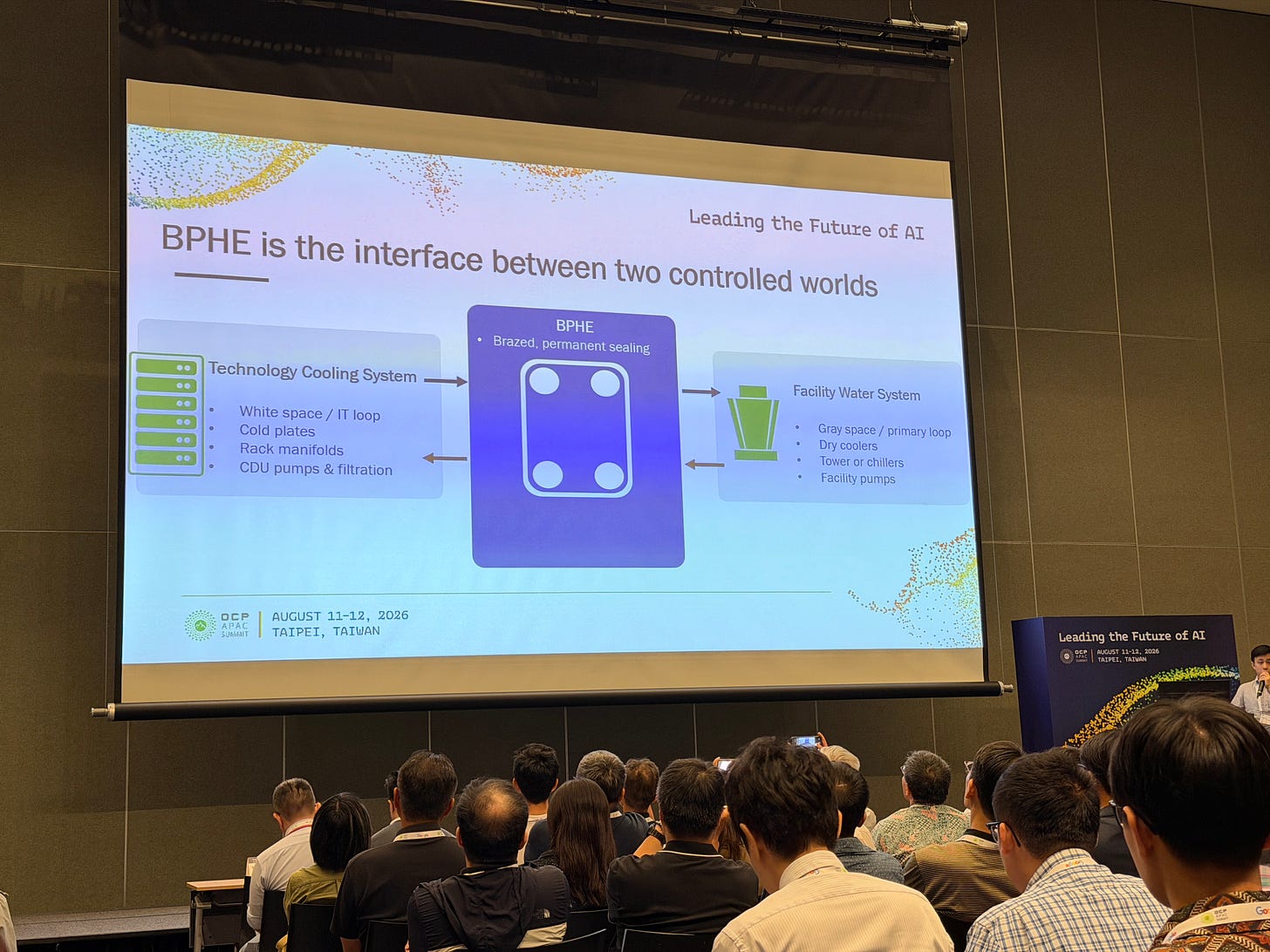
KAORI is a leading supplier of Brazed Plate Heat Exchangers (BPHEs), which are increasingly important in high-density AI data center cooling. BPHEs use stacked stainless-steel plates brazed together to provide high heat-transfer efficiency within a compact footprint. In liquid-cooled AI infrastructure, KAORI’s BPHEs can be deployed in CDUs and facility cooling loops, transferring heat between server-side coolant and facility water. As AI rack power density rises toward hundreds of kilowatts, efficient heat exchange becomes critical. KAORI therefore represents an important thermal-management supplier benefiting from the shift toward direct liquid cooling and higher-density AI infrastructure.
KAORI 是釬焊板式熱交換器(BPHE)的領先供應商,此類產品在高密度 AI 資料中心散熱領域日益重要。BPHE 透過將堆疊的不鏽鋼板釬焊結合,能在緊湊的空間內提供高效的熱傳導性能。在液冷式 AI 基礎設施中,KAORI 的 BPHE 可部署於冷卻分配單元(CDU)及廠區冷卻迴路中,負責在伺服器側冷卻劑與廠區用水之間進行熱交換。隨著 AI 機櫃功率密度攀升至數百千瓦,高效熱交換已成為關鍵所在。因此,KAORI 作為重要的熱管理供應商,正受益於朝向直接液冷及更高密度 AI 基礎設施的產業轉型趨勢。
AI Networking Is Running Out of Physical Space
AI 網路正面臨實體空間耗盡的挑戰
The optical-networking conversation has historically been dominated by bandwidth.
光網路的討論歷來以頻寬為主導。
400G.400G。
800G.800G。
1.6T.1.6T。
Next comes 3.2T.接下來是 3.2T。
But bandwidth is no longer the only problem.
但頻寬已不再是唯一的問題。
The physical infrastructure required to carry that bandwidth is becoming increasingly difficult to manage.
承載該頻寬所需的實體基礎設施正變得日益難以管理。
This is why Corning’s multicore fiber is interesting.
這正是 Corning 的多芯光纖備受關注的原因。
The fundamental problem is fiber density.
根本問題在於光纖密度。
As GPU clusters grow from thousands to tens of thousands of accelerators, the number of optical connections increases rapidly.
隨著 GPU 叢集從數千個加速器擴展到數萬個,光學連接的數量迅速增加。
That creates secondary constraints:
這產生了次要限制:
Cable tray capacity電纜托盤容量
Rack congestion機架擁塞
Connector count連接器數量
Installation labor安裝人力
Cable weight纜線重量
Maintenance complexity維護複雜度
Bend radius彎曲半徑
Airflow obstruction氣流阻礙
Multicore fiber attacks the problem by putting multiple optical cores into one physical fiber footprint.
多芯光纖透過將多個光學核心整合至單一實體光纖佔地面積中,來解決此問題。
This changes the optimization target.
這改變了最佳化的目標。
The industry is moving from:
產業正從以下方向轉型:
Bandwidth per transceiver
每個收發器的頻寬
toward:朝向:
Bandwidth per unit of physical infrastructure.
每單位實體基礎設施的頻寬。
That distinction matters.
這一區別至關重要。
As clusters scale, the industry will increasingly optimize not just bits per second, but bits per cable, bits per connector, and bits per rack volume.
隨著叢集規模擴大,產業將不僅優化每秒位元數,更將著重於每條纜線、每個連接器及每個機櫃體積所能傳輸的位元數。

2月20日2 月 20 日
CPO Is an Ecosystem Problem
CPO 是一個生態系統問題
This is also why CPO needs to be viewed differently.
這也是為什麼必須以不同的視角來看待 CPO。
Most investors think about co-packaged optics primarily as a Broadcom, NVIDIA, or switch-ASIC story.
大多數投資人主要將共封裝光學(CPO)視為 Broadcom、NVIDIA 或交換器 ASIC 的議題。
That is incomplete.這種看法並不完整。
A production CPO architecture requires an ecosystem around:
生產級 CPO 架構需要圍繞以下要素構建生態系統:
PICs
EICs
lasers雷射器
fiber arrays光纖陣列
optical connectors光學連接器
packaging封裝
thermal management熱管理
alignment對位
testing測試
repairability可維修性
manufacturing製造
This is where companies such as Lightmatter become interesting.
這正是 Lightmatter 等公司備受矚目的原因。
The strategic question is not whether silicon photonics works.
策略性的問題不在於矽光子技術是否可行。
We already know it works.
我們已經知道它行之有效。
The question is whether the industry can build a manufacturable and interoperable photonics ecosystem around it.
關鍵在於產業能否圍繞此技術建立具備可製造性與互通性的光子學生態系。
CPO adoption will therefore be determined by much more than optical performance.
因此,CPO 的採用與否將取決於遠比光學性能更廣泛的因素。
The winning architecture needs to solve:
勝出的架構必須解決以下問題:
Yield + Cost + Packaging + Test + Reliability + Field Service
良率 + 成本 + 封裝 + 測試 + 可靠度 + 現場服務
The optical engine may be technologically impressive.
光學引擎在技術上或許令人印象深刻。
If hyperscalers cannot repair it efficiently, qualify multiple suppliers, or manufacture it at scale, deployment will remain constrained.
若超大型資料中心業者無法有效維修、認證多家供應商,或實現大規模製造,其部署仍將受到限制。
CPO is fundamentally a supply-chain problem.
CPO 本質上是一項供應鏈問題。


7月27日7 月 27 日
BMC Is Becoming the Operating System of the Rack
BMC 正成為機架的作業系統
Another underappreciated part of the AI infrastructure stack is system management.
AI 基礎設施堆疊中另一個被低估的環節是系統管理。
This makes ASPEED and Nuvoton particularly interesting.
這使得 ASPEED 與 Nuvoton 尤為引人注目。
Historically, a BMC was essentially a management processor for a server.
歷史上,BMC 本質上是伺服器的管理處理器。
It handled remote access, telemetry, firmware update, fan control, and basic system monitoring.
它負責處理遠端存取、遙測、韌體更新、風扇控制以及基本的系統監控。
AI racks are different.AI 機櫃則有所不同。
The control architecture increasingly needs to monitor and coordinate:
控制架構日益需要監控並協調:
GPU temperaturesGPU 溫度
CPU temperaturesCPU 溫度
power shelves電源機架
BBUs備援電池單元(BBU)
pumps泵浦
CDUs冷卻液分配單元 (CDU)
fans風扇
networking網路
firmware韌體
security安全性
fault states故障狀態
rack telemetry機架遙測
As the number of components rises, management complexity grows significantly faster than rack count.
隨著元件數量增加,管理複雜度的成長速度遠高於機架數量的增長。
This turns the BMC from a peripheral device into part of the rack control plane.
這使得基板管理控制器(BMC)從周邊設備轉變為機架控制平面的一部分。
ASPEED’s newer platforms increasingly support higher-speed interfaces and stronger security functions aimed at next-generation server architectures.
ASPEED 的新世代平台日益支援更高速的介面與更強大的安全功能,以因應次世代伺服器架構的需求。

Nuvoton is expanding in a similar direction through BMCs, satellite management controllers, security functions, and battery-management solutions.
新唐科技正透過 BMC、衛星管理控制器、安全功能與電池管理解決方案,朝類似方向擴展佈局。

These are relatively low-cost ICs compared with GPUs.
與 GPU 相比,這些是相對低成本的 IC。
But they sit in an increasingly strategic position.
但它們正處於日益重要的戰略地位。
The AI boom does not only increase compute silicon content.
人工智慧熱潮不僅提升了運算晶片的含量,
It also increases control silicon content.
也提高了控制晶片的含量。
Why ASE Matters at OCP
為何 ASE 在 OCP 至關重要
Advanced packaging was once a semiconductor manufacturing problem.
先進封裝曾經是半導體製造的問題。
It is increasingly becoming a system-architecture problem.
這正日益成為一個系統架構問題。
That is why ASE belongs at OCP.
這就是為什麼 ASE 必須參與 OCP。
Modern AI accelerators are no longer single chips.
現代 AI 加速器已不再是單一晶片。
They are heterogeneous systems containing combinations of:
它們是包含以下組合的異質系統:
GPU diesGPU 晶粒
HBM
I/O diesI/O 晶粒
chiplets小晶片
interposers中介層
bridges橋接器
power structures電源架構
potentially photonic components
潛在的光子元件
The package is effectively becoming the motherboard.
封裝實際上正成為主機板。
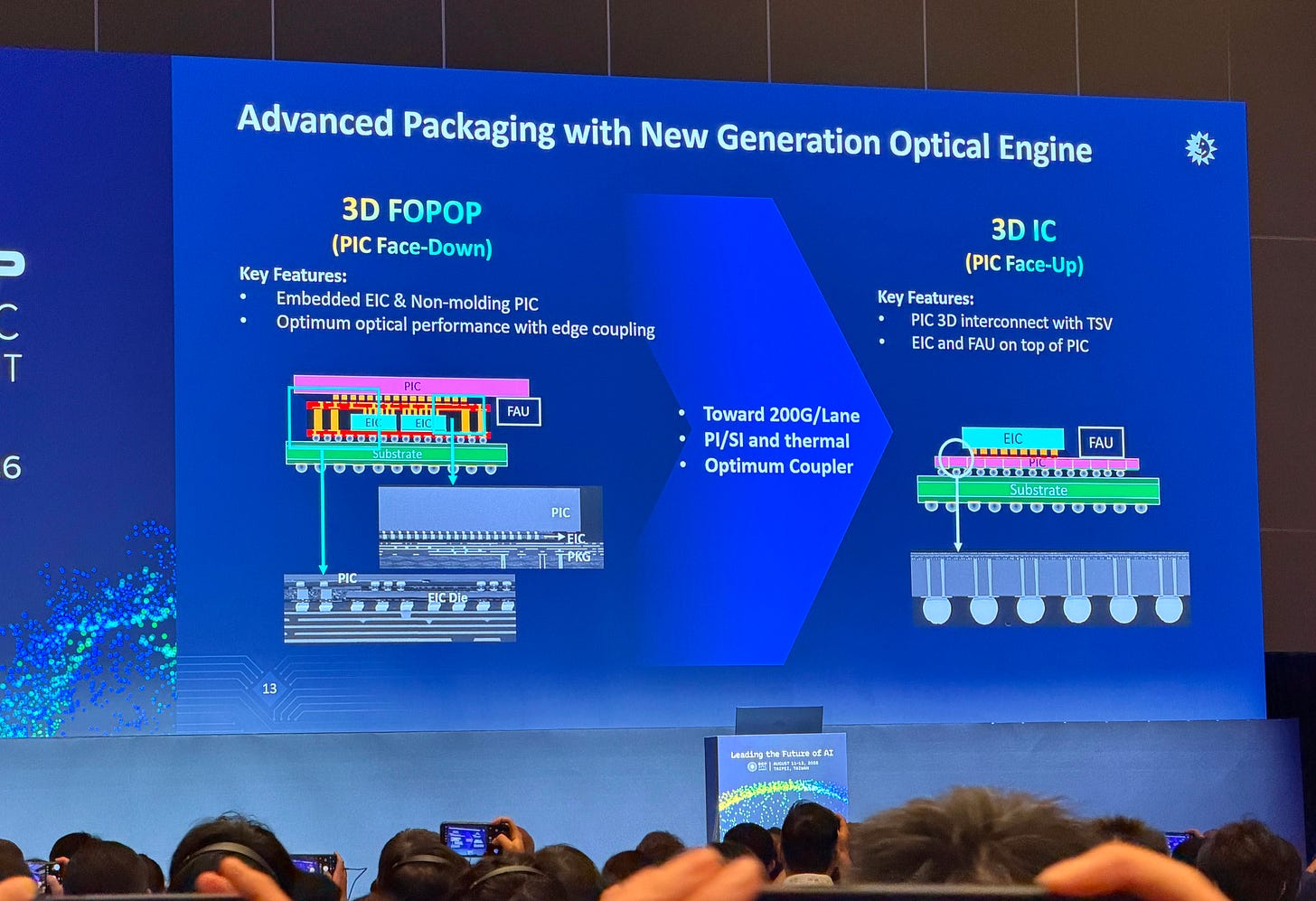
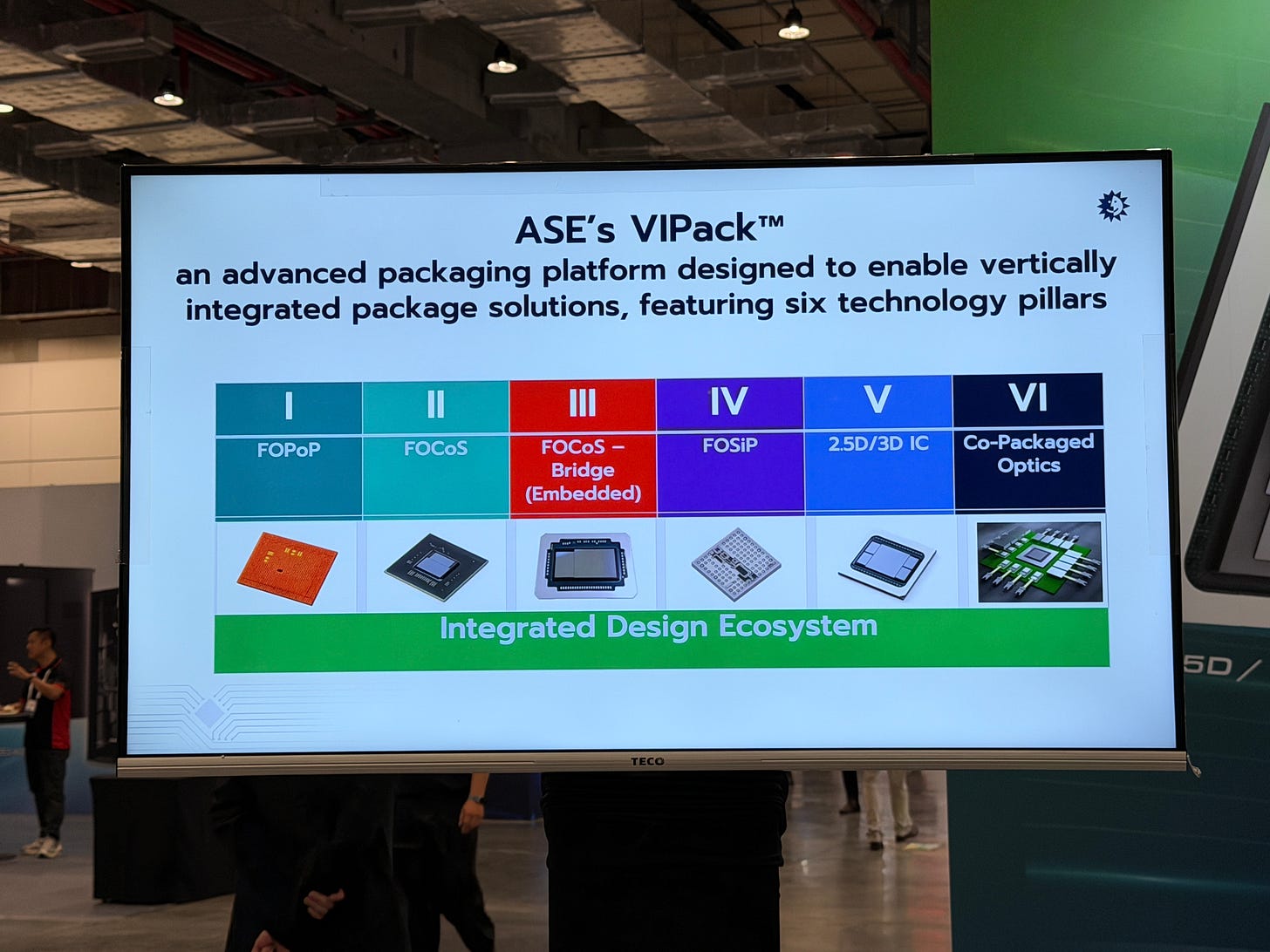
This is why 2.5D integration, hybrid bonding, fan-out, silicon bridges, and panel-level packaging are increasingly relevant to data-center architecture.
這正是 2.5D 整合、混合鍵結、扇出型封裝、矽橋接器以及面板級封裝技術,對於資料中心架構日益重要的原因。
ASE’s move into larger-format panel-level packaging is therefore worth watching.
因此,日月光(ASE)進軍更大尺寸的面板級封裝值得關注。
AI packages continue getting larger.
AI 封裝的尺寸持續增大。
Large packages create an obvious geometric inefficiency when manufactured on circular wafers.
大型封裝在圓形晶圓上製造時,會產生明顯的幾何效率低落問題。
Rectangular panels potentially improve substrate utilization and throughput.
矩形面板有望提升基板利用率與產出量。
This does not mean panel-level packaging replaces CoWoS.
這並不表示面板級封裝將取代 CoWoS。
The more likely outcome is architectural segmentation.
更可能的結果是架構上的區隔化。
Different accelerators will use different combinations of:
不同的加速器將採用以下不同的組合:
Silicon Interposer矽中介層
RDL InterposerRDL 中介層
Silicon Bridge矽橋
Fan-Out扇出型
Panel-Level Packaging面板級封裝
Hybrid Bonding混合鍵合
There will not be one universal solution.
不會存在一種通用的解決方案。
There will be multiple architectures optimized around cost, bandwidth, package size, thermals, and yield.
將出現多種架構,針對成本、頻寬、封裝尺寸、散熱與良率進行最佳化。
Advanced Packaging Creates a Much Larger Supply Chain Than OSAT
先進封裝所創造的供應鏈規模遠大於傳統 OSAT
The investment opportunity extends well beyond ASE.
投資機會遠不止於日月光(ASE)。
Large AI packages create demand across:
大型 AI 封裝帶動了以下領域的需求:
RDL equipmentRDL 設備
Lithography微影製程
Temporary bonding暫時接合
Debonding去接合
Carrier materials載體材料
Mold compounds封裝膠
Underfill底部填充
Substrates基板
Inspection檢測
Metrology量測
Test測試
Thermal interface materials
熱介面材料
This is important because advanced packaging capacity expansion creates multiplier effects.
這一點至關重要,因為先進封裝產能的擴張會產生乘數效應。
A new packaging line does not only generate revenue for the OSAT.
一條新的封裝生產線不僅能為 OSAT 帶來營收。
It pulls equipment, specialty materials, testing, and substrate capacity along with it.
它同時帶動了設備、特殊材料、測試以及基板產能的需求。
The key investment question therefore becomes:
因此,關鍵的投資問題變成:
Which previously small semiconductor suppliers are seeing AI change their addressable market?
哪些原本規模較小的半導體供應商正見證人工智慧改變其可觸及市場?
Those are often more interesting than the obvious headline beneficiaries.
這些公司往往比顯而易見的頭條受益者更有趣。

7月13日7 月 13 日
The Most Important Framework: Follow Qualification, Not Announcements
最重要的架構:遵循認證,而非公告
One of the biggest mistakes in analyzing AI infrastructure is treating every new technology announcement as commercially meaningful.
分析 AI 基礎設施時,最大的錯誤之一便是將每項新技術的發布都視為具備商業意義。
It is not.事實並非如此。
The relevant progression is:
正確的演進路徑為:
Concept → Prototype → Sample → Qualification → Design-In → Mass Production
概念 → 原型 → 樣品 → 認證 → 設計導入 → 量產
Revenue generally appears toward the right side of that sequence.
營收通常出現在該序列的右側。
This framework is particularly useful for 800V, liquid cooling, CPO, and advanced packaging.
此架構對於 800V、液冷散熱、CPO 及先進封裝尤為實用。
For 800V:針對 800V:
Architecture proposals are interesting.
架構提案頗具吸引力。
Test-equipment orders are more interesting.
測試設備訂單更令人關注。
Customer qualification is much more interesting.
客戶認證過程更為關鍵。
Production-line investment is where the story becomes financially relevant.
生產線投資才是故事具備財務相關性的所在。
The same applies to cooling.
散熱亦是如此。
Do not ask:不要問:
Who can manufacture a cold plate?
誰能製造冷板?
Ask:要問:
Who has passed hyperscaler qualification?
誰已通過超大型資料中心的認證?
Who has secured a platform design-in?
誰已獲得平台設計導入(design-in)?
Who is expanding production capacity?
誰正在擴大產能?
Who controls the interface standard?
誰掌握介面標準?
That is where pricing power and durable revenue begin to appear.
這正是定價權與持續性營收開始顯現之處。
7月9日7 月 9 日
AI’s Bottleneck Is Moving Through the Stack
AI 的瓶頸正沿著技術堆疊向上移動
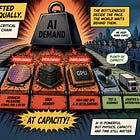
The AI infrastructure trade has progressed in stages.
AI 基礎設施產業的發展歷經了不同階段。
Phase 1 :GPU availability.
第一階段:GPU 供貨能力。
Phase 2: HBM availability.
第二階段:HBM 供貨能力。
Phase 3 :Advanced packaging capacity.
第三階段:先進封裝產能。
Phase 4 :Power and cooling.
第四階段:電力與散熱。
Phase 5: Networking and optical connectivity.
第五階段:網路與光學連接。
Phase 6 :Physical data-center capacity.
第六階段:實體資料中心容量。
These phases overlap.這些階段彼此重疊。
None of the earlier bottlenecks disappears.
先前的瓶頸並未消失。
But incremental system constraints continue moving outward.
但系統的限制持續向外擴展。
This is exactly what OCP APAC 2026 demonstrated.
這正是 OCP APAC 2026 所展示的。
The next generation of AI infrastructure is not primarily constrained by transistor performance.
下一代 AI 基礎設施的主要瓶頸已不再是電晶體效能。
It is increasingly constrained by the ability to physically deploy compute.
而是日益受限於實體部署運算資源的能力。
That means supplying electricity.
這意味著必須提供電力。
Moving heat.並有效散熱。
Routing optical signals.路由光訊號。
Managing racks.管理機架。
Packaging larger processors.
封裝更大的處理器。
Testing everything before installation.
在安裝前測試所有內容。
The AI Trade Is Becoming an Infrastructure Trade
AI 交易正轉變為基礎設施交易
The first generation of AI winners was obvious:
第一代 AI 贏家顯而易見:
NVIDIA.NVIDIA。
HBM suppliers.HBM 供應商。
TSMC.台積電。
Advanced packaging.先進封裝

7月30日7 月 30 日
The second generation will be harder to identify because the value is distributed across a much larger ecosystem.
第二代將更難以辨識,因為其價值分散於更龐大的生態系之中。
The supply chain increasingly looks like:
供應鏈的樣貌日益呈現為:
Compute運算
Memory記憶體
Advanced Packaging先進封裝
Power電源
Cooling散熱
Networking網路
Optics光學
Testing測試
Data-Center Infrastructure
資料中心基礎設施
This creates opportunities for companies that historically would not have been considered AI companies at all.
這為歷來從未被視為人工智慧公司的企業創造了新的機會。
Chroma is a test-equipment company.
Chroma 是一家測試設備公司。
Samtec makes connectors.Samtec 生產連接器。
KAORI makes heat exchangers.
KAORI 製造熱交換器。
Corning makes fiber.Corning 生產光纖。
ASPEED makes BMCs.ASPEED 製造 BMC。
None of them builds GPUs.
這些公司均未生產 GPU。
But each can become increasingly important as GPU deployment scales.
但隨著 GPU 部署規模擴大,它們各自的重要性將日益提升。
That is the central investment takeaway from OCP APAC 2026.
這正是 OCP APAC 2026 所傳達的核心投資啟示。
The most important question is no longer:
最重要的問題已不再是:
Who can build the fastest AI accelerator?
誰能打造最快的 AI 加速器?
It is:即:
Who provides the infrastructure required to deploy the next million accelerators?
誰能提供部署下一百萬顆加速器所需的基礎設施?
That shift dramatically expands the investable AI supply chain.
此轉變大幅擴展了可投資的 AI 供應鏈。
And many of the most interesting beneficiaries may be companies that, until recently, investors did not think of as AI companies at all.
而許多最具潛力的受益者,可能是直到最近投資者仍未將其視為人工智慧公司的企業。
8月9日8 月 9 日


Share分享
Previous上一頁Next下一則