EMC’s Rise to No. 1: AI Servers Redefine the Global CCL Supply Chain
EMC’s Rise to No. 1: AI Servers Redefine the Global CCL Supply Chain
- Source: SemiVision
- Author: SEMIVISION
- Published: 2026-08-03T11:45:25+08:00
- URL: https://tspasemiconductor.substack.com/p/emcs-rise-to-no-1-ai-servers-redefine
中文翻譯與英文原文(雙語)
EMC 躍居全球第一:AI 伺服器重塑 CCL 供應鏈格局 --- EMC’s Rise to No. 1: AI Servers Redefine the Global CCL Supply Chain


EMC’s Rise to No. 1: AI Servers Redefine the Global CCL Supply Chain
EMC 躍居全球第一:AI 伺服器重塑銅箔基板(CCL)供應鏈格局
Original Article By SemiVision Research [Reading time: 9 mins]
原文作者:SemiVision Research [閱讀時間:9 分鐘]

Aug 03, 2026
∙ Paid∙ 付費
Share分享
EMC’s Rise to No. 1: AI Servers Redefine the Global CCL Supply Chain
EMC 躍居全球第一:AI 伺服器重塑銅箔基板(CCL)供應鏈
When the market discusses AI servers, attention usually centers on GPUs, HBM, and advanced packaging. However, as computing performance increases, switches migrate from 400G to 800G and eventually 1.6T, and system architectures become more complex, performance bottlenecks are spreading across a much broader supply chain.
當市場討論 AI 伺服器時,焦點通常集中在 GPU、HBM 與先進封裝。然而,隨著運算效能提升、交換器從 400G 升級至 800G 並最終邁向 1.6T,加上系統架構日益複雜,效能瓶頸正擴散至更廣泛的供應鏈環節。

Photo by SemiVision / TPCA 2025
圖片來源:SemiVision / TPCA 2025
Copper-clad laminate, or CCL, is one of the most easily overlooked—but increasingly critical—components.
銅箔基板(CCL)是最容易被忽視、卻日益關鍵的元件之一。
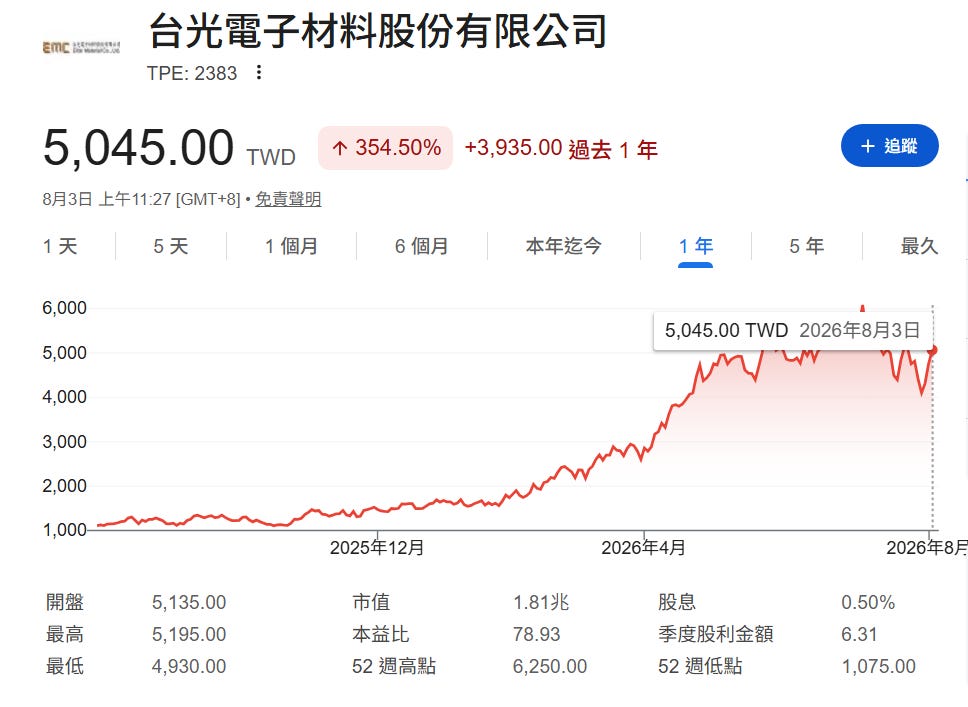
According to Prismark, excluding mass laminate but including prepreg, the global CCL market reached US$18.68 billion in 2025, up 24.4% from US$15.01 billion in 2024. Elite Material Co., Ltd. (EMC) captured a 16.2% global market share, surpassing Shengyi Technology and Kingboard Laminates to become the world’s largest CCL supplier.
根據 Prismark 數據,若排除厚銅基板但包含預浸材料,2025 年全球銅箔基板(CCL)市場規模達 186.8 億美元,較 2024 年的 150.1 億美元成長 24.4%。台光電子材料股份有限公司(EMC)以 16.2% 的全球市佔率,超越生益科技與建滔積層板,躍升為全球最大 CCL 供應商。
This is more than a change in supplier rankings. It reflects how AI infrastructure is redistributing value across the global materials supply chain.
這不僅是供應商排名的變動,更反映出 AI 基礎設施正重新分配全球材料供應鏈的價值。
From a Cost Component to a Critical Signal-Integrity Material
從成本組成要素到關鍵訊號完整性材料
For traditional servers and networking equipment, CCL requirements were primarily centered on cost, manufacturability, and supply stability. In the AI era, however, internal data-transfer volumes, signal frequencies, and PCB layer counts are all increasing.
對於傳統伺服器與網路設備而言,CCL 的需求主要聚焦於成本、可製造性及供應穩定性。然而在 AI 時代,內部資料傳輸量、訊號頻率以及 PCB 層數皆持續攀升。
CCL is no longer merely a base material used to support electronic circuits. It has become a critical medium that directly affects system performance.
銅箔基板(CCL)已不再只是支撐電子電路的基礎材料,而是直接影響系統效能的關鍵介質。
When electrical signals travel through high-speed and high-frequency systems, material properties such as dielectric constant, dissipation factor, moisture absorption, copper-foil roughness, and thermal stability can affect signal loss, crosstalk, reliability, and transmission distance.
當電信號在高速與高頻系統中傳輸時,材料的介電常數、耗散因數、吸濕性、銅箔粗糙度及熱穩定性等特性,都會影響訊號損耗、串擾、可靠度與傳輸距離。
Mid- and low-end materials used in conventional servers may no longer provide sufficient signal integrity for AI accelerators, high-speed switches, and advanced network interface cards. This is pushing PCB manufacturers and system vendors to adopt materials with lower transmission loss, higher heat resistance, and better dimensional stability.
傳統伺服器所使用的中低階材料,可能已無法為 AI 加速器、高速交換器與先進網路介面卡提供足夠的訊號完整性。這促使 PCB 製造商與系統供應商轉向採用具有更低傳輸損耗、更高耐熱性及更佳尺寸穩定性的材料。
In other words, AI servers are not simply increasing the amount of CCL used. They are simultaneously raising material specifications, average selling prices, and qualification barriers.
換言之,AI 伺服器不僅增加了 CCL 的使用量,同時也提升了材料規格、平均售價以及認證門檻。
This helps explain why the global CCL market expanded by more than 20% in 2025. The growth was driven not only by higher shipment volumes but also by a rapid shift toward a more advanced and higher-value product mix.
這有助於解釋為何全球銅箔基板(CCL)市場在 2025 年成長超過 20%。此波成長不僅受惠於出貨量增加,更源自產品組合快速朝向更高階、更高價值的方向轉型。

5月4日5 月 4 日
Why Has EMC Overtaken Chinese and Japanese Suppliers?
為何 EMC 能超越中國與日本供應商?
The ranking of major global CCL suppliers changed significantly in 2025:
2025 年全球主要銅箔基板(CCL)供應商排名發生顯著變化:

Below we will share:以下我們將分享:
The Beneficiaries Extend Beyond EMC
受惠者不僅限於台光電
Glass Fiber Is Another Critical Area to Watch
玻纖布是另一項值得關注的關鍵領域
Three Supply-Chain Variables to Watch
三大供應鏈變數值得關注
The most important change was EMC’s three-percentage-point increase in market share within a single year. By contrast, Shengyi Technology, Kingboard Laminates, Nan Ya Plastics, ITEQ, and Panasonic all recorded varying degrees of market-share decline.
最關鍵的變化在於,EMC 在一年內市占率提升了三個百分點。相較之下,生益科技、建滔積層板、南亞塑膠、聯茂電子與松下電器則呈現不同程度的市占率下滑。
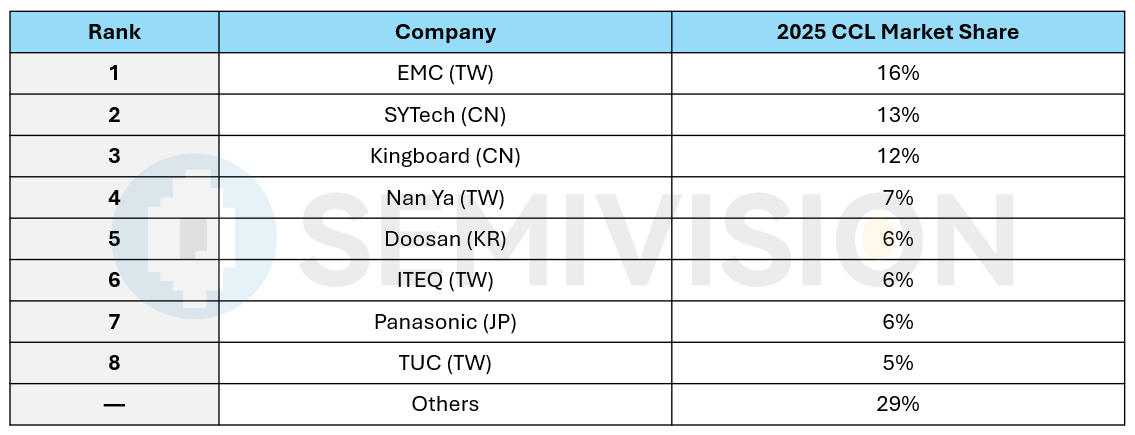
This indicates that EMC grew substantially faster than the overall market.
這顯示 EMC 的成長速度遠高於整體市場。
EMC’s advantage is not based solely on manufacturing capacity. The company entered the material qualification systems of high-end server and networking customers relatively early.
EMC 的優勢並非僅建立在產能之上。該公司較早便進入高階伺服器與網路客戶的材料認證體系。
CCL may appear to be a standardized material, but in the high-end market, each new material generation must undergo lengthy validation involving PCB manufacturing processes, layer structures, copper-foil specifications, and end-system performance.
銅箔基板(CCL)看似標準化材料,但在高階市場中,每一代新材料都必須經過漫長的驗證流程,涵蓋 PCB 製程、層疊結構、銅箔規格以及終端系統效能。
Any change in material formulation, thickness, or processing conditions can affect PCB yield and high-speed signal performance. Cloud service providers, switch vendors, server ODMs, and PCB manufacturers are therefore reluctant to replace qualified materials without extensive testing.
任何材料配方、厚度或加工條件的變動,都可能影響 PCB 良率與高速訊號傳輸表現。因此,雲端服務供應商、交換器廠商、伺服器 ODM 業者及 PCB 製造商,若未經廣泛測試,通常不願替換已通過認證的材料。
這形成了典型的「先認證、後放量」供應鏈結構。一旦 EMC 通過 AI 伺服器、高速交換器及資料中心平台的認證,其出貨量便能隨著客戶需求增長與平台升級而同步擴張。

2025年7月6日2025 年 7 月 6 日
Taiwan Controls the High-Value Segment, Not Just Market Share
台灣掌握高價值區段,而不僅是市場佔有率
Combining EMC, Nan Ya Plastics, ITEQ, and TUC, the four Taiwanese suppliers accounted for 34.4% of the global CCL market in 2025—roughly one-third of worldwide demand.
結合 EMC、南亞塑膠、聯茂電子與台光電,這四家台灣供應商在 2025 年佔全球 CCL 市場的 34.4%,約為全球需求的三分之一。
However, this figure does not fully capture the importance of Taiwan’s supply chain.
然而,此數據並未完全反映台灣供應鏈的重要性。
Chinese suppliers have strong scale and cost advantages in consumer electronics, home appliances, industrial control, and mid- to low-end communications products. Taiwanese suppliers, by comparison, are more heavily exposed to technically demanding applications such as AI servers, high-speed networking, semiconductor testing, and high-performance computing.
中國供應商在消費性電子、家電、工業控制以及中低階通訊產品領域,具備顯著的規模與成本優勢;相較之下,台灣供應商則更集中於技術門檻較高的應用,如 AI 伺服器、高速網路、半導體測試及高效能運算。
Future evaluations of CCL suppliers therefore cannot rely solely on shipment area or overall market share. Investors and industry participants should also monitor:
因此,未來對銅箔基板(CCL)供應商的評估,不能僅依賴出貨面積或整體市場佔有率。投資人與產業參與者亦應密切關注:
The revenue contribution from high-end, low-loss materials
高階、低損耗材料的營收貢獻
Qualification progress for 800G and 1.6T switch platforms
800G 與 1.6T 交換器平台的認證進度
Penetration into AI-server motherboards, accelerator boards, and switch boards
在 AI 伺服器主機板、加速器卡及交換器板的滲透率
Average selling prices and margins for next-generation materials
下一代材料的平均售價與利潤率
Access to high-end copper foil, glass cloth, and specialty resins
取得高端銅箔、玻璃布及特殊樹脂的管道
Customer concentration among GPU suppliers and cloud-service providers
客戶集中度集中於 GPU 供應商與雲端服務提供者
The industry is not competing for every CCL order. The real contest is for high-specification, high-value products with lengthy qualification cycles.
產業競爭的焦點並非所有 CCL 訂單,真正的角逐在於具備長週期認證流程的高規格、高價值產品。
The Beneficiaries Extend Beyond EMC
受惠者不僅限於台光電
台光電目前是最直接的受惠者,但由 AI 驅動的銅箔基板(CCL)升級浪潮將向上游延伸至整個材料供應鏈。
The first beneficiary is low-profile copper foil. High-speed signals are highly sensitive to copper surface roughness. As frequencies increase, the skin effect becomes more pronounced, making signal energy increasingly vulnerable to conductor-surface conditions. This raises the importance of very-low-profile and hyper-very-low-profile copper foils.
首要受惠者為低輪廓銅箔。高速訊號對銅箔表面粗糙度極為敏感;隨著頻率提升,集膚效應愈發顯著,使得訊號能量更易受導體表面狀況影響。因此,極低輪廓(VLP)與超低輪廓(HVLP)銅箔的重要性日益提升。
The second area is low-dielectric and low-loss resin. Materials suppliers must balance electrical performance, heat resistance, adhesion, manufacturability, and cost. The higher the required performance, the more difficult it becomes to manage formulations and production consistency.
第二個領域是低介電、低損耗樹脂。材料供應商必須在電氣性能、耐熱性、附著力、可製造性與成本之間取得平衡;所需性能越高,配方管理與生產一致性的難度也隨之提升。
The third area is high-end glass cloth. As AI-server PCBs become larger and incorporate more layers, requirements for dimensional stability, thickness uniformity, low thermal expansion, and dielectric performance also increase. Specialty glass cloth could therefore become the next supply constraint requiring close attention.
第三個領域是高階玻璃布。隨著 AI 伺服器 PCB 尺寸增大且層數增加,對尺寸穩定性、厚度均勻性、低熱膨脹係數以及介電性能的要求也同步提高。因此,特殊玻璃布可能成為下一個需要密切關注的供應瓶頸。
The fourth group of beneficiaries is high-end PCB manufacturers. Improved material performance must be supported by lamination, drilling, electroplating, impedance control, and yield management before it can be converted into commercially viable AI-server and high-speed-switch boards.
第四類受益者為高階 PCB 製造商。材料性能的提升必須透過壓合、鑽孔、電鍍、阻抗控制與良率管理等製程支援,方能轉化為具商業可行性的 AI 伺服器板與高速交換器板。
The AI CCL opportunity is therefore not the result of a single materials company’s technological breakthrough. It depends on a coordinated ecosystem spanning resins, copper foil, glass fiber and glass cloth, CCL manufacturing, PCB production, and system customers.
因此,AI 用銅箔基板(CCL)的商機並非源於單一材料廠商的技術突破,而是仰賴涵蓋樹脂、銅箔、玻璃纖維與玻璃布、CCL 製造、PCB 生產乃至系統客戶的協同生態系。

2025年10月27日2025 年 10 月 27 日
Glass Fiber Is Another Critical Area to Watch
玻璃纖維是另一個值得關注的關鍵領域
In addition to CCL suppliers, glass fiber deserves close attention because it accounts for a substantial portion of a CCL’s structure.
除了銅箔基板(CCL)供應商之外,玻璃纖維也值得密切關注,因為它在 CCL 的結構中佔有相當大的比重。
Glass fibers are woven into glass cloth, which serves as the reinforcing material inside the laminate. It affects the CCL’s dimensional stability, mechanical strength, thermal expansion, thickness uniformity, and electrical performance.
玻璃纖維被織成玻璃布,作為積層板內的增強材料。它影響覆銅板(CCL)的尺寸穩定性、機械強度、熱膨脹係數、厚度均勻性以及電氣性能。
As AI-server PCB designs move toward higher frequencies, larger board sizes, higher layer counts, and tighter signal-integrity requirements, glass cloth specifications must also improve.
隨著 AI 伺服器 PCB 設計朝向更高頻率、更大板面尺寸、更多層數以及更嚴格的訊號完整性要求發展,玻璃布的規格也必須同步提升。
This is particularly important for low-coefficient-of-thermal-expansion glass and other specialty electronic-grade glass materials. These products are more difficult to manufacture than conventional glass fiber and require precise control over fiber diameter, weaving quality, surface treatment, and material uniformity.
這一點對於低熱膨脹係數玻璃及其他特殊電子級玻璃材料尤為重要。這些產品的製造難度高於傳統玻璃纖維,需要精確控制纖維直徑、織造品質、表面處理及材料均勻性。
The capacity expansion progress of Nittobo, a critical supplier of high-end electronic-grade glass fiber and glass cloth, should therefore be monitored closely.
因此,應密切監控高端電子級玻璃纖維與玻璃布關鍵供應商日本電氣硝子(Nittobo)的產能擴張進度。
Nittobo has announced an expansion of its glass-cloth production facilities at its Fukushima Enterprise Center, with production scheduled to begin in the fourth quarter of fiscal 2026. The company’s equipment installation, production ramp-up, customer qualification, and capacity-allocation progress will be important indicators for the wider AI materials supply chain.
Nittobo 已宣布擴建其位於福島企業中心的玻璃布生產設施,預計於 2026 財年第四季開始投產。該公司的設備安裝、產能爬坡、客戶認證進度以及產能分配狀況,將成為觀察整體 AI 材料供應鏈的重要指標。
Even if CCL manufacturers have sufficient downstream production capacity, shortages of high-end glass fiber or glass cloth could still restrict actual shipment growth, extend customer qualification schedules, or increase material costs.
即使銅箔基板(CCL)製造商擁有充足的下游產能,高階玻璃纖維或玻璃布的短缺仍可能限制實際出貨成長、延長客戶認證時程,或推升材料成本。
In other words, the next bottleneck may not necessarily emerge at the CCL manufacturing stage. It could appear further upstream in specialized glass fiber and glass cloth.
換言之,下一個瓶頸未必出現在 CCL 製造階段,而可能發生在更上游的專用玻璃纖維與玻璃布環節。

2025年7月30日2025 年 7 月 30 日
Three Supply-Chain Variables to Watch
三大供應鏈變數值得關注
-
The Timing of 1.6T Switch Volume Production
-
1.6T 交換器量產時程
每次網路速度升級都會提高運作頻率,並增加對低損耗材料的需求。
若 1.6T 交換器與次世代光模組的量產時程快於預期,CCL 的升級週期將可能延長,超越僅由 AI 伺服器出貨量所驅動的單一需求週期。

3月4日3 月 4 日
-
The Expansion of Custom AI Accelerators
-
客製化 AI 加速器的擴張
As hyperscalers develop more in-house ASICs, system architectures will become increasingly diverse. Different accelerators, switches, and rack designs may require different PCB layer counts and material combinations.
隨著超大型資料中心業者開發更多自研 ASIC,系統架構將日趨多樣化。不同的加速器、交換器與機架設計,可能需要不同層數的 PCB 與材料組合。
This could create additional opportunities for suppliers that have already entered international customer qualification systems.
這可能為已進入國際客戶認證體系的供應商創造額外機會。
-
The Risk of High-End Supply Shifting from Shortage to Oversupply
-
高階供應從短缺轉向過剩的風險
AI demand is currently strong, and Taiwanese materials suppliers continue to expand capacity. However, CCL capacity can generally be added faster than leading-edge semiconductor capacity.
目前 AI 需求強勁,台灣材料供應商持續擴充產能。然而,銅箔基板(CCL)的產能擴張速度通常快於先進製程半導體產能。
If multiple suppliers expand simultaneously—or if AI data-center construction grows more slowly than expected—mid-range materials may face pricing pressure first.
若多家供應商同時擴產,或 AI 資料中心建設成長速度慢於預期,中階材料可能率先面臨價格壓力。
The suppliers with the strongest defensibility will be those with next-generation formulations, end-customer qualifications, and proven mass-production capabilities, rather than those relying only on capacity expansion.
最具防禦力的供應商,將是那些擁有次世代配方、終端客戶認證資格,以及經證實的量產能力者,而非僅依賴產能擴張的廠商。
At the same time, upstream supply must be considered. A shortage of specialty glass cloth could limit the effective capacity utilization of CCL suppliers, even if those companies have sufficient equipment and factory space.
與此同時,必須考量上游供應鏈。特殊玻璃布的短缺可能限制覆銅板(CCL)供應商的有效產能利用率,即使這些公司擁有足夠的設備與廠房空間。
SemiVision View: A Revaluation of Materials in the AI Era
SemiVision 觀點:AI 時代的材料重估
EMC’s rise to become the world’s largest CCL supplier appears, on the surface, to be a change in market-share rankings. In reality, it reflects a broader redistribution of value across the AI supply chain.
EMC 躍升為全球最大 CCL 供應商,表面上看似市場佔有率排名的變動,實際上卻反映了 AI 供應鏈中價值分配的更廣泛重組。
The market has traditionally assigned most of the value to GPUs, memory, and advanced packaging. But as AI systems become denser and data-transfer speeds continue to rise, any material that affects signal integrity, thermal performance, power delivery, and reliability can evolve from a cost item into a performance bottleneck.
傳統上,市場將大部分價值賦予 GPU、記憶體與先進封裝。然而,隨著 AI 系統密度日益增加且資料傳輸速度持續提升,任何影響訊號完整性、散熱效能、電力傳輸與可靠度的材料,都可能從成本項目演變為效能瓶頸。
For Taiwan’s supply chain, the most important development is not simply that EMC, Nan Ya, ITEQ, and TUC collectively hold 34.4% of the global CCL market. It is that Taiwan is increasingly controlling the high-end material qualifications, mass-production expertise, and customer relationships required by AI servers and high-speed networking systems.
對台灣供應鏈而言,最重要的發展並非僅是台光電、南亞塑膠、聯茂電子與台耀化學合計佔有全球銅箔基板(CCL)市場 34.4% 的份額,而在於台灣正日益掌握 AI 伺服器與高速網路系統所需的高端材料認證資格、量產專業技術以及客戶關係。
The next question is not only whether EMC can maintain its position as the global market leader. It is whether Taiwan can extend its CCL advantage into low-profile copper foil, specialty glass cloth, low-loss resin, and high-end PCB manufacturing, creating a more complete AI-materials ecosystem.
下一個問題不僅是 EMC 能否維持其全球市場龍頭地位,更在於台灣能否將其在覆銅板(CCL)的優勢延伸至低輪廓銅箔、特殊玻璃布、低損耗樹脂及高階 PCB 製造,進而打造更完整的 AI 材料生態系。
Nittobo’s glass-fiber and glass-cloth capacity expansion is therefore another critical indicator to watch. Because glass fiber represents a major structural component of CCL, upstream capacity availability could directly affect CCL production, pricing, and shipment growth.
因此,日東紡的玻璃纖維與玻璃布產能擴張是另一項值得關注的關鍵指標。由於玻璃纖維是銅箔基板(CCL)的主要結構組件,上游產能的供應狀況將直接影響 CCL 的生產、定價及出貨成長。
AI-server competition is spreading outward from the chip. While the market continues to debate the next generation of GPUs, the next major supply-chain constraint may already be emerging inside a seemingly ordinary sheet of copper-clad laminate—and within the specialized glass fiber that supports it.
AI 伺服器的競爭正從晶片向外擴散。當市場持續辯論下一代 GPU 之際,下一個主要的供應鏈瓶頸可能已悄然浮現於看似普通的銅箔基板之中,以及支撐它的特殊玻璃纖維之內。

Global high-end CCL leader Elite Material Co. (EMC, 2383) continues to expand its footprint. On July 29 2026, EMC announced that it had acquired nearly 2,000 ping (approximately 6,600 square meters) of industrial land in the Dayuan Industrial Park in Taoyuan for roughly NT$538 million to support its future operations.
全球高階銅箔基板(CCL)龍頭宜華實業股份有限公司(EMC,股票代號 2383)持續擴大版圖。2026 年 7 月 29 日,EMC 宣布以約新台幣 5.38 億元,於桃園大園工業區購得近 2,000 坪(約 6,600 平方公尺)工業用地,以支援其未來營運發展。
Market observers believe the acquisition not only reflects EMC’s capacity expansion needs amid continued investment in AI, high-tech manufacturing, and supply chains, but also highlights the growing scarcity of large-scale industrial sites in northern Taiwan.
市場觀察人士認為,此項收購不僅反映 EMC 在持續投資人工智慧、高科技製造與供應鏈之際的產能擴張需求,也凸顯台灣北部大型工業用地日益稀缺的現況。
Thanks for reading SEMIVISION @_@! This post is public so feel free to share it.
感謝閱讀 SEMIVISION @_@!本文為公開文章,歡迎自由分享。


Share分享
Previous上一頁