South Korea’s Real-Life Squid Game: Leveraged ETFs, Margin Debt and Market Panic
South Korea’s Real-Life Squid Game: Leveraged ETFs, Margin Debt and Market Panic
- Source: SemiVision
- Author: SEMIVISION
- Published: 2026-07-30T13:47:09+08:00
- URL: https://tspasemiconductor.substack.com/p/south-koreas-real-life-squid-game (1) South Korea’s Real-Life Squid Game: Leveraged ETFs, Margin Debt and Market Panic


South Korea’s Real-Life Squid Game: Leveraged ETFs, Margin Debt and Market Panic
Original Article By SemiVision Research [Reading time: 7 mins]

Jul 30, 2026
South Korea’s Real-Life Squid Game: Leveraged ETFs, Margin Debt and Market Panic
IfSquid Gameever returns for a fourth season, the story may no longer take place on a mysterious island. It could be set in South Korea’s stock market.
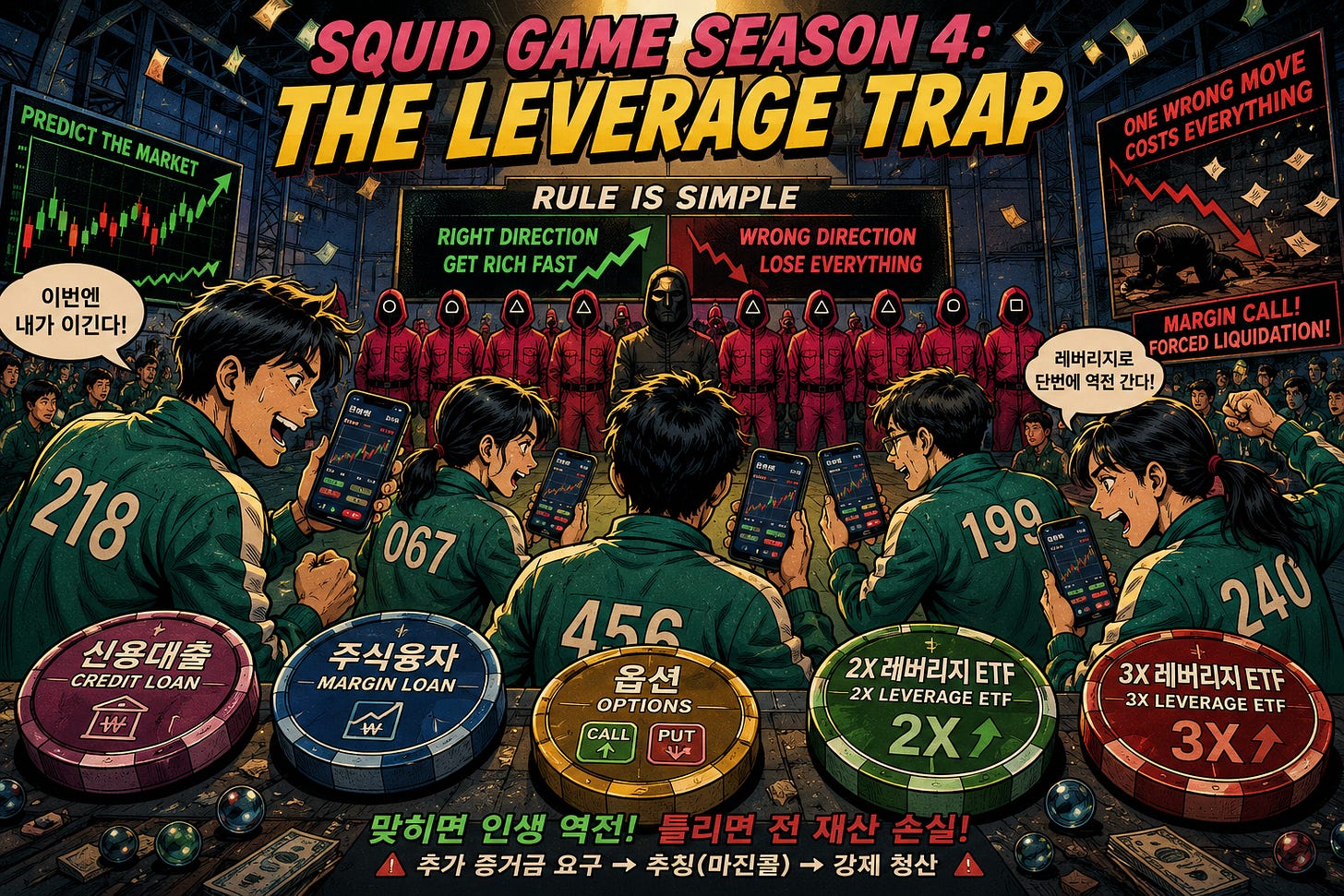
Contestants would not need to wear green tracksuits. They would only need to open a mobile brokerage app. The chips would no longer be glass marbles, but personal loans, margin financing, options, and two- or three-times leveraged ETFs.
The rules would appear simple: make the right bet and gain a chance to transform your life; make the wrong one and lose not only your principal, but potentially face margin calls and forced liquidation.
According to media report, South Korea’s equity market reversed sharply after reaching record highs. Margin calls, algorithmic trading, and the withdrawal of leveraged capital combined to create a classic deleveraging cycle: falling prices triggered margin calls, margin calls forced investors to sell, and additional selling pressure pushed prices even lower.
However, the most important development is not the market decline itself. It is what happened afterward.
Instead of leaving the market, many young Korean investors regarded the sell-off as an opportunity to enter at lower prices.
This is not simply a story of greed. It is a financial experiment driven by generational anxiety.
Young People Understand the Risks—They Just Feel They Have Few Alternatives
Traditional financial education often assumes that investors will choose more conservative asset allocations once they fully understand the risks involved.
The behavior of young Korean investors suggests otherwise.
The problem may not be that they are unaware of the risks. Many continue to participate precisely because they believe that avoiding risk offers them little chance of upward mobility.
For a growing number of young people, stable employment, disciplined saving, and long-term investing are no longer sufficient to secure a place in the middle class.
Housing prices in Seoul remain far beyond what ordinary salaried workers can realistically accumulate through income alone. Competition in the labor market is intense, while wage growth has struggled to keep pace with housing, education, and everyday living costs.
When saving for a home down payment may take 20 or even 30 years, leveraged investment is no longer seen merely as speculation. For some young people, it becomes one of the few perceived ways to close the wealth gap within a reasonable period.
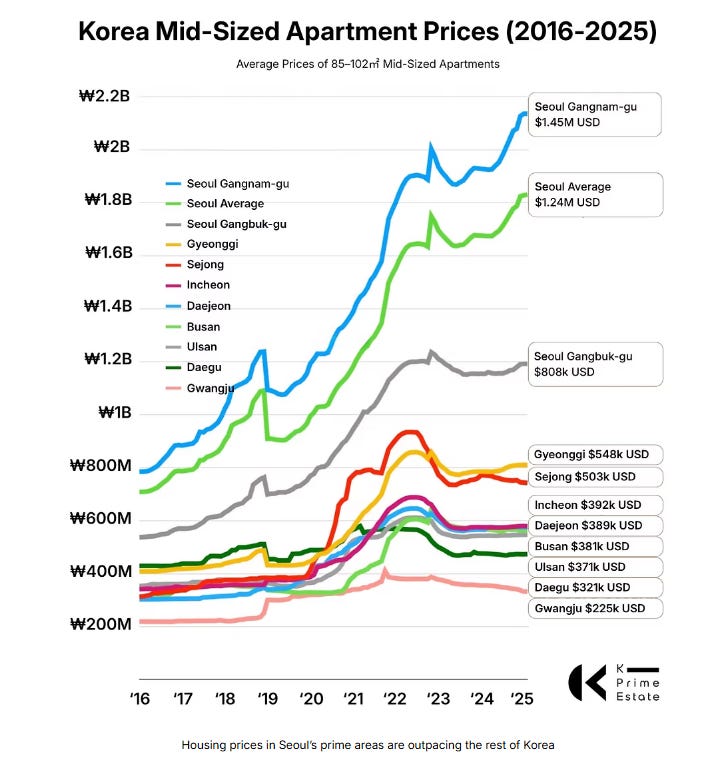
Korea Real Estate Trends: How People Buy in 2026
This is the structural reason South Korea has witnessed the rise of concepts such as “soul-investing” and “debt-investing.”
Young people borrow through personal loans and put the money into stocks, property, or cryptocurrencies—not because they believe prices can never fall, but because they fear that without taking extreme risks, they may never be able to change their economic position.
That is why older investors may see a sharp KOSPI correction as a warning, while younger investors may see it as a new round of cards being dealt.

6月25日
From Investing in Companies to Betting on Direction
In the traditional model of retail investing, individuals purchased shares in a company and waited for earnings and valuations to rise over time.
South Korea’s retail trading culture, however, is increasingly shifting from “investing in businesses” to “betting on market direction.”
With the expansion of leveraged ETFs, inverse ETFs, single-stock leveraged products, options, and other derivatives, investors no longer need to spend months studying a company’s fundamentals.
They only need to answer one question: will the price rise or fall tomorrow?
This has introduced powerful elements of gamification into financial markets.
Mobile brokerage platforms provide real-time prices, profit-and-loss rankings, lists of trending stocks, and one-click trading. Social media continuously amplifies screenshots of spectacular gains. YouTube channels and online forums are filled with narratives about “buying the dip,” “doubling your money,” and “the last opportunity to change your life.”
When the market rises, leverage magnifies returns. When the market reverses, it magnifies losses just as quickly.
The greatest danger is that leveraged investors may not have the financial capacity to wait for the market to recover.
An investor who owns ordinary shares can theoretically continue holding through a temporary paper loss. An investor using margin financing or derivatives may be forced to sell when collateral falls below required levels—often at the precise moment when the market is most fearful and prices are at their lowest.
In other words, an investor can be correct about the long-term direction and still be eliminated by short-term volatility.
That is the brutal rule of leveraged markets: outcomes are determined not only by direction, but also by volatility, timing, and financial endurance.
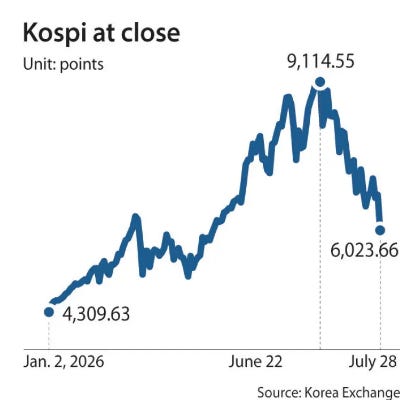
A Large Decline Does Not Necessarily Mean the Market Is Cheap
After a sharp correction, valuations may indeed become more attractive. But “the market has fallen significantly” does not automatically mean “the market is cheap,” nor does it mean that prices have reached the bottom.
This is particularly important when a decline is driven by tightening liquidity, policy changes, or systemic deleveraging.
Such corrections often occur in several stages.
The first stage is usually a decline in highly valued stocks.
The second involves margin calls, algorithmic selling, and forced liquidation.
The third may spread into the real economy, as companies reduce capital expenditure, consumers cut spending, and financial institutions tighten credit.
Young investors who use leverage to buy immediately after the first decline may therefore be liquidated during the second wave of selling.
Leveraged ETFs also contain another risk that is frequently overlooked: volatility decay.
Suppose an asset rises by 10% on the first day and falls by 10% on the second. It does not return to its original value. It ends up down by 1%.
Because leveraged ETFs reset their exposure daily, repeated market fluctuations can cause substantial value erosion, especially in volatile markets without a clear directional trend.
These products are therefore designed primarily for short-term directional trading, not for simple long-term holding.
An investor who treats a leveraged ETF as a “cheaper version of a stock” may discover that even after the underlying index recovers, the ETF’s net asset value remains well below its previous level.
South Korea Today Could Be Taiwan Tomorrow
South Korea’s leveraged-investing phenomenon offers an important warning for Taiwan.
The two markets are not identical, but several similar conditions are emerging: widespread mobile trading, high day-trading activity, rapid ETF growth, active futures and options markets, and the increasing influence of social media on investment behavior.

For many younger investors, the stock market is gradually becoming a second workplace—a place where they hope to supplement wages and accelerate wealth accumulation.
Taiwan also faces another distinctive risk: its stock market is highly concentrated in a small number of large technology companies.
As artificial intelligence, semiconductors, and advanced packaging continue to attract capital, investors can easily develop the illusion that a correct industrial trend guarantees that stock prices will not fall.
But even when an industry has strong long-term prospects, its stocks can still undergo severe corrections because of excessive valuations, capital outflows, cyclical downturns, or regulatory risks.
A company can be an excellent company without being an attractive investment at every price. An industry can have a powerful long-term growth story and still experience a 30% to 50% valuation contraction.
Should Taiwan further expand access to single-stock leveraged ETFs or higher-leverage retail derivatives, regulators will need to consider more than product disclosure.
The central question will be whether these instruments could create systemic forced selling during a market downturn.
Financial innovation can improve market access and efficiency. But it can also transform individual misjudgments into market-wide liquidity risks.
The Real Squid Game Is the Collapse of Social Mobility
The rush of young Koreans into leveraged markets appears, on the surface, to be a financial phenomenon.
At a deeper level, it is a social problem.
In a society where stable employment, education, saving, and gradual career advancement still provide a credible path to upward mobility, young people generally have less need to gamble their futures on highly leveraged trades.
But when the gap between income, housing prices, and asset ownership continues to expand, more people become willing to accept extreme risks.
They know the game is dangerous. They are simply more afraid of not playing.
The most disturbing part of Squid Game was not that contestants were unaware of the possibility of death. It was that after returning to the outside world, they concluded that ordinary life offered no meaningful escape either.
South Korea’s leveraged-investing boom is the financial-market version of the same dilemma.
The next market rebound may allow some young investors to make money. But as long as housing affordability, stagnant income, and intergenerational wealth inequality remain unresolved, new participants will continue to enter the game.
The real problem is not merely leveraged ETFs.
It is an economic structure that convinces young people that the only way to change their destiny is to place their entire future on the table.

7月2日

6月8日


PreviousNext