Millions of Books Are Being Destroyed to Train AI—What Could Be Lost Forever?
Millions of Books Are Being Destroyed to Train AI—What Could Be Lost Forever?
- Source: SemiVision
- Author: SEMIVISION
- Published: 2026-07-29T12:17:42+08:00
- URL: https://tspasemiconductor.substack.com/p/millions-of-books-are-being-destroyed (1) Millions of Books Are Being Destroyed to Train AI—What Could Be Lost Forever?


Millions of Books Are Being Destroyed to Train AI—What Could Be Lost Forever?
Original Article by SemiVision Research [Reading time: 9 mins]

Jul 29, 2026

Millions of Books Are Being Destroyed to Train AI—What Could Be Lost Forever?
Recently, I came across an article online that genuinely shocked me.
AI companies are reportedly buying used books, out-of-print titles, and even rare historical works in enormous quantities. These books are not being sent to libraries or carefully preserved by collectors. Instead, they are shipped to industrial scanning facilities, where high-speed machines cut off their spines, feed the loose pages into scanners, convert the text into digital training data, and then discard, recycle, or shred what remains of the original books.


8:18 AM · Jul 27, 2026·1800萬 Views
3730 Replies·2.59萬 Reposts·6.54萬 Likes
It sounds like the plot of a dystopian novel.
But it is not fiction.
Investigative outlet404 Mediareported that book-data company ISBNdb has been promoting large-scale physical-book acquisition services to AI companies, with orders ranging from thousands to as many as one million books. It describes printed books as edited, structured, and more reliable sources of human knowledge than data scraped indiscriminately from the internet.
The company has also acknowledged the serious public-relations problem associated with destroying large quantities of books. Confidentiality agreements may therefore be used to conceal the identities of the buyers.
This immediately brought a disturbing historical analogy to mind:
A modern form of digital book burning.

International Cyber Digest@IntCyberDigest

6:15 PM · Jul 28, 2026·34.9萬 Views
197 Replies·1880 Reposts·7020 Likes
Why Are AI Companies Suddenly Buying Old Books?
The answer is not nostalgia. It is anxiety over data quality.
Since generative AI began spreading rapidly in late 2022, the amount of AI-generated text on the internet has exploded. News summaries, SEO articles, product descriptions, social-media posts, academic-style content, and even entire electronic books may now be written or substantially rewritten by AI systems.
This creates a serious problem for the next generation of AI models: they may increasingly be trained on content created by previous generations of AI.
Researchers describe one potential consequence as model collapse. When models repeatedly learn from synthetic data generated by other models, uncommon ideas, minority patterns, stylistic diversity, and unusual information can gradually disappear. The model’s output may become increasingly repetitive, distorted, and detached from the original distribution of human knowledge.

This does not mean that the presence of any AI-generated content will inevitably destroy a model. Synthetic data can still be useful when it is carefully selected, verified, and combined with sufficient quantities of authentic human-created material.
The deeper problem is that reliable, human-originated text is becoming increasingly scarce—and therefore increasingly valuable.
That is why books published before 2022 have suddenly become premium commodities in the AI industry.
They were written before generative AI became deeply embedded in the content-production process. Their text generally passed through several layers of human judgment: authors, editors, publishers, reviewers, and readers. Compared with an internet increasingly filled with recycled and machine-generated material, physical books offer structured, stylistically diverse, and relatively uncontaminated human language.
The irony is difficult to ignore:
AI must continue consuming authentic human thought in order to avoid sounding increasingly like AI.
Anthropic’s Effort to Obtain “All the Books in the World”
One of the most prominent examples of industrial-scale book acquisition involves Anthropic.
According to publicly released US federal court documents, Anthropic had previously obtained millions of electronic books from unauthorized online libraries. In 2024, however, the company pursued another route with potentially lower legal risk. It hired Tom Turvey, a former Google executive involved in Google Books partnerships, with the stated ambition of obtaining “all the books in the world.”
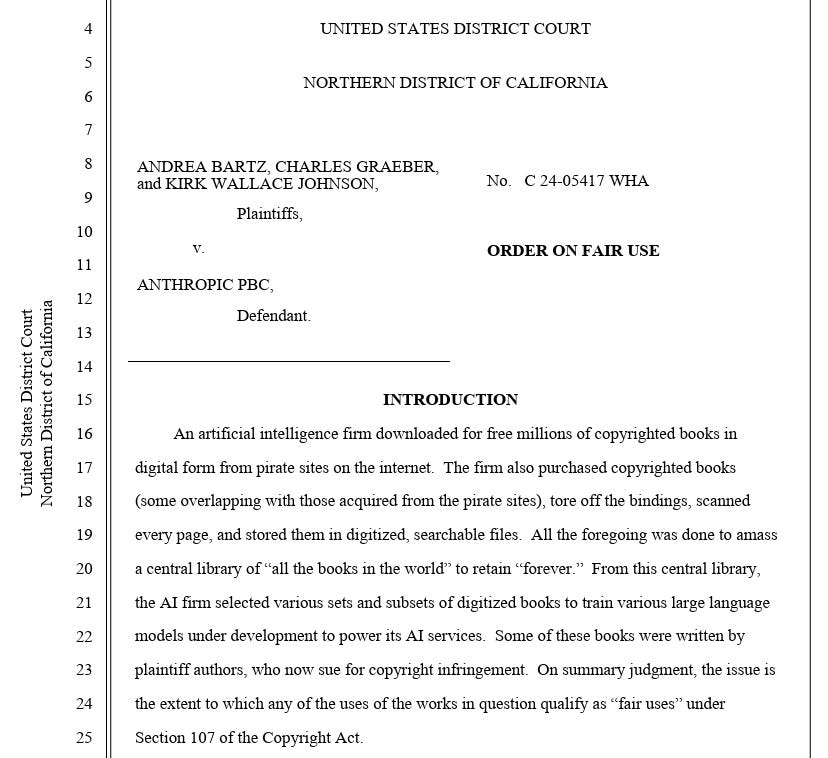
Anthropic subsequently spent millions of dollars purchasing millions of physical books, many of them second-hand copies.
External service providers removed the bindings, cut the pages from the spines, scanned the books into searchable PDF files, and discarded the physical originals. The digital files were placed in Anthropic’s internal research library, with selected material potentially entering datasets used to train its AI models.
This was not a small experiment conducted quietly by a handful of engineers. It was the beginning of an industrialized AI data-supply chain:
Used-book dealers supply the inventory. Data companies identify and purchase the books. Logistics providers consolidate and transport them. Scanning contractors cut and digitize them. AI laboratories obtain machine-readable text for model training.
In this system, books are no longer treated as cultural objects.
They are disassembled and converted into raw material for tokens.
Did a Court Really Rule That Destroying Books Is Legal?
This point requires careful clarification because online discussions often oversimplify the ruling.
In June 2025, US District Judge William Alsup of the Northern District of California ruled that, under the specific circumstances of the case, using books to train a large language model could be considered highly transformative and therefore qualify as fair use.
The court also concluded that when Anthropic legally purchased one physical copy of a book, destroyed that copy, and retained one internal digital copy without increasing the total number of copies or distributing it externally, the conversion could qualify as a legitimate format change.
However, the ruling did not declare that AI companies may freely buy and destroy any book they choose.
It was a federal district court decision based on the specific facts and evidence of one case. It was not a comprehensive law passed by Congress, nor did it establish that every form of AI training or book digitization is automatically legal.
The decision also distinguished between books that were legally purchased and books obtained through unauthorized sources. Acquiring pirated digital copies did not automatically become lawful simply because the files were later used for AI training.
The real concern is that this ruling may create a new commercial pathway:
By purchasing a physical book, a company may gain legal room to destroy the original, retain a private digital copy, and use its contents for AI development.
That possibility could significantly accelerate industrial-scale book acquisition and destruction.
Digitization Is Not Necessarily Preservation
Supporters may argue that the text has been scanned, so the knowledge has not disappeared. It has merely been transferred from paper into digital form.
But this argument fails to distinguish between information and cultural artifacts.
The value of a book does not exist only in its words.
Its paper, binding, typography, edition, printing methods, handwritten notes, ownership marks, printing errors, and physical signs of use can all provide important evidence for historians, literary scholars, archivists, artists, sociologists, and researchers of publishing culture.
A first edition, revised edition, privately printed edition, and mass-market reprint of the same text may have entirely different historical meanings.
A scan may preserve the sentences, but it does not necessarily preserve the book as a physical and historical object.
Moreover, genuine digital preservation generally requires transparent standards, complete provenance records, long-term readability, geographically distributed backups, integrity verification, and sustainable access for researchers and the public.
Destroying a book and storing the only surviving digital copy on a private company’s servers—where it is available only for internal AI development—is not necessarily preservation.
It may be more accurately described asprivate data extraction.
Not Every Old Book Is a Unique Cultural Treasure
It is also important to remain rational and avoid exaggeration.
Available reporting suggests that some booksellers have observed unusual bulk-buying patterns. Buyers may purchase books without showing much interest in their subjects or prices, and their orders may include out-of-print titles, foreign-language books, and relatively uncommon works.
One bookseller reportedly saw sales rise from fewer than 20 books per week to several hundred.
However, the available evidence does not prove that AI companies are systematically searching for and destroying the last surviving copies of rare books around the world. Many books involved may be ordinary used editions, excess inventory, or titles that remain widely available in libraries and private collections.
The more realistic danger is that this acquisition-and-scanning pipeline appears to lack adequate mechanisms for identifying cultural and historical value.
When hundreds of thousands or millions of books are processed, warehouse workers cannot realistically investigate the global availability, edition history, archival importance, or unique physical features of every volume.
As long as a book is affordable and compatible with the scanning process, a rare local history, a minority-language publication, a small-press title, an annotated copy, or an obscure out-of-print work could enter the cutting machine alongside ordinary commercial books.
That is the real and irreversible risk.
What Is at Stake Is Human Memory Sovereignty
Printed books are not perfect.
They can burn, decay, become moldy, suffer water damage, or be deliberately destroyed by political authorities.
But physical books possess one characteristic that purely digital information cannot fully replace: they are distributed, offline, and difficult to modify remotely.
When copies of the same book are dispersed among households, bookstores, universities, archives, and libraries around the world, the historical record remains resilient. Even if a digital platform removes the content or a company shuts down, other physical copies may still survive and provide evidence of what was originally written.
By contrast, once the physical original is destroyed and the only digital copy is controlled by a private AI company, the public may have no way to determine whether the file is complete, whether it has been altered, whether it will be preserved permanently, or whether anyone outside the company will ever be allowed to access it.
This does not mean that AI companies will necessarily rewrite history.
It means that society should not build a knowledge-preservation system that depends entirely on corporate self-regulation.
When knowledge disappears from the public world and is absorbed into the statistical weights of a private model, people may still be able to ask the AI questions about that knowledge.
But they may no longer be able to inspect the original source.
We gain a model capable of answering questions, while losing the evidence needed to verify its answers.
AI Needs Books—but Books Must Not Become Disposable Training Material
There is nothing inherently wrong with using printed material to improve AI.
Large collections of books that have never been digitized could become easier to search, translate, study, and understand through artificial intelligence. That could create enormous public value.
The issue is not scanning itself.
The issue is who gets to decide which books may be destroyed, who owns the resulting digital files, and whether the public retains access to the original knowledge.
Several minimum safeguards should therefore be considered.

@HedgieMarketsI’ve asked the SpaceXAI team to preserve any rare books in a library and scan them the hard way vs just cutting off the spine and scanning
4:48 AM · Jul 28, 2026·144萬 Views
1880 Replies·3690 Reposts·5.24萬 Likes
Rare books, out-of-print works, historical documents, regional publications, minority-language materials, and books with very limited surviving holdings should be scanned only through non-destructive methods. Large-scale purchasers should disclose the quantity, sources, and intended treatment of acquired books. Before destruction, companies should check library databases and archival records to determine whether a particular edition is scarce. A preservation copy of every digital file should be deposited with a trusted public library or archival institution. Authors and publishers should also receive transparent licensing, compensation, and opt-out mechanisms.
Without such protections, the AI industry’s promise of “digital preservation” may preserve only the text required by the model while destroying the historical object required by humanity.
Ancient book burnings were ordered openly by emperors and political authorities.

Today’s digital book burning may be driven by capital, efficiency, legal loopholes, regulatory vacuums, and the relentless demand for training data.
There are no flames, no smoke, and no public decree.
There are only cutting machines operating inside warehouses, and shipment after shipment of books disappearing from shelves and being converted into tokens.
As AI becomes more intelligent from the remains of our libraries, the most important question is not how beautifully it can write.
The question is:
Why must the human memories it absorbs cease to remain in human hands?


PreviousNext