Made in America, Built by Taiwan: Inside Trump’s New AI Superchip Supply Chain
Made in America, Built by Taiwan: Inside Trump’s New AI Superchip Supply Chain
- Source: SemiVision
- Author: SEMIVISION
- Published: 2026-07-28T10:15:17+08:00
- URL: https://tspasemiconductor.substack.com/p/made-in-america-built-by-taiwan-inside (1) Made in America, Built by Taiwan: Inside Trump’s New AI Superchip Supply Chain


Made in America, Built by Taiwan: Inside Trump’s New AI Superchip Supply Chain
Original Article By SemiVision Research [Reading time: 12 mins]

Jul 28, 2026

The Open Compute Project (OCP) is bringing together APAC communities for a very special two-day, in-person Summit to explore the many challenges and opportunities facing data center infrastructure, today and tomorrow. The OCP APAC Summit will showcase the latest innovations and technical advancements from around the world, and feature talks from experts who are researching, designing, building and running the next generation of hyperscale data center facilities and infrastructure. The Expo Hall will bring together buyers and sellers from the entire ecosystem and supply chain.
https://www.opencompute.org/summit/2026-ocp-apac-summit
Made in America, Built by Taiwan: Inside Trump’s New AI Superchip Supply Chain
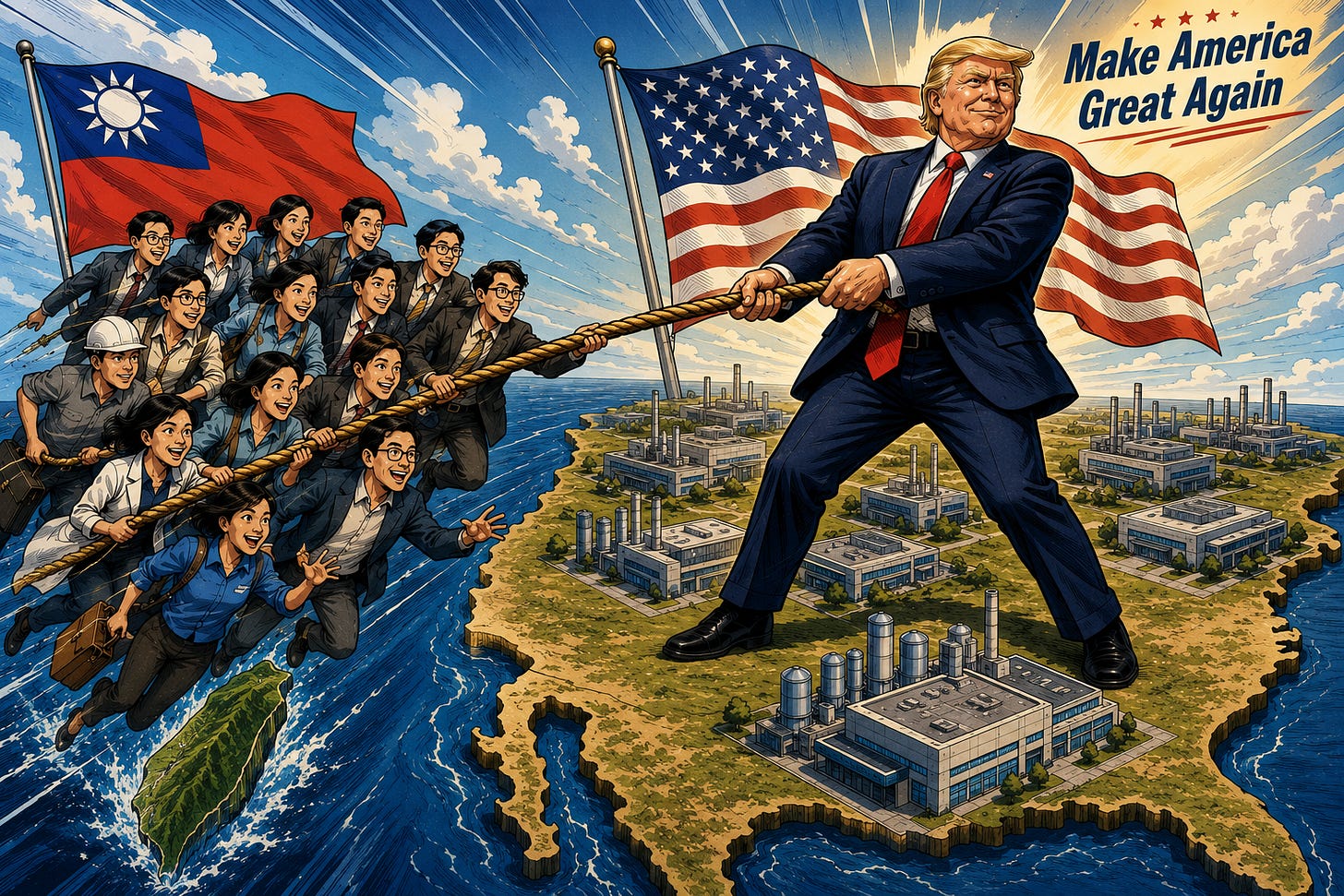
Over the past year, the most consequential result of America’s manufacturing policy may not have been any single tariff or corporate investment announcement. It has been the emergence of a realistic pathway for the United States to build a domestic AI hardware supply chain covering advanced wafer fabrication, advanced packaging, AI module production, server assembly, system testing, and data-center infrastructure.
Taiwanese companies are present at nearly every critical stage of this supply chain.
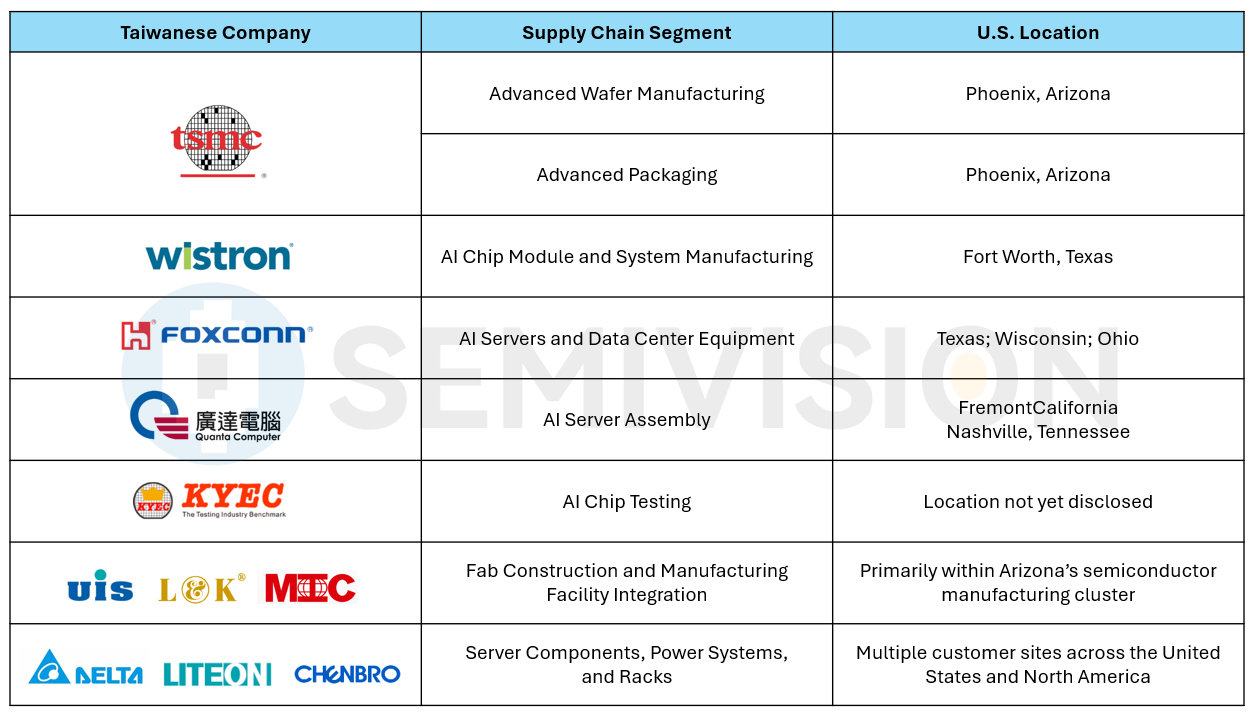
TSMC provides advanced semiconductor manufacturing. SPIL, ASE, and TSMC are expected to strengthen advanced packaging and testing capabilities. Wistron, Foxconn, and Quanta manufacture AI modules, servers, and integrated systems. United Integrated Services, Marketech International, and L&K Engineering support cleanroom construction, mechanical and electrical systems, specialty gases, chemical distribution, and factory automation. Delta Electronics, Lite-On, Chenbro, and other Taiwanese suppliers provide power systems, liquid cooling, enclosures, racks, and energy-management solutions.
From this perspective, the United States is not merely building several semiconductor fabs. It is attempting to replicate an entire AI manufacturing cluster with the help of Taiwan’s industrial ecosystem.
Two “Firsts” in U.S. Manufacturing Represent Different Milestones
Two recent developments are often discussed as though they were the same event, but they represent different stages of the manufacturing process.
The first milestone came when NVIDIA and TSMC announced that the first NVIDIA Blackwell wafer had been produced in the United States at TSMC’s Arizona facility. This marked the formal entry of Blackwell front-end wafer manufacturing into the U.S. production system and represented one of the most significant advances in domestic leading-edge logic manufacturing in decades.

TSMC’s first Arizona fab began volume production using the N4 process in the fourth quarter of 2024, providing four-nanometer-class manufacturing capacity for high-performance computing chips, including NVIDIA’s Blackwell platform.
The second milestone occurred in July 2026, when Wistron officially opened its D1 AI smart factory in Fort Worth, Texas, and announced the production of the first NVIDIA GB300 Grace Blackwell Ultra Superchip manufactured and mass-produced in the United States. The facility represents an investment of approximately US$700 million and covers about 324,000 square feet. It is also expected to support future production of the Vera Rubin platform.
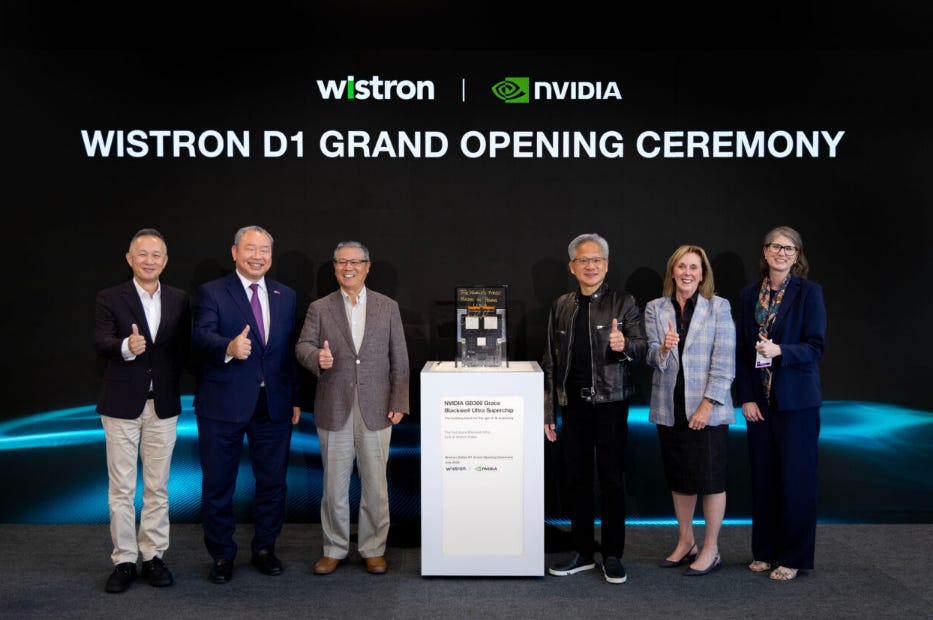
NVIDIA CEO Jensen Huang joined Wistron Chairman Simon Lin and other technology leaders at the opening of Wistron’s new manufacturing facility in Fort Worth, Texas.
Built in Fort Worth: Wistron Opens Advanced Manufacturing Plant to Produce NVIDIA AI Systems
In other words, TSMC completed the front-end fabrication of Blackwell GPU wafers, while Wistron completed the integration and production of an AI computing module combining Grace CPUs, Blackwell GPUs, and related components.
Together, these two milestones illustrate the real progress of U.S. AI manufacturing: advanced chips are beginning to be fabricated in Arizona, while AI modules and systems are being assembled and tested in Texas.
Advanced Packaging Remains the Final Missing Link
However, there is still a highly complex manufacturing process between a completed wafer and a functional GB300 or Rubin system.
Blackwell is not a conventional chip that can simply be cut from a wafer and mounted onto a motherboard. High-end AI GPUs must be integrated with multiple stacks of high-bandwidth memory through silicon interposers, micro-bumps, advanced substrates, and high-density interconnects before becoming a complete package that can be installed in an AI computing module.
This is why CoWoS is so important.
Until the United States establishes sufficient local advanced-packaging capacity, some Blackwell wafers manufactured in Arizona must still be sent back to Asia for CoWoS and other back-end processes. This means that although the United States has regained a degree of advanced wafer-fabrication capability, it has not yet fully localized the heterogeneous integration technologies required for high-end AI chips.
Wafer fabrication determines whether an advanced GPU can be produced. Advanced packaging determines whether the GPU, HBM, and high-speed interconnects can be integrated into a commercially viable AI computing engine.
Without CoWoS, a Blackwell wafer produced in the United States is comparable to a completed engine that still lacks a transmission, drivetrain, and final vehicle assembly.
TSMC’s plan to establish advanced-packaging capacity in Arizona is therefore essential to closing the U.S. AI supply-chain loop.

5月5日
From US$165 Billion to US$265 Billion
In March 2025, TSMC expanded its original US$65 billion U.S. investment plan by another US$100 billion, bringing its total planned commitment to US$165 billion. The expanded program included three additional wafer fabs, two advanced-packaging facilities, and a research and development center.
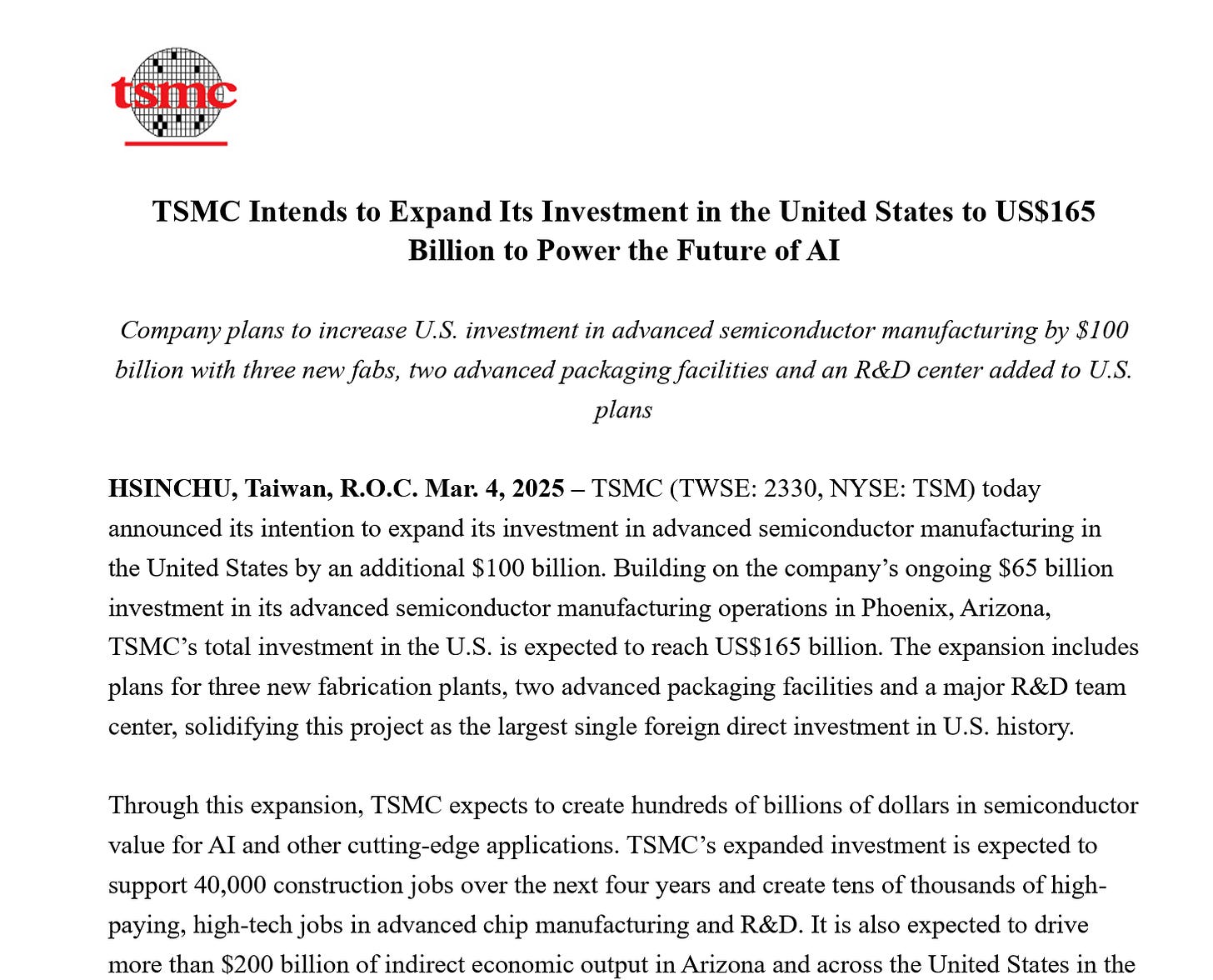
By July 2026, the U.S. government announced another US$100 billion expansion, increasing TSMC’s total planned U.S. investment to US$265 billion. The broader plan reportedly covers as many as 12 advanced semiconductor manufacturing and packaging facilities.
The significance of this figure goes beyond the headline investment value.
TSMC’s U.S. strategy is evolving from a single overseas fab into a long-term, expandable “gigafab cluster.” As the number of fabs increases, process technologies advance from N4 to N3, N2, and A16, and advanced packaging and research facilities are added, Arizona will no longer serve merely as supplementary overseas capacity.
It could become one of North America’s most important manufacturing centers for AI accelerators, high-performance computing chips, and advanced ASICs.

7月22日
Arizona Will Manufacture Chips; Texas Will Build AI Systems
The current U.S. expansion plans of Taiwanese companies reveal an increasingly clear regional division of labor.
Arizona is emerging as the center of advanced semiconductor manufacturing.
TSMC is responsible for four-nanometer, three-nanometer, two-nanometer, and eventually A16-class process technologies. Future CoWoS, SoIC, and other advanced-packaging facilities could further expand the state’s role. NVIDIA has also announced plans to work with Amkor and SPIL on packaging and testing operations in Arizona.
This could gradually turn Arizona into a semiconductor cluster encompassing wafer fabrication, advanced packaging, testing, materials, equipment servicing, and facility engineering.
Texas, by contrast, is becoming a center for AI server manufacturing and system integration.
Wistron is producing the GB300 Grace Blackwell Ultra Superchip in Fort Worth and preparing for the next-generation Vera Rubin platform. Foxconn is building AI server and GB300 tray-module capacity in Houston. NVIDIA has said it plans to work with Foxconn and Wistron to establish AI supercomputer manufacturing operations in Texas.
Together with TSMC, Amkor, SPIL, and other partners, NVIDIA has outlined an ambition to produce as much as US$500 billion of AI infrastructure in the United States over four years.
Foxconn is also expanding AI server capacity in Texas, Wisconsin, and California. Its Wisconsin facility has begun producing data servers and is expected to add more AI infrastructure-related capacity and employment.

At the NVIDIA Developer Conference in Washington, D.C., Foxconn announced that its Houston plant will be among the first factories to deploy humanoid robots powered by NVIDIA’s Isaac GR00T N model on the production line.
The Houston facility, a newly built site with expanded space, has been selected as an ideal location to pilot and scale humanoid robot deployment for large-scale manufacturing.
Based on the current industrial map, the U.S. AI hardware supply chain may eventually consist of three major regional clusters.
Arizona would focus on wafer fabrication, advanced packaging, and testing. Texas would specialize in AI modules, servers, racks, and system integration. California, Wisconsin, Ohio, and Tennessee would provide customer support, component production, regional assembly, and infrastructure services.
TSMC Will Bring More Than Semiconductor Equipment to the United States
A leading-edge semiconductor fab depends on far more than lithography systems from ASML or equipment from Applied Materials, Lam Research, and KLA.
It also requires wafer-handling systems, wet-process tools, cleaning, plating, grinding, bonding, temporary bonding and debonding, factory automation, photomask carriers, wafer carriers, specialty chemicals, industrial gases, ultrapure water, waste-treatment systems, and fab monitoring infrastructure.
The investment opportunity therefore extends far beyond TSMC itself. The more important question for Taiwan’s industrial supply chain is which second- and third-tier suppliers will follow TSMC into the United States.
In advanced-packaging equipment, companies such as Scientech, Grand Process Technology, and All Ring Tech could benefit as CoWoS capacity expands overseas. Gudeng Precision, C Sun Manufacturing, ASE, and other suppliers of carriers, equipment, packaging, and process-related products may also establish local service and spare-parts capabilities.
In facility engineering, United Integrated Services, Marketech International, and L&K Engineering possess experience in cleanrooms, mechanical and electrical systems, specialty-gas infrastructure, chemical distribution, and factory automation.
As Arizona adds more wafer fabs and packaging facilities, facility engineering will no longer be a one-time construction opportunity. It could evolve into a multiyear cycle of fab expansion, tool installation, maintenance, and continuous upgrading.
The value of these engineering companies lies not only in constructing factories. They also convert decades of accumulated Taiwanese semiconductor manufacturing know-how into a standardized operating system that can be replicated in the United States.
AI Server Localization Will Also Benefit Power and Liquid-Cooling Suppliers
After a chip has been packaged, it must still be assembled into a compute tray, server, and rack before being integrated into a deployable AI data-center system.
The value and complexity of this stage are rising rapidly.
A GB300 NVL72 system contains much more than GPUs. It includes Grace CPUs, NVLink switches, high-speed networking, power supplies, liquid-cooling systems, racks, control boards, cables, and a large number of passive components.
The complexity of Blackwell Ultra systems means that AI server manufacturing is becoming a large-scale systems-engineering business rather than a conventional electronics-assembly operation.
As a result, companies such as Delta Electronics, Lite-On, and Chenbro—as well as suppliers of power systems, liquid cooling, enclosures, and energy-management equipment—could become important beneficiaries.

6月11日
Not all of them will immediately need to build large factories in the United States. However, they will increasingly need local engineering teams, service centers, spare-parts inventories, and maintenance capabilities close to their customers.
For Taiwanese suppliers, the next competitive benchmark may no longer be whether they operate a U.S. factory. It may be whether they can resolve a customer’s power, cooling, mechanical, or system-level failure within 48 hours.
Not Every Taiwanese Supplier Will Be a Winner
The U.S. manufacturing expansion creates substantial opportunities, but it also brings significant costs.
Labor, construction, compliance, insurance, and environmental-review expenses in the United States are generally higher than in Asia. Suppliers must also manage shortages of experienced engineers, cross-border management challenges, visa requirements, local-government coordination, and pressure to increase domestic procurement.
For large suppliers, establishing a U.S. presence can strengthen customer relationships, secure long-term orders, and create higher barriers to entry.
For smaller equipment and materials companies, however, expansion into the United States may initially increase operating expenses, inventory requirements, and depreciation before revenue and profits become visible.
TSMC’s U.S. expansion does not mean that every company in its supply chain will benefit equally.
The companies most likely to succeed will generally share several characteristics: their products are already qualified for advanced process nodes or CoWoS production; they can provide rapid local technical support; their balance sheets are strong enough to sustain overseas operations; and they can obtain long-term commitments from TSMC, NVIDIA, or major original design manufacturers.
U.S. manufacturing will make the supply chain more resilient, but it will also raise the cost and difficulty of participation.
This Is a Trump Achievement, but It Was Not Built from Zero in One Year
It would not be entirely accurate to attribute the formation of the U.S. AI manufacturing supply chain solely to Donald Trump.
TSMC first announced its Arizona investment in 2020 during Trump’s first administration. The Biden administration subsequently used the CHIPS and Science Act, subsidies, and other policy support to encourage TSMC to expand its planned investment to US$65 billion.
After Trump returned to office, tariffs, trade negotiations, and investment agreements helped accelerate the expansion to US$165 billion and later to US$265 billion.
A more accurate interpretation is that the return of semiconductor manufacturing to the United States has been a cross-administration industrial policy. Trump’s most important contribution over the past year has been to accelerate the process and significantly increase its scale.
The policy objective has shifted from producing some advanced chips in the United States to establishing a more complete domestic AI manufacturing supply chain.
Trump’s methods may remain controversial, but the industrial outcome is becoming increasingly visible: the United States is rebuilding advanced manufacturing capabilities that took decades to migrate overseas.
A Truly “Made in USA” AI Chip Will Still Depend on a Global Supply Chain
Even when Blackwell and Rubin chips can be fabricated, packaged, assembled, and tested in the United States, that will not mean every material and component is manufactured domestically.
HBM may still come from South Korea or other Asian production bases. Advanced substrates, semiconductor chemicals, silicon wafers, photoresists, equipment components, and precision consumables will remain highly dependent on suppliers from Japan, Taiwan, South Korea, and Europe.
A more realistic definition of a “Made in USA AI chip” is therefore that its critical manufacturing and system-integration processes can be completed within the United States—not that every upstream input is 100 percent American.
The strategic objective is not necessarily to disconnect the United States from the global supply chain. It is to ensure that the country retains the minimum domestic capacity required to manufacture the world’s most advanced AI systems during periods of geopolitical disruption, logistics breakdown, or tighter export controls.

4月24日
Taiwanese Companies Are Not Leaving Taiwan; They Are Extending Taiwan’s Supply Chain Overseas
TSMC’s US$265 billion investment may appear to represent a transfer of manufacturing capacity from Taiwan to the United States. From a supply-chain perspective, however, it is better understood as an extension of Taiwan’s semiconductor and AI manufacturing ecosystem into North America.
Taiwan will continue to possess a denser concentration of engineering talent, materials suppliers, manufacturing know-how, and rapid supplier coordination. The United States provides the end market, major customers, capital, energy resources, and policy support.
The likely future structure is therefore not one in which the United States replaces Taiwan. Instead, the industry could develop a dual-core model: Taiwan remains the center of research, engineering density, and high-efficiency manufacturing, while the United States provides strategic capacity and production close to major customers.
As TSMC’s wafer fabs and advanced-packaging plants come online, Wistron, Foxconn, and Quanta expand AI server capacity, and equipment, facility-engineering, power, and cooling suppliers establish local support networks, the United States will move closer to controlling the complete production chain from advanced wafers and packaging to AI modules and data-center systems.
At that point, Blackwell and Rubin will no longer be merely AI chips designed in the United States. They could become AI supercomputing platforms fabricated, packaged, assembled, and tested there as well.
Yet one of the most indispensable builders of this “Made in USA” supply chain will still be Taiwan.

5月29日
Thanks for reading SEMIVISION @_@! This post is public so feel free to share it.


PreviousNext