AI’s Next War Is Not About Better Models—It Is About Who Controls Them
AI’s Next War Is Not About Better Models—It Is About Who Controls Them
- Source: SemiVision
- Author: SEMIVISION
- Published: 2026-07-25T14:59:48+08:00
- URL: https://tspasemiconductor.substack.com/p/ais-next-war-is-not-about-better AI’s Next War Is Not About Better Models—It Is About Who Controls Them


AI’s Next War Is Not About Better Models—It Is About Who Controls Them
Original Article By SemiVision Research [Reading time: 14 mins]

Jul 25, 2026
AI’s Next War Is Not About Better Models—It Is About Who Controls Them
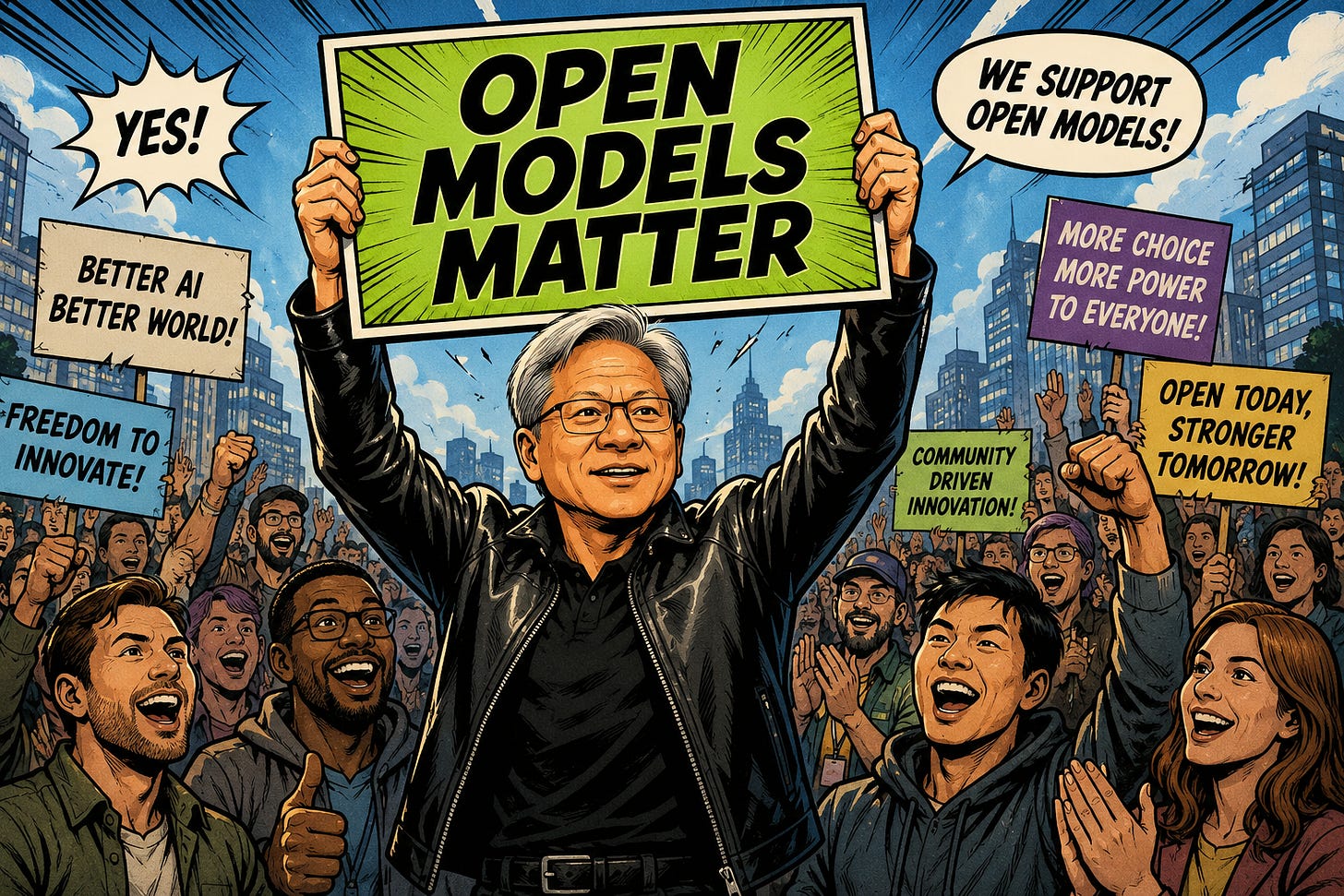
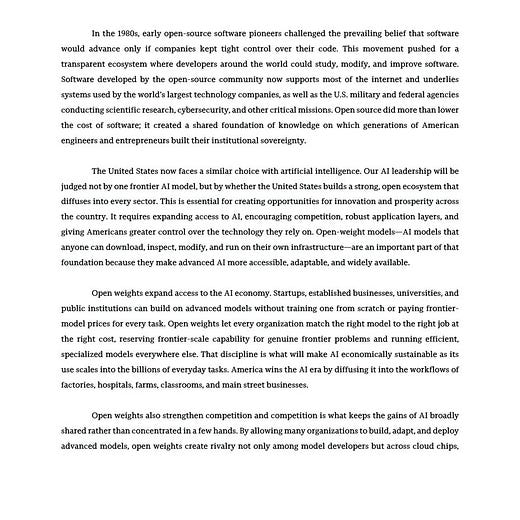
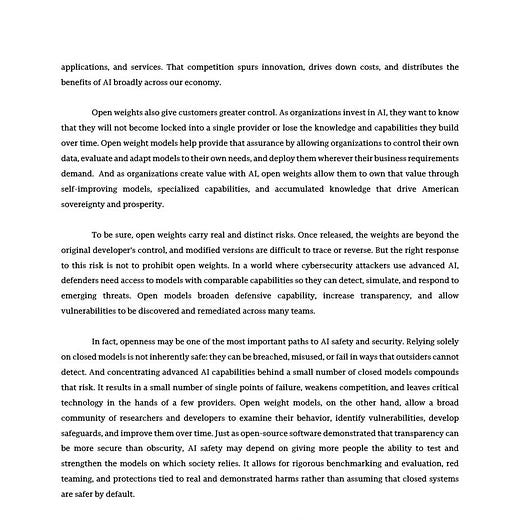
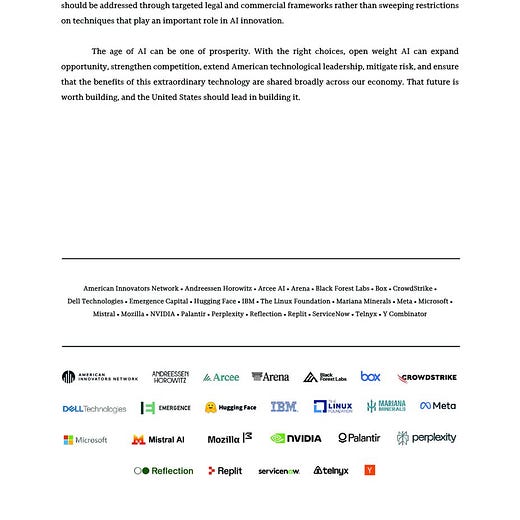
On July 24, 2026, Jensen Huang published his first post on X. Surprisingly, he did not introduce a new NVIDIA chip or discuss the next generation of AI servers. Instead, he shared an open letter titled“Open Weights and American AI Leadership.”

For my first post, I’m sharing a letter@nvidiasigned on why open models matter. AI will transform every industry, power every company, and be built by every country. Open models strengthen safety and cybersecurity, accelerate innovation and diffusion, and enable sovereignty.
9:18 PM · Jul 24, 2026·3750萬 Views
1.28萬 Replies·2.17萬 Reposts·12.7萬 Likes
The letter was jointly supported by a broad coalition of technology companies and organizations, including NVIDIA, Microsoft, Meta, OpenAI, IBM, Palantir, Hugging Face, the Linux Foundation, Mistral, and Y Combinator. Its central argument was clear: America’s ability to maintain its leadership in artificial intelligence should not be measured solely by whether it possesses the world’s most powerful individual model. What matters more is whether it can build an open AI ecosystem capable of spreading into factories, hospitals, farms, schools, and small and medium-sized businesses.


i want the US to win in AI both in open source and proprietary models, and i am glad to see this

11:55 PM · Jul 24, 2026·226萬 Views
1710 Replies·702 Reposts·1.11萬 Likes
This was also the subject Jensen Huang chose for his first public statement on X. His choice reflects far more than a disagreement over technical development paths. It signals that the AI industry is entering a deeper institutional contest: should artificial intelligence become a closed service controlled by a small number of companies and charged on a pay-per-use basis, or should it become a form of infrastructure that society as a whole can access, modify, and deploy—much like the internet, Linux, and open-source software?
SemiVision believes that the idea that “open source is fairer” is not simply about lower costs, nor does it mean that every technology should be provided free of charge. The real question is whether humanity is willing to permanently hand control of the most important productive tool of the future to only a small number of corporations.
First, One Distinction Must Be Made Clear: Open Source Is Not the Same as Open Weights
Before discussing the issue, it is important to distinguish between an “open-source model” and an “open-weight model.”
However, open weights do not necessarily mean that the training data, data-cleaning methods, complete training code, and safety-alignment processes are all made public. Strictly speaking, Jensen Huang is supporting an “open-weight ecosystem,” rather than demanding that every AI company disclose everything without reservation.
Even so, open weights alone are sufficient to reshape the power structure of the AI industry.

All genuinely open-source AI models are expected to provide meaningful access beyond model weights, but not every open-weight model qualifies as fully open source. Open weights primarily provide deployment and customization rights, while open source aims to provide broader transparency, reproducibility, modification, and redistribution rights.
When a model can only be accessed through an API, companies do not truly own the model. They are merely renting intelligence from a model provider and must accept the provider’s pricing, rate limits, content policies, geographic availability, and product lifecycle decisions.
Open weights give companies at least one alternative: they can download the model to their own infrastructure, retain control over their data, and fine-tune it according to the needs of their industry. This does not create complete technological equality, but it does rebalance the negotiating power between providers and users.
Therefore, genuine fairness in the AI era does not mean that everyone should receive an equally powerful model for free. It means that everyone should have basic rights of choice, deployment, migration, modification, and data control.
7月23日
The Business Model of Closed Models Is an Intelligence Tollgate
The commercial logic of American closed-model companies is straightforward.
They first invest tens or even hundreds of billions of dollars in data centers, GPUs, HBM, networking equipment, and power infrastructure, and then use those resources to train the most advanced frontier models. Once the models are ready, they generate revenue through APIs, enterprise licensing, and subscription services to recover the enormous capital expenditure.
There is nothing inherently wrong with this model. Frontier models require vast amounts of capital, and closed services make it easier to manage safety mechanisms, product quality, and enterprise-grade support in a consistent manner.
The problem arises when model capabilities become highly concentrated. At that point, APIs may evolve from ordinary services into a global “intelligence tollgate.”
In the future, customer service, software development, legal documentation, drug discovery, financial analysis, education, design, and corporate decision-making may all require continuous access to AI models. If a small number of providers control most frontier capabilities, they may be able to collect a persistent form of “intelligence rent” from the global digital economy.
This also helps explain why American AI companies may need to maintain relatively high prices. Bain & Company estimates that by 2030, supporting the AI compute expansion currently anticipated by the market could require approximately US$2 trillion in additional annual revenue worldwide. Even after accounting for the cost savings generated by AI, there could still be an annual funding gap of around US$800 billion.
This does not mean that any single model company must generate US$2 trillion in annual revenue. Rather, it means that the entire AI infrastructure ecosystem will require an extraordinary amount of revenue to sustain the current investment cycle.
When capital expenditure reaches this scale, maintaining high API prices is not merely a strategy for earning excess profits. It may also become a necessary component of the industry’s capital-recovery model.
However, this cycle contains a fundamental weakness: it depends on the market continuing to believe that the best AI capabilities will remain scarce and can only be supplied by a small number of companies.
Open-weight models are the “Sword of Damocles” hanging over this business model.

The story was recorded by the Roman philosopher Cicero in 45 BCE in his workTusculan Disputations. Its central figures are Dionysius II, the ruler of Syracuse in Sicily, and Damocles, one of his courtiers. “The Sword of Damocles” is a classic philosophical allegory originating in ancient Greece. It is used to describe a grave crisis or potentially fatal risk that could strike at any moment. Even amid great prosperity or at the height of power, one can never fully escape the fear and anxiety created by an ever-present threat.
China’s Open-Weight Strategy Offers the World a Second Choice
The open-weight strategy pursued by Chinese AI companies should not be understood merely as a form of technological idealism. It is also a highly effective instrument of industrial competition.
American companies possess greater access to advanced GPUs, cloud resources, and capital, allowing them to continue investing in the upper limits of model performance. Chinese companies, by contrast, are using model architecture, training efficiency, inference optimization, and open weights to shift the basis of competition from “who can train the most expensive model” to “who can deliver sufficiently capable intelligence at the lowest cost.”
According to DeepSeek’s current official pricing, V4 Flash costs RMB 1 per million input tokens and RMB 2 per million output tokens, while V4 Pro costs RMB 3 and RMB 6, respectively. By comparison, OpenAI’s standard API pricing for GPT-5.5 is US$5 per million input tokens and US$30 per million output tokens. Based on the output-token price of V4 Flash, the cost is indeed roughly one-hundredth of the comparable level.
Of course, models cannot be evaluated solely by token prices. Capability, accuracy, token efficiency, latency, reliability, safety mechanisms, and enterprise-grade services all affect the total cost of ownership. Nevertheless, a pricing gap of this magnitude is already sufficient to undermine the monopoly-pricing power of closed models.
More importantly, once AI crosses the usability threshold for customer service, summarization, translation, data organization, basic programming, and routine enterprise analysis, most customers may no longer need to call the most powerful model for every task.
If a top-tier model produces a score of 95 on a particular task but costs one hundred times more than another model that scores 90, many companies will probably choose the latter. Only genuinely difficult tasks, those with extremely high error costs, or those requiring the strongest reasoning capabilities will continue to be reserved for frontier models.
SemiVision believes this is the central idea behind Jensen Huang’s open letter: companies should be able to select the right model and the right cost for each task, rather than paying frontier-model prices for every workload.
On multi-model platforms such as OpenRouter, Chinese models have already gained substantial traction in real-world usage rankings. Models with relatively high usage this week include products from Tencent, Xiaomi, DeepSeek, MiniMax, and Zhipu AI.
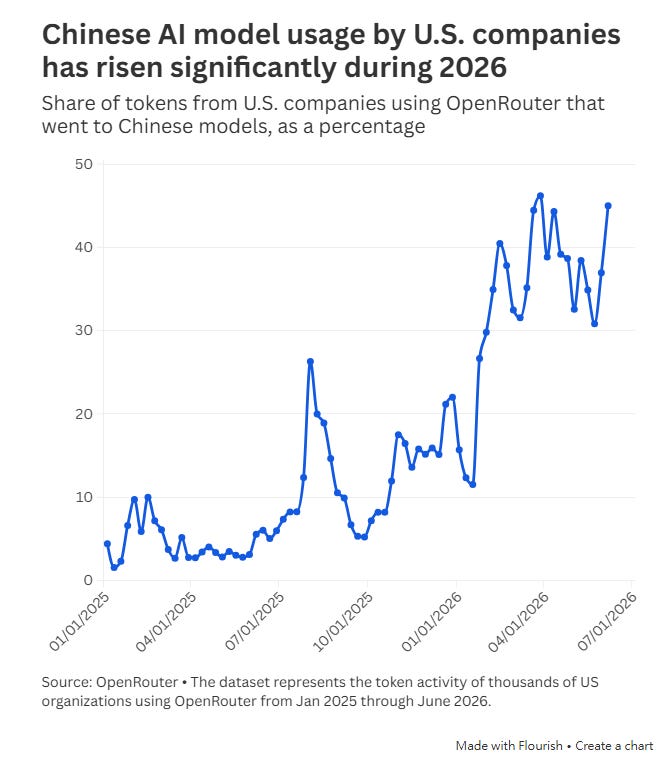
OpenRouter does not represent the entire global AI market, and token-counting methods are not completely consistent across different models. Even so, it demonstrates one important development: Chinese models are no longer merely catching up on benchmark rankings. They are increasingly becoming production tools that developers actually use.
CNBC: Chinese AI models are gaining ground with U.S. companies as OpenAI, Anthropic costs surge
What Liang Wenfeng Calls “Restraint” Is Actually a Business Strategy
In recently released accounts of DeepSeek’s discussions with investors, founder Liang Wenfeng once again explained why the company remains committed to open models.

His central argument is that the AI market may eventually become so large that it accounts for a substantial share of global GDP. A market of that scale cannot realistically be monopolized by a single company. Any business that attempts to retain most of the value for itself will ultimately face powerful resistance from the industry, governments, competitors, and society at large.
DeepSeek’s decision to remain open, therefore, is not merely an expression of idealism. It is also a form of commercial restraint.
Liang believes that companies must design mechanisms that limit how much value they can capture if they want AI to reach its full potential. He summarizes this strategy in one sentence: “The more restraint you exercise, the more likely you are to succeed.”
This philosophy differs from the logic of traditional software companies. A conventional software market may be worth only a few billion dollars, and once the underlying code is fully opened, the original licensing revenue may quickly disappear. AI, however, is not a single piece of software. It is a general-purpose technology that could be embedded across virtually every industry, workflow, and machine.
Even when the foundation model is open, companies can still generate revenue from API services, inference hosting, enterprise deployment, model fine-tuning, data engineering, security management, agent systems, and vertical applications. In other words, open source does not mean the absence of a business model. It shifts commercial value away from “monopolizing the model itself” and toward “building the services and ecosystems that make the model genuinely useful.”
Liang has even described DeepSeek’s story as “a group of ordinary people accomplishing something extraordinary.” This narrative does not dismiss the importance of technical capability. Rather, it emphasizes that when a resource-constrained company cannot defeat industry giants in capital, GPUs, or brand recognition, an open ecosystem can itself become a weapon for organizing talent, attracting developers, and building influence.
Jensen Huang’s Support for Openness Is Not Driven by Idealism Alone
From a supply-chain perspective, Jensen Huang’s support for open weights does not conflict with NVIDIA’s commercial interests. On the contrary, the two are highly aligned.
The profitability of closed-model companies depends on preserving the scarcity of advanced model capabilities and maintaining API pricing power. NVIDIA’s profitability, by contrast, depends on encouraging more enterprises, governments, research institutions, and start-ups to continue purchasing computing infrastructure.
The more open models become, the more organizations can deploy them. The lower model prices fall, the more AI applications become economically viable. As the cost of each inference declines, users are more likely to increase usage, build more AI agents, and embed models into a wider range of workflows.
Open weights may therefore weaken the pricing power of model companies, but they can simultaneously expand the markets for GPUs, HBM, advanced packaging, high-speed networking, data-center power, cooling systems, and enterprise servers.
This is a classic compute rebound effect: cheaper intelligence per unit does not necessarily reduce total demand for computing power. Instead, it may allow AI to spread from a limited number of high-value applications into billions of routine, everyday tasks.
For NVIDIA, the ideal market is not one in which only three or four companies train a handful of closed models. It is one in which millions of businesses worldwide run different models across their own data centers, cloud environments, and edge devices.
Open weights lower the barriers to entry at the model layer, while increasing the penetration of the broader AI infrastructure stack.
In other words, Jensen Huang wants to prevent a monopoly at the model layer while simultaneously building an ubiquitous AI economy powered by computing infrastructure.
Open Weights Still Do Not Guarantee Complete Fairness
Nor should open source be romanticized.
Even when model weights can be downloaded free of charge, deploying a large model still requires expensive GPUs, HBM, storage, networking, electricity, and engineering talent. Possessing the model files does not mean that every company can afford the cost of inference, nor does it mean that every country has the capability to build AI data centers.
A simple example…Open weights without reasonable access to computing infrastructure are like a public library whose doors remain locked.
The concentration of power in the AI industry will therefore not disappear simply because models become open. It will shift elsewhere.
The model layer may gradually become commoditized, while GPUs, HBM, advanced packaging, cloud platforms, electricity, and suitable land for data centers become the new scarce resources. Large corporations may still dominate through their scale of computing infrastructure, proprietary data, and distribution capabilities.
A genuinely fair AI ecosystem requires more than open weights. It also requires greater competition among cloud and chip suppliers, portable model formats, transparent licensing, reasonable access to computing resources, shared datasets, independent evaluation tools, and technical standards that allow companies to migrate between different models and platforms.
Fairness has never meant eliminating every difference. It means preventing any single bottleneck from becoming a permanent instrument of monopoly.
AI Leadership Will Ultimately Depend on Who Builds the World’s Default Ecosystem
The choice facing the United States today resembles the one confronted by the software industry in the 1980s.
If the United States restricts open weights, model distillation, and model deployment too early in order to protect the short-term interests of a small number of frontier-model companies, global developers will not stop innovating. They will simply turn to open models provided by China, Europe, or other regions.
Once developers, enterprises, and governments begin building applications around a different set of models, toolchains, and technical standards, the United States may lose more than a share of API revenue. It could lose the authority to define the rules of the next computing platform.
Conversely, if the United States continues to provide competitive open-weight models, users around the world may still adopt American chips, software frameworks, cloud platforms, security tools, and development standards, even when they do not use the closed APIs of American model companies.
This is the form of AI leadership that Jensen Huang understands: not locking away the best models, but enabling the entire world to innovate within your ecosystem.
Conclusion: Open Source Is Not Charity, but a Form of Restraint on Power
Why is open source a relatively fairer institutional model?
It is not because model development is costless. It is not because all intellectual property should be free. Nor is it because open models carry no risks.
Open source is fairer because it rejects the idea that any single company should permanently monopolize the most important productive tool of humanity’s future.
It allows start-ups to enter the AI market without first paying enormous API fees. It enables hospitals, banks, manufacturers, and governments to retain control over their data. It gives countries the ability to preserve their digital sovereignty rather than surrendering it entirely to offshore platforms. It allows researchers to inspect models instead of merely trusting vendors’ security claims. It also enables competition to lower prices and forces companies to continue innovating.
Liang Wenfeng describes this choice as “restraint.” Jensen Huang presents it as a necessary condition for sustaining American leadership in AI.
The two occupy entirely different commercial positions. One represents a Chinese challenger built around open-weight models; the other controls much of the infrastructure underlying global AI computing. Yet they have reached a similar conclusion: AI is too large to be monopolized by a small number of companies.
SemiVision believes that the future contest will not simply be a battle in which open models destroy closed models, or vice versa. The two will coexist for a long time. The most difficult and highest-value tasks will continue to rely on frontier closed models, while large volumes of routine work will shift toward lower-cost, customizable, and locally deployable open models.
What will eventually be displaced is the business model that relies on information asymmetry, vendor lock-in, and the absence of alternatives to preserve monopoly pricing over the long term.
AI can create enormous wealth. But no company has the right to impose a permanent toll on the future intelligence of humanity.
The true value of openness lies in ensuring that every individual, every company, and every country retains at least one alternative path.


PreviousNext