China Has Not Won the Chip War—But It Is Changing the Battlefield
China Has Not Won the Chip War—But It Is Changing the Battlefield
- Source: SemiVision
- Author: SEMIVISION
- Published: 2026-07-20T22:08:19+08:00
- URL: https://tspasemiconductor.substack.com/p/china-has-not-won-the-chip-warbut China Has Not Won the Chip War—But It Is Changing the Battlefield


China Has Not Won the Chip War—But It Is Changing the Battlefield
Original Article By SemiVision Research [Reading time: 13 mins]

Jul 20, 2026
Welcome to IEEE ICCC 2026!
IEEE/CIC International Conference on Communications in China (ICCC) is a premier regional conference held annually across the greater China region, aiming to embody the vision of practical globalization by expanding IEEE ComSoc’s presence in this rapidly growing area. The conference adopts the established format of IEEE ICC, offering an extensive program that includes Technical Symposia, Industry Forums, Invited Tracks, Tutorials, Panels, and Workshops.
https://iccc2026.ieee-iccc.org/
China’s Chip Export Boom Is Not the Same as Winning the Semiconductor Race

AI-driven memory inflation, mature-node expansion and the redistribution of back-end manufacturing are creating a more complicated semiconductor order—one in which China may gain influence without controlling the technological frontier.
The most easily misread semiconductor headline in July 2026 is not TSMC’s record quarterly profit, nor the latest progress in extreme ultraviolet lithography. It is the sudden acceleration in China’s chip exports.
China exported 179.44bn integrated circuits worth $177.28bn in the first six months of 2026, according to customs data. The value was more than 96 per cent higher than a year earlier. Exports of computers, servers, memory products and other data-processing equipment also rose 41.3 per cent to more than $138bn. invites a simple conclusion. American restrictions have failed. China has caught up. The balance of semiconductor power is shifting more quickly than Washington, Taipei or Seoul expected.
But trade statistics do not provide such a clean verdict.
China’s export boom is significant, although not mainly because it proves that the country has mastered the world’s most advanced artificial intelligence processors.It matters because it reveals how the AI investment cycle is spreading beyond GPUs and leading-edge foundries into memory, mature-node chips, packaging, testing, modules and the vast industrial infrastructure surrounding modern computing systems.
China has not yet conquered the technological apex of the semiconductor industry. It is, however, becoming more influential across its widening base.

7月20日
The problem with the headline number
Export value is not the same as technological capability. Nor is gross export value the same as domestically created semiconductor value.
Dividing China’s first-half export value by the number of units shipped produces an average of approximately $0.99 per integrated circuit. This figure is useful as a warning against assuming that the exports consisted primarily of expensive AI accelerators. But it should not be treated as a precise measure of the product mix. A power-management IC, a memory device and a complex processor are all counted as individual chips despite having radically different functions, dimensions and prices.
The more persuasive evidence lies elsewhere.
In the first two months of 2026, China’s IC export value increased 68.9 per cent, while shipment volume grew only 13.7 per cent. By June, semiconductor export prices had become an increasingly important driver of trade values. China was also importing substantially more semiconductors from South Korea and Taiwan: June imports from the two economies rose 85 per cent and 41.1 per cent respectively from a year earlier. ion suggests that China’s export figures capture at least three overlapping developments.
The first is genuine expansion in domestic semiconductor production.
The second is a sharp increase in the prices of memory and certain mature products.
The third is China’s continuing role as a manufacturing, packaging, module-assembly and re-export centre for components that may have originated elsewhere.
That does not make the export surge artificial. It simply changes what the number means.
Rather than demonstrating complete semiconductor independence, the figures show that China remains deeply embedded in the Asian electronics production system—even as governments attempt to divide that system along geopolitical lines.
Memory inflation has become an export multiplier
The most immediate explanation for the rise in export value is the global memory market.
Samsung Electronics, SK hynix and Micron have been directing a growing share of capital expenditure, engineering resources and advanced DRAM capacity towards high-bandwidth memory and DDR5 products for AI accelerators and servers. At the same time, major suppliers have been reducing production of older DDR4, LPDDR4 and lower-density memory products.
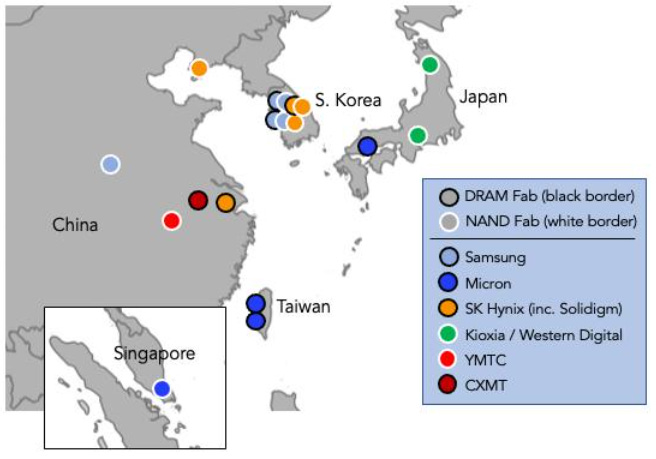
The result is an unusual form of scarcity. The industry is investing heavily in memory, but much of that investment is concentrated in the most advanced and profitable products. Legacy memory can therefore become more expensive even as total industry expenditure rises.
Industry report estimated that consumer DRAM contract prices would rise 45 to 50 per cent quarter on quarter in the second quarter of 2026. Prices for some DDR4 products increased more than 20 per cent in March alone, while shortages spread into DDR3 and DDR2, where prices rose by 20 to 40 per cent. aradox of the AI memory cycle. HBM is not merely creating a premium market at the top. It is removing capacity, equipment attention and technical resources from older product categories, allowing scarcity to move down the hierarchy.
For Chinese exporters, this acts as a valuation amplifier. A large volume of commodity or mature memory does not need to become technologically more advanced for its export value to rise sharply. It only needs to become scarcer.
The effect extends beyond memory chips themselves. Higher memory prices influence the cost and value of modules, servers, industrial computers, networking equipment and consumer electronics assembled in China. In other words, part of China’s semiconductor export boom is the financial reflection of an AI-driven price shock that began outside China but is being transmitted through Chinese manufacturing.
This also explains why the surge should not be dismissed. Pricing power is itself an important part of semiconductor economics. Companies do not need to manufacture the world’s best GPU to benefit from the scarcity created by it.

7月9日
China is building the industrial base, not yet controlling the frontier
The semiconductor market is increasingly separating into two capital-intensive layers.
At the technological frontier are 2nm and sub-2nm logic, HBM, advanced lithography, chiplet integration and high-density packaging. Taiwan, South Korea, the US, Japan and the Netherlands remain central to this layer.
5月14日
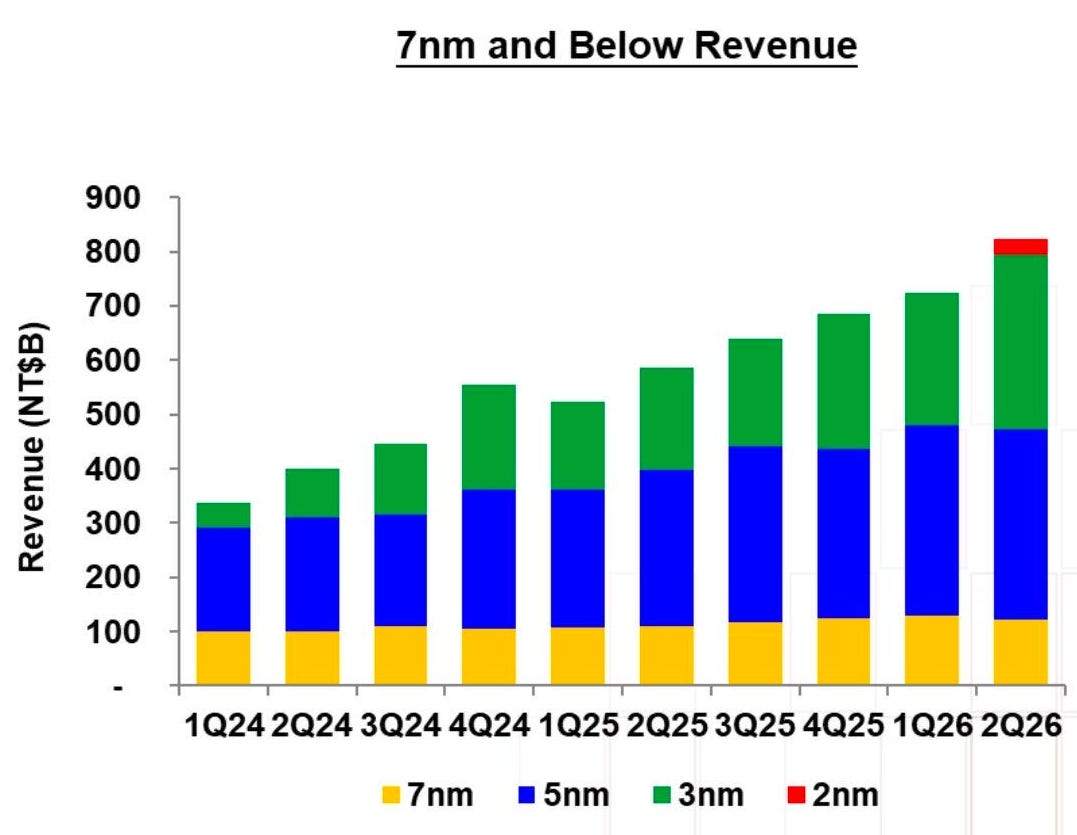
TSMC’s second-quarter results illustrate the concentration of value at the frontier. The company generated $40.2bn in quarterly revenue, with advanced processes of 7nm and below accounting for 77 per cent of wafer revenue. Its newly ramping 2nm technology already represented 3 per cent, while 3nm and 5nm contributed 30 per cent and 33 per cent respectively. ontier sits a much broader industrial base: display drivers, microcontrollers, analogue devices, power-management chips, connectivity controllers, automotive components, commodity memory and the supporting silicon required in servers, robots, vehicles and industrial equipment.
This is where China’s scale is becoming more consequential.
SEMI expects China, Taiwan and South Korea to remain the three largest destinations for semiconductor equipment spending through 2028. China is expected to retain the leading position, even if growth moderates after several years of elevated investment. Much of this capital is aimed at strengthening domestic capacity and reducing dependence on foreign suppliers. not immediate parity with TSMC or the international EUV ecosystem. China continues to face important constraints in advanced lithography, high-end inspection, metrology, electronic design automation and some specialised materials. US licensing requirements also continue to restrict access to advanced computing products and semiconductor manufacturing technologies, although certain AI chips are now reviewed case by case. ical constraints at the frontier do not prevent China from expanding below it.
A factory producing mature-node power-management devices does not need High-NA EUV. An automotive microcontroller does not require 2nm. Many analogue and industrial chips benefit more from manufacturing stability, process qualification, cost control and long product cycles than from transistor density.
This is why the most plausible competitive outcome is not China replacing the entire global semiconductor ecosystem. It is China becoming increasingly difficult to displace from the high-volume layers beneath the frontier.


Packaging and testing are becoming strategic, not secondary
The export figures also expose a second change in the semiconductor supply chain: the economic centre of gravity is shifting from individual chips towards integrated systems.
AI processors cannot be commercialised through wafer fabrication alone. They require advanced packaging, high-density substrates, HBM integration, thermal interfaces, burn-in, final testing, power delivery, optical connectivity and server-level assembly.
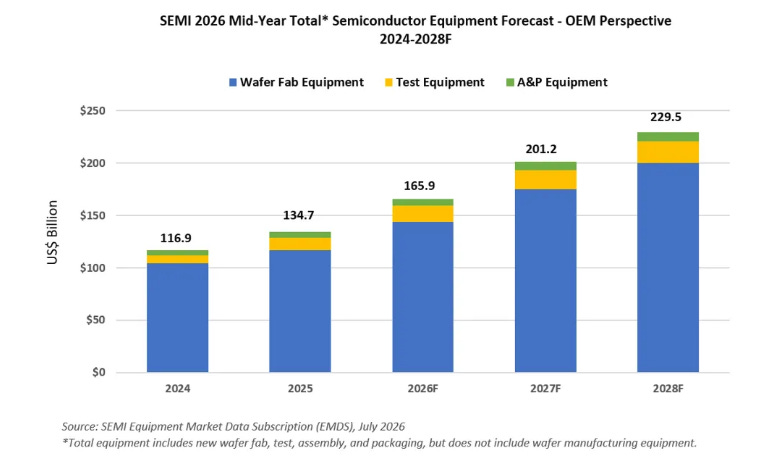
SEMI expects test equipment sales to rise 31 per cent to $15.3bn in 2026. Assembly and packaging equipment sales are forecast to increase 9.6 per cent to $6.7bn. By 2028, the two markets are expected to reach $20.8bn and $8.6bn respectively, reflecting the rising complexity of AI and HBM devices. erial change from previous semiconductor cycles. Testing is no longer simply the final low-value stage after fabrication. As devices become more heterogeneous and expensive, the cost of allowing a defective chiplet, HBM stack or interposer to enter a package rises dramatically. Known-good-die screening, thermal validation, high-speed interface testing and system-level reliability are becoming critical sources of value.
China already possesses substantial scale in conventional assembly, electronics manufacturing and module integration. This gives it leverage over large parts of the downstream chain even when the most advanced wafers are fabricated elsewhere.
At the same time, the high end of packaging is becoming more concentrated around foundries, memory manufacturers and leading outsourced semiconductor assembly and test companies in Taiwan and South Korea. The emerging structure is therefore not a simple transfer of packaging leadership to China. It is a division between advanced heterogeneous integration and high-volume industrial back-end services.

Both layers matter. One captures exceptionally high value per device. The other captures scale, utilisation and control over the flow of physical products.
The supply chain is becoming regionalised—but not truly separated
Governments increasingly speak of semiconductor localisation, trusted supply chains and technological sovereignty. The industry itself is moving towards something less tidy.
Advanced logic capacity is expanding in Taiwan and the US. Memory investment is rising in South Korea, Japan and the US. Packaging capacity is being added across Taiwan, South Korea, Southeast Asia and North America. China is simultaneously investing in domestic fabs, equipment, materials and supporting components.
Worldwide 300mm fab equipment spending is forecast to rise 18 per cent to $133bn in 2026 and another 14 per cent to $151bn in 2027. SEMI attributes the expansion to both AI demand and the construction of more localised semiconductor ecosystems. ce is not deglobalisation in the literal sense. It is duplicated globalisation.
Companies are being required to build parallel production routes, qualify additional suppliers, separate certain products by destination and maintain more inventory. A chip may be designed in the US, fabricated in Taiwan, combined with Korean memory, packaged in Taiwan or another Asian location, assembled into a server in China or Mexico and deployed in a data centre elsewhere.
The chain is becoming more expensive, but it is not becoming simple.
China’s simultaneous rise in semiconductor exports and imports illustrates this reality. Its manufacturing system is becoming more capable, yet it remains connected to Taiwanese and Korean semiconductor production. Export controls may reduce China’s access to selected technologies, but they also encourage Chinese customers to qualify domestic alternatives in mature logic, memory, analogue devices and manufacturing equipment.
The result may be a bifurcated market in which the US and its allies retain leadership in the most advanced technologies while China builds a larger semi-independent ecosystem below the frontier.
Such a system would not produce a single winner. It would create two overlapping supply chains with different standards, cost structures, equipment bases and geopolitical risks.
Taiwan now faces a two-front competition
For Taiwan, China’s export data should not be interpreted as evidence that its advanced semiconductor advantage is about to disappear.
TSMC’s results suggest the opposite. Demand for 2nm, 3nm and advanced packaging remains exceptionally strong. Taiwan continues to occupy the central co-ordination role linking chip design, foundry manufacturing, packaging, substrates, testing and server production.
But Taiwan’s strategic challenge is changing.
The first front is technological. Taiwan must continue advancing in sub-2nm processes, backside power delivery, silicon photonics, chiplets, CoWoS-class packaging and thermal management.
The second front is industrial. Taiwanese companies must defend their positions in mature foundry, commodity packaging, substrates, printed circuit boards, passive components, power semiconductors and legacy memory against Chinese suppliers with larger domestic markets and increasingly competitive cost structures.
China may not need to displace TSMC to pressure Taiwan’s semiconductor industry. It can exert pressure by compressing margins across the supporting layers of the supply chain.
This creates a risk of strategic polarisation. A small group of Taiwanese companies connected directly to AI accelerators may generate exceptional returns, while suppliers exposed to mature products face overcapacity and price competition.

5月27日
Taiwan’s long-term advantage must therefore be broader than leading-edge wafer fabrication. It must retain a complete high-value ecosystem around advanced testing, materials, power delivery, substrates, thermal solutions and system integration.
Dominating the apex is valuable. But the country that controls only the apex may still surrender a large share of the industrial value beneath it.

7月14日
The winners will be determined by scarcity, not labels
The central investment question is no longer whether a company should be classified as an “AI semiconductor supplier”. The category has become too broad to be useful.
The more important questions are where scarcity exists, how long it can last and which suppliers possess genuine pricing power.
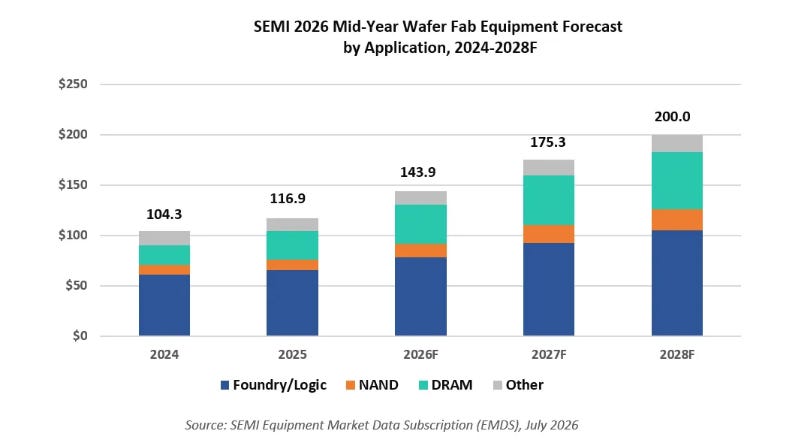
SEMI forecasts wafer-fabrication equipment sales to rise 23.1 per cent to $143.9bn in 2026. Foundry and logic equipment spending is expected to increase 18.9 per cent, while DRAM equipment sales are forecast to surge 39 per cent as manufacturers invest in HBM and advanced memory. show that the AI cycle is generating several simultaneous investment waves.
At the frontier, the beneficiaries are advanced foundries, lithography suppliers, HBM producers, advanced packaging companies and high-end test-equipment vendors.
In the middle of the chain, suppliers of substrates, deposition and bonding equipment, thermal materials, power-management systems and high-speed interconnects benefit from increasing system complexity.
At the mature end, the picture is more divided. Temporary shortages can support memory and analogue pricing, but Chinese capacity expansion may eventually create oversupply in selected products. The same segment can therefore experience strong near-term earnings and deteriorating long-term economics.
The distinction between structural scarcity and cyclical inflation will become increasingly important.

2025年8月25日
What investors should watch
Four indicators will reveal whether China’s export surge represents durable industrial progress or mainly a temporary pricing phenomenon.
The first is the relationship between export value and shipment volume. Continued value growth without comparable unit growth would point primarily to pricing and product-mix effects. Accelerating units would provide stronger evidence of market-share expansion.
The second is the composition of China’s semiconductor imports. If imports from Taiwan and South Korea remain elevated alongside exports, China will still be functioning partly as a processing and re-export hub. A sustained decline in imported content would provide clearer evidence of domestic substitution.
The third is capacity utilisation in mature-node foundries. New factories create strategic capability, but not necessarily attractive returns. Falling utilisation and wafer prices would indicate that China’s investment push is beginning to produce excess capacity.
The fourth is the geography and ownership of packaging and test investment. The ability to combine logic, memory and chiplets with high yield may prove more important than nominal wafer capacity. Back-end industrialisation will be one of the decisive competitive tests of the next several years.
A new map of semiconductor power
China’s chip exports nearly doubling is a major development. But it is not a declaration that China has won the semiconductor race.
It is evidence that the race itself has changed.
The centres of technological power remain advanced logic, HBM, lithography and heterogeneous packaging. TSMC, the Korean memory companies and critical western and Japanese equipment suppliers continue to dominate much of this frontier.
Yet the AI investment cycle is pushing value into a much wider set of products. Memory inflation is lifting legacy devices. Server expansion is increasing demand for power, connectivity and control chips. Packaging and testing are becoming more strategic. Governments are financing duplicated capacity. China is accumulating scale in the industrial layers where cost, volume and supply-chain integration matter more than the smallest transistor.
China has not captured the summit. It is thickening the mountain beneath it.
For the global semiconductor industry, that may be the more important development. The next phase of competition will not be decided by a single process node or one generation of AI accelerators. It will be determined by which economies and companies can combine technology leadership with manufacturing depth, supply-chain resilience and durable pricing power.
China’s export figures do not tell us who has won. They tell us that the contest has expanded from chips to the entire industrial system that surrounds them.

5月30日


PreviousNext