SK hynix Is Taking HBM to Wall Street—and Rewriting the Rules of AI Memory
SK hynix Is Taking HBM to Wall Street—and Rewriting the Rules of AI Memory
- Source: SemiVision
- Author: SEMIVISION
- Published: 2026-07-10T21:19:45+08:00
- URL: https://tspasemiconductor.substack.com/p/sk-hynix-is-taking-hbm-to-wall-streetand (6) SK hynix Is Taking HBM to Wall Street—and Rewriting the Rules of AI Memory


SK hynix Is Taking HBM to Wall Street—and Rewriting the Rules of AI Memory
Original Article By SemiVision Research [Reading time: 12 mins]

Jul 10, 2026
∙ Paid
SK hynix Is Taking HBM to Wall Street—and Rewriting the Rules of AI Memory
AI data center investment is entering a period of unprecedented expansion. Global spending is projected to rise from approximately USD 466 billion in 2025 to USD 3.379 trillion by 2030, representing a CAGR of 48% and more than sevenfold growth within five years. This investment cycle will extend far beyond GPUs and servers, driving demand across advanced semiconductors, HBM, networking, power infrastructure, cooling systems, optical interconnects, construction, and energy supply. As AI workloads become larger and more computationally intensive, the industry’s primary challenge will shift from securing individual components to building complete, scalable data center ecosystems. The next phase of AI competition will therefore be determined not only by computing performance, but also by how quickly companies can deploy capital, infrastructure, power, and supply chain capacity.

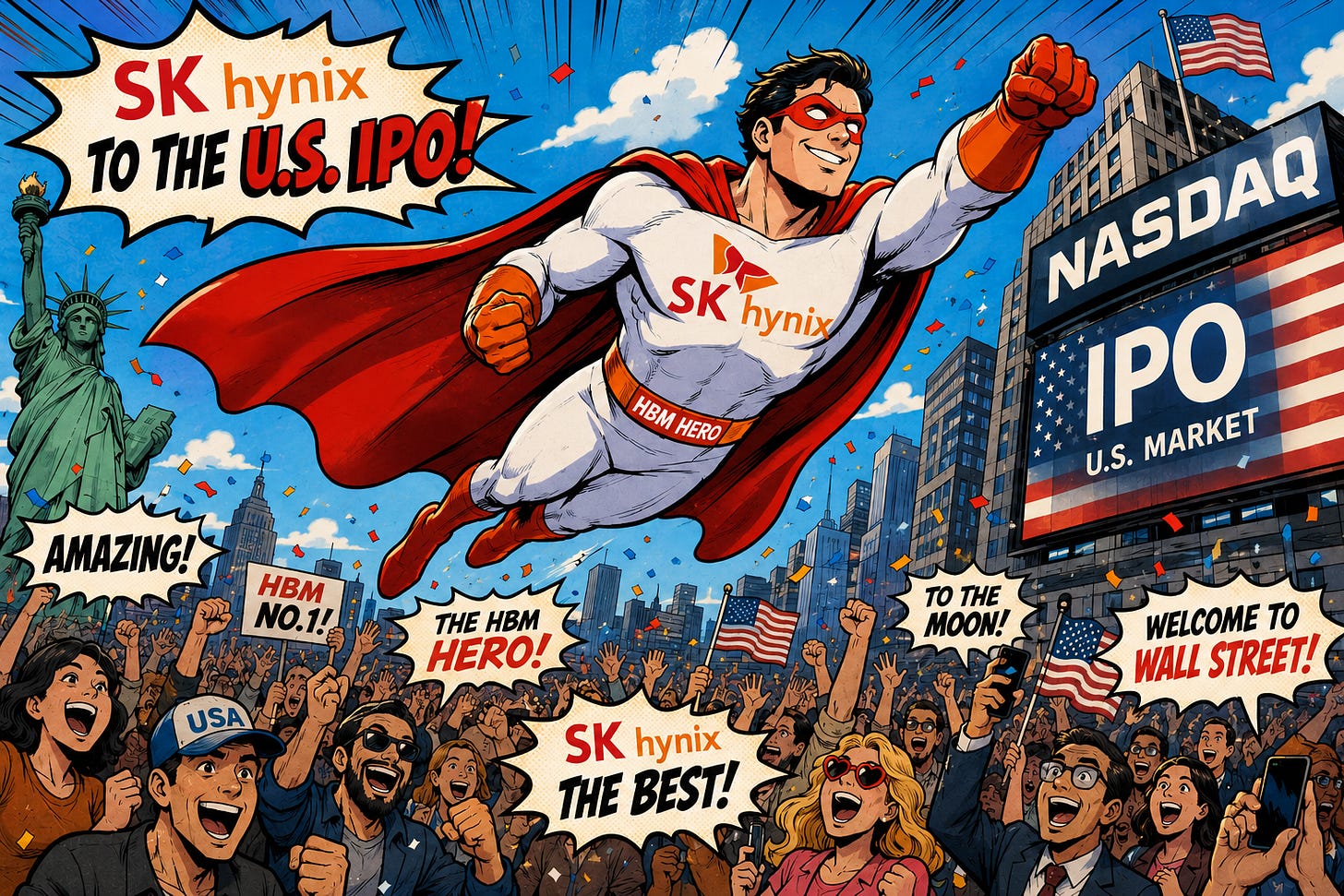
SK hynix’s proposed ADR issuance in the United States appears, on the surface, to be a fundraising transaction worth approximately US$28 billion.
However, interpreting the move simply as “SK hynix desperately needs capital and therefore has to raise money in the United States” would be far too superficial.
SK hynix is no longer a cash-strapped memory company. It has become one of the most strategically important HBM suppliers in the AI era. According to its first-quarter 2026 financial results, the company generated KRW 52.6 trillion in quarterly revenue, KRW 37.6 trillion in operating profit, and KRW 40.3 trillion in net income, representing an operating margin of 72%. At the end of the quarter, cash and cash equivalents reached KRW 54.3 trillion, while the company held a net cash position of approximately KRW 35 trillion.
In other words, SK hynix is not going to the United States because it lacks money. It is using the AI memory supercycle to move itself into a larger capital market, a higher valuation framework, and a deeper global pool of institutional capital.
The key question, therefore, is not how much SK hynix can raise.
The real significance is that the company is:
Converting its technological leadership in HBM into an advantage in the capital markets
Reframing itself from a domestically valued Korean memory company into a globally valued AI infrastructure company
Turning its publicly traded shares into international currency for future acquisitions, strategic alliances, equipment procurement, and supply chain negotiations
This is not simply a financing exercise.
It is a capital-market repricing of the AI memory industry.
Below we will share:
Layer One: Reducing the Korea Discount and Lowering the Cost of Equity
Layer Two: Monetizing Its Equity as a Currency for Global Acquisitions and Strategic Alliances
Layer Three: Directing Capital Demand Toward a Deeper Overseas Market Without Draining Domestic Liquidity
Supply Chain Observation One: Capital Will Ultimately Flow Into Equipment, Packaging, Materials, and Infrastructure
Supply Chain Observation Two: HBM Expansion Is Evolving From a Wafer-Fab War Into a Packaging-Capacity War
Supply Chain Observation Three: SK hynix’s U.S. Listing Will Reshape Its Negotiating Position With Customers
Impact on Taiwan’s Market: Neither Bearish Nor Simply Bullish, but a Reordering of Capital and Supply Chain Priorities

Layer One: Reducing the Korea Discount and Lowering the Cost of Equity
For decades, Korean equities have traded under what is commonly known as the “Korea Discount.”
Even though SK hynix holds a leading position in the HBM market and has become a critical memory supplier to AI ecosystems involving Nvidia, Google, and other major customers, its valuation in the domestic market remains constrained by the cyclical nature of the memory industry, corporate governance concerns, foreign-investor allocation limits, and the relatively limited liquidity of the Korean capital market.
Industry media has also reported that the proposed ADR listing is viewed by the market as a way to broaden SK hynix’s investor base and narrow the valuation gap between the company and its U.S. competitor Micron.
Taiwanese investors are already familiar with this dynamic.
TSMC listed in Taiwan is viewed through one capital-market framework, while its ADR in the United States is interpreted through a different financial language. The U.S. market does not value companies solely on earnings. It also pays for global technology narratives, ETF inclusion, market liquidity, U.S. dollar asset allocation, and the premium associated with AI infrastructure.
SK hynix is now attempting to reposition itself from a “Korean memory stock” into a “global AI memory infrastructure company.”
Once the capital market is willing to assign the company a higher price-to-earnings multiple, a higher price-to-book multiple, and greater liquidity, SK hynix will be able to raise substantially more capital in the future while issuing relatively fewer shares. This is fundamentally a question of the cost of equity.
Raising capital in a low-valuation market is called dilution.
Raising capital in a high-valuation market is called financial leverage.
This is the first major strategic implication of SK hynix’s U.S. listing.

6月30日
Layer Two: Monetizing Its Equity as a Currency for Global Acquisitions and Strategic Alliances
A U.S.-listed ADR does more than make SK hynix shares easier for American investors to purchase.
More importantly, it gives the company’s equity the characteristics of an internationally accepted transaction currency.
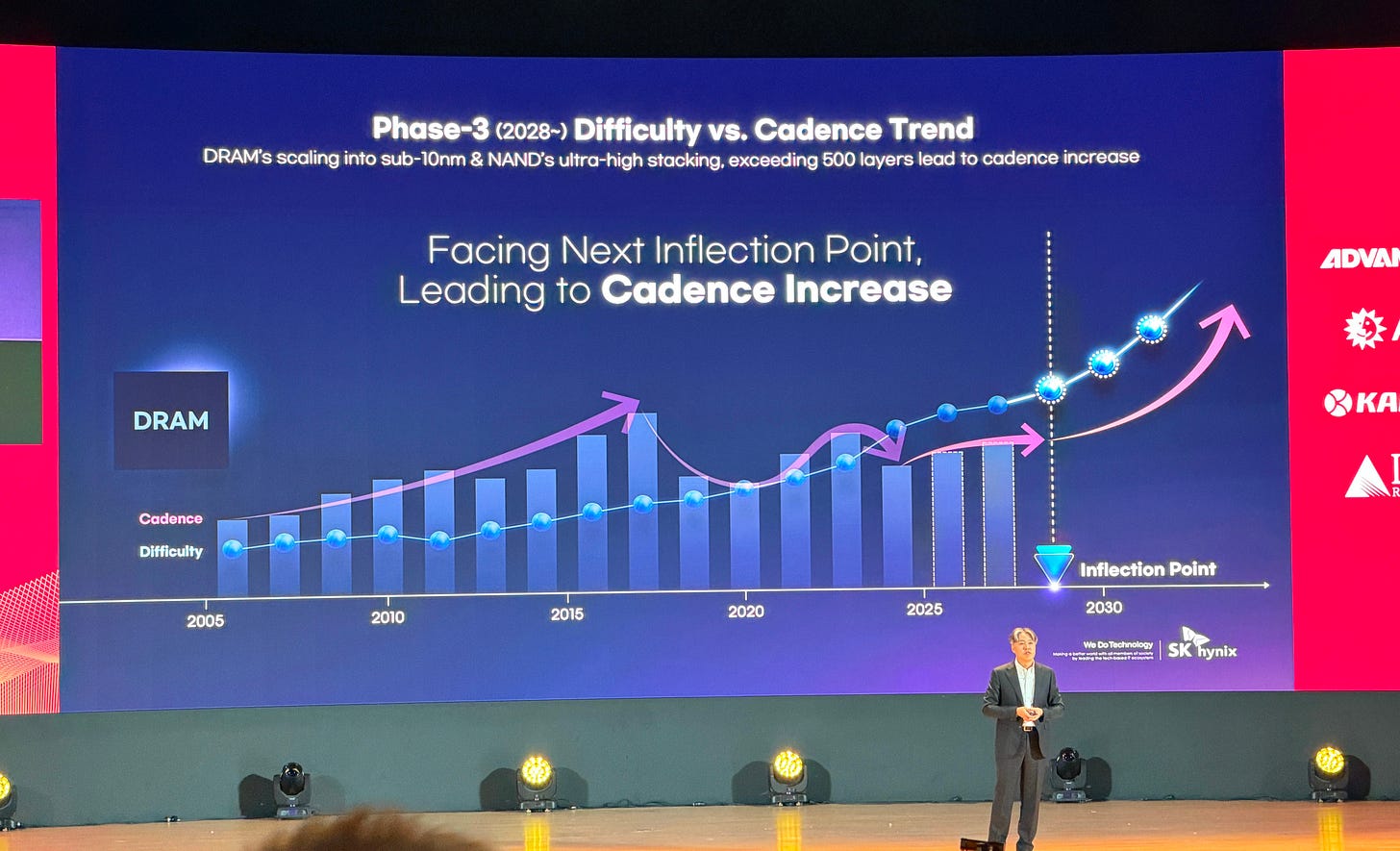
The next phase of HBM competition will not be limited to DRAM wafer fabrication. The competitive battlefield will expand across HBM4, HBM4E, base dies, logic dies, TSV, micro-bumps, hybrid bonding, advanced packaging, thermal materials, probe cards, test sockets, burn-in systems, AI server validation, and the co-design cadence between memory suppliers and GPU or ASIC customers.
To further consolidate its leadership in HBM, SK hynix will require more than capital expenditure. It will need greater control over the entire supply chain.
The company may need to invest in or acquire next-generation memory-controller IP, packaging equipment, stacking materials, testing solutions, thermal-management technologies, and potentially deeper equity relationships with U.S. AI ASIC developers, cloud service providers, and advanced-packaging ecosystem partners.
In this context, a U.S.-listed ADR becomes a powerful negotiation instrument.
For an American, European, or Japanese supply chain company, accepting highly liquid U.S.-listed equity is significantly easier than accepting shares traded only in Korea. This would provide SK hynix with greater flexibility in international acquisitions, strategic investments, supply chain partnerships, and joint investment programs with customers.
In the AI era, supply chain leadership is not determined solely by who has the best technology.
It is also determined by who can bind together capital, customers, equipment, and manufacturing capacity.

5月13日
Layer Three: Directing Capital Demand Toward a Deeper Overseas Market Without Draining Domestic Liquidity
If a company of this scale were to conduct an extremely large equity offering entirely within the Korean domestic market, it would inevitably create a crowding-out effect on the KOSPI. Large institutional investors would need to rebalance their holdings, ETFs would be forced to adjust their allocations, and smaller listed companies could suffer from capital and liquidity being redirected toward SK hynix.
Another important purpose of the U.S. listing is therefore to redirect the funding burden toward the world’s deepest capital market.
This could, in fact, help protect Korea’s domestic financial market.
SK hynix would be able to absorb international capital while reducing the extent to which its financing needs drain liquidity from the Korean market. This is not merely a corporate-level financial transaction. It is also a form of national industrial-capital allocation.

6月25日
Supply Chain Observation One: Capital Will Ultimately Flow Into Equipment, Packaging, Materials, and Infrastructure
SK hynix has stated that the proceeds from its ADR issuance will be used to build semiconductor fabs in Korea and to purchase semiconductor equipment, including ASML’s EUV lithography systems.
This statement is highly significant.
It tells us that the capital will not simply remain on the balance sheet. It will eventually be converted into tangible supply chain orders.
The first wave of beneficiaries will be equipment suppliers. Demand for EUV lithography, thin-film deposition, etching, cleaning, metrology, inspection, CMP, bonding, dicing, probing, and burn-in equipment will continue to tighten lead times and manufacturing capacity across the semiconductor equipment industry as the AI memory cycle accelerates.
The second wave will be materials suppliers. HBM capacity expansion requires greater volumes of photoresists, wet-process chemicals, CMP slurries, specialty gases, wafers, packaging materials, underfills, molding compounds, thermal interface materials, advanced substrates, and low-loss materials.
The third wave will be packaging and testing.
HBM production does not end when the DRAM dies are fabricated. The real bottlenecks lie in stack yield, TSV yield, bonding throughput, warpage control, thermal stress management, known-good-die management, and final testing.
In the AI era, the shortage is not limited to one component.
The real constraint is the ability of the entire supply chain to expand in a synchronized manner.
7月2日
Supply Chain Observation Two: HBM Expansion Is Evolving From a Wafer-Fab War Into a Packaging-Capacity War
SK hynix’s capacity expansion in Korea is not focused solely on front-end wafer fabrication.
The Yongin Semiconductor Cluster will serve as a long-term production base for DRAM and AI memory. SK hynix previously stated that the first Yongin fab is scheduled for completion in 2027. The full cluster is expected to include four advanced fabs and support a semiconductor ecosystem involving more than 50 local small and medium-sized enterprises.
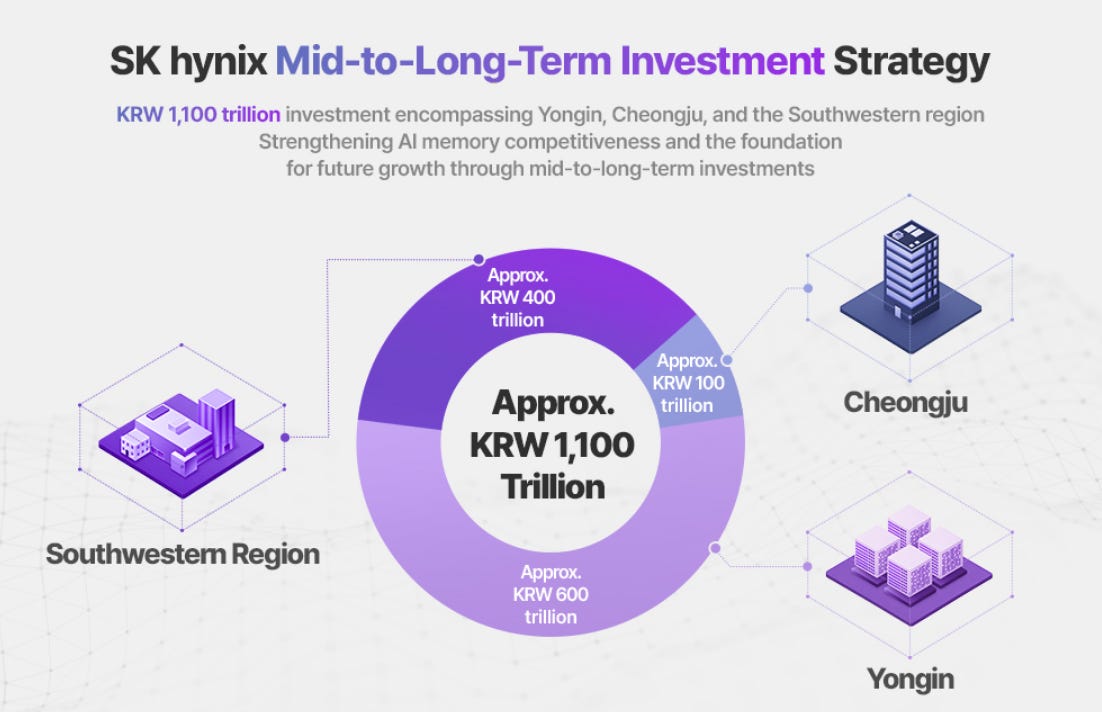
Source: SK Hynix
At the same time, Cheongju is being repositioned as a major AI memory and advanced-packaging hub. Industry media has reported that SK hynix plans to construct the P&T7 advanced-packaging fab in Cheongju, with an estimated investment of approximately KRW 19 trillion. The facility is expected to become fully operational by the end of 2027 and strengthen the company’s HBM production capacity.
This means that HBM competition is no longer simply about wafer capacity.
It is a combined competition involving wafer capacity, TSV processing, stacking, packaging, testing, and customer qualification.
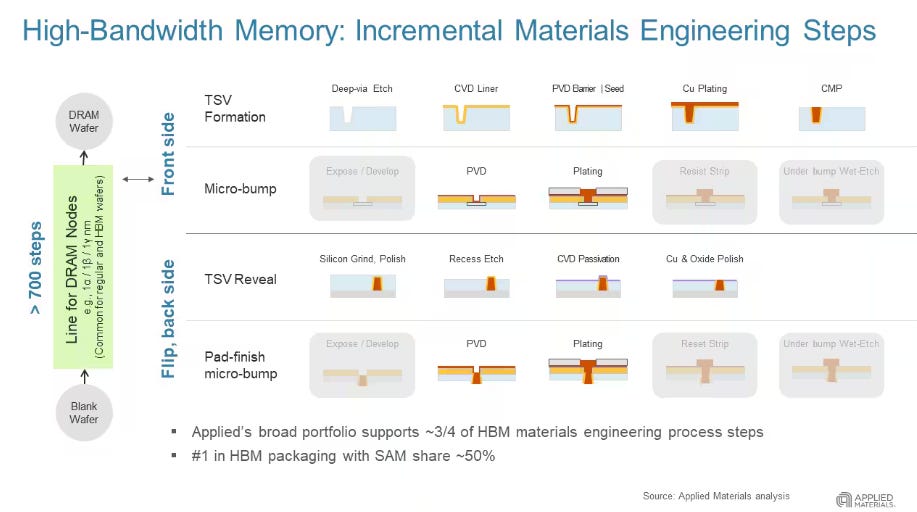
HBM supply chain bottlenecks will therefore extend across:
TSV process equipment
Copper plating and wafer-thinning equipment
Temporary bonding and debonding systems
Micro-bump and bonding materials
Underfill and molding materials
Probe cards, test sockets, and burn-in boards
Thermal interface materials
AI server validation and system-level testing
This is why the next critical constraint in the AI supply chain will not be limited to GPUs or even HBM itself.
The key question is whether advanced-packaging and testing capacity can expand quickly enough to keep pace.

Supply Chain Observation Three: SK hynix’s U.S. Listing Will Reshape Its Negotiating Position With Customers
HBM has become a shared bottleneck for Nvidia, Google, AMD, Broadcom, Marvell, AI ASIC developers, and cloud service providers.
As SK hynix gains access to a lower cost of capital, a higher valuation, and stronger international financial leverage, its position at the customer negotiating table will also change.
Historically, memory suppliers have often been treated as cyclical vendors. They generate substantial profits when prices rise, but once the cycle turns downward, the market quickly assigns them commodity-style valuations again.
HBM, however, is not a conventional commodity.
It is one of the most important system-level performance constraints in an AI accelerator. Without sufficient HBM, GPUs cannot be shipped. Without sufficient HBM, AI ASIC deployments cannot scale. Without sufficient HBM, cloud service providers cannot maintain their planned data-center construction schedules.
SK hynix is therefore transforming itself from a “memory supplier” into an “AI infrastructure gatekeeper.”
This shift will strengthen its bargaining position in long-term supply agreements, customer prepayments, joint investments, capacity reservations, and the co-definition of future product specifications.
The HBM supplier business model is gradually shifting away from the traditional memory cycle and toward a capacity-reservation cycle.
Impact on Taiwan’s Market: Neither Bearish Nor Simply Bullish, but a Reordering of Capital and Supply Chain Priorities
SK hynix’s U.S. listing will have at least three levels of impact on Taiwan’s market.
First, it may create a capital crowding-out effect.
Once SK hynix enters the U.S. market—and potentially becomes eligible for inclusion in the Philadelphia Semiconductor Index—global ETFs and institutional investors may be forced to rebalance their portfolios. Indutry media also noted that analysts believe SK hynix could eventually be added to the SOX Index, which would generate additional passive fund inflows.
This means that some capital may rotate away from broad AI-themed stocks and toward larger, purer AI infrastructure assets supported by stronger earnings and cash flow.
In Taiwan, AI concept stocks that rely mainly on market narratives, lack sufficient earnings support, or already reflect overly aggressive valuations may face a more disciplined reassessment.
Second, the benchmark for Taiwan’s AI supply chain will be raised.
In the future, international investors will no longer ask only whether a Taiwanese company has exposure to AI.
They will ask:
Is the company indispensable within the AI supply chain?
Is its capacity something customers must reserve in advance?
Can its gross margin expand as supply bottlenecks intensify?
Can its capital expenditure be converted into long-term contracts and stronger pricing power?
Is its technology being adopted in next-generation platforms, or is it merely benefiting from short-term rush orders?
This will accelerate differentiation across Taiwan’s advanced packaging, ABF substrate, high-end PCB, CCL, thermal-management, power, connector, testing, server ODM, and related supply chains.

5月4日
Third, Taiwan’s supply chain may also accelerate its move toward overseas capital markets.
Industry media noted in the same report that Taiwan-based Unimicron is also seeking to raise approximately US$1.4 billion through an overseas depositary receipt offering.
This is not an isolated event.
The AI supply chain requires enormous capital expenditure. When domestic markets cannot provide sufficient valuation support or liquidity, more Asian semiconductor companies will seek access to overseas capital.
In the future, we may see more Taiwanese, Japanese, and Korean supply chain companies raise funds through ADRs, GDRs, overseas convertible bonds, strategic investors, and international funds to secure cheaper, deeper, and more globally diversified capital.
Competition in the AI supply chain is expanding beyond the factory floor and into the capital markets.

7月1日
The Final Takeaway: In the AI Era, Capital Is Also Part of the Supply Chain
In the past, semiconductor analysis focused on process technology, yield, equipment, materials, customers, and production capacity.
In the AI era, one additional variable must be included: the capital market.
Advanced process nodes, HBM, CoWoS, glass substrates, CPO, 800V DC power architectures, liquid cooling, and AI server clusters all require enormous capital expenditure.

6月3日
The company with the lowest cost of capital can expand capacity faster.
The company with the highest valuation can obtain more resources with less shareholder dilution.
The company that can transform its shares into an internationally accepted strategic currency can take the lead in acquisitions, alliances, and supply chain negotiations.
SK hynix is not pursuing a U.S. listing because it lacks money.
It is signaling to the market that HBM is no longer merely a memory product. It has become a core asset within global AI infrastructure.
How much capital SK hynix raises is not the main issue.
The real issue is that the company is converting its technological leadership in HBM into valuation leadership in the capital markets, stronger bargaining power across the supply chain, and greater authority to shape the rules of the future AI memory ecosystem.
That is the strategic endgame investors should truly understand.
7月9日
Thanks for reading SEMIVISION @_@! This post is public so feel free to share it.


Previous