6 MLCC Questions Everyone Is Asking — SemiVision Explains
6 MLCC Questions Everyone Is Asking — SemiVision Explains
- Source: SemiVision
- Author: SEMIVISION
- Published: 2026-07-07T17:40:53+08:00
- URL: https://tspasemiconductor.substack.com/p/6-mlcc-questions-everyone-is-asking (6) 6 MLCC Questions Everyone Is Asking — SemiVision Explains


6 MLCC Questions Everyone Is Asking — SemiVision Explains
Original Article By SemiVision Research [Reading time: 14 mins]

Jul 07, 2026
∙ Paid

RAISE is the world’s leading AI summit, bringing together 9,000 AI leaders, C-suite executives, startups, investors, and policymakers. WithPresident Emmanuel Macronaddressing the summit, it reflects AI’s growing importance at the highest levels of policy, industry, and investment.
6 MLCC Questions Everyone Is Asking — SemiVision Explains
In the AI server supply chain, the market naturally focuses on GPUs, HBM, CoWoS, switch ASICs, liquid cooling, power architecture, and high-speed connectors.
But in many cases, what determines whether a system can operate reliably is not the most expensive chip. It is often the small, high-volume, high-spec, low-substitutability components that used to be treated as “standard parts.”
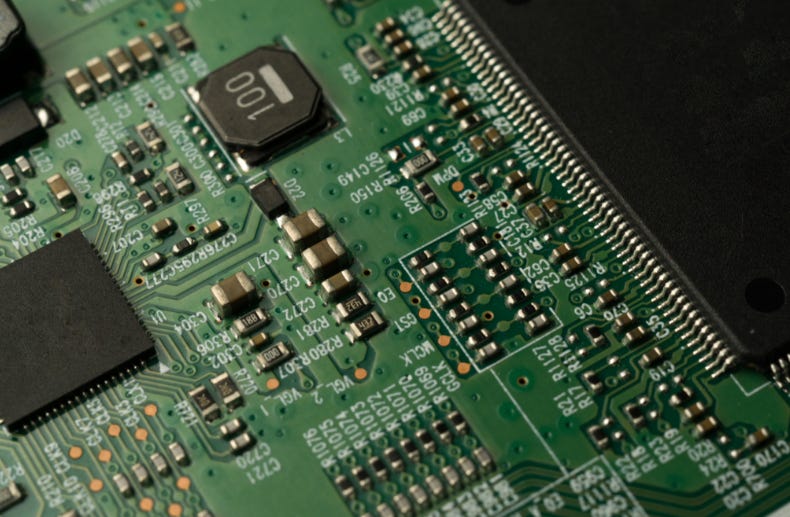
MLCC is one of them.
In one sentence:
MLCC is shifting from a consumer electronics cycle component into a high-reliability, high-value, high-specification component inside AI server platforms.

6月15日
Below we will answer:
Q1: Why AI Servers Are Pulling MLCC Demand Higher?
Q2: Why This Is Not Simply a Repeat of 2018?
Q3: Why Low-Capacitance MLCC Has Not Risen Across the Board?
Q5: Implications for Yageo, PSA, and Taiwanese MLCC Suppliers?
Q6: How Long Can This MLCC Cycle Last?
SemiVision Views
Q1: Why AI Servers Are Pulling MLCC Demand Higher?
The core function of MLCC is decoupling, filtering, voltage stabilization, and transient current support.
MLCC has long been widely used in smartphones, PCs, home appliances, automotive electronics, and industrial systems. But AI servers are different. An AI server is not a normal server. It is a highly dense, high-power, high-bandwidth, high-current switching computing system.
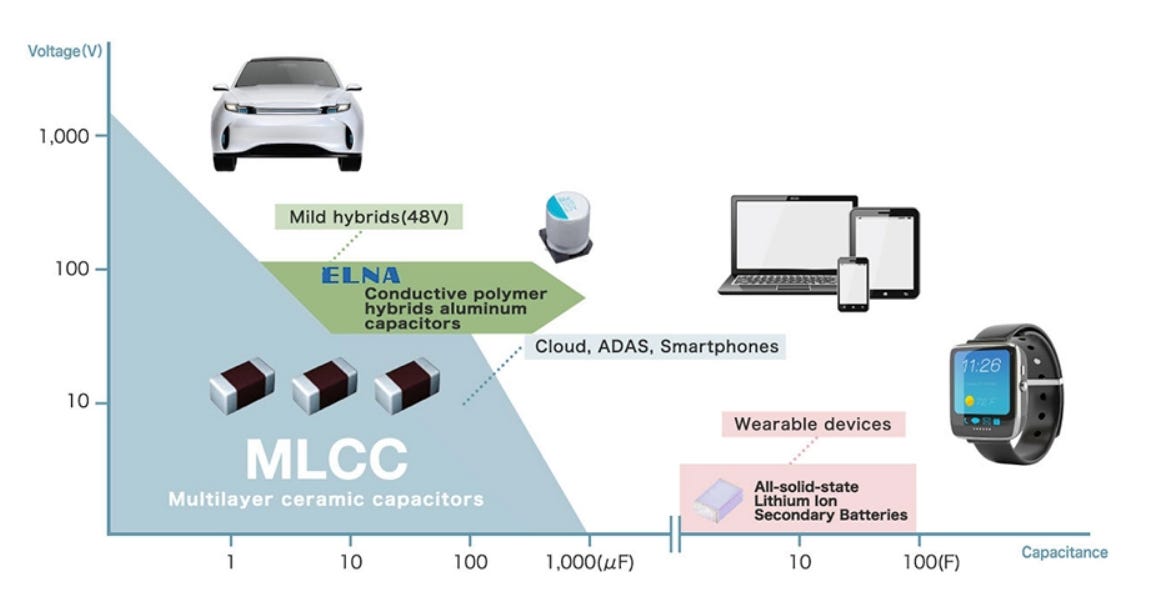
Source: yuden.co.jp
The core challenge of an AI server is not only whether it can compute fast enough.
The real question is:
When the GPU or AI ASIC switches rapidly between load states, can the power delivery network remain stable?
When a GPU moves from low load to high load within an extremely short time, the core voltage rail requires a fast transient current response. If the power delivery network cannot compensate quickly enough, voltage droop, noise, signal integrity degradation, and even system instability may occur.
This is why MLCC is becoming more important.
In AI server motherboards, GPU modules, HBM areas, power modules, switch boards, accelerator cards, and high-speed I/O zones, MLCC is no longer just about increasing quantity. It must meet much higher requirements.

AI servers are changing the logic of MLCC.
In the past, when analyzing MLCC, the market usually asked:
Is smartphone demand recovering?
Is PC demand improving?
Is automotive electronics still growing?
Now the market needs to ask one more question:
AI Servers Are Not Only Increasing MLCC Quantity; They Are Changing the Product Mix
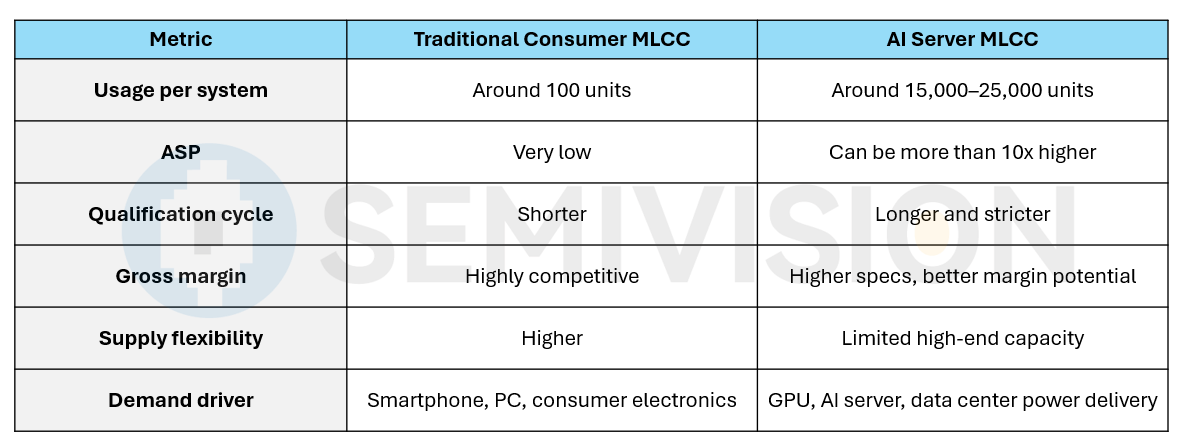
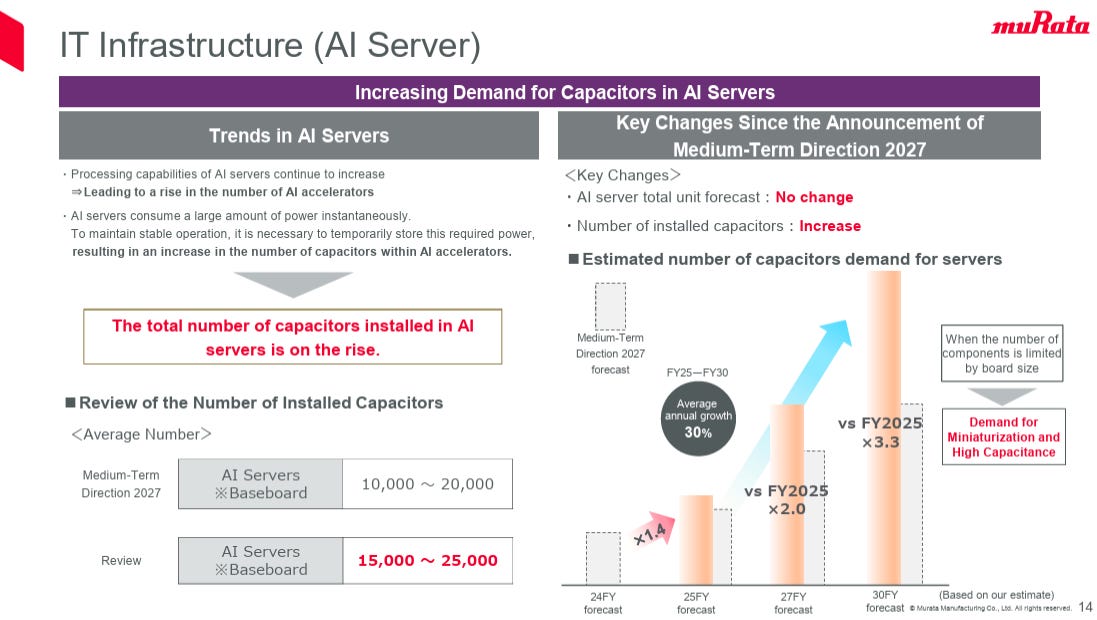
According to industry data, one AI server may require around 15,000 to 25,000 capacitors.
That number is already significant. But the more important point is that AI servers are not mainly driving low-end MLCC demand. They are driving demand for mid-to-high-capacitance, high-specification, high-reliability products.
Some of the commonly discussed part numbers include:
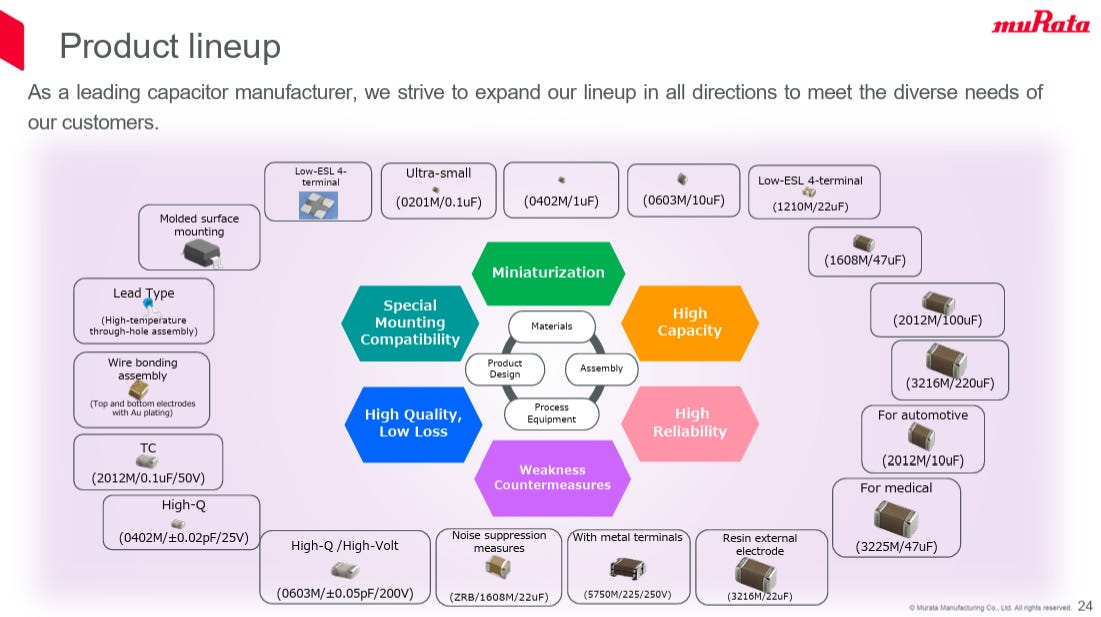
0402 47µF
0603 100µF
0402 476
0603 107
10V / 16V / 4V / 6.3V voltage classes
Low ESR / low ESL / high-reliability specifications
High-capacitance MLCC used around GPU, HBM, VRM, and server motherboard power zones
These products are very different from ordinary consumer electronics MLCC.
A standard consumer MLCC may cost only a few cents or even less. But high-end AI server MLCC can be several times or even more than ten times more expensive. Some high-capacitance part numbers such as 0603 107 and 0402 476 carry significantly higher pricing than ordinary products.
This means the investment significance of AI MLCC is not only about rising shipment share. It is about rising value share.
AI-related MLCC may still account for a relatively small portion of total shipment volume, but its revenue contribution is already higher than its unit share. This is why the market is starting to reassess the product mix of MLCC makers, rather than only looking at traditional utilization rates.
A simplified comparison is as follows:
This is the most important change in this MLCC upcycle:
Not all MLCC is in shortage. The real shortage is in high-end AI MLCC.
Q2: Why This Is Not Simply a Repeat of 2018?
In 2018, MLCC experienced a very aggressive upcycle.

At that time, demand from consumer electronics, automotive electronics, and industrial applications rose at the same time. Japanese suppliers also adjusted their product mix, which created broad-based supply-demand imbalance in low-end and mid-low-end MLCC. Channel prices rose sharply. Some part numbers saw extreme price increases, and the market saw hoarding, tight allocation, and duplicate ordering.
But the problem in 2018 was that demand and inventory signals quickly became distorted.
Once end demand slowed and channel inventory became excessive, prices corrected rapidly. The entire cycle moved from upturn to reversal very quickly.
The 2026 AI MLCC cycle has some similarities, but also major differences.
The similarities include:
Channel prices are rising again
Some part numbers are in tight supply
Japanese suppliers still control key high-end capacity
Customers are accelerating inventory preparation
Original manufacturers have stronger pricing power
But the differences are more important:

The 2018 cycle was more like a broad supply-demand mismatch.
This difference matters. If it were only a general MLCC price hike, investors would worry about a repeat of history. But if this is a revaluation of high-end AI part numbers, the market may apply a different valuation logic
Japanese Suppliers Still Control High-End MLCC Pricing Power

At present, high-end AI MLCC is still largely controlled by Japanese suppliers. Key players include:
Murata (JP)
Taiyo Yuden (JP)
TDK (JP)
Kyocera (JP)
Samsung Electro-Mechanics (KR)
Yageo (TW)
PSA (TW)
Holystone (TW)
Among them, Murata, Taiyo Yuden, Kyocera and TDK still have strong advantages in high-end, miniaturized, high-capacitance, and high-reliability MLCC.
This is why the current MLCC price increase cannot be quickly copied by Chinese or Taiwanese suppliers across the board.
The bottleneck in high-end AI MLCC is not simply about whether a supplier has equipment. It involves:
Ceramic powder materials
Dielectric layer thinning
Multilayer stacking technology
Sintering and shrinkage control
Miniaturized high-capacitance design
High-temperature, high-voltage, high-reliability validation
Customer platform qualification
Long-term failure rate data
In other words, AI MLCC has meaningful technical barriers.
For low-end MLCC, price competition can spread quickly. But for high-end AI MLCC, yield, reliability, and customer qualification matter more than short-term capacity.
This is why some high-end part numbers are currently difficult to source even when buyers are willing to pay higher prices.

6月16日
Supply Is Expanding, but This Is Not a Short-Cycle Industry
From the supply side, major vendors have already started expanding AI-related MLCC capacity.
There are several key directions to watch.
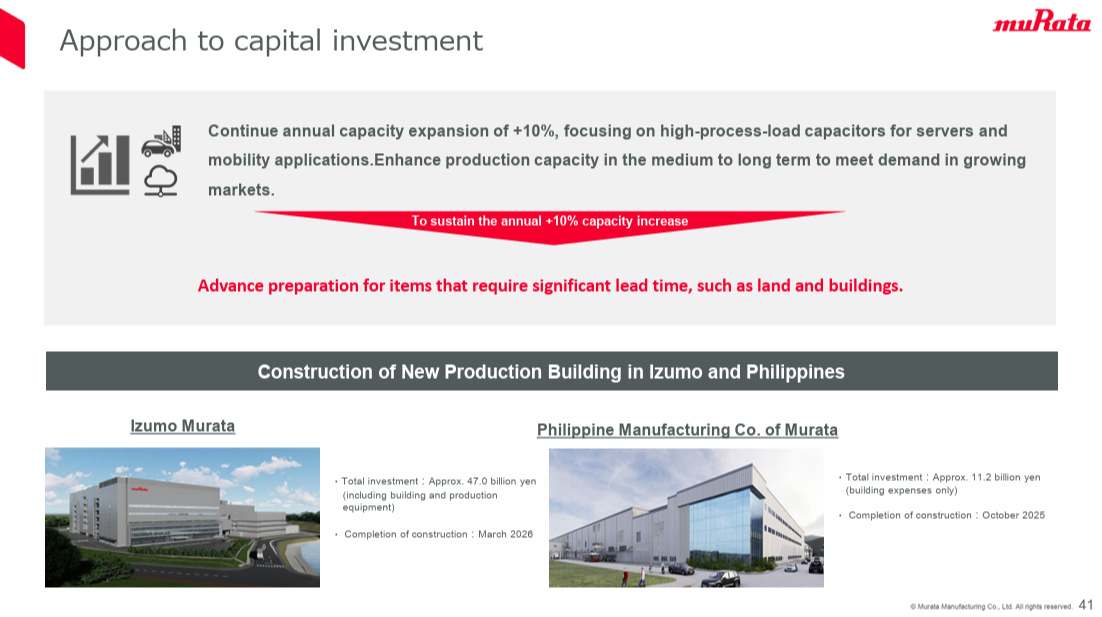
First, Murata is increasing investment in AI server MLCC.
Murata is adding new capacity focused on high-end MLCC for AI servers and is expected to gradually increase its AI product exposure over the next few years.
Second, Samsung Electro-Mechanics is expanding its Tianjin plant.
Samsung Electro-Mechanics’ Tianjin facility is increasing capacity. The market expects around 20% capacity expansion in 2026, with the medium-term goal of scaling capacity further.

Samsung Electro-Mechanics’ Tianjin plant is currently operating at full capacity, with around 8,000 workers working in shifts to ensure continuous production. The plant has also been selectively improving production process efficiency. The facility supplies MLCCs to smartphone brands such as Apple and Huawei, as well as automotive customers including Tesla, Hyundai Mobis, and Bosch.
Third, Taiyo Yuden is maintaining annualized expansion.
Taiyo Yuden continues to expand capacity by around 10–20% and is adjusting its product mix toward AI server applications.
But the issue is that MLCC capacity expansion is not a short-cycle process.
From equipment installation, process tuning, powder and material matching, sintering stability, yield ramp, to customer qualification, it usually takes more than one year. If high-end AI customers are involved, the validation cycle can be even longer.
Therefore, short-term supply elasticity is limited.
This is also why the current MLCC price increase may continue.
If AI server demand continues to grow rapidly while high-end capacity takes more than one year to come online effectively, prices are unlikely to return to previous levels in the near term.
Q3: Why Low-Capacitance MLCC Has Not Risen Across the Board?
One very important observation in this cycle is:
Low-capacitance, low-value MLCC has not risen across the board.
This means the market is not entering a universal shortage. It is highly structural.
AI MLCC demand is concentrated in high-capacitance, miniaturized, high-reliability products. These part numbers are usually used in GPU modules, AI server motherboards, VRM power delivery zones, HBM areas, and high-performance computing platforms.
By contrast, low-capacitance products below 1µF still have relatively sufficient supply. These products have less direct exposure to AI server power delivery demand and have not benefited as much from the current high-end demand cycle.
Therefore, this MLCC cycle should not be simplified as “all MLCC is rising.”
A more precise statement is:
AI servers are carving out a high-end, structurally tight segment within the broader MLCC market.
For manufacturers, the key is not total capacity. The key is high-end capacity mix.
For investors, the key question is not simply “who has MLCC capacity?” The real questions are:
Who has AI customer qualification?
Who can supply high-capacitance, miniaturized products?
Who can enter GPU and AI server BOMs?
Whose ASP and gross margin can truly improve?
Who can convert low-end capacity into high-end capacity?
These are the real competitive variables in this MLCC cycle.

6月3日
There is one market question worth addressing:
If future AI platforms adopt more advanced power architectures, such as Rubin using improved power delivery systems, will this reduce MLCC demand?
The answer is likely no.
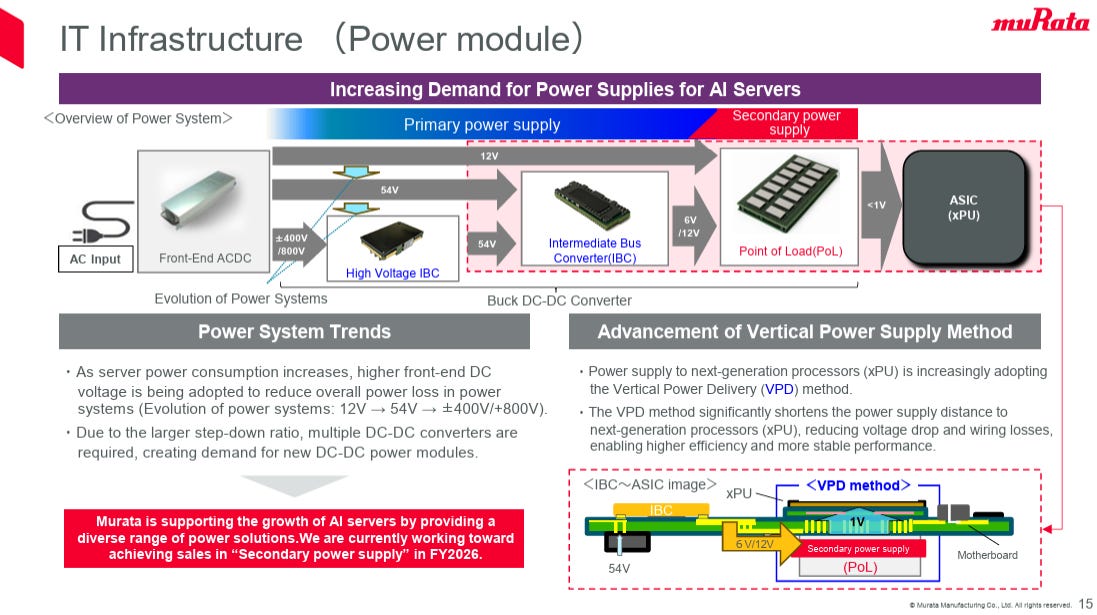
After Rubin and GB300, system power architecture will indeed change. VPD, TLVR, vertical power delivery, and low-voltage high-current designs will all reshape where MLCC is placed and how it is used.

3月17日
But this does not mean total MLCC value will decline.
There are three reasons.
First, GPU power consumption continues to rise.
Even if the power architecture improves, power consumption at the GPU, board, rack, and system level will continue to increase. Higher power means transient current management becomes even more important.
Second, power delivery hierarchy is becoming more complex.
AI servers now involve GPU modules, motherboards, switch boards, power modules, and rack-level power systems. MLCC may decrease in some locations but increase in others.
Third, high-end MLCC value is rising.
If some low-end MLCC is reduced through architectural optimization, the remaining MLCC may be concentrated in higher-specification and higher-value locations. The unit count may not explode, but the value content can still increase.
From the transition between GB300 and VR200 platforms, industry data suggests that both system-level and board-level MLCC demand may continue to rise, with more emphasis on high-capacitance and high-reliability specifications.
So the more reasonable conclusion is:
Rubin power architecture will not make MLCC disappear. It will shift MLCC demand from pure volume growth toward higher-value, higher-reliability demand.

6月22日
The Real Meaning of AI MLCC: From Cost Component to System Stability Component
There is one recurring pattern in the AI server supply chain:
The closer a component is to system stability, the easier it is to be underestimated.
The market looks at GPUs, but often ignores power delivery.
It looks at HBM, but ignores power integrity.
It looks at CoWoS, but ignores passive components.
It looks at liquid cooling, but ignores the high-frequency decoupling network on the motherboard.
MLCC belongs to this category.
Each unit is not expensive, but its system value is high.
It is not the most expensive component, but a shortage can affect full-system delivery.
It does not determine the upper limit of AI model performance, but it helps determine whether the system can be reliably produced and deployed.
AI servers are not consumer electronics. They cannot only pursue thinness, compactness, and low cost. They must operate reliably for long periods of time. Data center customers care about:
System reliability
Long-duration operating stability
Power noise
Failure rates under thermal stress
Maintenance cost
Downtime risk
Supply chain delivery stability
Therefore, the value of MLCC in AI servers is not just the value of the component itself. It is part of the reliability foundation of the data center.
Q5: Implications for Yageo, PSA, and Taiwanese MLCC Suppliers?
For Taiwanese suppliers, this AI MLCC cycle is an opportunity, but not an easy one.
Yageo, PSA, Holystone and other Taiwanese MLCC suppliers already have foundations in general-purpose, automotive, industrial, and some high-end products. But the key competitive variable in AI server MLCC is not just capacity expansion. It is product mix and customer qualification.
If Taiwanese suppliers can enter high-end AI server MLCC, there are three potential benefits.
First, ASP improvement.
High-end AI part numbers have much higher ASP than ordinary consumer MLCC and can improve product mix.
Second, gross margin improvement.
High-specification products have fewer competitors and generally better margin potential than low-end standard products.
Third, reduced dependence on consumer electronics cycles.
Historically, MLCC has been highly exposed to smartphone and PC inventory cycles. If AI, data center, automotive, and industrial exposure increases, cyclicality may become less severe.
But the challenges are also clear:
Japanese suppliers still dominate high-end customers
AI customer qualification cycles are long
High-capacitance miniaturized products are difficult to manufacture
Price increases may stimulate rapid capacity expansion
If AI capex slows, demand expectations may be revised
If channel prices rise too aggressively, inventory correction risk will increase later
Therefore, the key for Taiwanese suppliers is not short-term price increases. The key is whether they can truly enter high-end AI specifications.
Q6: How Long Can This MLCC Cycle Last?
Based on the current supply-demand structure, this AI MLCC upcycle may last longer than the 2018 cycle.
There are four reasons.
First, AI server demand is still expanding.
GPU, AI ASIC, HBM, switch ASIC, liquid cooling, and power systems are all still in rapid growth. MLCC is a foundational component for these systems and will grow with platform shipments.
Second, high-end capacity expansion takes time.
Even if suppliers expand capacity now, stable supply may not be fully available until 2027 or even 2028.
Third, customer qualification slows substitution.
AI server customers will not quickly switch suppliers just because prices rise. Reliability, qualification, and yield matter more than low prices.
Fourth, the product structure is upgrading.
The rising value share of AI MLCC means the market is no longer only looking at total shipment volume. It is looking at high-end part number exposure.
If AI server demand grows as expected and original manufacturers do not release new capacity earlier than expected, the MLCC supply gap may extend toward 2028.
But this does not mean there is no risk.
The biggest risk is that AI capex falls short of expectations. If major cloud customers slow AI server procurement, MLCC demand will be affected. Another risk is that overseas capacity ramps faster than expected, easing the high-end supply shortage. A third risk is that channel prices rise too aggressively, leading to customer over-ordering and later inventory correction.
Therefore, this cycle should be understood as:
A structural upcycle with inventory volatility.
SemiVision View: MLCC Is a Foundational Component Being Revalued by AI
AI server competition is moving beyond GPU procurement and spreading into full-system engineering.
HBM determines memory bandwidth.
CoWoS determines advanced packaging capacity.
Liquid cooling determines thermal density.
HVDC determines rack-level power efficiency.
High-speed connectors determine signal transmission.
MLCC determines power stability and local transient response.
This is the nature of the AI supply chain:
The deeper you look, the more you realize that the bottleneck is not only the chip. It is the entire system.
The rising importance of MLCC shows that AI infrastructure competition has entered the second layer.
The first layer is compute.
The second layer is power delivery, thermal management, advanced packaging, passive components, and system stability.
The third layer is data center-scale deployment.
Under this framework, MLCC is no longer just a cyclical passive component theme. It is becoming a key revalued component inside the AI server BOM.
The most important observation is not simply that “MLCC prices are rising.”
The real signal is:
AI is bringing previously overlooked foundational components back into the high-value supply chain.
This will be one of the core directions for AI hardware supply chain research over the next few years.
The market should not only track GPU shipments. It should also track power delivery, passive components, connectors, substrates, thermal solutions, power architecture, and full-system integration capacity behind the GPU.
Because in an AI data center, the shortage of even a small component can affect the delivery of the entire system.
The current MLCC story is a perfect example of that trend.

6月18日
Thanks for reading SEMIVISION @_@! This post is public so feel free to share it.


Previous