From 800V HVDC and Chroma’s Testing Platforms to Delta’s High-Voltage Infrastructure
From 800V HVDC and Chroma’s Testing Platforms to Delta’s High-Voltage Infrastructure
- Source: SemiVision
- Author: SEMIVISION
- Published: 2026-06-27T20:43:57+08:00
- URL: https://tspasemiconductor.substack.com/p/from-800v-hvdc-and-chromas-testing (1) From 800V HVDC and Chroma’s Testing Platforms to Delta’s High-Voltage Infrastructure


From 800V HVDC and Chroma’s Testing Platforms to Delta’s High-Voltage Infrastructure
Original Article By SemiVision Research [Reading time: 16 mins]

Jun 27, 2026
∙ Paid
The 72nd annual IEEE International Electron Devices Meeting (IEDM) is scheduled for December 12 - 16, 2026 at the Hilton San Francisco Union Square, with OnDemand access to recorded content after the event. Paper submission deadline is July 16, 2026, and the late-news deadline is August 18, 2026.
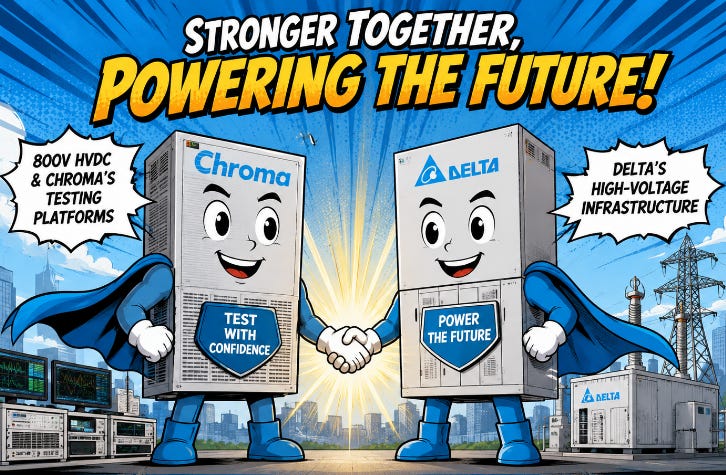
The Next Bottleneck in AI Data Centers Is Not the GPU — It Is Power Architecture
Over the past two years, when the market discussed AI data centers, most attention went to GPUs, HBM, CoWoS, optical interconnects, liquid cooling, PCBs, CCLs, and server assembly.
All of these are important.
But as AI systems move from single-server architectures to rack-scale systems, and eventually to cluster-scale and data-center-scale deployment, the real bottleneck is no longer only computing power.
It is power.
More precisely, the key question is how electricity enters the data center, how it is distributed to racks, how it is converted for GPUs, how the system handles fast transient loads, how conversion losses are reduced, and how reliability is maintained under extreme power density.
AI data centers are evolving from IT infrastructure into power infrastructure.
In the past, a data center was mainly a facility that housed servers. In the AI era, a data center is increasingly becoming an AI factory — a highly electrified system that integrates power grids, transformers, rectifiers, energy storage, power distribution, liquid cooling, monitoring, testing, reliability validation, and operations.
This is why 800V HVDC is becoming one of the most important trends in next-generation AI data centers.
6月18日
The Nature of AI Data Centers Is Changing
Traditional cloud data centers were designed for search, storage, streaming, enterprise cloud services, and general-purpose computing. These workloads were large, but their power density was relatively manageable.
AI data centers are different.
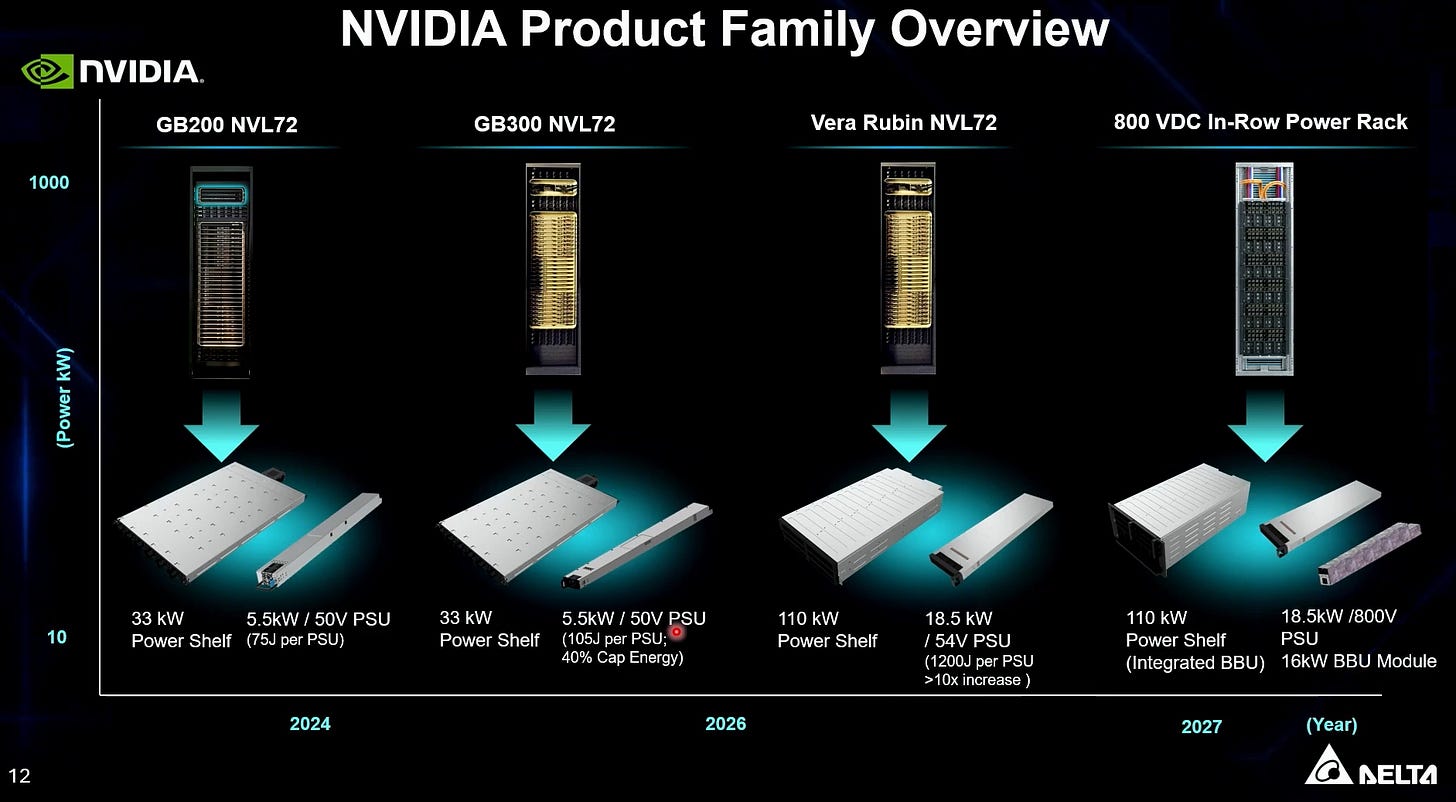
In the past, a rack might consume 10kW, 20kW, or 30kW. Today, AI racks are moving toward 100kW and 200kW. Future rack-scale AI systems may push toward several hundred kilowatts or even megawatt-level power.
Below we will share:
Why 800V Is the Future Trend
800V Will Create a New Supply Chain
Chroma: The Testing Platform Behind 800V HVDC AI Power Systems
Delta: From Power Supply to Grid-to-Chip Infrastructure
The Next AI Battleground Is Power Efficiency and Reliability

6月3日

At that point, the old architecture starts to hit its limits.
The question is no longer simply, “Do we have enough power?”
The real questions are:
Can the power enter the rack efficiently?
Can it be converted with minimal loss?
Can copper busbars, cables, and connectors handle the current?
Can the heat be removed?
Can voltage stability be maintained during fast load changes?
Can the system protect itself during abnormal conditions?
Can the entire power architecture be fully tested before deployment?
This is why AI data centers are shifting from a compute problem into a power problem.
Why 800V Is the Future Trend
There is a simple principle in power systems:
For the same power level, higher voltage means lower current.
Power equals voltage multiplied by current:
P = V × I
If power demand keeps rising while distribution voltage remains low, current must increase significantly.
Higher current creates three major problems.
First, I²R loss rises sharply.
The larger the current, the greater the heat loss in cables, conductors, connectors, and busbars. This is a basic electrical reality. When power demand rises but voltage remains low, the system must push more current through the distribution path. That current does not come for free. It turns into heat, reduces efficiency, and increases stress on every layer of the power delivery network.
Second, copper usage and cable volume increase.
This is not only a cost issue. It is also a space issue. In an AI rack, every inch matters. If cables, busbars, and power components occupy too much space, they reduce the room available for compute, cooling, airflow, maintenance access, and serviceability. At the rack scale, power distribution is no longer just an electrical design problem. It becomes a mechanical design problem, a thermal design problem, and eventually a system architecture problem.
Third, thermal management becomes more difficult.
Power conversion and distribution losses eventually become heat. Data centers must cool not only GPUs, CPUs, HBMs, switches, and optical modules, but also the losses generated by the power delivery system itself. As rack power moves from tens of kilowatts toward hundreds of kilowatts, even small efficiency losses can translate into meaningful thermal burden. The power system becomes part of the cooling problem.
Fourth, power delivery becomes harder to scale.
A low-voltage, high-current architecture may work at moderate rack power levels, but it becomes increasingly inefficient as AI rack density rises. More current means thicker conductors, larger connectors, higher distribution losses, and more complex protection design. At some point, simply adding more copper is no longer an elegant solution. The industry needs a higher-voltage architecture to move large amounts of power more efficiently.
Fifth, system reliability becomes more sensitive to power architecture.
AI servers are not static loads. GPU clusters create fast load transients, sudden current spikes, and highly dynamic power behavior during training and inference workloads. If the power delivery system cannot respond quickly and efficiently, it may affect system stability, uptime, and performance. In AI data centers, power is no longer just a utility input. It is part of the compute infrastructure.
This is why the industry is moving toward higher-voltage distribution architectures such as 800V HVDC. The core logic is simple: for the same power level, increasing voltage reduces current. Lower current reduces I²R loss, copper usage, cable volume, connector stress, and thermal burden. In other words, 800V HVDC is not just about power efficiency. It is about enabling the next generation of high-density AI racks.
The bottleneck of AI infrastructure is no longer only GPU supply, HBM capacity, or advanced packaging. Power delivery is becoming one of the defining constraints of AI data center scaling.
Therefore, AI data centers need to move to higher voltage.
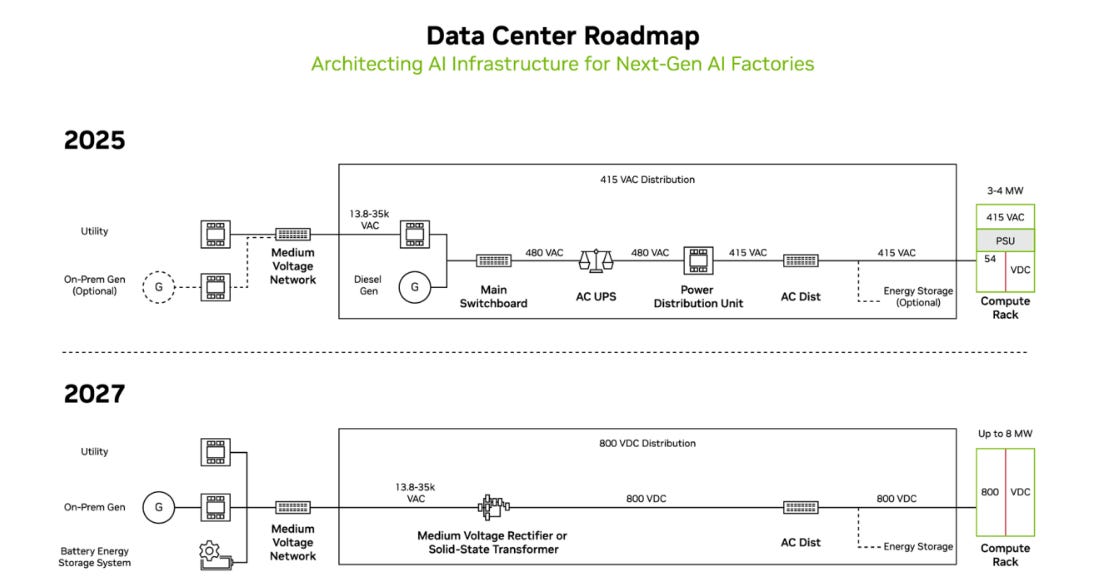
The strategic meaning of 800V HVDC is not simply replacing 48V or 54V power distribution with a higher voltage. It is about redesigning the entire power chain.
The future direction is clear: utility power enters the facility, fewer conversion stages are used, a high-voltage DC bus is created, and power is delivered to AI compute racks through rack-level, row-level, or sidecar-level infrastructure. Then, power is converted closer to the load into the low voltages required by GPUs, CPUs, ASICs, memory, and networking devices.
It is a restructuring of data center power architecture.
This is why NVIDIA has positioned 800VDC as a foundation for next-generation AI factory infrastructure.

Source: NVIDIA
The goal is not only to improve the efficiency of a single server. The goal is to improve the scalability, space efficiency, copper efficiency, power conversion efficiency, and tokens-per-watt economics of the entire AI factory.
In the AI era, efficiency is no longer just about chip performance.
It becomes:
tokens per watt
tokens per rack
tokens per square meter
tokens per dollar of power infrastructure
This is the strategic significance of 800V.
800V Will Create a New Supply Chain
Once data centers move toward 800V HVDC, the beneficiaries will not be limited to power supply manufacturers.
A broader value chain will emerge.
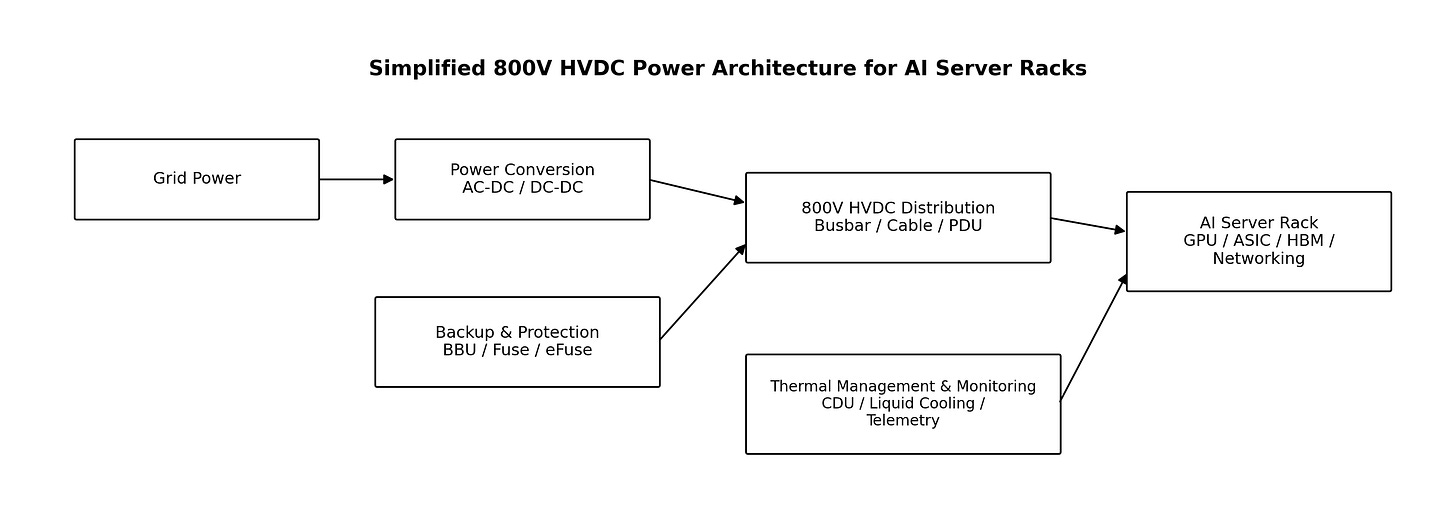
One area that the market may underestimate is testing.
800V HVDC systems do not only need to be designed. They must be proven to be safe, stable, and reliable under real operating conditions.
If a power system fails in an AI data center, it is not just a single device failure. It may affect an entire rack, row, or cluster.
In high-power AI systems, power failure means compute downtime.
And compute downtime means revenue loss.
This is why 800V testing will become increasingly important.
800V Testing Is Not Just Voltage Measurement
When people hear “800V testing,” they may think it simply means measuring voltage, current, and efficiency.
In reality, it is far more complex.
An 800V HVDC AI data center power system requires validation across many dimensions.

The key point is that AI data center power systems must be validated under normal conditions, high-load conditions, fast transient conditions, abnormal conditions, long-term operation, and maintenance scenarios.
AI workloads are very different from traditional server workloads. A GPU cluster may generate fast, synchronized, and aggressive power demand changes. When many GPUs draw power simultaneously, the system must not only supply enough power, but also avoid bus voltage instability, false protection triggers, converter instability, and localized overheating.
Therefore, the value of 800V testing is not simply pass or fail.
It determines whether the entire AI power architecture can be mass-produced, deployed, operated, and trusted by hyperscale customers.
Chroma: The Testing Platform Behind 800V HVDC AI Power Systems
Chroma is one of Taiwan’s important companies in power electronics testing, automated test systems, and high-power validation.
From Chroma’s official product information, it is clear that the company has already positioned HVDC server power testing as a key application for AI servers.
Chroma describes ±400V HVDC as a system with two 400V rails, positive and negative, with the neutral point grounded. The total voltage difference between the positive and negative rails is 800V. This architecture improves transmission efficiency and reduces energy loss in cables and power distribution equipment.
In a typical architecture, a front-end PDU or power conversion system converts AC power into ±400VDC. A downstream DC-DC converter then converts ±400VDC into 48VDC or 50VDC to supply the AI server system.
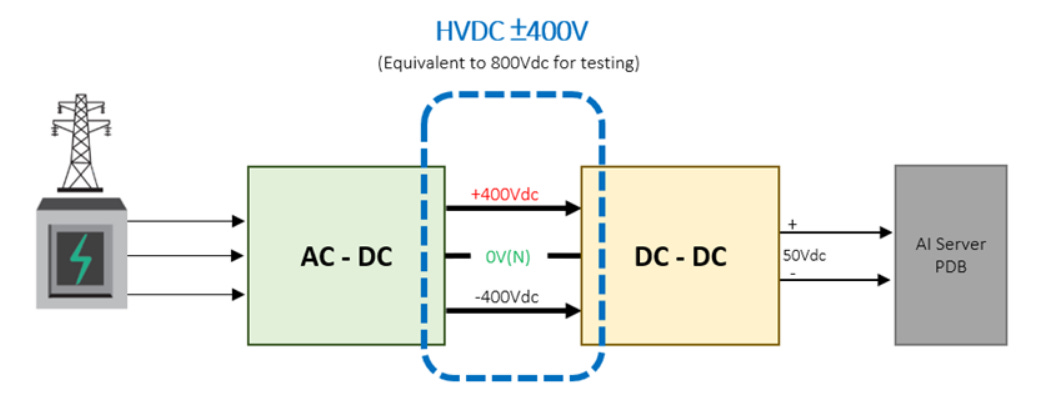
To address the testing requirements of these two major modules, the overall design must cover everything from a single PSU, or power supply unit, to the power shelf and the power rack. The power range spans from 25kW to 800kW and even higher. AC-DC modules require HVDC DC load equipment, while DC-DC modules require HVDC DC power supply equipment. A test voltage of ±400V can also be viewed as an 800V differential voltage. Therefore, the test equipment must offer a high degree of flexibility and be expandable through parallel connection to support different power levels. Ideally, the equipment should also provide bidirectional source and load functionality to meet the diverse testing needs of different modules.
Chroma’s 62450D-2000HL bidirectional DC power supply features a high-power-density design, delivering up to 45kW of output power in a single 4U unit. Through master-slave parallel operation, the system can achieve a total output power of 360kW within a standard 19-inch, 41U rack. It also supports parallel expansion across multiple racks, enabling megawatt-level output power. This fully covers the power module requirements under the sidecar architecture and allows users to select the appropriate power solution for products under test at different power levels, including PSUs, power shelves, and power racks. This provides strong scalability and high application flexibility.
For long-duration operating requirements such as reliability testing and burn-in testing of AC-DC modules under the sidecar HVDC architecture, the 62450D-2000HL’s built-in regenerative load function can effectively feed energy generated during the testing process back to the grid. Under rated operating conditions, the energy recovery efficiency can reach up to 94%, helping reduce energy consumption, carbon emissions, electricity costs, and the burden on the cooling system.

For DC-DC module testing, the 62450D-2000HL can also serve as a stable and reliable DC power supply. Its built-in High/Low dual-range design allows users to select either 400V or 800V input voltage according to different testing requirements. By flexibly supporting different current levels and equipment configurations, it provides stable and reliable power supply performance.
The AI server market is moving toward a more efficient, more flexible, and higher-power HVDC power architecture. With both power supply and regenerative load capabilities, Chroma’s 62450D-2000HL bidirectional DC power supply provides an efficient energy recovery mechanism and flexible application modes. It serves as a key enabling force behind the development of AI technology and green energy sustainability.

Fully aligned with international standards such as OCP M-CRPS and ORV3, the Chroma 8000 supports the entire process from R&D validation to mass production, helping customers accelerate their entry into the server power market.
Chroma’s HVDC Server Power Automated Test System Model 8000 is built on the Chroma 8000 ATS platform. It is designed to test and validate ±400V HVDC server power conversion devices. It can integrate Chroma’s regenerative test instruments, including the 61800, 63200A, 62000D, and 63700 series, to perform input, output, protection, dynamic load, surge, and PMBus communication testing.
This reveals an important trend:
In the 800V AI data center era, ATE is not only a semiconductor testing concept. It will also become part of the manufacturing and reliability validation process for power infrastructure.
Chroma also offers the 62450D-2000HL bidirectional DC power supply. According to Chroma’s official information, this model can deliver 45kW in a 4U form factor. Through master-slave parallel operation, it can reach 360kW within a 19-inch 41U standard rack, and can be expanded across cabinets to megawatt-level systems.
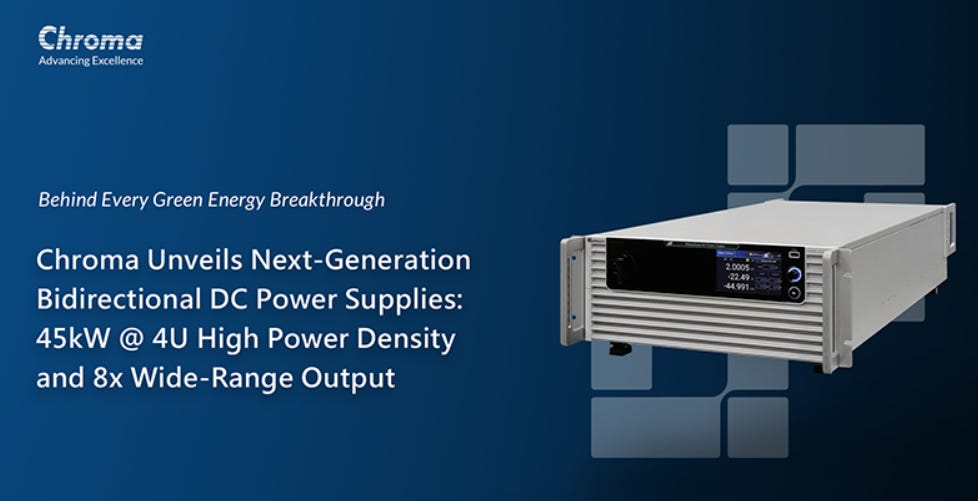
The key word is bidirectional.
In source mode, it can provide 800VDC output to simulate the power source and validate server rack performance.
In load mode, it can accept 800VDC input to simulate the server rack load and validate power rack stability.
This is critical for AI data centers because customers need to test not only the power supply side, but also load conditions. They need to test not only steady-state operation, but also dynamic response. They need to test not only short-term function, but also long-duration burn-in and reliability.
Chroma also emphasizes regenerative load capability. Its energy recovery efficiency can reach up to 94% under rated operating conditions.
This matters because the power level of AI power rack testing is becoming extremely high. If all test energy is converted into heat, the result is not only wasted electricity but also increased cooling burden and higher test facility cost.
Therefore, Chroma’s role in the 800V trend is not simply selling instruments.
It provides the validation platform for AI data center power systems.

As AI infrastructure moves from 100kW racks toward 1MW racks, testing equipment must also evolve toward higher power, higher voltage, higher automation, and higher energy recovery efficiency.
Chroma Provides a Complete SST Module Test Solution Covering Full-Range AC and DC Validation Requirements
A solid-state transformer, or SST, is composed of multiple integrated power modules. Through multi-module series and parallel configurations, it can support medium-voltage AC input, or MVAC, as well as ±400V / 800V output, while delivering megawatt-class power capability.
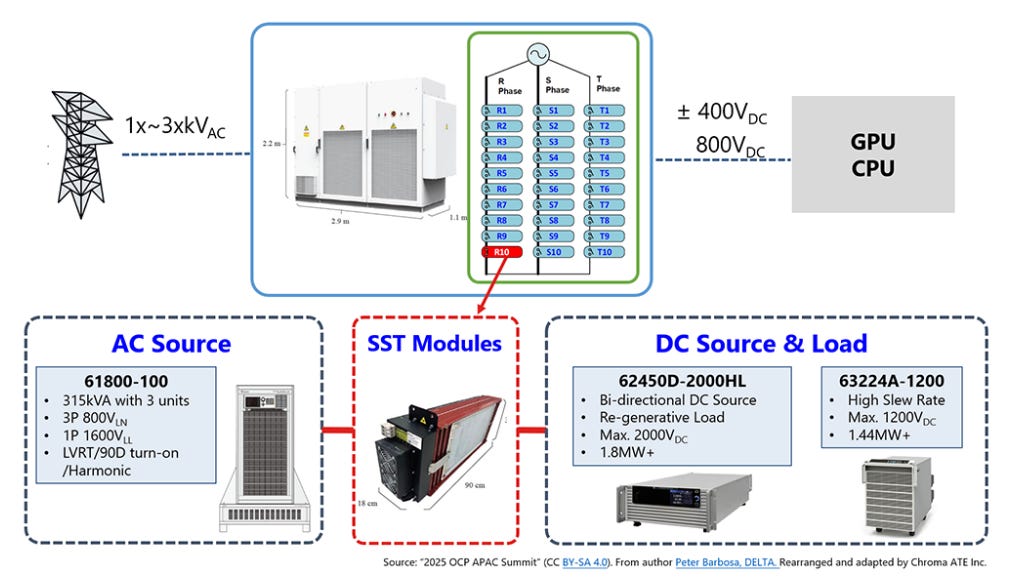
To help customers shorten development cycles and improve the reliability of SST modules, Chroma provides a comprehensive test solution covering both AC-side simulation and DC-side loading requirements.
AC-Side Test Solution
The Chroma 61800-100 grid simulator, paired with a dedicated step-up transformer, can deliver up to 1,600VLL single-phase output voltage. This voltage range can meet the requirements of most module-level tests and helps customers fully simulate and validate different grid conditions.
DC-Side Test Solution
The Chroma 62450D-2000HL programmable bidirectional DC power supply supports a 2,000V DC source and regenerative load functionality. This voltage specification can satisfy the voltage requirements of most DC links in SST modules and support bidirectional architecture testing. It can also significantly reduce testing energy consumption by more than 80%.
The Chroma 63224A-1200 high-power programmable DC electronic load features 1,200V capability and high-current, microsecond-level high slew rate load characteristics. This enables users to perform fast dynamic response load testing required by most devices under test.

3月9日
Delta: From Power Supply to Grid-to-Chip Infrastructure
If Chroma represents the testing and validation layer of 800V HVDC, Delta represents high-voltage power, distribution, cooling, and system integration.
Delta has long been a global leader in power and thermal management. But AI data centers are making its strategic position even more important.
AI data centers no longer need only power supplies. They need complete power architecture.
Delta’s recent AI data center roadmap shows several important directions.

First, Delta has introduced an 800VDC In-Row Power Solution.
The core idea is to deploy high-voltage power and backup power modules near the rack or row. This improves space utilization, reduces distribution losses, and enhances system resilience and scalability.
Second, Delta’s 1.1MW-scale In-Row Power is designed for high-end AI data centers. In a standard 19-inch footprint, it supports 400–480VAC input and 800VDC output. Through multiple HVDC power shelves, it provides up to 1.1MW-class in-row power delivery. This means Delta is not only making individual power supplies. It is building megawatt-scale AI rack power infrastructure.

Third, Delta has disclosed high-voltage DC power solutions supporting both 800VDC and ±400VDC architectures for high-density, megawatt-scale AI data centers. The company has also developed a 19-inch 90kW DC/DC server power shelf that converts 800VDC into 50VDC or 48VDC. It is also developing DC/DC power distribution boards that can convert 800VDC directly into 50VDC or 12VDC, with peak overall conversion efficiency of up to 98.5%.
These details are important because they show that Delta’s direction is not a single product. It is an integrated solution covering high-voltage DC conversion, distribution, backup power, and thermal management.
Fourth, Delta is connecting 800V power with liquid cooling.
At COMPUTEX 2026, Delta showcased a prefabricated AI modular data center integrating 800V In-Row Power and 3MW liquid cooling systems. This means high-voltage power and liquid cooling are no longer separate components. They are becoming one integrated AI data center solution.
Delta also showcased an 800VDC 2.4MW liquid-to-liquid CDU with 25kW HVDC electric pumps, N+1 redundancy, and hot-swappable design. This indicates that not only GPUs require higher power. The cooling infrastructure itself is also moving into an HVDC architecture.

2月28日
This is Delta’s Grid-to-Chip strategy.
From the utility grid to data center power distribution, from rack power to board-level conversion, and from chip cooling to system-level thermal management, everything must be integrated.

The Real Investment Logic: Who Solves the Power Bottleneck?
In the past, the market often classified AI beneficiaries as GPU suppliers, HBM suppliers, CoWoS beneficiaries, optical interconnect companies, or server ODMs.
The next stage may require a new category:
AI power infrastructure beneficiaries.
This group includes several types of companies.

Chroma’s position is especially interesting.
The adoption of 800V HVDC cannot rely only on design. It requires extensive validation:
Module validation
Rack validation
Power shelf validation
BBU validation
DC/DC converter validation
Burn-in
Reliability
Protection testing
Dynamic load testin
Communication testing
Long-term operation testing
As power systems move from low voltage to high voltage, the testing threshold rises.
As power levels move from tens of kilowatts to hundreds of kilowatts and megawatts, the power rating of test equipment must also rise.
As customers move from single power modules to rack-level and row-level solutions, testing must also move from component-level validation to system-level validation.
Therefore, the 800V trend is not just another application market for Chroma. It increases testing complexity, testing power, testing automation, and testing value content at the same time.
Delta’s investment logic is closer to system-level infrastructure.
Delta is not only making power supplies. It is building in-row power systems, DC/DC shelves, power distribution boards, PCS, liquid cooling systems, CDUs, fans, energy storage, and modular data centers. This gives Delta more opportunities to capture system value from the AI data center power and thermal bottleneck.
Conclusion: The Next AI Battleground Is Power Efficiency and Reliability
AI data center development is entering a new stage.
The first stage was GPU scarcity.
The market cared about who could secure GPUs.
The second stage was advanced packaging scarcity.
The market focused on CoWoS, HBM, substrates, PCBs, CCLs, and optical interconnects.
The third stage will be infrastructure scarcity.
The market will increasingly focus on power, cooling, space, grid connection, deployment speed, and operational reliability.

800V HVDC is one of the core technologies of this third stage.
The logic is simple:
The more powerful AI systems become, the higher the power density.
The higher the power density, the harder it is to maintain low-voltage, high-current architectures.
The harder low-voltage architectures become, the more necessary high-voltage DC becomes.
The more widely high-voltage DC is adopted, the more important testing, protection, distribution, conversion, cooling, and system integration become.
Therefore, the future competition in AI data centers is not only about who has the strongest GPU.
It is about who can operate those GPUs stably, efficiently, and at scale.
The key questions are:
Who can deliver power into the rack?
Who can remove the heat?
Who can keep the system running?
Who can prove that the system is safe and reliable under 800V high-voltage conditions?
This is why companies like Chroma and Delta deserve attention.
Chroma solves the question of how to validate 800V AI power systems.
Delta solves the question of how to build 800V AI power and cooling infrastructure.
In the AI era, compute is only the surface.
The real foundation is electricity.
And when electricity becomes the foundation of intelligence, 800V HVDC is no longer just a power technology. It becomes essential infrastructure for AI data centers moving toward megawatt-scale and eventually gigawatt-scale deployment.
The future of AI competition will not only happen on the chip.
It will also happen in every busbar, every power shelf, every DC/DC module, every CDU, every test system, and every high-voltage reliability validation process.
No power, no compute.
No validation, no deployment.
No infrastructure, no AI.
Thanks for reading SEMIVISION @_@! This post is public so feel free to share it.


PreviousNext