South Korea’s Survival Gamble: When a Young Generation Stops Believing in Hard Work and Goes All In
South Korea’s Survival Gamble: When a Young Generation Stops Believing in Hard Work and Goes All In
- Source: SemiVision
- Author: SEMIVISION
- Published: 2026-06-25T09:34:03+08:00
- URL: https://tspasemiconductor.substack.com/p/south-koreas-survival-gamble-when (1) South Korea’s Survival Gamble: When a Young Generation Stops Believing in Hard Work and Goes All In


South Korea’s Survival Gamble: When a Young Generation Stops Believing in Hard Work and Goes All In
Original Article By SemiVision Research [Reading time: 16 mins]

Jun 25, 2026
South Korea’s Survival Gamble: When a Young Generation Stops Believing in Hard Work and Goes All In

The despair of South Korea’s young generation did not appear overnight.
It was not caused by a single financial crisis, nor by the mistake of one administration. It is the result of structural pressures accumulated over many years. When housing, education, employment, gender inequality, pension burdens, and chaebol dominance all press down on one generation at the same time, young people eventually stop choosing the traditional path of “work hard, save slowly, get married, buy a home, and raise children.”
Instead, many push all their chips onto the table and gamble for one chance to change their fate.
This is one of the most important social phenomena in South Korea today.
On one side, South Korea has one of the world’s lowest fertility rates, hovering around 0.7 to 0.8. On the other side, young people in their 20s and 30s are rushing into leveraged ETFs, cryptocurrencies, altcoins, and other highly volatile assets. At first glance, these two trends seem unrelated. One is about family and demographics; the other is about financial speculation.

South Korea’s birthrate, the world’s lowest, rises again amid signs of easing demographic crisis
But underneath the surface, they come from the same root:young people no longer believe society will reward them in a fair or rational way.
When the normal road offers no exit, gambling starts to look like a rational choice.

6月8日
The Problem Is Not Laziness. The Ladder Has Been Removed.
When people discuss South Korea’s young generation, they often use words like “lying flat,” “nihilistic,” “anti-marriage,” or “anti-birth.” But these labels only describe the surface. They do not explain the structure underneath.
The real issue is that South Korea’s upward mobility ladder has become extremely narrow.
South Korea is a highly chaebol-driven economy. Major groups such as Samsung, SK, Hyundai, LG, and Lotte control enormous industrial resources, employment opportunities, and wage premiums.For young Koreans, one of the most important doors in life is whether they can enter these large corporations.
Once inside, income, benefits, social status, and even competitiveness in the marriage market can rise dramatically. If they fail to enter, however, many are pushed into small businesses, temporary contracts, informal jobs, low-wage service work, or unstable employment.
This is not merely a wage gap. It is a life-path gap.
From a young age, Korean students are trained inside an intense examination system. The goal is to enter elite universities, then compete for a small number of positions at large corporations. But top corporate jobs are limited. They cannot absorb everyone.
The result is a giant social funnel. Everyone is pushed upward, but only a small minority can pass through. Those who are filtered out are not necessarily lazy or incompetent. In many cases, they are simply eliminated by the design of the system.
The situation becomes even harsher when automation is added to the picture.
South Korea is one of the most automated economies in the world. Its industrial robot density ranks among the highest globally. From the corporate perspective, automation improves efficiency and reduces cost. But from the perspective of young workers, it means that the number of stable manufacturing jobs is shrinking.
At the top, they cannot enter the chaebol world. At the bottom, they are squeezed by robots and lower-cost labor.
This is the reality many Korean young people face.
They do not misunderstand the value of hard work. They understand it too well. What they increasingly see is that hard work no longer guarantees mobility. When the link between effort and reward breaks, social trust begins to collapse.
Housing Is No Longer Shelter. It Has Become a Black Hole.
For previous generations, housing represented stability, security, and family formation. For many young Koreans today, housing has become a source of fear, debt, and even fraud.
South Korea has a unique rental system known as jeonse. Under this system, tenants pay a large lump-sum deposit instead of monthly rent. The deposit can reach 50% to 80% of the property’s value. At the end of the contract, the landlord is supposed to return the deposit.
In a rising housing market with easy credit and constant asset inflation, this system can appear to be mutually beneficial. Tenants avoid monthly rent, while landlords receive a large pool of capital that can be reinvested or used to buy more properties.
But once housing prices fall and funding chains break, the system can start to resemble a Ponzi structure.
Many landlords used tenants’ deposits as leverage to buy more properties. They relied on the next tenant’s deposit to repay the previous tenant. When the market reversed and new money stopped coming in, some landlords went bankrupt. Young tenants then found themselves unable to recover their deposits.
For many young workers, that deposit is not spare cash. It may represent years of savings, parental support, or even borrowed money. Losing it means losing the first pool of capital in life.
This is not just a financial setback. It is the destruction of early-life capital.
If a person loses their first meaningful savings between the ages of 25 and 35, they lose more than money. They lose the ability to marry, buy a home, raise children, change jobs, take risks, or build a future.
That directly changes how they imagine life.
When even secure housing cannot be guaranteed, how can society expect young people to get married and have children?
This is why South Korea’s low fertility rate cannot be explained simply by saying “young people do not want children.” A more accurate explanation is that many young people no longer believe they are capable of carrying the financial burden of a family.
Education Has Turned Childbirth into a High-Risk Investment.
If housing makes young people afraid to marry, education costs make them afraid to have children.
South Korean society treats education like an arms race. Private tutoring, elite schools, English, mathematics, interviews, résumés, extracurricular activities, and exam preparation often begin at a very young age. In areas such as Daechi-dong in Seoul, one of the country’s most famous private education districts, monthly tutoring costs for high school students can reach staggering levels.

Lots of Private After-School Academies in One Building in Korea
For middle-class families, raising a child is not just about providing food, shelter, and basic schooling. It means pouring enormous resources into the child to make sure they do not fall behind in the next round of class competition.
This creates a brutal logic: if you do not have enough resources, do not have children.
In an agricultural society, children were labor and family assets. In a hyper-competitive modern society, children become long-term, high-cost, uncertain investments. Parents must pay for living expenses, education, housing space, time, emotional labor, and opportunity costs. Even after all that, there is no guarantee the child will enter a top university or a top company.
As a result, childbirth has become a class risk.
For many young Koreans, not having children is not simply a lifestyle preference. It is a defensive mechanism. They may not dislike children. They simply do not want to drag themselves and the next generation into the same competitive machine.
This is also why government cash subsidies often fail to reverse fertility decline. The issue is not whether a few million won in subsidies can encourage births. The deeper issue is that the entire cost structure of life, education, housing, and work has made childbirth feel like an unfair gamble.
Behind the Gender War Is a System That Pushes Risk onto Women.
South Korea’s fertility crisis cannot be understood without looking at gender.
Korean women today are highly educated and increasingly active in the labor market. Yet within marriage and childbirth, women still bear a disproportionate share of the cost. Pregnancy, childbirth, and childcare can mean career interruption, slower promotion, lower income, and workplace marginalization.
This is the motherhood penalty.
For many young women, marriage is no longer seen as protection. It may be seen as a risk. Childbirth is no longer necessarily viewed as a life milestone. It may be seen as the end of economic independence.
Once women observe their mothers, seniors, or colleagues being punished in the workplace after marriage or childbirth, many make a rational decision: do not marry, do not have children, and protect your income and freedom.
In recent years, South Korea has experienced intense gender conflict. On the surface, it appears as mutual distrust between men and women. But at a deeper level, the system has failed to fairly distribute the costs of work and family.
Men face housing pressure, low wages, and employment insecurity. Women face workplace discrimination, childcare burdens, and the motherhood penalty. Both sides feel like victims. Under this structure, the marriage market naturally weakens.
Low fertility is not merely a demographic statistic. It is the outcome of a broken social contract.
The Pension System Makes Young People Feel Betrayed by the Future.
Beyond jobs, housing, and family, young Koreans face another long-term pressure: pensions.
Under the dual pressure of rapid aging and ultra-low fertility, the sustainability of the pension system is becoming more difficult. Young people see a deeply unfair picture. They are expected to contribute more now, while potentially receiving less in the future. They are not only responsible for themselves, but also for supporting the retirement system of older generations.
This feeling matters.
A pension system is supposed to be an intergenerational contract. Today’s workers support today’s retirees, and tomorrow’s workers will support them in the future. But when fertility collapses and the working-age population shrinks, the contract begins to lose credibility.
Young people start asking a basic question: why should I pay into a system that may not protect me when I retire?
Once they stop believing institutions will protect them, they turn to shorter-term, more aggressive, and more individualistic financial strategies.
That is the social background behind South Korea’s speculative fever.
When the Normal Path Fails, Leverage Becomes a Legal Lottery.
Why are so many young Koreans fascinated by cryptocurrencies, altcoins, leveraged ETFs, and other high-volatility financial products?
The answer is not that they do not understand risk. The answer is that they understand reality too well.
If a young person calculates that salary alone will not buy a home, that a home is needed for marriage, that marriage and children are too expensive, and that retirement is uncertain, then naturally they will search for another road.
It may be extremely risky, but at least it appears to offer a theoretical chance of escape.
In this mindset, leveraged financial products are not simply investments. They become legal lottery tickets.
They are not asset allocation. They are an emergency exit.
Many young Koreans are not buying stable assets. They are buying high-volatility, high-leverage, high-risk instruments. They know they may lose everything. But from their perspective, slowly saving money also leads nowhere.
Instead of being gradually consumed by low wages, high housing prices, and intense competition, they choose to gamble big.
This is the most dangerous part of structural despair: it pushes risk appetite to extremes.
In a healthy society, young people should be willing to invest in education, careers, family, and long-term assets. In an imbalanced society, young people begin chasing short-term wealth because they no longer believe long-term effort will be fairly rewarded.
Gen Z has become a generation of gamblers.
“Those who have money may speculate. Those who have little money should not speculate. Those who have no money must speculate.”
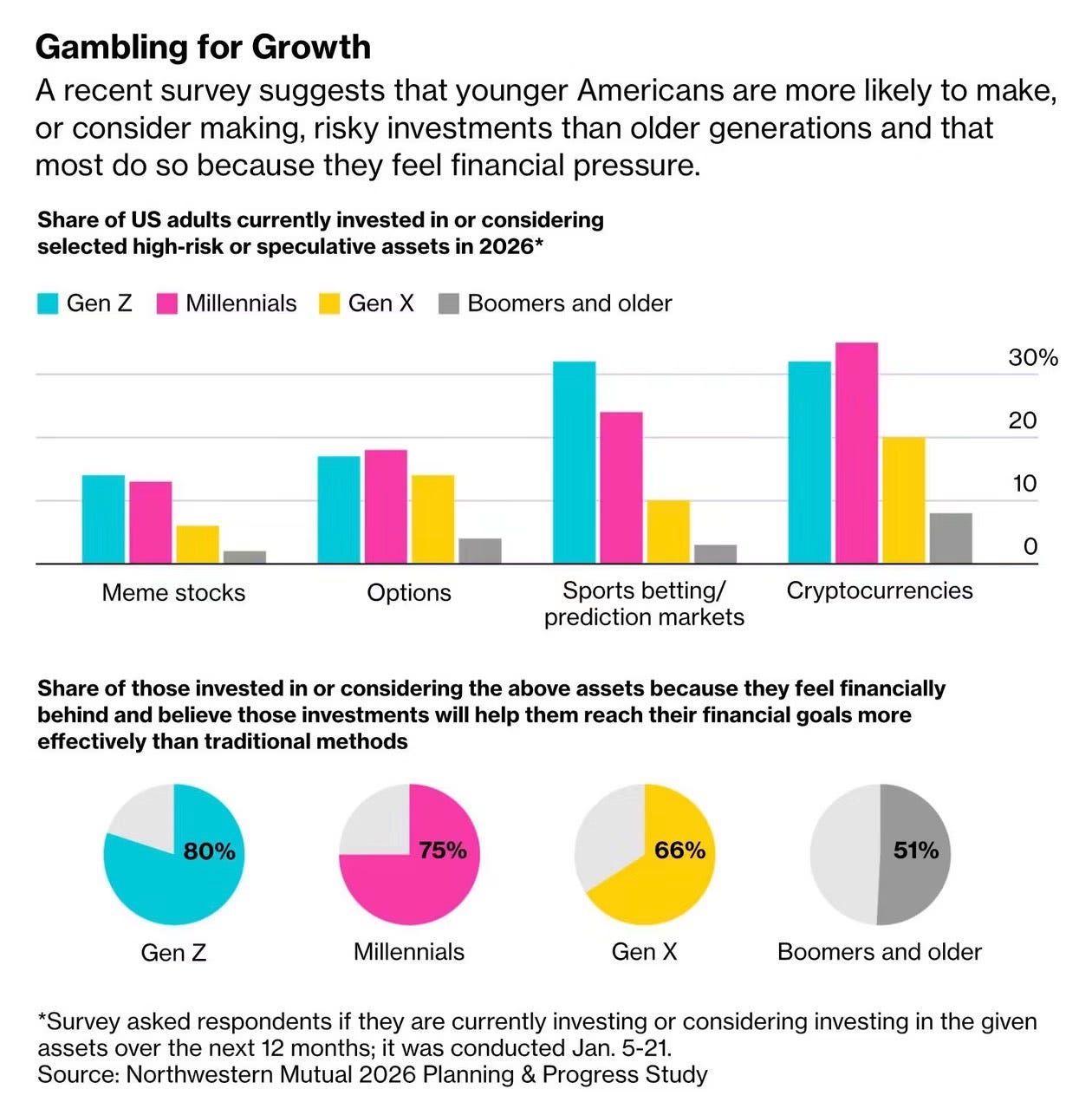
This market cycle reflects exactly that logic. Around the world, more and more young people are treating stock options, meme stocks, and leveraged ETFs not as ordinary investments, but as tools for changing their destiny.
According to a survey by the Financial Industry Regulatory Authority (FINRA), 62% of investors under the age of 35 believe they must take greater risks in order to achieve their financial goals. Among them, 43% have traded options, 29% have bought meme stocks or other popular investment themes, and 22% have even borrowed money to invest.
A Bloomberg survey also found that 80% of Gen Z and 75% of millennials feel they are financially behind. This sense of falling behind makes them more vulnerable to the appeal of high-risk investments.
Although the S&P 500 has delivered an average annual return of around 11% over the past 20 years, many young people believe that building wealth from zero through conventional investing is simply too slow. Against the backdrop of soaring housing prices, rising living costs, and the possibility that artificial intelligence may replace high-paying jobs, high-leverage investing has become a more attractive path to a rapid turnaround.
Academic research has also found that when the dream of homeownership becomes increasingly unreachable, people are more likely to engage in lottery-like investing. Once renters believe that traditional work, saving, and steady investing can no longer help them buy a home, they tend to increase consumption, reduce work effort, and take on greater financial risks.
South Korea Is a Warning for Taiwan. We Have No Right to Feel Superior.
Taiwan should not look at South Korea as if it were someone else’s problem.
Taiwan also has low fertility, high housing prices, stagnant wages among young workers, education anxiety, and a widening generational wealth gap. These problems are highly similar to South Korea’s.

The difference is that Taiwan still has several firewalls preventing society from moving toward South Korea’s more extreme condition.
First, Taiwan does not have a jeonse-style rental structure. Taiwan’s rental market has many problems, including rising rents, inconsistent housing quality, and weak tenant protections. But most renters do not need to pay a deposit equal to 50% to 80% of the home’s value. Therefore, even though rental pressure is serious, Taiwan is less likely to experience a large-scale collapse of tenant deposits.
Second, Taiwan’s industrial structure is more decentralized. Taiwan certainly has large corporations and a strong technology sector, but it also has a vast base of small and medium-sized enterprises. These businesses provide a degree of employment resilience and social buffering. In South Korea, the chaebol structure is far more concentrated. If young people fail to enter the top corporate system, they can easily feel that life has already disqualified them. Taiwan’s SMEs, supply chains, entrepreneurial opportunities, and freelance economy still provide more gray zones and flexible paths.
Third, Taiwan’s young investors remain relatively conservative compared with South Korea’s speculative culture. Taiwan also has speculation, day trading, cryptocurrencies, and leverage. But the mainstream financial imagination still leans toward real estate, high-dividend ETFs, index funds, and stable cash flow.
This does not mean Taiwan has no risk. It means that many young Taiwanese are still searching for “stable accumulation” rather than full-scale survival gambling.
But these firewalls are not permanent.
If housing prices continue to squeeze young people’s life choices, if wage growth continues to lag behind asset inflation, if education anxiety and class pressure intensify, and if young people broadly conclude that hard work is useless, Taiwan could develop a similar psychological structure: no marriage, no children, no institutional trust, and a growing dependence on high-risk speculation.
The Real Question: Why Do Young People No Longer Believe in the Future?
The most important thing to observe in South Korea is not which coin young people are buying, nor whether the fertility rate has fallen again.
The real question is this:
Why has an entire generation begun to stop believing in the future?
When young people believe in the future, they are willing to delay gratification. They are willing to save, build skills, invest in careers, form families, raise children, and take long-term responsibility. They do these things because they believe today’s effort will bring tomorrow’s reward.
But when young people stop believing in the future, everything becomes short-term.
Short-term trading. Short-term speculation. Short-term escape. Short-term pleasure.
Falling birth rates, falling marriage rates, rising speculation, and worsening mental health are not separate phenomena. They are different symptoms of the same disease.
This is not a moral problem. It is a failure of the reward mechanism.
If a society only rewards asset owners and not workers, only protects vested interests and not upward mobility, only demands responsibility from young people while denying them reasonable living conditions, then young people will eventually withdraw in their own ways.
Not marrying is a form of withdrawal.
Not having children is a form of withdrawal.
Lying flat is a form of withdrawal.
Going all in on high-risk assets is also a form of withdrawal.
They look different, but they are all votes of no confidence against the existing social contract.
How Should Taiwanese People Protect Themselves?
South Korea is a mirror, not a prophecy.
It reminds Taiwan that in an era of inflation, high housing prices, weak wage growth, and asset inflation, people cannot rely only on complaints. Nor can they assume institutions will automatically fix everything. Individuals still need to build their own defensive systems.
First, understand that cash loses purchasing power over time.
In a long-term environment of inflation and asset appreciation, holding only cash often fails to protect purchasing power. Cash has liquidity value, but if all wealth remains in cash, it can be steadily eroded. This is not an argument for reckless investing. It is a reminder that everyone must understand the relationship between money, assets, and purchasing power.
Second, own assets that cannot be easily printed.
For ordinary people, the goal is not to chase short-term wealth, but to build a durable asset base. A primary residence, broadly diversified index ETFs, and assets with long-term cash flow or competitive advantage can be more suitable foundations than short-term speculation. The key is to allow personal wealth to participate in long-term economic and corporate profit growth, rather than being controlled by daily market emotion.
Third, strengthen active income.
Under structural pressure, a person’s most important asset remains their ability to generate cash flow. This includes professional skills, industry judgment, language ability, cross-disciplinary integration, networks, and trust. For young people, instead of placing all hope on one chance to get rich, it is better to become harder to replace in the market.
The stronger your active income, the more risk you can absorb, and the less likely you are to be forced into a desperate gamble.
Fourth, build a cognitive firewall.
In an age of information overload, everyone is surrounded by speculative stories. Today, someone became rich through crypto. Tomorrow, someone made a fortune with a leveraged ETF. The next day, someone claims to have found the next hundred-bagger.
The most dangerous thing about these stories is not that they are always false. It is that they make people forget probability and risk.
True cognitive ability means knowing which money should not be chased, which risks should not be taken, and which stories sound attractive but are not suitable for you.
5月6日
Conclusion: Hell Is Not Built in One Day.
The gambling behavior of South Korea’s young generation does not come from a natural love of risk. It is the result of a highly compressed society forcing young people to search for an exit.
When chaebols dominate upward mobility, when housing becomes a financial trap, when education becomes an arms race, when women are punished for motherhood, when the pension system makes young people feel betrayed by the future, and when hard work no longer provides a reasonable life, speculation stops being merely irrational behavior.
It becomes a social symptom.
This is what makes South Korea so important for Taiwan to observe.
The real danger is not that young people are buying crypto. The real danger is not even that young people are refusing to have children.
The real danger is that young people no longer believe in the normal life path.
When a society makes young people believe that slow and steady effort no longer works, it usually produces two outcomes: some people withdraw completely, while others go all in. South Korea is showing how both can happen at the same time. Taiwan has not reached that point yet, but it cannot pretend it is fully insulated from the same risks. Low fertility, high housing prices, wage stagnation, and rising class anxiety are all warning signs along the same road. The real firewall is not only government policy; it is also each person’s understanding of assets, careers, risk, and the structure of society itself. Before hell fully takes shape, the most important task is not to panic, but to see clearly where the fire started. Only by seeing clearly can people find a way out. More importantly, only by seeing clearly can a society prevent itself from becoming the same burning building.

4月19日


PreviousNext