The New Power Stack for AI Servers: MLCCs, Silicon Capacitors, Vertical Power Delivery, and Supply Chain Shifts
The New Power Stack for AI Servers: MLCCs, Silicon Capacitors, Vertical Power Delivery, and Supply Chain Shifts
- Source: SemiVision
- Author: SEMIVISION
- Published: 2026-06-22T21:26:47+08:00
- URL: https://tspasemiconductor.substack.com/p/the-new-power-stack-for-ai-servers (1) The New Power Stack for AI Servers: MLCCs, Silicon Capacitors, Vertical Power Delivery, and Supply Chain Shifts


The New Power Stack for AI Servers: MLCCs, Silicon Capacitors, Vertical Power Delivery, and Supply Chain Shifts
Original Article By SemiVision Research [Reading time: 24 mins]

Jun 22, 2026
∙ Paid
The New Power Stack for AI Servers: MLCCs, Silicon Capacitors, Vertical Power Delivery, and Supply Chain Shifts
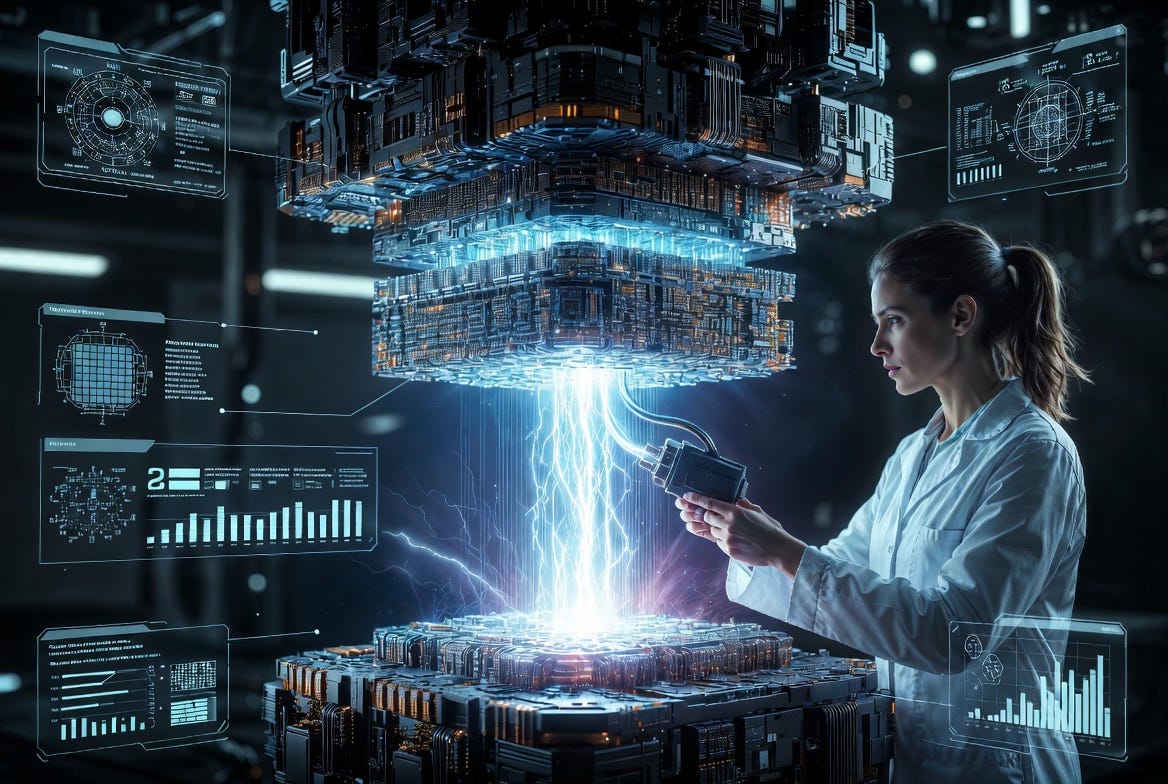
In recent years, the rapid development of artificial intelligence (AI) and high-performance computing (HPC) has driven a profound transformation in data center and server architectures. The power consumption of GPUs, TPUs, AI accelerators, and dedicated SoCs has increased sharply. The power draw of a single AI GPU has risen from several hundred watts in earlier generations to nearly one kilowatt today. Power demand for a single server rack has increased significantly from 5–15 kW to 40–60 kW, and is expected to exceed 100 kW in the future.
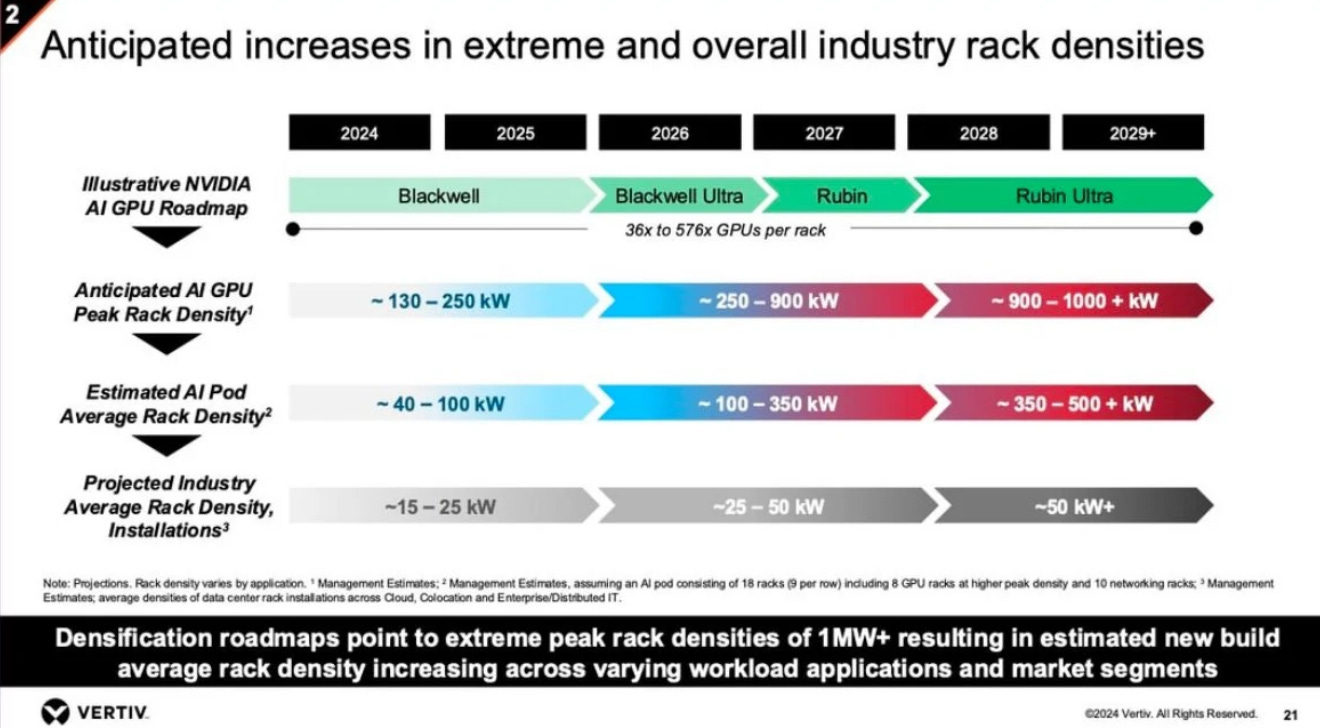
Total data center electricity consumption accounted for approximately 4% of global electricity usage in 2024 and is projected to rise to 8–12% by 2030, with AI workloads serving as a major driver.
Against this backdrop, power supply systems are facing enormous challenges:
Low-voltage, high-current operation and high-frequency transients:
AI accelerators typically operate at low voltages of 0.8–1.2 V, while instantaneous current can reach hundreds or even thousands of amperes. Voltage droop tolerance is only in the range of several tens of millivolts. Any insufficient transient response may lead to system failure or downtime.
Space and thermal management constraints:
As server rack density increases, power modules must become smaller and thinner while also handling higher heat flux.
Parasitic impedance in the power delivery path:
Traditional horizontal power delivery architectures, which supply power from the motherboard to the processor, involve long routing distances and PCB vertical vias. These introduce large parasitic inductance, resulting in longer current loops and making it difficult to meet high-speed transient requirements.
Supply chain and cost pressures:
AI servers require 10–15 times more passive components than conventional servers, especially in ultra-high-capacitance and high-voltage MLCCs. Demand for these components has surged. Major manufacturers are shifting capacity toward high-end applications, causing shortages in general-purpose MLCC supply and driving prices higher.
To address these issues, capacitor technologies, power delivery architectures, and magnetic materials are evolving rapidly. This article provides an in-depth analysis of the characteristics and application scenarios of different capacitor types, including MLCCs, tantalum capacitors, polymer capacitors, and silicon capacitors (SiCaps). It also examines advanced power delivery architectures such as vertical power delivery, embedded trench capacitors (eTDC), and integrated voltage regulators (IVR). Finally, the article analyzes the strengths and challenges of Japan, South Korea, and Taiwan within the relevant supply chains.
Capacitor Technology Classification and Characteristics
Multilayer Ceramic Capacitors (MLCC)
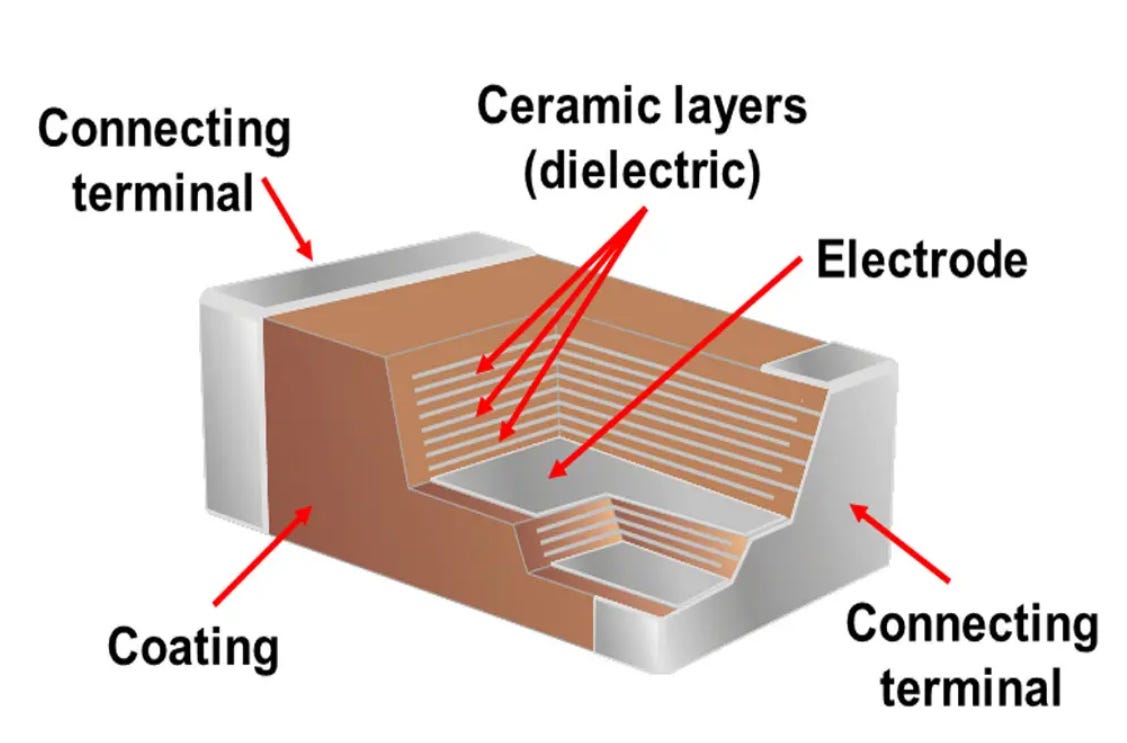
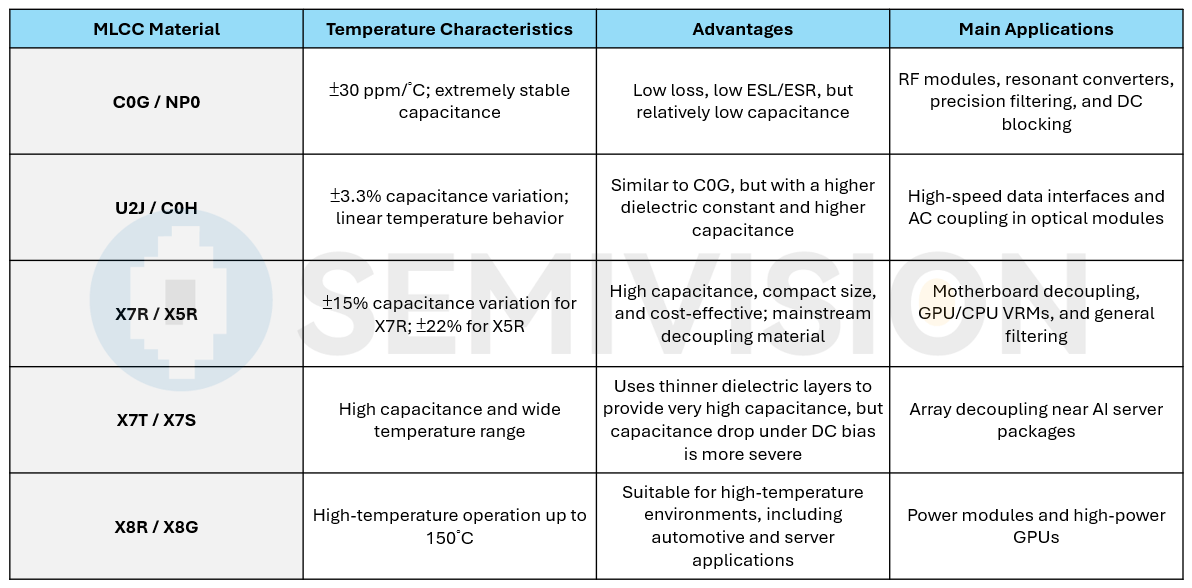
The dielectric codes are industry-standard MLCC temperature-characteristic classifications, but actual electrical performance varies significantly by manufacturer, product series, case size, rated voltage, and DC bias conditions.
In AI servers, the power consumption of a single GPU/TPU can reach 300–800 W, while the tolerance for power noise is only around ±2%. Therefore, dense arrays of low-ESL MLCCs in 0201/01005 form factors must be placed near the package. In some cases, MLCCs are even embedded inside the PCB inner layers to shorten the current loop. These MLCC arrays absorb high-frequency noise in the MHz–GHz range and suppress transient voltage droop.
However, MLCCs have several limitations:
Capacitance loss under DC bias and temperature:
As dielectric layers become thinner, capacitance becomes highly sensitive to voltage. Under rated voltage, capacitance may drop by 40–70%. In high-temperature environments of 85–125°C, the effective capacitance may decline further.
Mechanical cracking and reliability issues:
High-layer-count, high-stress structures are prone to cracking, making soft-termination designs necessary.
Limitations in large capacitance:
Even with high-k dielectrics, the maximum capacitance of a single MLCC is usually limited to the range of several tens of microfarads (µF). In low-voltage power paths, dozens of MLCCs often need to be connected in parallel to meet capacitance requirements from the µF to mF range.
Below we will share:
Tantalum Capacitors and Polymer Capacitors
Silicon Capacitors (SiCap)
Overview of Capacitor Application Scenarios
Vertical Power Delivery Architecture and Advanced PDN
Integration of Embedded Trench Capacitors (eTDC) and SiCap
Trend of Integrated Voltage Converters: From Board-Level Power Delivery to On-Chip IVR
Supply Chain Analysis
Market Trends and Future Outlook

6月15日
Tantalum Capacitors and Polymer Capacitors
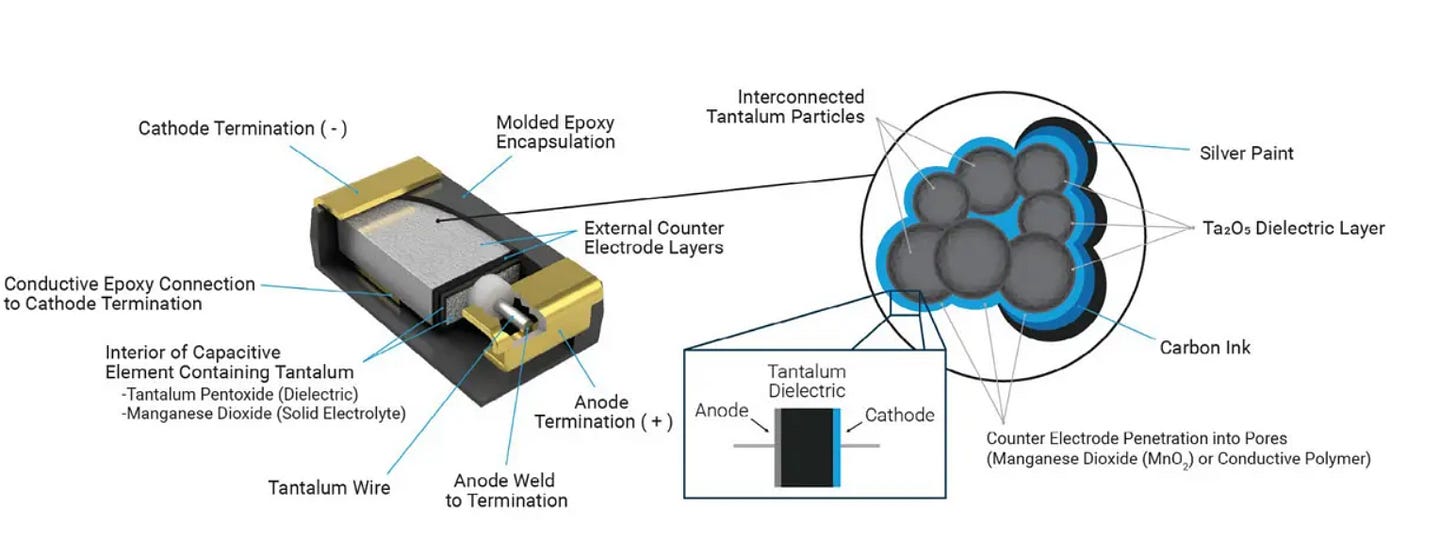
Tantalum capacitors use anodized tantalum as the dielectric layer and provide high capacitance density. Their ESR is lower than that of aluminum electrolytic capacitors, but conventional tantalum capacitors still suffer from relatively high ESR and leakage current. To improve high-frequency performance, the industry has introduced polymer tantalum capacitors and hybrid aluminum polymer capacitors.
Polymer Tantalum Capacitors
Low ESR and high ripple-current capability:
Polymer electrolytes can reduce ESR to 5–20 mΩ, roughly one order of magnitude lower than conventional tantalum capacitors. This enables them to handle high-frequency and large-pulse currents.
Wide operating temperature range and high reliability:
Their performance remains nearly unchanged from –55°C to +125°C. Unlike liquid electrolytes, they do not dry out, making them suitable for 24/7 data center operation.
Safe failure mode:
Under overload conditions, the polymer layer tends to fail open rather than short, reducing fire risk.
Applications:
Polymer tantalum capacitors are used in VRM outputs for AI servers, GPU/TPU power modules, HBM memory power rails, and power-loss protection (PLP) modules in enterprise SSDs. They provide large capacitance across the µF to mF range and work together with MLCCs to form a broadband filtering network.
YAGEO, KEMET, Panasonic, and other suppliers have all introduced polymer tantalum capacitor products. YAGEO’s HC-series X6S/X7R MLCCs can be combined with polymer tantalum capacitors to form a hybrid filtering solution capable of delivering nanosecond-level transient response. Another example is YMIN’s 47–100 µF / 35 V ultra-thin polymer tantalum capacitors, introduced in 2026 for PLP modules in AI server SSDs. With a thickness of only 1.5–1.9 mm and bottom-side terminations that reduce ESL by 50%, these capacitors are suitable for EDSFF and U.2 ultra-thin SSDs.
Hybrid Aluminum Polymer Capacitors
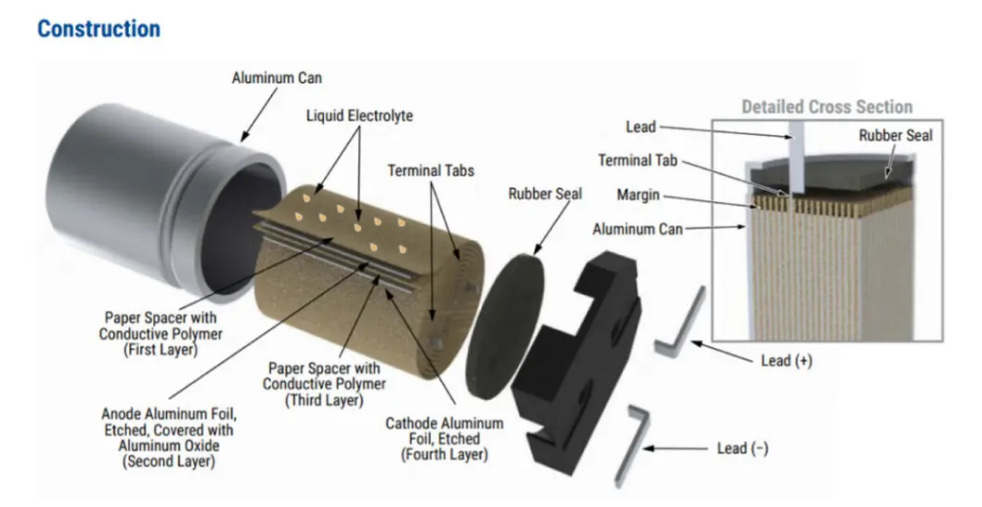
KEMET is pleased to launch its first products in the aluminum hybrid e-cap space, capitalizing on the outstanding potential discussed in this article. These capacitors will be part of the A780 series and will initially include two values (56 µF and 100 µF) rated at 63 VDC.
Hybrid aluminum polymer capacitors combine conductive polymer with liquid electrolyte, offering both the high capacitance of aluminum electrolytic capacitors and the low ESR characteristics of polymer capacitors. Their key features include:
High ripple-current capability and low ESR:
Suitable for high-current PSUs and 48/54 V power buses.
Long lifetime and high reliability:
Capable of operating for extended periods under high-temperature and high-voltage conditions, with slower electrolyte evaporation.
Applications:
AI server power supply units (PSUs), 800 V DC bus modules, and automotive power systems. Panasonic’s Hybrid series is a representative product family, offering lifetimes that can reach hundreds of thousands of hours.
Hybrid and Low-ESL Bulk Capacitors for AI Power Buses
As AI servers migrate toward higher-power architectures, large bulk capacitance is becoming increasingly important for 48 V and future 800 V power bus designs. Traditionally, electrolytic capacitors and large aluminum electrolytic capacitors were used to provide the required energy storage. However, their relatively high ESR and ESL can limit PDN stability, especially under fast load transients, surge events, and hot-swap conditions.
In AI data centers, a 48 V power shelf may require roughly 50,000 µF of capacitance to absorb current surges and suppress voltage disturbances during hot plugging or rapid load changes. This has renewed interest in hybrid tantalum capacitor technologies, which combine a tantalum anode with a ruthenium dioxide cathode to achieve very high capacitance and low ESR. For example, Quantic Evans’ TDE series offers products rated at 18 mF / 75 V with extremely low ESR, making them suitable for high-energy bulk decoupling in advanced power systems.
Low-ESL tantalum capacitor structures are also gaining attention. AVX has introduced three-terminal low-ESL tantalum capacitors with parasitic inductance as low as 340 pH, far below the roughly 2.2 nH typically associated with conventional tantalum capacitors. By reducing parasitic inductance, these capacitors can improve high-frequency transient response and may reduce the total number of decoupling capacitors required by 4–5 times.
For 12 V VRM bulk capacitance, 48 V power shelves, and next-generation AI server power architectures, hybrid tantalum and low-ESL tantalum capacitors provide an important alternative to conventional aluminum electrolytic capacitors. Their value lies not only in capacitance density, but also in lowering impedance across a wider frequency range, improving PDN stability, and reducing board-level component count.
Silicon Capacitors (SiCap)
SiCap is a new type of passive component that uses semiconductor processes, such as MOS and MIM structures, to form three-dimensional capacitor structures on silicon substrates. Its key features include:
Ultra-low ESL / ESR:
Because SiCaps use monocrystalline or amorphous silicon substrates, short terminal distances, and thin stacked structures, they can achieve nearly leadless parasitic inductance. This makes them highly suitable for high-frequency transient response.
High-temperature and high-voltage stability:
Murata’s SiCap maintains stable electrical characteristics across a wide temperature range from –250°C to +250°C and can support operating voltages from 1 V to 1250 V.
High density and thin form factor:
Deep trench etching or multilayer MIM structures are used to increase surface area, enabling capacitance density at the µF/mm² level. According to Murata’s roadmap, the target density for low-voltage products is 4–10 µF/mm², while high-voltage products target more than 1 nF/mm² per layer.
Customized packaging options:
SiCaps can be manufactured in various forms, including standalone chips, stacked arrays, embedded types, and RC snubbers. They can be directly mounted inside chip packages, on package substrates, or on silicon interposers.
High-frequency performance:
SiCaps can support frequencies above 200 GHz, making them suitable for optical modules, millimeter-wave systems, and other high-frequency applications.
Murata has established a 200 mm silicon capacitor production line in Caen, France, using PICS technology, or Passive Integration Connective Substrate technology. The line targets markets including mobile phones, electric vehicle systems, and high-frequency communications. The new production line was expected to add more than 100 employees between 2023 and 2025 and provide ultra-thin, high-performance silicon capacitors with thicknesses down to 40 µm.
From a supply chain perspective, in addition to Murata, companies such as Samsung Electro-Mechanics, Empower Semiconductor, STMicroelectronics, and Skyworks have also introduced silicon capacitor products for RF modules, AI package PDNs, automotive electronics, and medical electronics.
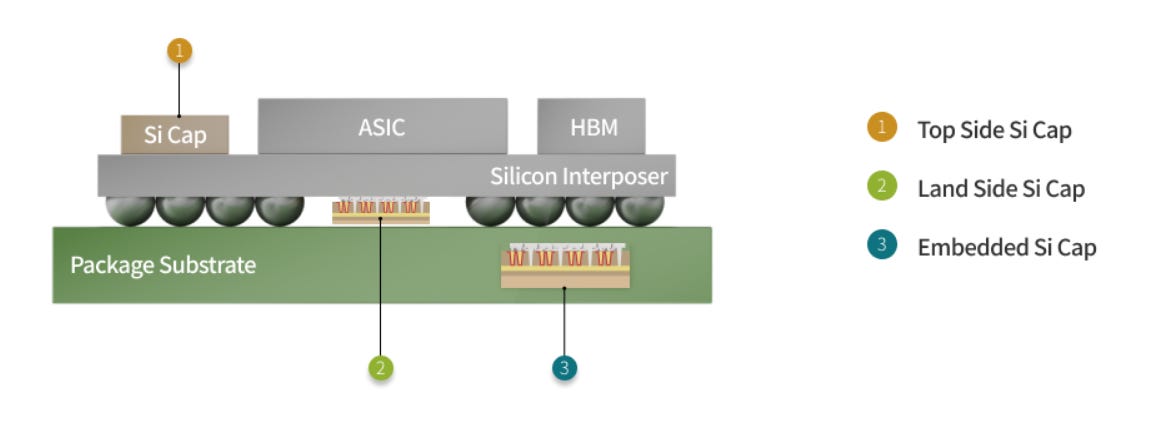
Samsung offers the Land Side Type, which is mounted on the bottom surface of the Package, the Top Side Type, which is mounted on the top surface of the Package, and the Embedded Type, which is built into the Substrate. Additionally, Samsung can design and manufacture products tailored to customer requirements, including Capacitance, thickness, Size, and Pad design.
Overview of Capacitor Application Scenarios
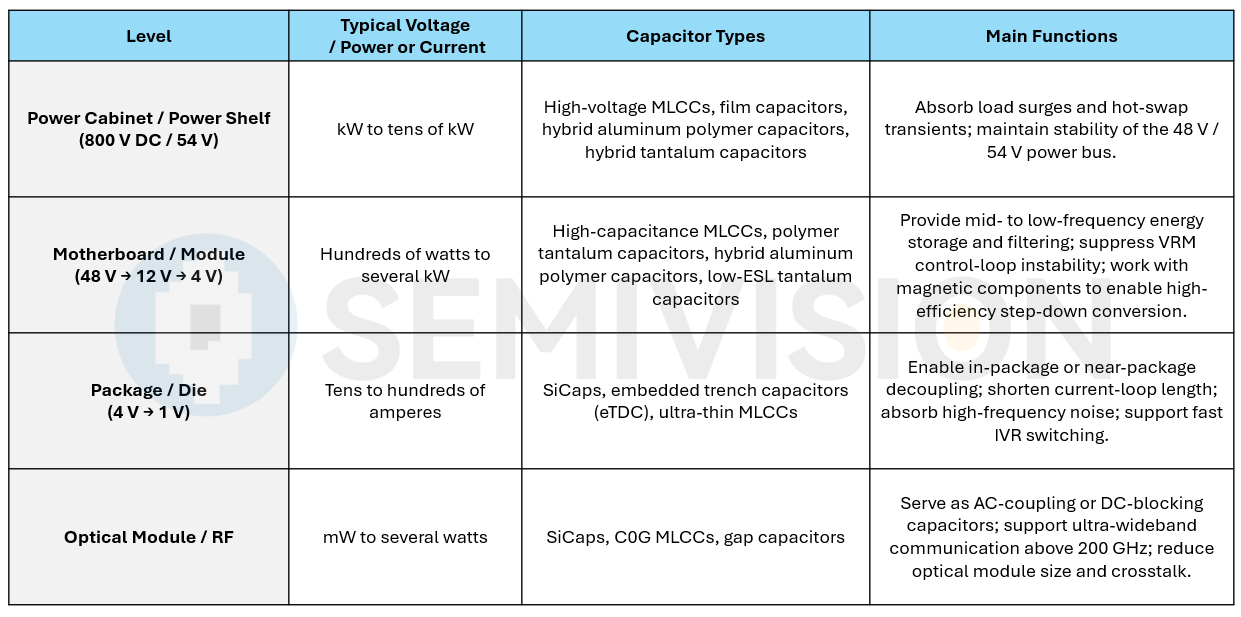

murata: Main Types of Capacitors
Common types of capacitors include tantalum electrolytic capacitors (MnO2 type and polymer type), aluminum electrolytic capacitors (electrolyte can type, polymer can type, and chip type), and MLCC.
Vertical Power Delivery Architecture and Advanced PDN
Comparison Between Traditional and Vertical Power Delivery
Traditional power delivery, or horizontal power delivery:
In a conventional architecture, the power module and VRM are placed on the motherboard, away from the processor. Low-voltage, high-current power must travel through PCB traces, multiple vias, and power planes before reaching the load. This creates high parasitic inductance and impedance, resulting in poor transient response.
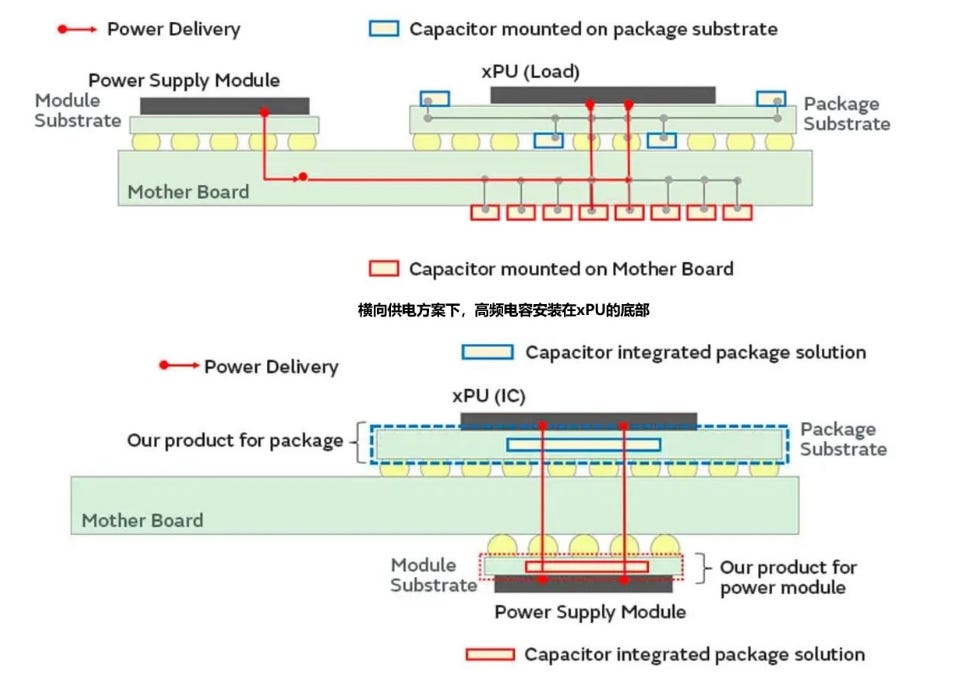
Source: murata
In a horizontal power delivery architecture, many high-frequency capacitors are placed directly underneath the xPU. These low-ESR capacitors can more effectively filter high-frequency noise, reduce power ripple, supply transient current, and improve the response speed of the power delivery network.
In a vertical power delivery architecture, however, the area previously occupied by high-frequency capacitors must be used to install the power module. As a result, the placement of the high-frequency capacitors has to change. One possible approach is to integrate the high-frequency capacitors into the power module. However, from the perspective of high-frequency decoupling, this solution places the capacitors too far away from the power pins. A more ideal solution is to embed the capacitors separately into the xPU package substrate and the PCB of the power module.
Vertical Power Delivery (VPD):
Vertical power delivery places the voltage conversion module underneath the processor or below the package, allowing current to flow vertically into the chip. This shortens the current loop to less than 5 mm. Such an architecture can reduce transmission losses, improve efficiency and transient response, and free up motherboard space for memory or optical modules. When combined with an integrated voltage regulator (IVR), voltage step-down from 4 V to 1 V, or even lower, can be completed inside the package, significantly reducing the need to transmit low-voltage, high-current power across the PCB.
The advantages of vertical power delivery include:
Lower transmission loss and parasitic inductance:
Short-distance power delivery reduces I²R losses and L·di/dt voltage droop, improving voltage stability.
Improved transient response and power density:
IVRs placed close to the load can adjust voltage at nanosecond-level speeds and support granular DVFS. VPD can support instantaneous current demand in the range of 2,000–5,000 A.
Board-space savings and improved signal integrity:
By placing the power module beneath the package, the upper layers of the PCB can be reserved for high-speed I/O traces, reducing crosstalk.
Modular design potential:
Integrated VRMs, magnetic components, and silicon capacitors can be packaged as modules, allowing reuse across different processor platforms.

SourceL Vicor
Integration of Embedded Trench Capacitors (eTDC) and SiCap
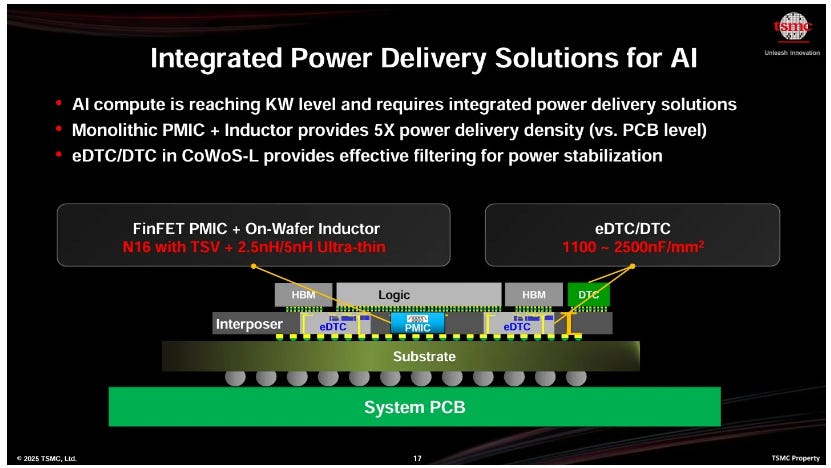
In advanced 2.5D packaging technologies such as TSMC’s CoWoS-L, manufacturers are embedding deep trench capacitors, or embedded trench capacitors (eTDC), into the interposer or substrate to reduce PDN impedance between the die and the substrate.

These eTDC structures use deep-trench etching to create high-surface-area capacitors in silicon or glass, achieving single-layer capacitance density at the nF/mm² level. Ultra-low-ESL silicon capacitors provided by Murata and IPDiA, which was later acquired by Murata, can be integrated with eTDC structures to form capacitor arrays beneath the package or on the interposer. This helps eliminate anti-resonance peaks and improves the stability of HBM power rails.
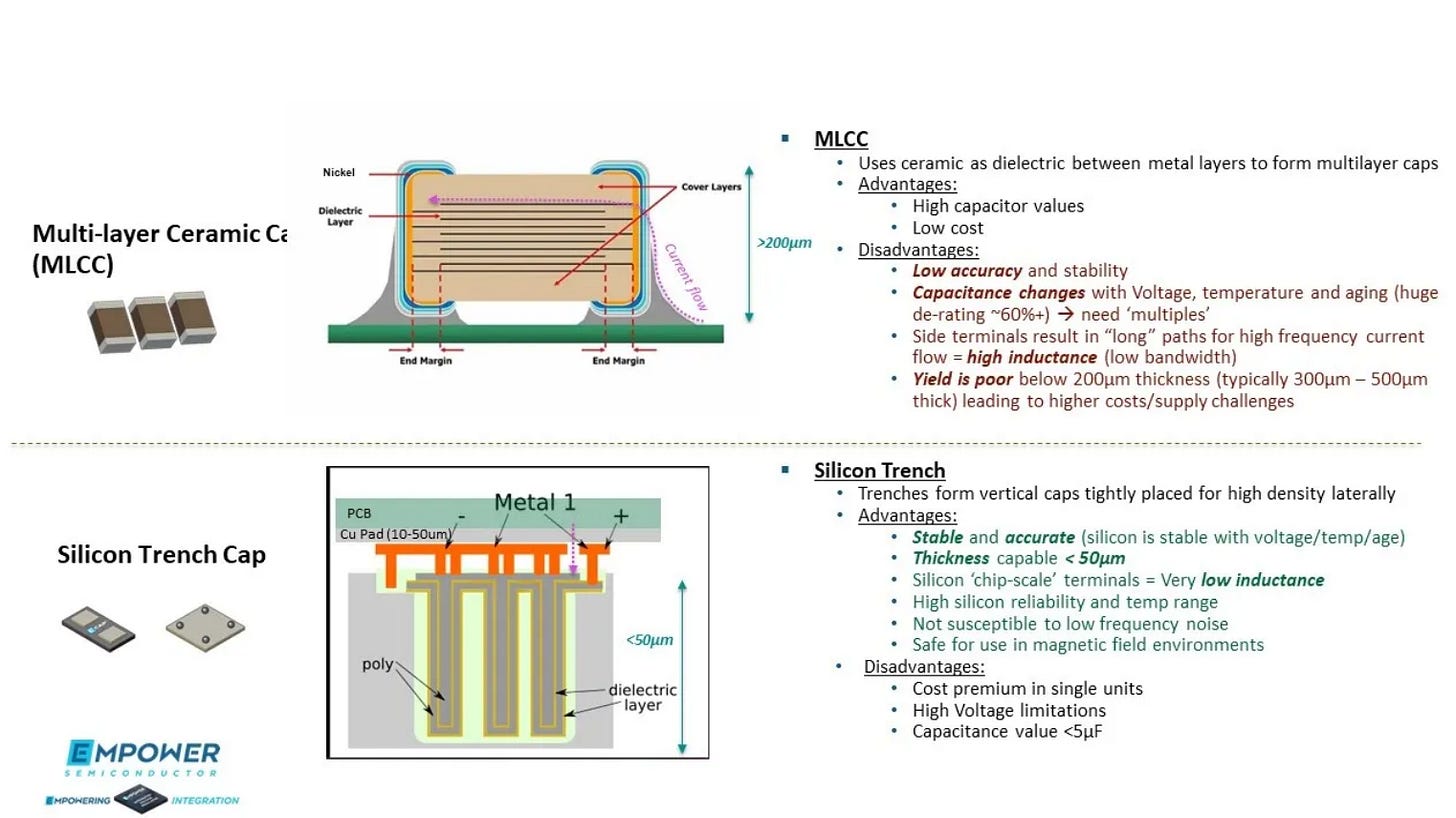
Source: Empower

4月23日
Integrated Voltage Regulators (IVR)
Integrated voltage regulators integrate step-down circuits and magnetic components inside the package or directly on the chip. Their operating frequency can be increased to 10–40 MHz, enabling the use of smaller inductors and capacitors.
Ferric’s Fe1766 IVR can deliver 160 A of current in an 8 × 4.4 mm package and is designed for AI processor packages. Its advantages include reducing the number of external inductors, shortening circuit loops, and enabling granular voltage control. However, IVR also introduces thermal management and efficiency challenges, requiring high-performance magnetic materials and advanced thermal design.
Empower Semiconductor has also developed the Crescendo platform, which allows voltage regulators to be placed beneath the chip and supports near-package, in-package, and under-package configurations.
To support IVR architectures, high-frequency, low-ESL capacitors are critical. Silicon capacitors, with their thin profile and low parasitic characteristics, can be used for IVR input and output decoupling. In addition, high-frequency gap capacitors from Quantic Eulex and low-ESL tantalum capacitors have also been proposed as solutions for package-level decoupling.

2025年8月4日
Trend of Integrated Voltage Converters: From Board-Level Power Delivery to On-Chip IVR

The evolution of integrated voltage converters is moving from conventional board-level power delivery toward deeply integrated power regulation inside the package and eventually inside the SoC itself. This transition is driven by the rising current demand of AI/HPC processors, tighter voltage tolerance, higher transient response requirements, and the need to reduce parasitic impedance in the power delivery network.
Conventional On-Board Solution
In the traditional architecture, the buck converter is placed on the motherboard, while the packaged SoC is located separately on the board. Power is delivered laterally through PCB traces, vias, and planes before reaching the processor. This approach is simple and mature, but the long current path creates higher parasitic resistance and inductance. As xPU current demand increases, this architecture becomes less efficient and struggles to provide fast transient response.
Embedded Passives with Board-Level Buck Converter
The next step is to embed passive components, such as inductors and capacitors, into the substrate or PCB while keeping the buck converter outside the SoC package. This reduces the loop area and improves power integrity compared with the conventional board-level solution. Embedded inductors and capacitors help lower impedance, improve transient response, and save board space. However, the active power conversion stage is still not fully integrated with the processor.
System-in-Package IVR
In a System-in-Package integrated voltage regulator architecture, the buck converter, embedded passives, and SoC are brought much closer together inside the package. The SoC may still use an LDO for local fine-grained voltage regulation, while the IVR performs high-efficiency step-down conversion near the load. This architecture significantly shortens the power delivery path, reduces parasitic inductance, and enables faster voltage response. It is especially attractive for AI accelerators, GPUs, and high-current processors that require dense, low-voltage power delivery.
System-on-Chip IVR
The most advanced direction is System-on-Chip IVR, where voltage regulation is integrated directly with the SoC. In this architecture, the SoC, LDO, and buck converter become highly integrated, while embedded inductors and capacitors are placed underneath or within the package structure. This approach offers the shortest current loop, the lowest parasitic impedance, and the fastest transient response. It also enables granular power management, dynamic voltage scaling, and localized voltage regulation for different compute blocks.
Overall, the industry trend is clear: voltage conversion is moving closer to the processor. The main goal is to reduce power delivery distance, lower PDN impedance, increase power density, and improve transient response. As AI/HPC processors move toward higher current and lower operating voltage, conventional board-level VRMs are no longer sufficient. Future power delivery architectures will increasingly rely on embedded passives, silicon capacitors, integrated magnetics, SiP-level IVRs, and eventually SoC-level voltage regulation.
However, deeper integration also introduces new challenges. Thermal management becomes more difficult as power conversion moves closer to the die. Magnetic materials must support higher switching frequencies with lower core loss. Embedded capacitors must deliver ultra-low ESL and high capacitance density. Packaging cost, reliability, and manufacturing yield will also become critical factors. Therefore, the future of integrated voltage converters will not depend only on circuit design, but also on advances in semiconductor packaging, passive components, magnetic materials, and substrate technology.

6月3日
Magnetic Materials and Integrated Magnetic Components
As switching frequency increases, the size of inductors can be reduced. However, core losses in magnetic materials rise sharply at high frequencies.
Experts from Tyndall National Institute have noted that thin-film magnetic cores used in integrated voltage regulators commonly use cobalt-zirconium-tantalum (CZT) alloys. By adding molybdenum, nitrogen, or boron, the resistivity of the material can be increased to reduce eddy-current losses. Annealing can also be used to control grain structure and reduce hysteresis losses.
CZT thin films enabled a closed magnetic-core structure in the IVR of Apple’s 2021 Mac M1 Pro and M1 Max. Through stripline structures, these materials can be used to create high-frequency, low-profile inductors.
The main losses in magnetic materials include:
Hysteresis loss:
This is related to the coercivity (Hc) of the material. Soft magnetic materials such as cobalt- and iron-based alloys have low Hc due to their fine grain structure, making them suitable for high-frequency applications. The addition of zirconium and tantalum can suppress crystallization and improve performance.
Eddy-current loss:
At high frequencies, current circulating inside the magnetic core generates eddy currents. This loss can be reduced by increasing the resistivity of the material, such as by adding boron or nitrogen, and by reducing layer thickness.
Anomalous loss:
This is caused by domain-wall motion and is related to material non-uniformity. Magnetic annealing and alloy composition optimization can help reduce this type of loss.
Tyndall’s research has also explored CZTB-OCZTB multilayers, or cobalt-zirconium-tantalum-boron oxide structures. These materials achieved a relative permeability of μr = 432 and a Q factor of 24.3 at 100 MHz, while also withstanding annealing at 150°C. In addition, FeCoN thin films integrated on PCBs also show potential for enabling ultra-thin inductors inside or beneath packages.
Another solution is planar magnetics. Compared with traditional wire-wound transformers, planar magnetic components embed windings into multilayer PCBs or copper foils, providing low leakage inductance, low resistance, and high power density.
Payton Group has noted that planar magnetic designs can achieve efficiency above 98% in high-frequency SMPS applications, typically from several hundred kHz to the MHz range. They also offer excellent thermal performance and modular customization, making them highly suitable for high-power-density PSUs in AI servers. Planar magnetic components are thin, improve heat dissipation, reduce EMI, and enhance system reliability.

Supply Chain Analysis
Japan: Leadership in High-End MLCCs and Silicon Capacitors
Japanese companies hold dominant positions in MLCCs, silicon capacitors, polymer capacitors, and magnetic components, particularly in high-reliability, automotive, and AI server markets. Major companies include Murata, TDK, Taiyo Yuden, Kyocera AVX, Panasonic, Nichicon, Nippon Chemi-Con, Rubycon, and ROHM.
Murata
Murata is the world’s largest MLCC supplier by market share and holds more than 50% of the high-end MLCC market. The company is also a leader in silicon capacitor development. According to Japanese media reports, Murata’s AI data center-related sales are expected to reach JPY 325 billion in fiscal year 2026, representing 84% year-on-year growth. The company has invested JPY 80 billion to expand high-capacitance MLCC production capacity. Murata has stated that the number of high-end MLCCs used in AI servers is 10–20 times higher than that required in smartphones.
Through its acquisition of France-based IPDiA, later renamed Murata Integrated Passive Solutions, Murata gained core silicon capacitor technology. The company has built a 200 mm PICS production line in Caen, France, capable of producing ultra-thin silicon capacitors with a thickness of 40 μm for smartphones, communications, and automotive markets. Murata’s PICS technology uses 3D structures to increase electrode surface area, enabling ultra-low ESL/ESR and high-frequency stability. In AI/HPC applications, Murata’s UESL silicon capacitors are used for in-package decoupling and can help eliminate anti-resonance peaks in the PDN.
In addition, Murata is actively developing magnetic components and power modules, including through-hole planar inductors and power modules, to support vertical power delivery architectures.
TDK
TDK is the world’s second-largest MLCC supplier and has deep technical expertise in magnetic materials and power inductors. TDK has introduced high-voltage MLCC solutions for data center PSUs, supporting 48 V and even 800 V systems. The company is also investing in thin-film magnetic materials and planar inductor technologies, while providing automotive-grade polymer aluminum capacitors. Its latest planar inductors, combined with GaN/SiC MOSFETs, can be used in high-efficiency LLC resonant converters, making them suitable for AI servers.
Taiyo Yuden
Taiyo Yuden has strong capabilities in high-capacitance MLCCs and high-frequency applications. In response to AI server demand, Taiyo Yuden has launched compact, high-capacitance MLCCs supporting 0201 and 01005 form factors. The company also plans to raise MLCC prices by 6–13% starting in 2026 to address rising AI server demand and raw material costs. It is also developing MLCCs and film capacitors for high-frequency and high-temperature applications.
Kyocera AVX and Nichicon
Kyocera AVX has leading technologies in hybrid tantalum capacitors and polymer tantalum capacitors. The company has introduced three-terminal low-ESL tantalum capacitors and Gap Cap products to support high-frequency and high-current applications. Nichicon, Nippon Chemi-Con, and Rubycon have long focused on aluminum electrolytic and hybrid aluminum polymer capacitors, supplying large-capacitance, high-temperature, and long-life capacitors for data center PSUs.
South Korea: MLCCs and Advanced Packaging
South Korea’s supply chain is centered on Samsung Electro-Mechanics, or Semco. The company has an MLCC market share of approximately 12–15%, second only to Murata. Semco is shifting its focus from smartphones toward AI servers and automotive applications, launching compact high-capacitance MLCCs and high-reliability products.
Semco is also a major supplier of FC-BGA package substrates and works closely with Samsung Electronics’ semiconductor division to advance packaging platforms such as CoWoS-L and H-Cube.
Other Korean companies, such as Samsung SDI and LG Chem, have strengths in materials and batteries, supporting 54 V and 800 V power systems with battery and chemical materials. LG Innotek supplies advanced package substrates and modules, supporting SiP and RF module applications. South Korea’s broader strategy is to integrate semiconductors, passive components, and packaging to build a complete AI server supply chain.
Taiwan: System Integration and High-Capacitance MLCC Supply
Taiwan plays an important role in passive component capacity, PCBs, packaging, and power modules, especially in system assembly and thermal solutions. Major companies include:
Yageo Group:
Yageo is one of the world’s top three passive component suppliers. Its brands and affiliates include Yageo, Pulse, KEMET, and Taiyo Yuden-related distribution channels. Yageo is one of the largest suppliers of high-capacitance X6S MLCCs and is also one of the world’s largest polymer tantalum capacitor manufacturers. Its products are widely used in AI servers. Yageo is also increasing investment in magnetic materials, developing high-frequency planar inductors and current-sensing components. AI-related business currently accounts for approximately 5% of revenue and is expected to continue growing.
Walsin Technology, Holy Stone, PDC, and Jamicon:
Chilisin Group:
Chilisin focuses on magnetic components, inductors, and power modules. Its subsidiary Mag.Layers supplies inductors and transformers and cooperates with Japanese and U.S. companies to develop thin-film magnetic materials.
Delta Electronics, Lite-On Technology, AcBel, and FSP:
These companies are global leaders in AI server PSUs, AC/DC power converters, and cooling solutions. Delta is one of the key participants in the Open Compute Project. Its 54 V and 800 V PSUs, as well as vertical voltage modules, are widely used in data centers.
Packaging and PCB:
Unimicron, Nan Ya PCB, and Kinsus provide advanced ABF substrates and high-density interconnect PCBs. ASE, SPIL, and KYEC provide advanced packaging and testing services, offering manufacturing platforms for CoWoS, eTDC, and SiCap integration.
Thermal and mechanical components:
Auras, AVC, and Jentech supply liquid cooling solutions and mechanical components, supporting the thermal requirements of vertical power modules.
Overall, Taiwan’s key advantage lies in system integration. Taiwan can combine MLCCs, polymer tantalum capacitors, magnetic components, power modules, PCBs, and packaging into complete power delivery solutions. Through close collaboration with U.S. chipmakers such as NVIDIA, Taiwan is well positioned to accelerate the adoption of AI server power architectures.

5月29日
Market Trends and Future Outlook
AI servers are driving a surge in demand for MLCCs and silicon capacitors:
AI servers require 10–15 times more MLCCs than conventional servers, and they also require specialized products with ultra-high capacitance, high voltage ratings, and ultra-low ESL. Japanese and Korean manufacturers are shifting capacity toward high-end MLCCs, resulting in tighter supply and rising prices for standard products. TrendForce estimates that the low-voltage MLCC market will grow from USD 1.897 billion in 2026 to USD 4.218 billion in 2031, representing a CAGR of 17.33%.
48 V / 800 V architectures are becoming mainstream:
OCP Open Rack V3 has raised the power bus voltage from 12 V to 48 V, and future 800 V DC architectures are also under development to reduce transmission losses and current levels while improving efficiency. This transition requires high-voltage MLCCs, hybrid capacitors, and new materials to build safe and reliable power delivery systems.
Vertical power delivery and IVR are gaining adoption:
To meet high-current-density and fast-response requirements, the power delivery path is shifting from the motherboard to a vertical direction, with in-package IVRs being introduced. Innovations in magnetic materials, such as CZTB/OCZTB and planar magnetics, together with the high density of silicon capacitors, will be key enabling technologies.
Supply chain reallocation and localization:
AI demand is creating a polarized market structure. Prices for high-end MLCCs are rising, while prices for standard products remain weak. As a result, manufacturers are less willing to expand capacity for low-end products. New capacity is also moving toward North America and Europe to shorten supply chains and meet geopolitical requirements.
Emergence of new hybrid capacitor technologies:
Hybrid capacitors, low-ESL tantalum capacitors, Gap Cap technologies, and other new capacitor solutions are gradually being adopted. These technologies can reduce MLCC usage and improve PDN performance. Silicon capacitors are also expected to grow rapidly in package-level decoupling, optical modules, and SiC/GaN snubber applications.
Higher operating frequencies and magnetic material innovation:
The switching frequency of IVRs and vertical power modules is rising to the tens-of-MHz range, placing stricter requirements on magnetic materials. Next-generation CoZrTaB and FeCoN thin-film magnetic cores, as well as planar magnetic technologies, will become key areas of focus.
The rapid development of AI/HPC is transforming power delivery architectures and passive component technologies. MLCCs remain the core decoupling components, but their performance is limited by DC bias, temperature, and parasitic inductance. Therefore, they must be used together with polymer tantalum capacitors and hybrid aluminum polymer capacitors to form a broadband filtering network.
Silicon capacitors, with their ultra-low ESL, ultra-thin profile, and high-frequency characteristics, are becoming indispensable in package-level decoupling, high-voltage snubbing, and optical modules. Vertical power delivery and integrated voltage regulators are reshaping PDN design by shortening current loops and improving efficiency. High-frequency magnetic materials and planar magnetic technologies will be critical to this transition.
Japanese companies remain far ahead in high-end MLCCs and silicon capacitors. South Korea is entering the market aggressively by leveraging its strengths in semiconductors and advanced packaging. Taiwan occupies a critical position in system integration, PCBs, packaging, and power modules. As supply chains reorganize and new technology challenges emerge, companies must strengthen materials R&D and capacity deployment to gain an early advantage in the fast-growing AI/HPC market.
Generative AI and large language models are driving a sharp increase in the power consumption of GPUs, TPUs, and custom ASICs, while core chip voltages remain in the 0.8–1.2 V range. A single processor may require thousands of amperes of instantaneous current, creating severe challenges for power integrity across printed circuit boards (PCBs) and packages.
The traditional approach places voltage regulator modules (VRMs) on the motherboard and delivers power laterally through power planes and vias. However, as current density rises to several amperes, or even more than ten amperes, per square millimeter, the horizontal power delivery path becomes longer and parasitic inductance increases, resulting in significant voltage droop and efficiency losses. Even stacking more MLCCs or increasing conductor thickness delivers diminishing returns.
Thanks for reading SEMIVISION @_@! This post is public so feel free to share it.


PreviousNext