7 Key AI Hardware Keywords to Watch in 2026
7 Key AI Hardware Keywords to Watch in 2026
- Source: SemiVision
- Author: SEMIVISION
- Published: 2026-06-18T22:16:05+08:00
- URL: https://tspasemiconductor.substack.com/p/7-key-ai-hardware-keywords-to-watch (1) 7 Key AI Hardware Keywords to Watch in 2026


7 Key AI Hardware Keywords to Watch in 2026
Original Article By SemiVision Research [Reading time: 17 mins]

Jun 18, 2026
∙ Paid
7 Key AI Hardware Keywords to Watch in 2026
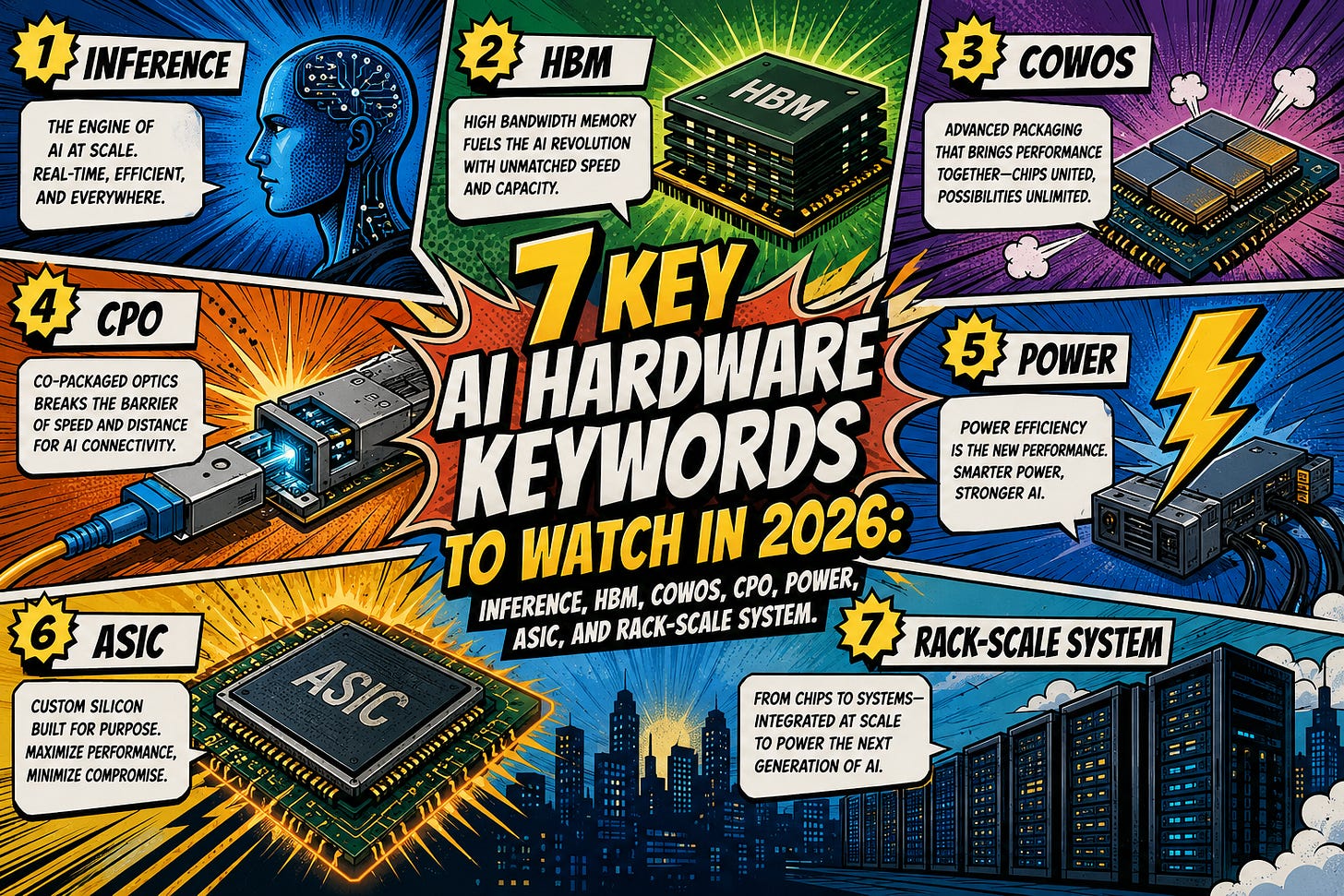
At first glance, AI competition appears to be a battle of models. Whose model is smarter? Whose reasoning capability is stronger? Whose agent is better at coding, searching for information, and making decisions?
But if we look deeper into the underlying layer, the real factor determining whether AI can continue to scale is hardware. Here, hardware does not simply mean GPUs. It refers to an entire technology chain spanning chips, memory, advanced packaging, networking, power delivery, thermal management, and data center deployment.
In the past, the market liked to use the word “compute” to summarize everything. But by 2026, talking only about compute will become increasingly insufficient. The bottlenecks in AI infrastructure are shifting. Models no longer just require more FLOPS; they also need higher memory bandwidth, lower-latency interconnects, more stable power delivery, and rack-scale systems that can be deployed quickly in real-world data centers.
In 2026, the core question for AI hardware will evolve from “who has the most GPUs?” to:
Who can turn AI compute into commercialized services at lower cost, with higher stability and greater efficiency?
This is why SemiVision believes that what matters in 2026 is not a single company, nor a single chip, but the following seven key keywords.
Together, they represent the transition of AI hardware from the first phase of GPU procurement competition into the second phase of system-level efficiency competition.

Below we will share:
Inference: The Real Battle Is Only Just Beginning
HBM: The Scarcest Memory in the AI Era
CoWoS: Taiwan’s Strategic Position in the AI Supply Chain
CPO: When AI Clusters Become Too Large for Copper
Power: Electricity Becomes a Hard Constraint for AI
ASIC: The Second Path Beyond GPUs
Rack-Scale System: The Unit of Competition Shifts from Chips to Full Racks
Inference: The Real Battle Is Only Just Beginning
Over the past two years, the market’s attention has been focused primarily on training. Training large models requires massive amounts of GPUs, HBM, power, and advanced packaging capacity. This has benefited NVIDIA, TSMC, SK hynix, CoWoS, and the broader AI server supply chain.
But in 2026, the area more worth tracking is inference.
The reason is simple: training is a capital expenditure for model companies, while inference is the operating cost that AI applications incur every single day. Every chatbot response, every coding agent task, and every enterprise AI workflow consumes inference compute.
Why is inference more complex than training?
Training usually concentrates large amounts of data and compute into a relatively controlled process, with the goal of producing model parameters. Inference is different. It must handle massive numbers of users, requests of varying lengths, different latency requirements, and highly unstable traffic spikes.
Inference can be broadly divided into two stages: prefill and decode.
Prefill sends the user’s prompt into the model and builds the initial state. Decode then generates the answer one token at a time. Prefill is more compute-intensive and relies heavily on matrix operations, while decode is often constrained by memory bandwidth. This is because every generated token requires the system to read model weights and access the KV cache.
This is why long context, agent workflows, and multi-turn conversations can rapidly increase inference cost. When an AI agent needs to read large volumes of documents, query tools, write code, and repeatedly revise its output, it is not simply running the model once. It is turning inference into a long-duration workload with high memory pressure.
In 2026, the core question for AI hardware is no longer simply:
Can the model run?
The real question is:
How much does it cost to process every one million tokens?
This question directly affects the business model of AI. If each agent task requires a large number of tokens, and inference cost cannot be reduced, the gross margin of AI applications will be consumed by hardware cost.
Conversely, whoever can drive down inference cost will have the opportunity to control the next stage of AI commercialization.
Key technical signals to watch in 2026
Whether prefill and decode begin to separate, with different hardware handling different stages.
Whether KV cache compression, quantization, and memory management improve significantly.
How the roles of GPUs, ASICs, CPUs, and DPUs are redefined within inference systems.
Whether cloud service providers begin disclosing more granular token cost, utilization, or inference margin metrics.
Inference marks the turning point where AI hardware moves from “buying equipment” to “calculating the economics.”
The winners in 2026 will not necessarily be the companies with the most impressive benchmarks. They will be the ones capable of turning large-scale real-world workloads into stable profits.
Companies to watch:
Nvidia
AMD
Amazon
Cerebras
Meta

4月7日
HBM: The Scarcest Memory in the AI Era
If the GPU is the engine of AI, then HBM is the fuel delivery system.
AI models require massive amounts of data to move rapidly between processors and memory. Traditional DRAM struggles to meet this level of bandwidth demand, which is why HBM has become a core component of AI accelerators.
The importance of HBM is not simply that it is “faster.” Its real significance lies in the fact that AI chip performance is often not limited by compute capability, but by data movement.
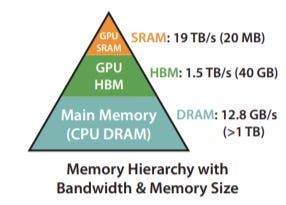
HBM Solves the Data Movement Problem
AI accelerators need to continuously feed data into massive matrix operations. If the compute units cannot receive data fast enough, theoretical peak performance becomes meaningless.
HBM addresses this problem by vertically stacking DRAM dies and connecting them to GPUs or ASICs through an ultra-wide interface. This provides much higher bandwidth and lower power consumption than conventional memory.
But HBM is not a free lunch. The higher the stack, the harder it becomes to manage heat. The higher the bandwidth, the more demanding the packaging and signal integrity requirements become. The larger the capacity, the greater the pressure on cost and yield.
By the time the industry moves to HBM4, the competition will no longer be only about whose memory is faster. It will be about who can achieve stable mass production, and who can integrate most effectively with customers’ accelerator packaging architectures.
This is why HBM directly affects the shipment schedules of platform companies such as NVIDIA, AMD, Google, and Broadcom. Designing the chip is not enough. Companies also need to secure sufficient HBM supply, while ensuring that packaging capacity, testing processes, and thermal design can all keep pace.
The Supply Chain Implications of HBM
HBM is pushing memory companies away from the traditional commodity cycle and toward a more customized, higher-barrier form of competition. The gap between SK hynix, Samsung, and Micron is not only about capacity. It is also about their ability to co-design with GPU and ASIC customers.
For Taiwan’s supply chain, the importance of HBM will also amplify demand for advanced packaging, testing, substrates, and materials. Because HBM must sit close to the accelerator, the overall package design becomes far more complex.

2025年10月13日
Key Technical Signals to Watch in 2026
HBM4 mass production progress and major customer qualifications.
Thermal and yield challenges as HBM stack height increases.
Whether HBM supply remains tied to a small number of major customers, making procurement difficult for smaller accelerator companies.
Whether memory bandwidth becomes the primary constraint for inference workloads.
The bottleneck in AI hardware is not always located inside the most eye-catching GPU. Very often, it is hidden in the expensive HBM stacks sitting right next to it.
Companies to watch:
SK hynix
Samsung
Micron
Onto
SEMICS

5月20日
CoWoS: Taiwan’s Strategic Position in the AI Supply Chain
When discussing AI hardware, we cannot focus only on chip design. Even the most advanced GPU cannot be shipped if packaging capacity is insufficient.
CoWoS is one of TSMC’s most important technologies in the AI era. It enables GPUs or ASICs and HBM to be connected at high speed within the same advanced packaging architecture, allowing data to move across extremely short distances with very high bandwidth.

Why Has Advanced Packaging Become a Bottleneck?
In the past, the semiconductor industry was mostly centered on advanced process nodes. Whoever could build smaller transistors gained advantages in performance, power consumption, and density.
But the challenge of AI accelerators is not only about transistors. It is about how to integrate compute dies, HBM, interposers, substrates, thermal solutions, and testing into a package that can be mass-produced and deployed.
The difficulty of CoWoS lies in its large package size, multiple materials, long process flow, and high yield pressure. AI GPU packages are often much larger than traditional logic chips and integrate more HBM stacks. If yield is poor at any single step, final shipments can be affected.
This makes Taiwan’s supply chain position even more critical. Advanced packaging is not only about TSMC. It also involves substrates, testing, equipment, materials, thermal management, and system assembly. As AI accelerator demand increases, these segments may shift from supporting roles into bottlenecks.

2月23日
CoWoS Is Changing Value Distribution
In the AI era, value is no longer concentrated only in chip design companies. Packaging capacity, yield, lead time, and material supply all affect the deployment speed of the entire AI infrastructure.
This is why the market is paying close attention to CoWoS capacity expansion, not just advanced process capacity.
The key question for 2026 is not whether CoWoS demand will grow. The real question is:
Can CoWoS capacity expansion keep up with AI accelerator demand?
Key Technical Signals to Watch in 2026
The pace of TSMC’s advanced packaging capacity expansion.
How different architectures such as CoWoS-L and CoWoS-S divide their roles.
Whether substrates, interposers, testing, and materials become new constraints.
How yield and cost curves evolve as AI accelerator package size increases.
If CoWoS cannot keep up, AI chip supply will be constrained. If it can, Taiwan’s supply chain will continue to stand at the center of AI infrastructure.
Companies to watch:
TSMC
ASE
SPIL
KYEC
Unimicron

5月5日
CPO: When AI Clusters Become Too Large for Copper
The challenge of AI data centers is not only compute. When a cluster contains thousands or even tens of thousands of GPUs, the real difficulty is enabling them to communicate with one another at high speed.
This is the networking problem.
An AI cluster is not simply a collection of GPUs placed together. It must allow those GPUs to work collaboratively like a supercomputer. If the interconnect is slow, latency is high, or packet loss increases, overall cluster utilization declines.
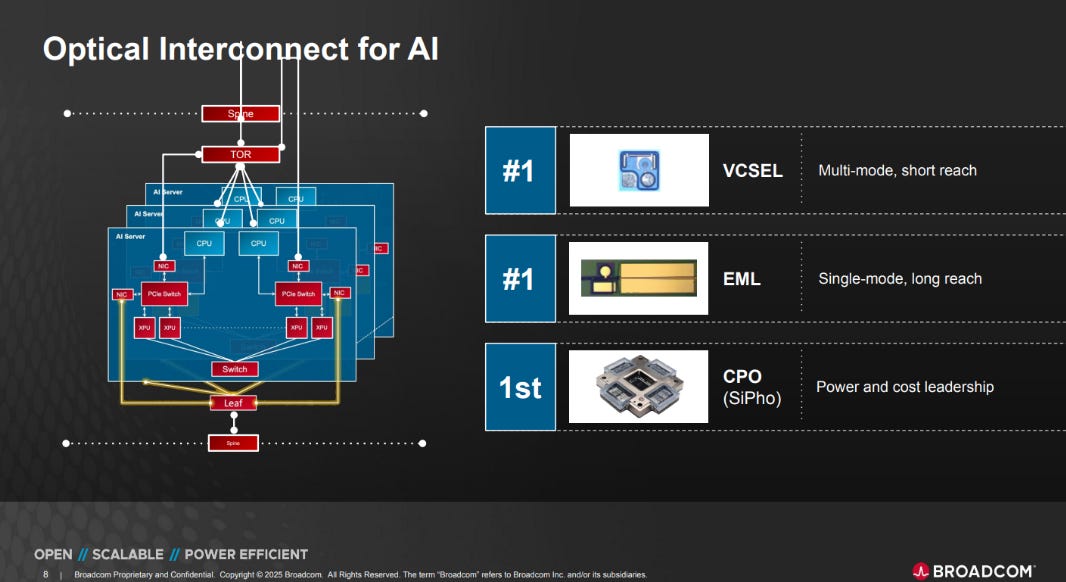
From Copper to Optical Interconnects
In the past, data centers could rely on copper cables and traditional optical modules. But as AI clusters become larger and data transmission speeds rise, traditional architectures begin to face limitations in power consumption, latency, thermal management, and signal integrity.
At high transmission speeds, electrical signals suffer losses across boards and connectors. More retimers, DSPs, and equalization are required to compensate for these losses, which increases both power consumption and heat. As speeds move from 400G to 800G and 1.6T, these problems become even more severe.

6月4日
This is where CPO, or co-packaged optics, starts to matter.
The core idea of CPO is to move optical communication modules closer to the switch ASIC. By shortening the distance that high-speed electrical signals must travel, data can be converted into optical signals more quickly, reducing power consumption and signal loss.
The future competition in AI clusters will not only be about how fast a single GPU is. It will be about whether the entire cluster can be connected as one system with lower latency, lower power consumption, and higher reliability.

3月10日
The Commercial Implications of CPO
If CPO becomes an important technology for large-scale AI data centers, it will affect switch ASICs, optical modules, lasers, silicon photonics, packaging, testing, and data center design.
This is not only a topic for networking companies. It will influence the entire AI hardware stack.
For investors and supply chain observers, the key question around CPO is not whether the concept is new. The real issue is when it can move from roadmap to large-scale deployment.
AI data centers have extremely high reliability requirements. Any new technology must prove that it can operate stably in high-temperature, high-density, and high-traffic environments.
Key Technical Signals to Watch in 2026
The shipment pace of 800G and 1.6T optical modules.
The networking roadmaps of NVIDIA, Broadcom, Marvell, and other key players.
Whether silicon photonics and CPO enter real data center deployment.
Whether the optical communication supply chain shifts from the telecom cycle to the AI data center cycle.
The larger AI becomes, the more important networking becomes.
The future AI bottleneck may not be compute. It may be interconnect.
Companies to watch:
Marvell
Coherent
Lumentum
Ayar labs
Lightmatter
Credo
3月26日
Power: Electricity Becomes a Hard Constraint for AI
AI data centers are consuming an unprecedented amount of electricity. This is not an exaggeration. It is an industrial reality.
As rack power density moves from tens of kilowatts to hundreds of kilowatts, and even toward discussions of 1 MW racks, traditional data center power architectures will be forced to change. This is why topics that were once considered infrastructure issues—such as 800VDC, onsite power, gas turbines, fuel cells, and grid capacity—are now entering the AI hardware discussion.
What AI Companies Are Really Buying Is Deployable Compute
AI companies are not really buying GPUs. They are buying deployable compute.
Deployable compute depends on many factors: whether electricity is available, whether power can be supplied reliably, whether power delivery efficiency is high enough, whether thermal systems can handle the load, whether data centers can be built quickly, and whether the capex payback period makes economic sense.
This is why power delivery will become a core technical issue in 2026. As rack density increases, traditional AC power distribution may face limits in efficiency, cable size, conversion losses, and thermal management. The discussion around new architectures such as 800VDC is about reducing conversion losses and improving power delivery efficiency under much higher power density.
Thermal and Power Must Be Viewed Together
High power density inevitably creates thermal challenges. Liquid cooling, cold plates, immersion cooling, and rear-door heat exchangers will become increasingly important. Cooling is not a secondary issue in data centers. It is a prerequisite for whether hardware can operate at full load.
If cooling is insufficient, GPUs and ASICs will experience thermal throttling, reducing real-world performance. If power supply is unstable, a data center cannot deploy equipment even if the hardware is physically available.
This means AI infrastructure competition will extend into power equipment, cooling systems, data center engineering, and energy procurement.
Key Technical Signals to Watch in 2026
Whether AI capex from major cloud providers becomes constrained by power availability and data center delivery timelines.
Whether 800VDC, liquid cooling, and high-power racks enter mainstream deployment.
Whether data centers begin adopting onsite power or long-term power purchase agreements.
The next battlefield in AI hardware may not be inside the chip lab. It may be next to the power grid.
Companies to watch:
Delta
Vertiv
Schneider
Eaton
Infineon
Chorma

6月3日
ASIC: The Second Path Beyond GPUs
NVIDIA remains at the center of AI hardware. But in 2026, ASICs will become increasingly important.
The reason is not that ASICs will completely replace GPUs. Rather, as AI workloads become more clearly defined, certain companies will want to use in-house or customized chips to reduce cost, improve efficiency, and reduce dependence on a single supplier.
The GPU vs. ASIC Trade-Off
The advantage of GPUs lies in general-purpose flexibility, software ecosystem, and mature supply. CUDA, libraries, frameworks, and the developer ecosystem have made GPUs the default choice for AI training and inference. When model architectures are changing rapidly, GPU flexibility is extremely valuable.

Source: semi
The advantage of ASICs lies in optimization for specific workloads. When a company has sufficiently large internal demand and relatively stable workloads, ASICs can achieve better efficiency in power consumption, cost, area, and performance.
Google TPU is the most typical example. Amazon Trainium and Inferentia, Microsoft Maia, Meta MTIA, and Broadcom’s support for hyperscaler custom silicon development are all part of the same trend.
But ASICs are not easy. They require high design costs, long development cycles, a mature software stack, and enough deployment scale to amortize the cost. If model architectures change quickly, ASICs may face the risk of insufficient flexibility.
Therefore, the key question in 2026 is not:
Will ASICs defeat GPUs?
A more precise question is:
Which AI workloads are worth running on ASICs, and which workloads must still remain on GPUs?
ASICs Will Reshape Supply Chain Power
If hyperscalers increase their use of in-house ASICs, value distribution across the supply chain will shift. NVIDIA’s system position will remain strong, but Broadcom, Marvell, EDA vendors, IP providers, TSMC, packaging, and testing suppliers will gain more strategic importance.
For cloud providers, ASICs are not only a cost optimization tool. They are also a source of bargaining power. When cloud companies have in-house alternatives, they gain more leverage in GPU supply and pricing negotiations.
Key Technical Signals to Watch in 2026
The actual deployment scale of Google TPU, Amazon Trainium, Microsoft Maia, and Meta MTIA.
Whether ASICs are mainly used for inference, rather than fully replacing training GPUs.
Broadcom and Marvell’s custom silicon revenue and design wins.
Whether the software stack allows ASICs to truly win on utilization and cost.
The answer will affect the long-term landscape of NVIDIA, Broadcom, Marvell, TSMC, EDA, IP, packaging, and cloud providers.
Companies to watch:
Broadcom
Marvell
AIchip
GUC
Mediatek
Apple
Microsoft
arm

4月28日
Rack-Scale System: The Unit of Competition Shifts from Chips to Full Racks
The unit of competition in AI hardware is changing. In the past, the market compared individual GPUs. Later, it compared servers. Now, the comparison is moving toward entire racks, and eventually full data center pods.
This is one of NVIDIA’s strongest positions. NVIDIA is not only selling GPUs. It is selling an integrated system consisting of GPUs, CPUs, NVLink, networking, switches, software, rack design, cooling, and power architecture.
Why Is the Unit of Competition Getting Larger?
When AI workloads require thousands or tens of thousands of accelerators to work together, the performance of a single chip is only one part of the equation. What matters more is whether the entire system can interconnect those accelerators efficiently, deliver power reliably, cool them effectively, and use the software stack to improve utilization.
The essence of a rack-scale system is co-design. Chips, memory, networking, power, cooling, mechanical design, and software scheduling must all be designed together. If any one layer falls behind, overall system performance suffers.
This is why the AI server supply chain can no longer be analyzed only through motherboards or assembly. PCBs, connectors, cables, power shelves, cooling modules, switches, NICs, DPUs, firmware, and cluster management all become part of system-level competition.
NVIDIA’s System Advantage
NVIDIA’s moat is not only in GPUs. It is also in the full system. NVLink, NVSwitch, InfiniBand and Ethernet networking, the CUDA software stack, and rack reference designs allow NVIDIA to turn hardware into deployable AI factories.
Competitors that only offer a high-performance accelerator still need to answer many additional questions: How will thousands of accelerators be interconnected? How should rack power be designed? How will cooling be handled? Is the software stack mature? Is cluster utilization high? What is the cost per token? Can customers deploy quickly?
In 2026, what matters most is not a single point technology, but system capability.
AI hardware is moving from a chip war to a system war.
Key Technical Signals to Watch in 2026
Shipments and customer adoption of NVL racks, GB platforms, Vera Rubin platforms, and other rack-scale systems.
Whether cloud providers begin adopting more non-NVIDIA rack-scale solutions.
Whether system TCO replaces single-chip benchmarks as the core factor in procurement decisions.
Companies to watch:
Foxconn
Wiwynn
Wistron
Supermicro
Quanta

6月11日
Conclusion: 2026 Is Not the Cooling Down of AI Hardware. It Is the Beginning of the Second Phase
Many people ask: Is AI hardware overheating?
This question is too broad.
A better question is:
Which AI hardware demand is short-term pull-in, and which demand represents structural change?
SemiVision’s view is that AI hardware in 2026 will no longer be only a GPU story. It will enter a more complex second phase.
The first phase was: buy GPUs and train larger models.
The second phase is: use the entire infrastructure stack to make AI operate at lower cost, higher efficiency, and greater scale.
Therefore, the seven key AI hardware keywords to watch in 2026 are:
Inference, HBM, CoWoS, CPO, Power, ASIC, and Rack-scale System.
If you only look at GPUs, you will miss the real changes in AI hardware.
The next wave of opportunity will appear where bottlenecks shift: from compute to memory, from chips to packages, from servers to racks, and from data centers to the power grid.
Whoever understands the bottlenecks will understand the next redistribution of value across the AI supply chain.


PreviousNext