Jensen Huang Becomes Korea’s New Tech Superstar
Jensen Huang Becomes Korea’s New Tech Superstar
- Source: SemiVision
- Author: SEMIVISION
- Published: 2026-06-08T16:30:25+08:00
- URL: https://tspasemiconductor.substack.com/p/jensen-huang-becomes-koreas-new-tech (1) Jensen Huang Becomes Korea’s New Tech Superstar


Jensen Huang Becomes Korea’s New Tech Superstar
Original Article By SemiVision Research [Reading time: 15 mins]

Jun 08, 2026
Jensen Huang Becomes Korea’s New Tech Superstar

Why Korea Is Not Just a Supporting Player in the AI Supply Chain, but a Key Battleground for the Next Wave of AI Industrialization
After leaving Taiwan, Jensen Huang traveled to South Korea, and the country quickly witnessed a familiar scene: media outlets chasing his motorcade, crowds gathering around him, corporate leaders lining up for meetings, financial communities tracking his itinerary in real time, and even investors mapping each stop on his trip to related Korean stocks as an “AI wealth map.”

Source: internet
This was no ordinary visit by a corporate CEO. It looked more like a technology version of a K-pop superstar tour.
But if we simply interpret this as “Jensen Huang is popular,” we miss the deeper point. The real question is: Why is South Korean society paying such close attention to NVIDIA? Why would his meal of grilled pork belly, his meeting with Faker at a PC café, his appearance on a variety show, and his ceremonial first pitch at a baseball stadium all be interpreted as part of Korea’s industrial destiny?
The answer is simple: in the AI era, South Korea occupies an extremely critical position.
Korea is not the world’s largest semiconductor foundry base, nor is it the main assembly hub for AI servers. But it controls several indispensable nodes in AI infrastructure: HBM memory, advanced-packaging-related capabilities, semiconductor materials and equipment, consumer electronics brands, automobile manufacturing, robotics, internet platforms, and sovereign AI demand.
In other words, Korea is not merely a single-component supplier. It is a national-level platform capable of bringing AI from data centers into factories, vehicles, robots, and consumer applications.
That is why Jensen Huang’s popularity in Korea is not merely personal admiration. Behind it lies industrial anxiety, national expectation, and a concentrated desire to secure a ticket into the AI era.
Korea Is Not Chasing Jensen Huang. It Is Chasing a Ticket Into the AI Era
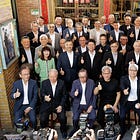
One of the most symbolic moments of Jensen Huang’s visit to Korea took place at a grilled pork belly restaurant, one of South Korea’s most beloved national food venues. There, he met with three major Korean business leaders: SK Group Chairman Chey Tae-won, LG Group Chairman Koo Kwang-mo, and Naver Chairman Lee Hae-jin. The gathering was described by some as a “Korean version of a trillion-dollar dinner.”
The scene itself was highly symbolic.
Around the sizzling barbecue table sat some of Korea’s most powerful technology and conglomerate leaders. Among them, LG Group Chairman Koo Kwang-mo, the youngest of the group, was even seen somewhat awkwardly grilling meat for everyone. This was a scene ordinary Koreans had rarely imagined, let alone witnessed.
Korea’s chaebol culture has long carried a sense of distance, hierarchy, and mystery. Yet Jensen Huang’s presence pulled these top-tier business leaders onto the same barbecue table, turning them into a surprisingly down-to-earth and human scene.
Even more interestingly, Huang walked outside the restaurant to greet the crowd and hand out food and drinks. The atmosphere felt less like a closed-door meeting among global technology giants and more like a K-pop idol fan meeting.
This is precisely what makes Jensen Huang so effective.
He understands that AI is no longer just a technical issue. It is a combination of social narrative, national competition, industrial confidence, and public emotion. That is why he did not merely meet corporate leaders. He met Korean society itself.
Jensen Huang Knows How to Play the Culture Card: From Faker and Yoo Jae-suk to a KBO First Pitch
Jensen Huang’s team clearly understands that Korea is not a market that can be won over only inside boardrooms. Korea has its own mass culture, esports culture, variety-show culture, baseball culture, and food culture.
That is why this visit was not just a series of corporate meetings. It was a carefully designed exercise in cultural communication.
He visited a PC café, met legendary esports player Faker, and posed with him using a signature hand gesture. This mattered deeply to Korea’s younger generation, because Korean PC gaming and esports culture were part of the early growth environment for NVIDIA’s GPUs.
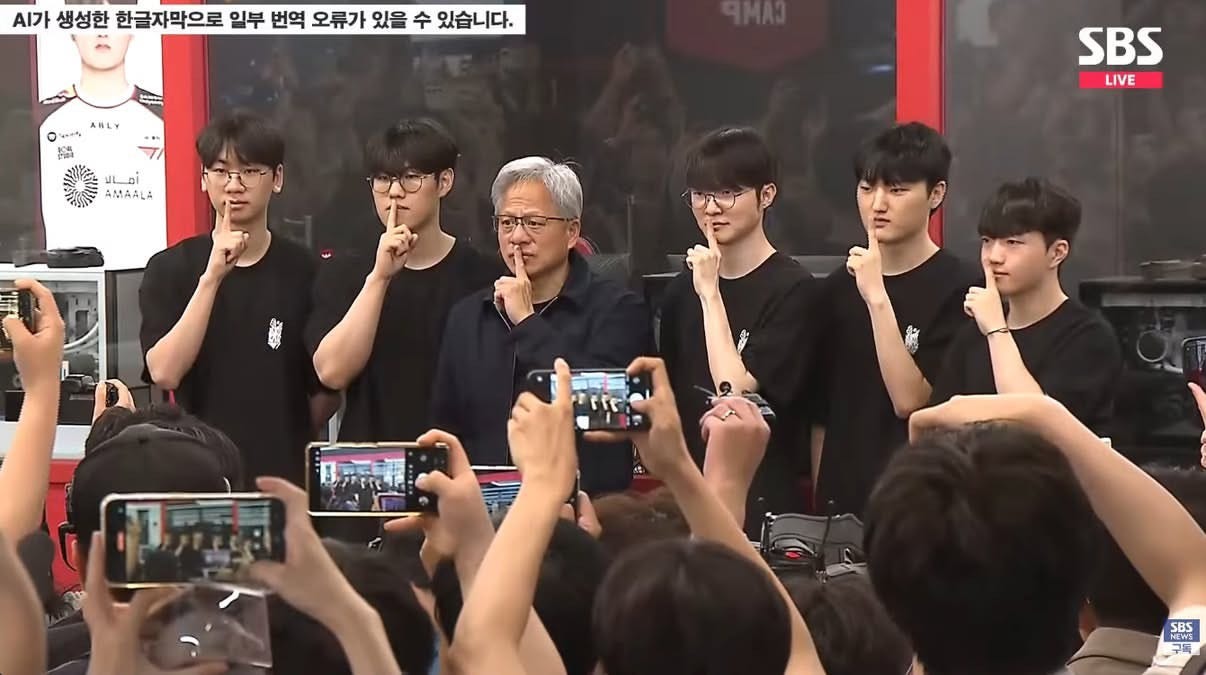
South Korea was one of the earliest countries to turn gaming into a mainstream culture. From the rise of PC bangs in the late 1990s to the professionalization of StarCraft and League of Legends, esports became part of Korea’s national technology identity. Teams like T1 and players like Faker are not just entertainers; they represent Korea’s ability to build global digital culture, talent systems, fan economies, and competitive platforms.
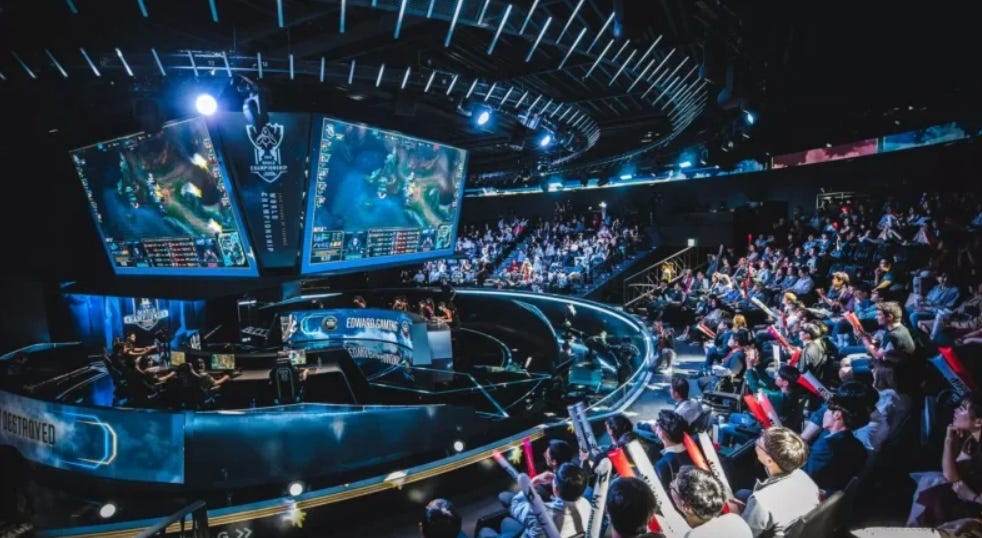
LoL Park Seoul / Riot Games
For NVIDIA, this history matters. Korea’s relationship with GPUs did not start with AI data centers. It started with gaming, graphics cards, PC cafés, and esports. By standing beside Faker, Huang was reminding Korea that the AI era is not disconnected from its gaming past. The same GPU ecosystem that powered Korean esports is now powering the next generation of AI infrastructure.
NVIDIA’s relationship with Korea is not just about HBM, nor did it begin with today’s AI cooperation. From gaming graphics cards and PC cafés to esports, AI data centers, and robotics, NVIDIA and Korea’s technology industry have grown together over time.
Huang also made his first appearance on a South Korean variety show, joining Yoo Jae-suk on the popular program You Quiz on the Block. He even danced to “Golden,” the theme song from the animated film KPop Demon Hunters.
These moments looked lighthearted, but they were actually highly precise public-relations moves.
Bloomberg has described Huang as a natural showman. Through these events, he fully displayed an image closer to that of a rock star than a traditional technology executive.
This approachable, hierarchy-breaking style created a major sensation in Korea.
Korean society has long had a complicated relationship with chaebols, power, and technology elites: admiration mixed with distance, dependence mixed with suspicion. Huang used restaurants, PC cafés, variety shows, and baseball stadiums—highly public, everyday spaces—to repackage the otherwise cold and distant image of the AI industry.
AI was no longer just an invisible GPU inside a data center, nor merely a capex number in a Wall Street report. It became a wave of change that ordinary people could feel.
The KBO First Pitch: The Industrial Signal Behind One Jersey Number
Another highlight of Huang’s Korea visit was his appearance at Jamsil Baseball Stadium in Seoul, where he threw the ceremonial first pitch before a KBO game between the Doosan Bears and the Kiwoom Heroes.
Known for his signature black leather jacket, Huang changed into a baseball look this time, wearing a jersey with the number “93.” This number was not chosen at random. It paid tribute to 1993, the year NVIDIA was founded.
Standing in the batter’s box to “face” Huang’s pitch was Doosan Bears owner and Doosan Group Chairman Park Jeong-won. Park wore the number “96,” symbolizing Doosan Group’s founding year of 1896.
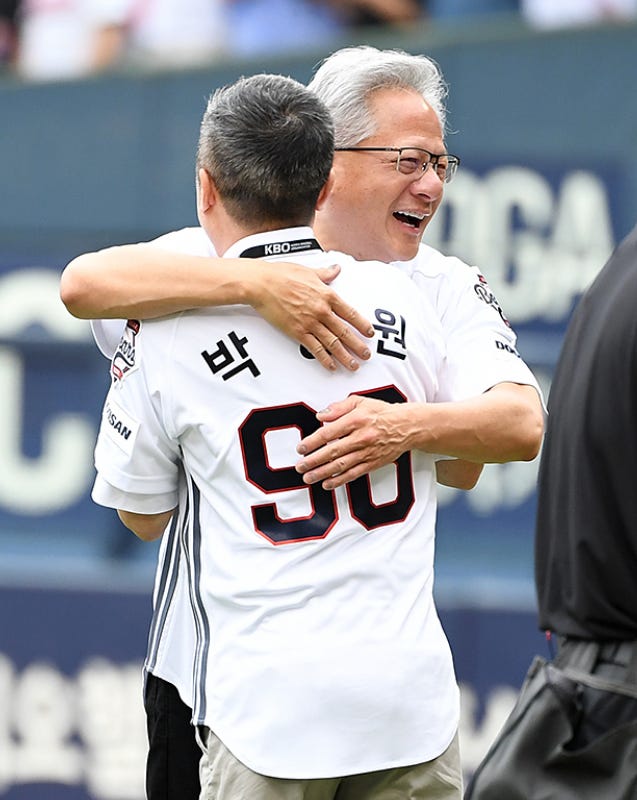
On the surface, this was a lighthearted baseball event. But beneath it was a powerful industrial symbol.
NVIDIA represents a new technological force born in 1993, while Doosan represents Korea’s traditional industrial power dating back to 1896. When an AI giant and a century-old industrial group appeared together on a baseball field, the message was clear: AI is not here to replace traditional industry. It is here to reshape it.
This matters especially for Korea.
Korea’s next AI opportunity is not only about data centers and HBM. It is also about how AI enters heavy industry, robotics, energy, manufacturing, and automation systems. Doosan itself is closely tied to robotics, energy equipment, and industrial manufacturing, which aligns strongly with NVIDIA’s push into robotics and physical AI.
Before throwing the pitch, Huang also said that NVIDIA’s relationship with Korea began with PC gaming. He said that NVIDIA and Korea’s PC gaming industry, as well as NVIDIA and Korea’s technology industry, grew up together.
That statement matters.
It was not just a polite remark. It was a reminder to Korea that NVIDIA is not an AI giant that suddenly arrived in the country. Since the gaming GPU era, NVIDIA and Korea’s technology industry have shared a common history.
From PC gaming to AI computing; from PC cafés to AI factories; from gaming GPUs to HBM and robotics. This trajectory is also a miniature version of Korea’s own technology transformation.
Chimaek Diplomacy: Supply Chain Politics Behind Fried Chicken and Beer
Huang also joked that another important reason for visiting Korea was to enjoy “chimaek,” Korea’s beloved pairing of fried chicken and beer.
He even said, “Nothing is better than chimaek.”
It sounded casual, but the impact was powerful.
To Koreans, chimaek is not just food. It is a cultural symbol of everyday life. By placing himself inside this familiar Korean cultural language, Huang quickly shortened the distance between himself and the public.
Even more notably, after saying he wanted to enjoy fried chicken and beer, his next stop was a nearby fried chicken restaurant for a “chimaek” gathering with SK Group Chairman Chey Tae-won.

Nvidia CEO Jensen Huang, right, and SK Group Chairman Chey Tae-won share fried chicken and snacks to reporters and citizens in front of a Kkanbu Chicken restaurant in Seoul, Sunday. Yonhap
This was no longer just a food stop. It was culturally packaged supply chain diplomacy.
The AI-era supply chain is extremely complex. If any node fails, the entire platform’s shipment schedule can be affected. Without enough HBM, GPUs cannot ship. Without enough CoWoS, AI accelerators cannot be packaged. If PCB lead times stretch, racks cannot be delivered. If liquid cooling is immature, data centers cannot operate stably. If power is insufficient, no amount of GPUs can be turned on.
Therefore, NVIDIA does not merely need suppliers. It needs allies.
Through grilled pork belly, chimaek, baseball, esports, and variety shows, Huang transformed supply chain relationships from cold procurement contracts into public recognition, national pride, and corporate community.
When he appeared in public cultural settings with leaders from SK, LG, Naver, Doosan, and other Korean companies, the message was not “we held a meeting.” The message was: “Korea is an important member of NVIDIA’s AI map.”
That signal is extremely effective for companies, governments, investors, and the general public.
Why Korea Matters: Its First Trump Card Is HBM
The bottleneck in AI training and inference is no longer just GPU compute power. It is data movement. The larger the model, the greater the parameter count, and the higher the token throughput, the more GPUs depend on high-bandwidth, low-latency, low-power memory systems.
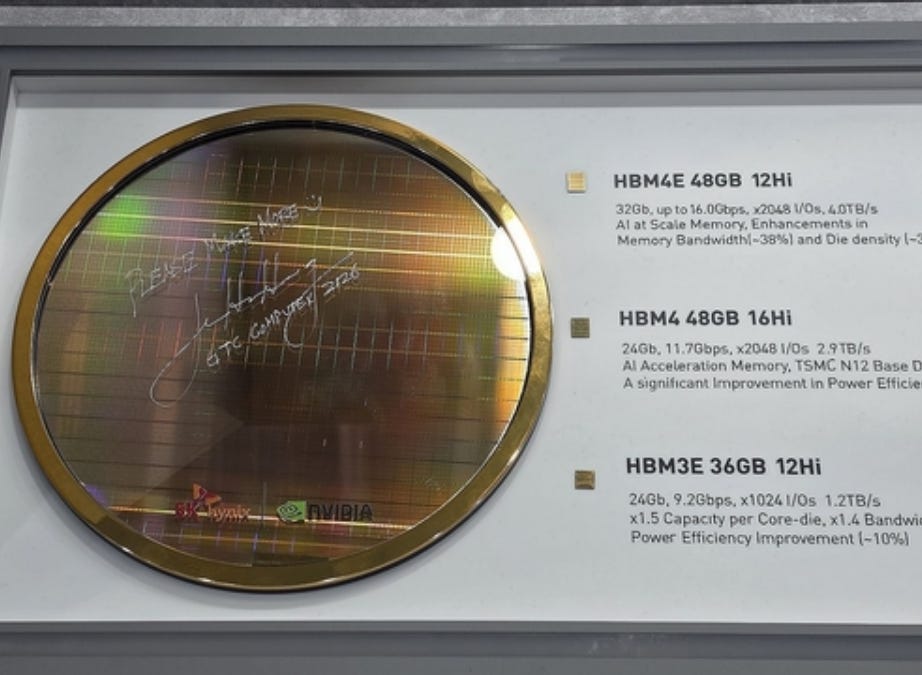
Jensen said PLEASE MAKE MORE : )
That is why HBM has evolved from a relatively niche high-end memory product into a strategic component for AI accelerators.
This is where Korea matters.
SK hynix is one of the most important suppliers in the global HBM market, while Samsung is aggressively catching up, hoping to regain its influence in high-end memory. For Korea, whether NVIDIA’s next-generation platforms adopt Korean HBM is not just a routine supply chain story. It is a central question that will shape memory capex, pricing cycles, and national technology status for years to come.
As AI chip architectures evolve, HBM increasingly looks less like conventional “memory” and more like a co-designed component inside the GPU package.
By the Rubin, Rubin Ultra, and later platform generations, HBM is no longer a commodity that can simply be plugged in. It involves base dies, TSVs, thermal management, package height, yield, power consumption, signal integrity, and total system cost.
Whoever can supply stable, sufficient, and qualified HBM can become deeply tied to the next-generation architectures of NVIDIA, AMD, Google, Amazon, Microsoft, Meta, and other AI platform companies.
This is why Korean investors are chasing Jensen Huang.
One sentence from him may determine not only the short-term stock price of a company, but also whether Korea’s memory industry can remain at the core of AI for the next several years.
Korea’s Value Is Not Only Memory, but Industrialization Capability
If we look only at HBM, Korea is already important. But if we look at AI deployment, Korea becomes even more important.
During his Korea visit, Huang specifically said robotics will become Korea’s next major industry. This was not accidental.
Korea is already a global manufacturing powerhouse. It has automobiles, home appliances, semiconductors, displays, batteries, industrial machinery, shipbuilding, logistics, and smart factories. These are precisely the best scenarios for AI to enter the physical world.
Hyundai Motor represents mobility and robotics. LG represents home appliances, displays, batteries, and smart factories. Samsung represents semiconductors, smartphones, terminals, and AI devices. SK represents memory, energy, and telecommunications. Naver represents cloud, search, content, language models, and sovereign AI.
These companies are not isolated corporations. They are part of Korea’s industrial system.
Therefore, what NVIDIA wants to do in Korea is not merely to buy HBM. It is more likely looking for the next wave of major collaboration cases in AI factories, robotics platforms, smart manufacturing, sovereign AI, and physical AI.
If AI is to truly enter the physical world, Korea is an ideal testbed.
It has dense cities, strong manufacturing, a powerful electronics industry, an advanced automotive supply chain, mature telecommunications infrastructure, and an industrial culture in which large corporate groups can quickly push new technologies into deployment.
Hyundai Motor has been an official major partner of FIFA since 1999 and has served as the official automotive brand of the FIFA World Cup for seven consecutive tournaments. During the 2026 FIFA World Cup in North America, Hyundai is not only launching a global promotional campaign but also deploying a large-scale mobility fleet consisting of nearly 1,500 passenger vehicles and buses.
Its key partnerships and marketing initiatives include:
Mobility fleet support:Across the 16 host cities in the United States, Canada, and Mexico, Hyundai will provide transportation services for national teams, officials, and media representatives.
Robotics technology showcase:As FIFA’s official robotics partner, Hyundai will deploy Boston Dynamics’ Spot robots at tournament venues for autonomous patrols and real-time monitoring.
From Taiwan to Korea: NVIDIA Is Connecting Asia’s AI Industrial Chain
The fact that Huang visited Taiwan first and then Korea says a great deal about the real map of NVIDIA’s AI supply chain.
Taiwan is the core hub of AI hardware manufacturing.
TSMC provides advanced process technology and CoWoS. Foxconn, Quanta, Wistron, Wiwynn, Inventec, and others handle AI servers and rack integration. Delta Electronics provides power and thermal solutions. Taiwan’s PCB, CCL, connector, mechanical-component, and cooling supply chains support the entire AI infrastructure stack.
5月29日
Korea controls high-end memory, consumer electronics terminals, automobiles, robotics, and internet platforms.
These two countries are not substitutes for each other. They are highly complementary.
One can understand it this way:
Taiwan makes AI compute possible.
Korea gives AI memory, applications, and a path into factories, vehicles, and everyday life.
As NVIDIA evolves from a GPU company into an AI infrastructure company, it needs more than chip manufacturing. It needs a complete national-level supply chain.
Taiwan provides manufacturing and system integration. Korea provides memory and industrial applications. Japan provides materials, equipment, and precision components. The United States provides architecture, software, cloud platforms, and capital expenditure.
This is the new Asian division of labor in the AI era.
Korea’s Anxiety: It Cannot Stop at HBM
Korea is important in AI, but it also faces obvious pressure.
First, HBM is critical, but ultimate system-level control still belongs to platform companies such as NVIDIA. If Korean companies only provide memory, they may still be trapped in a structure of high capex, strong cycles, and high customer concentration.
Second, Samsung still faces challenges in advanced logic foundry and AI accelerator manufacturing. If Korea wants to become a complete AI semiconductor powerhouse, it cannot rely solely on memory. It must also make breakthroughs in foundry, advanced packaging, EDA/IP, ecosystem development, and AI ASICs.
Third, although Korea has internet platforms and AI model companies such as Naver, it still lags behind U.S. hyperscale cloud platforms in capital expenditure and global reach. This means Korea needs a clearer sovereign AI strategy.
Fourth, while robotics is Korea’s next opportunity, the real difficulty lies in the software stack, data flywheel, sensors, control systems, simulation platforms, and large-scale deployment.
Korea has hardware manufacturing advantages, but it still needs long-term investment to turn manufacturing strength into AI robotics platforms.
This is why Huang’s popularity in Korea also contains a sense of anxiety. Korea knows it is important, but it also knows that the rules of competition in the AI era are changing.
In the past, Korea excelled at making single products globally dominant, such as DRAM, NAND, OLED, smartphones, and televisions. But AI-era competition is about system-level integration, platforms, ecosystems, and full-chain capabilities from data centers to end devices.
For Korea, this is both an opportunity and a challenge.
3月2日
Conclusion: Korea Is Not Chasing Jensen Huang. It Is Chasing Its Own AI Future
Jensen Huang being chased across Korea may look like a technology celebrity phenomenon. But what Korea is really chasing is its own AI future.
Koreans understand that AI is not just the next smartphone cycle, nor merely another memory upcycle. It is a reordering of the industrial hierarchy.
Whoever enters the core supply chains of NVIDIA, OpenAI, Microsoft, Google, Amazon, Meta, and other AI giants will capture the next decade of capital expenditure. Whoever can bring AI into manufacturing, automobiles, robotics, and end devices will turn compute into real industrial productivity.
That is why Jensen Huang’s Korea visit became a national event.
Grilled pork belly, chimaek, Faker, Yoo Jae-suk, and the KBO first pitch all looked like lighthearted cultural activities. But in essence, together they formed a highly successful exercise in AI supply chain diplomacy.
Jensen Huang did not come to Korea merely to eat barbecue, drink beer, dance, and throw a baseball.
He came to tell Korea:
You are not just NVIDIA’s suppliers.
You are important partners in the age of AI industrialization.
And through this wave of “Jensen Mania,” Korea also showed the world that it is not merely a memory powerhouse. It is an indispensable national platform as AI moves from data centers into the physical world.
Thanks for reading SEMIVISION @_@! This post is public so feel free to share it.
NAVER Expands AI Infrastructure With NVIDIA to Serve Surging Global AI Demand
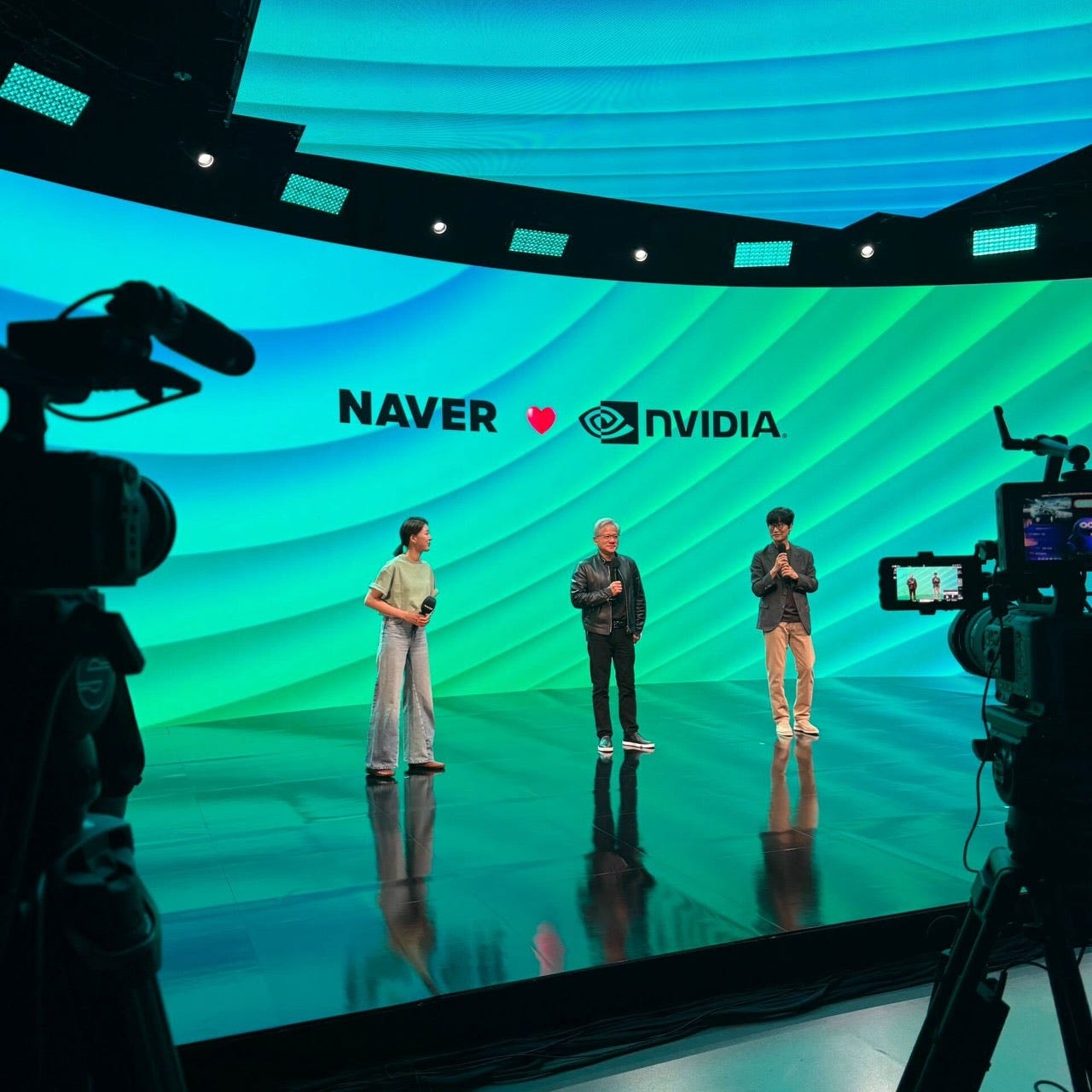
NAVER, an AI Cloud, will build AI factories on the NVIDIA DSX platform at gigawatt scale, starting with AI infrastructure expansion at GAK Sejong.
NVIDIA DSX gives NAVER a proven AI factory blueprint to serve Korea’s industries and global AI cloud customers as demand for useful AI surges at lowest token cost.
NAVER will use NVIDIA full-stack AI platforms, models and software to advance regional AI models including next-generation HyperCLOVA X models, its Seoul World Model development and agentic AI services.
Korea’s AI Boom Is Creating a Two-Speed Economy

South Korea’s economy is increasingly becoming a two-speed story. In May, exports surged 53.2% year over year to a record $87.75 billion, with a trade surplus of $26.95 billion—the fastest growth since 1984. But the boom is being driven almost entirely by one sector: AI semiconductors. As the home of Samsung and SK hynix, Korea is becoming one of the biggest beneficiaries of the global AI infrastructure arms race, with semiconductor exports reaching $37.16 billion in May, nearly tripling from a year earlier and exceeding $30 billion for the third straight month. Computer-related exports also jumped nearly fourfold. Yet traditional industries are moving in the opposite direction: auto exports fell 5.9%, steel declined 2.1%, and exports to the Middle East dropped 7.7% amid geopolitical tensions. The message is clear: Korea’s AI supply chain is overheating, but much of its old manufacturing economy is not sharing the same momentum.
Jia Choi: Korean Fried Chicken is a must-have dish when it comes to Korea. It is light and crispy with a thin, almost paper like skin, and inside is moist and tender. I simplified the recipe so that you can make the taste of a chicken restaurant at home.
Thanks for reading SEMIVISION @_@! This post is public so feel free to share it.


PreviousNext