The Next Power Architecture for AI Data Centers: Solid-State Transformers and 800V HVDC
The Next Power Architecture for AI Data Centers: Solid-State Transformers and 800V HVDC
- Source: SemiVision
- Author: SEMIVISION
- Published: 2026-06-03T09:28:54+08:00
- URL: https://tspasemiconductor.substack.com/p/the-next-power-architecture-for-ai (1) The Next Power Architecture for AI Data Centers: Solid-State Transformers and 800V HVDC


The Next Power Architecture for AI Data Centers: Solid-State Transformers and 800V HVDC
Original Article By SemiVision Research [Reading time: 18 mins]

Jun 03, 2026
∙ Paid
The Next Power Architecture for AI Data Centers: Solid-State Transformers and 800V HVDC

AI data centers are entering a new power era. As GPU clusters scale from tens of kilowatts per rack toward hundreds of kilowatts, and eventually megawatt-class rack systems, the bottleneck is no longer only compute, memory, or networking. It is power delivery.
Traditional data center power architectures were designed for a very different workload profile. The conventional path—medium-voltage AC input, multiple AC/DC and DC/DC conversion stages, UPS systems, power shelves, busbars, and finally low-voltage delivery to the server—worked reasonably well when rack power stayed below 30–60 kW. But AI infrastructure is now pushing far beyond that range. In this environment, every conversion stage, every copper busbar, every thermal loss, and every square meter of power-room space becomes a strategic constraint.
This is why the industry is moving toward 800V high-voltage direct current architecture, or 800V HVDC, with the solid-state transformer, or SST, emerging as one of the most important enabling technologies.
The Rise of the 800V HVDC ArchitectureSurging Power Consumption in AI Data Centers
The rapid increase in AI server power consumption is being driven by the sharp rise in GPU computing performance. For example, the power demand of NVIDIA’s GB200/GB300 server racks has already exceeded 200 kW. Future 1 MW-class Kyber racks will consume even more electricity.
Under the traditional 54V power distribution architecture, a single 1 MW rack would require approximately 200 kg of copper busbars. If this model were applied to a GW-scale data center, copper consumption could reach as high as 500,000 tons, which is clearly unsustainable.
In addition, repeated AC/DC and DC/DC conversion stages increase line losses, making the traditional architecture increasingly inefficient. As a result, the industry needs a power delivery solution with higher voltage, lower current, fewer conversion stages, and better adaptability to high power density.
Advantages of High-Voltage DC Architecture
High-voltage DC power distribution raises the supply voltage from the traditional 48V/54V level to ±400V or 800V DC.
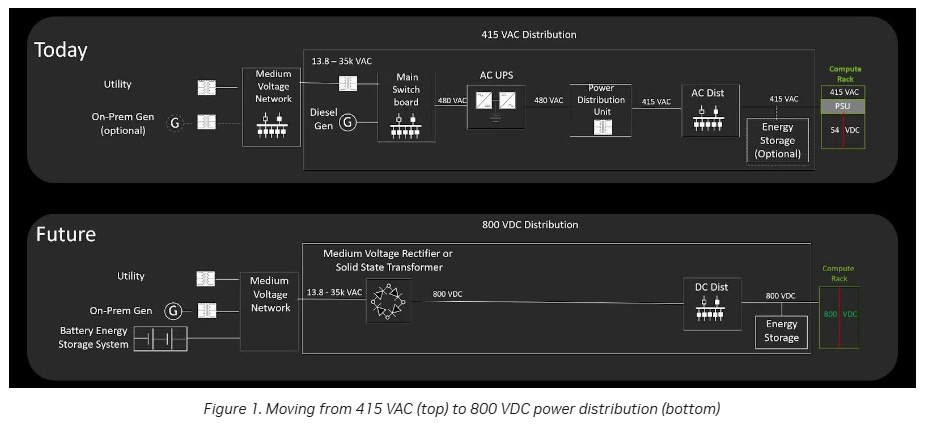
According to NVIDIA’s white paper released at GTC 2025, an 800V HVDC architecture can use solid-state transformers and industrial-grade rectifiers at the edge of the data center to directly convert 13.8 kV AC power into 800V DC.
This architecture requires only two conductors to deliver 800V power into IT racks. Inside the rack, DC/DC modules then step the voltage down to 50V or lower for GPU power delivery.
Because the system operates at a higher voltage, the required current is reduced. This can significantly lower copper weight, by roughly 45%, while also reducing line losses and heat generation.
In addition, by reducing the number of AC/DC and DC/DC conversion stages, the architecture can improve end-to-end power delivery efficiency by around 5%.
Below we will share:
Limitations of Traditional HVDC and the 800V Breakthrough
The Role of the Solid-State Transformer (SST)
Advantages of SST
SST Cost Structure
Development Stages and Adoption Timeline
Key Suppliers and Strategies
Supply Chain Structure
Challenges and Future Outlook


Limitations of Traditional HVDC and the 800V Breakthrough
High-voltage direct current is not a new concept. As early as around 2010, companies such as Google and Microsoft had already experimented with 240–380V HVDC data centers. However, early HVDC architectures faced three major challenges:
High cost— They required customized rectifiers, converters, and backup battery systems, resulting in much higher upfront investment than traditional UPS-based architectures.
Fragmented standards— There was no unified voltage standard. Solutions based on 240V, 336V, and 380V were not mutually compatible.
As AI computing power drives rack power density higher, these limitations have pushed the industry to search for a higher-voltage solution that is compatible with next-generation components.
In 2025, NVIDIA proposed an architecture combining 800V HVDC with solid-state transformers. By using wide-bandgap semiconductors and high-frequency magnetic materials, this architecture enables higher efficiency and a more compact system design.
It also shares part of its technological foundation with 800V electric vehicle platforms, particularly in power modules and safety certification. This gives the architecture a stronger path toward commercial deployment.
The Role of the Solid-State Transformer
The solid-state transformer is the key component that makes this new architecture possible.

A solid-state transformer is a power-electronics-based energy router designed to replace traditional line-frequency transformers. Its basic architecture includes input rectification (AC/DC), isolation and voltage transformation (DC/AC → high-frequency transformer → AC/DC), and output conversion (DC/DC).
Unlike traditional 50/60 Hz line-frequency transformers, the high-frequency transformer inside an SST operates at the kHz level. This can significantly reduce magnetic core size and increase power density. Through software-programmable DSP/FPGA controllers, SSTs can also provide the following functions:
•Bidirectional energy flow— Supports power flow from the grid to the load, as well as power feedback from the load to the grid. This makes SSTs suitable for renewable energy grid integration and energy storage dispatch.
•High-precision voltage regulation— Enables real-time adjustment of output voltage and frequency, dynamically compensates reactive power, suppresses harmonics, and improves power quality.
•Modular design— Uses parallel power modules, with each module functioning as a complete low-power SST unit. This makes the system easier to scale and maintain.
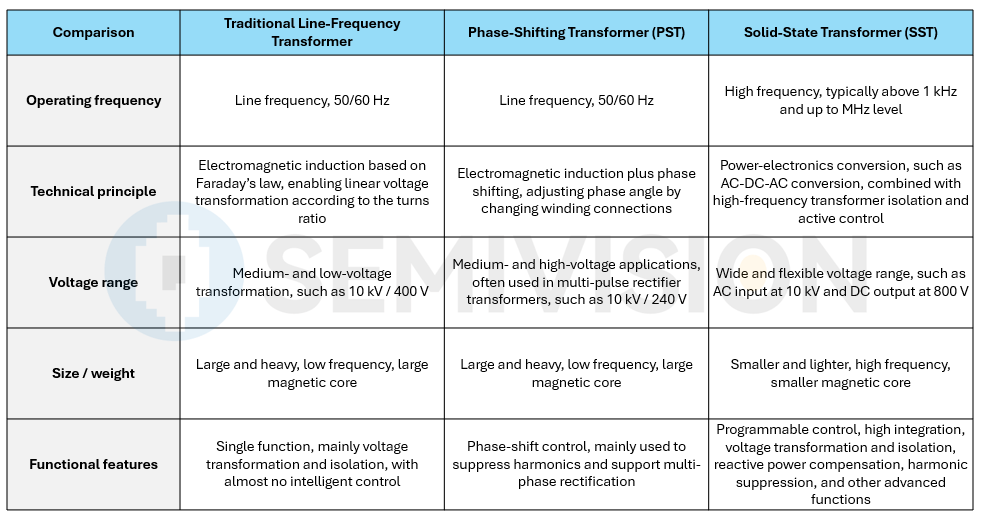
The first generation of HVDC systems and traditional UPS architectures both relied on bulky line-frequency transformers. The second generation of HVDC architecture, often referred to as the Panama approach, adopted phase-shifting transformers with multi-winding structures. These transformers provide AC inputs with different phase angles to the rectifier modules, effectively suppressing harmonics and improving power delivery efficiency.
Solid-state transformers use advanced insulation design and materials that allow them to operate at high frequencies and withstand higher voltages. As SST technology becomes capable of handling high-frequency operating environments, it is now entering a new stage of industrialization and broader commercial deployment.
Advantages of SST
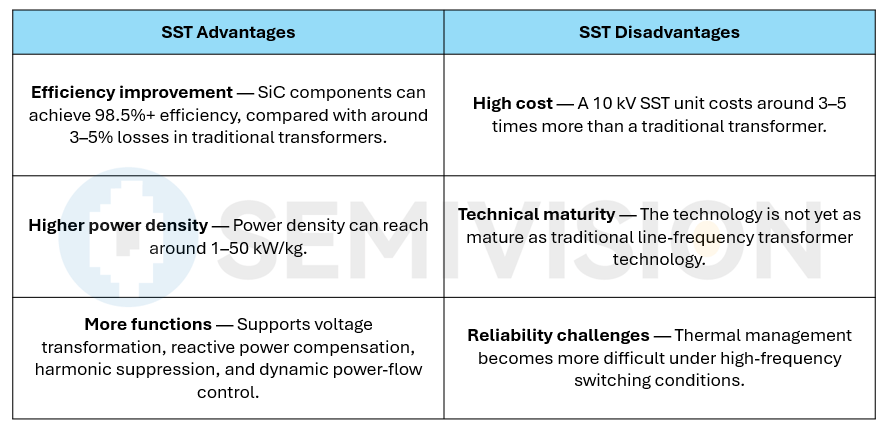
High efficiency and energy savings— SSTs use wide-bandgap semiconductors such as silicon carbide (SiC) and gallium nitride (GaN) to achieve high-frequency switching. System efficiency can exceed 98%, outperforming traditional HVDC architectures at around 95.1% and the Panama-style solution at around 97.5%. Guosheng Securities noted that for gigawatt-scale data centers with massive electricity consumption, every 1% improvement in efficiency could save tens of millions of yuan in annual electricity costs.
Smaller size and lighter weight— The volume of high-frequency magnetic cores is inversely related to operating frequency. As a result, SST magnetic cores can be significantly smaller, reducing the equipment footprint to only around 50% of traditional solutions, or even less.
Programmability and intelligent control— SSTs are essentially software-defined energy routers. Through digital controllers, they can support dynamic regulation, fault self-healing, and coordinated operation between components. This makes them an important foundation for future renewable energy grids and microgrids.
As a “power router,” SST represents the future direction of power architecture. 800V HVDC is the starting point for SST adoption, but it is not the endpoint.
SST penetration is still far from reaching the stage of large-scale volume deployment. At present, SST is often viewed merely as one component within the 800V HVDC architecture, and public understanding of SST is still largely limited to its ability to improve circuit efficiency and energy performance.
In reality, SST’s value goes far beyond efficiency improvement. Unlike passive power conversion solutions, SST is an actively controlled architecture. Its flexibility, controllability, and compatibility with green power will allow it to capture a much larger market share in the future.
SST Cost Structure
Based on industry report, the cost structure of SSTs is mainly composed of the following components:
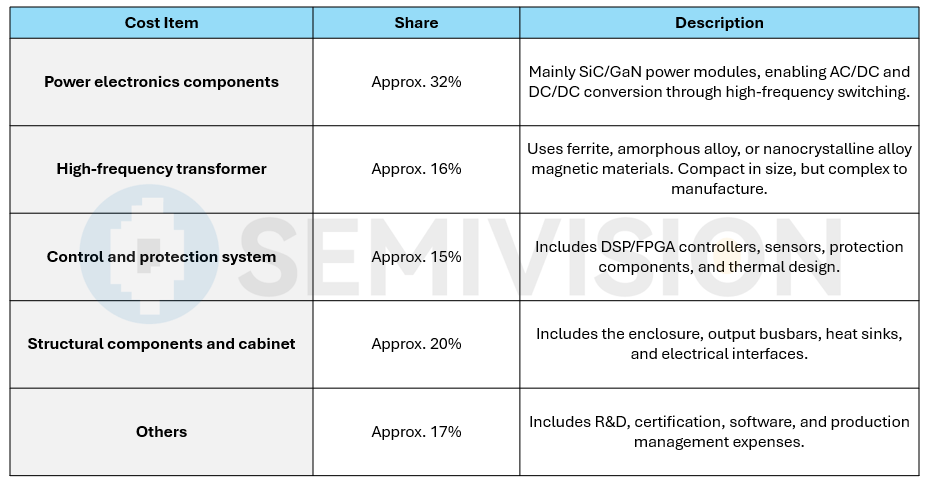
As the cost of SiC/GaN semiconductors continues to decline and magnetic materials technology advances, the overall cost of SSTs is expected to gradually decrease, accelerating commercial adoption.
Development Stages and Adoption Timeline
The industry generally expects SST adoption to unfold in three stages:
Prototype stage (2025–2026)— Major suppliers will introduce prototype systems to validate power conversion efficiency and safety standards. For example, Delta Electronics showcased an SST at OCP 2025 capable of converting medium-voltage AC power into 800 VDC, with efficiency reaching up to 98.5%.
Small-volume deployment (2027)— NVIDIA plans to mass-produce its 800 V HVDC system in 2027 alongside its Kyber racks. Eaton is also expected to launch its medium-voltage solid-state transformer, or MVSST, solution in 2027. By eliminating components such as UPS systems and distribution panels, the new architecture is expected to significantly reduce the number of power conversion stages.

Scaled deployment (2028–2029)— The market expects 2028–2029 to become the key period for large-scale SST adoption. Supply chain estimates suggest that the global solid-state transformer market could achieve a compound annual growth rate of 25–35% over the next 5–10 years, benefiting related materials and power semiconductor demand at the same time.
Key Suppliers and Strategies
Delta Electronics
Delta Electronics is a global leader in power supplies and thermal management solutions, and has been actively positioning itself in high-voltage DC architectures for AI data centers.
In October 2025, Delta showcased 800 VDC and ±400 VDC power architecture solutions at the OCP Global Summit. The company introduced a row-level power system with an integrated solid-state transformer, capable of directly converting medium-voltage AC power into 800 VDC, with power conversion efficiency reaching up to 98.5%.
Delta also launched a 1 MW row-level power system containing multiple 106 kW AC/DC rack-mounted power supplies. Its new EVA, or Energy Variance Appliance, cabinet can use energy storage to smooth GPU peak loads, achieving full-load efficiency of up to 97%.
For the ±400 VDC architecture, Delta provides a 72 kW rack-mounted power supply that converts 480 VAC input into 48/50 VDC output, with efficiency reaching 97.5%. Delta also showcased advanced thermal management solutions, including a 300 kW liquid-to-air cooling CDU and a 2,000 kW liquid-to-liquid CDU.
Delta Electronics President and COO Simon Chang stated that as AI server power consumption continues to rise, Delta has introduced a next-generation “secret weapon” — the solid-state transformer — and expects demand to accelerate around 2027.
Eaton
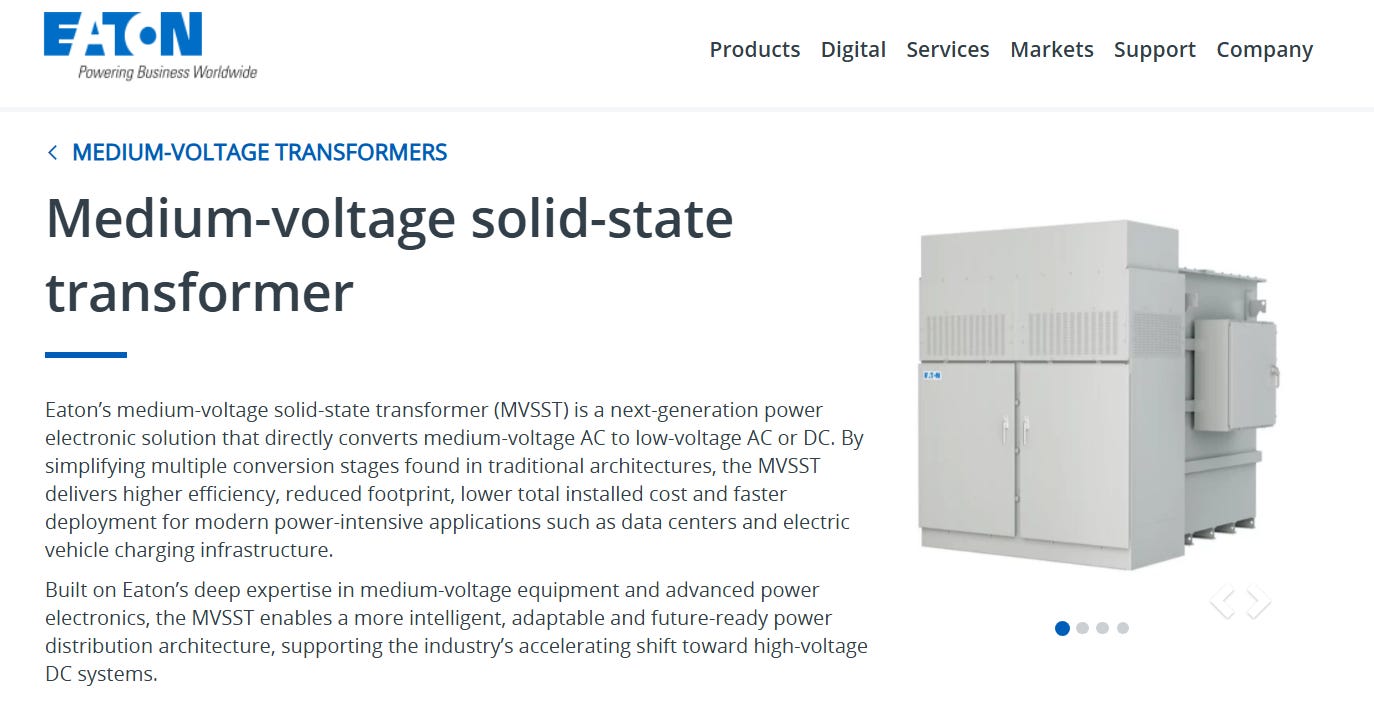
Eaton is a leading supplier of UPS and power distribution systems. In response to the needs of AI data centers, Eaton introduced its “From Grid to Chip” strategy at SEMICON Taiwan 2025, along with a medium-voltage solid-state transformer, or MVSST, solution.
Eaton East Asia General Manager noted that Eaton is working with NVIDIA on an 800 V HVDC co-development program for Rubin Ultra GPUs, and is introducingMVSSTto support the growth of AI computing.
Eaton Taiwan and Philippines General Manage stated that the new architecture can compress the six to seven intermediate power conversion stages into just one or two stages, reducing energy consumption and copper usage. The MVSST solution is expected to be deployed around 2027.
Vertiv
Vertiv is a global provider of critical infrastructure solutions and has long been active in the ±400 VDC DC power field.
In May 2025, Vertiv announced that it would launch an 800 VDC power product portfolio in the second half of 2026 to align with NVIDIA’s technology roadmap and support future IT racks of 1 MW or higher.
Vertiv’s experience dates back to telecom-grade ±400 VDC systems in the 2000s, and the company is trusted by the industry for its system safety and deployment capabilities.
Navitas Semiconductor
Navitas Semiconductor is a global leader in GaN and SiC power semiconductors.
In May 2025, Navitas announced a collaboration with NVIDIA to develop a next-generation 800 V HVDC power architecture. The company will use its GaN and SiC technologies to enable high-efficiency, low-loss power delivery.
Navitas stated that this architecture directly converts grid power into 800 VDC for GPU systems, improving end-to-end power efficiency by up to 5%, reducing maintenance costs by 70%, and lowering cooling costs.
The announcement once drove Navitas’ stock price to surge by more than 180% in after-hours trading.

Navitas GaN and SiC technologies cover the complete power delivery from grid to the GPU
Component Suppliers such as Infineon and TI
Multiple semiconductor companies are working with NVIDIA to provide the power chips and controllers required for the 800 V HVDC architecture.
In May 2025, Infineon announced its participation in the development of 800 V HVDC power systems, providing power conversion solutions based on silicon, silicon carbide, and gallium nitride technologies.
Texas Instruments also announced in the same year that it would work with NVIDIA to develop power management and sensing technologies for 800 V HVDC power distribution systems.
The participation of these suppliers indicates that the entire power semiconductor supply chain is beginning to align around this new architecture.
In the current data center power architecture, AC power first needs to be converted into 800V high-voltage DC. This is typically paired with a local battery backup unit, after which the power goes through high-voltage conversion. The 800V DC bus is then stepped down through DC/DC conversion to 48V, supplying power to onboard chips and system-level components.

TI provides a broad portfolio of high-voltage power solutions for this architecture. Its GaN power devices and C2000 digital power controllers play particularly important roles across the power conversion chain.
From AC/DC conversion to DC/DC conversion, TI’s chips can be applied in nearly every major stage. In the AC/DC stage, TI’s GaN devices help achieve efficient and stable power conversion, turning AC input into DC power and providing a reliable power foundation for data centers. In the DC/DC stage, TI’s C2000 digital power controllers provide real-time control capability and high-precision PWM control, helping ensure stable operation of internal data center components under rapidly changing loads.
Looking ahead, TI’s design work in high-voltage DC architectures deserves close attention, especially in areas such as AC-to-800V conversion, as well as 800V or ±400V HVDC conversion down to 12V.
TI’s GaN chips integrate internal drivers, which help reduce switching losses while providing reliable protection functions. At the same time, TI’s advanced packaging design improves thermal performance, allowing the system to maintain stable operation under high-load conditions.
TI’s TOLL package can achieve more than 98% efficiency and over 100 W/in³ power density. Its integrated driver reduces turn-off losses to nearly zero. The built-in zero-voltage switching monitoring function can optimize dead time without requiring external circuitry, while integrated OCP, SCP, OTP, and UVLO protection functions make it well suited for data center workloads with sudden load transients.
In addition, TI has introduced a low-cost, high-precision battery management system reference design for low-voltage 48V BBU applications: TIDA-010247. This design uses the cost-effective, high-precision BQ76972 battery monitor together with the MSPM0 series MCU to enable real-time monitoring and precise control of 48V battery systems. It also completes TI’s BMS solution matrix from high-voltage to low-voltage applications.
With this reference design, customers can quickly build efficient and reliable battery management systems to meet the diverse backup power requirements of data centers.
Other Power Suppliers and the Broader Ecosystem
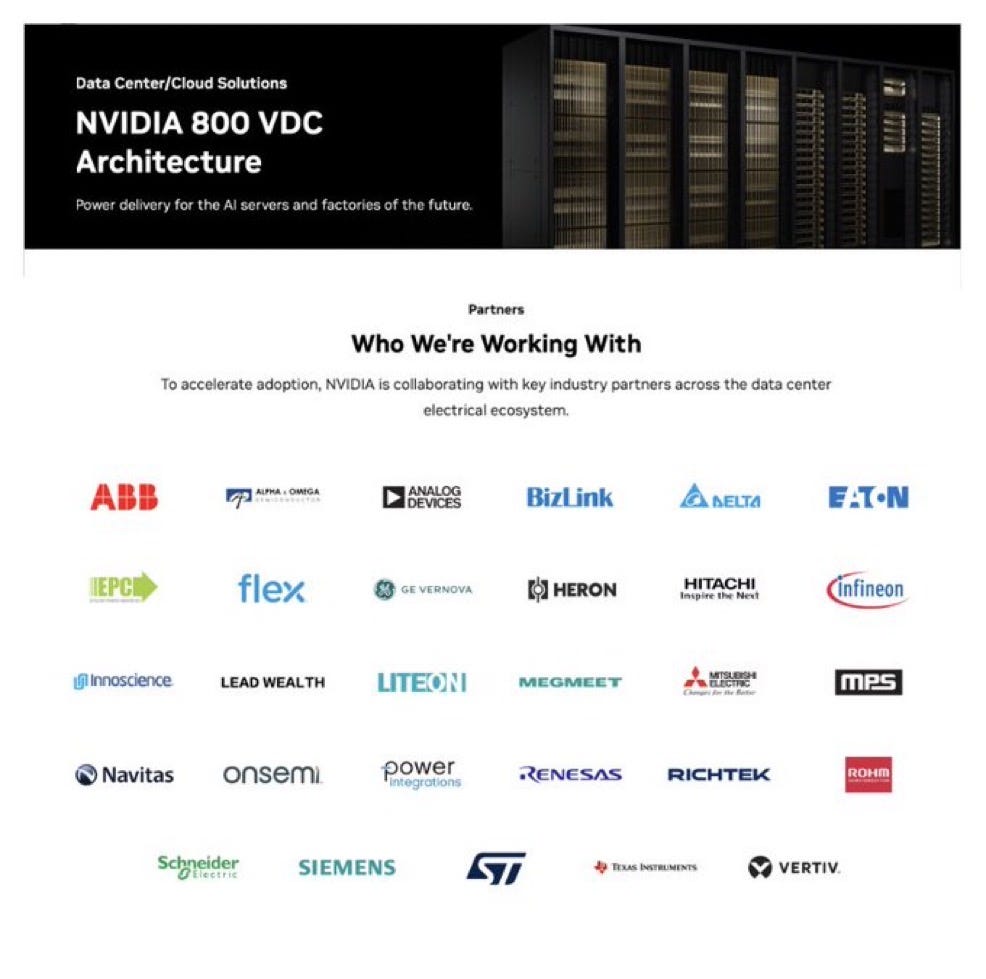
After NVIDIA announced its 800 V HVDC initiative, many major power suppliers publicly joined the ecosystem.
In the power semiconductor field, Infineon, MPS, STMicroelectronics, and Rohm provide silicon and wide-bandgap power devices. On the system side, Delta, Flex Power, Lead Wealth, Lite-On, and Megmeet are jointly developing power systems.
At the data center power infrastructure level, Eaton, Schneider Electric, and Vertiv are among the key partners.
Supply Chain Structure
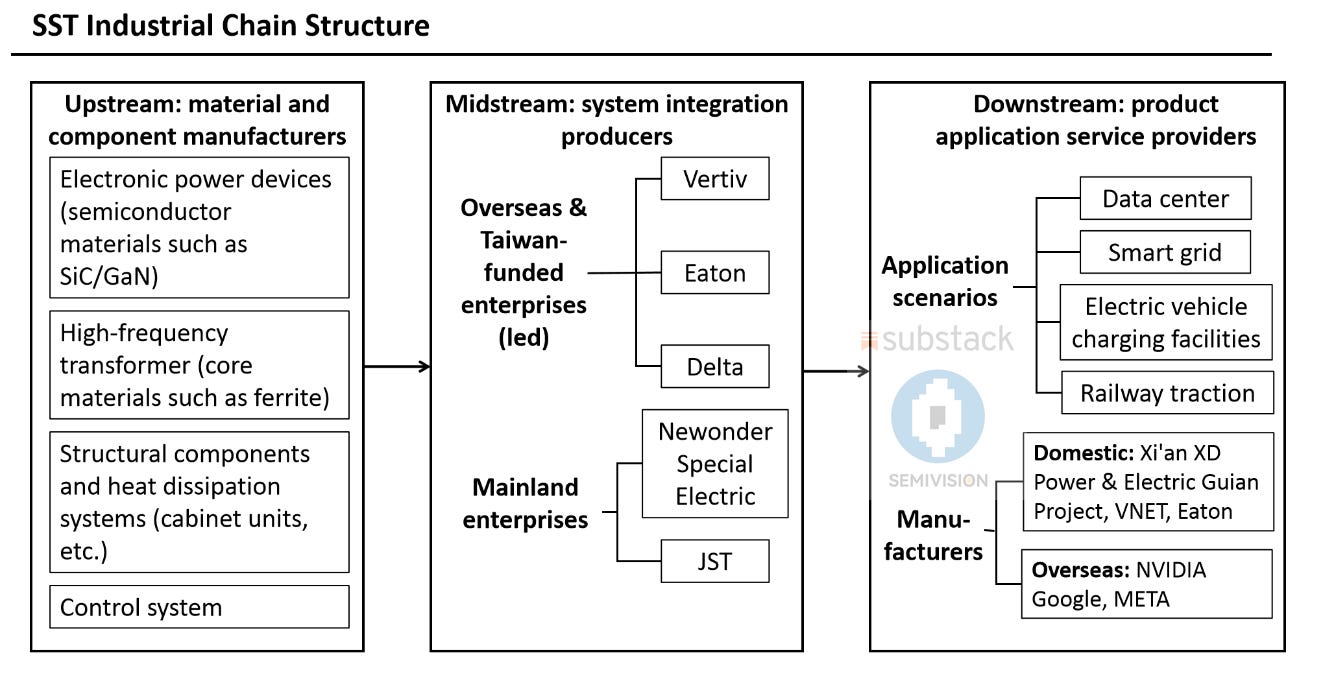
Source: cnesa
Upstream Materials and Components
Power semiconductors: SiC/GaN— These are key components for SSTs. SiC modules are typically used at the input stage because their high voltage resistance and strong thermal management capability make them suitable for AC/DC rectification. GaN modules are more commonly used at the output stage because of their high electron mobility, making them suitable for high-frequency DC/DC conversion. As AI server power continues to rise, PSUs above 24–30 kW require high-voltage, high-frequency components, driving strong demand growth for both SiC and GaN.
Magnetic materials— The high-frequency transformer inside an SST requires magnetic core materials with high permeability and low hysteresis loss. Amorphous alloys, nanocrystalline alloys, and ferrites are ideal choices. Citing forecasts from Feijing China Big Data Center, Guosheng Securities estimates that the global SST market could achieve a compound annual growth rate of 25–35% over the next 5–10 years, with both magnetic materials and power semiconductors benefiting from this trend.
Conductive materials— As voltage increases and the cross-sectional area of copper busbars decreases, demand for highly conductive materials will rise. Silver, copper, and alloy materials will play important roles in HVDC systems.
Thermal and insulation materials— High-frequency switching generates additional heat, requiring highly thermally conductive materials, such as aluminum nitride ceramics, as well as high-voltage insulation materials. ACME Electronics is developing aluminum nitride bulk materials to address high-power thermal management demand.
Midstream System Integration and Manufacturing
Midstream suppliers are responsible for integrating upstream devices and materials into complete SST products and HVDC power distribution systems. Key participants include Delta Electronics, Eaton, Vertiv, ABB, Siemens, and General Electric.
Delta Electronics launched multiple rack-mounted AC/DC and DC/DC power products in 2025, with efficiency exceeding 98%. Eaton is expected to provide its MVSST solution in 2027, while Vertiv plans to launch its 800 VDC product series in 2026.
Chinese suppliers such as Sifang Co., whose 2.4 MW SST has reportedly improved efficiency to 98.5%, and Jinpan Technology are also developing large-scale SST prototypes.
Downstream Applications
Downstream applications mainly include hyperscale cloud service providers, enterprise data centers, semiconductor fabs, and high-performance computing facilities.
NVIDIA, Google, Microsoft, AWS, and Meta are all planning to adopt 800V HVDC architectures to power AI servers. TSMC and Delta Electronics are also exploring the use of SSTs in semiconductor fabs. At the same time, TSMC is advancing silicon photonics packaging and AI accelerators, both of which have extremely high power and cooling requirements.
To meet the power needs of semiconductor giants such as TSMC and ASE, Eaton has expanded capacity in Taiwan and plans to continue increasing investment over the next three years.
800 V HVDC Investment and Capacity Outlook
According to industry report, global data center capital expenditure is expected to exceed US$1 trillion by 2029, after reaching US$455 billion in 2024.
Taiwan Power Company estimates that by 2028, additional electricity demand driven by semiconductors and AI will exceed one million kilowatts.
Power reliability and energy efficiency are becoming critical issues for governments and enterprises worldwide, driving a new wave of investment in HVDC and SST technologies.
Other industry report believes that SST technology has gained strong recognition from major players such as NVIDIA, which will further drive demand growth for SiC and GaN.

Challenges and Future Outlook
Technical and Standardization Challenges
Although 800V HVDC and SST are widely viewed as the ultimate power architecture for next-generation data centers, several challenges remain:
Safety and standards— High-voltage DC operation requires strict protection against arcing and electric shock risks. Countries will need to establish unified safety standards, insulation requirements, and hot-plug interface specifications. Maintenance personnel working on 800V systems will also require specialized training, making safety compliance costs an important consideration during early deployment.
Cost and supply chain— SST costs remain relatively high. Upstream SiC and GaN chip capacity is still limited, and prices remain higher than conventional silicon components. The manufacturing processes for amorphous alloy and nanocrystalline magnetic materials are also complex, and supply still needs to expand. As capacity ramps and technology matures, costs are expected to decline.
Compatibility and retrofitting— Most existing data centers still use 54V power distribution. Upgrading to 800V HVDC requires redesigning racks, distribution panels, and protection systems. To reduce retrofit costs, suppliers are introducing ±400V transitional architectures and backward-compatible power modules.
Market acceptance— Although NVIDIA and major cloud service providers are actively promoting the 800V architecture, small and mid-sized data centers may prefer mature ±400V or traditional architectures due to smaller scale or capital constraints. The adoption rate of SST will depend on the pace of technology deployment and cost reduction.

Development Trends
Starting from 800V and moving toward higher voltages— 800V HVDC is currently the most practical high-voltage DC solution. However, as power density continues to increase, data centers may evolve toward 1 kV or even higher-voltage architectures, where SST will play an increasingly critical role.
Integration with renewable energy and energy storage— SST supports multi-port architecture and bidirectional energy flow, allowing direct connection to green power sources such as solar and wind, as well as energy storage systems. In the future, data centers may store power during off-peak periods, feed electricity back to the grid during peak periods, and even participate in power market dispatch.
Standardization and ecosystem formation— As NVIDIA, OCP, and other organizations promote standardization, common interface specifications for 800V HVDC and SST are expected to emerge, accelerating supply chain collaboration. More companies will participate in the development of power modules, magnetic materials, thermal management systems, and control systems, forming a complete ecosystem.
Cross-industry convergence— SST and HVDC technologies are not limited to data centers. They can also extend to EV ultra-fast charging stations, renewable energy systems, industrial drives, and grid stabilization equipment. Demand for power semiconductors and magnetic materials will expand across multiple industries.
Conclusion
Data centers in the AI era are facing unprecedented power challenges. The combination of 800V HVDC architecture and solid-state transformers provides a breakthrough path forward. By increasing voltage, shortening the power delivery path, and using wide-bandgap devices, this architecture can significantly improve end-to-end efficiency while reducing copper consumption and thermal burden.
The programmability, high efficiency, and compact form factor of SST make it a core technology for next-generation power delivery. SST can raise system efficiency above 98%, saving substantial electricity costs. Its use of SiC/GaN power devices and nanocrystalline magnetic cores also highlights the growing industrial value of power semiconductors and advanced magnetic materials.
From a supply chain perspective, the SST ecosystem is taking shape rapidly. Upstream suppliers of SiC/GaN semiconductors, amorphous alloys, and nanocrystalline magnetic materials are expanding capacity. Midstream system integrators such as Delta Electronics, Eaton, and Vertiv are launching rack-level power supplies and medium-voltage solid-state transformers with efficiency approaching 98%. Downstream data center operators are evaluating strategies to transition from ±400V to 800V or even higher-voltage architectures.
According to market forecasts, the global SST market could achieve a compound annual growth rate of 25–35% over the next 5–10 years, driving explosive demand for silicon carbide and gallium nitride.
Although the new architecture still faces challenges in cost, safety, and standardization, the growing investment from major cloud providers and semiconductor companies suggests that solid-state transformers and 800V HVDC could begin scaled deployment around 2027, with a more significant market emerging in 2028–2029.
For supply chain companies, opportunities in SiC/GaN devices, magnetic materials, and medium-voltage solid-state transformers could become a core growth driver in the next wave of AI infrastructure investment.
In the future, SST may not only become the ultimate power management solution for data centers, but also a key node in the era of smart grids and green energy.
Thanks for reading SEMIVISION @_@! This post is public so feel free to share it.


PreviousNext