NVIDIA GTC Taiwan 2026: The AI Factory Era Has Arrived, and Taiwan Is Moving from Supply Chain to Co-Designer
NVIDIA GTC Taiwan 2026: The AI Factory Era Has Arrived, and Taiwan Is Moving from Supply Chain to Co-Designer
- Source: SemiVision
- Author: SEMIVISION
- Published: 2026-06-01T22:11:07+08:00
- URL: https://tspasemiconductor.substack.com/p/nvidia-gtc-taiwan-2026-the-ai-factory (1) NVIDIA GTC Taiwan 2026: The AI Factory Era Has Arrived, and Taiwan Is Moving from Supply Chain to Co-Designer


NVIDIA GTC Taiwan 2026: The AI Factory Era Has Arrived, and Taiwan Is Moving from Supply Chain to Co-Designer
Original Article By SemiVision Research [Reading time: 11 mins]

Jun 01, 2026
∙ Paid
NVIDIA GTC Taiwan 2026: The AI Factory Era Has Arrived, and Taiwan Is Moving from Supply Chain to Co-Designer
On June 1, 2026, Jensen Huang stepped onto the stage at the Taipei Music Center. His opening line —“Very good to be home”— immediately electrified the audience.
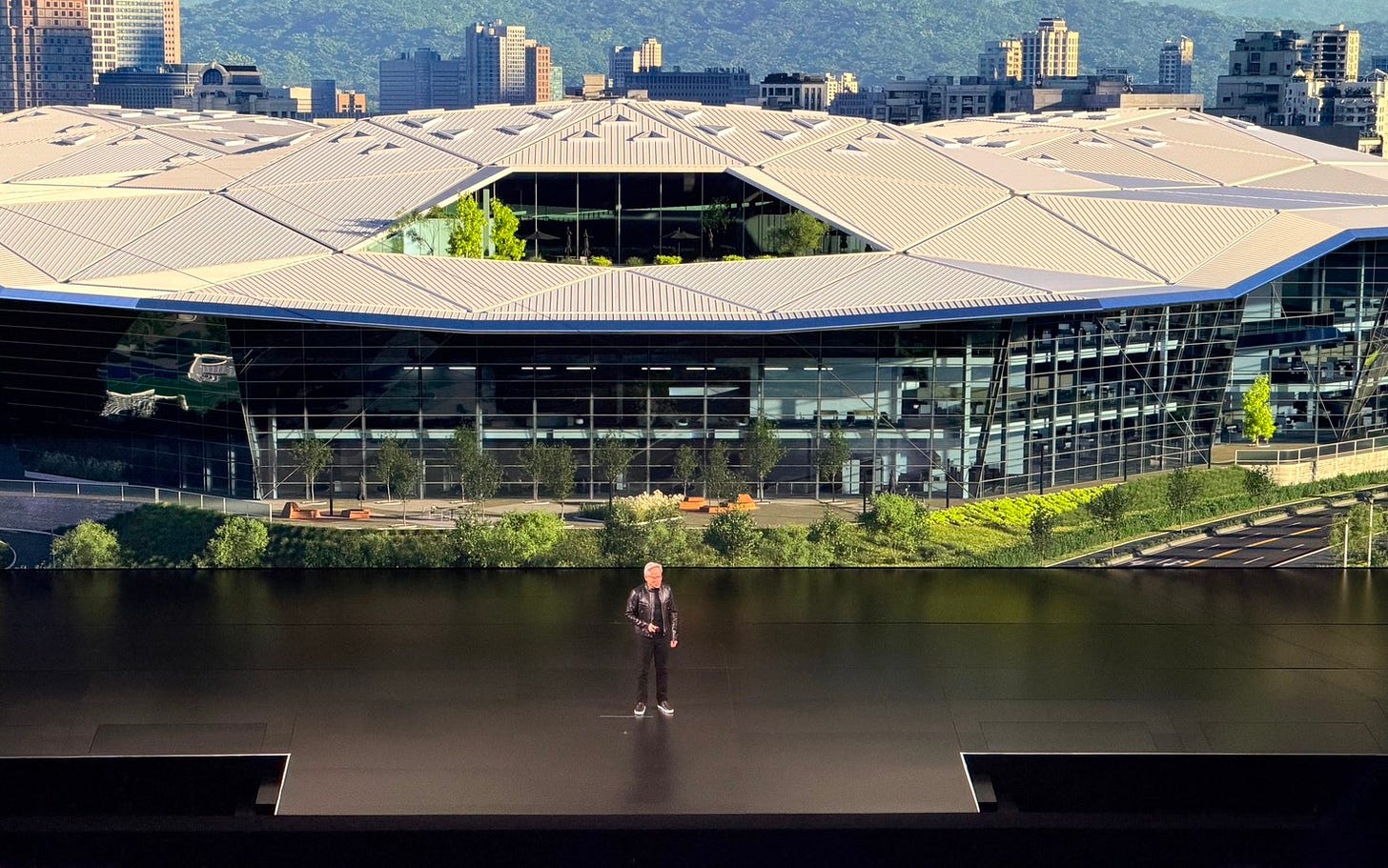
But if we treat this GTC Taiwan Keynote merely as another product launch, we underestimate its significance.
This was, in essence, a strategic declaration that the AI factory era has officially arrived. Huang was not simply saying that a new GPU is faster or that a new rack is more powerful. He was explaining that the business model, manufacturing logic, and supply-chain structure of AI infrastructure are being fundamentally redefined.
In the past, data centers were viewed as cost centers. Companies bought servers, GPUs, electricity, and facilities. At their core, these investments were treated as IT infrastructure expansion.
But in Huang’s new narrative, AI data centers are no longer just “server rooms.” They are a new form of industrial production unit. They do not produce steel, cars, or chips. They produce tokens.
In other words, the AI factory of the future converts electricity, chips, networking, cooling, software, and models into tokens that can be priced, sold, and monetized.
That is the most important underlying logic of the entire keynote.
Token Economics: Compute Is No Longer a Cost — It Is a Revenue Engine
One of the most striking numbers Jensen Huang presented was the economic model of a 1GW AI data center.
In the past, when enterprises bought GPUs, they asked: How much does this card cost? How many years will it depreciate over? How much electricity will it consume?
In the AI factory era, the questions become: How many tokens can each watt of power generate? How much revenue can each token create? How quickly can the capital expenditure of the entire data center be recovered?
This is what Huang means by token economics.
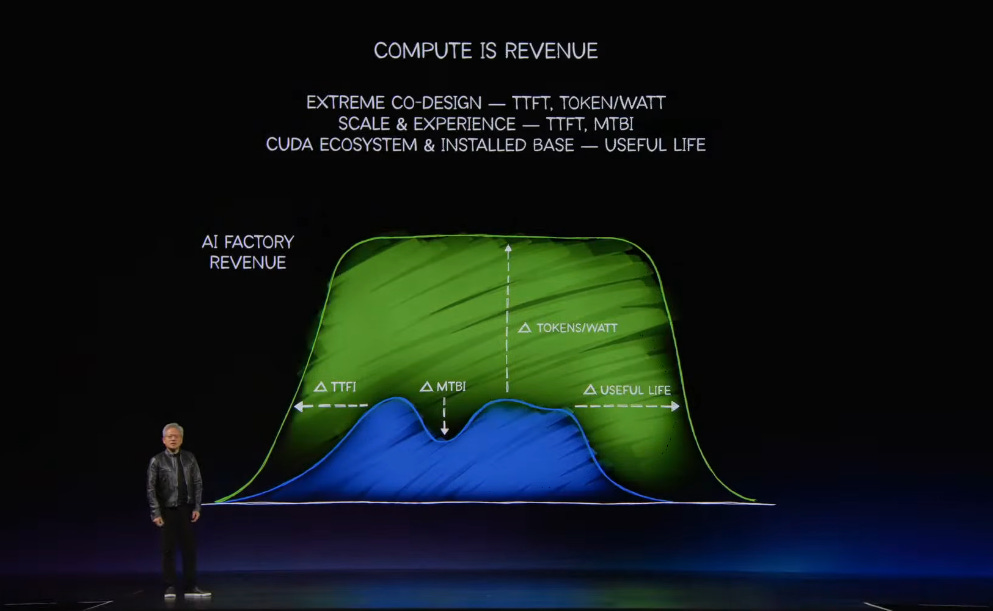
Under this framework, GPUs are no longer just hardware devices. They are revenue machines. Data centers are no longer just infrastructure. They are factories with productive output. Every kilowatt-hour of electricity, every GPU, every NVLink connection, every optical module, and every PCB ultimately needs to be converted into token capacity.
Therefore, “the more you buy, the more you earn” is not just a marketing slogan. It is a capital expenditure logic.
As long as model demand continues to grow, inference workloads continue to expand, and token output per watt continues to improve, investment in AI data centers will shift from a cost burden into a profit engine.
This is also why NVIDIA is redefining itself from a GPU company into an AI infrastructure company.
Agentic AI Has Arrived: AI Is Moving from Tool to Worker
The second major theme of Huang’s keynote was agentic AI.
Over the past two years, the market has focused mostly on generative AI. Users enter prompts, and AI generates text, images, code, or reports. This generation of AI is still largely about answering questions.
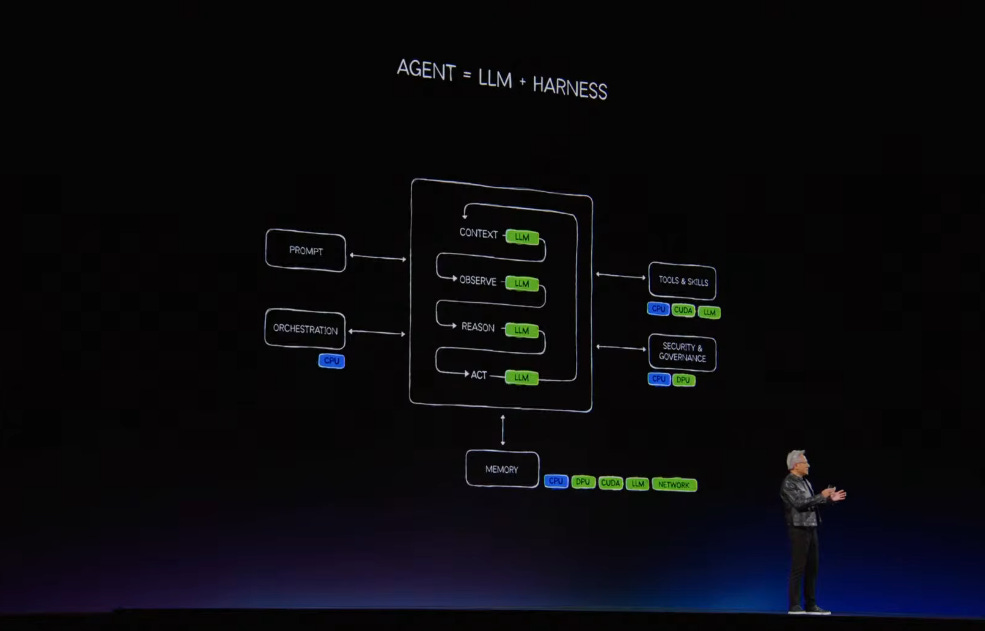
Agentic AI is different.
It does not merely answer. It can understand goals, break down tasks, observe its environment, call external tools, execute workflows, and complete complex jobs.
This means AI is evolving from a “tool” into a “worker.”
Huang used software development as an example.
AI has not made engineers irrelevant. Instead, it has significantly increased software output. When AI amplifies the productivity of engineers, companies have even more reason to invest in additional development resources, because each engineer can now generate far greater leverage.
This point is critical.
The true value of AI is not about removing people. It is about increasing the density of human output.
In the past, one engineer could complete only a limited amount of code in a day. In the future, that same engineer may use AI agents to manage multiple development workflows at once.
In the past, one researcher could read only a limited number of papers. In the future, an AI agent can first perform data collection, comparison, summarization, and preliminary reasoning.
In the past, enterprise workflows required multiple systems, multiple departments, and multiple people to connect manually. In the future, AI agents may connect these processes directly.
That is the real meaning of agentic AI.
Once AI begins to acquire the ability to act, data center demand will shift from training to inference, from single queries to long-running workflows, and from single-model outputs to multi-agent collaboration.
This will drive structural growth in token consumption.
DSX AI Factory: NVIDIA’s Biggest Strategic Transformation
If token economics is the commercial narrative, and agentic AI is the source of demand, then the DSX AI Factory Ecosystem is the strategic backbone that allows NVIDIA to turn this demand into reality.
Jensen Huang officially launched the NVIDIA DSX AI factory ecosystem, making it the most important product-level strategy of the keynote.
The core meaning of DSX is that NVIDIA is no longer just selling GPUs, nor even just selling racks. It is now offering a methodology for building AI factories.
This methodology covers three stages of the AI factory lifecycle:
First, design.
Second, deployment.
Third, operation.
In the past, these three stages were often fragmented. Data center builders handled civil engineering and power. Server makers handled racks. Chip companies provided GPUs. Networking companies supplied switches. Cooling vendors managed liquid cooling. Software teams then tried to integrate everything afterward.
The problem is that an AI factory is not a traditional data center.
Its power density is higher. Its signal transmission is more complex. Its cooling pressure is greater. Its system-integration difficulty is much higher. GPUs, CPUs, NVLink, optical interconnects, liquid cooling, power systems, mechanical parts, PCBs, connectors, and software scheduling must be co-designed from the beginning.
This is where DSX creates value.
DSX is not a single product. It integrates open-source software libraries, APIs, reference designs, accelerated computing platforms, and supply-chain technologies into one AI factory co-design platform.
Its three key pillars are:
First, DSX Sim Omniverse.
Before physical construction begins, the entire AI factory can be simulated through a digital twin. Power, networking, liquid cooling, rack configuration, and chip integration can be validated in advance to reduce construction risk.
Second, DSX OS.
Once the AI factory is powered on, DSX OS manages operations and converts massive hardware infrastructure into schedulable, manageable, and optimizable AI compute capacity.
Third, DSX Max LPM.
Within the same power envelope, more GPUs can be safely deployed, increasing token output per watt and enabling data center operators to generate higher revenue without expanding their power budget.
This means NVIDIA is turning AI factories from “hardware stacking” into “system engineering.”
More importantly, DSX allows NVIDIA to close the full loop from planning and construction to operation.
This is a major shift.
When NVIDIA controls the design standards of AI factories, it is no longer just a chip supplier. It becomes the architecture-defining company for the entire AI infrastructure stack.
Vera Rubin Enters Full Production: AI Racks Enter the Super-System Era
Another key focus of the keynote was the full production rollout of the next-generation rack-scale supercomputer, Vera Rubin.
Huang revealed that Vera Rubin is one of the largest engineering projects in NVIDIA’s history, involving as many as 40,000 engineers. The entire platform contains up to six trillion transistors.
Behind this number is not just a more powerful chip, but a new level of complexity for the entire AI system.
In the past, semiconductor competition mainly centered on the chip itself. Who had the most advanced process? Whose GPU die was larger? Whose HBM bandwidth was higher?
But in the Vera Rubin generation, competition is no longer confined to the chip level. It has expanded to the full rack system.
GPUs must be co-designed with CPUs, HBM, NVLink, switches, optical modules, power modules, liquid cooling systems, PCB backplanes, and mechanical structures. If any link fails, the output efficiency of the entire AI factory is constrained.
This is why Taiwan’s supply chain has become strategically more important.
TSMC provides advanced process technology and CoWoS packaging.
Foxconn, Quanta, Wistron, and Wiwynn handle full-rack system integration.
Delta plays a key role in power and thermal solutions

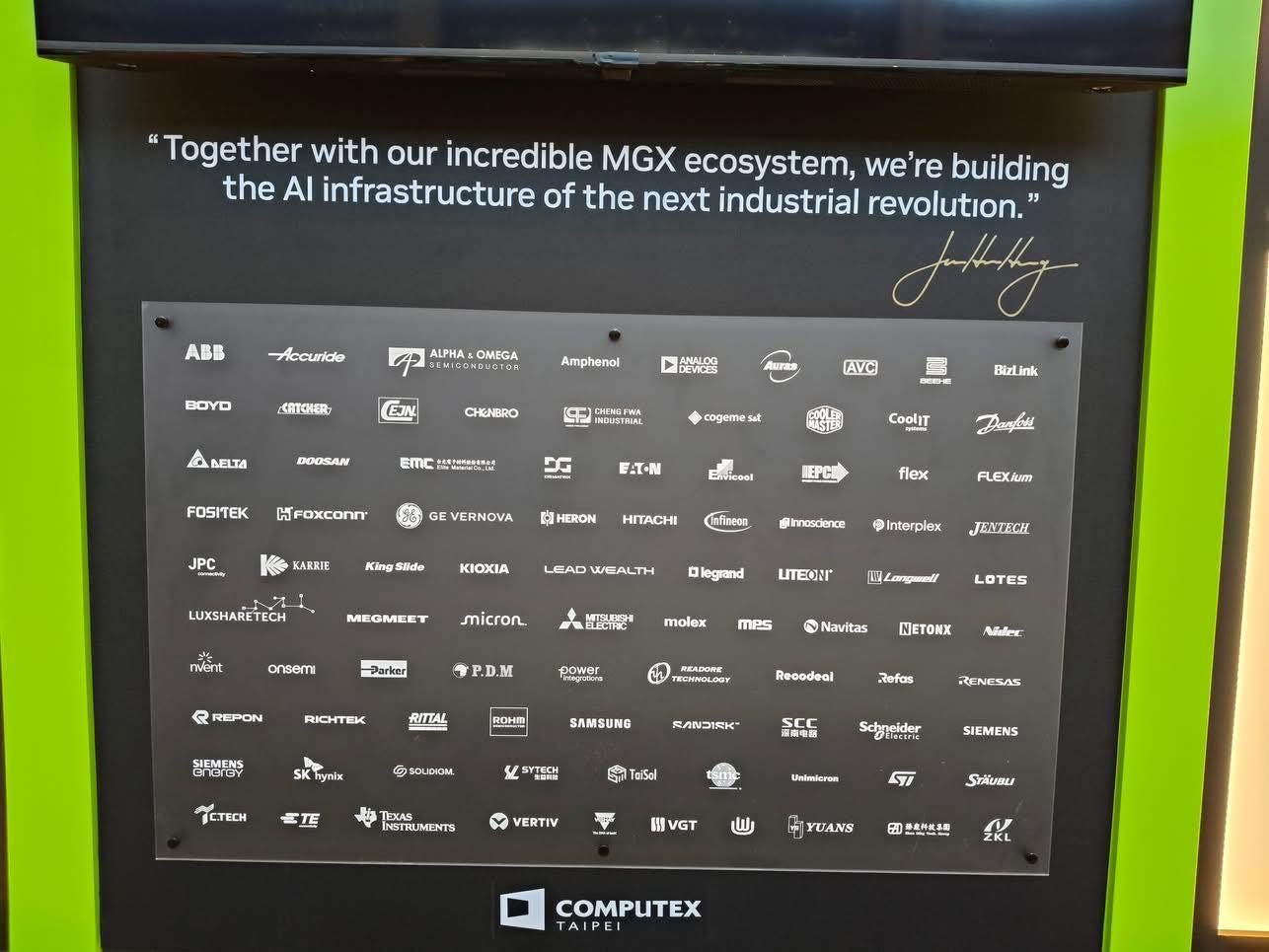
Huang mentioned that NVIDIA is already working with 150 supply-chain partners in Taiwan.
That statement carries deep significance.
Taiwan is no longer simply “manufacturing on order.” It has been deeply embedded into the co-design system of AI factories. From chips to packaging, from motherboards to backplanes, from thermal systems to power delivery, from mechanical parts to full-rack assembly, Taiwan’s supply chain has become an indispensable part of NVIDIA’s AI infrastructure expansion.
The most important implication of this keynote for Taiwan’s technology industry is the change in Taiwan’s role.

In the past, Taiwan’s position in the global technology industry was very clear: a high-efficiency manufacturing base.
TSMC handled wafer foundry.
ODMs handled server and PC assembly.
PCB, thermal, power, connector, and mechanical-component suppliers provided key parts.
But in the AI factory era, this division of labor is changing.
AI systems are now too complex to be built through a traditional linear supply chain. In the past, brand companies designed and suppliers executed. In the future, chip companies, cloud service providers, system makers, materials suppliers, power vendors, thermal companies, and PCB makers will all participate in the design process.
This is co-design.
In an AI rack, power efficiency affects GPU deployment density. Thermal capability affects clock speed and reliability. PCB materials affect high-speed signal integrity. Connectors and mechanical parts affect rack maintainability and reliability. Packaging capability determines chip bandwidth and yield.

5月29日
Therefore, the value of Taiwan’s supply chain is no longer just about being cheap, fast, and reliable. It is about whether Taiwanese companies can participate in engineering decisions early in the system-design process.
This changes the valuation logic.
In the past, the market often valued Taiwanese hardware companies through the framework of contract-manufacturing margins.
But if Taiwanese companies increasingly enter the co-design layer of AI factories, their order stickiness, product cycles, technical barriers, and pricing power will all look very different.
As Vera Rubin, Rubin Ultra, and future platforms continue to advance, Taiwan’s supply chain will increasingly resemble an “engineering community” for AI infrastructure, rather than a group of ordinary component suppliers.
AI PC: Microsoft and NVIDIA Redefine Personal Computing
Beyond AI factories, Huang also discussed the next stage of AI PCs.
He noted that Microsoft and NVIDIA have spent the past three years jointly redesigning how PCs operate, turning PCs from devices that merely run traditional applications into new computing platforms with AI agent capabilities.
This means the interaction model of PCs will change.
In the past, using a computer meant opening software, clicking menus, entering text, and manually completing tasks.
In the future, using a computer may mean directly describing intent, while AI understands files, reads data, generates code, performs analysis, and produces output.
The PC will evolve from a “collection of tools” into a “personal AI workstation.”
This is also why NVIDIA’s collaboration with MediaTek on Arm-based AI PC chips has drawn market attention. If N1X lands successfully, it will represent NVIDIA’s further expansion from data centers, robotics, and automotive platforms into personal AI computing.
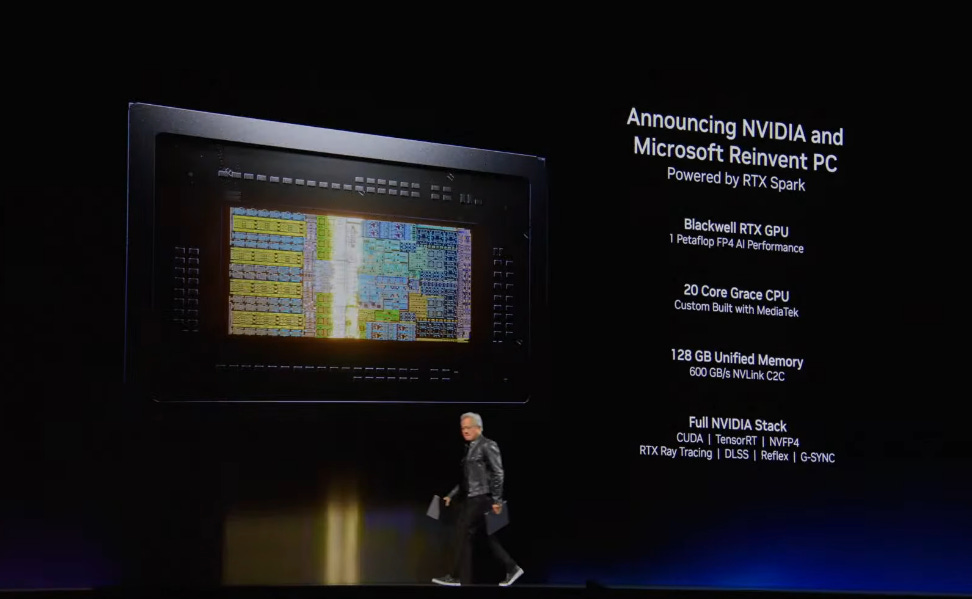
The strategic significance is that AI will not exist only in the cloud. The future AI architecture will be a combination of cloud, edge, PC, and end devices.
AI factories will handle large-scale training and high-density inference.
Edge AI will handle real-time sensing, low-latency control, and field applications.
Together, these layers will form a new AI computing network.
NVIDIA Constellation Taipei Headquarters: Taiwan’s Strategic Role Moves Higher
Huang’s announcement of the official opening of NVIDIA Constellation’s Taipei headquarters also carries strong symbolic importance.
This is not merely the opening of an office. It is the concrete expression of NVIDIA’s long-term commitment to Taiwan’s supply chain.
By establishing a permanent R&D and collaboration base in Taiwan, NVIDIA is signaling that Taiwan is not only a shipping base. It is part of R&D, design, co-engineering, and supply-chain decision-making.
Before the keynote, Huang invited senior leaders from TSMC, Quanta, Wistron, ASUS, MediaTek, Pegatron, and Foxconn to join him in discussion. That scene itself made one thing clear:
The core battlefield of AI infrastructure cannot operate without Taiwan.
In the future, the rollout of every new NVIDIA platform will depend not only on GPU architecture, but also on whether Taiwan’s supply chain can simultaneously solve the bottlenecks in process technology, packaging, thermal management, power delivery, connectors, PCBs, mechanical parts, and full-rack assembly.
This is a system-level competition.
Whoever can turn chips into racks faster, racks into data centers faster, and data centers into token factories faster will gain the advantage in the AI infrastructure race.
Conclusion: In the AI Factory Era, Taiwan Is Already on Board
The core message of GTC Taiwan 2026 is very clear.
AI competition has moved from model competition to infrastructure competition.
GPU competition has moved from single-chip performance to full-rack system efficiency.
Data center competition has moved from compute accumulation to token economics.
Taiwan’s role has moved from manufacturing base to co-designer.
This is a new opportunity for Taiwan’s technology industry, but also a new stress test.
An AI factory cannot be built by a single company. It requires full coordination across wafer foundry, advanced packaging, PCBs, power, thermal systems, optical communications, connectors, mechanical parts, ODMs, system integration, and software platforms.
Taiwan’s greatest strength in the past was manufacturing efficiency. But in the future, the real scarce capabilities will be system integration, co-design, and the ability to maintain a strategic position inside the global AI infrastructure stack.
On the surface, Huang’s keynote introduced Vera Rubin, DSX, and AI PCs.
But the deeper message is this: the AI factory era has officially begun, and Taiwan is standing at the center of this new industrial revolution.
The question is no longer whether Taiwan can participate in the AI supply chain.
The real question is whether, as AI factories become the next generation of global infrastructure, Taiwan can move from being a critical supplier to becoming a standard-setter, a system designer, and eventually part of the new industrial order of AI.
That is the real reason GTC Taiwan 2026 deserves to be remembered.
Thanks for reading SEMIVISION @_@! This post is public so feel free to share it.


PreviousNext