Jensen Huang’s Taiwan Dinner: Why Taiwan’s Entire Supply Chain Is Becoming the Backbone of AI Infrastructure
Jensen Huang’s Taiwan Dinner: Why Taiwan’s Entire Supply Chain Is Becoming the Backbone of AI Infrastructure
- Source: SemiVision
- Author: SEMIVISION
- Published: 2026-05-29T10:06:52+08:00
- URL: https://tspasemiconductor.substack.com/p/jensen-huangs-taiwan-dinner-why-taiwans (1) Jensen Huang’s Taiwan Dinner: Why Taiwan’s Entire Supply Chain Is Becoming the Backbone of AI Infrastructure


Jensen Huang’s Taiwan Dinner: Why Taiwan’s Entire Supply Chain Is Becoming the Backbone of AI Infrastructure
Original Article By SemiVision Research [Reading time: 10mins]

May 29, 2026
∙ Paid
Jensen Huang’s Taiwan Dinner: Why Taiwan’s Entire Supply Chain Is Becoming the Backbone of AI Infrastructure
NVIDIA CEO Jensen Huang’s latest “trillion-dollar dinner” in Taiwan may look like a gathering of tech industry leaders on the surface. But from a semiconductor and AI infrastructure perspective, it is closer to a live map of Taiwan’s AI supply chain power structure.

2026/5/28
From foundry manufacturing, IC design, OSAT, thermal management, power systems, servers, motherboards, ODM assembly, to industrial computers, nearly every critical node of the AI hardware ecosystem appeared in the same room. This was not just a public relations moment. It was a snapshot of how global AI infrastructure is pushing Taiwan back to the center of the technology world.
1月31日
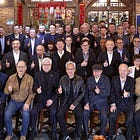
One Group Photo, One Complete AI Supply Chain
What made this dinner important was not only the six heavyweight Taiwanese tech leaders seated in the front row, but also the executives standing behind them. Together, these companies form the real supply chain behind AI servers and AI data centers.
The second row represents the core of Taiwan’s AI server assembly, system integration, and global delivery capability. From NVIDIA GPU platforms to full rack-scale systems, turning chips into deployable data center hardware is not the work of a single company. It depends on the highly coordinated capabilities of Taiwan’s ODM, EMS, and system integration ecosystem.
The third row covers thermal management, semiconductor packaging and testing, servers, motherboards, and system platforms. It also includes companies that directly interface with cloud customers. In other words, this was not just a dinner photo. It was an AI Factory supply chain layout.
Taiwan Tech Valuation Is No Longer Just a TSMC Story
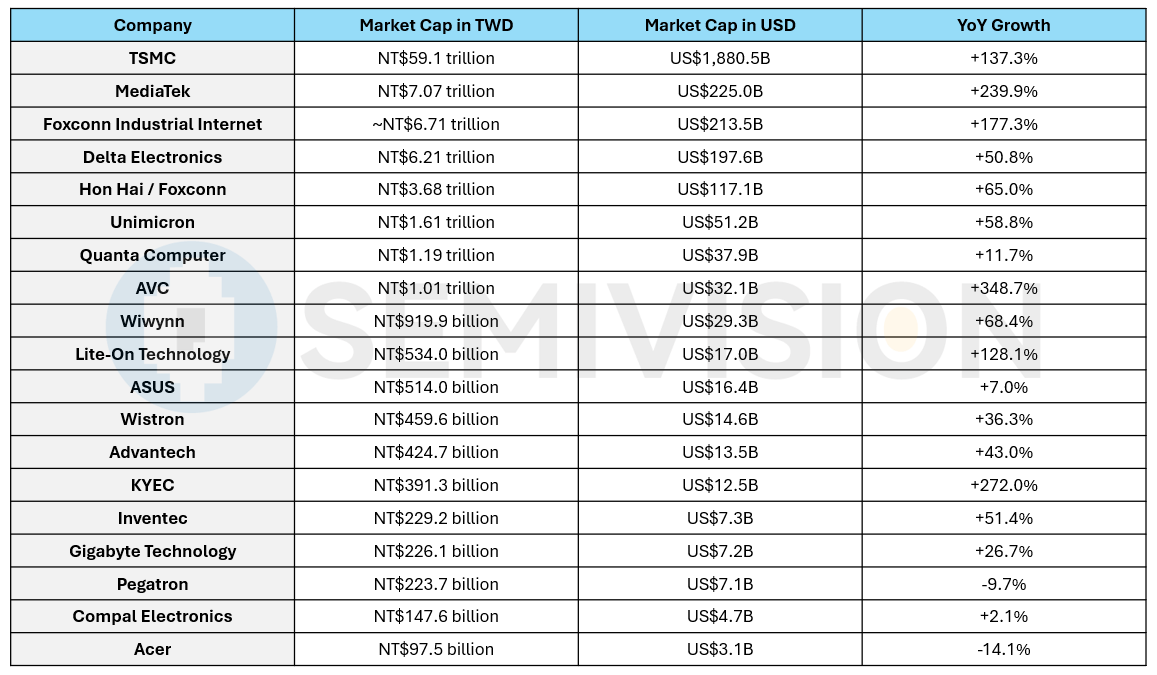
According to the market cap table cited in the report, TSMC still sits at the top with a market capitalization of about NT$59.51 trillion. It remains the gravitational center of Taiwan’s technology sector.
But the more important point is that the AI wave is now pushing value outward across the entire supply chain. MediaTek, Foxconn Industrial Internet, Delta Electronics, Hon Hai, Unimicron, Quanta, AVC, Wiwynn, Lite-On, and many others are all being repriced by the current AI capital expenditure cycle.
This shows that the market is beginning to understand one critical point: AI is not only about GPUs, and it is not only about advanced process nodes.
AI needs foundry manufacturing. It needs CoWoS and advanced packaging. It needs high-end PCBs and substrates. It needs thermal modules, power management, server assembly, rack-scale system integration, and global logistics.
In the past, Taiwan was often simplified as a “contract manufacturing island.” But in the AI era, Taiwan is no longer just a manufacturing base. It has become the system-level manufacturing hub of global AI hardware infrastructure.
When NVIDIA wants to scale GPUs, CPUs, networking chips, switches, NVLink, HBM, and rack-scale platforms into global data centers, it inevitably returns to the Taiwan supply chain.
Why Jensen Huang Needs Taiwan
Jensen Huang’s visit to Taiwan was not only about emotional connection, nor was it merely a stage for saying “Taiwan is booming.” What he truly needs is the collaborative efficiency of Taiwan’s supply chain.
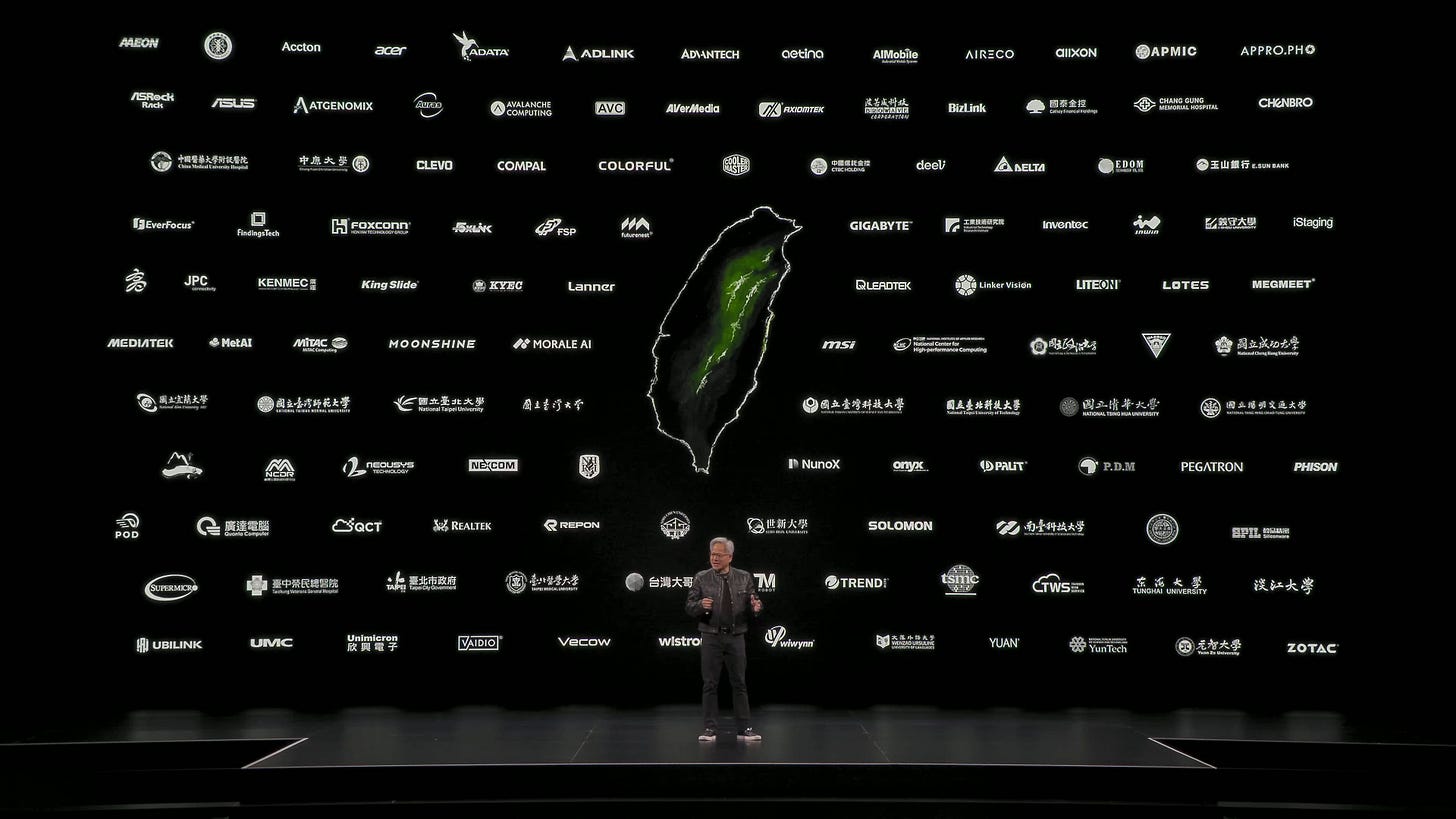
The biggest difference between AI servers and traditional servers is that AI servers are no longer simple combinations of motherboards and chassis. They are complex engineering systems involving power delivery, thermal management, signal integrity, packaging, memory, networking, and system-level integration.
GPU power consumption is rising. HBM bandwidth is expanding. Rack power density is increasing rapidly. Liquid cooling and power architecture are becoming part of platform competitiveness.
That is why this dinner brought together TSMC, OSAT players, thermal solution providers, power companies, ODMs, motherboard makers, server vendors, and industrial computer companies.
NVIDIA is not only selling chips. It is pushing an entire AI Factory architecture. This architecture requires Taiwan’s supply chain to compress design, trial production, volume production, delivery, and customer support into an extremely short cycle.
In the AI era, competition is no longer only about who has the most powerful chip. It is about who can most quickly turn the most powerful chip into a manufacturable, deliverable, serviceable, and scalable data center system.
Tung Tzu-hsien Pointed to the Real Issue: AI Is Also About Talent and Power
Pegatron Chairman Tung Tzu-hsien told the media that Taiwan is currently in the middle of the AI wave, and that AI is the central point of technological progress. He said Taiwan will play an important role.
He also noted that Taiwan needs to make a lot of effort to keep moving forward, including in talent development. Many companies are expanding capacity, and one of the most important issues is the pursuit of more stable and more sufficient power supply.
This statement goes straight to Taiwan’s two biggest bottlenecks in the AI supply chain: talent and energy.
First, the AI hardware supply chain does not only need electrical engineers. It also needs talent in thermal engineering, mechanical design, power electronics, materials, packaging, optical communications, firmware, software, and system integration.
AI servers are not a single-component industry. They are the sum of cross-disciplinary engineering. Taiwan’s long-term advantage in manufacturing and supply chain execution is now being amplified by AI demand, but the pressure on talent supply is also rising.
Second, electricity is becoming the new ceiling for Taiwan’s technology sector.
AI data centers, advanced process fabs, advanced packaging facilities, server manufacturing lines, and testing lines are all power-intensive. In the future, the core of global AI competition will not only be about how many tokens each GPU can generate. It will also be about whether the entire supply chain can secure enough stable energy and convert every kilowatt-hour into more computing output.
If Taiwan wants to remain at the center of the AI supply chain, power stability, green energy access, grid resilience, and high-power data center infrastructure will become national-level industrial issues.

ASRock Rack Shows the Real Constraint: Demand Is Strong, but Components Are Tight
ASRock’s subsidiary ASRock Rack focuses on AI server business. Its chairman Hsu Lung-lun recently said that end demand remains very strong, but second-quarter revenue will be somewhat constrained by tight NVIDIA and related component supply. As components gradually become available in the third quarter, shipments are expected to rebound significantly and drive second-half growth.
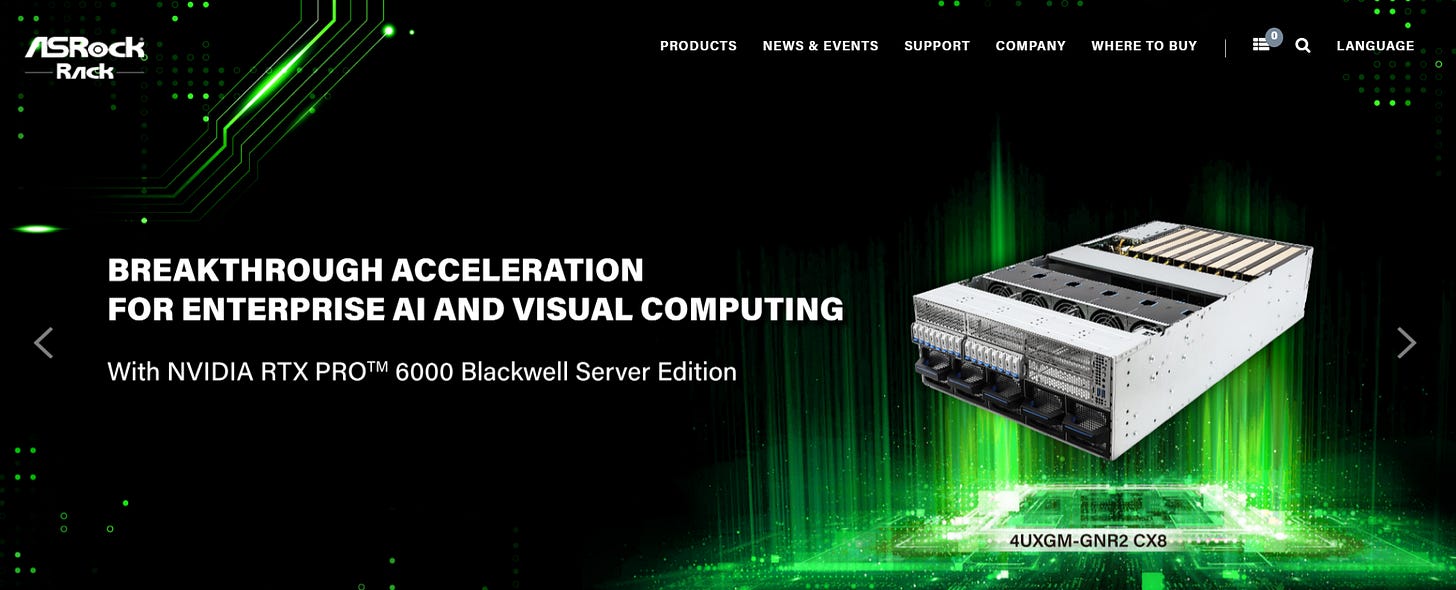
This is an important signal. It shows that the current AI server market is not facing a demand problem. The real constraint is still on the supply side.
The bottleneck may come from GPUs, networking chips, power modules, thermal components, PCBs, connectors, mechanical parts, or even rack-scale assembly and testing capacity.
ASRock Rack also noted that general-purpose server demand has exceeded expectations. The company expects general-purpose servers to account for more than 30% of total server revenue in the second quarter, up sharply from the previous estimate of about 20%. It also expects annual shipments of general-purpose servers to grow 50%.
This means AI demand is not simply replacing traditional servers. Instead, it is lifting the entire data center investment cycle. AI servers, CPU servers, storage, networking, and edge nodes are expanding together.
The market has focused too heavily on GPUs. But the real AI infrastructure cycle is the expansion of the entire data center hardware stack.
Jensen Huang’s Humor Reflects Deep Trust with Taiwan’s Supply Chain
There was also a lighter moment during the dinner. When Jensen Huang saw a portrait, he joked: “Is this really a painting of me? I guess it looks more like TSMC President C.C. Wei. The white hair makes it look more like C.C. than me. This painting could be me or it could be C.C.”
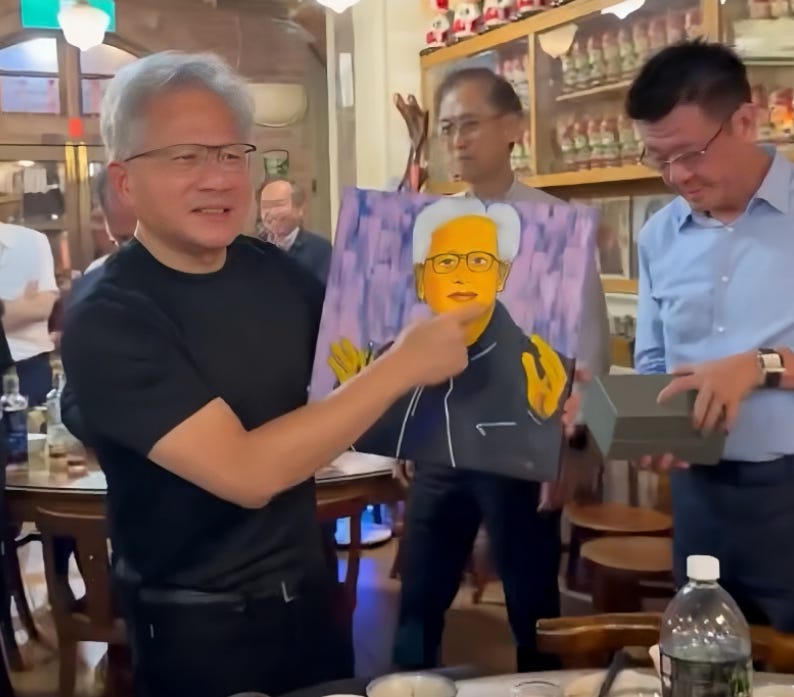
The room burst into laughter. C.C. Wei then walked over to take a photo with Jensen Huang and the portrait.
This looked like a casual moment, but it reflected the deep trust between NVIDIA and Taiwan’s supply chain.
For NVIDIA, TSMC is not just a foundry partner. It is the most important manufacturing foundation of the AI era. For Taiwan’s supply chain, NVIDIA is not just a customer. It is the platform company that has helped reprice the entire Taiwanese technology sector.
As global AI infrastructure enters a high-speed expansion phase, the relationship between NVIDIA and Taiwan is no longer just a chip procurement relationship. It has become a symbiotic relationship between a platform company and a system-level supply chain.

3月31日
Taiwan Is Becoming the Physical Construction Team of the AI Factory
If the United States defines AI models, cloud platforms, and GPU architecture, Taiwan is the region that turns these architectures into mass-producible hardware.
TSMC manufactures the most advanced GPUs and ASICs. ASE, SPIL, and other OSAT companies handle packaging and testing. Unimicron, Kinsus, and other substrate and PCB suppliers provide advanced interconnect foundations. Delta Electronics and Lite-On support power and energy management. AVC, Auras, and thermal solution providers handle the power density problem. Quanta, Hon Hai, Wistron, Wiwynn, Inventec, Pegatron, and Compal turn chips into AI servers and rack-scale systems deliverable to cloud customers.
This is Taiwan’s real value.
It does not only make one component. It can integrate an entire AI hardware supply chain within the shortest cycle in the world.
In the AI Factory era, chips are only the starting point. The real battlefield is system-level delivery capability, and this is where Taiwan is strongest.
The Market Is Redefining What “Taiwan Tech” Means
In the past, the market often valued Taiwanese technology companies through the lens of gross margin, contract manufacturing, and cyclical demand.
After the rise of AI, that valuation logic is changing.
The value of the AI supply chain no longer comes only from manufacturing cost advantage. It comes from irreplaceable engineering coordination.
When NVIDIA, Amazon, Google, Microsoft, Meta, and other cloud giants need to rapidly expand AI data centers, they do not only need a single supplier. They need an entire supply chain network that can scale together.
This is why Taiwan’s technology market capitalization has expanded rapidly. The market is beginning to recognize that AI infrastructure is not a short-term theme. It is a long-cycle capital expenditure trend.
As long as AI models continue to grow, inference demand continues to expand, and data centers continue to scale, Taiwan’s supply chain will continue to benefit.
But the risks are also clear.
If AI capital expenditure slows, or if pressure from electricity, land, talent, and geopolitics increases, the high valuations of Taiwan’s AI supply chain will also face renewed scrutiny.

4月9日
The Trillion-Dollar Dinner Is Not the End. It Is the Beginning of Taiwan’s Next Challenge
This dinner showed Taiwan’s technology sector at a high point. Jensen Huang sitting with Taiwan’s leading technology executives symbolized Taiwan’s importance in the AI era.
But the deeper question is whether Taiwan can turn this AI dividend into structural competitiveness for the next decade.
The answer depends on several issues.
First, Taiwan must continue expanding advanced process and advanced packaging capacity, especially CoWoS, SoIC, HBM integration, and future 3.5D packaging capability.
Second, Taiwan must solve system bottlenecks in thermal management, power delivery, optical communications, and high-end PCB materials, so that the AI server supply chain is not constrained by a single component.
Third, Taiwan must solve its energy and talent problems. Without stable power, there is no AI Factory. Without cross-disciplinary engineering talent, there is no system-level innovation.
Fourth, Taiwanese companies must move beyond manufacturing and participate more deeply in specification definition, system architecture, hardware-software integration, and global service capability.
In the future, the companies with real pricing power will not only be those that can manufacture. They will be those that can help define the platform.

5月11日
Conclusion: Whoever Controls Taiwan Controls the Future of AI Hardware
Jensen Huang’s trillion-dollar dinner delivered a simple message: the AI revolution is not happening only in the cloud, and it is not happening only inside models. It is reshaping the global hardware supply chain.
Taiwan is standing at the most critical point of that chain.
From TSMC to Hon Hai, from Quanta to Wiwynn, from Delta Electronics to AVC, from Unimicron to SPIL, from ASUS, Gigabyte, and MSI to ASRock Rack, these companies together form the physical backbone of global AI infrastructure.
This dinner was not a victory party for Taiwan’s technology industry. It was the opening scene of the next stage of competition.
As AI moves from model competition to infrastructure competition, the key question is no longer only who has the strongest GPU. It is who can integrate GPUs, power, thermal management, packaging, memory, networking, and server systems into a manufacturable, deliverable, and scalable AI Factory.
That is why Taiwan is being repriced by the world.


PreviousNext