Taiwan Did Not Steal America’s Chip Technology — It Bought the Starting Point and Built the System
Taiwan Did Not Steal America’s Chip Technology — It Bought the Starting Point and Built the System
- Source: SemiVision
- Author: SEMIVISION
- Published: 2026-05-21T21:55:16+08:00
- URL: https://tspasemiconductor.substack.com/p/taiwan-did-not-steal-americas-chip (1) Taiwan Did Not Steal America’s Chip Technology — It Bought the Starting Point and Built the System


Taiwan Did Not Steal America’s Chip Technology — It Bought the Starting Point and Built the System
Original Article By SemiVision Reserach [Reading time: 13 mins]

May 21, 2026
∙ Paid
Taiwan Did Not Steal America’s Chip Technology — It Bought the Starting Point and Built the System
In recent political debate, the claim that “Taiwan stole America’s semiconductor technology” has once again been amplified. It is a simple sentence, emotionally powerful and politically useful. But from the perspective of industrial history, technology transfer, business-model innovation, and semiconductor manufacturing reality, this claim is deeply misleading.

Taiwan did not steal America’s chip technology. Taiwan purchased an early technological starting point, learned from it, absorbed it, localized it, and then spent nearly five decades building one of the most disciplined manufacturing ecosystems in modern industrial history.
The more accurate story is not about theft. It is about technology transfer, state-led industrial policy, engineering discipline, talent formation, and the emergence of a new global division of labor.
Taiwan’s Semiconductor Industry Began as a National Survival Strategy
To understand Taiwan’s semiconductor rise, we must return to the 1970s.
At that time, Taiwan was still a labor-intensive manufacturing economy. Its exports were dominated by textiles, consumer electronics, plastics, toys, and low-end assembly. The island had strong human capital and a hardworking industrial base, but it lacked high-value technology industries. Taiwan’s policymakers understood that if the economy remained dependent on low-cost manufacturing, it would eventually be squeezed by even lower-cost competitors.
The strategic question was clear: what industry could move Taiwan from assembly manufacturing into high-value technology?
Semiconductors became the answer.
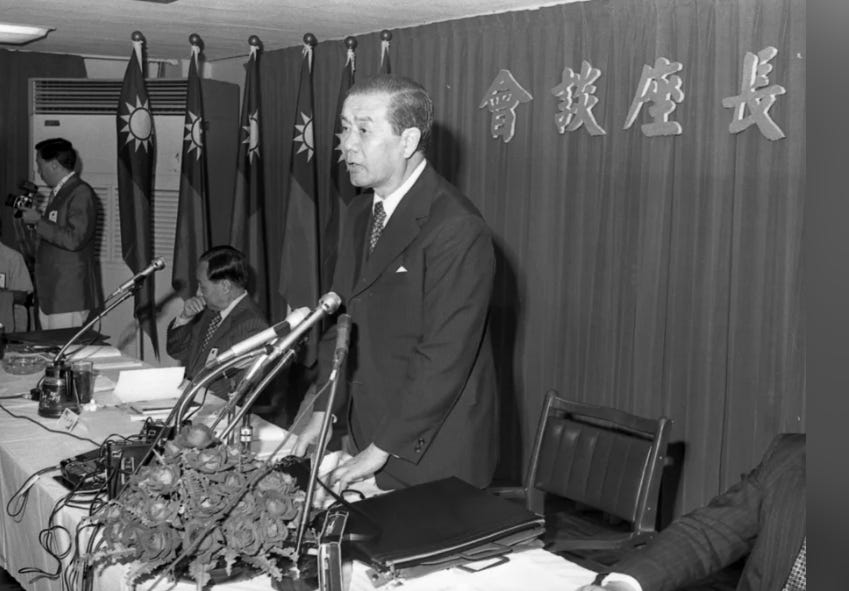
Among all segments of the electronics industry, integrated circuits were the most critical and had the broadest impact. Pan believed that the IC industry was highly likely to create the greatest added value for Taiwan’s electronics sector after 1980.
He also emphasized that time was the key factor in developing the IC industry. The fastest shortcut was to introduce technology from the United States, because the U.S. was the birthplace of the IC industry.
But Taiwan did not possess an advanced chip industry at the time. It lacked mature IC design capability, wafer fabrication know-how, process engineers, equipment experience, and a complete electronics supply chain. The only realistic path was to learn from countries that already had the technology.
This was not unusual. Japan, South Korea, Singapore, and later China all used different forms of technology introduction, licensing, joint ventures, reverse engineering, overseas training, and state support to climb the technology ladder. Industrial catch-up almost always begins with learning from earlier leaders.
Taiwan’s difference was that it built a remarkably disciplined and commercially effective mechanism for turning imported knowledge into domestic capability.
The RCA Agreement Was a Formal Technology Transfer, Not Theft
The decisive moment came in 1976, when Taiwan’s Industrial Technology Research Institute, better known as ITRI, signed a formal IC technology transfer and licensing agreement with RCA (Radio Corporation of America) in the United States.
In March 1976, RCA agreed to sign a ten-year technology transfer agreement with ITRI for a technology transfer fee of US$2.5 million and a technology licensing fee of US$1 million. In addition to transferring technology, RCA also provided training for Taiwanese talent.
This was not an underground transaction. It was not espionage. It was not “stealing.” It was a paid and contractual technology transfer.
The agreement allowed Taiwan to acquire integrated circuit technology, send engineers to RCA for training, and establish the foundation for Taiwan’s first IC manufacturing capabilities. At that time, RCA was a major American electronics company with semiconductor expertise, while Taiwan was still at the very beginning of its semiconductor journey.

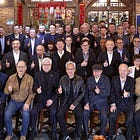
In April 1976, Taiwan sent its first group of 13 trainees to RCA to study IC design, manufacturing, testing, and management. This group included Robert Tsao, Ming-Kai Tsai, Tseng Fan-Cheng, Ying-Ta Liu, Ting-Yuan Yang, Ching-Chu Chang, and Chin-Tay Shih, among others — all of whom later became prominent figures in Taiwan’s IC industry
The contract reportedly included technology transfer fees and licensing payments. Taiwan also invested public resources into building a demonstration fab and training engineers. The goal was not simply to import a technology package, but to create a domestic learning platform.
This distinction matters. Semiconductor technology is not like copying a document or downloading a design file. A chip process is a living manufacturing system. It requires thousands of parameters, equipment recipes, materials control, cleanroom discipline, defect reduction, process integration, yield management, and continuous engineering refinement.
Taiwan did not receive a finished semiconductor empire from the United States. It received an early-stage learning opportunity.
Taiwan Bought 7-Micron CMOS — Not Today’s 3-Nanometer Technology
One of the biggest misunderstandings in the “Taiwan stole the technology” narrative is the failure to recognize the difference between the technology Taiwan acquired in the 1970s and the technology Taiwan later developed.
The RCA transfer involved early CMOS technology, often described as around the 7-micron generation. For Taiwan in the 1970s, this was a major step forward. But by today’s standards, 7 microns was extremely primitive.
Modern TSMC technology has advanced through multiple generations: 3 microns, 1 micron, 0.35 micron, 0.18 micron, 90 nanometers, 40 nanometers, 28 nanometers, 16 nanometers, 7 nanometers, 5 nanometers, 3 nanometers, and now toward 2 nanometers and beyond.
Each transition required new lithography, new materials, new device structures, new process integration, new design rules, new yield-learning cycles, new capital investment, and new supply-chain coordination.
The RCA agreement gave Taiwan a starting point. Taiwan’s later success came from what it did after that starting point.
ITRI Built the First Platform: Government Took the Risk Before Private Capital Could
Taiwan’s semiconductor rise was not initially driven by private venture capital. It was driven by the state.
At the time, no private company in Taiwan had the capital, technical confidence, or risk appetite to build a modern semiconductor industry from scratch. The government therefore used ITRI as an industrial incubator. ITRI created the early technical platform, trained engineers, absorbed foreign knowledge, built process capability, and demonstrated that Taiwan could operate an IC production line.
This was a critical institutional design.
Instead of asking the private sector to take impossible early-stage risks, the government absorbed the uncertainty. Once the technology became more mature and commercially viable, the capability could be transferred into companies.
This is how Taiwan’s first IC company, UMC, emerged in 1980. UMC was effectively born from the technology and talent base built inside ITRI. Engineers, process experience, and manufacturing know-how were moved from the research institute into a commercial enterprise.
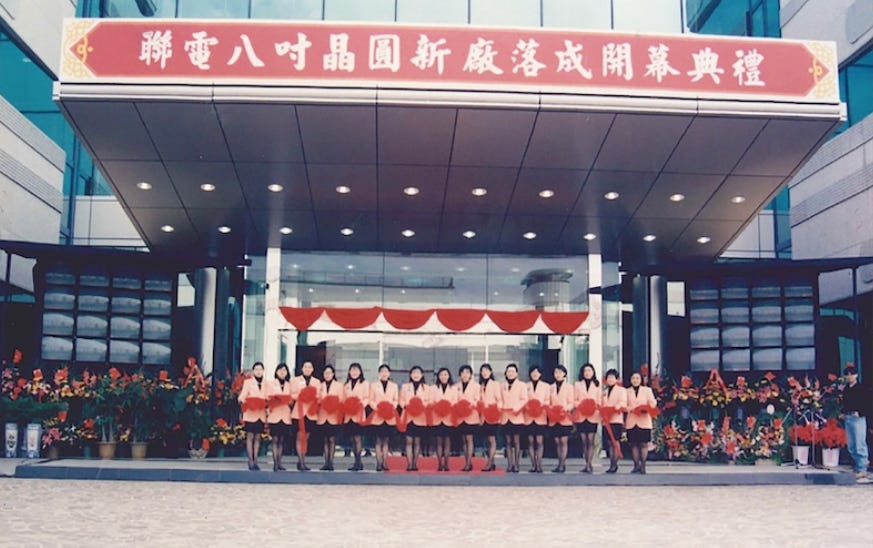
The opening of UMC's 8-inch fab in 1995. Although the newest high-performance chips are made on 12-inch wafers with highly advanced process nodes, 8-inch semiconductors are still widely used in areas like power management, displays, automotive, and communications
This pattern later repeated in different forms. Taiwan’s semiconductor industry was not built by one genius, one company, or one imported technology. It was built through a national system that connected public research, private enterprise, engineering talent, and export-oriented industrial strategy.

3月5日
The Role of Returning Engineers: Taiwan’s Hidden Asset Was Human Capital
Another key factor was the movement of people.
From the 1970s to the 1980s, many Taiwanese engineers studied or worked in the United States, especially in electrical engineering, physics, computer science, and semiconductor-related fields. Some gained experience at major American technology companies and research institutions. Later, many returned to Taiwan or helped connect Taiwan’s emerging semiconductor sector with global technology networks.
This talent flow was not theft. It was part of the normal circulation of global engineering labor.
In fact, the United States benefited enormously from immigrant and foreign-born engineers, including many from Taiwan, China, India, South Korea, and Europe. Silicon Valley itself was built on international talent flows. Taiwan’s semiconductor industry similarly benefited from overseas-trained engineers who returned with experience, management practices, and technical judgment.

Morris Chang founded TSMC in 1987
Morris Chang is the most famous example. Before founding TSMC, he had decades of experience at Texas Instruments and General Instrument. His value was not that he carried a secret formula back to Taiwan. His value was that he understood semiconductor economics, manufacturing discipline, customer trust, and capital allocation at a level few people in Taiwan could match at the time.
Taiwan’s rise was therefore not only a story of imported technology. It was also a story of imported experience being transformed into domestic institution-building.
TSMC’s Real Innovation Was the Dedicated Foundry Model
When TSMC was founded in 1987, the company did not simply become another chip manufacturer. It introduced a new business model that changed the global semiconductor industry: the dedicated foundry model.
Before TSMC, most major semiconductor companies were integrated device manufacturers, or IDMs. They designed, manufactured, and sold their own chips. This created a structural problem: if a chip design company wanted to outsource manufacturing, it often had to work with a company that might also become its competitor.

TSMC solved this problem by making a strategic promise: it would manufacture chips for customers but would not compete with them in chip design.
This created trust.
That trust enabled the rise of fabless semiconductor companies. Firms such as NVIDIA, Qualcomm, Broadcom, AMD, MediaTek, Marvell, and many others could focus on architecture, design, software ecosystems, and market development, while relying on a specialized foundry for manufacturing.
This was one of the most important structural shifts in modern technology history.
Taiwan did not “steal” America’s semiconductor industry. Taiwan created a manufacturing platform that allowed America’s fabless semiconductor industry to flourish.
Without TSMC and the broader Taiwanese foundry ecosystem, the U.S. chip design sector would likely be smaller, slower, and more capital constrained.

Morris Chang delivers a speech at TSMC’s 1994 stock listing ceremony, marking a historic milestone in Taiwan’s semiconductor industry and the rise of the dedicated foundry model that would later reshape the global chip supply chain
Why the United States Lost Manufacturing Share
A serious discussion must ask a harder question: if the United States had the original semiconductor leadership, why did manufacturing shift to Taiwan and East Asia?
The answer is not theft. It is economics.
Over several decades, the U.S. technology sector increasingly favored asset-light, high-margin business models. Software, chip design, platforms, intellectual property, and financialized growth were rewarded by capital markets. Wafer fabrication, by contrast, required enormous capital expenditure, long depreciation cycles, constant reinvestment, operational discipline, and exposure to brutal industry cycles.
Building and running fabs is hard. It is capital intensive, labor intensive, resource intensive, and unforgiving.
A leading-edge fab requires billions — now tens of billions — of dollars in investment. It needs stable electricity, water, chemicals, gases, equipment maintenance, process engineers, yield engineers, suppliers, logistics, and customers willing to commit volume. It also requires a culture where manufacturing problems are solved every day, not just at the design stage.
Taiwan chose to specialize in this difficult domain. The United States increasingly specialized in design, software, architecture, and systems.
Both sides made strategic choices. The outcome was a global division of labor.
The problem is that once manufacturing capability migrates, it is extremely hard to rebuild. Semiconductor manufacturing is not just physical infrastructure. It is an accumulated ecosystem of tacit knowledge.
The Most Difficult Technology Is Not the Blueprint — It Is Yield
Political debates often imagine semiconductor technology as a secret recipe. In reality, the hardest part is execution.
A process node is not valuable because a company knows the theory. It is valuable because the company can produce chips at high yield, high volume, high reliability, and predictable cost.
This is where Taiwan became exceptional.
TSMC’s strength is not merely lithography or equipment access. Many companies can buy equipment from ASML, Applied Materials, Lam Research, Tokyo Electron, KLA, and other global suppliers. But buying equipment does not automatically produce high-yield chips.
The real challenge is integration: how each process step interacts with the next; how defects are detected; how recipes are adjusted; how materials behave; how design rules are co-optimized; how packaging constraints feed back into chip architecture; how customers and foundries collaborate under extreme time pressure.
This is why TSMC’s moat is so difficult to copy. It is not a single stolen technology. It is a manufacturing organism built over decades.
5月14日
From Wafer Manufacturing to Advanced Packaging: Taiwan Kept Moving the Frontier
Taiwan’s semiconductor story also did not stop at wafer fabrication.
As Moore’s Law slowed and AI computing exploded, the industry began shifting from transistor scaling alone toward system-level scaling. Advanced packaging became a core battlefield.
TSMC’s CoWoS platform, SoIC technology, and broader 3D integration roadmap are now central to AI infrastructure. NVIDIA GPUs, AI accelerators, HBM integration, high-bandwidth interconnects, and chiplet architectures all depend on advanced packaging capacity and process control.
This again shows why the “stolen technology” argument is too shallow.
The technologies that make Taiwan indispensable today did not exist in commercial form in 1976. CoWoS, chiplets, hybrid bonding, HBM integration, advanced substrate engineering, and 3D IC packaging are the result of decades of cumulative innovation.
Taiwan did not simply preserve an imported technology. It repeatedly moved into new layers of the semiconductor stack.

Taiwan’s Semiconductor Success Was Also Built by Suppliers
Another missing piece in the political narrative is the supply chain.
TSMC alone is not the entire story. Taiwan’s strength comes from a dense industrial ecosystem: foundries, OSAT companies, substrate suppliers, PCB manufacturers, equipment service providers, materials companies, IC design houses, testing firms, precision machinery suppliers, and logistics networks.
The reason Taiwan is hard to replace is not only because TSMC is strong. It is because the ecosystem around TSMC is dense, responsive, and highly specialized.
When a process problem appears, engineers, suppliers, tool vendors, materials specialists, and customers can work together quickly. This speed of problem-solving is an industrial advantage.
The United States still leads in many upstream technologies, including EDA software, chip architecture, semiconductor equipment, IP, and advanced design. Japan remains critical in materials and equipment. The Netherlands dominates EUV lithography. South Korea leads in memory. Taiwan’s unique role is manufacturing integration.
This is not a story of one country stealing from another. It is a story of global specialization — and Taiwan becoming the world’s most important manufacturing integrator.
1月31日
The Geopolitical Problem: Success Has Become a Political Liability
Today, Taiwan’s semiconductor success creates geopolitical tension.
For the United States, Taiwan is both a strategic partner and a dependency risk. American AI companies rely heavily on Taiwanese manufacturing. At the same time, Washington wants to rebuild domestic semiconductor capacity through industrial policy, including the CHIPS Act.
This creates a political temptation: instead of admitting that the United States underinvested in manufacturing for decades, some voices blame Taiwan.
But blaming Taiwan misunderstands the problem.
Taiwan did not force American firms to become fabless. Taiwan did not force U.S. capital markets to prefer asset-light models. Taiwan did not force American companies to outsource manufacturing. Taiwan provided a solution that the global industry actively used because it was efficient, reliable, and technologically superior.
The uncomfortable truth is that Taiwan became indispensable because it did the difficult manufacturing work that others were less willing to do.
2月2日
The Correct Historical Interpretation
The correct interpretation of Taiwan’s semiconductor history should be:
Taiwan bought early technology from the United States through formal channels.
Taiwan used government institutions to absorb and localize that technology.
Taiwan trained engineers and created a mechanism to transfer public-sector know-how into private companies.
Taiwan built UMC as the first major IC company and later created TSMC as a new kind of dedicated foundry.
Taiwan’s foundry model enabled the global fabless semiconductor revolution, including many of America’s most important chip companies.
Taiwan then continued to invest across multiple technology generations, from mature nodes to advanced nodes, and from wafer fabrication to advanced packaging.
That is the real history.
It is not a story of theft. It is a story of disciplined industrial upgrading.

3月31日
Conclusion: Taiwan Bought the Ticket, Then Ran the Marathon
Taiwan did not steal America’s chip technology. Taiwan bought an early starting point and then ran one of the longest industrial marathons in modern economic history.
The 1976 RCA agreement gave Taiwan access to early CMOS knowledge. But it did not give Taiwan TSMC. It did not give Taiwan 3-nanometer process technology. It did not give Taiwan CoWoS. It did not give Taiwan the ability to support NVIDIA, Apple, AMD, Qualcomm, Broadcom, MediaTek, and the global AI infrastructure boom.
Those capabilities were built through capital, engineering, institutions, and time.
The real lesson is not that Taiwan took something from America. The real lesson is that Taiwan understood something many economies underestimated: in semiconductors, manufacturing is not a low-value activity. Manufacturing is strategy. Manufacturing is knowledge. Manufacturing is national capability.
The future of AI, HPC, robotics, autonomous systems, and digital infrastructure will not be determined only by who designs the best chip. It will also be determined by who can manufacture, package, test, and deliver the most complex systems at scale.
That is why Taiwan matters.
And that is why the question should not be: “Did Taiwan steal America’s chip technology?”
The better question is:
How did Taiwan turn a 7-micron technology transfer into the world’s most important semiconductor manufacturing platform — and why did so many other countries fail to do the same?


PreviousNext