If America and Korea Build the Next Chip Alliance, Where Does Taiwan Stand?
If America and Korea Build the Next Chip Alliance, Where Does Taiwan Stand?
- Source: SemiVision
- Author: SEMIVISION
- Published: 2026-05-13T11:08:48+08:00
- URL: https://tspasemiconductor.substack.com/p/if-america-and-korea-build-the-next (1) If America and Korea Build the Next Chip Alliance, Where Does Taiwan Stand?


If America and Korea Build the Next Chip Alliance, Where Does Taiwan Stand?
Original Article By SemiVision Research [Reading time: 12 mins]

May 13, 2026
∙ Paid
If America and Korea Build the Next Chip Alliance, Where Does Taiwan Stand?
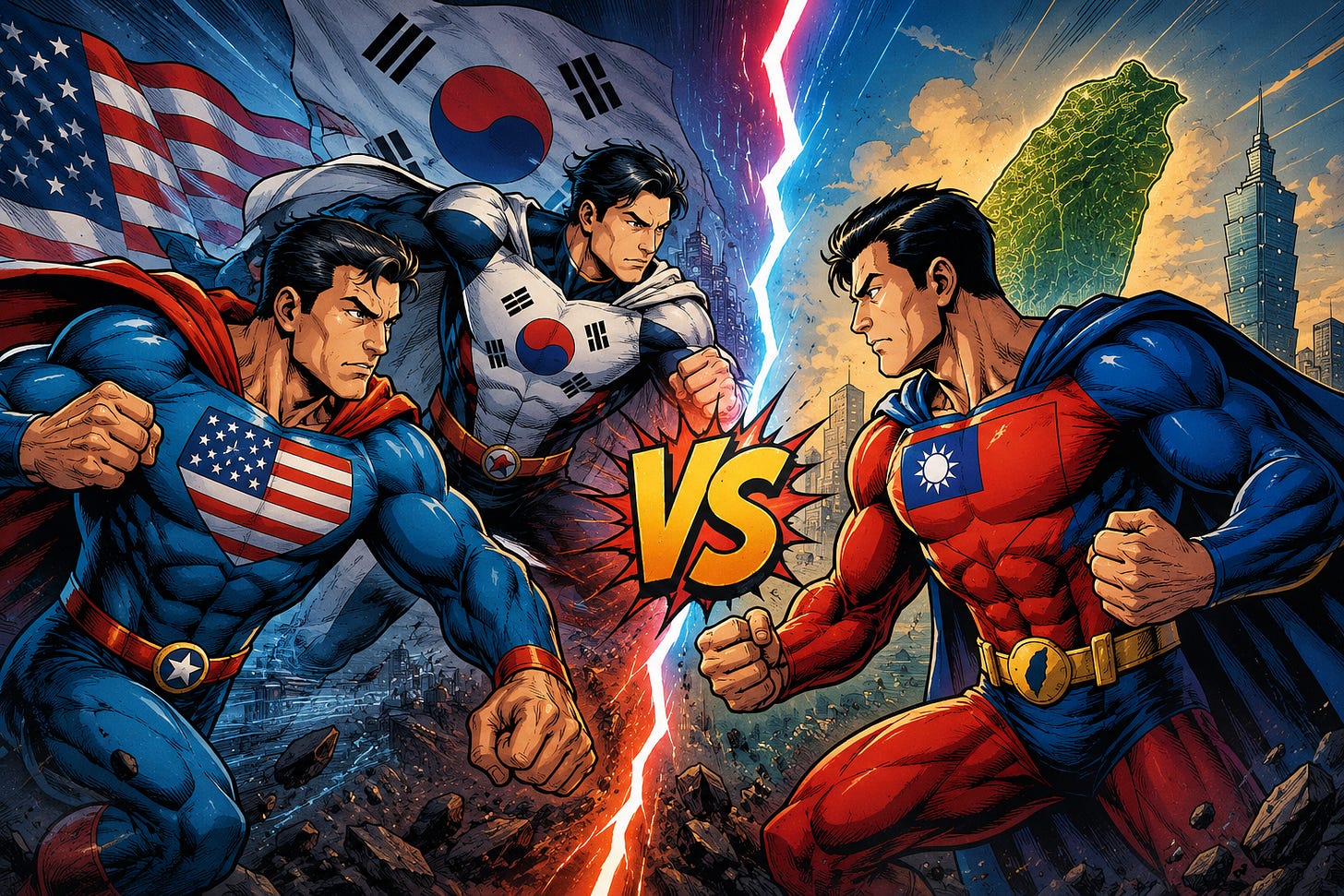
The global semiconductor industry is moving from efficiency-based specialization to geopolitical integration.
Over the past three decades, the global semiconductor industry was built on a highly efficient model of specialization. The United States controlled chip design, EDA, IP, and end-platform ecosystems. Taiwan became the center of advanced foundry manufacturing and packaging. South Korea dominated DRAM, NAND, and memory supply. Japan retained key positions in materials and equipment. China provided massive electronics manufacturing capacity and end-market demand.
This globalization-driven division of labor once formed the foundation of rapid semiconductor growth. It also enabled TSMC to become the world’s most critical advanced manufacturing platform.
But that order is now being rewritten.
As globalization retreats, export controls intensify, and AI infrastructure becomes a core dimension of national power, semiconductors are no longer merely a commercial competition. They have become a combined contest of national security, supply chain sovereignty, AI compute deployment, and industrial control.
If the United States and South Korea form a deeper semiconductor strategic alliance over the next decade — potentially even facilitating cooperation between Intel and Samsung — Taiwan could face an unprecedented structural challenge.
The core issue is not whether one company can defeat another. The real question is whether Taiwan’s current industrial model is strong enough to compete against a new semiconductor alliance built around U.S. logic chips, Korean memory, and American end-application giants.
The Real Threat of a U.S.–Korea Alliance Is Not a Single Technology, but a System-Level Combination
If we look only at individual technology nodes, Taiwan remains extremely competitive. TSMC still leads the world in advanced process technology, yield management, production discipline, customer trust, and supply chain execution. Although Samsung continues to pursue advanced logic foundry leadership, it still faces challenges in customer confidence, high-volume manufacturing stability, and ecosystem depth.
However, the threat of U.S.–Korea cooperation does not lie in Samsung alone defeating TSMC. The real threat is the possible formation of a system-level competitor.
The United States controls the world’s most important AI chip companies, cloud service providers, automotive platforms, aerospace systems, AI server architectures, and capital markets. South Korea controls critical DRAM, HBM, and NAND memory supply chains. If these two forces are further integrated through policy, capital, capacity, and technology platforms, they could form a powerful alliance spanning logic chips, memory, advanced packaging, system applications, and end-market demand.
The pressure on Taiwan would be direct.
AI chip competition is no longer simply about transistor density. It is about who can deliver the most complete system solution. From GPUs, ASICs, HBM, CoWoS, substrates, optical interconnects, power management, thermal solutions, server design, to data center deployment, AI infrastructure is a deeply coupled system engineering problem.
Whoever controls more critical layers will gain stronger pricing power and bargaining power in the next phase of industrial competition.
5月8日
If Intel–Samsung Cooperation Takes Shape, It Will Represent a New U.S.–Korea Industrial Alignment
Around 2027, the United States may push Samsung and American companies such as Intel toward more substantial cooperation. This view deserves attention because it fits the current logic of semiconductor regionalization.
Intel may have fallen behind in advanced process competition for several years, but it still possesses major strategic value: U.S.-based manufacturing, the x86 platform, advanced packaging capabilities, government support, and deep relevance to defense and high-performance computing. Samsung, meanwhile, has logic foundry, DRAM, NAND, HBM, packaging, smartphone brands, and massive capital expenditure capability.
If the two companies cooperate under a U.S. policy framework, Washington would gain more than additional wafer capacity. It would gain an alternative architecture capable of supporting AI and high-performance computing within the U.S. and allied supply chain system.
For the United States, this is a rational strategic option. Washington cannot permanently rely on the most critical AI compute manufacturing being concentrated in one geography, even if Taiwan remains a trusted partner. From a national security perspective, the U.S. will continue to push for second-source supply.
For South Korea, deeper cooperation with the U.S. could bring technology access, market opportunities, policy protection, and geopolitical security. For Samsung, support from the U.S. government and major American customers could help it rebuild its strategic position in advanced logic and AI supply chains.
Therefore, a U.S.–Korea alliance is not an abstract political slogan. It has a clear industrial logic.
4月8日
Taiwan’s Core Problem: TSMC Is Strong, but Taiwan Cannot Rely on TSMC Alone
Most important warning to Taiwan is this: TSMC is an extraordinarily strong company, but Taiwan’s semiconductor industry cannot depend solely on TSMC’s strength.
This statement does not deny TSMC’s value. Rather, it points to the next structural risk in Taiwan’s industrial model.
TSMC’s pure-play foundry model is one of the most successful business models in the history of the global semiconductor industry. By avoiding direct competition with customers and focusing on process technology, yield, capacity, and manufacturing services, TSMC earned the trust of global IC design companies. This remains the foundation of its success.
But in the AI era, industry competition is shifting from process-node competition to system-platform competition.
When chips, memory, packaging, optical interconnects, thermal systems, power architecture, and data center design become deeply integrated, the pure-play foundry model remains essential, but it may no longer be sufficient to determine system-level leadership.
Future customers will need not only wafers, but more complete AI hardware solutions. Not only process technology, but compute delivery capability. Not only foundry services, but supply chain coordination.
This is why Taiwan must ask a harder question: beyond TSMC, does it have sufficiently strong capabilities in memory, systems, modules, equipment, materials, optoelectronics, hardware-software integration, and end-application platforms?
If not, Taiwan will become relatively passive when facing a possible vertically integrated U.S.–Korea alliance.
2月2日
Korea’s Advantage Is Not Only Samsung, but National-Level Vertical Integration
Many people look at Samsung and focus only on its smartphone margin pressure, its difficulties in advanced foundry competition, or its internal governance challenges. But from a national industrial strategy perspective, Korea’s real advantage is that it retains a highly complete semiconductor vertical integration structure.
Samsung has memory, logic, packaging, end-device brands, and large-scale capital spending capability. SK hynix has gained a powerful strategic position in the HBM era. Although Korea still lags behind TSMC in advanced logic foundry manufacturing, it has become indispensable in AI memory.
In other words, Korea is not competing through logic chips alone. It controls a core gateway into the AI supply chain through memory.
This is critical.
No matter how powerful an AI chip is, without HBM and advanced packaging, it cannot become effective compute. In the future, the bottleneck of AI systems may not be a single logic chip. It may be memory bandwidth, packaging density, I/O power consumption, data movement efficiency, and system-level integration.
Korea’s memory advantage gives it natural bargaining power with American AI chip companies, cloud service providers, and server platform vendors.
If U.S. logic chip companies need a second supply chain, if the U.S. government needs secure domestic and allied capacity, and if Korean memory companies need deeper access to the AI market, U.S.–Korea cooperation becomes not an accident, but a convergence of strategic interests.

4月25日
Taiwan Cannot Only Defend; It Must Actively Build Strategic Alliances
The ancient Chinese strategic concept of “using two peaches to kill three warriors” and the broader logic of alliance-building. The deeper message is that Taiwan cannot wait passively until others form an alliance and then try to respond.
Taiwan must proactively design its own industrial alliances.
In the AI era, the most important issue is not simply selling capacity to customers. It is embedding customers, applications, platforms, and supply chains into deeper relationships of mutual dependence.
This is one of the most important questions for Taiwan over the next decade: how should Taiwan build deeper cooperation with major U.S. AI platform companies, cloud service providers, automotive and robotics companies, optical communication firms, and system integrators?
For example, Elon Musk’s Tesla, xAI, and SpaceX represent a combined platform across automotive AI, robotics, data centers, satellite communications, and aerospace electronics. These companies will not only need advanced chips. They will also need AI servers, power systems, thermal management, advanced packaging, sensors, communication modules, and system manufacturing capabilities.

4月16日
If Taiwan can integrate TSMC, Foxconn, Quanta, Wistron, Pegatron, Inventec, Delta Electronics, optical communication suppliers, PCB makers, thermal solution providers, materials companies, and advanced packaging ecosystems, it can become an irreplaceable partner for these end-platform giants.
In other words, Taiwan should not only ask, “Who will place chip orders with TSMC?”
It should ask, “Whose next-generation AI system cannot be completed without Taiwan’s supply chain?”
1月31日
Taiwan Needs an Industrial Fund, Not Just Individual Corporate Investment
TSMC should make better use of its capital strength and establish a foundation or fund platform to lead the vertical integration of Taiwan’s semiconductor industry. This proposal carries strategic significance.
Taiwan has long been strong in manufacturing, but relatively weaker in system integration and capital coordination. Many small and mid-sized materials, equipment, module, optoelectronics, packaging, and software companies have technological potential, but lack capital, international channels, and large-customer validation opportunities.
If Taiwan can establish a semiconductor strategic investment platform jointly supported by leading companies, government funds, industrial banks, and international customers, it could systematically cultivate the next generation of critical supply chains.
This platform does not need to be carried by TSMC alone, nor should it become the burden of a single enterprise. A more practical approach would be to start from national industrial strategy and combine TSMC’s technology vision, Taiwan’s system manufacturing capability, materials and equipment innovation, and international customer demand into a mechanism ofjoint investment, joint validation, and joint adoption.
What Taiwan needs to strengthen is not one single link, but the overall connection across materials, equipment, advanced packaging, silicon photonics, CPO, power, thermal management, PCB, AI servers, and end applications.
The Next Decade: From Foundry Leadership to AI Infrastructure Sovereignty
In the past, semiconductor competition was centered on process nodes. Whoever could mass-produce 7nm, 5nm, or 3nm first would win high-end chip orders. But over the next decade, the competitive axis is changing.
In the AI era, the key question is no longer only “who can manufacture the most advanced chips?” It is “who can support the largest-scale, most efficient, and most secure AI infrastructure?”
This means advanced process technology remains important, but it will be increasingly tied to HBM, advanced packaging, CPO, silicon photonics, glass substrates, power architecture, thermal systems, AI servers, data centers, and energy supply.
Semiconductors are no longer just chips. They are national compute infrastructure.
In this framework, the potential threat of a U.S.–Korea alliance becomes clearer. The United States has AI models, cloud platforms, end applications, and capital markets. Korea has memory and vertical integration. If Intel’s U.S. manufacturing and advanced packaging resources are added, the result could be a new alliance with policy legitimacy, supply chain security narratives, and market scale.
If Taiwan positions itself only as the home of the world’s best foundry, it will remain powerful, but its strategic depth will be insufficient.
Taiwan’s Breakthrough Is Not De-Samsungization, but Systemization
Facing a potential U.S.–Korea alliance, Taiwan should not fall into a simplistic friend-versus-enemy framework. Korea is a competitor, but it is also an indispensable part of the global semiconductor ecosystem. The United States is Taiwan’s most important customer and security partner, but it will also continue to diversify supply chains based on its own interests.
Taiwan’s real task is not to stop others from cooperating. It is to make itself an unavoidable node in any cooperation framework.
That means Taiwan must pursue “systemization.”
First, Taiwan must extend its wafer manufacturing advantage into advanced packaging and system-level integration. Second, it must strengthen weaker areas such as memory, optoelectronics, materials, equipment, power, and thermal solutions. Third, it must build deep co-development relationships with major U.S. end-platform companies. Fourth, Taiwan’s supply chain must evolve from passive order-taking to joint specification definition, joint architecture design, and joint value distribution.
Most importantly, Taiwan’s industrial policy cannot stop at land, water, electricity, subsidies, and talent supply. It must move toward global alliance strategy.
Future semiconductor competition will not be determined only by who has fabs. It will be determined by who can organize alliances, distribute interests, control standards, and secure system-level entry points.

3月31日
Taiwan Needs a Strategic Architect for This Era
Taiwan needs a “Zhuge Liang” for this generation — someone with the ability to design and coordinate the full picture.
The point is not to mythologize one individual. The real message is that Taiwan now needs a higher level of industrial strategic design.
Taiwan’s semiconductor success was built on engineering culture, manufacturing discipline, global specialization, customer trust, and long-term corporate investment. But over the next decade, corporate self-driven competition alone may not be enough.
The competitors are no longer individual companies. They are national-level industrial alliances. The battlefield is no longer a single process node. It is a combined arena of AI infrastructure, ecosystems, capital markets, and geopolitics.
Taiwan needs integrated planning capacity that understands technology, industry, capital, diplomacy, and international customer demand. This cannot be completed by the government alone. It also cannot be carried by TSMC alone.
It requires the state, enterprises, investors, research institutions, and international partners to jointly rebuild Taiwan’s next-generation semiconductor strategy.
4月21日
Conclusion: Taiwan’s Real Risk Is Not That Its Rivals Become Stronger, but That It Uses an Old Map for a New Battlefield
Whether a deep U.S.–Korea semiconductor alliance will fully materialize remains uncertain. It will depend on politics, corporate interests, technology maturity, and the international environment. But the warning itself is already important enough.
It reminds Taiwan that semiconductor competition over the next decade will not simply be a process race between TSMC and Samsung, nor a question of whether Intel can catch up in advanced nodes. It will be a redistribution of control over global AI infrastructure.
Taiwan still has enormous advantages. TSMC’s manufacturing capability, Taiwan’s complete electronics supply chain, AI server ODM capacity, advanced packaging ecosystem, PCB industry, and thermal management suppliers are all assets that the world cannot easily replace.
But if Taiwan only defends its existing advantages and does not proactively extend into system integration, international alliances, and strategic investment, it may face growing pressure as the global semiconductor map is reorganized.
The real question is not whether the United States will cooperate with Korea.
The real question is whether Taiwan can make the global AI industry unable to move forward without Taiwan.
Over the next decade, Taiwan’s semiconductor industry must not only remain the world’s strongest manufacturing base. It must become the most difficult node to bypass, the most valuable partner to ally with, and the core platform most capable of distributing value in the global AI hardware order.
That is the real breakthrough strategy Taiwan needs in response to the U.S.–Korea semiconductor alliance warning.

4月9日

5月6日


PreviousNext