Toshiba and Kioxia: The Japanese Semiconductor Story of Selling the Golden Goose
Toshiba and Kioxia: The Japanese Semiconductor Story of Selling the Golden Goose
- Source: SemiVision
- Author: SEMIVISION
- Published: 2026-05-12T10:29:16+08:00
- URL: https://tspasemiconductor.substack.com/p/toshiba-and-kioxia-the-japanese-semiconductor (1) Toshiba and Kioxia: The Japanese Semiconductor Story of Selling the Golden Goose


Toshiba and Kioxia: The Japanese Semiconductor Story of Selling the Golden Goose
Original Article By SemiVision Reserach [Reading time: 12 mins]

May 12, 2026
∙ Paid
Toshiba and Kioxia: The Japanese Semiconductor Story of Selling the Golden Goose
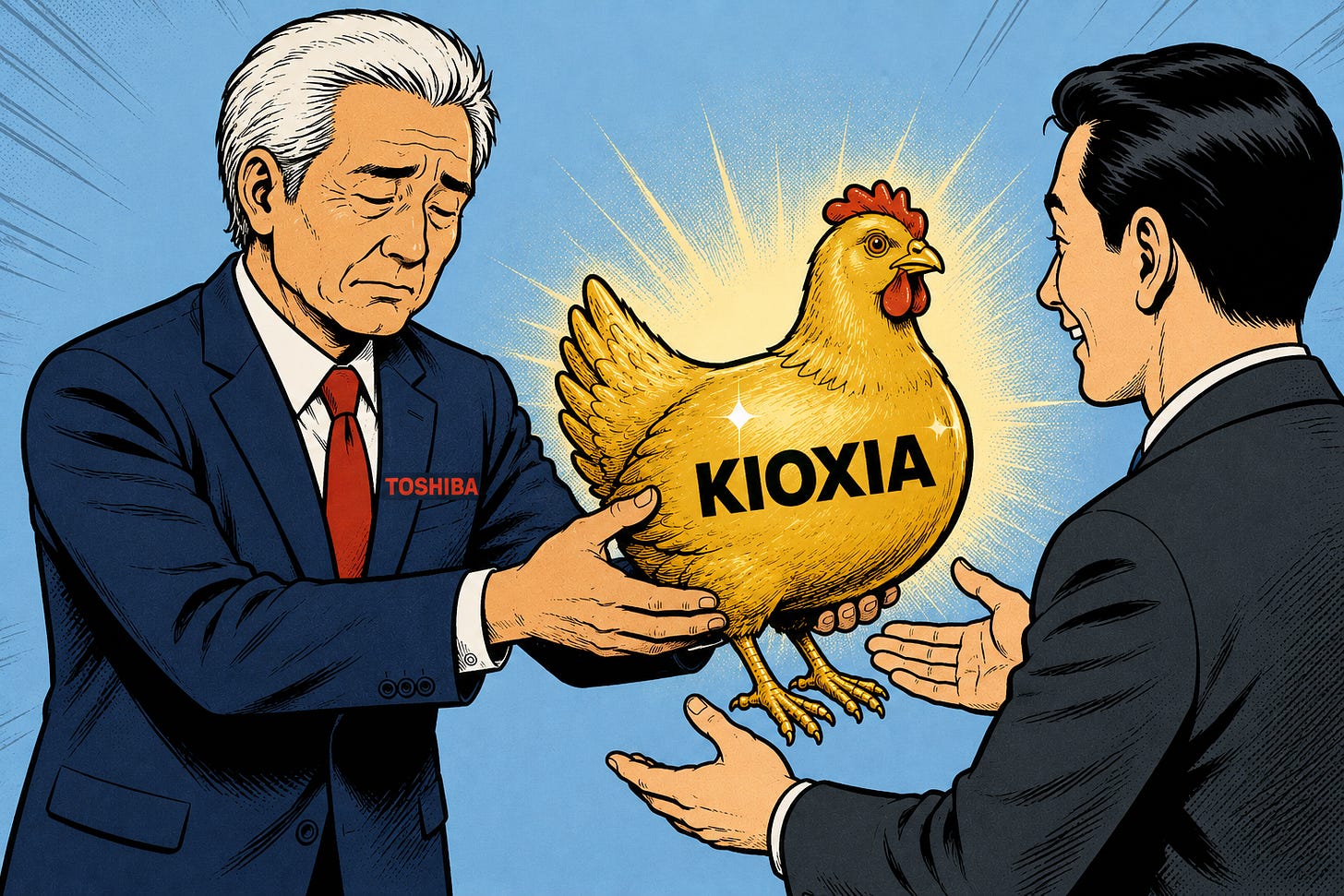
If we want to explain the relationship between Toshiba and Kioxia in one sentence, it would be this:Kioxia was originally Toshiba’s memory business. It was later carved out, sold, renamed, listed independently, and has now become one of Japan’s most important NAND flash and SSD companies.

The new name “Kioxia” is a combination of the Japanese word “kioku,” meaning memory, and the Greek word “axia,” meaning value. Kioxia stated that the new brand name integrates the dual meanings of “memory” and “value,” forming the foundation of the company’s vision for the future.
But this is not merely a story of corporate restructuring or brand renaming. It is a deeper story about Japan’s semiconductor industry: from technological leadership to financial crisis, from forced asset sales to a dramatic revaluation in the AI era.
Today, as AI data centers drive explosive demand for storage, Kioxia is no longer viewed simply as a cyclical NAND supplier. It is being redefined as a strategic infrastructure company for the AI economy. For Toshiba, this must be a deeply complicated reality. The business it once had to sell has now become one of the most valuable semiconductor assets in Japan.
4月28日
Kioxia Was Once Toshiba Memory
Kioxia’s origin is very clear: it was formerlyToshiba Memory Corporation, the memory business of Toshiba.
Toshiba was once one of the most important players in the global semiconductor industry. In particular, it had a deep technological foundation in memory. NAND flash itself is closely tied to Toshiba’s research history, which is why Kioxia is not an ordinary spin-off or a new memory start-up. It inherited decades of Toshiba’s technology, manufacturing know-how, customer relationships, engineering talent, and production assets.

In 2018, Toshiba sold Toshiba Memory to a consortium led by Bain Capital. In 2019, Toshiba Memory was renamedKioxia. The new name symbolized a new corporate identity, but the core business remained deeply rooted in Toshiba’s semiconductor legacy.
That is why Kioxia should not be understood as just another related company of Toshiba. It is more accurate to say that Kioxia is the continuation of Toshiba’s most strategically important memory business after it was separated and independently developed under a new ownership structure.
In other words, Kioxia is not merely a company that came after Toshiba Memory. It is Toshiba Memory under a new name, new capital structure, and new market narrative.
Why Did Toshiba Sell Its Memory Business?
Looking back from today, Toshiba’s sale of its memory business seems extremely painful. But at the time, it was a decision forced by financial pressure.
Toshiba was under severe stress because of massive losses related to its U.S. nuclear power subsidiary Westinghouse. The company’s balance sheet deteriorated, and Toshiba urgently needed to raise capital to stabilize the group.
The memory business was the most valuable asset Toshiba could sell. It was technologically advanced, globally competitive, and attractive to financial investors and strategic partners. But this also created the tragedy of the decision:
Toshiba did not sell a marginal business. It sold one of the most important building blocks of the future AI infrastructure era.
Memory is a highly cyclical industry. NAND flash prices can rise and fall dramatically depending on supply and demand. During a downturn, NAND looks like a difficult business: heavy capital expenditure, large inventories, price volatility, and margin pressure. But when the cycle turns, especially when a new demand driver emerges, the same business can suddenly become a strategic asset.
This is exactly what happened in the AI era.
When Toshiba sold Toshiba Memory, the market still largely viewed NAND flash as a cyclical storage component tied to smartphones, PCs, consumer electronics, and enterprise storage cycles. But today, AI has changed the structure of demand. Training data, inference workloads, vector databases, high-performance SSDs, multimodal content, and enterprise AI systems are all increasing the need for fast, high-capacity storage.
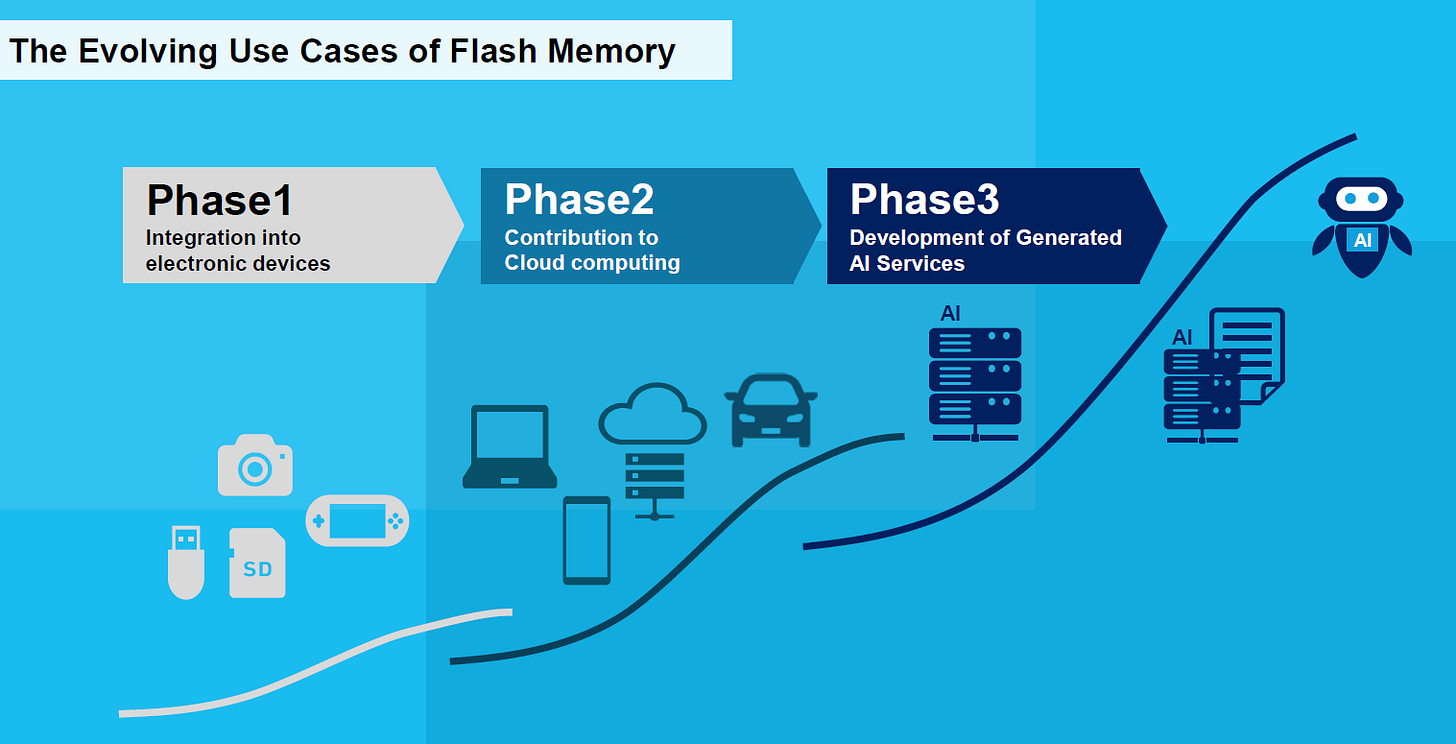
The asset Toshiba sold was not just a memory business. It was a future AI infrastructure asset that had not yet been fully recognized by the market.
Kioxia Is No Longer a Toshiba Subsidiary
Many people still misunderstand Kioxia as a Toshiba subsidiary or Toshiba’s memory brand. That is no longer accurate.
Today, Kioxia is an independent listed company. Toshiba still holds a stake, but the relationship has changed fundamentally. The two companies are no longer in a simple parent-subsidiary relationship. Toshiba is better described as the former parent company and an important shareholder, while Kioxia operates as an independent semiconductor company.
This change is important.
In the past, Toshiba could directly control the strategy, investment direction, manufacturing roadmap, and financial consolidation of its memory business. Today, it can only participate indirectly through shareholding. That means Toshiba can still benefit from Kioxia’s success, but it no longer fully controls one of Japan’s most important memory platforms.
A simple analogy would be this: Kioxia was once a child raised inside the Toshiba family. Later, because of a family financial crisis, it was sent out, brought in external capital, changed its name, and eventually became independent. Toshiba still has a historical and financial connection with it, but Kioxia is no longer fully under Toshiba’s roof.

This is why the Kioxia story carries both industrial significance and emotional weight. It is a story of survival, but also a story of lost control.
Kioxia’s Core Value: NAND Flash and SSDs
Kioxia’s main business is NAND flash, a type of non-volatile memory used in SSDs, smartphones, data center storage, enterprise servers, and many other digital systems.
For ordinary consumers, NAND flash is simply “storage.” It is what allows a phone, laptop, or SSD to store data even when the power is turned off. But in the AI era, storage is no longer just a passive component. It is becoming part of the performance architecture of modern computing systems.
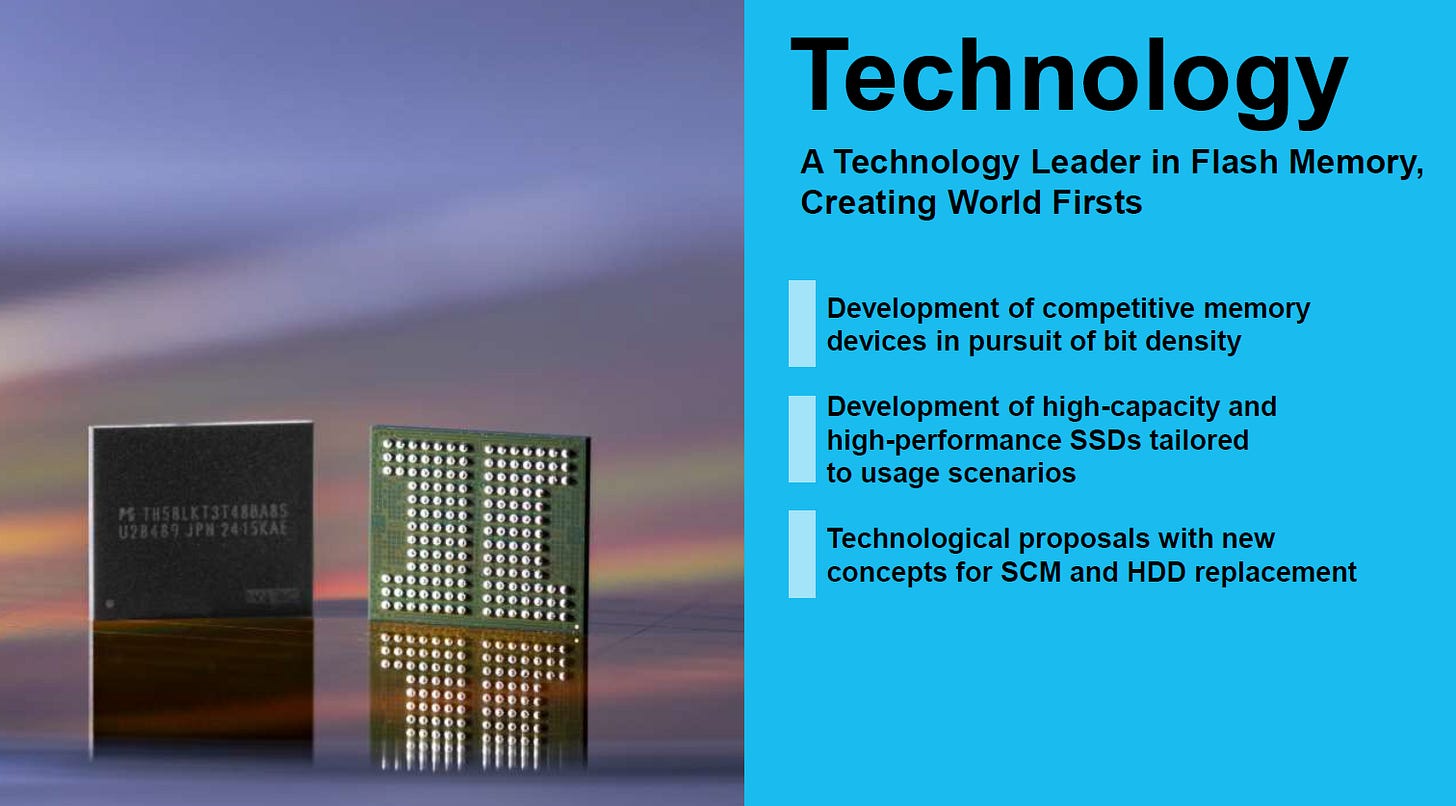
In the past, most AI discussions focused on GPUs, HBM, advanced packaging, CoWoS, networking, power supply, and data center construction. These are indeed critical. But as AI moves from training to large-scale inference, storage becomes increasingly important.

5月5日
AI systems do not only need computation. They also need massive data movement, data retention, high-speed access, and efficient storage hierarchy. Training models requires huge datasets. Inference services need to access user histories, embeddings, cache layers, vector databases, multimodal files, and enterprise knowledge bases. As AI expands from text to images, video, speech, robotics, and corporate data systems, SSD demand becomes even more important.
This is where Kioxia’s position becomes strategically meaningful.
Kioxia is not an AI accelerator company. It does not compete directly with Nvidia in GPUs or with HBM leaders in high-bandwidth memory. But it supplies one of the essential layers of AI infrastructure: storage. In an AI data center, GPUs may be the engine, HBM may be the high-speed working memory, but NAND-based SSDs are the storage foundation that holds and feeds the data.
Without storage, AI infrastructure cannot scale efficiently.

AI Is Changing the Value of NAND
For many years, NAND flash was treated as a cyclical commodity. When prices rose, suppliers made money. When supply became excessive, prices collapsed. Investors often treated NAND companies with caution because of this volatility.
But AI is changing the narrative.
As hyperscalers continue to increase investment in AI infrastructure, demand for enterprise SSDs and high-capacity NAND is rising rapidly. AI servers require not only powerful processors but also massive storage capacity. The larger and more complex AI workloads become, the more important storage architecture becomes.
This shift has helped memory companies such as Kioxia, Samsung Electronics, and SanDisk regain investor attention. The market is no longer looking only at near-term NAND price fluctuations. It is beginning to ask a more strategic question:
If AI demand continues to grow, should NAND suppliers be valued as cyclical commodity companies, or as core infrastructure providers?
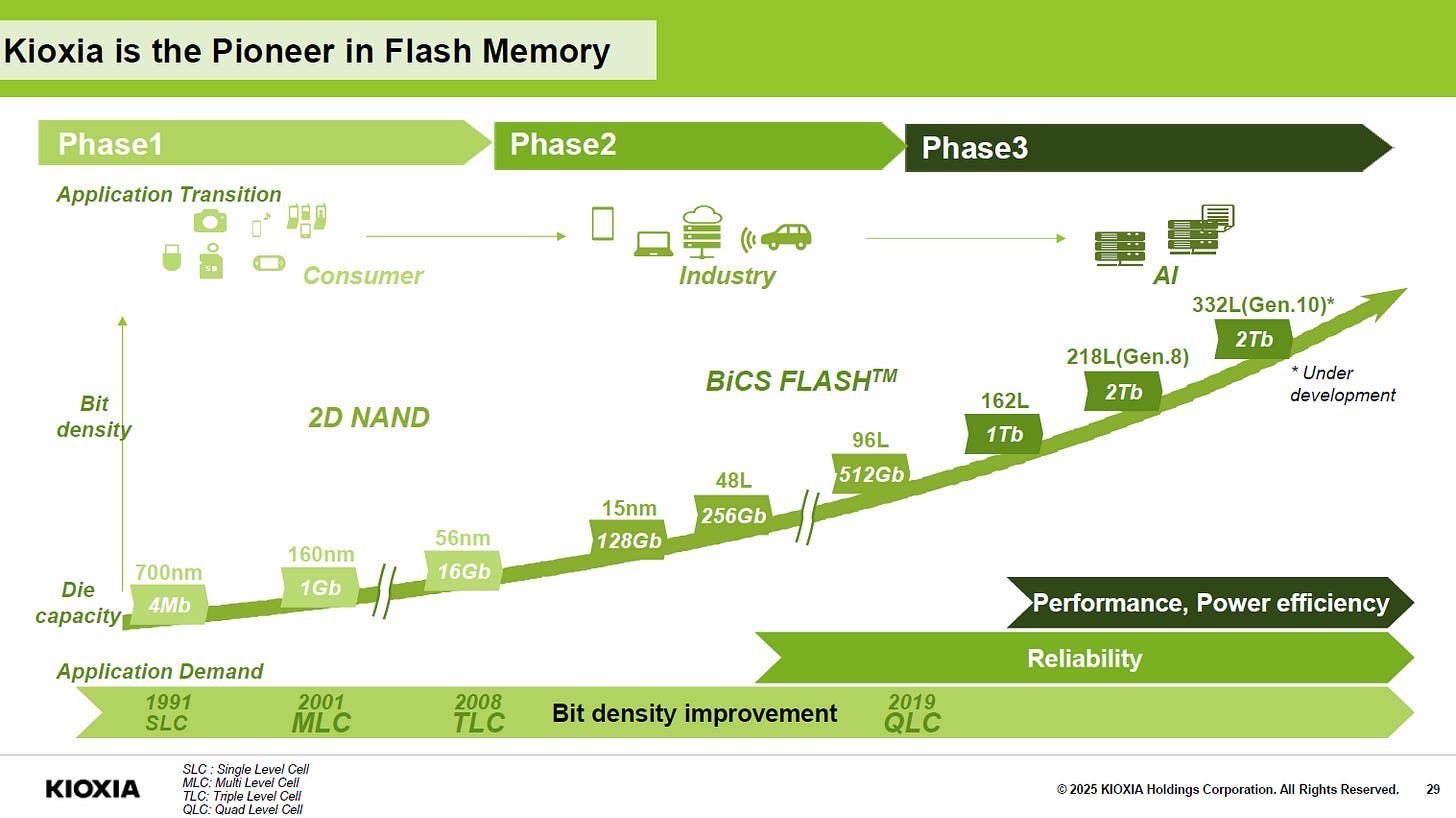
Kioxia’s recent market performance suggests that investors are moving toward the second interpretation.
Driven by rising memory-chip prices, Kioxia has reportedly entered the top ten Japanese listed companies by market capitalization for the first time.
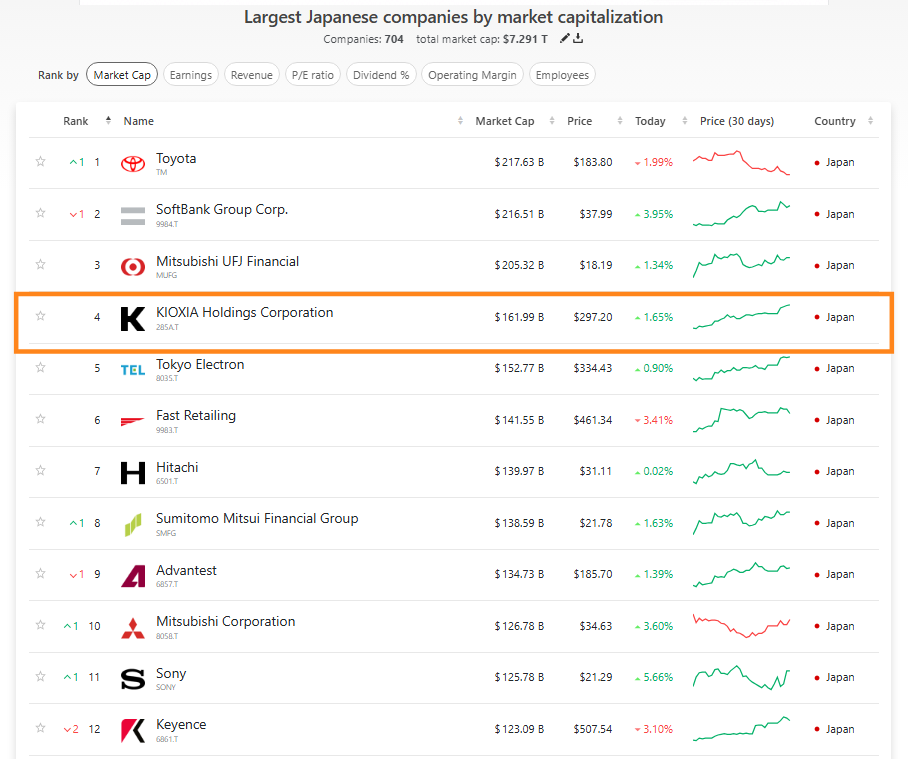
Screenshot on 2026/05/12
This is not a normal semiconductor rebound. It is a market repricing.
Kioxia Becomes a New Face of the Nikkei 225
Kioxia has also become a new member of Japan’s benchmarkNikkei 225 index.It was only added to the index on April 1, 2026, making it a new face in Japan’s most watched equity benchmark.
Among Nikkei 225 constituents, Kioxia’s year-to-date share price performance was reportedly second only to Furukawa Electric, which rose 324.88%. This shows how quickly Kioxia has moved from being a former Toshiba memory asset to becoming one of the most watched names in Japan’s stock market.
This matters because index inclusion changes investor behavior. Once a company enters a major benchmark, it receives more attention from passive funds, institutional investors, and global portfolio managers. For Kioxia, joining the Nikkei 225 reinforces its transition from a specialized memory company into a major Japanese technology stock.
It also highlights a broader shift in Japan’s equity market. For years, Japan’s market leaders were dominated by automakers, trading houses, banks, electronics brands, and industrial conglomerates. Now, AI-related semiconductor names are moving toward the center of market attention.
Kioxia is becoming part of that new Japanese technology leadership group.
Why Investors Are Repricing Kioxia
The reason behind Kioxia’s surge is not difficult to understand: memory prices are rising, AI storage demand is increasing, and investors are beginning to price in a sharp improvement in profitability.
As U.S. technology giants continue to expand AI investment, demand for NAND flash used in AI servers has surged. This has provided strong support not only for Kioxia, but also for other memory suppliers such as Samsung Electronics and SanDisk.
Investors have started to factor in a major profit increase from rising memory prices. He also noted that market attention is shifting toward memory-related stocks, and that even among semiconductor shares less exposed to geopolitical risk, memory stocks still appear undervalued.
This point is important.
In recent years, many semiconductor investors focused heavily on AI logic chips, GPUs, HBM, advanced packaging, and semiconductor equipment. NAND flash did not receive the same premium because it was still associated with price cycles. But when AI infrastructure investment becomes broad-based, storage can no longer be ignored.
AI does not only consume compute. It consumes memory bandwidth, storage capacity, networking bandwidth, energy, and data center space. Once investors understand AI as a full infrastructure stack, NAND suppliers such as Kioxia start to look different.
According to analyst expectations cited in the market, Kioxia’s net profit for the fiscal year ending in March may rise to about ¥2.5 trillion, roughly five times higher than previous estimates. If achieved, that would make Kioxia one of the most profitable companies in Japan, second only to Toyota Motor.
Despite this, Kioxia’s forward price-to-earnings ratio was still reportedly below eight times. Saito argued that this suggests the stock may still be undervalued and that the long-term upward trend could continue.
This is the core reason investors are excited: Kioxia is no longer being valued only as a cyclical NAND maker. It is being valued as a company whose earnings power may be structurally lifted by AI demand.

High Volatility, High Attention
Kioxia’s rapid rise has also made it a popular target for both retail day traders and hedge funds.
This is understandable. A stock that rises quickly, has strong AI-related momentum, and remains tied to a volatile memory cycle naturally attracts different types of capital. Long-term investors may buy and hold because they believe in the structural AI storage trend. Short-term traders may enter because of volatility and momentum.
This dynamic clearly: long-term investors are adopting buy-and-hold strategies, while short-term capital is accelerating the stock’s rise.
This dual structure can make Kioxia’s share price more powerful, but also more volatile. The long-term thesis is AI storage demand. The short-term trading logic is momentum. When both forces move in the same direction, the stock can rise sharply. But if NAND prices weaken or investors start taking profits, volatility could also increase.
That is why Kioxia should not be viewed as a simple one-way stock story. It is both a strategic AI infrastructure company and a cyclical memory supplier. The market is currently emphasizing the AI infrastructure side. But the memory cycle has not disappeared.

Why Toshiba May Feel Regret
From Toshiba’s perspective, the Kioxia story must be painful.
To be fair, Toshiba’s decision to sell Toshiba Memory was not made in a normal environment. The company was under severe financial pressure and needed to stabilize its balance sheet. In that context, selling the memory business was not irrational. It may even have been necessary.
But from a long-term industrial perspective, the sale looks increasingly costly.
Toshiba sold a business that looked capital-intensive, cyclical, and difficult to manage. But in the AI era, that same business has become one of the key assets in the global data center supply chain. NAND flash and SSDs are no longer just storage products for consumer electronics. They are part of the backbone of AI infrastructure.
Kioxia’s value today does not come only from NAND technology. It also comes from its position inside Japan’s semiconductor supply chain. It has important manufacturing sites, long-term technology know-how, and deep cooperation with Western Digital and SanDisk in 3D NAND and related areas. These are not assets that can be easily rebuilt.
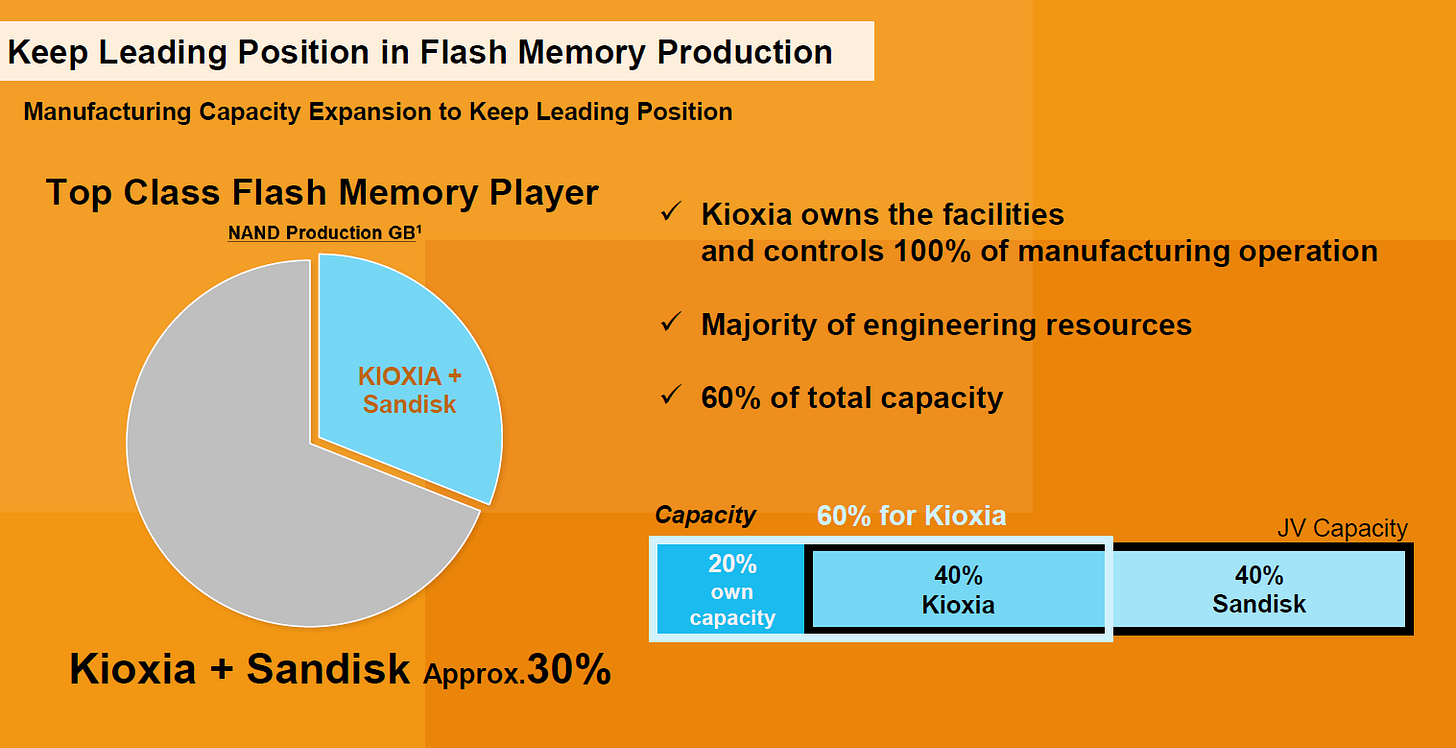
If Toshiba had retained full control of this business, it might today be seen as one of Japan’s most important AI infrastructure semiconductor groups. Instead, Toshiba can only participate through its remaining shareholding. It can benefit financially, but it no longer fully controls the strategic direction of the asset.
This is why the phrase “selling the golden goose” feels appropriate.
At the time of the sale, Toshiba needed cash. But what it sold was not just a business unit. It sold a platform that later became central to one of the most important technology cycles of the decade.

2月14日
The Bigger Lesson for the Semiconductor Industry
The Toshiba-Kioxia story offers a powerful lesson for the semiconductor industry:
Assets sold during a downturn may become strategic assets in the next technology cycle.
Semiconductors are not ordinary businesses. Their value depends not only on current profits, but also on technology roadmaps, capital intensity, supply chain position, and future application cycles. A business that looks unattractive in one cycle can become indispensable in the next.
NAND flash is a perfect example.
In a smartphone slowdown, NAND may look like a weak commodity business. In an AI infrastructure boom, it becomes an essential storage layer. The physical technology may be similar, but the market narrative changes completely because the application environment changes.
This is why semiconductor strategy cannot be based only on current financial statements. It must consider long-term technology inflection points. AI is not only increasing demand for GPUs. It is reorganizing the entire compute infrastructure stack: logic, memory, storage, networking, packaging, power, cooling, and software.
When the whole system expands, previously underappreciated components can suddenly become bottlenecks. Once a component becomes a bottleneck, its pricing power and strategic value rise.
That is what is happening to NAND. And that is why Kioxia’s market value has been dramatically re-rated.
Conclusion: Toshiba Has Every Reason to Feel Regret
Kioxia’s story is both a continuation of Toshiba’s semiconductor legacy and a reminder of the painful decisions Toshiba had to make during its restructuring period. Toshiba once owned one of the world’s most important memory businesses. Under financial pressure, it sold that business. Years later, the company was renamed Kioxia, listed independently, and has now become one of the most closely watched AI infrastructure stocks in Japan.
Today, Kioxia is benefiting from rising NAND prices, expanding AI data center demand, and a market shift toward memory-related semiconductor stocks. Its entry into Japan’s top ten listed companies by market value shows that investors no longer see it simply as a cyclical storage company. They increasingly see it as a strategic supplier to the AI infrastructure buildout.
For Toshiba, this must be difficult to watch. It still has an economic link to Kioxia, but it no longer fully owns the asset. The company that was once Toshiba Memory has become a major winner of the AI storage cycle.
In hindsight, Toshiba sold the golden goose just before the world discovered how valuable that goose could become. As AI continues to drive demand for NAND flash and enterprise SSDs, Kioxia’s rapid rise will likely make Toshiba look back at that decision with deep regret.

2月6日
Reference:
Toshiba came under severe financial pressure because of its U.S. nuclear subsidiary, Westinghouse Electric. The background was mainly as follows:
In 2006, Toshiba acquired Westinghouse Electric from British Nuclear Fuels Limited (BNFL) for about US$5.4 billion. At the time, Toshiba was optimistic about a global “nuclear renaissance” and hoped to expand its nuclear power business by gaining advanced technology and new orders.
However, after the acquisition, the situation deteriorated rapidly. The main problems were concentrated in two U.S. AP1000 advanced nuclear reactor projects: the Vogtle plant in Georgia and the VC Summer plant in South Carolina, involving four reactors in total.
The projects suffered from serious cost overruns and delays. Construction costs far exceeded original budgets, and completion schedules were delayed by several years. The reasons included stricter safety requirements imposed by U.S. regulators after the 2011 Fukushima nuclear accident, which led to design changes and additional equipment needs; labor, equipment, and material costs that were much higher than expected; and technical and supply-chain problems in the actual implementation of Westinghouse’s AP1000 design, even though it had been promoted as a modular construction model.
A critical mistake came in 2015. To resolve legal disputes and cost issues with its contractor, Chicago Bridge & Iron Company, also known as CB&I / Stone & Webster, Westinghouse acquired CB&I’s nuclear construction business. The original intention was to gain better control over costs. Instead, the move meant that Westinghouse could no longer shift the risk of cost overruns to contractors and had to absorb the losses itself.
By the end of 2016, Toshiba announced massive losses at Westinghouse and had to recognize asset impairment charges of more than ¥700 billion, or roughly US$6 billion. In March 2017, Westinghouse filed for Chapter 11 bankruptcy protection in the United States. Toshiba’s losses for that fiscal year exceeded ¥1 trillion, with some reports putting the figure at around US$8.8 billion.
This crisis pushed Toshiba to the brink of bankruptcy and forced it to sell several core profitable businesses. These included its NAND flash memory business, which later became Kioxia; its white-goods home appliance business, sold to China’s Midea; and its PC business, sold to Sharp. These asset sales allowed Toshiba to survive the crisis.
In summary, Toshiba’s crisis was the result of multiple factors: an overly optimistic bet on the revival of nuclear power, an expensive acquisition, severe construction execution problems, regulatory changes after Fukushima, and major cost-control failures. Together, these factors turned Westinghouse into one of the most serious financial disasters in modern Japanese corporate history.

In 2016, Midea Group acquired an 80.1% stake in Toshiba’s home appliance business, Toshiba Lifestyle Products & Services Corporation. Through this transaction, Midea obtained a 40-year global license to use the Toshiba brand, access to more than 5,000 white-goods patents, as well as Toshiba’s production bases and distribution channels in Japan and Southeast Asia.
The key points in the relationship between Toshiba and Midea are as follows:
Acquisition:
In March 2016, Chinese home appliance giant Midea Group acquired an 80.1% stake in Toshiba Lifestyle Products & Services Corporation for approximately ¥53.7 billion, or about US$477 million.
Brand Licensing:
Midea obtained the right to use the Toshiba brand globally for 40 years.
Production and R&D:
The operating entity of Toshiba’s home appliance business was transferred to Midea. Midea also gained access to Toshiba’s R&D capabilities and integrated the Toshiba brand into its broader white-goods ecosystem.
Brand Strategy:

In late 2018, Toshiba announced that it would transfer more than 80% of its PC business to Sharp. Sharp retained the Dynabook name as the product line brand. Last week, Toshiba announced that it had sold its remaining 19.9% stake to Sharp, making Dynabook a wholly owned subsidiary of Sharp. With this transaction, Toshiba officially ended its 35-year notebook computer business, which had begun in 1985.
After Toshiba sold off its remaining stake, the brand’s 35-year history in the notebook computer market came to an end.
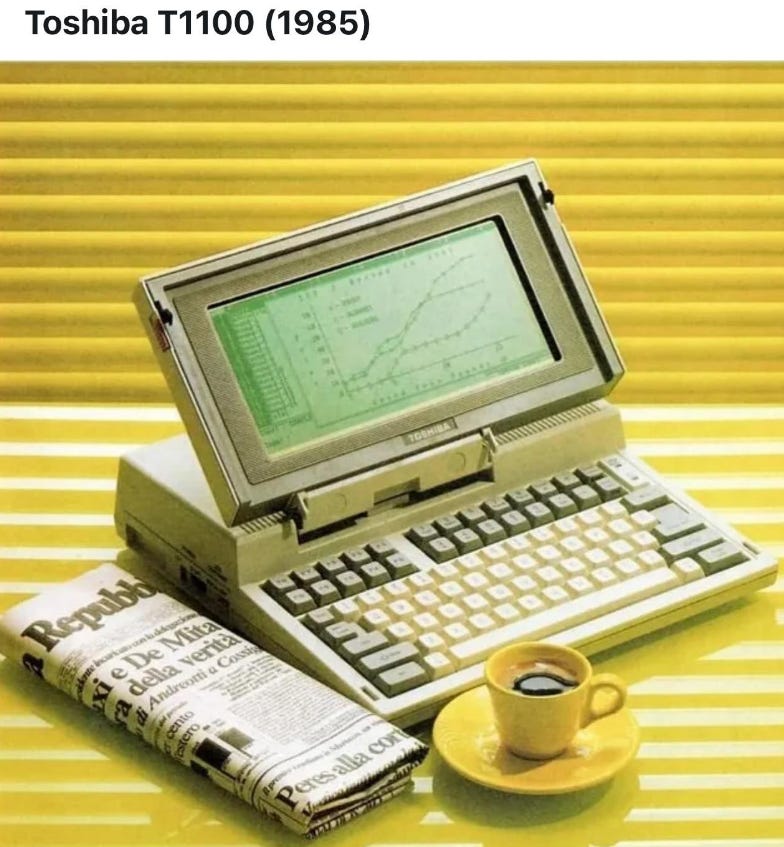
Toshiba was a pioneer in the notebook computer industry. In 1985, it launched the T1100, one of the first laptop computers with a built-in battery. The company enjoyed its golden era from the 1990s to the 2000s. However, after 2000, emerging brands began catching up rapidly with lower-priced products, and Toshiba, like other Japanese laptop brands, gradually struggled to compete.
After entering the 2000s, Japanese notebook computer brands were gradually acquired by other companies. In addition to Toshiba’s PC business being acquired by Sharp, Sharp itself was effectively acquired by Foxconn. NEC’s laptop business now belongs to Lenovo, while Sony’s VAIO business was spun off from Sony and is now operated by Japan Industrial Partners, or JIP.
Thanks for reading SEMIVISION @_@! This post is public so feel free to share it.

4月17日


PreviousNext