COMPUTEX 2026: Why Taiwan Is Becoming the Strategic Center of the Global AI Supply Chain
COMPUTEX 2026: Why Taiwan Is Becoming the Strategic Center of the Global AI Supply Chain
- Source: SemiVision
- Author: SEMIVISION
- Published: 2026-05-11T10:54:27+08:00
- URL: https://tspasemiconductor.substack.com/p/computex-2026-why-taiwan-is-becoming (1) COMPUTEX 2026: Why Taiwan Is Becoming the Strategic Center of the Global AI Supply Chain


COMPUTEX 2026: Why Taiwan Is Becoming the Strategic Center of the Global AI Supply Chain
Original Article By SemiVision Reserach [Reading time: 10mins]

May 11, 2026
∙ Paid
Welcome to Taiwan next month forCOMPUTEX.
This year’s COMPUTEX is no longer just a technology exhibition. It is becoming a live stress test of the global AI supply chain. What used to be a PC-centric event has now evolved into one of the most important platforms for observing the next phase of AI infrastructure. From AMD, NVIDIA, Arm, and Intel to cloud giants such as Google, AWS, and Meta, the companies shaping the future of computing are increasingly using Taiwan as a strategic stage.
The reason is clear. AI is no longer only a model race. It is now a full-stack infrastructure race involving advanced logic, advanced packaging, HBM, AI servers, high-speed networking, power delivery, thermal management, optical interconnects, and data center architecture. In this new cycle, Taiwan is not merely a manufacturing base. It is becoming one of the most important coordination hubs for the global AI economy.

COMPUTEX Is No Longer Just a PC Show
For many years, COMPUTEX was closely associated with PCs, motherboards, notebooks, components, and consumer electronics. That era has not disappeared, but the center of gravity has clearly shifted. In 2026, the dominant theme is AI infrastructure.
The most important products at COMPUTEX are no longer only finished devices. The real focus is the system behind AI: GPUs, CPUs, custom ASICs, HBM stacks, substrates, interposers, server motherboards, switch platforms, cooling systems, power modules, and complete rack-level architectures.
This change reflects a deeper transformation in the semiconductor industry. AI workloads have pushed computing beyond the boundary of individual chips. Performance is now determined by the entire system: how chips are packaged, how memory is connected, how data moves between accelerators, how heat is removed, and how power is delivered across the rack. COMPUTEX has therefore become a place where the next generation of AI infrastructure is displayed, negotiated, and coordinated.

Photo by SemiVision @ Computex 2025
The Return of Global Technology Leaders to Taiwan Is a Strategic Signal
The expected presence of major technology leaders, including AMD CEO Lisa Su, NVIDIA CEO Jensen Huang, Arm CEO Rene Haas, and Intel CEO Lip-Bu Tan, sends a powerful signal. These visits are not only about keynote speeches or media visibility. They reflect Taiwan’s central role in the AI hardware value chain.

June 1–4 | Taipei International Convention Center
Join us Explore Taiwan’s AI ecosystem, from AI infrastructure and agentic AI to physical AI, and beyond.

3月17日
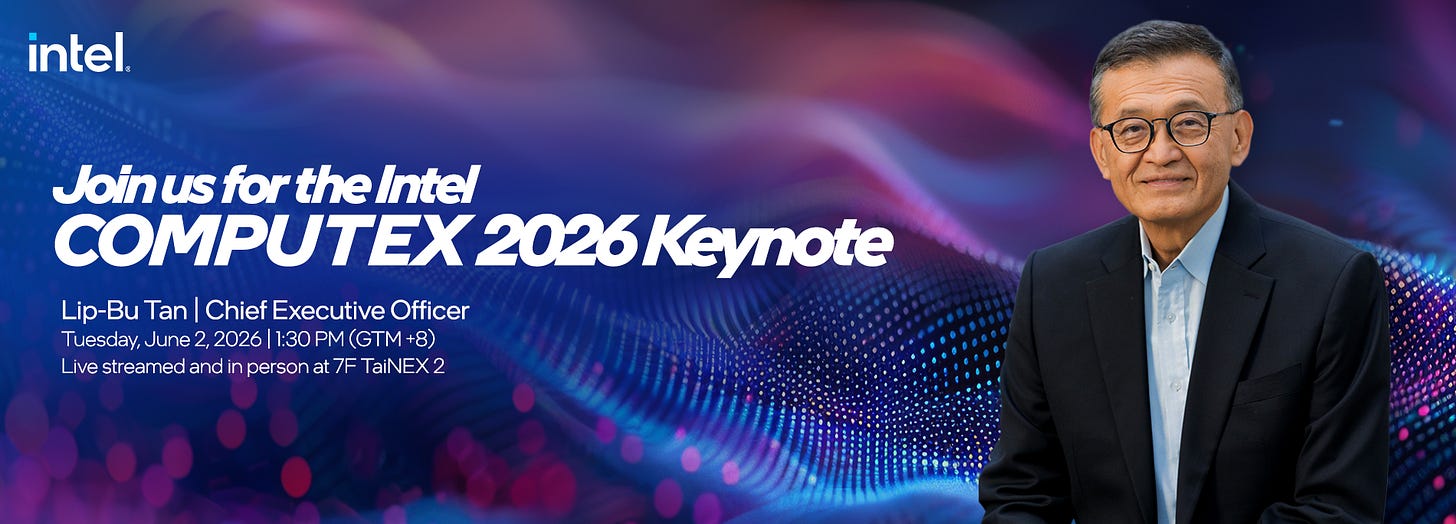
Intel at Computex 2026: Advancing the Next Era of AI-Driven Computing
When:June 2 from 1:30 pm – 2:30 pm Taiwan Local Time
Where:Taipei Nangang Exhibition Center
Event Registration:Invitation-only event

COMPUTEX 2026Arm CEO Keynote
June 2, 2026 | 09:30 AM | Le Méridien Taipei
The foundation for the agentic AI era
Join Rene Haas at COMPUTEX 2026 as Arm unveils the future of AI compute - powering agentic AI from cloud to edge.
At the center of this shift, Arm is enabling AI at every scale with a platform built for performance, efficiency, and flexibility.


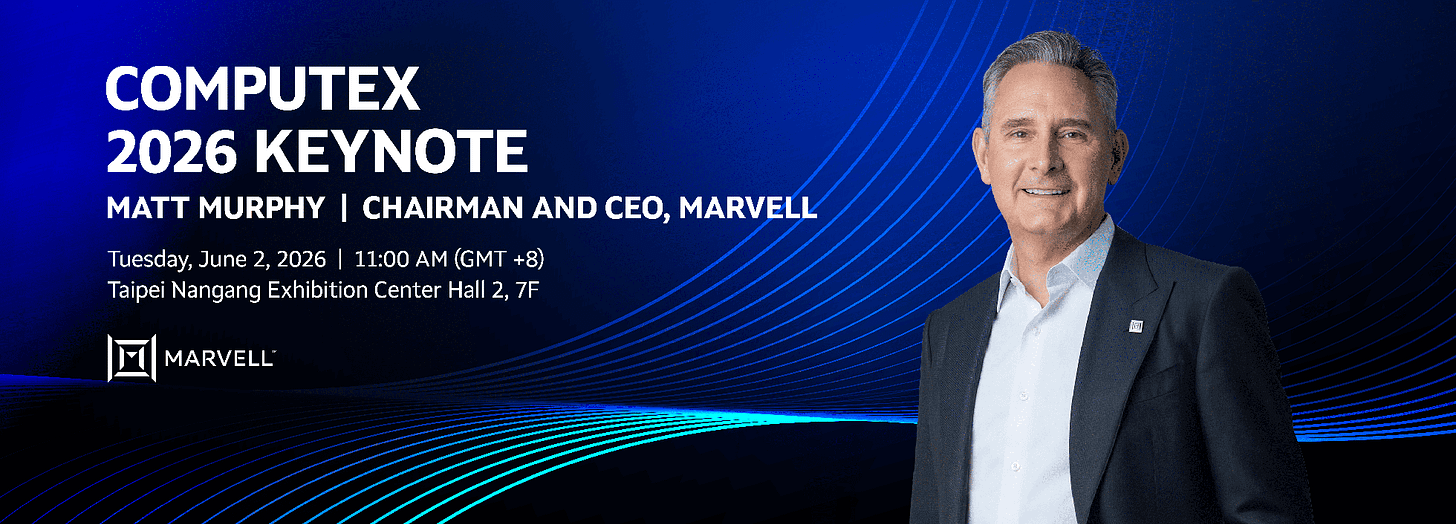
AMD is strengthening its EPYC CPU and Instinct GPU roadmap. NVIDIA is expanding its AI factory vision around GPU systems, networking, and full-stack accelerated computing. Arm is increasingly important as cloud providers and AI system designers pursue more power-efficient and customizable CPU architectures. Intel, under new leadership, is trying to reposition itself through advanced process technology, foundry services, and advanced packaging.
These companies compete fiercely at the platform level. But they all share one reality: without Taiwan’s manufacturing, packaging, server, and component ecosystem, their AI roadmaps become much harder to execute at scale.
This is why Taiwan matters. It is not just where chips are made. It is where many of the physical constraints of AI are solved.

3月25日
Taiwan’s Core Advantage Is the Combination of Advanced Process and Advanced Packaging
Taiwan’s strategic value in the AI era comes from two tightly connected strengths: advanced semiconductor manufacturing and advanced packaging.
In the past, the semiconductor industry often measured leadership by process nodes. A smaller node meant better density, better power efficiency, and higher performance. That logic still matters, but it is no longer sufficient. AI accelerators are now limited not only by transistor density, but also by memory bandwidth, package size, interconnect density, thermal control, substrate availability, and system-level integration.
This is why CoWoS, SoIC, advanced substrates, and high-end PCB materials have become critical bottlenecks. AI chips need massive bandwidth between GPU or ASIC dies and HBM. They also require large interposers, complex chiplet integration, precise warpage control, and extremely reliable high-speed signal paths.

5月5日
In this environment, advanced packaging is no longer a back-end process with limited strategic value. It has become a front-line enabler of AI performance. The ability to package large AI processors with HBM at scale is now one of the most important competitive advantages in the global semiconductor industry.
Taiwan is one of the few places in the world where advanced logic manufacturing, advanced packaging, OSAT capability, PCB expertise, thermal solutions, and server system integration exist in close proximity. That density is difficult to replicate.
1月31日
AI Competition Is Moving From Chip Specifications to System Architecture
The AI hardware race is moving away from simple chip-to-chip comparisons. It is no longer enough to ask which GPU has more compute performance, which CPU has more cores, or which accelerator has better peak throughput. The more important question is how the entire AI system performs.
The relevant unit of competition is shifting from the chip to the rack, from the rack to the cluster, and from the cluster to the AI data center. NVIDIA’s concept of the AI factory captures this transition well. AI infrastructure is becoming a new form of industrial production system, where data, compute, memory, networking, and software are integrated to generate intelligence at scale.
AMD is also pushing a more complete platform strategy through CPUs, GPUs, and open ecosystem partnerships. Meanwhile, hyperscalers such as Google, AWS, and Meta are accelerating custom AI silicon programs, including TPU, Trainium, and MTIA. Their objective is not simply to replace GPUs, but to optimize specific workloads, reduce dependency on a single supplier, and improve performance per watt and total cost of ownership.

4月7日
This shift creates a more complex but also more valuable opportunity for Taiwan. Whether the platform is based on NVIDIA GPUs, AMD accelerators, Arm-based CPUs, Intel packaging, or hyperscaler ASICs, the system still needs advanced manufacturing, packaging, PCB, thermal, power, and assembly capabilities. Taiwan’s role expands as AI architectures diversify.
Cloud AI ASICs Will Deepen Taiwan’s Role in the Supply Chain
One of the most important trends behind COMPUTEX is the rise of custom AI chips from cloud service providers.
Google TPU, AWS Trainium, and Meta MTIA are examples of a broader shift. Large cloud companies no longer want to rely exclusively on merchant GPUs. They want silicon that is optimized for their own models, data center environments, cost structures, and inference workloads.
This does not reduce Taiwan’s importance. In many ways, it increases it.
Custom AI ASICs still require leading-edge or advanced-node foundry capacity. They still need HBM integration, advanced packaging, substrate support, high-speed PCB design, and server-level validation. But unlike standardized platforms, each hyperscaler design may come with different requirements in package size, power delivery, memory configuration, thermal envelope, and system architecture.
This means Taiwan’s supply chain must evolve from pure manufacturing execution toward deeper co-development. Suppliers must support more customized platforms, faster engineering cycles, and more complex integration demands. The companies that can move from component supply to system-level collaboration will capture more value in the AI infrastructure cycle.

2月24日
Advanced Packaging Is the Hidden Main Character of COMPUTEX
Although COMPUTEX will be filled with AI chip announcements, server platforms, and keynote narratives, the hidden main character is likely to be advanced packaging.
The logic is simple. AI processors are becoming larger, hotter, and more bandwidth-hungry. HBM integration requires short, dense, and reliable interconnects. Chiplet architectures require advanced package-level communication. Reticle limits are pushing the industry toward larger package footprints. Thermal and mechanical challenges are becoming more difficult with each generation.
These problems cannot be solved by front-end process technology alone. They require CoWoS, SoIC, EMIB, fan-out panel-level packaging, glass substrates, advanced organic substrates, low-loss materials, and increasingly sophisticated assembly and testing ecosystems.

4月23日
This is why technology leaders coming to Taiwan will not only talk about chip roadmaps. They will also care about package capacity, HBM supply, substrate readiness, yield stability, thermal design, and server production schedules.
In AI, a great chip without scalable packaging is not a product. It is only a prototype.

4月21日
Taiwan’s Supply Chain Is Moving From Manufacturing Partner to Architecture Partner
The next phase of AI will reward suppliers that understand system architecture. Taiwan’s companies have traditionally been strong in manufacturing efficiency, cost control, engineering execution, and supply chain coordination. Those capabilities remain essential. But the AI era requires something more.
AI servers are becoming increasingly integrated systems. GPUs, CPUs, NICs, switch ASICs, optical modules, power modules, liquid cooling systems, and high-speed PCBs must be designed as part of a coherent architecture. A change in one layer affects every other layer. Higher GPU power affects cooling. Higher bandwidth affects PCB materials. Larger packages affect substrates and mechanical design. Faster networking affects optical modules and signal integrity.
This is why Taiwan’s role is moving upstream. The most valuable suppliers will not simply wait for specifications from customers. They will help define feasible architectures, identify bottlenecks, shorten qualification cycles, and reduce execution risk.
This transition is important. It means Taiwan is no longer only an execution engine for global brands. It is becoming part of the design logic of AI infrastructure itself.

Photo by SemiVision @ Computex 2025
What to Watch at COMPUTEX
For industry observers, the most important part ofCOMPUTEXmay not be a single product launch. The more important signals will come from platform direction, supply chain alignment, and capacity planning.
The first signal is the competitive balance among AI platforms. NVIDIA remains the dominant force, but AMD is pushing harder into data center AI, while hyperscaler ASICs are becoming more visible. The market is unlikely to move toward one single architecture. Instead, we may see a more segmented landscape: GPUs for general AI training and large-scale inference, custom ASICs for optimized cloud workloads, and Arm-based platforms for power-efficient computing.
The second signal is the evolution of advanced packaging. Any discussion around CoWoS, HBM integration, chiplet packaging, glass substrates, or larger package architectures should be watched closely. These are not secondary technical details. They are directly tied to AI system shipment capacity.
The third signal is the rise of system-level supply chain collaboration. AI server makers, PCB suppliers, cooling solution providers, power module companies, and optical interconnect players will become increasingly important. The bottleneck is no longer only the GPU. It is the entire rack.
The fourth signal is whether Taiwan’s supply chain can continue to scale while maintaining flexibility. Serving NVIDIA, AMD, cloud ASIC customers, networking companies, and server OEMs at the same time requires not only capacity, but also engineering bandwidth and operational discipline.

5月4日
Taiwan Is Becoming the Infrastructure Layer of the AI Economy
The global AI boom is often described through software models, GPU demand, and data center capex. But underneath that narrative is a more fundamental industrial transformation. AI requires a new physical infrastructure stack, and Taiwan sits at the center of many of its most critical layers.
This includes advanced foundry manufacturing, advanced packaging, HBM integration, substrate and PCB supply, server assembly, thermal management, power delivery, high-speed interconnects, and increasingly optical communication. These are not isolated sectors. They are becoming one interconnected AI infrastructure supply chain.
That is why COMPUTEX matters more than before. It is no longer simply a regional ICT event. It is becoming a global checkpoint for the AI hardware cycle.
When global technology leaders gather in Taiwan, they are not only promoting products. They are aligning roadmaps, securing partners, testing supply chain readiness, and preparing for the next wave of AI infrastructure deployment.
Conclusion: COMPUTEX Is Where the Next AI Supply Chain Will Be Seen First
The message is straightforward: welcome to Taiwan next month for COMPUTEX, because the future of AI infrastructure will be visible here before it becomes visible in many financial statements.
The next phase of AI will not be decided by models alone. It will be decided by who can manufacture, package, connect, cool, power, and scale the systems required to run those models. That is why Taiwan has become indispensable.
From GPUs to ASICs, from CPUs to HBM, from CoWoS to AI servers, from advanced PCBs to optical interconnects, Taiwan is turning decades of semiconductor and electronics manufacturing capability into the foundation of the next AI infrastructure cycle.
COMPUTEX 2026 will not just show new products. It will show how the global AI supply chain is being reorganized. And Taiwan is standing at the center of that reorganization.

Thanks for reading SEMIVISION @_@! This post is public so feel free to share it.


PreviousNext