The 2026 AI IPO Wave: From Models to Chips
The 2026 AI IPO Wave: From Models to Chips
- Source: SemiVision
- Author: SEMIVISION
- Published: 2026-05-07T09:24:27+08:00
- URL: https://tspasemiconductor.substack.com/p/the-2026-ai-ipo-wave-from-models (1) The 2026 AI IPO Wave: From Models to Chips - SEMIVISION @_@


The 2026 AI IPO Wave: From Models to Chips
Original Article By SemiVision Research [Reading time: 12mins]

May 07, 2026
∙ Paid
The 2026 AI IPO Wave: From Models to Chips, Capital Markets Are Redefining AI Infrastructure

2026 could become a major turning point for AI capital markets.
Over the past three years, the core AI story has centered on NVIDIA GPUs, cloud data centers, and large language models. But as we move into 2026, the market’s attention is shifting from “who has the strongest model” to “who controls the critical nodes of AI infrastructure.” Cerebras, OpenAI, and Anthropic each represent a different capital-market narrative within the AI value chain: AI chips, AI model platforms, and enterprise AI agents.
This IPO wave is not just about startups going public. It is more like a collective signal that the AI industry is moving from technical expansion toward capitalization, platformization, and supply-chain restructuring. Cerebras is targeting a valuation of up to around US$26.6 billion. OpenAI is valued at around US$852 billion after its latest financing round. Anthropic has been reported to be considering a valuation above US$900 billion. Behind these valuations is not a traditional profit model, but the market’s attempt to price the “right to control AI compute access” in advance

Cerebras: Challenging NVIDIA with Wafer-Scale Chips Is Not a Direct War, but an Architecture War
What makes Cerebras worth watching is not simply its claim to challenge NVIDIA, but the fact that it has chosen a completely different technical path from GPUs. NVIDIA’s strength comes from GPU clusters, the CUDA ecosystem, HBM, high-speed interconnects, and system-level platforms. Cerebras, by contrast, is trying to use its Wafer-Scale Engine to integrate massive compute cores, memory, and interconnects onto a single ultra-large chip, reducing the data-movement bottlenecks that occur in traditional multi-chip and multi-node clusters.
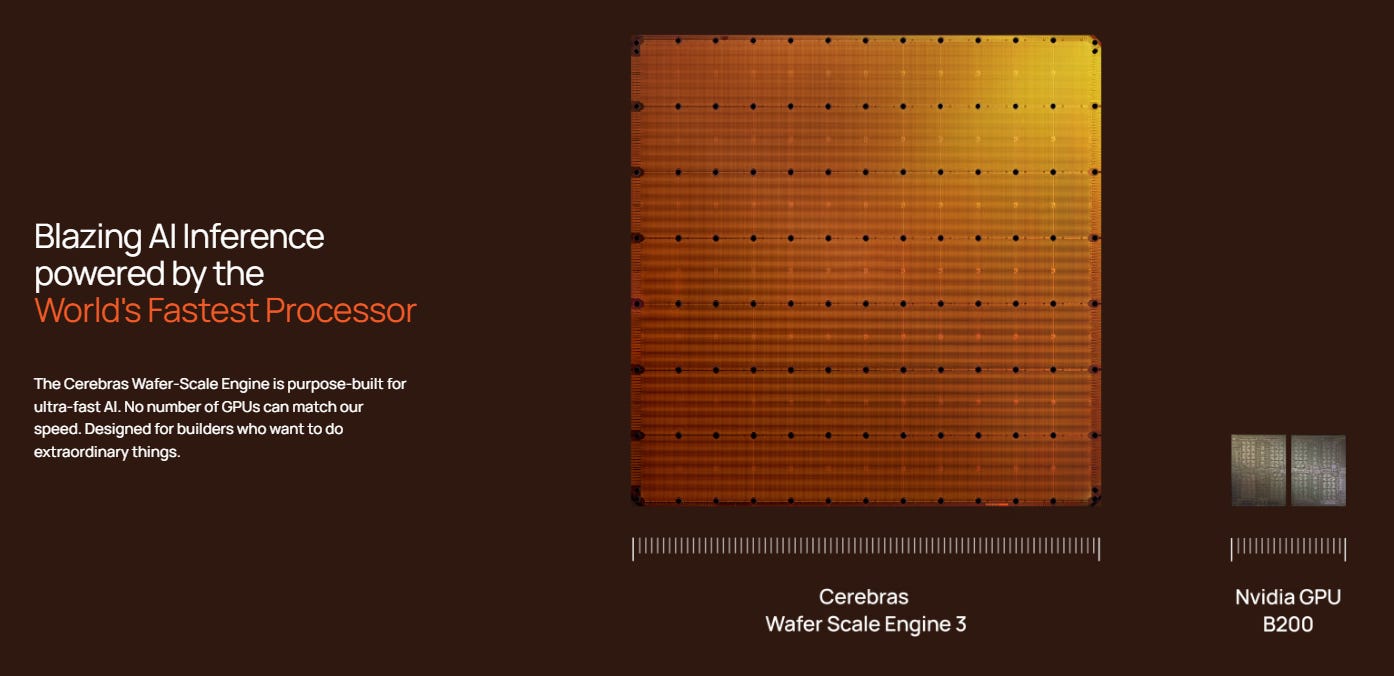
From a technical perspective, Cerebras is not merely building a “larger chip.” It is turning the entire wafer into an AI computing system. The core value of this design lies in reducing the latency and power consumption generated by chip-to-chip interconnects, packaging, and system synchronization. For certain large-model training workloads, sparse models, scientific computing, and specific inference tasks, a single large compute plane may deliver better efficiency than traditional GPU clusters.
But this path also brings substantial risks. Wafer-scale chips impose extremely high requirements on process yield, defect tolerance, packaging, thermal management, power delivery, and system integration. More importantly, Cerebras is highly dependent on TSMC’s advanced 5nm manufacturing capability. Its wafer-scale AI chip is the company’s core differentiation, and that also means Cerebras’ production capacity is closely tied to a single advanced manufacturing ecosystem.
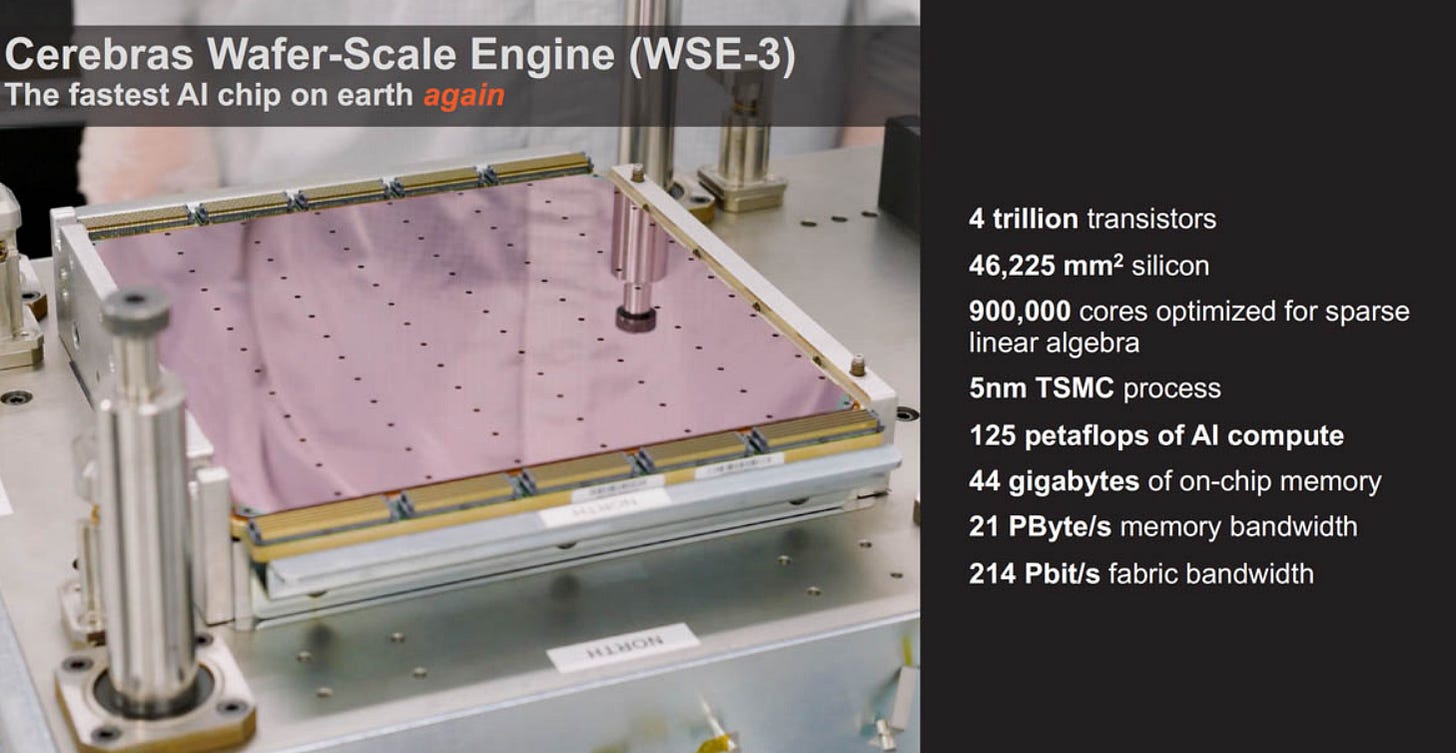
For Taiwan’s semiconductor supply chain, Cerebras carries significant strategic meaning. It proves that AI chip competition is not limited to GPU architecture. Competition may also emerge around wafer-level integration, advanced packaging, ultra-large die design, and system-level manufacturing capability. In other words, the future of AI chips may not only be about “smaller, denser, more advanced nodes.” It may also be about who can turn an entire wafer into a usable computing system.


5月5日
Cerebras’ Commercialization Test: OpenAI Orders Provide Support, but Scalability Must Still Be Proven
The most important commercial signal in Cerebras’ IPO story is its large multi-year agreement with OpenAI. This agreement gives the market stronger confidence in the company’s long-term revenue visibility.
The strategic significance is substantial. For AI chip startups, the hardest part is often not building a chip, but securing enough real workloads. Without large customers, it is difficult to accumulate software experience, ecosystem maturity, system tuning know-how, and production-scale deployment data. If OpenAI becomes an important customer for Cerebras, it would suggest that Cerebras is no longer merely a laboratory technology, but a platform with the potential to enter large-scale AI infrastructure deployment.
However, Cerebras still faces three key questions.
First, can OpenAI’s orders translate into sustainable gross margins rather than high-cost customized projects?
Second, can Cerebras serve more customers instead of relying heavily on a single major model company?
Third, can its system cost, power efficiency, and software usability create clear differentiation against NVIDIA in real-world deployments?
SemiVision believes that Cerebras’ real value is not in “replacing NVIDIA,” but in opening a second architectural option for the AI infrastructure market. As AI models become larger, GPU clusters will face rising pressure from data movement, network latency, HBM cost, and power constraints. If Cerebras can prove a better performance-per-cost ratio in selected workloads, it does not need to defeat NVIDIA across the board. It can still secure a high-value niche in the AI infrastructure market.

2026/3/13 Cerebras is coming to AWS

Trainium is Amazon's purpose-built AI chip, designed for scalable performance and cost efficiency across a broad range of generative AI workloads. Its dense compute cores are especially suited for the prefill phase. The Cerebras CS-3 is the world's fastest AI inference system. Storing all model weights on-chip in SRAM, it delivers thousands of times greater memory bandwidth than the fastest GPU, making it the fastest processor for decode.

4月7日
OpenAI: From a Model Company to the Super Gateway of AI Demand
OpenAI is the most central company in this AI IPO narrative. It is neither a chip company nor a traditional cloud provider, but it is becoming one of the largest engines of AI compute demand. With its latest financing round, OpenAI has become one of the world’s most valuable AI companies.
OpenAI is unique because it controls three assets at once: model capability, user access, and enterprise application scenarios. ChatGPT has made OpenAI one of the few companies to build a truly global consumer-level AI gateway. Its API and enterprise services bring it into software development, customer service, document processing, knowledge management, and workflow automation. Its partnerships with Microsoft, Oracle, SoftBank, and other infrastructure players are gradually turning OpenAI into a demand source for AI data center investment.

This is why OpenAI’s valuation cannot be understood through the lens of a traditional SaaS company. Traditional SaaS companies are valued based on seats, subscriptions, and enterprise workflow penetration. OpenAI is closer to an AI operating-system gateway. If agents, code generation, multimodal content production, automated workflows, and enterprise AI assistants continue to expand, OpenAI may become not just a tool provider, but the default interface through which individuals and enterprises enter the AI era.
However, OpenAI also faces obvious challenges. First, compute costs are extremely high, and model training and inference expenses will continue to pressure profitability. Second, the proportion of free users remains high, and monetization efficiency still needs to be proven. Third, its model leadership could be challenged by Anthropic, Google, Meta, and open-source models. Fourth, although AI application adoption is accelerating, capital markets still need to see whether this demand can evolve into a high-margin, sustainable, low-churn business model.
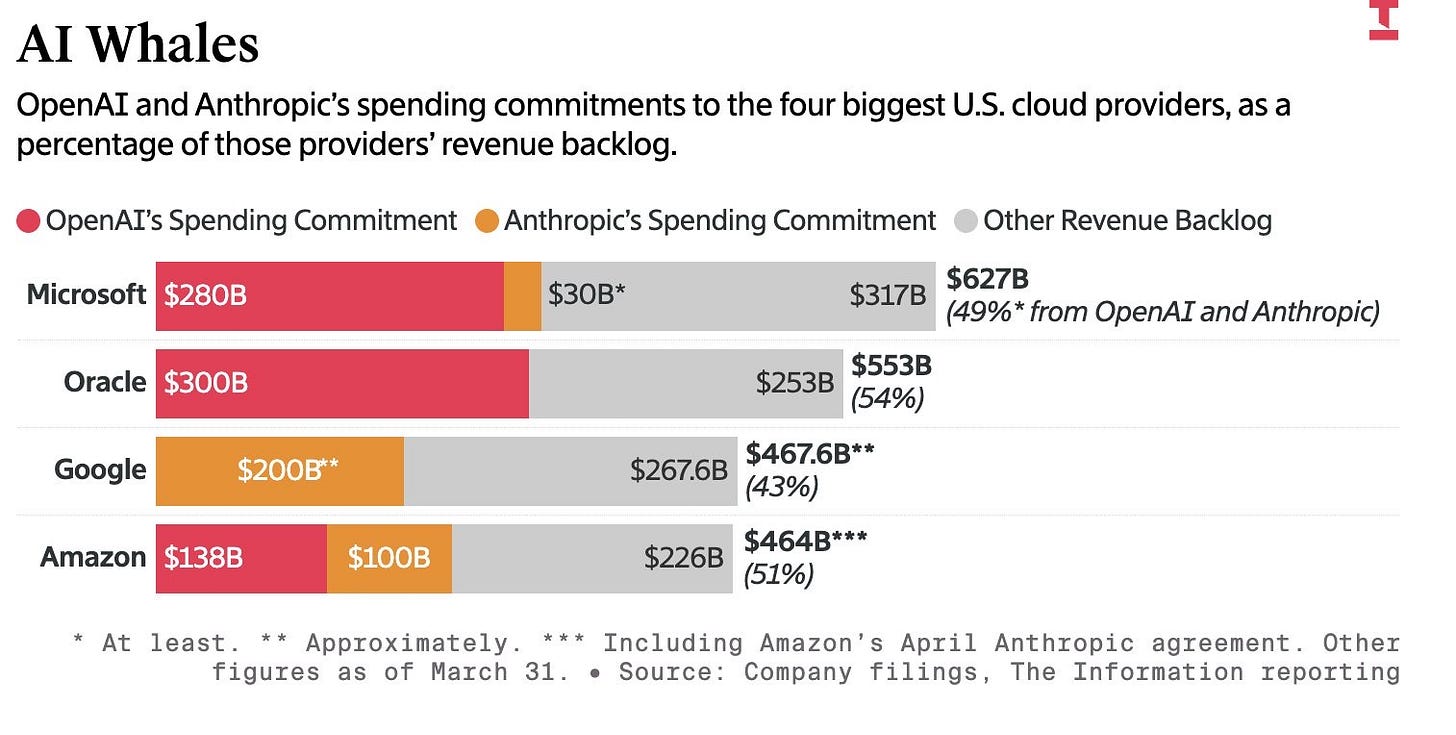
AI demand is no longer incremental—it is structurally dominating cloud economics. Across Microsoft, Oracle, Google, and Amazon, roughly half of the revenue backlog is now anchored by OpenAI and Anthropic commitments. This concentration signals a shift from diversified enterprise demand to hyperscale AI-driven capacity absorption. In effect, foundation model players are becoming the primary allocators of compute, power, and capital across the cloud stack. What appears as backlog strength is, in reality, a reconfiguration of industry control—where AI workloads dictate infrastructure roadmaps, compress optionality, and pull the entire semiconductor and data center ecosystem into a single, vertically coupled growth engine.
Anthropic: Claude Is Not a Copy of ChatGPT, but a High-Value Route into Enterprise AI and Coding Agents
Anthropic’s positioning is different from OpenAI’s. OpenAI is more like a general AI gateway, while Anthropic is closer to an enterprise-grade AI agent and trusted model provider. Claude is highly regarded for coding, document understanding, long-context processing, and enterprise workflow applications. This gives Anthropic strong appeal among large enterprises, cloud partners, and AI agent use cases.
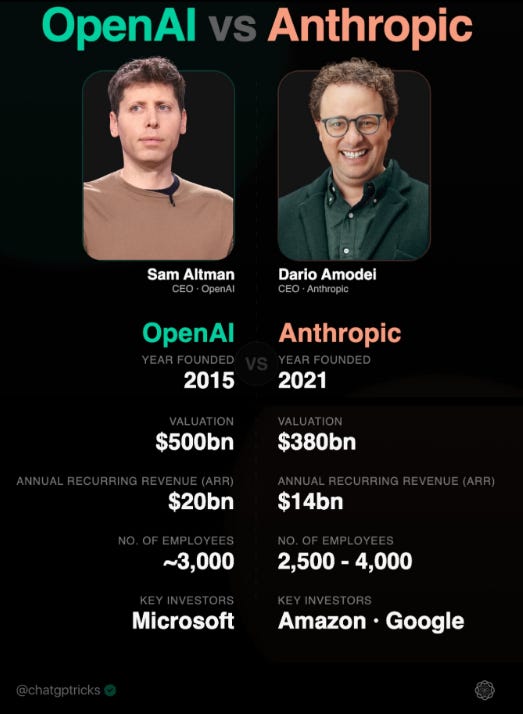
From an industry perspective, the most important aspect of Anthropic is that it may become a major demand source for non-NVIDIA AI hardware such as Google TPUs and Amazon Trainium. This is highly important for the semiconductor industry. If large model companies diversify their compute strategy to reduce dependence on NVIDIA, the AI chip market will no longer be defined by GPUs alone. Instead, GPUs, TPUs, in-house ASICs, Trainium, Cerebras WSE, and other architectures could coexist.
Anthropic’s advantage is not necessarily that it has more users than OpenAI. Its strength lies in enterprise customers’ willingness to pay for stability, safety, controllability, and high-quality coding capability. If Claude Code and enterprise agent workflows continue to grow, Anthropic may become one of the companies closest to building a high-value B2B AI operating system.

Still, Anthropic faces the same valuation challenge: infrastructure spending is massive, and revenue growth must outpace compute cost growth. AI model companies look like software companies on the surface, but their underlying cost structure is closer to that of cloud infrastructure companies. This means Anthropic’s future investment priority is not only model capability, but also access to cheaper, more efficient, and more stable AI compute supply.
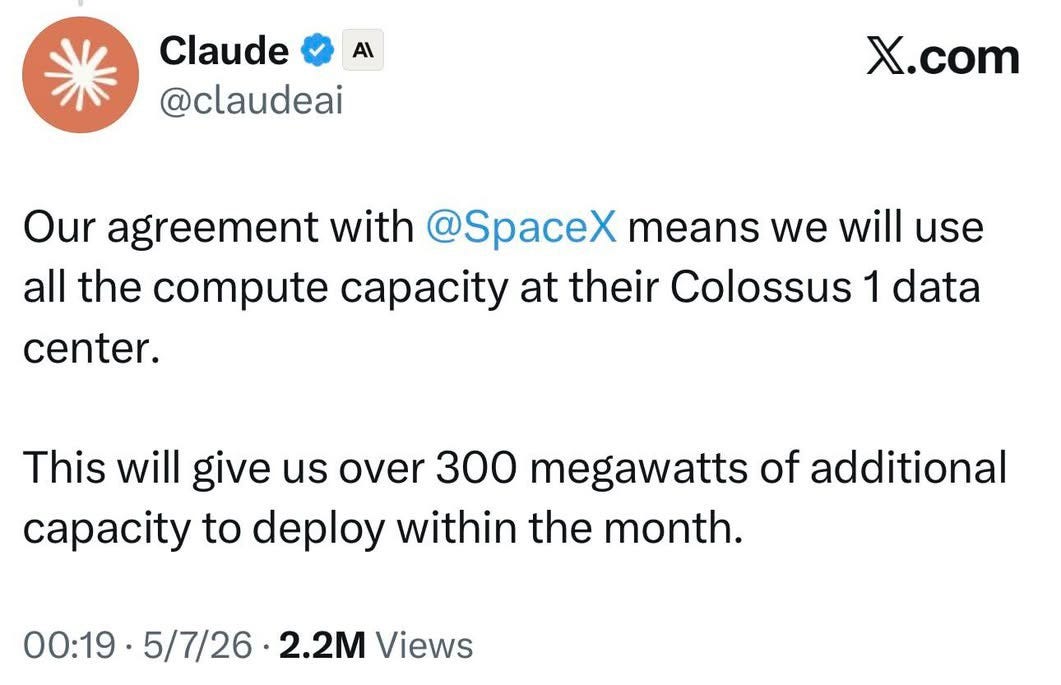
According to the post, SpaceX and Claude have announced a major cooperation agreement under which SpaceX will provide all of the compute capacity from its Colossus 1 data center for Claude’s use, equivalent to roughly the capacity of 220,000 NVIDIA GPUs.
The post also suggests that SpaceXAI has already shifted its own training workload to Colossus 2, freeing up Colossus 1 for Claude. Claude stated that the agreement will give it more than 300 megawatts of additional deployment capacity within the month. Elon Musk also emphasized that he had spent significant time speaking with Claude’s senior leadership to ensure the company remains aligned with a mission that is beneficial to humanity, while noting that SpaceX would reserve the right to reclaim resources if Claude were to engage in harmful behavior.
The Three Companies Represent Three Types of Power in AI Infrastructure
When these three companies are placed on the same industry map, a new division of labor in AI becomes clear.
OpenAI controls the gateway of AI demand. It determines how a large number of users and enterprises use AI, and therefore transmits demand pressure into cloud computing, chips, data centers, and power systems.
Anthropic controls enterprise AI agents and trusted model capability. It may not necessarily pursue the largest consumer traffic, but it targets high-value enterprise scenarios, coding workflows, and multi-cloud compute partnerships.
Cerebras controls a specialized AI compute architecture. It is trying to prove that GPUs are not the only answer, especially in large-model and specific AI workloads where wafer-scale computing may offer a different performance-per-cost curve.
Although all three companies are called AI companies, their essence is completely different. OpenAI and Anthropic are model and application gateways. Cerebras is a semiconductor and system architecture company. This shows that the AI industry is evolving from single-model competition into a full-system competition across chips, cloud, data centers, energy, and software gateways.
What It Means for Taiwan’s Semiconductor Supply Chain: The AI IPO Wave Will Drive Demand for Advanced Nodes, Advanced Packaging, and High-End Materials
From Taiwan’s semiconductor perspective, the most important issue in this AI IPO wave is not which company successfully lists, but how much incremental compute demand these companies create. As long as OpenAI, Anthropic, and Cerebras continue to raise capital, that capital will be converted into demand for data centers, AI servers, advanced chips, HBM, advanced packaging, PCBs, CCLs, thermal solutions, power systems, and optical communications.
Cerebras is directly tied to TSMC’s advanced process and wafer-scale system manufacturing capabilities. OpenAI and Anthropic indirectly drive demand for NVIDIA GPUs, Google TPUs, Amazon Trainium, Broadcom ASICs, Marvell interconnect chips, CoWoS, HBM, and optical modules.
For Taiwan’s supply chain, AI IPOs are not just financial news. They are leading indicators of future capital expenditure. The higher the valuations and fundraising capacity of AI companies, the greater their ability to pre-book compute, chips, packaging, and data center resources. This will strengthen the long-term demand visibility of TSMC, ASE, SPIL, Unimicron, Nan Ya PCB, Kinsus, Zhen Ding, Taiwan Union Technology, ITEQ, Gold Circuit, optical module suppliers, and thermal management companies.
Valuation Is Not the Main Point. The Real Issue Is the Control Point Behind the Valuation
The market often focuses on valuation numbers: Cerebras at around US$26.6 billion, OpenAI at around US$852 billion, and Anthropic potentially above US$900 billion. But the real issue is not whether these valuations are high. The real question is which scarce node each company controls within the AI industry.
Cerebras controls a scarce architecture. OpenAI controls users and model demand. Anthropic controls enterprise AI trust and high-value workflows. As AI becomes increasingly capital-intensive, control points matter more than short-term profitability. Whoever controls the gateway can influence compute procurement. Whoever controls compute can influence chip supply. Whoever controls chips and system architecture can redistribute value across the semiconductor industry.
This is also why NVIDIA remains the biggest winner of the AI era. It is not just selling GPUs. It controls the AI compute platform, software ecosystem, system design, and supply-chain rhythm. Cerebras, OpenAI, and Anthropic are taking different paths, but fundamentally, they are all searching for their own control points.
Conclusion: The 2026 AI IPO Wave Marks the Shift from Model Competition to Infrastructure Competition
The 2026 AI IPO wave could mark the beginning of the second stage of the AI industry. The first stage was model competition: whose model was stronger, whose chatbot was better, and whose parameter scale was larger. The second stage is infrastructure competition: who can access cheaper compute, more stable chip supply, more efficient data centers, and more complete enterprise application scenarios.
Cerebras represents AI chip architecture innovation. OpenAI represents the gateway of AI demand. Anthropic represents enterprise AI agents and diversified compute strategies. If these three companies enter the public market, investors will, for the first time, use public-market prices to reassess the value of different layers of the AI value chain.
SemiVision believes the future AI industry will not have only one winner. NVIDIA will continue to maintain a powerful leading position, but large model companies, specialized AI chips, cloud ASICs, advanced packaging, optical communications, and data centers will all create new value distribution patterns. The 2026 AI IPO wave is not merely a listing boom. It is a repricing of AI infrastructure sovereignty.

SpaceX Is Turning the Space Economy Into a Trillion-Dollar Market Narrative
SpaceX, arguably the world’s most closely watched private company, is pushing the market’s imagination of “space stocks” to a new high. According to recent Reuters reporting, SpaceX has begun laying the groundwork for an IPO, with a target valuation potentially reaching $1.75 trillion to $2 trillion. If realized, this would not only make it one of the largest IPOs in history, but also place SpaceX directly among the six most valuable publicly listed companies in the United States.
The scale of this valuation reset is striking. At the end of 2024, an internal share sale reportedly valued SpaceX at around $350 billion. Compared with that level, the latest IPO valuation expectation implies an expansion of nearly five times in a very short period.
This almost myth-like valuation premium is not driven by the rocket launch business alone. The real core of the story lies in Starlink’s satellite internet network, the long-term strategic narrative of Starship, and the capital market’s persistent willingness to price Elon Musk-related companies as category-defining growth platforms rather than conventional industrial businesses. In other words, SpaceX is no longer being valued simply as a space company. It is being priced as a future infrastructure company for connectivity, logistics, defense, and eventually interplanetary expansion.


PreviousNext