Taiwan’s GDP Is Booming — But Most of the Economy Isn’t...
Taiwan’s GDP Is Booming — But Most of the Economy Isn’t...
- Source: SemiVision
- Author: SEMIVISION
- Published: 2026-05-06T09:19:58+08:00
- URL: https://tspasemiconductor.substack.com/p/taiwans-gdp-is-booming-but-most-of (1) Taiwan’s GDP Is Booming — But Most of the Economy Isn’t...


Taiwan’s GDP Is Booming — But Most of the Economy Isn’t...
Original Article By SemiVision Research [Reading time: 11 mins]

May 06, 2026
∙ Paid
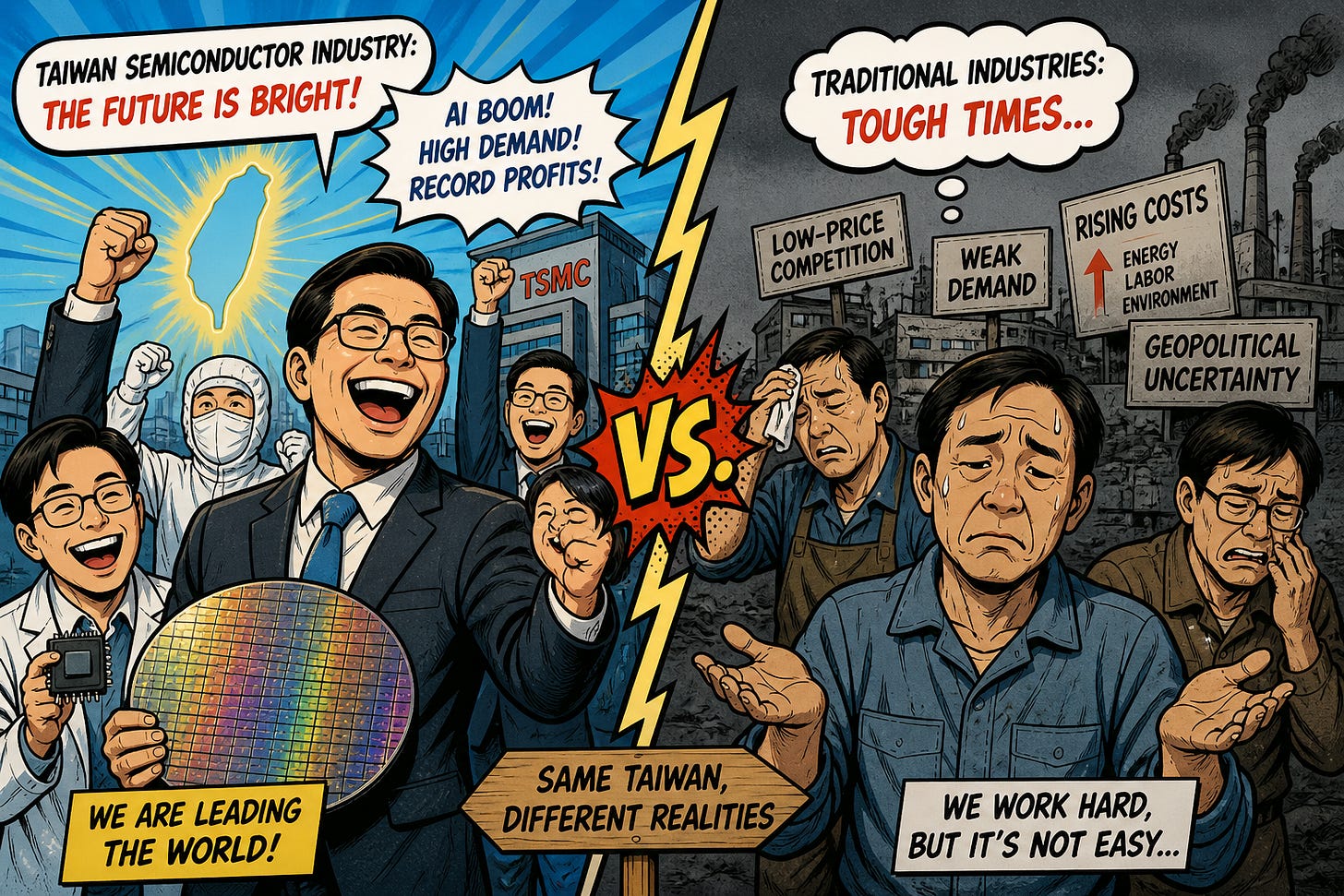
A 13.69% Miracle Is Not Just a Growth Figure. It Is a Signal of Structural Imbalance.
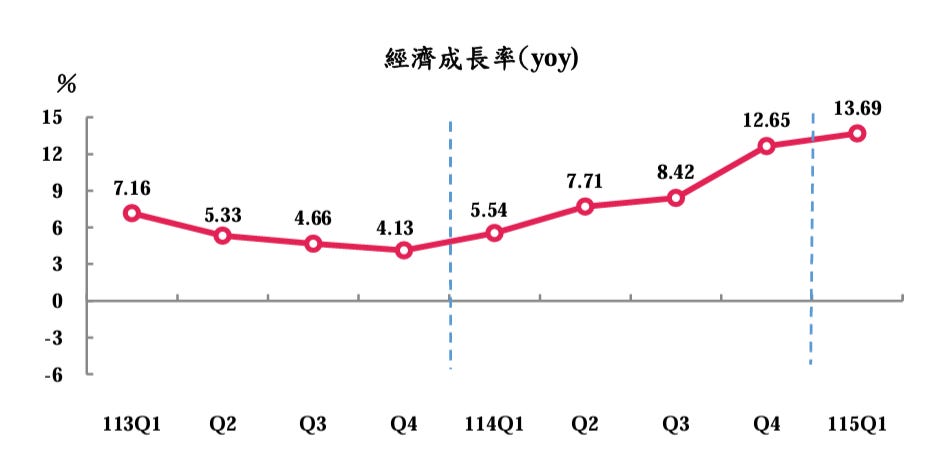
Taiwan’s Directorate-General of Budget, Accounting and Statistics recently released its preliminary estimate for first-quarter GDP growth. The economy expanded by 13.69% year over year, not only exceeding previous forecasts but also marking the highest single-quarter growth rate in nearly 39 years. On the surface, this is an extraordinary figure. Taiwan appears to be leading the Four Asian Tigers in economic momentum, while per-capita GDP, exports, investment, equity-market performance, and technology supply-chain activity all point to a strong economy.
However, from SemiVision’s perspective, the real issue is not simply how strong Taiwan’s economy appears to be. The more important question is:
Which part of Taiwan’s economy is actually becoming stronger?
This growth was not broadly distributed across all industries. It was not driven by a synchronized recovery in domestic consumption, services, traditional manufacturing, and export sectors. Instead, it was highly concentrated in AI, semiconductors, servers, information and communications technology, and electronic components.
In other words, the 13.69% growth rate does not mean the entire Taiwanese economy is running forward together. It means the semiconductor and AI hardware supply chains are pulling the overall GDP number sharply upward.
Exports Grew by 51.10%, But Taiwan’s Export Economy Has Split into Two Worlds.
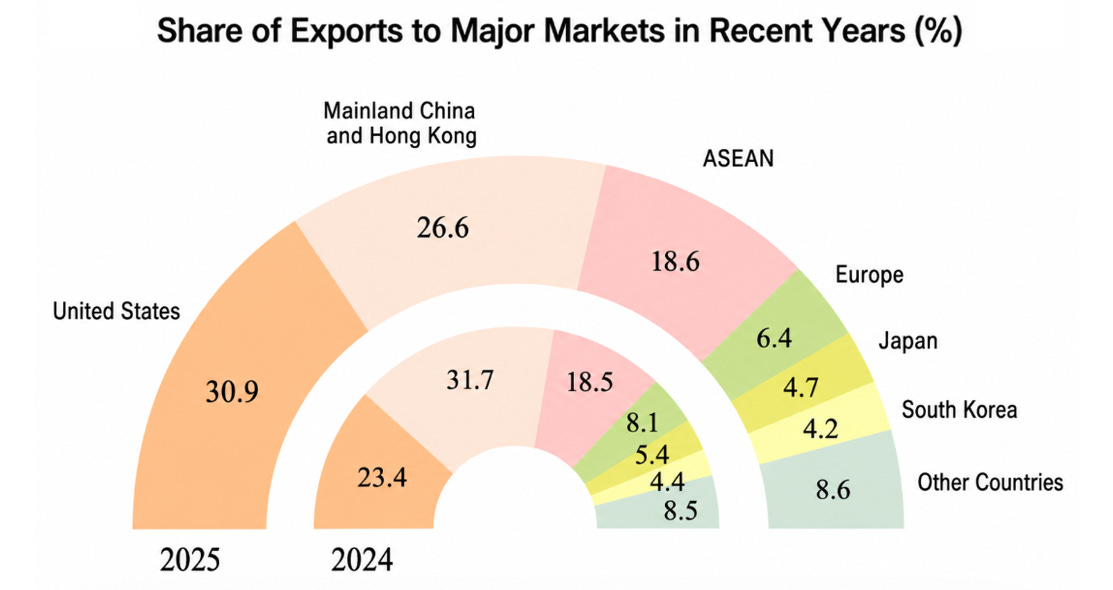
Over the past year, Taiwan’s export structure has reached a major turning point. Taiwan’s export share to the United States rose to 30.9%, the highest level in nearly 35 years, officially surpassing Mainland China and Hong Kong at 26.6%, while the gap continues to widen. Compared with 2020, when Mainland China and Hong Kong accounted for 43.9% of Taiwan’s exports, their share has dropped by more than 17 percentage points. This shows that Taiwan’s trade center of gravity is shifting from the China manufacturing chain to the U.S. demand chain. With first-quarter exports reaching a new high, Taiwan has effectively entered a new phase: its export momentum is now increasingly driven by the U.S. AI cycle, from semiconductors and advanced packaging to AI servers and data center infrastructure.
But once we break down the export data, a very different picture emerges. Taiwan’s economy is now clearly operating on a dual-track structure. On one side, electronic components and ICT-related products are expanding rapidly. On the other side, many traditional export categories, including plastics, textiles, paper products, transportation equipment, and other conventional manufacturing segments, remain weak or even continue to decline.
Industry data shows that first-quarter exports of electronic components reached US$65.58 billion, up 42.7% year over year. Exports of ICT and audiovisual products reached US$87.95 billion, up 102.1% year over year. These two categories almost entirely explain the explosive growth in Taiwan’s exports.
This means Taiwan’s export boom is not a broad-based cyclical recovery. It is a concentrated AI supply-chain surge. From a macro perspective, exports grew by more than 50%. But from the perspective of many companies on the ground, traditional industries are still facing weak orders, pricing pressure, exchange-rate volatility, low-margin competition, and displacement from Chinese supply chains.
This is why GDP can hit a record high while many companies and workers still feel little connection to the economic boom.
Traditional Industries Are Not Without Recovery, But the Recovery Is Not Enough to Return to Previous Highs.
Some traditional industries may appear to have returned to positive year-over-year export growth. But this does not necessarily mean they have genuinely recovered. If last year’s comparison base was very low, even a modest rebound can produce a positive growth rate. Yet when compared with 2021 levels or post-pandemic peaks, many traditional industries still have not returned to their former export scale.
This is where Taiwan’s economic data can easily become misleading. A positive year-over-year growth rate does not automatically mean the industry has regained structural strength.
For example, chemicals, non-metallic mineral products, basic metals, household appliances, and optical precision instruments may show positive annual growth in certain quarters. But if their export value remains lower than five years ago, the problem is not short-term cyclicality. It is structural weakness.
Traditional industries are currently facing multiple pressures: China’s excess capacity spillover, low-price competition, weak end demand, geopolitical supply-chain restructuring, higher energy and environmental costs, and rising land, labor, and capital costs in Taiwan. These problems cannot be solved simply because one quarter of year-over-year export growth turns positive.
Semiconductors may be entering a supercycle due to AI demand, but many traditional industries are still trapped in destocking, price competition, and difficult structural transformation.

GDP Is Strong, But Why Do Most People Feel Nothing?
GDP measures total economic output, but it does not directly reflect how most people experience income, job security, or economic improvement. Taiwan’s first-quarter GDP growth of 13.69% is indeed historically strong. But if most of that growth is concentrated in a small number of high-value-added industries, then most people outside those industries will naturally feel limited benefits.
This is the core contradiction in Taiwan’s current macroeconomic environment. Semiconductors generate enormous output value, exports, capital expenditure, tax revenue, and strategic importance. However, the share of total employment directly connected to semiconductor and ICT manufacturing remains limited.
Although electronic components, computer and electronic products, and optical products are central to Taiwan’s manufacturing output and exports, most workers are still employed in services, traditional manufacturing, construction, wholesale and retail, hospitality, transportation, education, healthcare, and small and medium-sized enterprises.
Therefore, when the government says Taiwan’s GDP growth leads the Four Asian Tigers, that is true from the standpoint of national competitiveness. But when ordinary people say they do not feel the boom, that is also true from the standpoint of lived economic reality.
The issue is not which side is right. The issue is that Taiwan’s growth engine has become highly concentrated, creating a large gap between headline macroeconomic numbers and individual economic experience.
Semiconductors Are Taiwan’s Strength, But They Are Also Becoming a Concentration Risk.
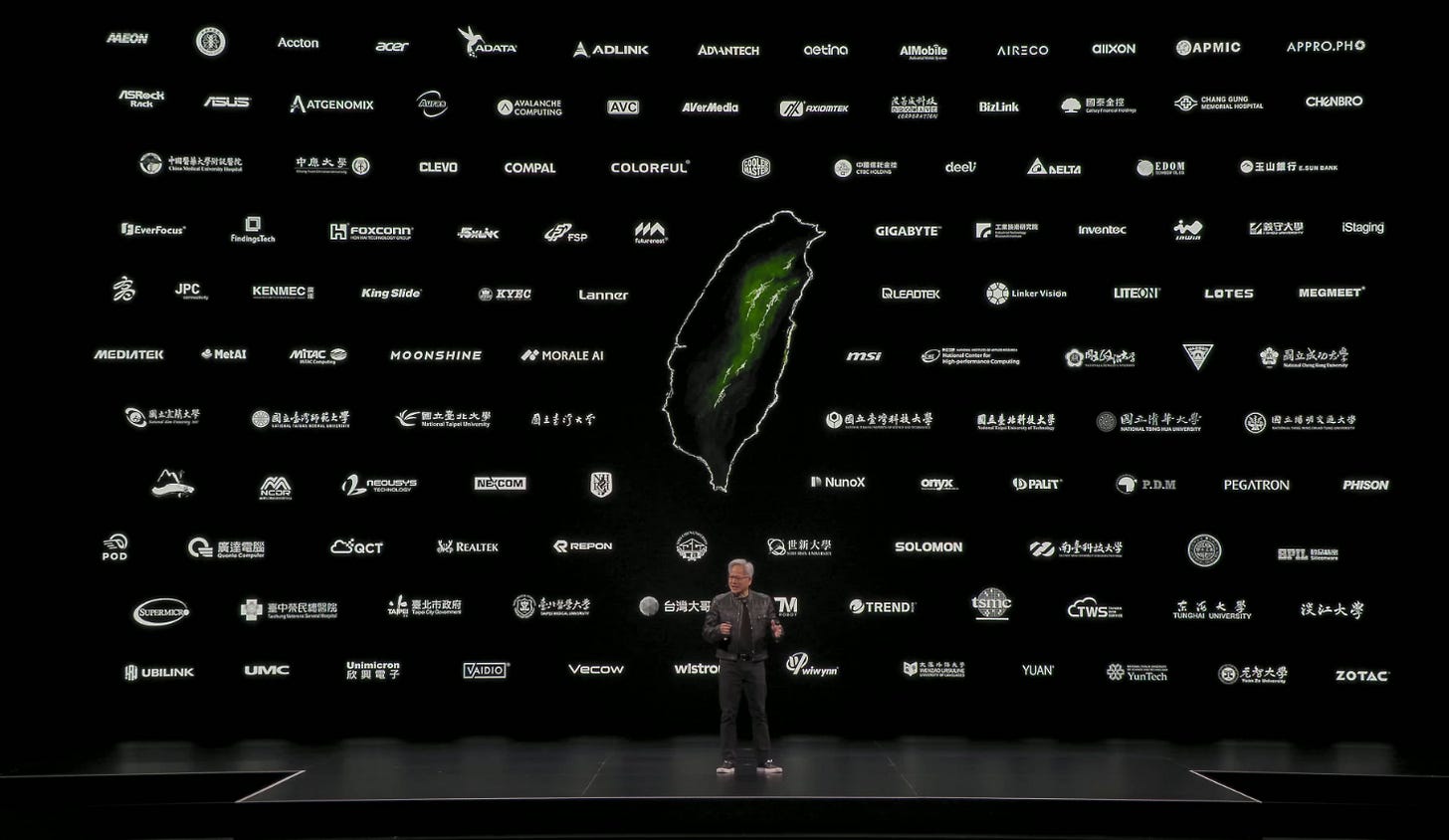
SemiVision has long argued that semiconductors are Taiwan’s most important strategic asset. From foundry manufacturing, advanced packaging, IC design, AI servers, PCBs, ABF substrates, thermal management, power systems, optical communications, to AI system integration, Taiwan is no longer just a semiconductor manufacturing base. It has become a central node in the global AI hardware infrastructure.
Taiwan’s electronics and ICT supply chains are not merely benefiting from a short-term business cycle. They are structurally benefiting from global supply-chain restructuring, AI infrastructure buildout, and the shift toward high-performance computing.
But the problem is that when a country’s economic growth, export performance, investment momentum, stock-market valuation, real-estate hotspots, fiscal revenue, and international strategic importance become increasingly dependent on one industry cluster, that strength also becomes a risk.
The stronger Taiwan’s semiconductor industry becomes, the more important Taiwan becomes to the world. But the more concentrated Taiwan’s economy becomes, the more vulnerable it becomes to a single industrial cycle, a single customer-demand shock, a single geopolitical event, or a single technological route.
1月31日
The AI Supercycle Is Amplifying Taiwan’s Structural Imbalance.
This AI demand cycle is different from previous consumer electronics cycles. In the past, growth in smartphones, PCs, notebooks, or consumer electronics tended to spread more broadly across assembly, components, channels, brands, and peripheral industries.
But the value of AI infrastructure is far more concentrated. The core value sits in GPUs, ASICs, HBM, advanced packaging, AI servers, high-speed PCBs, connectors, power systems, thermal solutions, optical modules, and data-center infrastructure.
As a result, AI does not automatically benefit all industries equally. It strengthens those already positioned in high-end hardware supply chains.
TSMC, advanced packaging suppliers, AI server ODMs, PCB and CCL makers, high-speed connector companies, thermal solution providers, power suppliers, and optical communication vendors can all enter new growth curves. But textiles, plastics, basic metals, traditional machinery, general consumer manufacturing, and domestic service sectors may not directly share in this growth.

5月4日
This means the AI cycle may not resolve Taiwan’s industrial imbalance. It may further amplify it.
Capital will flow toward semiconductors. Talent will flow toward semiconductors. Land will flow toward science parks. Policy resources will flow toward AI supply chains. Financial-market valuations will flow toward technology stocks. Over time, other industries may face more serious talent outflow, underinvestment, and slower transformation.
4月28日
Taiwan Without Semiconductors Is the Economic Indicator We Need to Track.
Taiwan should begin establishing a clearer set of “ex-semiconductor economic indicators.” This is not because semiconductors are unimportant. It is precisely because semiconductors are too important that we need to understand whether the rest of the economy remains healthy after excluding semiconductors and ICT.
Such indicators should include several dimensions.
First, export growth excluding electronic components and ICT products.
Second, real GDP growth excluding semiconductor and ICT manufacturing.
Third, wage growth and employment in non-tech manufacturing sectors.
Fourth, investment rates and R&D spending among traditional industries.
Fifth, revenue and profitability trends among small and medium-sized enterprises.
Sixth, whether regional economic development has become overly concentrated in semiconductor clusters such as Hsinchu, Taichung, Tainan, and Kaohsiung.
If we only look at overall GDP, Taiwan looks extremely prosperous. But once we disaggregate the economy, we may find that “semiconductor Taiwan” and “non-semiconductor Taiwan” are becoming two very different economies.
The former is a core hub of the global AI supply chain, enjoying high margins, high wages, high capital expenditure, and global strategic value. The latter is still dealing with low growth, low wages, labor shortages, rising costs, and difficult transformation.

3月19日
Semiconductors Must Not Become an Island. They Must Become a Platform for Broader Industrial Upgrading.
SemiVision believes the right industrial policy is not to suppress semiconductors. The goal should be to make the spillover effects of semiconductors reach more industries.
Taiwan cannot and should not weaken its semiconductor industry. This is Taiwan’s strongest global competitive advantage. But Taiwan also cannot allow semiconductors to become a highly prosperous yet relatively isolated industrial island.
The key is to convert semiconductor capabilities into upgrading tools for other sectors.
The machinery industry can move toward semiconductor equipment, precision components, automation, and inspection systems. The chemical industry can move toward electronic chemicals, advanced packaging materials, high-frequency low-loss materials, thermal materials, and optoelectronic materials. The textile industry can move toward smart textiles, automotive materials, medical materials, and high-performance composites. Metal processing and traditional manufacturing can enter precision mechanical parts, thermal management, data-center infrastructure, and high-reliability components.
In other words, semiconductors should not be merely a growth story for a small number of companies. They should become a technology platform for upgrading Taiwan’s broader manufacturing base.
Taiwan does not only need more fabs. It needs more new supply chains that connect semiconductors, AI, data centers, energy, healthcare, robotics, photonics, defense, cybersecurity, and smart manufacturing.

4月19日
Taiwan’s Challenge Is Not That Semiconductors Are Too Strong. It Is That Other Industries Are Not Upgrading Fast Enough.
Taiwan should not explain industrial imbalance by saying semiconductors are too strong. The real problem is not that semiconductors are too strong. The real problem is that many other industries have not kept pace with global industrial restructuring.
AI, energy transition, geopolitics, supply-chain security, industrial automation, and population aging are all changing global demand structures at the same time. If traditional industries remain locked in old outsourcing models, price competition, and low-margin export strategies, they will struggle to participate in the next stage of global growth.
Over the next decade, Taiwan’s industrial policy should shift from supporting a few star industries to building cross-sector upgrading pathways.
Semiconductors will remain the core. But they should be treated as a platform that connects outward to materials, machinery, energy, healthcare, automotive electronics, robotics, photonics, aerospace, cybersecurity, and smart manufacturing. They should not become the only pillar supporting Taiwan’s economy.

4月9日
SemiVision’s View: Balanced Development Matters. Taiwan Cannot Lean Too Heavily on One Industry.
SemiVision believes Taiwan’s first-quarter GDP growth of 13.69% is an achievement worth recognizing. It proves that Taiwan’s position in the global AI hardware supply chain is rising.
But this number is also a warning. Taiwan’s growth engine is becoming increasingly concentrated. The gap between industries is widening. The distance between headline prosperity and public economic perception is growing.
Taiwan needs semiconductors, but Taiwan cannot rely only on semiconductors.
Semiconductors are a national strategic asset. They are Taiwan’s most important bargaining chip in the global restructuring of AI infrastructure and geopolitics. But if policy resources, talent flows, capital-market attention, and social imagination all tilt excessively toward one industry, the long-term result will be weaker industrial resilience, unbalanced regional development, widening wage gaps, and a deeper disconnect between GDP growth and public experience.
Taiwan’s next-stage challenge is not to question why semiconductors are too strong. It is to ask how the technology, talent, capital, management capability, and global customer networks of the semiconductor industry can be diffused into more sectors.
Therefore, SemiVision recommends that the government regularly publish GDP, export, wage, and employment indicators excluding semiconductors and ICT. This would allow society to see the real structure of Taiwan’s economy more clearly.
At the same time, policy resources should more actively help traditional industries enter AI, data centers, advanced materials, smart manufacturing, energy systems, and high-reliability component supply chains.
Taiwan’s future is not about slowing down semiconductors. It is about helping other industries catch up.
Semiconductors can be Taiwan’s main engine, but they cannot be Taiwan’s only engine. Only when the growth dividends from AI and semiconductors spread to more industries, more regions, and more workers will Taiwan’s GDP growth become more than a beautiful statistic. It will become real economic progress that more people can actually feel.
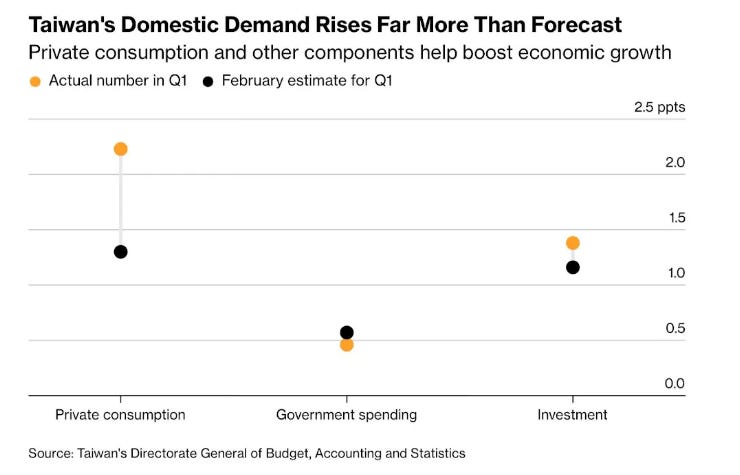
Taiwan’s stock market rally is already creating a visible wealth effect. Beyond the much stronger-than-expected export performance, Q1 domestic demand also surprised on the upside, with private consumption becoming the most important driver. According to the chart, private consumption contributed roughly 2.2 percentage points to Q1 growth, far above the February estimate of around 1.2 percentage points, adding nearly 1 extra percentage point versus expectations. This suggests that rising equity prices are no longer just a financial-market story. The wealth effect is beginning to translate into real household spending, helping domestic demand take over as an additional engine of Taiwan’s economic growth.


PreviousNext