CoWoS Is No Longer Just Packaging: It Is TSMC’s New Value-Creation Engine
CoWoS Is No Longer Just Packaging: It Is TSMC’s New Value-Creation Engine
- Source: SemiVision
- Author: SEMIVISION
- Published: 2026-05-05T10:38:08+08:00
- URL: https://tspasemiconductor.substack.com/p/cowos-is-no-longer-just-packaging (1) CoWoS Is No Longer Just Packaging: It Is TSMC’s New Value-Creation Engine


CoWoS Is No Longer Just Packaging: It Is TSMC’s New Value-Creation Engine
Original Article By SemiVision Reserach [Reading time: 14 mins]

May 05, 2026
∙ Paid
CoWoS Is No Longer Just Packaging: It Is TSMC’s New Value-Creation Engine

TSMC’s CoWoS is powerful not simply because capacity is tight, nor because Nvidia, AMD, Broadcom, Google, Amazon, and other AI chip customers are all fighting for allocation.
The more important signal is this: CoWoS is rumored to have a value-added rate approaching 50%. That number matters because traditional electronics manufacturing usually operates with a value-added rate of roughly 15% to 25%. In other words, for every dollar of output, a large portion is passed through to raw materials, outsourced processes, labor, components, external services, and supply-chain costs. CoWoS follows a very different logic. If its value-added rate is truly close to 50%, then CoWoS is not merely a packaging service. It is a highly internalized, process-driven, capital-intensive, and technology-closed manufacturing platform. This is not just high margin. It is structural proof that profit is being locked inside TSMC’s internal ecosystem.
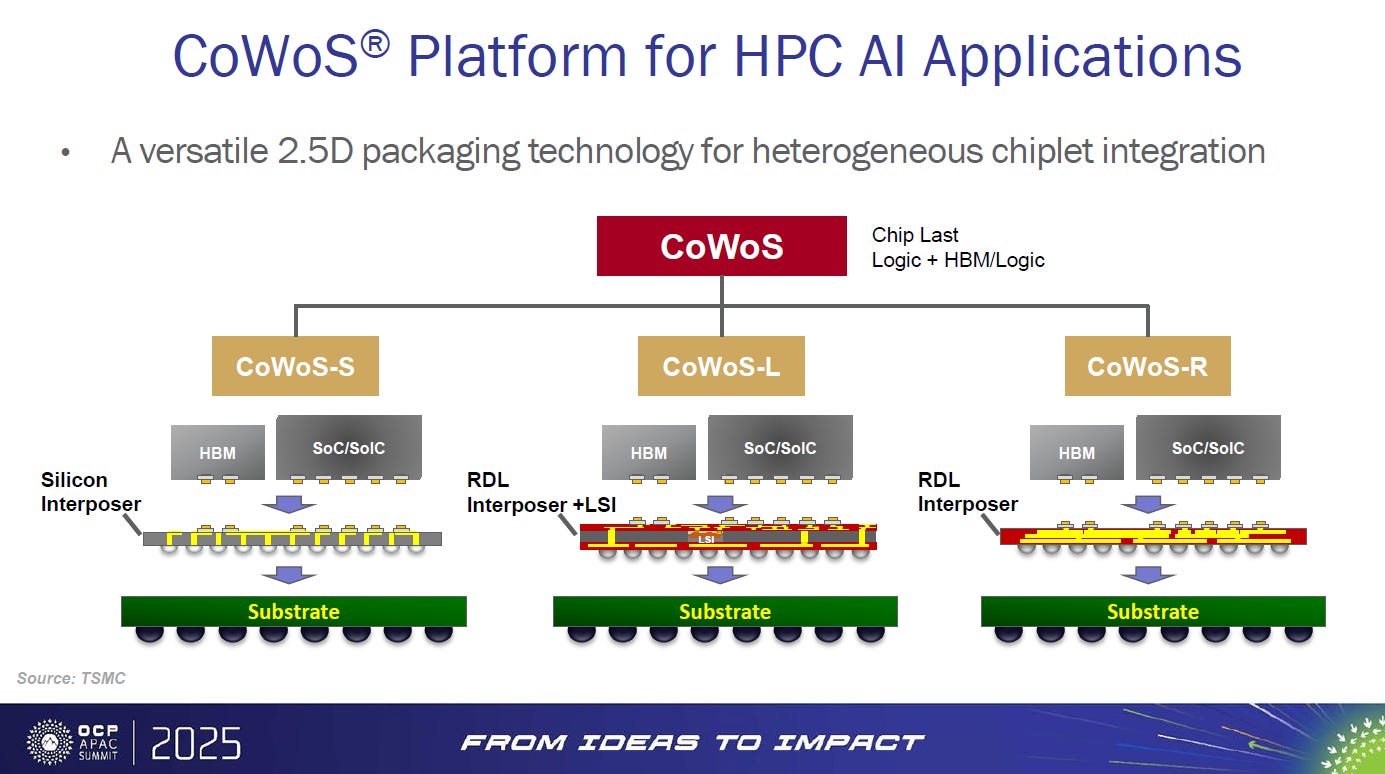
Source: TSMC
According to industry sources, the average selling price of a single CoWoS wafer is approximately US$10,000, already approaching the price level of a 7nm advanced process wafer. This indicates that advanced packaging is evolving from a traditional back-end process into a high-value platform comparable to advanced logic manufacturing.
CoWoS Is Not Packaging. It Is TSMC’s Second Advanced-Process Wall
Many people still describe CoWoS as “advanced packaging.” That description is not wrong, but it is deeply incomplete. Traditional packaging is built around dicing, die attach, wire bonding, molding, testing, and final delivery. Its core value lies in yield control, cost control, capacity scheduling, and customer service. CoWoS is different. Its essence is the integration of advanced logic dies, HBM, silicon interposers, micro-bumps, RDL, TSV, thermal management, and high-density interconnects into a system-level platform capable of carrying AI accelerators.
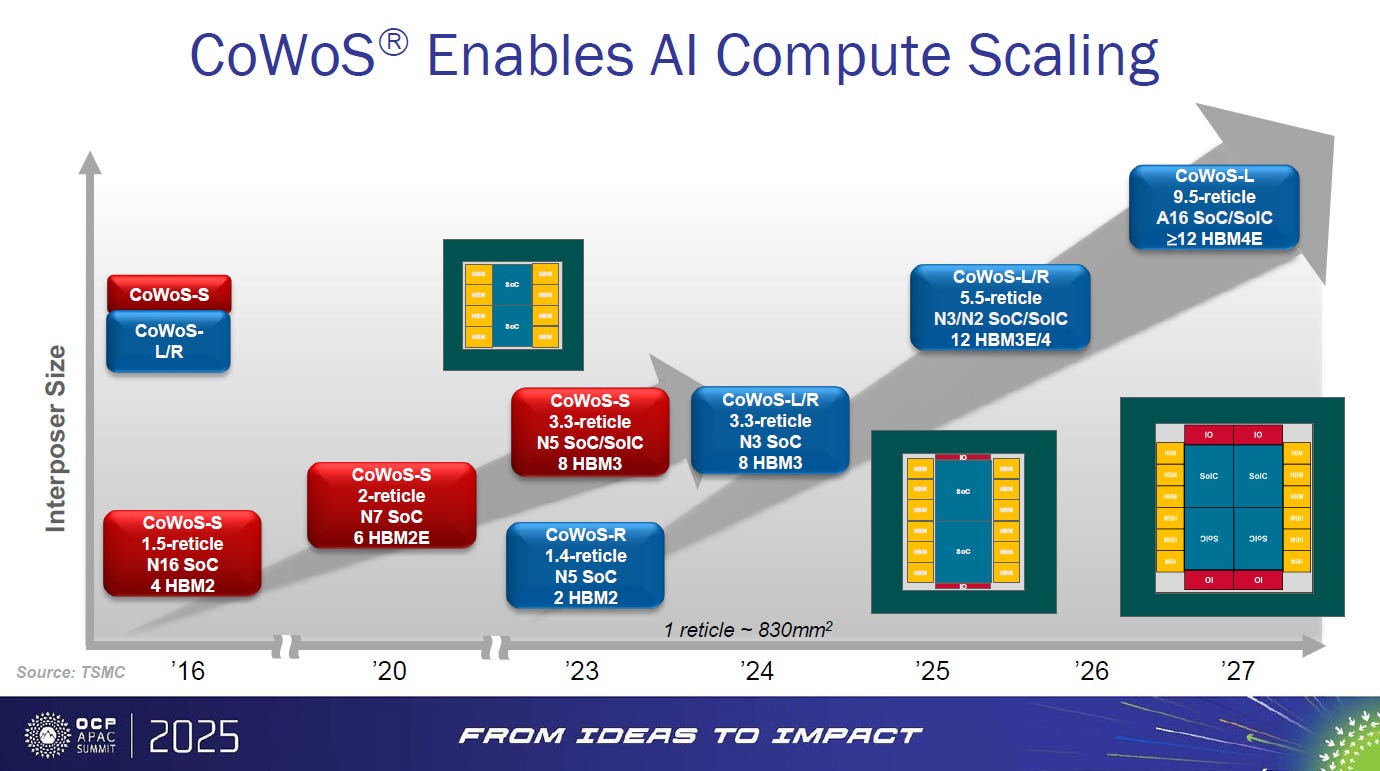
Source: TSMC
This is no longer traditional back-end manufacturing. It is much closer to an extension of wafer fabrication. CoWoS is not an add-on service after front-end manufacturing. It extends the logic of wafer manufacturing into the packaging domain. It requires cleanrooms, advanced equipment, silicon interposer fabrication, wafer-level integration, ultra-high-precision alignment, material control, warpage management, thermal-mechanical simulation, and engineering capability tightly coupled with front-end process technology.
That is why TSMC can keep so much of CoWoS value inside its own system. Traditional OSAT companies can do many things, but what is hardest to replicate is TSMC’s ability to integrate front-end process, silicon interposer, advanced packaging, design co-optimization, and capacity commitment into one unified platform. The real moat of CoWoS is not just technology. It is TSMC’s ability to transform wafer foundry from chip manufacturing into AI chip system manufacturing.

Source: TSMC
A 50% Value-Added Rate Means Profit Is Not Leaking Out
The biggest structural limitation of traditional electronics manufacturing is that value easily leaks out. If you build servers, you must buy CPUs, GPUs, DRAM, SSDs, PCBs, power supplies, chassis, and cooling modules. If you build smartphones, you must buy displays, cameras, memory, RF components, batteries, and mechanical parts. If you build modules, you depend on upstream materials, components, equipment, and outsourced processing.
That is why many electronics manufacturing service companies can generate massive revenue but still operate with thin margins. A large share of their output value is merely the circulation of supply-chain cost.
CoWoS is the opposite. Many of its high-value steps are locked inside TSMC’s process system. The silicon interposer is not casually outsourced. Wafer-level packaging is not something a conventional back-end factory can simply absorb. High-density micro-bumps, RDL, TSV, warpage control, thermal-mechanical simulation, and customer design co-optimization cannot be built by stacking low-cost production lines.
If CoWoS really has a value-added rate close to 50%, it reflects one thing: TSMC is not simply selling capacity. It is selling a closed high-value manufacturing ecosystem.
This also explains why CoWoS expansion will certainly stimulate demand for equipment, materials, facilities, engineering services, and infrastructure, but it may not distribute profit across local suppliers in the same way traditional electronics manufacturing once did. Capital expenditure will flow toward ASML, Applied Materials, Lam Research, KLA, TEL, and TSMC’s own fabs, cleanrooms, and engineering systems. But the highest value-added layer will remain as internalized as possible inside TSMC.
This is the fundamental difference between CoWoS and traditional packaging. Traditional packaging is a supply chain. CoWoS is a fortress.

Source: TEL
N2 + CoWoS: TSMC’s Real Power Is Not Single-Point Leadership, but a Combination Lock
If we only look at advanced logic process, TSMC is strong. If we only look at advanced packaging, TSMC is also strong. But the truly frightening part is not that these two areas are individually strong. It is that they are increasingly locked together into one inseparable combination.

Source: TSMC
N2 plus CoWoS is becoming the most difficult combination lock to bypass in AI chip manufacturing.
For AI chip companies, advanced process determines compute density, power efficiency, frequency, and performance per unit area. Advanced packaging determines HBM bandwidth, I/O density, memory proximity, system power, and total throughput. AI chips do not only need good process technology. They need good process technology plus good packaging.
If compute performance is high but HBM cannot be integrated properly, bandwidth is insufficient, package warpage is uncontrolled, thermal management fails, or yield cannot be stabilized, the product still cannot enter mass production.
This is the core problem facing Samsung and Intel. Samsung does have advanced process technology, and it also has advanced packaging capability. But AI chip customers are not buying PowerPoint roadmaps. They need a stable, manufacturable, deliverable, and predictable platform. If Samsung’s advanced-node yield is insufficient, customer chip cost rises sharply. If its advanced packaging platform is not mature enough, customers must absorb additional engineering risk. If process and packaging cannot mature together, AI chip companies must carry the integration risk themselves. Few companies are willing to pay that bill.
Intel faces a similar issue. Intel has EMIB, Foveros, and real advanced-packaging capability. But in today’s AI chip battlefield, customers want a full platform that can scale immediately into high-volume production. Intel’s process nodes, packaging platforms, customer adoption rhythm, and ecosystem trust are still being rebuilt.
Therefore, the market’s real choices are narrowing. Not because everyone loves TSMC, but because AI chip production risk is now too high. No one wants to simultaneously bear process risk, packaging risk, HBM integration risk, and supply-chain delivery risk.
TSMC’s dominance does not come from one technology crushing everything else. It comes from two critical bottlenecks being ahead at the same time — and being extremely difficult for competitors to catch up with simultaneously.
Taiwan’s Semiconductor Industry Is Splitting Into Two Parallel Lines
The most fascinating thing about Taiwan’s semiconductor industry used to be that it was never only about TSMC. Taiwan had foundries, DRAM, NOR flash, NAND controllers, IC design, packaging and testing, PCB, substrates, probe cards, equipment components, materials, and fab engineering. It was a complete cluster.
For the past decade, we have been used to describing this system as the “Taiwan semiconductor supply chain.” But in the AI chip era, that narrative is starting to fracture.
TSMC’s leading-edge manufacturing capability is spiraling upward. Many traditional suppliers, meanwhile, are being pulled downward. This is not because they are not working hard. It is because industrial value is concentrating around the most critical bottlenecks.
What are the bottlenecks in AI chips? Not ordinary packaging. Not mature-node manufacturing. Not general consumer ICs. The bottlenecks are advanced process, HBM integration, CoWoS capacity, silicon interposers, advanced testing, high-speed interconnect, thermal management, and system-level yield.
The more important these bottlenecks become, the more value concentrates around TSMC. Once TSMC can bind advanced process and CoWoS together, customers are no longer buying only wafers from TSMC. They are buying the entire mass-production path for AI chips.
This creates a major contradiction for Taiwan’s semiconductor industry. The stronger TSMC becomes, the stronger Taiwan’s semiconductor industry appears. But the stronger TSMC becomes, the harder it may be for some local suppliers to share the highest value-added layers.
Traditional OSAT Companies Are Being Redefined
For ASE, Powertech, KYEC, Ardentec, ChipMOS, Sigurd, and other packaging and testing companies, the AI chip era still brings opportunities. But the nature of those opportunities is changing.
In the past, OSAT companies could serve a wide range of customers and products: consumer electronics, communication chips, automotive chips, memory, MCUs, and high-end logic chips. Different products created different levels of back-end demand.
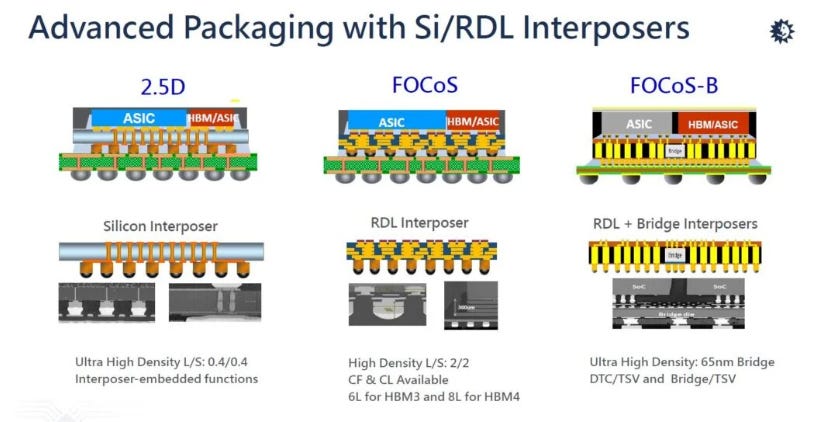
Source: ASE
But in top-tier AI accelerators, value is concentrating inside TSMC. The more internalized CoWoS capacity becomes, the harder it is for traditional OSAT companies to directly capture the highest-value portion.
They may still participate in testing, substrates, modules, back-end support, specific customer programs, and certain overflow demand related to CoWoS. But their strategic position is different. In the past, they were core members of Taiwan’s semiconductor cluster. In the AI accelerator battlefield, they are increasingly functional nodes around TSMC’s system.
That difference matters. Functional nodes can still make money, but they rarely control value distribution. They may face pricing pressure from customers, capacity-cycle volatility, and capital-expenditure burden during technology transitions, without receiving equivalent pricing power.
The painful reality is this: the advanced-packaging narrative looks very hot, but the most valuable part of advanced packaging is being captured by TSMC.
So the market may develop an illusion: AI drives advanced packaging, therefore all packaging companies should benefit. The reality may be more selective. AI does drive advanced packaging, but the largest beneficiary is not necessarily the traditional OSAT industry. It is the company that has turned advanced packaging into an extension of wafer manufacturing.

2025年6月18日

3月5日
Taiwan’s IC Design Companies Must Also Accept TSMC’s Pricing Power
Another underestimated impact is the declining bargaining power of Taiwan’s IC design companies. MediaTek, Realtek, Phison, Silicon Motion, GUC, Alchip, and Faraday all depend, to different degrees, on TSMC or Taiwan’s semiconductor supply chain.
Historically, Taiwan’s IC design companies had flexibility. They could move between mature processes, specialty processes, packaging and testing options, fast iteration cycles, and customer relationships. But in the advanced-node era, that flexibility is shrinking.
At N3, N2, and A16, chip design companies are not simply choosing the cheapest foundry. They are choosing who can provide the most stable PDK, IP, ecosystem, yield, capacity, packaging, and customer-delivery capability.
If they choose TSMC, they must accept TSMC’s pricing, capacity allocation, and technology roadmap. If they do not choose TSMC, they may take on higher technology risk and delayed time to market.
For large AI chip customers, this may be an acceptable cost. For mid-sized IC design companies, it raises the capital threshold dramatically. Mask costs are rising. IP licensing is becoming more expensive. EDA cost is increasing. Packaging and testing costs are also rising.
The final outcome is structural: fewer companies will be able to enter the most advanced nodes. TSMC will continue moving forward, but the number of customers able to follow will decline. Each customer will become more valuable, but the customer base will become more concentrated.
That is good for TSMC. It is not necessarily good for Taiwan’s broader IC design ecosystem. The industry may gradually move from “a hundred flowers blooming” to “only a few giants can afford the ticket.”

2月14日
CoWoS Expansion Is Not a Collective Victory. It Is a Recentralization of Value Distribution
The market often says that TSMC’s CoWoS expansion will benefit Taiwan’s supply chain. This is half true and half dangerous.
It is true because CoWoS expansion will drive demand for equipment, materials, facilities, substrates, testing, probe cards, thermal solutions, chemicals, and engineering services. But it is dangerous because not every participant will share the high value-added layer.
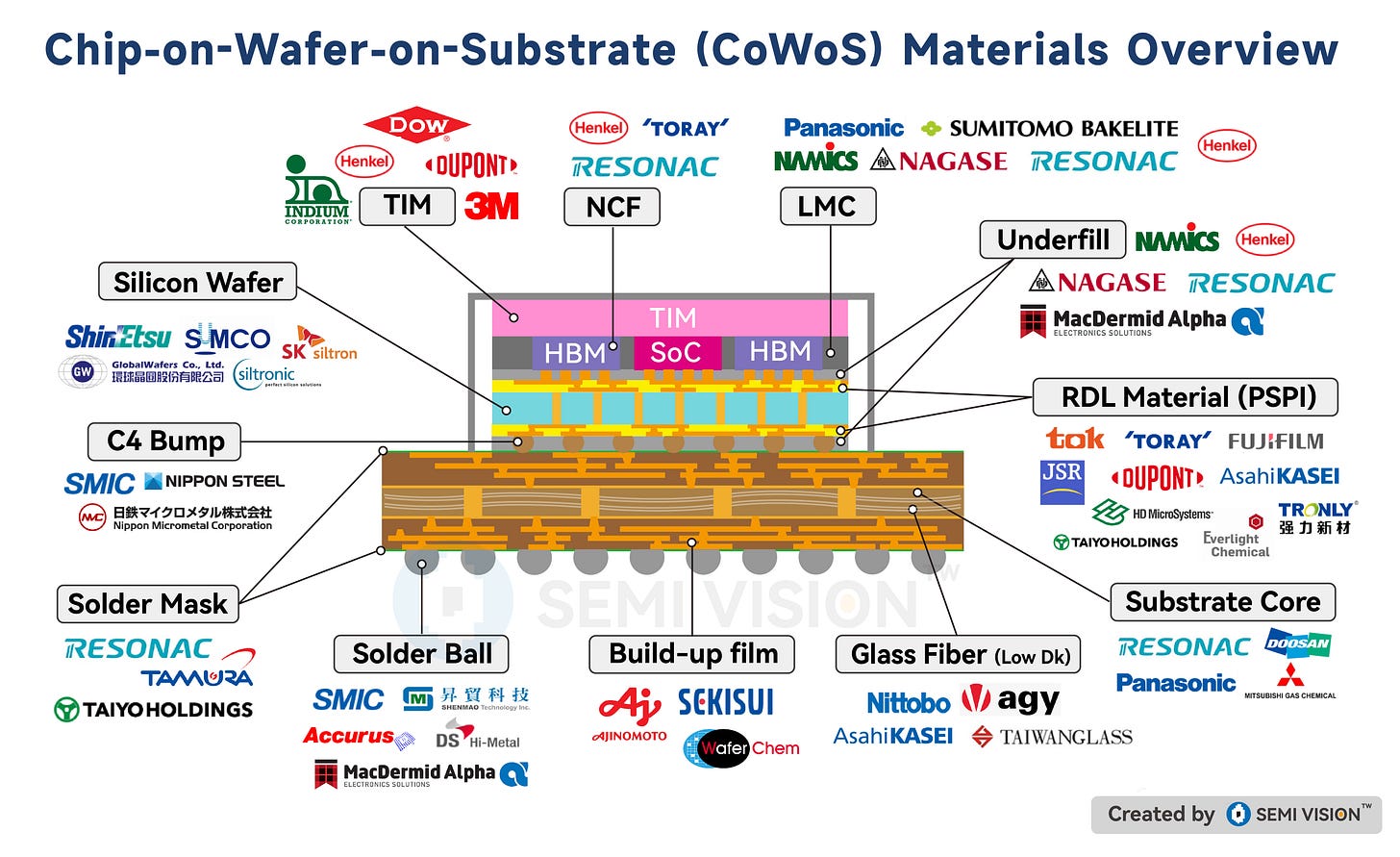
Having orders does not mean having pricing power. Having growth does not mean having margin. Entering the AI supply chain does not mean standing at the top of the value chain.
The real questions are simple:
Who controls the bottleneck?
Who owns the customer relationship?
Who allocates capacity?
Who defines the technology roadmap?
Who controls the yield data?
Who owns system integration?
The answer is increasingly clear:TSMC.
That is why the high value-added rate of CoWoS matters so much. It is not merely a financial metric. It tells us that TSMC is not evenly distributing the AI packaging windfall across Taiwan’s supply chain. It is locking the most critical value layer inside its own manufacturing system.
This is excellent for TSMC shareholders. But for Taiwan’s semiconductor ecosystem, it means a value redistribution is underway.

4月17日
Taiwan’s Biggest Semiconductor Risk Is Not Lack of Growth. It Is Excessive Concentration of Growth
Taiwan’s semiconductor problem today is not a lack of growth. The problem is the opposite: growth is becoming too concentrated.
If TSMC grows, Taiwan’s semiconductor exports grow. If CoWoS expands, Taiwan’s AI supply chain grows. If Nvidia increases orders, related Taiwanese suppliers grow. On the surface, this is a beautiful story.
But the deeper issue is that this growth increasingly depends on one company, one technology path, one manufacturing platform, and a small group of American AI customers.
This creates three risks.
First, Taiwan’s semiconductor cycle will become increasingly tied to TSMC’s capex cycle and Nvidia’s product cycle.
Second, suppliers’ independent pricing power will decline because they will find it harder to bypass TSMC’s manufacturing rhythm.
Third, industrial innovation may become more centered around TSMC. Companies that cannot enter the high-end ecosystem defined by TSMC may be left in mature processes, traditional packaging, low-margin manufacturing, or niche markets.
This is not TSMC’s fault. It is the result of technology evolution. When AI chips become more complex, the industry naturally concentrates around the company most capable of solving the largest system-level risks.
The real question is whether Taiwan can cultivate second-layer and third-layer companies outside TSMC that can still capture high value-added opportunities. If not, Taiwan’s semiconductor industry may become a very strange structure: the world’s strongest manufacturing company is in Taiwan, but many local suppliers outside that company are moving farther away from the core of the value chain.
2月2日
The Next Divide: Can Suppliers Become System Nodes Instead of Outsourcing Vendors?
Taiwan’s supply chain will still have opportunities. But those opportunities will not appear automatically.
The companies that survive and thrive in the next stage will not be traditional subcontractors. They will be companies that become irreplaceable system nodes inside TSMC’s AI manufacturing platform.
What is a system node?
It is not merely a company that receives outsourced work. It is a company that solves critical problems in AI chip mass production.
Can advanced testing support system-level validation of GPU plus HBM?
Can probe cards handle higher I/O density and larger die sizes?
Can thermal materials support packages exceeding 1,000 watts?
Can substrates maintain yield under larger size, higher layer count, lower warpage, and higher-speed requirements?
Can optical communication and CPO be integrated with advanced packaging?
Can material suppliers deliver next-generation materials with lower loss, higher reliability, and lower CTE mismatch?
Can equipment suppliers enter the production rhythm defined by TSMC’s advanced packaging roadmap?
These are the real questions for Taiwan’s supply chain.
Not every packaging company will benefit. Not every material company will benefit. Not every equipment-component company will benefit. Only those that can embed themselves into the system-level bottlenecks of AI chip manufacturing will have a chance to capture the next wave of high value-added growth.
In other words, Taiwan’s suppliers can no longer define themselves as peripheral beneficiaries of TSMC’s expansion. They must become engineering capabilities that TSMC cannot easily replace.
1月31日
Conclusion: CoWoS at 50% Is a Warning Signal for Taiwan’s Semiconductor Structure
A CoWoS value-added rate approaching 50% looks like a beautiful financial signal. But from an industrial-structure perspective, it is more like a warning.

Source: TSMC
It tells us that TSMC is locking the highest-value manufacturing layers of the AI chip era inside its own internal ecosystem. It also tells us that the old model of electronics manufacturing — supply-chain division of labor, outsourcing diffusion, and cluster-wide prosperity — is being replaced by a new manufacturing-platform logic.
In the past, Taiwan’s semiconductor story was about a group of companies collectively weaving a complete industrial cluster. In the future, the story may become one where TSMC continues integrating upward, while everyone else must prove they still have irreplaceable value.
This is not necessarily bad. But it is a brutal dividing line.
For TSMC, N2 plus CoWoS is the strongest combination lock in global AI chip manufacturing. For Nvidia, AMD, Broadcom, and the cloud giants, it is currently the most reliable mass-production path.
But for Taiwan’s local suppliers, it is also a warning: TSMC’s success will not automatically become the success of every Taiwanese semiconductor company.
In the AI chip era, the real competition is no longer about who receives orders. It is about who controls the bottleneck.
Whoever controls the bottleneck controls the profit.
Whoever controls the system defines the industry.
CoWoS’s 50% value-added rate is reminding Taiwan’s entire semiconductor industry of one thing:
TSMC is no longer just one company inside the supply chain. It is becoming the supply chain itself.

4月23日


PreviousNext