From AI Servers to High-Speed PCBs: Why CCL Prices Are Entering a New Upcycle
From AI Servers to High-Speed PCBs: Why CCL Prices Are Entering a New Upcycle
- Source: SemiVision
- Author: SEMIVISION
- Published: 2026-05-04T10:10:24+08:00
- URL: https://tspasemiconductor.substack.com/p/from-ai-servers-to-high-speed-pcbs (1) From AI Servers to High-Speed PCBs: Why CCL Prices Are Entering a New Upcycle


From AI Servers to High-Speed PCBs: Why CCL Prices Are Entering a New Upcycle
Original Article By SemiVision Research [Reading time: 17 mins]

May 04, 2026
∙ Paid

The industry has undergone three major rounds of technological transformation. Driven by environmental protection requirements and the continuously evolving needs of downstream end markets, copper-clad laminate technology has gradually advanced from conventional boards toward lead-free and halogen-free materials, thinner and lighter structures, and high-frequency/high-speed performance. In recent years, with the rapid development of 5G, automotive electrification and intelligence, AI, and the broad expansion of related end applications, downstream customers have raised higher requirements for copper-clad laminate materials, leading to a significant increase in demand for high-frequency and high-speed boards .
Lead-free and Halogen-free
As electronic products have increasingly penetrated people’s daily work and life, and as awareness of environmental protection has continued to strengthen both in China and globally, green environmental requirements in the electronics industry have also risen accordingly. Lead-free processes impose higher requirements on the heat resistance and reliability of copper-clad laminates, as lead-free soldering requires higher soldering temperatures due to its higher melting point. Halogen-free requirements mean replacing traditional halogenated flame retardants with phosphorus- and nitrogen-based halogen-free flame retardants, while adjusting resin formulation systems to achieve balanced and optimized copper-clad laminate performance.
Thinner and Lighter
The trend toward thinner and lighter copper-clad laminates places high demands on production processes. On one hand, it requires precise control over the impregnation process, production process, tolerance control, substrate flatness, and dimensional stability. On the other hand, while maintaining mass reduction, the material must also preserve key performance characteristics. This often requires targeted reinforcement of copper-clad laminate performance through filler technologies or resin formulation adjustments to meet end-application requirements.
High-frequency and High-speed
In traditional electronic product applications, operating frequencies were mostly below 1 GHz, where ordinary copper-clad laminates could meet most requirements and were often overlooked by PCB and end-product designers. However, in high-frequency and high-speed environments, high-frequency signals experience attenuation. At the same time, signal transmission in dielectric materials is affected and constrained by the intrinsic properties of the copper-clad laminate itself, resulting in signal loss or even distortion. Therefore, high-frequency and high-speed applications impose very high electrical performance requirements on copper-clad laminates.
Why Does CCL Keep Rising in Price? An Analysis Through the Four Core Pursuits of the Electronics Industry
If someone still sees CCL — copper-clad laminate — as merely a basic upstream material for PCBs, then they may still be looking at the electronics industry through the lens of the previous generation.

In the era of low speed, low frequency, and low complexity, the role of CCL was indeed closer to that of a “passive material.” As long as it provided stable supply, controlled cost, and met basic specifications, it could enter the supply chain.
But after the industry entered the era of AI servers, high-speed switches, 800G/1.6T optical modules, high-end substrates, and advanced packaging, the role of CCL has changed. It is no longer just the base of the board. It has become part of overall system performance, reliability, and manufacturing yield.
Therefore, the continued price increases of CCL cannot be explained simply by saying “the cycle is strong” or “demand is robust.” The real reason is that the entire electronics industry is moving toward higher precision, higher frequency, and higher integration. Behind this shift, there is a clear framework for understanding the trend: the four core pursuits of the electronics industry —True Size, True Position, True Selection, and True Structure.

On the surface, these four concepts sound like engineering terminology. But in essence, they are telling the market why materials can no longer remain cheap, and why the value of high-end CCL is being redefined.
Below we will share:
True Size: The More Accurate the Dimension, the More Expensive the Material
True Position: The More Precise the Alignment, the Higher the Yield Cost
True Selection: It’s Not About What Works, but Choosing the Right Material
True Structure: The More Complex the Structure, the More CCL Becomes a System Material
The Essence of CCL Price Increases: Not Cycles, but Industry Upgrading
Conclusion: More Expensive Materials Are Not Necessarily a Bad Thing
Copper-clad laminate products have seen intensive price increases, mainly due to the following three factors
True Size: The More Accurate the Dimension, the More Expensive the Material
The first pursuit of the electronics industry is True Size. In other words, the dimensions you design must be manufactured as close to the intended dimensions as possible. More importantly, they must not drift too much under different temperature, humidity, frequency, and process conditions.
For current AI-related applications, substrate sizes have already exceeded 75 × 75 mm. According to some substrate manufacturers’ roadmaps, substrate sizes may reach 300 × 300 mm by 2030.
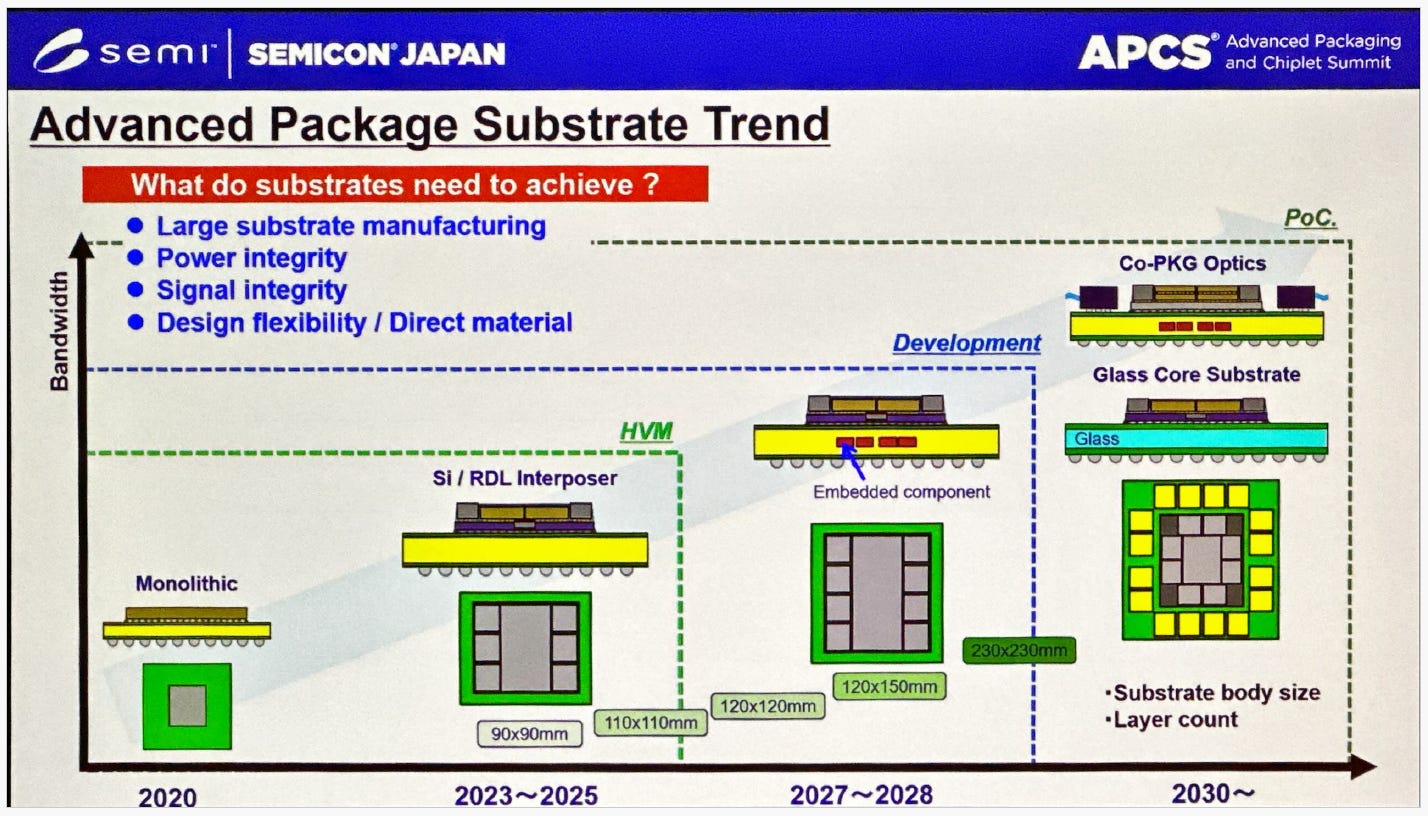
SEMICON Japan 2025
In the past, this may not have been a fatal issue. But in the era of high-speed transmission, dimensional error is no longer just a cosmetic issue. It has become a signal integrity issue.
As data transmission speeds continue to move toward 56G, 112G, and 224G PAM4, the line width, line spacing, dielectric thickness, copper foil surface roughness, and even the uniformity of glass fiber distribution on the board will directly affect impedance control, insertion loss, and reflection performance. What may appear to be a board that is merely slightly thicker or thinner can, in a high-speed system, determine whether the eye diagram can open and whether the system can operate stably.
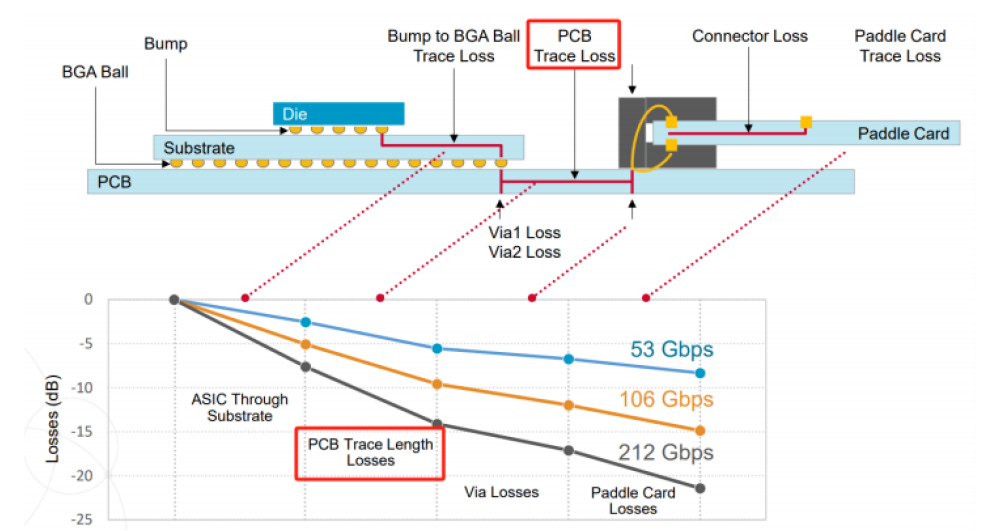
Source: Broadcom
As a result, the market now requires CCL not only to be “usable for board fabrication,” but also to deliver better dimensional stability, a lower coefficient of thermal expansion, smaller tolerance variation, and the ability to maintain structural consistency after high-temperature reflow and multilayer lamination.
The problem is that this kind of True Size does not come for free.
Behind it are higher-grade fiberglass cloth, more precise resin formulations, stricter lamination conditions, finer process control, and even lower tolerance for scrap. For material suppliers, this is not simply about selling one more sheet of laminate. It means investing more in R&D and manufacturing cost in exchange for higher stability.

TPCA 2025
According to the roadmaps of some substrate manufacturers, by around 2030, high-end substrate sizes may further advance toward the 300 × 300 mm class. This means that future substrates will no longer be merely an interface for “carrying chips.” They will gradually evolve into a core platform that supports ultra-large system modules, advanced packaging, and high-density interconnects. The larger the substrate becomes, the higher the requirements will be for material stability, warpage control, process precision, and yield management.
In the AI era, substrates are not only becoming larger. They must also remain stable, precise, and reliable after becoming larger. This means the core reason behind CCL price increases cannot be viewed only as a result of tight raw material supply. One must also recognize the deeper industrial logic: once dimensional stability becomes a basic threshold for high-end electronic systems, the material itself is no longer merely a cost item, but a performance item.
Larger area and stronger demand are only surface-level phenomena. The real force pushing the pricing center upward is the higher technical requirement and lower error tolerance behind large-size materials.
True Position: The More Precise the Alignment, the Higher the Yield Cost
The second pursuit is True Position, or alignment accuracy.
In the world of multilayer boards, HDI, and advanced substrate packaging, the real challenge has never been stacking materials—it’s ensuring that after stacking, every layer is aligned, every via is precise, and every laser drilling and pattern transfer step is accurate.
As circuit density increases, layer counts rise, and hole sizes shrink, the tolerance for misalignment rapidly narrows. In the past, slight offsets could sometimes be corrected; today, a deviation of just a few microns can result in scrapping an entire board. Especially in AI servers, high-speed switches, and advanced networking equipment, PCBs are no longer just passive carriers of components—they directly influence electrical performance and thermo-mechanical stability.
What does this imply?
It means CCL must support higher-precision manufacturing processes. The material itself must deliver better dimensional stability, moisture control, and post-lamination shrinkage management—otherwise even the most advanced downstream equipment cannot compensate. From this perspective, CCL is not merely passively meeting PCB specifications; it is one of the starting points of the entire alignment accuracy system.
And once alignment precision requirements increase, costs rise in three directions:
Equipment cost: Higher-precision exposure, drilling, AOI, and metrology systems are required.
Yield cost: The more precise the product, the less room for error—tiny deviations can scale into batch-level losses.
Qualification cost: High-end server, automotive, and telecom products have long validation cycles. Once materials are qualified, suppliers gain stronger pricing power.
So when the market sees CCL price increases, it is often not because manufacturers “want” to raise prices, but because the entire supply chain must pay for higher precision in pursuit of True Position—and that cost inevitably reflects in pricing.

2025年7月6日
True Selection: It’s Not About What Works, but Choosing the Right Material
The third pursuit isTrue Selection, arguably the most critical driver behind the structural price increases in CCL in recent years.
Before the electronics industry entered the era of high speed, high frequency, and high power, material selection was largely a balance between performance and cost. That is no longer the case. The question today is not “which material is cheaper,” but “which material can actually perform.”
Applications such as AI servers, switches, optical communication modules, automotive electronics, and millimeter-wave communication all point to one reality: material selection now directly determines whether a product is viable.
For example:
High-speed signals require lower dielectric constant (Dk) and dissipation factor (Df)
High-frequency applications demand more stable resin systems
Thermal and reliability requirements impose stricter thermo-mechanical constraints
Under these conditions, the applicability of traditional general-purpose FR-4 continues to shrink, while the market shifts toward higher-end low-loss and ultra-low-loss materials.
The challenge with advanced materials is not just cost—it’s supply constraints, slow qualification, and limited alternatives.
High-end glass fabric cannot be expanded at will. Low-loss resin systems are not easily replicated. Copper foil is evolving from standard grades to HVLP and VLP, requiring a rebalancing of surface roughness, adhesion, and high-frequency performance. These materials are becoming more expensive not simply because suppliers raise prices, but because they have shifted from “options” to “performance necessities.”
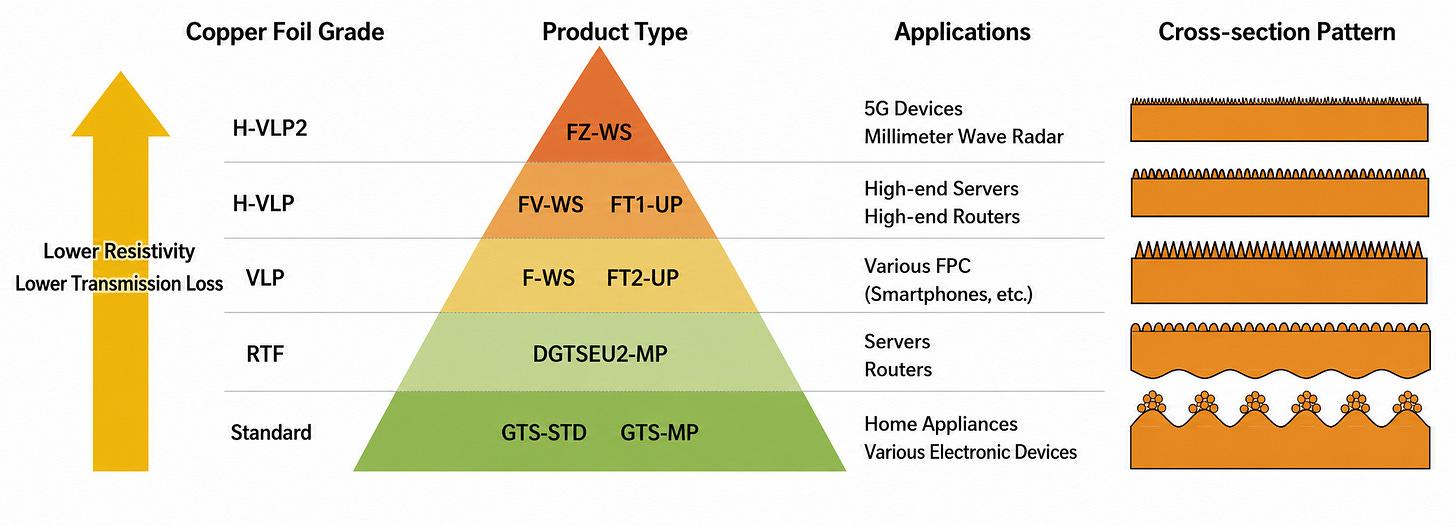
Source: furukawaelectric
In other words, the essence of True Selection is that freedom of material choice is decreasing, while dependence on high-performance materials is increasing.
This leads to an important industry outcome: high-end CCL is no longer easily commoditized through price competition. Customers are not just buying a laminate—they are buying signal integrity, reliability, qualification success rates, and the probability of successful product deployment.
This is why, even though all are called CCL, price gaps between different tiers will continue to widen. Low-cost materials will still exist, but pricing in the high-end market no longer follows traditional commodity logic.
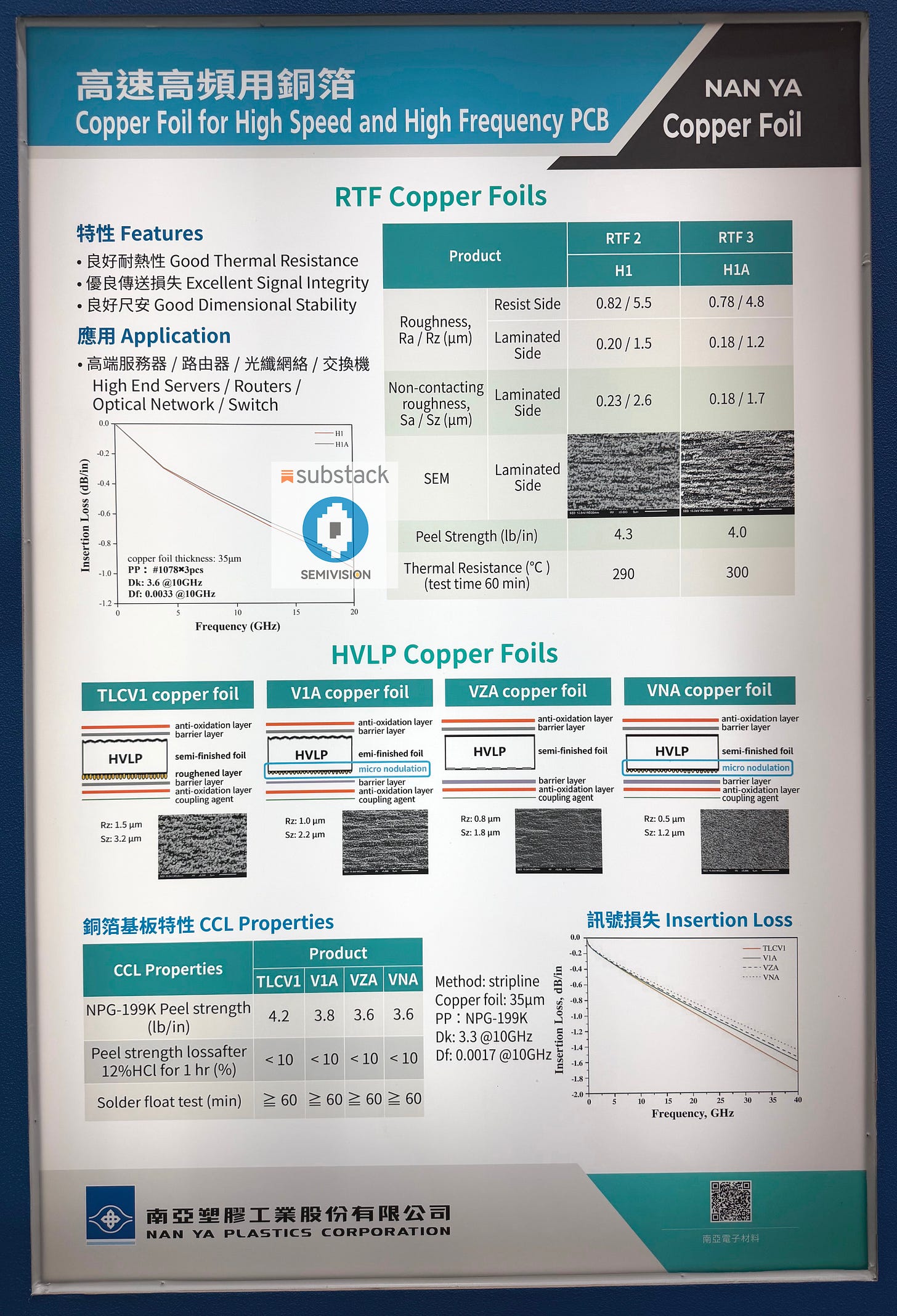
TPCA 2025
True Structure: The More Complex the Structure, the More CCL Becomes a System Material
The fourth pursuit isTrue Structure.
The key idea here is that modern electronic products no longer compete at the component level, but at the system level. Especially in the era of AI infrastructure, everything—from GPU modules, switches, optical modules, and power systems to thermal architectures—is being redesigned. As a result, materials themselves are being redefined.
CCL used to be a board material. Today, it is closer to a system-level structural material.
Why? Because the board itself now carries far more responsibilities:
Supporting higher layer counts
Handling larger form factors
Enabling denser power and signal routing
Mitigating more severe warpage issues
Maintaining reliability under thermal cycling and mechanical stress
As server motherboards, AI accelerator boards, switch boards, and advanced module substrates evolve toward higher layer counts, higher density, and higher power density, CCL is no longer just a structural carrier—it becomes a critical factor in overall system stability, significantly increasing its structural value.
One clear trend in recent years is the continuous increase in CCL thickness—from the traditional ~1.8 mm toward 2 mm, 3 mm, or even thicker. The reason is straightforward: thicker boards provide greater stiffness, which helps suppress warpage and deformation in large modules. In AI substrates and high-end server boards, where size continues to grow, warpage control is no longer just a process issue—it directly affects assembly, reliability, and long-term operational stability.
However, thicker boards come with trade-offs.

As CCL core thickness increases, manufacturing difficulty rises sharply. This is especially true when using high-performance glass fibers like Q-glass. These materials are stronger and tougher, making them much less friendly to mechanical processing. Thicker boards mean longer drilling paths, increased heat accumulation, and greater mechanical wear—leading to drill bit consumption that can increase several-fold, even up to 10×. This is why discussions around drill life, hole quality, wall roughness, and processing cost have intensified in recent years.
Q-glass cloth is made from high-hardness, high-elasticity quartz fiber, its processing difficulty is significantly higher than that of conventional glass-fiber laminates. The main challenges are as follows:
High material hardness:Q-glass cloth has a Mohs hardness above 7, causing severe tool wear.
Fiber elastic rebound:During drilling, fiber rebound can easily lead to hole-wall burrs, delamination, and edge chipping.
High requirements for hole accuracy and hole-wall quality:Verticality, roundness, and interlayer integrity must be maintained.
Strict processing conditions:High spindle speeds of ≥180k RPM, low feed rates of ≤10 mm/min, and high-rigidity drilling equipment are required.


TPCA 2025
To ensure hole quality and tool life, the following drilling solutions are recommended:
CVD diamond drills
Chemical Vapor Deposition diamond drills are suitable for long-life mass production and applications requiring high hole-wall smoothness.
PCD diamond drills
Polycrystalline diamond drills are suitable for precision drilling of ultra-high-hardness or composite substrates.
Through professionally designed drill geometry and coating structures, tool wear can be effectively reduced and hole quality can be improved, meeting the processing requirements of Q-glass cloth, quartz cloth, Q-glass, and other similar substrates.
In the past, CCL was evaluated mainly on electrical properties and material formulations. Today, manufacturability itself is becoming a key barrier to mass production.
This is also why ceramic cores are gaining attention. Their importance is not just novelty, but the alternative they offer: for the same warpage resistance, a ceramic core may require only about one-third the thickness of traditional CCL to achieve similar structural support. This suggests that as system designs move toward larger sizes and higher power density, the solution may not simply be “making CCL thicker,” but adopting alternative core materials with higher stiffness and thinner profiles.
In other words, warpage is no longer just a thickness issue—it is becoming a platform-level material selection problem.
Looking further ahead, as advanced packaging, CPO, board-level interconnects, and higher system integration mature, the boundary between substrates and packaging will continue to blur. Challenges once confined to packaging are extending into the board level, while performance requirements once irrelevant to laminates are becoming essential.
This means the market can no longer treat CCL as a pure upstream raw material. Instead, it should be viewed as one of the foundational platforms enabling system-level structural evolution.
And once a material becomes a platform, its pricing is no longer driven solely by raw material costs—it begins to reflect technological value, reliability value, and system integration value.
The Essence of CCL Price Increases: Not Cycles, but Industry Upgrading
Many people ask: why do CCL prices keep rising? If you look only at short-term supply and demand, the answer will always be incomplete.
As systems move toward higher frequency, higher speed, greater power density, and deeper integration, materials can no longer remain within their old cost structures. True Size demands better dimensional stability, True Position requires tighter alignment accuracy, True Selection pushes toward higher-end material choices, and True Structure elevates CCL from a supporting role to a structural core.
Taken together, these four forces lead to a clear conclusion:
The rise in CCL prices is not just a commercial phenomenon—it is an inevitable outcome of rising engineering requirements.
Moreover, this type of price increase is often structural. Once advanced materials are adopted, high-end specifications are established, and rigorous qualifications are completed, customers rarely revert to lower-tier solutions. This means the pricing baseline for high-end CCL may not decline as quickly after a market cycle as it did in the past.
From the perspectives of investment, industry research, and supply chain strategy, this is an important signal that needs to be reinterpreted:
CCL should no longer be viewed as a traditional material purely driven by economic cycles, but as a critical infrastructure material in the era of AI and high-speed electronics.

2025年10月27日
Conclusion: More Expensive Materials Are Not Necessarily a Bad Thing
From a broader industry perspective, the continued rise in CCL prices reflects something deeper: the technological center of gravity in electronic systems is shifting toward materials, structures, and integration capabilities.
This is not just a PCB industry story, nor merely an upstream materials story. It represents the cost the entire electronics industry must bear as it pushes toward the next performance frontier.
When transistor scaling alone is no longer sufficient to solve problems, system-level optimization becomes more critical. And as system-level optimization grows in importance, elements once considered “supporting”—such as laminates, substrates, packaging, thermal management, and interconnects—become central to value redistribution.
So the real signal behind persistent CCL price increases is not that the market has become greedy, but that the electronics industry is paying a higher price in exchange for higher performance and greater certainty.
This leads to a fundamental reality in advanced electronics manufacturing today:
When the industry begins to pursue true size, true position, true selection, and true structure, materials can no longer remain cheap.

Copper-clad laminate products have seen intensive price increases, mainly due to the following three factors:
Continued price increases in raw materials such as copper foil and fiberglass cloth
Copper foil:As a core raw material for CCL, copper foil prices have shown a clear upward trend in line with fluctuations in electrolytic copper prices.
First, the price center has risen rapidly. The average copper foil price in 2025 jumped continuously from RMB 82,000/ton in September to over RMB 92,000/ton by December.
Second, the supply-demand structure has become deeply mismatched. Due to global copper mine disruptions and production cuts at the smelting level caused by low treatment charges, the industry chain has formed a rigid transmission logic of “tight ore supply → tight smelting capacity → tight finished product supply.”
Fiberglass cloth:The fiberglass industry had previously suffered from cost inversion due to excessive competition. As expectations around China–U.S. tariff policies became clearer, industry leaders began raising prices for products such as direct roving and chopped strand mat yarn by 5–10% starting in September.
Specifically, AI computing demand has forced fiberglass manufacturers to shift capacity toward higher-end product categories, directly resulting in a structural shortage of standard fiberglass cloth. As of December 2025, spot delivery lead times had extended to more than one month. In addition, Nittobo fully raised prices for its fiberglass products by 20% starting in August 2025, strengthening expectations for catch-up price increases across the industry.
With demand related to AI servers expected to grow rapidly in 2026, high-end fiberglass cloth grades are expected to see phased price increases of around 10%, which should also effectively lift the pricing center of mid- and low-end products. The fiberglass segment has entered an earnings recovery cycle driven by technology iteration and supply-demand mismatch.
Strong downstream demand, reflected in high PCB utilization rates
In addition, the recovery in consumer electronics demand, together with the development of automotive electrification and intelligence, has further boosted PCB demand.
AI products are crowding out conventional capacity, while CCL manufacturers have strong bargaining power
From the supply side, rising AI computing demand has significantly increased demand for high-end copper-clad laminates, which has to some extent crowded out capacity for conventional CCL products.
Meanwhile, because the CCL market is relatively concentrated, CCL manufacturers have stronger bargaining power than downstream PCB makers and are therefore better positioned to pass through price increases. According to market report, the combined global market share of the top five rigid CCL companies reached 55.80% in 2024, while the combined market share of the top five downstream PCB companies was only 23.55%.

2025年7月30日
Thanks for reading SEMIVISION @_@! This post is public so feel free to share it.


PreviousNext