The Three Waves of the AI Token Economy: GPUs, Data Center Storage and Optical Modules, CPU
The Three Waves of the AI Token Economy: GPUs, Data Center Storage and Optical Modules, CPU
- Source: SemiVision
- Author: SEMIVISION
- Published: 2026-04-28T11:25:44+08:00
- URL: https://tspasemiconductor.substack.com/p/the-three-waves-of-the-ai-token-economy (1) The Three Waves of the AI Token Economy: GPUs, Data Center Storage and Optical Modules, CPU


The Three Waves of the AI Token Economy: GPUs, Data Center Storage and Optical Modules, CPU
Original Article By SemiVision Research [Reading time: 10 mins]

Apr 28, 2026
∙ Paid
The Three Waves of the AI Token Economy
The First Wave Was NVIDIA GPUs, the Second Was Data Center Storage and Optical Modules, and the Third Is Moving Toward the CPU

If we view this AI revolution as a new phase of industrialization, then what the market truly needs to track is not just how intelligent the models are, but what kind of infrastructure is actually producing each token.
Over the past few years, discussions around AI have naturally centered on model capability, parameter scale, the open-source versus closed-source debate, or which application companies are growing the fastest. But if we push the lens deeper into the underlying stack, a more fundamental industrial question emerges:Tokens are not generated out of thin air.
They are highly industrialized digital outputs, and their cost, speed, latency, energy consumption, and scalability are all determined by how the underlying hardware system works together.
In other words, AI is not merely a software story.
This is what I call: the three great waves of the AI token economy.
The first wave was NVIDIA GPUs.
The second wave was data center storage and optical modules.
The third wave will no longer belong solely to accelerators. It is beginning to shift back toward the central processor, the CPU.
Wave One: The Market First Saw the GPU, Because It Was the Most Direct Engine for Token Production
Why did the first AI wave erupt around NVIDIA? The answer is straightforward. In the early stage of generative AI, the market was focused on one urgent question:
how do you get the model running at all?

2月28日
Whether for training or inference, the first visible bottleneck was floating-point performance, matrix throughput, and the architecture required to support high-bandwidth memory and large-scale parallelism. That made the GPU the obvious first asset for capital to crowd into.
This is also why NVIDIA is not simply selling chips. It has effectively redefined the computing platform of the AI era.
From the GPU itself to CUDA, the software ecosystem, NVLink, NVSwitch, rack design, liquid cooling, power architecture, and the broader concept of the AI factory, what NVIDIA is really selling is not a card, but a complete system for turning electricity into tokens.
The market logic in this phase was simple:
whoever owned the most GPUs owned the most AI production capacity.
Capital therefore rushed first into raw compute itself: accelerators, HBM, CoWoS, advanced process nodes, and every supply chain layer directly tied to the ability to “compute faster.”
In hindsight, this first wave shaped almost the entire narrative of the semiconductor capital market over the last two years.
The GPU became the most visible core asset of the AI era, and NVIDIA was re-rated from a chip company into the system architect of AI infrastructure.
But once the first wave approached its extreme, the market began to realize something important:
Being able to generate tokens does not necessarily mean you can produce tokens efficiently, at low cost, and at sustained scale.
In other words, the bottleneck began to migrate outward from compute itself.
Wave Two: Once Tokens Had to Be Moved, Stored, and Fed Continuously, the Other Layers of the Data Center Began to Re-rate
As models became larger and inference traffic rose, and as agentic AI, multimodal AI, enterprise deployments, and AI search began to expand, the token economy stopped being merely about whether GPUs could compute. It became about whether the data center as a whole could sustain that continuous flow of high-bandwidth, low-latency data movement.
That is when the second wave began to emerge.
The market gradually recognized that AI was not an industry that could be built on GPUs alone.
Even if GPUs were powerful, if the data could not be fed in fast enough, if the outputs could not be transmitted out efficiently, if model switching took too long, or if the storage layer could not keep up, then the efficiency of the entire token factory would degrade quickly. In many cases, what constrained token cost was not that the GPU computed too slowly, but that data movement was too slow, too far, and too power-hungry.
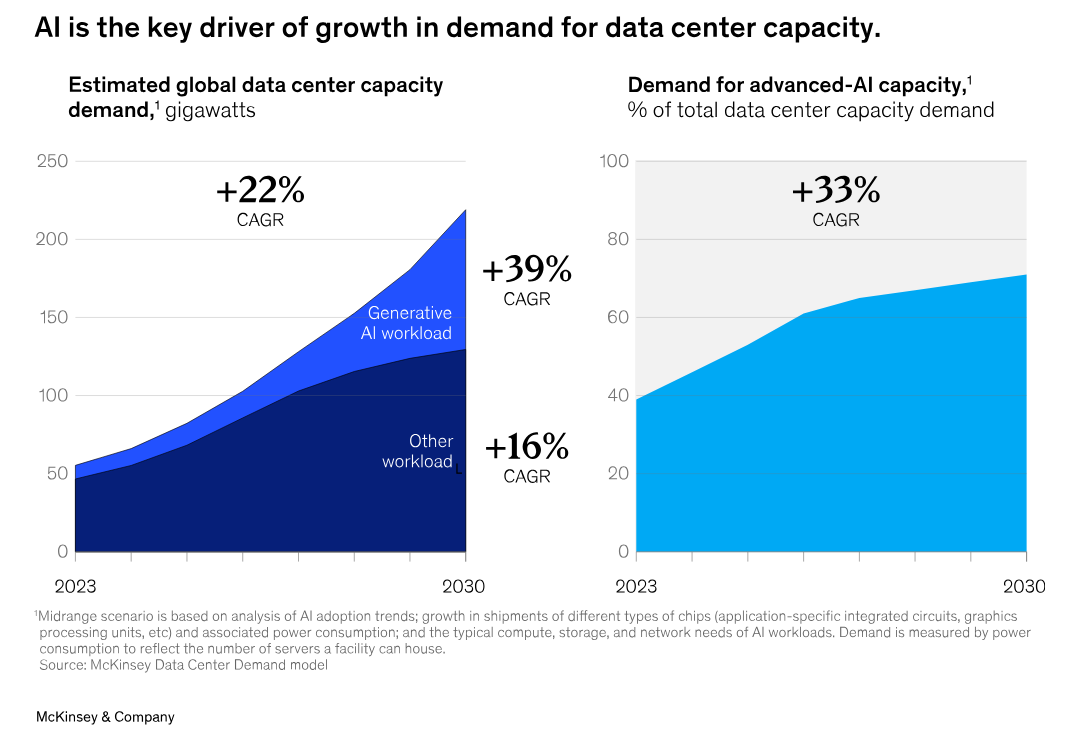
As a result, the second wave of capital began flowing into two major directions.
The first was data center storage.
AI does not only require training data. It also requires massive intermediate result storage, vector database reads, checkpoint management, model version switching, cache acceleration, inference logging, and enterprise knowledge base retrieval. In the future, agentic systems may elevate the importance of storage even further, because AI will no longer be limited to real-time computation. It will increasingly need to read and write context continuously, retrieve memory, manage task states, and revisit prior outputs.

That means SSDs are no longer just supporting actors in traditional servers. They are becoming foundational infrastructure in the AI data path.
The IOPS, latency, power efficiency, reliability, and scalability of enterprise storage will directly shape the throughput efficiency of the AI factory.
The second direction was optical modules and high-speed interconnects.
As GPU clusters scale larger, bandwidth pressure in both scale-up and scale-out architectures rises sharply. Once parameter sizes, node counts, and inference clusters all expand at the same time, the communication cost inside the data center rapidly becomes a system-level bottleneck.
Because once the AI token economy entered its middle phase, the market began to understand that
Token cost is not determined only by how chips compute, but also by how data flows.
This marked a crucial turning point.
The core narrative of the first wave was compute scarcity.
The core narrative of the second wave became system efficiency scarcity.
And once those two waves were substantially priced in, the next major question began to surface:
if future AI systems are no longer single-model, single-path systems, but instead involve large numbers of agents, multi-step reasoning, multi-model collaboration, dynamic orchestration, and context management, then who is actually responsible for coordinating the entire factory?
The answer increasingly points back to the CPU.
Wave Three: As AI Enters the Era of System Orchestration, the CPU May Move from Supporting Role Back to Strategic Importance
When people talk about AI hardware today, their instinct is still largely GPU-centric. But that view contains an implicit assumption: that AI workloads are primarily large-scale parallel math, and that the system itself operates in a relatively linear manner.
The problem is that future AI may not look like that at all.
As AI evolves from one-shot prompting into agentic workflows, tool calling, multi-model chaining, task decomposition, memory management, cross-node collaboration, and real-time response, the nature of the workload becomes increasingly fragmented, dynamic, and dependent on orchestration and control. At that point, what matters is no longer just matrix multiplication, but also:
Who assigns tasks?
Who manages I/O?
Who coordinates memory and storage layers?
Who handles network packets, data prefetching, workload scheduling, resource arbitration, fault recovery, and context switching?
The answer is usually not the GPU.
It is the CPU.
This is precisely where the third wave is most likely to be underestimated.
For years, the market’s view of CPUs has remained trapped in the traditional server era: general-purpose compute, control-plane logic, but limited upside, and overshadowed in the AI era by the GPU.
But if the future AI factory is really about end-to-end token production efficiency rather than isolated peak accelerator performance, then the CPU’s role begins to shift from “background controller” to “system coordination hub.”
This does not mean CPUs will replace GPUs.
That is not the point.
The real point is that the next AI bottleneck may not be compute itself, but whether the full system can be organized efficiently.
And once the industry shifts from an accelerator-centered architecture toward a system-coordination-centered architecture, the value of the CPU starts to be recalculated.

4月24日
Why Is the Third Wave Only Beginning to Be Seen Now?
The reason is simple: industrial evolution has an order.
When GPUs were in acute shortage, the market was not going to spend much time debating orchestration, because the basic compute layer was not even sufficient yet.
Once large clusters began to be deployed, the next pressure point the market felt was networking and storage, which is why the second wave moved first.
Only when data centers began to truly operate AI factories, and to confront the realities of dense inference, complex workflows, and multi-tenant resource management, did people begin to realize that buying GPUs was not the end of the problem.
The real issue was how to keep the entire system from sitting idle.
At that point, the CPU’s responsibility was no longer just to boot the OS and manage standard server tasks. It started to move much deeper into the orchestration logic of the AI workflow itself.
Its value may become especially visible in the inference era.
Inference is less tolerant of long batch jobs than training. It is more sensitive to latency, context switching, token streaming, task scheduling, and service quality. Once workloads involve larger volumes of irregular operations, the CPU’s importance as an orchestration engine rises significantly.
Put more directly:
In the future, the most valuable capability may not be who has the most compute, but who can prevent expensive compute from going idle.
And that is exactly where the CPU has a chance to be re-rated.

2月4日
The Third Wave Is Not Just About the CPU Chip Itself, but a Revaluation of the Entire Control-Plane Ecosystem
If the market truly enters the third wave, then what gets re-rated will not be CPU vendors alone.
What matters more is the broader ecosystem tied to control planes, data-path optimization, memory coordination, and system-level software-hardware integration.
What does that include?
It includes server CPU architectures better suited for AI orchestration.
It includes DPUs, SmartNICs, and data-movement offload silicon.
It includes CXL-related memory expansion and resource pooling technologies.
It includes new operating system optimizations, runtimes, schedulers, and management software purpose-built for AI clusters.
And it includes how cloud providers and large system vendors redesign resource allocation at the rack, cluster, and even data-center level.
So the third wave is not “the CPU replacing the GPU.”
It is the market beginning to acknowledge that
In the mature phase of the token economy, value migrates from point compute toward total coordination.
This resembles the natural evolution of any industrial system from early buildout to operational maturity.
At first, everyone cares most about whether the primary equipment is powerful enough. Then they begin to care about conveyors, warehouses, and logistics. Eventually they realize that what truly determines profitability is the scheduling system, the management system, and total factory efficiency.
AI is moving down the same path.

2025年10月13日
How Should the Market Think About What Comes Next?
If we accept the framework of the three great waves of the AI token economy, then analyzing the sector going forward can no longer be about isolated components. It must be about how value propagates from one layer to the next.
The first wave told us that the origin of AI is compute, and GPUs were the first assets to be re-rated.
The second wave told us that once tokens scale, bottlenecks spill outward into storage and interconnect, which is why optical modules, switches, SSDs, networking equipment, and their supply chains begin to benefit.
The third wave suggests that as AI enters large-scale deployment and complex orchestration, CPUs and the broader control plane will become more important than the market previously assumed.
These waves do not replace one another. They accumulate.
GPUs are not going away. Optical modules and storage are not fading either. And the CPU is not suddenly becoming the only protagonist. The real change is that the market is moving from a single-chip narrative toward a full-system narrative.
This is also why analyzing the AI industry will become harder from here.
Because the winners may not simply be the companies with the single strongest chip. They may be the ones best able to integrate chips, memory, networking, storage, power, and cooling into a highly efficient AI factory.
Seen from that perspective, the AI token economy has never been just another semiconductor cycle. It looks more like a new kind of digital industrial revolution, and the token is its standardized unit of output.
Whoever can produce tokens faster, cheaper, and more reliably is the one most likely to shape the next phase of AI industry leadership.

3月17日
Conclusion: What the Third Wave Really Re-rates Is Not Just the CPU, but Who Controls the Entire AI Factory
If we still think AI infrastructure simply means buying more GPUs, we may already be behind.
Because the industry is entering a more complex and more realistic phase:
token production is no longer just a competition in raw compute. It is a competition in total systems engineering. And once the contest shifts from chip performance to factory efficiency, the market has to reassess those components that were once treated as supporting players, but are in fact responsible for keeping the entire system running.
The first wave captured the compute dividend through NVIDIA GPUs.
The second wave captured the data-flow dividend through storage and optical modules.
The third wave may become the moment when CPUs, and more broadly the control plane, begin to be revalued.
So the real question may not be:
can the CPU be great again?
It may instead be: as the AI token economy matures, who is the true master scheduler capable of keeping the entire AI factory running at peak efficiency?
The answer may be far closer to the CPU than the market is currently willing to admit.

4月7日

2025年7月9日


PreviousNext