Intel Has Moved From “Can It Survive?” to “How Fast Can It Expand Capacity?”
Intel Has Moved From “Can It Survive?” to “How Fast Can It Expand Capacity?”
- Source: SemiVision
- Author: SEMIVISION
- Published: 2026-04-24T11:39:00+08:00
- URL: https://tspasemiconductor.substack.com/p/intel-has-moved-from-can-it-survive (1) Intel Has Moved From “Can It Survive?” to “How Fast Can It Expand Capacity?”


Intel Has Moved From “Can It Survive?” to “How Fast Can It Expand Capacity?”
Original Article By SemiVision Research [Reading time: 16 mins]

Apr 24, 2026
∙ Paid

This is not just an earnings surprise. It is a signal that a legacy semiconductor giant is stepping back into the center of the AI battlefield.
In after-hours trading, Intel’s stock surged nearly 20%, and market sentiment shifted almost instantly. For a company that, over the past several years, has been weighed down by process delays, organizational sluggishness, capital expenditure pressure, and persistent strategic doubts, such a reaction was about far more than simply “beating earnings expectations.” It felt more like a delayed collective acknowledgment: the market is finally beginning to believe that Intel may actually be on its way back.

And at the center of this turning point is none other than CEO Lip-Bu Tan.
For years, most discussions about Intel focused on what it had missed: it missed mobile computing, missed the GPU wave, missed the most lucrative early phase of AI training growth, and missed the era when process leadership alone was enough to dictate the rhythm of the industry. But this time, what the market is starting to see is not just what Intel once lost, but what it is now rebuilding.
That is why this earnings report deserves to be read on a higher level. What truly matters is not simply that Q1 numbers looked strong, but that Intel’s corporate narrative is beginning to undergo a structural shift.

After Lip-Bu Tan took over, Intel appears to have made four important moves in the right direction, each addressing a different layer of the company’s recovery.
First, political backing.
By bringing in the U.S. government as a 9% shareholder, Intel gained more than just capital. It gained strategic protection. In today’s semiconductor industry, where national security, industrial policy, and supply chain control are tightly linked, political support matters. This move helps position Intel not simply as a struggling chip company, but as a national technology asset with long-term strategic importance.
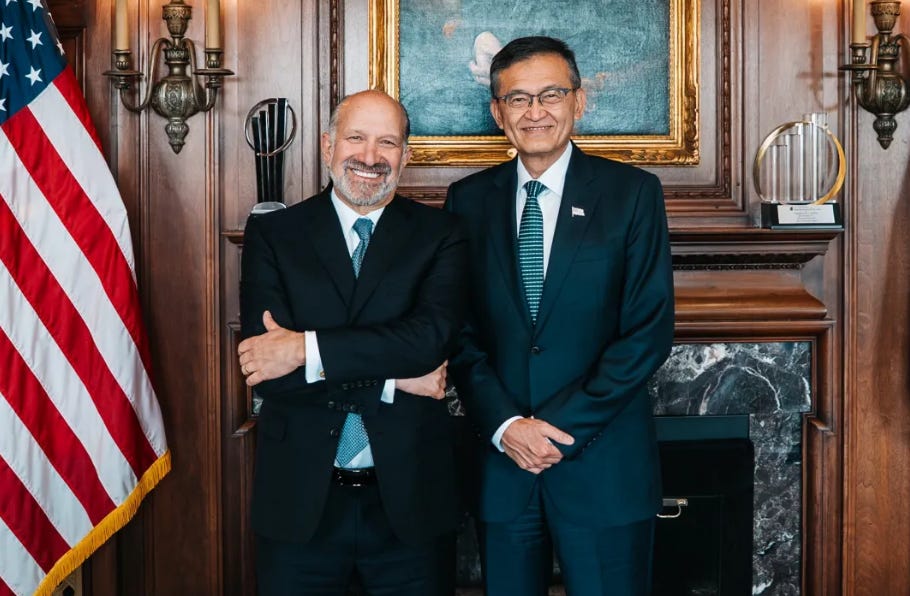
U.S. Secretary of Commerce Howard Lutnick poses with Intel CEO Lip-Bu Tan in a photo he shared on X on Aug. 22, 2025.
Second, technical validation.
Having NVIDIA take a 4.5% stake sends a powerful signal to the market. NVIDIA is the center of the current AI infrastructure ecosystem, so its involvement is not just financial. It functions as a form of technical endorsement. It tells the market that Intel is still relevant in the next phase of computing, and that its technology, manufacturing roadmap, or system-level role remains valuable to the broader AI ecosystem.
Third, customer traction.
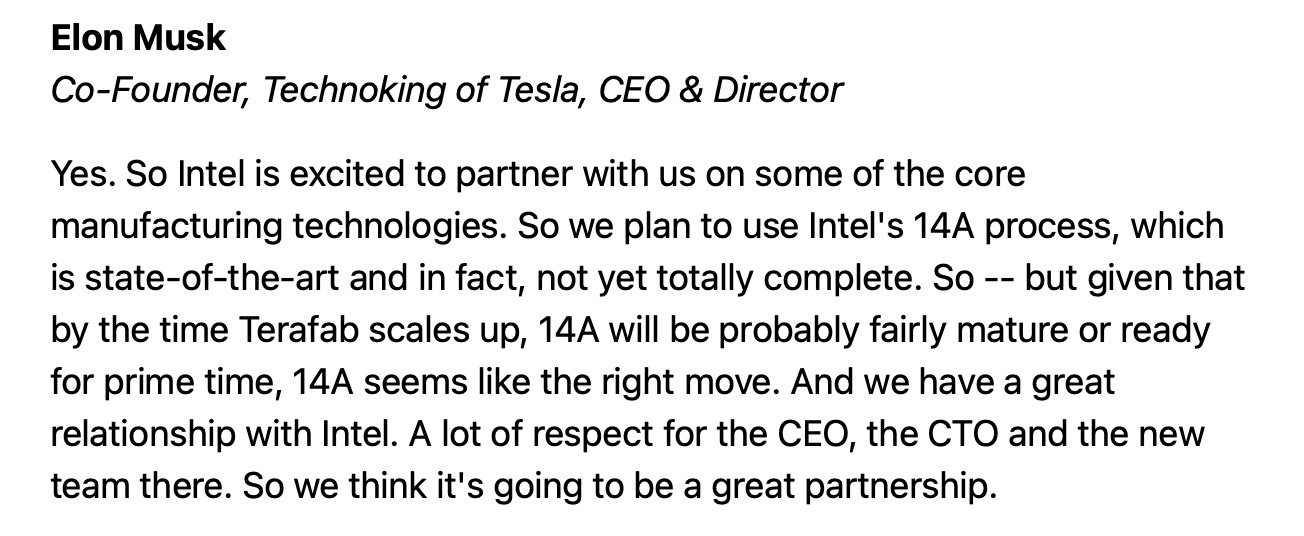
Intel’s participation in Musk’s TeraFab project is especially important because it gives Intel Foundry a landmark external customer. If Intel’s 14A process is used as the first major manufacturing platform in such a high-profile project, that means Intel is no longer only talking about foundry ambitions in theory. It is beginning to translate those ambitions into real customer demand. That is a major shift, because foundry credibility is built not by promises, but by customers willing to commit.
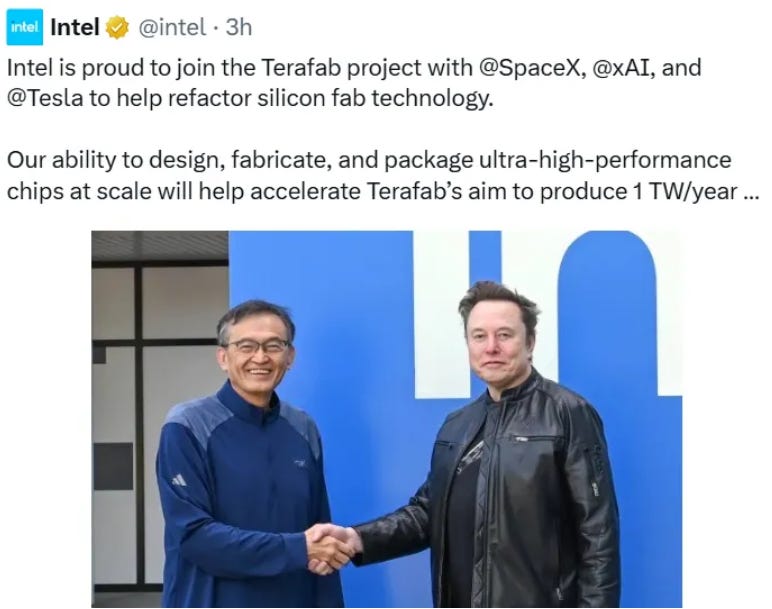
From a different perspective, Terafab’s decision to partner with Intel is less about preference and more about the absence of viable alternatives. TSMC’s capacity is already tightly committed to high-margin customers for years ahead, while Samsung Electronics remains anchored in a lucrative memory upcycle. With both players enjoying clear demand visibility through roughly 2028–2030, neither is incentivized to divert resources toward a high-uncertainty project like Terafab.
Fourth, balance-sheet repair and strategic control.
Buying back the Ireland fab that had previously been sold to Apollo is not just an asset transaction. It signals that Intel is trying to restore control over its manufacturing base and improve the long-term structure of its balance sheet. In turnaround situations, regaining ownership of critical assets can matter as much as improving quarterly earnings, because it gives management more flexibility over capacity planning, capital allocation, and future expansion.
Fab 34’s Strategic Importance: The Critical Birthplace of Core Ultra and Xeon 6
Just how important is Fab 34 in Ireland that Intel was willing to spend $14.2 billion to fully buy it back?
Fab 34 is one of the most important manufacturing sites in Intel’s global production network, with both substantial capacity and some of the company’s most advanced EUV lithography capabilities. It is currently a key production base for products built on the Intel 4 and Intel 3 process nodes. That means a significant share of the core dies used in Intel’s highly sought-after AI PC processors under the Intel Core Ultra family, as well as the Intel Xeon 6 server processors designed for data centers and AI infrastructure, are produced at this fab.
Intel has emphasized that Ireland, and Fab 34 in particular, will remain central to its future product roadmap. After regaining full ownership, Intel plans to continue making major capital investments in the site to expand manufacturing capacity and meet strong demand from next-generation AI systems.
With Intel securing the development progress of next-generation nodes such as Intel 18A while also regaining full control of one of Europe’s largest advanced wafer fabs, the company is expected to be better positioned for the long-term competition ahead—both against TSMC in foundry manufacturing and against AMD in the AI chip market.
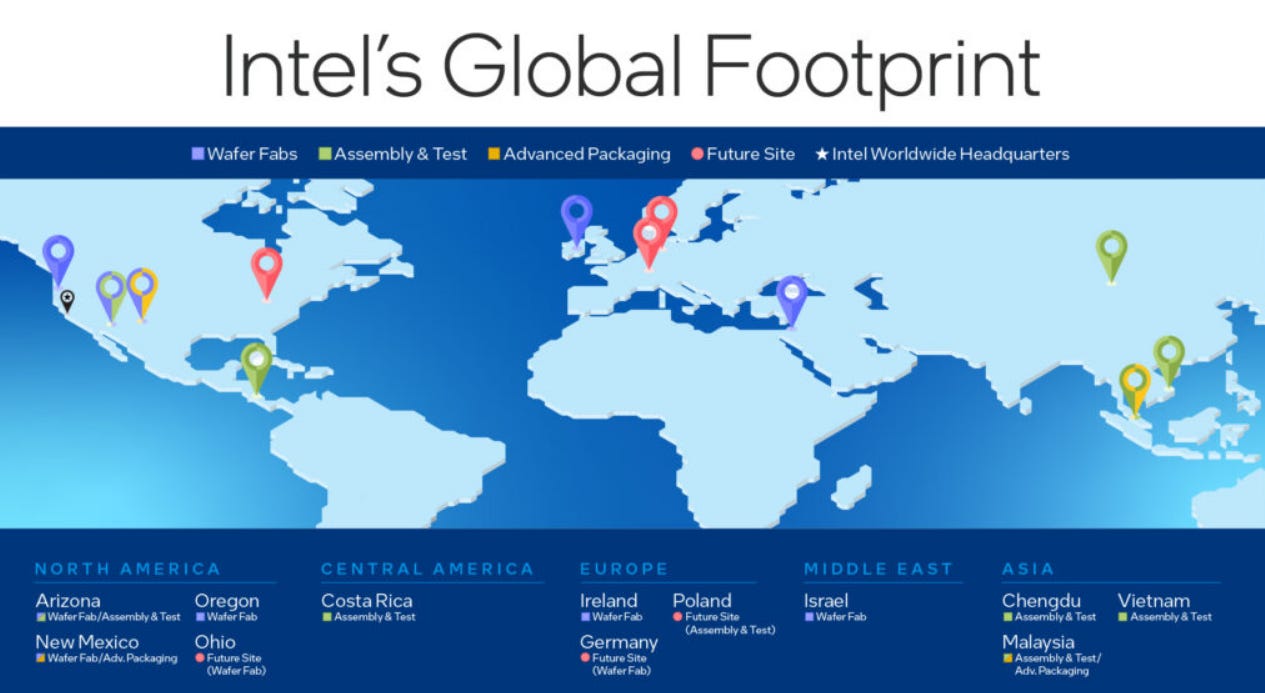
Sourece: intel
Taken together, these four moves form a coherent recovery framework: political protection, technical endorsement, real customer momentum, and asset restructuring. That is why Intel’s narrative has changed from “Can the company survive?” to “How fast can it expand capacity?” This is starting to look like a structural shift, not just a short-term emotional reaction from the market.

From “Can It Survive?” to “How Fast Can It Scale Capacity?”
A single line from Lip-Bu Tan during the earnings call almost defined the entire report:
“A year ago, the conversation around Intel was whether we could survive. Today, the conversation is how quickly we can expand manufacturing capacity and scale supply to meet enormous product demand. This is a fundamentally different company.”
The power of that statement lies not just in its drama, but in the fact that it reflects what is actually happening inside Intel: the market’s frame of reference for evaluating this company is changing.
Intel’s Q1 earnings report came in clearly ahead of expectations on nearly every major metric. Revenue rose 7.2% year over year to $13.577 billion, beating Wall Street expectations by more than $1.1 billion. EPS reached $0.29, far above the market’s original estimate of $0.01 and also well ahead of the company’s own earlier conservative guidance. Gross margin came in at 41.0%, roughly 650 basis points above prior expectations. More importantly, this was not a one-off surprise. It marked the sixth consecutive quarter in which Intel outperformed its own guidance.
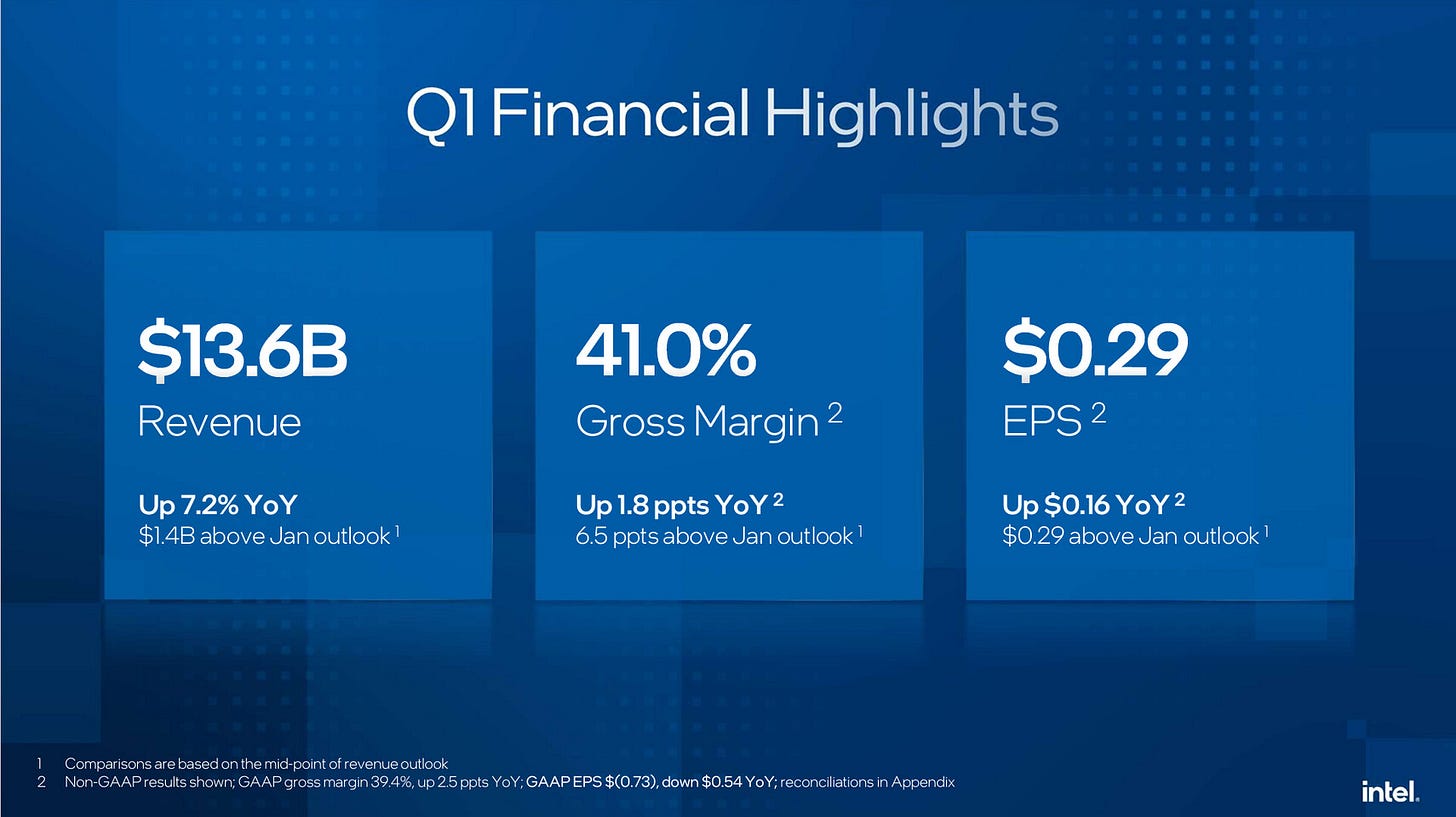
That consistency matters. What the market fears most is not a company going through a downturn, but a company that still shows no execution discipline after the downturn begins. The signal Intel is sending now is exactly the opposite: it is not just improving, it is improving systematically.
Q2 guidance was equally strong. The company projected revenue of $13.8 billion to $14.8 billion, with a midpoint of about $14.3 billion, well above the market consensus of $13.07 billion. EPS is expected to come in at $0.20, again above the previous Wall Street estimate of $0.09. Even capital expenditure guidance was revised upward, from “flat to down” to simply “flat,” suggesting management now has greater confidence in the durability of demand.
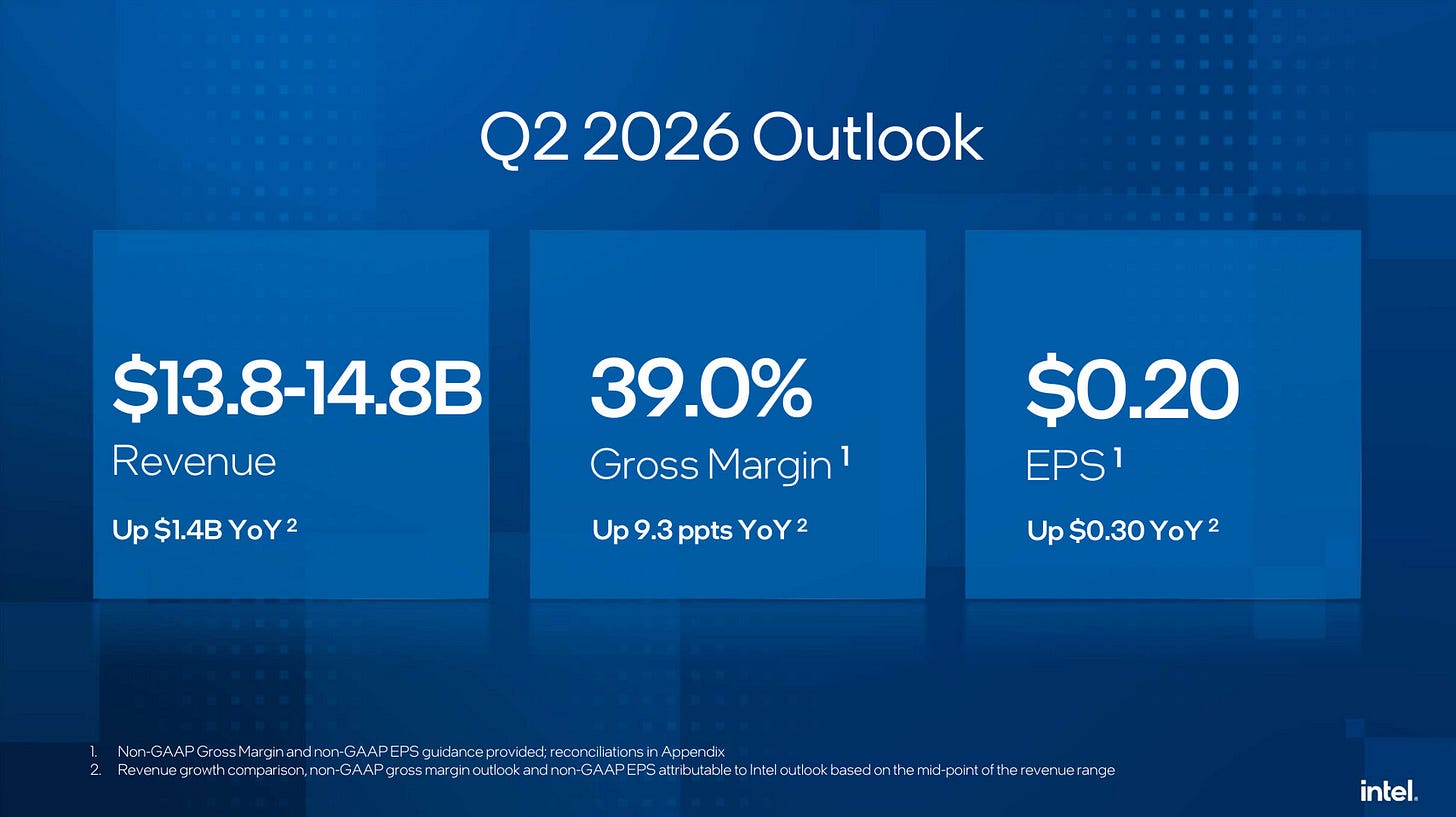
This is not the tone of a company still in defensive mode. It sounds more like a company beginning to regain initiative.
The Real Turning Point: CPU Reclaims Its Place in the AI Era
If there is one area in this earnings report that most deserves a market reappraisal of Intel, it is not PCs, nor process technology alone. It is the data center.

This quarter, Intel’s Data Center and AI (DCAI) segment generated $5.15 billion in revenue, up 22% year over year and 7% sequentially, significantly above market expectations. Operating income reached $1.5 billion, up more than 150% year over year, while operating margin jumped from 13.9% a year earlier to 30.5%. This was not just a revenue rebound. It reflected improving earnings quality and a better product mix.
More importantly, Intel told the market a new story: in the AI era, this is not just a GPU story. The CPU is moving back toward the center.
For the past two to three years, the entire AI infrastructure narrative has been dominated by GPUs. The market talked about compute, HBM, NVLink, scale-up, and scale-out, as if discussing AI was synonymous with discussing GPUs. But as AI moves from model training to inference, from single models to agentic AI, multi-agent collaboration, and large-scale workflow orchestration, the bottlenecks in the system are beginning to change.
At that point, the CPU is no longer just a supporting actor. It once again becomes the core of the control plane, orchestration layer, and task scheduling layer.
The deployment ratios Intel described are especially revealing: in the training phase, the ratio may be one CPU paired with seven to eight GPUs, but in inference, that ratio may fall to 1:3 or 1:4. In agentic AI and multi-agent workloads, the CPU’s role may rise even further. Behind this lies a larger industry logic: the value of AI systems is shifting from point compute performance to overall coordination efficiency.
Whoever can manage data flow, memory flow, model switching, task scheduling, and I/O resources can reclaim strategic control over the infrastructure stack.
And that is exactly the position Intel wants to win back.

4月21日

3月25日
Customer Signals Are Starting to Become Real
Any argument without customer behavior to support it remains just a story. What is different this time is that Intel is starting to show evidence from the customer side that can support this new narrative.
In Q1, Intel signed a multi-year agreement with Google under which Google will deploy multiple generations of Intel Xeon processors in optimized compute instances, including the latest Xeon 6 platform. This is not merely about shipment volume. It is about whether a major customer is willing to place part of its infrastructure roadmap in your hands for the next several years.

Intel, Google Deepen Collaboration to Advance AI Infrastructure
The cooperation also extends into custom ASIC infrastructure processing units. That suggests Intel is moving beyond simply selling CPUs and toward deeper participation in infrastructure design itself.
Another highly symbolic signal is that NVIDIA selected Intel Xeon 6 as the host CPU for its DGX Rubin NVL8 system. That matters because it means that even inside the most advanced AI accelerator platforms, Intel has not been pushed out. It remains the orchestrator the overall system still depends on.

Intel Xeon 6 used as Host CPUs in NVIDIA DGX Rubin NVL8 Systems
At the same time, Intel is also partnering with SambaNova to advance a heterogeneous computing architecture combining GPUs, RDUs, and Xeon processors. Taken together, these signals are telling the market something important: Intel may not have won every battlefield in AI chips, but it is re-penetrating the foundation layer of AI infrastructure.
This kind of return may not be as dazzling as GPUs, but it may prove more durable, deeper, and harder to replace.

These three were placed side by side because they represent three different architectural paths for large-scale AI inference, especially for trillion-parameter and premium inference workloads. Intel + SambaNova represents a more deployable and data-center-friendly approach that emphasizes compatibility with existing infrastructure, lower power per rack, and stronger utilization. NVIDIA + Groq represents a high-performance but far more infrastructure-intensive path, requiring large-scale new cooling and power deployment. Cerebras represents a more specialized architecture that is being tested against the same workload class, but in this comparison is portrayed as less practical for this specific trillion-parameter premium inference scenario. In other words, the comparison is really about three competing ideas for how future large inference systems should be built: scalable integration into today’s data centers, brute-force high-performance expansion, or highly specialized alternative compute architecture.

3月30日
What Lip-Bu Tan Is Really Saving at Intel Is Not Just the Financials, but Its Sense of Direction
People often reduce corporate turnarounds to a few simple moves: layoffs, cost cuts, inventory cleanup, and higher gross margins. But the hardest part of a real turnaround is not just rescuing the numbers. It is rescuing the company’s sense of direction.
Intel’s biggest problem in recent years was never just that a particular process node fell behind. It was that the company as a whole began to lose clarity around a more fundamental question: who are we, and how do we win? It wanted to defend PCs, chase data centers, build a foundry business, and break into AI, all while absorbing massive time pressure and capital burdens on every front. When a company wants to do everything but does none of it fast enough, the market inevitably applies a discount.
Lip-Bu Tan’s value lies precisely in the fact that he is not managing Intel through nostalgia. He is restructuring Intel at the intersection of capital markets, industry structure, and customer demand.
He is helping the market understand that Intel’s future does not need to be a replica of its old golden era, when its in-house CPU architecture could dominate the world on its own. A new Intel can instead be an infrastructure company that simultaneously controls CPUs, ASICs, advanced packaging, advanced manufacturing, and critical system integration entry points.
That is the real meaning of rescue.
It is not about taking Intel back to the past. It is about helping Intel find a position from which it can still survive, and perhaps become important again, in the future.
4月8日
Foundry, ASIC, and Advanced Packaging Are the Real Bet Beyond 2028
Beyond the earnings report itself, another area being rapidly repriced by the market is the long-term potential of Intel Foundry.
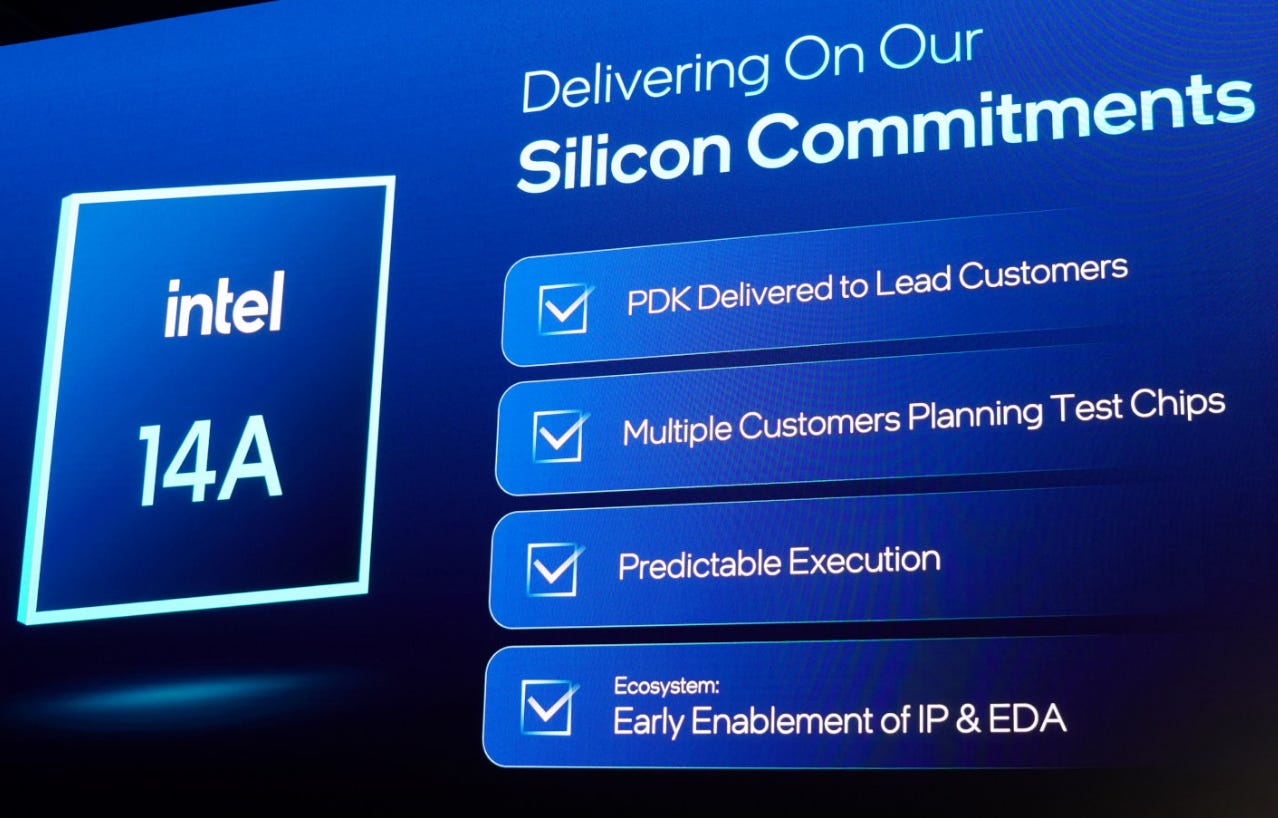
Yield progress on 18A is running ahead of internal expectations, and management described 14A as maturing faster than 18A did at the same stage. That suggests Intel is at least beginning to recover a degree of predictability in both technology execution and organizational execution. In the foundry business, predictability matters far more than slogans, because external customers do not place orders because you have a compelling story. They place orders because you can manufacture at scale, deliver reliably, and control risk.
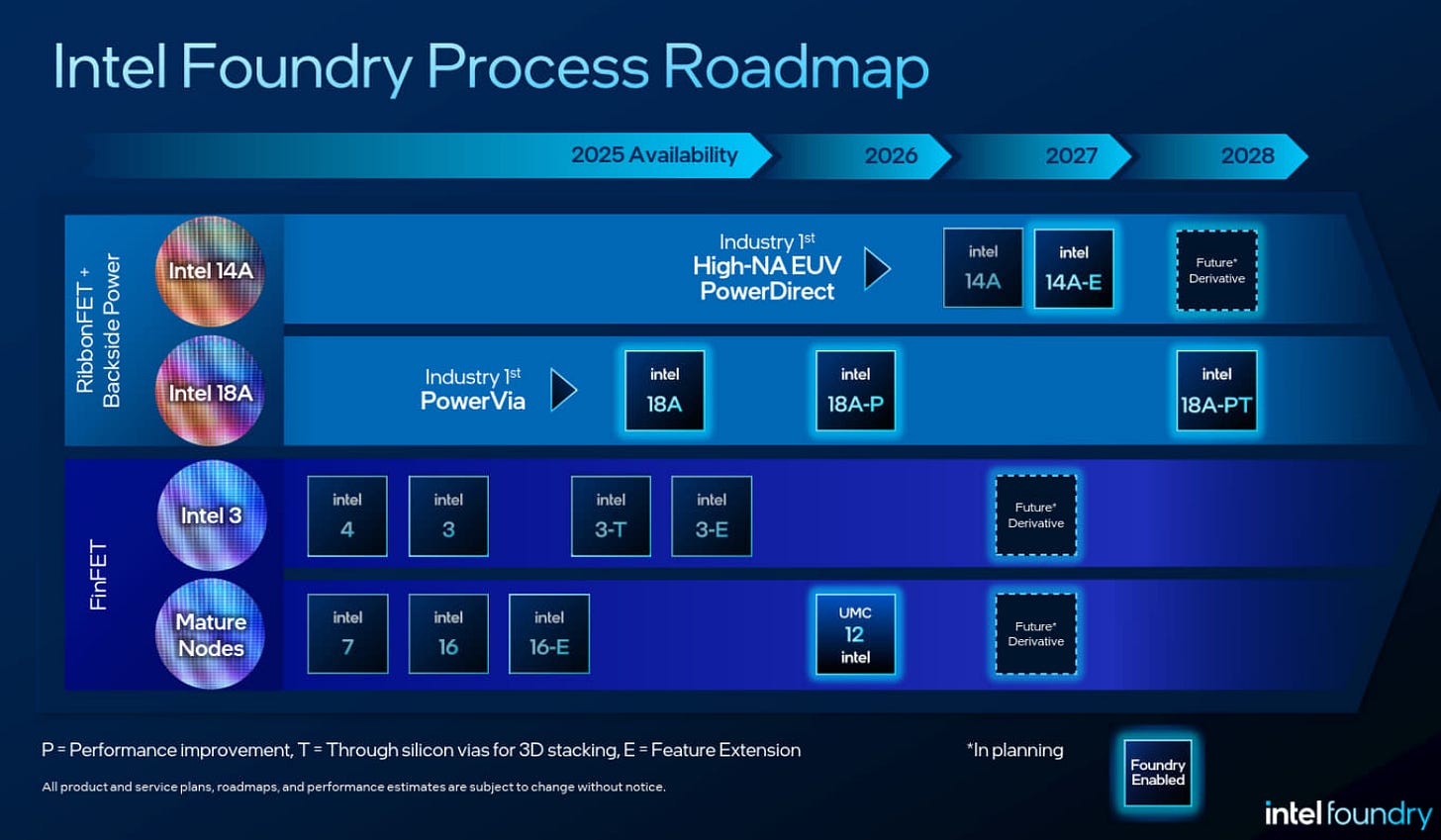
Even more worth watching is the growth of ASIC and advanced packaging. Management noted that it had originally assumed this opportunity would amount to only a few hundred million dollars, but actual demand is proving to be in the tens of billions of dollars annually. If that holds true, then Intel has not simply found a short-term lifeline. It may have found a new entry point capable of genuinely reopening its growth curve.
Because in the AI era, competition is no longer simply about who has the most advanced process node. It is about who can integrate custom silicon, packaging, I/O, memory, and overall system co-design. If Intel can establish an unavoidable presence at that level, the market will have to reevaluate the company.
That is also why today’s elevated valuation multiple, while aggressive on the surface, may not be entirely irrational. The market is not buying the Intel of today. It is betting on the Intel of 2028 and beyond: an Intel with external foundry customers, volume production on 14A, advanced packaging as a strategic entry point, and a gradually recovering margin structure.
The Rescue Is Not Finished, but the Direction Has Changed
Of course, this needs to be stated clearly: Intel has not completed its turnaround yet.
The PC business may soften in the second half of the year. Costs for memory, wafers, and substrates are still rising. The foundry business still needs more time to prove it can attract external customers at meaningful scale. And the progress of 18A and 14A must ultimately be validated through actual volume production and customer adoption, not merely through earnings-call narratives.
But the market does not care only about outcomes. It also cares about direction.
And the biggest significance of this earnings report is that, for the first time in a long time, it gave the market more confidence that Intel is no longer simply being hit passively, no longer just waiting for historical advantages to return, but is genuinely starting to reorganize its future in a new way.
So, has Lip-Bu Tan already saved Intel?
Strictly speaking, it is still too early to say. A true turnaround does not happen in a single quarter.
But if we reframe the question, the answer may become clearer:
Has Lip-Bu Tan already made the market believe that Intel deserves to be believed in again?
Based on the stock reaction, the earnings numbers, the customer signals, and the strategic narrative, the answer is very likely yes. And that is often the first step in saving a legacy technology giant.
Addendum: Which Companies Has Lip-Bu Tan Saved Before?
If the market is now willing to believe that Lip-Bu Tan has a real chance of pulling Intel out of its slump, it is not just because this quarter’s earnings were strong. It is also because he has repeatedly proven in the past that he is not merely an investor, nor just a chairman who tells a compelling story. He is someone who has actually restructured companies, rescued them, and helped them turn around.
The most representative example is, of course, Cadence.
Around 2009, Cadence was going through a difficult period. The company faced stagnating growth, rising competitive pressure, and the need to restructure its product portfolio. After taking over as CEO, Lip-Bu Tan did not rely on short-term financial engineering to polish the numbers. Instead, he worked simultaneously on product strategy, customer relationships, R&D cadence, and operating discipline, gradually bringing the EDA company back onto a growth trajectory. Cadence not only regained its competitiveness, but also went on to become one of the central pillars of the global semiconductor design ecosystem. In many ways, this was Lip-Bu Tan’s most classic turnaround story, and it showed the market that he was not a typical financially driven venture capitalist, but an industrial leader capable of getting deep into the substance of a business.
Another frequently cited example is his long-term involvement through Walden International in supporting, restructuring, and guiding numerous semiconductor and technology companies. Not every one of these companies is as well known as Intel or Cadence, but within the industry, Lip-Bu Tan has long been known as someone willing to step in at critical moments, work deeply through the board, and help companies regain their direction. What he has done has never been just about investing capital. It has involved helping companies reset strategy, bring in resources, rebuild governance structures, and in some cases directly influence management teams and technology roadmaps.
If we widen the scope further, the Avago/Broadcom ecosystem is also often seen as an important example of his influence. Strictly speaking, this is not a single “saved company” case, but rather an illustration of his long-term ability to shape outcomes across both the semiconductor capital world and the industrial landscape. Many companies do not automatically become scaled platforms with real capital market value just because they have technical assets. They need people like Lip-Bu Tan to help them find the right place at the right time.
So what makes Lip-Bu Tan truly exceptional is not merely that he has saved one company or another. It is that he has repeatedly proven something deeper:
He knows how to restore order to a company at the moment when it is most chaotic, most undervalued, and most directionless.
And that is exactly the capability Intel needs today.
From that perspective, the market’s confidence in him is not about charisma or aura. It is about the fact that he has done this before, and more than once.
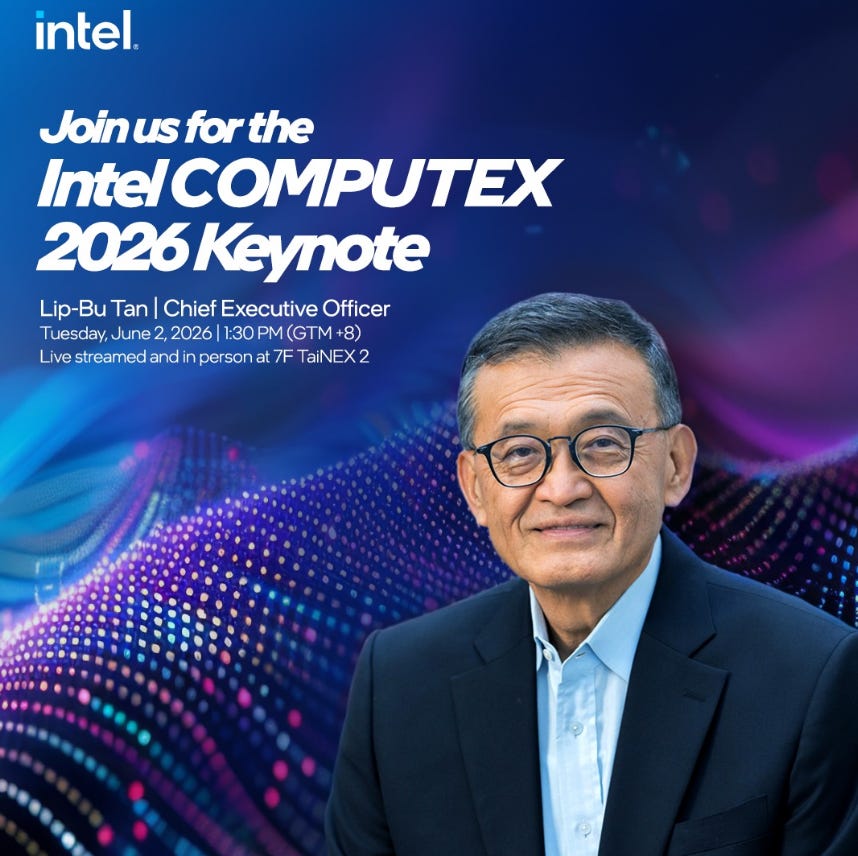
[Intel CEO Lip-Bu Tan to Deliver a Keynote at COMPUTEX 2026]
Intel CEO Lip-Bu Tan will deliver a keynote speech at COMPUTEX 2026 on June 2, where he will share Intel’s vision for the next generation of computing in the AI era.
Tan will discuss key breakthroughs across silicon, systems, and software, and how deep collaboration with the broader ecosystem can help drive performance, energy efficiency, and scalable growth to the next level. He will also share how Intel is working closely with customers and partners to help define the future of heterogeneous computing and build the infrastructure needed to support the AI era.
Event Information:
Date:June 2, 2026, 1:30 PM
Venue:7F, Taipei Nangang Exhibition Center, Hall 2
Registration:Expected to open in mid-April on the official COMPUTEX website


PreviousNext