VLSI: Taiwan’s Window for International Collaboration in Critical AI Technologies
VLSI: Taiwan’s Window for International Collaboration in Critical AI Technologies
- Source: SemiVision
- Author: SEMIVISION
- Published: 2026-04-21T09:01:28+08:00
- URL: https://tspasemiconductor.substack.com/p/vlsi-taiwans-window-for-international (1) VLSI: Taiwan’s Window for International Collaboration in Critical AI Technologies


VLSI: Taiwan’s Window for International Collaboration in Critical AI Technologies
Original Article By SemiVision Reserach [Reading time: 13 mins]

Apr 21, 2026
∙ Paid
As semiconductor strength begins to spill outward, Taiwan’s real opportunity is no longer just chip manufacturing, but helping define the infrastructure of the AI era
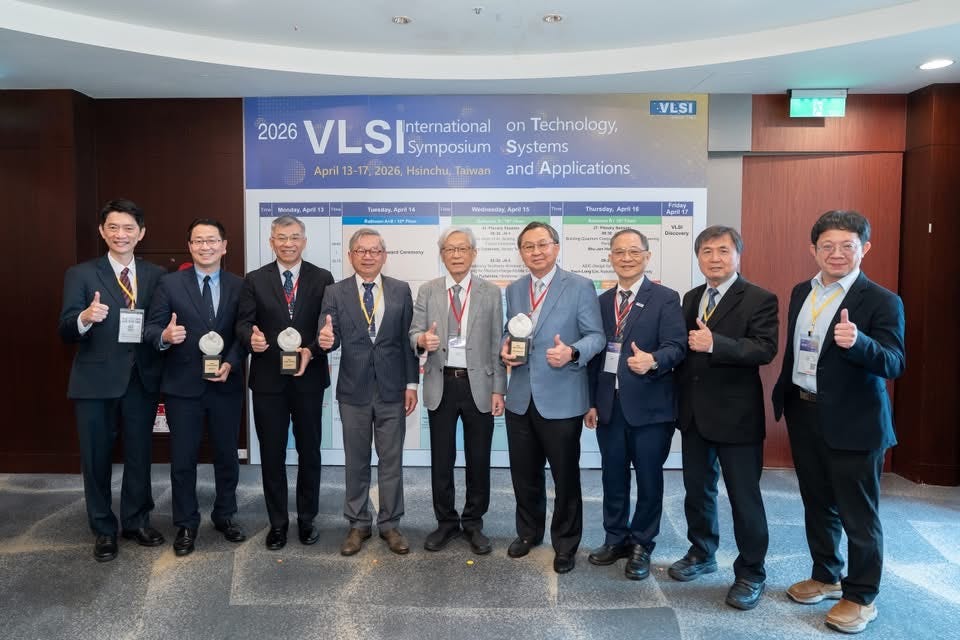
The 2026 VLSI Technology, Systems and Applications Symposium (VLSI TSA), organized by ITRI, was held in Hsinchu from April 13 to 17. Now in its 43rd year, the conference remains one of Taiwan’s most enduring and internationally recognized semiconductor gatherings. Its significance has never been limited to paper presentations. What makes it valuable is its role as a long-running platform that brings together the world’s most important conversations in semiconductors, systems, communications, computation, and applications into one place.

What stood out this year was how clearly the conference had moved beyond the boundaries of traditional semiconductor topics. The agenda still covered core chip technologies, but it also expanded into AI, quantum computing, networking, smart healthcare, intelligent systems, robotics, autonomous vehicles, and silicon photonics. That shift may look natural on the surface, but it reveals something more profound underneath:
Semiconductors are no longer a standalone industry. They are becoming the common substrate of nearly every next-generation strategic technology.
That is why Taiwan’s role is changing.
For decades, Taiwan’s value to the global technology system was built on one central capability: being a highly efficient, deeply trusted, and highly scalable manufacturing hub. That model allowed Taiwan to rise from a latecomer in the 1970s into one of the central pillars of the global semiconductor supply chain. But in the AI era, being excellent at making chips is no longer enough. What the market increasingly needs is not a single chip, but a full-stack physical infrastructure spanning compute, packaging, optical interconnect, networking, system integration, and real-world deployment.
In other words, Taiwan’s next competition is no longer about foundry ranking alone. It is about whether it can extend its semiconductor advantage into a broader systems advantage, platform advantage, and cross-border collaboration advantage.
That is the deeper meaning behind Taiwan’s current push into strategic AI technologies.

Source: chengwenwu
Taiwan’s next move is not merely to build AI chips, but to build the physical foundation of AI sovereignty
The Taiwanese government’s broader AI development agenda, including the so-called “New Ten AI Infrastructure Projects,” can easily be read as a collection of policy initiatives. But at a deeper technical level, many of these efforts are converging around the same objective:
Building the critical infrastructure required for sovereign AI.
Whether the focus is silicon photonics and all-photonic networks, high-speed quantum computing, intelligent robotics, or autonomous vehicles, the underlying dependence on semiconductors is overwhelming. And this dependence is not limited to advanced-node logic. It includes high-speed I/O, advanced packaging, low-power communications, heterogeneous integration, sensing, power management, materials, thermal systems, testing, and system validation.
The exhibition materials and discussion themes at the conference reflected this direction clearly. AI was not being framed as an abstract software trend. It was being grounded in specific deployment domains: food service and hospitality, healthcare and elderly care, logistics and inspection, disaster response, smart government, smart enterprise, and smart living. That framing matters because it points to a critical truth:
Future national competitiveness in AI will not be determined only by who has the largest model, but by who can embed AI into real physical systems.
And once AI enters the physical world, the conversation inevitably returns to hardware, networks, and systems architecture.
That is where Taiwan’s opportunity becomes much more strategic. Taiwan does not need to compete head-on with U.S. frontier model developers in training the biggest foundation models. Its opening lies elsewhere: in becoming one of the indispensable physical nodes in the rebuilding of global AI infrastructure.

4月17日
Sovereign AI is not a slogan. It is an integrated project spanning networks, compute, and data governance
“Sovereign AI” has become a popular policy phrase worldwide, but it is often described too vaguely. In practice, sovereign AI is not just about keeping data local, nor is it simply about building another data center. Its real meaning is this:
From that perspective, Taiwan’s efforts in all-photonic networking and regional AI compute orchestration deserve more attention.
Taiwan’s growing cooperation with Japan under the IOWN framework is important for exactly this reason. The meaning of this partnership is not simply that two countries are collaborating on telecom technology. The deeper significance is that they are beginning to test a new model for AI infrastructure: integrating AI data centers, data center interconnects, optical switching, and sovereign data governance into a resilient cross-regional compute network.
This matters because future AI capacity will not reside in a single city or a single server hall. Real AI sovereignty will come from the ability to coordinate compute nodes, data nodes, and network nodes across regions with resilience and operational flexibility. The phrase “cross-region resilient orchestration,” highlighted in the conference materials, points directly at that idea.
The future of sovereign AI is not isolated compute. It is an orchestrated, redundant, and secure compute network.
That is also why Taiwan-Japan collaboration carries strategic weight. Taiwan brings world-class semiconductor and ICT supply chains. Japan brings deep capabilities in telecom systems, optical networking architecture, and long-cycle industrial coordination. Together, they are not simply building a faster network. They are experimenting with a new model of national AI infrastructure.
Silicon photonics and co-packaged optics are Taiwan’s real bridge from AI supply chain participant to AI platform enabler
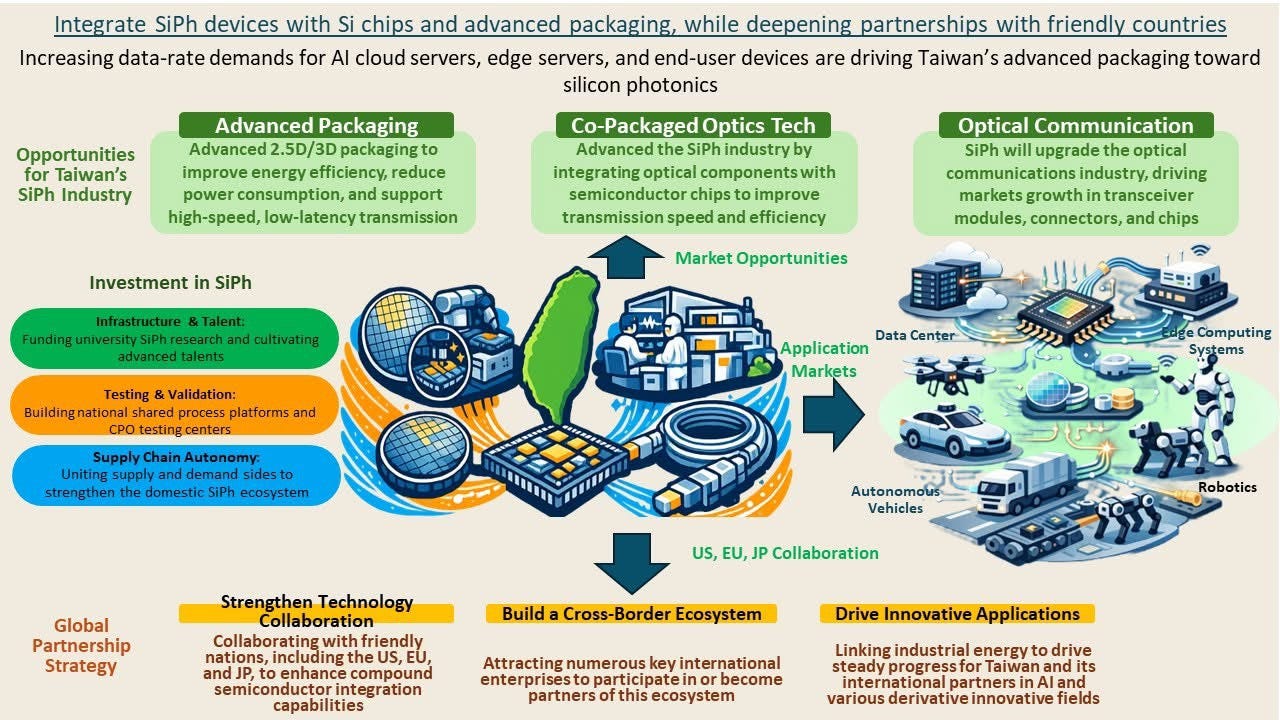
If all-photonic networks represent the external skeleton of sovereign AI, then silicon photonics and co-packaged optics represent its internal bloodstream.
Source: chengwenwu
That shift creates a meaningful opening for Taiwan.
Taiwan is not starting from zero in the capabilities required for silicon photonics. It already has much of the industrial base: advanced packaging, semiconductor manufacturing, substrates, modules, networking equipment, test infrastructure, and system integration. The question is not whether Taiwan can build isolated components. The real question is whether it can integrate these capabilities into a manufacturable, verifiable, and continuously evolving ecosystem.
That direction was visible in the conference materials. The strategic logic is clear: use advanced 2.5D and 3D packaging to improve energy efficiency, reduce power consumption, and support high-speed, low-latency transmission; deepen the integration of silicon photonics with chips and packaging through co-packaged optics; and extend those capabilities into broader application markets including data centers, edge systems, robotics, and autonomous mobility.
One of the most important aspects of this vision is that Taiwan is not trying to do everything alone. International collaboration is explicitly built into the strategy. That is the right approach. Silicon photonics is not an industry that any one country can fully localize end to end. Silicon platforms, compound semiconductor lasers, packaging equipment, testing systems, standards, and system-level customer validation are distributed across multiple countries and technical domains.
So Taiwan’s real opportunity is not to build a closed national stack. It is to become the most effective place for international silicon photonics capabilities to be integrated, verified, scaled, and industrialized.
Taiwan’s ambition should not simply be to have a silicon photonics industry. It should be to become the best cross-border integration base for the global silicon photonics ecosystem.
That matters more than winning a narrow race over who ships a specific optical engine first.

3月13日
Taiwan’s real advantage is not semiconductor strength alone, but the rare coexistence of four industrial foundations
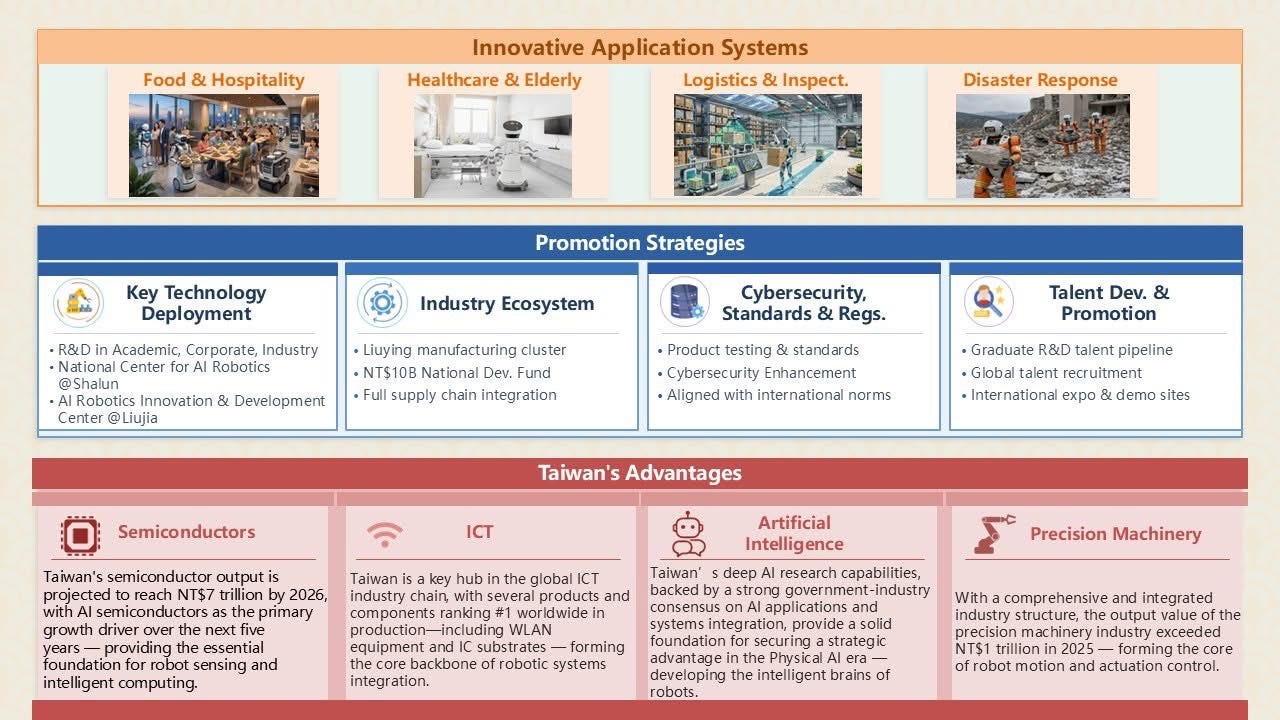
The conference materials repeatedly emphasized Taiwan’s four core strengths: semiconductors, ICT, artificial intelligence, and precision machinery. At first glance, that may sound like standard policy language. But in the context of AI becoming more physical, more distributed, and more system-intensive, the fact that these four domains coexist in one dense geography is a major structural advantage.
Semiconductors provide compute and sensing. ICT provides connectivity and system integration. AI contributes algorithmic intelligence and application logic. Precision machinery turns perception, compute, and control into motion and physical execution. These are not separate sectors. In robotics, autonomous systems, smart manufacturing, and intelligent healthcare, they are tightly coupled.
This is why countries talking about AI development eventually circle back to supply chains and manufacturing depth. The AI systems that will create durable economic value are not limited to cloud models. They will increasingly extend into embodied intelligence, industrial systems, mobility, and machine autonomy. And when AI moves into the real world, what matters most is not having the flashiest demo. It is having the engineering ecosystem that can integrate chips, modules, structures, communications, software, and application workflows into scalable products.
Taiwan is stronger in this stage than many realize. Its greatest asset is not a single technology leadership point, but an engineering environment with extraordinary industrial density, low coordination friction, and fast iteration cycles. That same environment previously powered the PC era, the smartphone era, and the server era. It is now being repurposed for the AI era.
So the most important question for Taiwan is not whether it can produce a breakout AI company. It is whether Taiwan can become the shared experimentation and deployment ground for global AI hardware, networks, and intelligent systems.
4月2日
High-speed quantum computing may also emerge through the industrial logic Taiwan already understands well
Quantum technology is often treated as distant, abstract, and reserved for physicists. That view is increasingly outdated. The global competition in quantum computing is no longer centered only on the QPU itself. It is becoming a systems engineering challenge: how QPUs integrate with CPUs, GPUs, control electronics, high-speed interconnect, cryogenic systems, and algorithmic frameworks.
That shift matters because it opens a path for Taiwan.
Taiwan’s strength has never been in abstract scientific prestige alone. Its real strength lies in turning technically difficult concepts into manufacturable, scalable, and engineering-ready systems. If quantum computing is to move from laboratory novelty into practical infrastructure, it will require extensive cross-disciplinary integration: materials, cryogenic electronics, packaging, control chips, high-performance computing platforms, signal chains, system software, and algorithms. None of these are alien to Taiwan’s industrial base.
What international teams increasingly recognize is that quantum progress will not come only from isolated scientific breakthroughs. It will also require a broader hardware and engineering ecosystem capable of bridging the gap between experiment and industrialization. That is why Taiwan is drawing attention. Global partners are not just looking at Taiwan as a chip maker. They are looking at Taiwan as a place that understands how to turn advanced computing platforms into real systems.
The logic here is the same as in silicon photonics, co-packaged optics, and AI servers. The real industrial race is not about who announces a concept first. It is about who can turn that concept into a scalable, repeatable, and economically viable system.

2025年5月12日
Robotics and autonomous vehicles may become the most direct test of Taiwan’s AI capability
If sovereign AI, all-photonic networking, silicon photonics, and quantum computing still belong partly to the layer of national infrastructure, then intelligent robotics and autonomous vehicles represent something more immediate: the direct test bed of Taiwan’s AI capability in the physical world.
These applications are unforgiving. They do not reward AI that works only in the cloud or only in the lab. They require real-time sensing, low-latency decision-making, stable communications, energy-efficient compute, safety, reliability, and maintainable systems in actual operating environments.
That requirement aligns unusually well with Taiwan’s industrial strengths.
The conference visuals positioned robotics across hospitality, healthcare, logistics inspection, and disaster response. These are important choices because they highlight a central reality: the winners in robotics will not necessarily be the teams with the most impressive model demos. They will be the ones that can integrate sensors, compute platforms, communications modules, mechanical design, energy systems, and regulatory compliance into deployable products and services.
This also explains why the strategic framework presented at the event gave so much weight to industrial ecosystem development, cybersecurity and standards, and talent cultivation. Robotics and autonomous systems do not become industries the moment a prototype appears. The real barriers emerge later, in validation, standardization, field deployment, lifecycle support, and operations.
For Taiwan to secure a strong position in this wave, the goal cannot simply be to fund a handful of robotics startups. The more important task is to reorganize its semiconductor, ICT, and precision machinery strengths into end-to-end solution capability for global customers. The key concept here is not isolated technical leadership, but system delivery capability.

4月11日
Conclusion: Taiwan’s next export may no longer be chips alone, but trusted AI systems capability
What makes conferences like VLSI TSA valuable is not only that they showcase new technologies. It is that they reveal how previously separate technologies are beginning to converge into a new industrial structure. This year’s signals were clear. Taiwan is gradually recognizing that the next phase of global competition will not be defined only by advanced-node manufacturing, nor only by how many AI chip orders a company can win. It will be defined by who can integrate semiconductors, optical communications, packaging, quantum systems, high-speed computing, robotics, and sovereign networks into a coherent industrial strategy.
Source: chengwenwu
And that shift plays to Taiwan’s strengths.
Taiwan’s real advantage has never been just one technology. It has been its ability to coordinate multiple difficult engineering disciplines and move them quickly toward scale and deployment. In the past, that capability served the global electronics industry. In the coming decade, it could serve the reconstruction of global AI infrastructure.
So the deeper message behind “Taiwan’s window for international collaboration in critical AI technologies” is not merely that Taiwan can work with friendly nations.
It is that Taiwan now has a credible path to evolve from a key manufacturer in the global supply chain into a key integrator, accelerator, and collaboration platform for the technologies that will define the AI era.
That is the more important signal.
Because as the world moves into a new phase shaped by AI, optical networks, quantum systems, and robotics, the scarcest asset may no longer be the single most powerful chip. It may be the place that knows how to turn all of these technologies into national capability and industrial capability.
Taiwan now has a real chance to become that place.

Wu Cheng-Wen (born September 18, 1958) is a Taiwanese electrical engineer, politician, and former Little League pitcher from Tainan. He currently serves as a Minister without Portfolio in the Executive Yuan and concurrently as Minister of the National Science and Technology Council.
He received his bachelor’s degree in Electrical Engineering from National Taiwan University, and his master’s and Ph.D. degrees in Electrical and Computer Engineering from the University of California, Santa Barbara. His areas of expertise include electrical engineering, electronic engineering, and integrated circuit design.
He has previously served as Dean of the College of Electrical Engineering and Computer Science at National Tsing Hua University, Vice President of National Tsing Hua University, Vice President of National Cheng Kung University, Professor of Electrical Engineering and concurrently President of Southern Taiwan University of Science and Technology, and Chairman of the National Sports Science Center.
Thanks for reading SEMIVISION @_@! This post is public so feel free to share it.

1月13日


PreviousNext