TSMC Is Building as Fast as It Can — And It Still Won’t Be Enough
TSMC Is Building as Fast as It Can — And It Still Won’t Be Enough
- Source: SemiVision
- Author: SEMIVISION
- Published: 2026-04-17T23:52:22+08:00
- URL: https://tspasemiconductor.substack.com/p/tsmc-is-building-as-fast-as-it-can (1) TSMC Is Building as Fast as It Can — And It Still Won’t Be Enough


TSMC Is Building as Fast as It Can — And It Still Won’t Be Enough
Original Article By SemiVision Research [Reading time: 14 mins]

Apr 17, 2026
∙ Paid
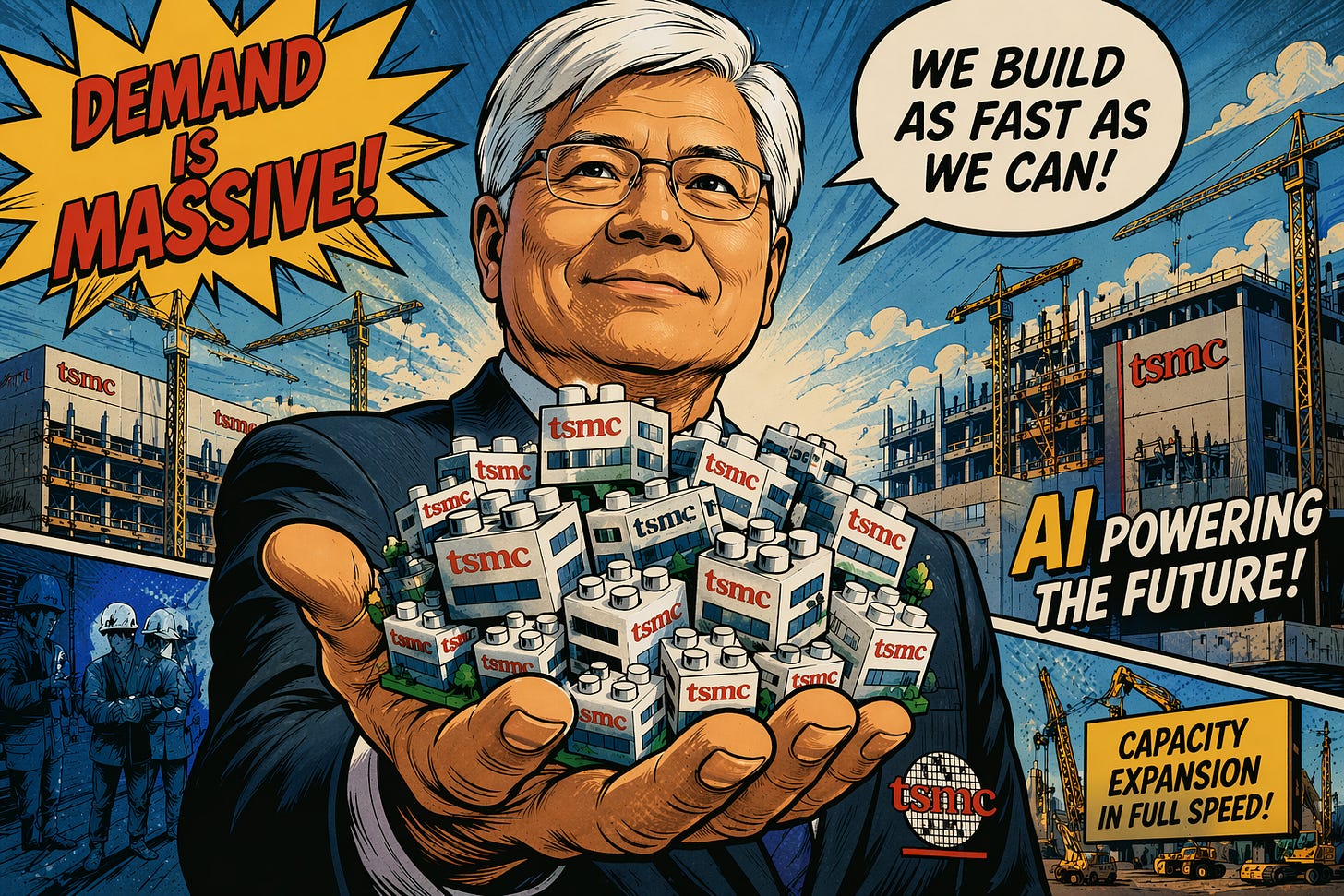
TSMC’s first-quarter 2026 earnings call, on the surface, looked like a continuation of strength: results beat expectations, full-year guidance remained robust, and capital expenditure is now set to land near the high end of its already massive $52 billion to $56 billion range.
But if this call is interpreted simply as “AI is hot and TSMC is doing well,” that misses the deeper point.
What truly mattered in this earnings call was not just that the quarter was strong. It was that three things became clear at the same time:AI demand for advanced nodes is stronger and longer-lasting than the market had expected; 3nm is not fading into maturity as quickly as many assumed, but is instead being extended by HPC and AI; and 2nm, while ramping successfully, will begin to dilute gross margin in the second half of 2026.
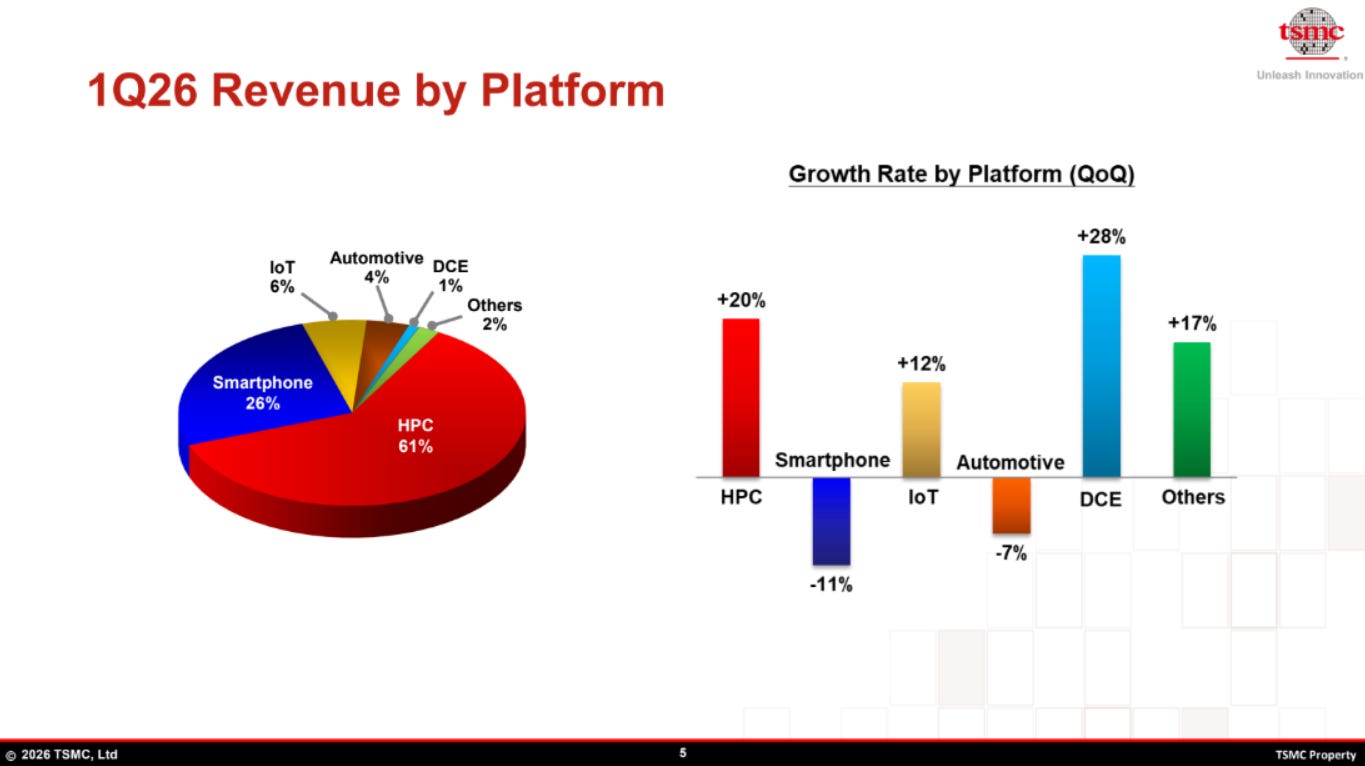
In other words, TSMC is no longer dealing with a normal semiconductor cycle. It is dealing with a structural reallocation of capacity.
AI is reshaping the logic of semiconductor capital spending, extending the lifecycle of leading-edge process nodes, and even changing the geography of global expansion.
And C.C. Wei, in his usual direct style, effectively summarized the entire situation in one sentence:
“The reason for raising capex is very simple: demand is very strong.”
That was not rhetoric. That was the reality.
AI Is No Longer a Short-Cycle Order Story. It Has Become a Multi-Year Structural Demand Curve
There is still a lingering assumption in parts of the market that AI demand, while powerful, may prove partially cyclical or short-lived. Perhaps some of it is temporary pull-in. Perhaps customer digestion or capital market normalization will eventually flatten the curve.
But this earnings call strongly suggested that TSMC no longer sees AI in that framework.
Instead, management’s message was clear:
AI demand is becoming structurally rigid, not opportunistic, and it is not being driven by a single model wave or a single end market.
More importantly, management specifically highlighted the transition from generative AI to agentic AI. That matters because it implies a new phase of compute consumption. AI is no longer just about answering prompts. It is evolving toward multi-step reasoning, tool use, autonomous execution, and persistent task orchestration.
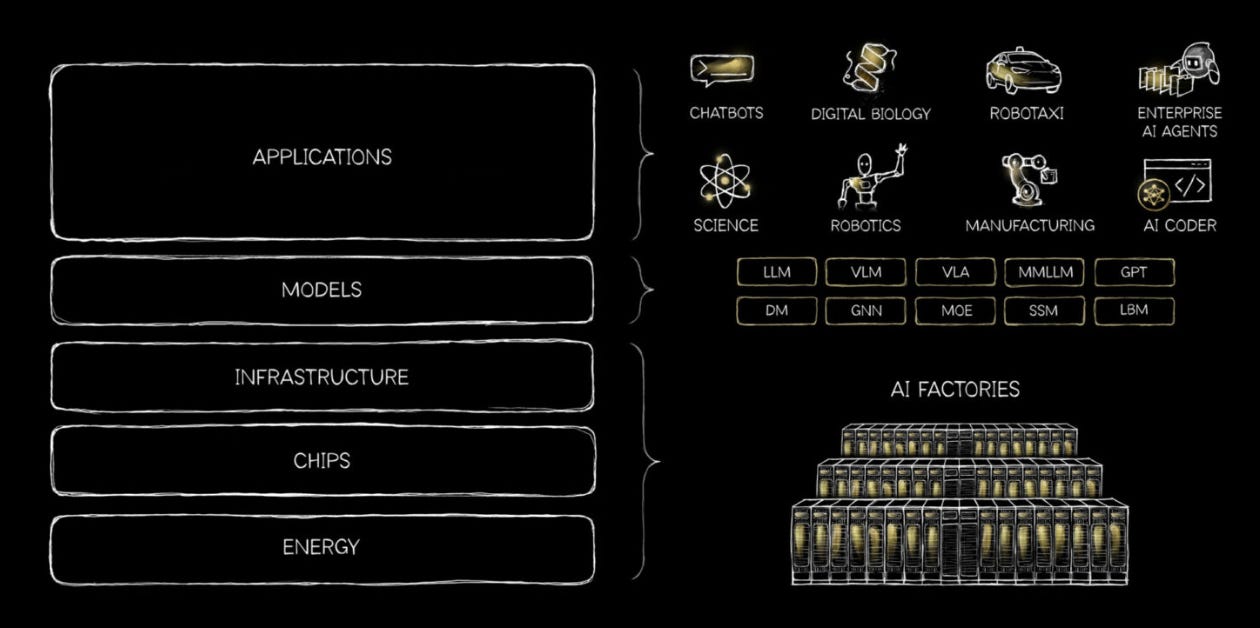
For the semiconductor industry, that means token consumption rises, inference intensity increases, and demand for compute infrastructure broadens beyond model training into always-on, large-scale inference.
Many investors are still debating whether AI is a bubble. TSMC, however, is seeing something much more concrete: customers asking a very simple question —can you make more chips for us?
That is why the company now expects 2026 capital expenditure to land at the high end of the range. For TSMC, this is no longer about whether to invest. It is about how to bring in equipment faster and get capacity online sooner.

2月23日
CapEx Near a Record High Is Not a Sign of Excess Confidence. It Is a Sign That Capacity Is Genuinely Too Tight
When analysts asked why capital spending is being pushed so aggressively higher, C.C. Wei did not hide behind financial jargon or polished corporate phrasing. He gave a straightforward answer:demand is growing faster than TSMC’s original expansion plans.
That statement is crucial.
It means TSMC is not investing defensively, nor is it raising capex merely to signal confidence. It is doing so because it is already seeing the orders, the customer roadmaps, and the supply gap. This is demand-driven investment, not preemptive spending.
At a deeper level, it also shows that the bottleneck in AI chips is no longer just about who has the right architecture or the strongest product roadmap. The bottleneck has moved upstream into the manufacturing system itself — including EUV tool availability, advanced process module installation, advanced packaging capacity, and the pace of fab construction.
TSMC said it is doing everything possible to accelerate execution, including pulling in all the equipment it can get and working closely with suppliers such as ASML and Applied Materials to move schedules forward. Yet even so, management remained careful not to suggest that supply-demand balance is near.
The reason is simple: semiconductor manufacturing is not software. Capacity cannot be scaled with a command line.
A new fab typically requires two to three years to build, followed by another one to two years to ramp efficiently at scale. The industry’s physical expansion cycle is inherently slower than the pace at which AI demand is exploding.
That is why C.C. Wei stated clearly that capacity tightness will likely persist at least through 2027.
This was not exaggeration. It was a sober engineering judgment.

2025年8月25日
3nm Is Not Exiting the Stage. AI Has Redefined Its Role
The market has traditionally viewed advanced nodes through the lens of the smartphone cycle: a new node launches, the previous one matures, and attention quickly shifts to the next generation. By that logic, many had assumed that by 2026, 3nm would already be moving toward maturity, with 2nm becoming the undisputed focus.

But this earnings call suggested the opposite.
3nm is not fading. It is being extended by AI and HPC.
Management explicitly said that N3 demand continues to be driven primarily by HPC and AI, and that TSMC is adding more 3nm capacity globally. What matters here is not just the expansion itself, but where and when it is happening:
A new 3nm fab in Tainan is expected to come online in the first half of 2027
Arizona Fab 2 is expected to support 3nm in the second half of 2027
JASM Fab 2 in Japan is also planned to adopt 3nm, with timing around 2028
In addition, TSMC will convert certain 5nm equipment in Taiwan to support 3nm production. That is a highly meaningful move. It indicates that N3 demand is strong enough to justify reconfiguring existing toolsets and reassigning manufacturing assets.
From an industry perspective, this means 3nm is no longer merely a leading smartphone node. It is evolving into one of the foundational capacity platforms of the AI era.
When analysts asked why TSMC would continue to expand N3 so aggressively when it is no longer the newest node, management’s answer was blunt: because demand is being driven by HPC and AI.
The deeper implication is that AI is extending the demand curve for advanced nodes far beyond the traditional consumer product cycle.

3月25日
2025年2月5日
2nm Is Entering Volume Production, but the Real Test Is Profitability, Not Ramp Status
Another major theme of the call was N2.
From a technology and manufacturing standpoint, TSMC sounded confident. Management said N2 has already entered high-volume production, yields are progressing well, and ramp activity is underway in both Hsinchu and Kaohsiung. Demand is coming from both smartphone and HPC/AI customers.
On the surface, that suggests a healthy start.
But the more important point was management’s frank acknowledgment of the financial impact.
TSMC clearly stated that N2 will begin to dilute gross margin in the second half of 2026, with a full-year impact of roughly 2 to 3 percentage points.
That matters because it reminds the market of a basic truth: a new node entering production does not immediately become a profitability engine.
Early-stage leading-edge ramps come with high depreciation, steep learning curves, elevated initial costs, and temporary efficiency drag. N2 may eventually become a major profit contributor like N5 and N7 did before it, but it will not arrive in that form overnight.
So the key questions for N2 over the next few quarters are not simply whether it is in production. They are:
Can the ramp proceed smoothly?
Can cost reduction move fast enough?
Can margin improvement from N3 and manufacturing efficiency gains elsewhere offset the initial dilution?
This is why the tone of the earnings call, while strong, was not euphoric. Revenue is clearly rising. Demand is clearly powerful. But gross margin may not move upward in a straight line.
For a company simultaneously expanding globally, transitioning process nodes, and building out overseas manufacturing footprints, that is the more realistic picture.

2025年2月11日
If one focuses only on near-term risk, it is easy to become fixated on margin dilution, higher overseas operating costs, and early-stage 2nm pressure.
Management now targets, through the cycle:
Gross margin of 56% or higher
ROE in the high 20% range or above
This is not a minor update. It is TSMC telling investors that even as it moves into N2 and A14, even as it expands in the United States and Japan, and even as its manufacturing footprint becomes more geographically diverse and more expensive, it still believes the business can sustain a very high profitability structure.
That message carries weight because it is not about one year’s cycle. It is about long-duration confidence in the company’s operating model.
TSMC is not denying margin dilution. It is saying that despite dilution, the overall structure remains highly profitable.
Where does that confidence come from? Fundamentally, from two things:
First, leadership in process technology and yield.
Second, the increasing dependence of leading customers on TSMC’s advanced nodes and advanced packaging capabilities.
As long as those two pillars remain intact, short-term margin volatility will not change TSMC’s long-term strategic position.

2025年4月22日
The Main Risk Is Not Lack of Growth. It Is Whether Cost Structure Can Keep Up With Growth
If there is one central risk from this earnings call, it is not demand. It is whether supply expansion and cost structure can scale fast enough to keep up with demand growth.
The first risk is margin pressure.
Management explicitly identified two major sources of dilution: N2 ramp dilution of roughly 2 to 3 points for 2026, and overseas fab dilution that starts around 2 to 3 points and may later widen to 3 to 4 points.
That means the key question in the coming quarters is not whether TSMC can keep growing revenue. It can. The real question is how efficiently that revenue converts into profit. AI is delivering demand upside, but advanced-node ramps and global fab expansion are simultaneously creating depreciation and cost pressure.
The second risk is energy and materials uncertainty.
TSMC said the current Middle East situation does not materially affect operations in the near term, thanks to diversified sourcing and safety inventory. Taiwan’s LNG supply is also secured into May. But the real issue is that many disruptions first appear not as production outages, but as cost pressure — through chemicals, specialty gases, and power pricing. These are difficult risks because they may not show up as lost wafers, but they can quietly erode margin.

3月9日
The third risk is inventory days, which rose to 80 days.
Management attributed this to N2 ramp preparation and strong N3 demand, which is reasonable for now. But it still deserves monitoring. A rise in inventory can reflect healthy strategic preparation, but it can also sometimes signal temporary inefficiencies in node mix, tool allocation, or operational synchronization.
2025年9月25日
The fourth risk is continuing price sensitivity in consumer end markets.
AI is strong, but not every end market is equally strong. Memory price increases could create pressure in PCs and smartphones, especially in price-sensitive segments. High-end devices remain healthier and are generally more favorable to TSMC, but a weaker-than-expected consumer recovery could still affect part of the demand mix.
The fifth risk is that overseas capacity expansion still needs to prove its cost efficiency over time.
Arizona, in particular, was discussed in a more confident tone than last year. Management said experience is improving and cost structure has room to get better. But it is still too early to conclude that overseas fabs can approach Taiwan fabs in operating efficiency. That remains a medium-term issue to watch.

1月16日
The Best Analyst Questions Were All Really About the Same Thing: How Long Will the AI Supply Gap Last?
The most valuable analyst questions in the call all revolved around one central issue:is this AI-driven tightness a short-term cycle, or a longer structural imbalance?
When BofA asked why TSMC is still expanding N3 so aggressively even though it is no longer the newest node, management answered that the demand is mainly coming from HPC and AI. That effectively confirmed that N3 demand is not fading according to the traditional node lifecycle.
When JPM asked how long supply tightness would last, C.C. Wei’s answer was direct: building a fab takes two to three years, and ramping it takes another one to two, so supply will likely remain tight through 2027. That is extremely important because it extends the AI supply imbalance from a quarterly issue into a multi-year one.
When analysts asked why capex was moving toward the high end of the range, management again emphasized that the reason was not optimism for its own sake, but the fact that demand — especially from HPC and AI — remains above supply capability.
And when Morgan Stanley asked whether advanced packaging could be challenged by alternatives such as Intel EMIB, management did not dismiss the existence of competition. But its stance was clear: the real barrier is engineering integration, large-format capability, and mass-production execution. CoWoS remains the main platform, CoPoS is in development, and TSMC views issues such as warpage and mechanical stress as solvable engineering problems within its core competence.

The deeper point is that in the AI era, leadership is no longer defined only by process node leadership. It is increasingly defined by system-level manufacturing leadership at scale.
4月8日
What This Earnings Call Really Showed Is a Much Bigger Industry Reality
If all the signals are put together, the most important conclusion from the call is not that “TSMC is strong.”
It is this:
The AI infrastructure cycle is far from over, and TSMC itself does not believe 2026 is the peak of the investment wave.
Capital expenditure this year is approaching $56 billion, already a historic level. More importantly, management went further and stated that the next three years of capex will be significantly higher than the total of the previous three years.
That is a very large statement. The past three years already added up to roughly $101 billion in capex. TSMC is effectively telling the market that the coming investment intensity will be even greater.
This is not the language of an ordinary cyclical recovery. It is the language of structural industrial rewiring.
From the extended life of N3 to the volume ramp of N2; from the addition of three new 3nm lines across Taiwan, the United States, and Japan to the conversion of 5nm tools into 3nm production assets; from the rise of AI accelerators to the higher token intensity implied by agentic AI; from advanced packaging competition to global tool bottlenecks — all of this points to one conclusion:
The scarcest thing in semiconductors today is no longer advanced technology by itself. It is the ability to turn advanced technology into large-scale, stable, manufacturable capacity at speed.
And that is precisely where TSMC’s strategic value now sits.

3月12日
Final Thought: The Market Is Still Asking How Long AI Will Stay Hot. TSMC Is Already Answering a Different Question
Many in the market are still asking: how long can the AI boom last?
But based on this earnings call, TSMC is already operating with a different question in mind:
If demand is strong enough that tightness will persist into 2027, how do we scale capacity, equipment, node transitions, and global manufacturing fast enough to keep up?
That is a fundamentally different level of thinking.
The first question is still about cycle timing.
The second is about rebuilding supply.
So perhaps the most important line from the earnings call was not “above 30%” revenue growth, not $56 billion in capex, and not even N2 yield progress.
It was C.C. Wei’s almost unembellished diagnosis:
Demand is very strong — and it is growing faster than TSMC can expand capacity.
When the world’s leading foundry describes the market that way, that in itself is already a stronger industry signal than any formal guidance number.
AI has not yet reached its peak.
And TSMC, through one of the most aggressive capital spending programs in its history, is making that unmistakably clear.

2月2日
C.C. Wei has also been named to TIME’s 2026 TIME100 list of the world’s most influential people, in the “Pioneers” category.
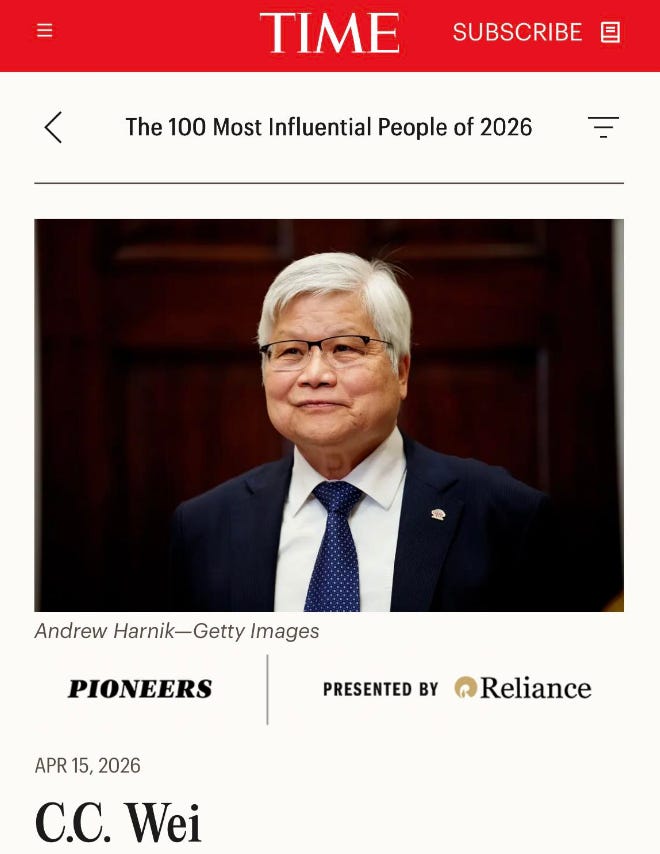
His profile was written by Nvidia founder and CEO Jensen Huang, who described Wei as the leader of one of the world’s most consequential companies. The recognition feels especially timely. At a moment when AI is reshaping the global technology stack, TSMC is no longer just a chip manufacturer. Under C.C. Wei’s leadership, it has become one of the central industrial platforms of the AI era—quietly enabling the infrastructure, scale, and manufacturing discipline behind the world’s most important computing transition.
Thanks for reading SEMIVISION @_@! This post is public so feel free to share it.


PreviousNext
TopLatestDiscussions








See all