Tesla AI5 Enters New Phase: Taiwan and Korea Positioned at the Center of the Supply Chain
Tesla AI5 Enters New Phase: Taiwan and Korea Positioned at the Center of the Supply Chain
- Source: SemiVision
- Author: SEMIVISION
- Published: 2026-04-16T10:45:45+08:00
- URL: https://tspasemiconductor.substack.com/p/tesla-ai5-enters-new-phase-taiwan (1) Tesla AI5 Enters New Phase: Taiwan and Korea Positioned at the Center of the Supply Chain


Tesla AI5 Enters New Phase: Taiwan and Korea Positioned at the Center of the Supply Chain
Origianl Article By SemiVision Research [Reading time: 12 mins]

Apr 16, 2026
∙ Paid

Tesla AI5 Enters New Phase: Taiwan and Korea Positioned at the Center of the Supply Chain
Tesla’s latest in-house chip milestone is a reminder of something the market increasingly needs to recognize: the company is no longer just an electric vehicle maker. It is steadily transforming itself into an AI systems company with growing control over its own computing platform.
According to the latest reports, Tesla CEO Elon Musk has confirmed that the company’s self-developed AI5 chip has completed tape-out and entered the critical pre-production validation stage. This is not merely a sign that Tesla’s next-generation automotive AI platform is moving from concept to physical silicon. It also suggests that Tesla’s roadmap across FSD, Dojo, and Optimus is gradually evolving from a set of separate initiatives into a long-term strategy built around a unified proprietary compute architecture.
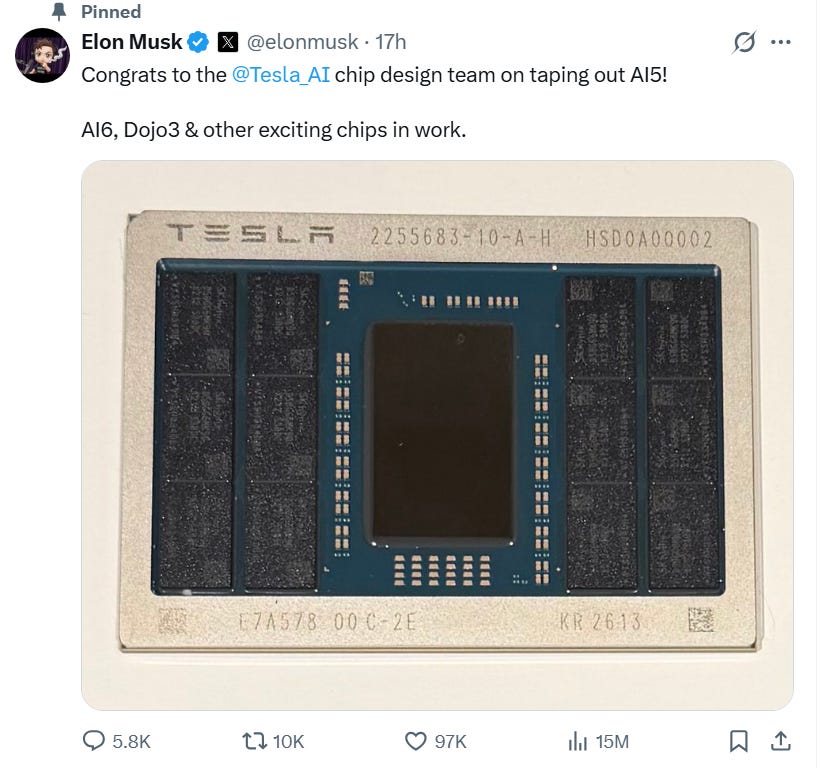
If the market once understood Tesla’s chip self-sufficiency efforts mainly as a way to reduce cost and improve performance for autonomous driving, AI5 now pushes that story into a much deeper dimension. Tesla is no longer designing chips for just one product. It is building a compute foundation that can potentially scale across vehicles, AI training infrastructure, and even humanoid robotics.
That is the real reason why both Taiwanese and Korean supply chains are attracting renewed attention.
From an industry execution standpoint, completing tape-out is already a highly meaningful signal. It means AI5 has passed through the most critical phases of architecture definition, logic design, and physical implementation. The next steps are engineering validation testing (EVT), design validation testing (DVT), and production validation testing (PVT). If development proceeds smoothly, AI5 could eventually be integrated into future Tesla vehicles and become the core of the company’s next-generation intelligent driving platform.
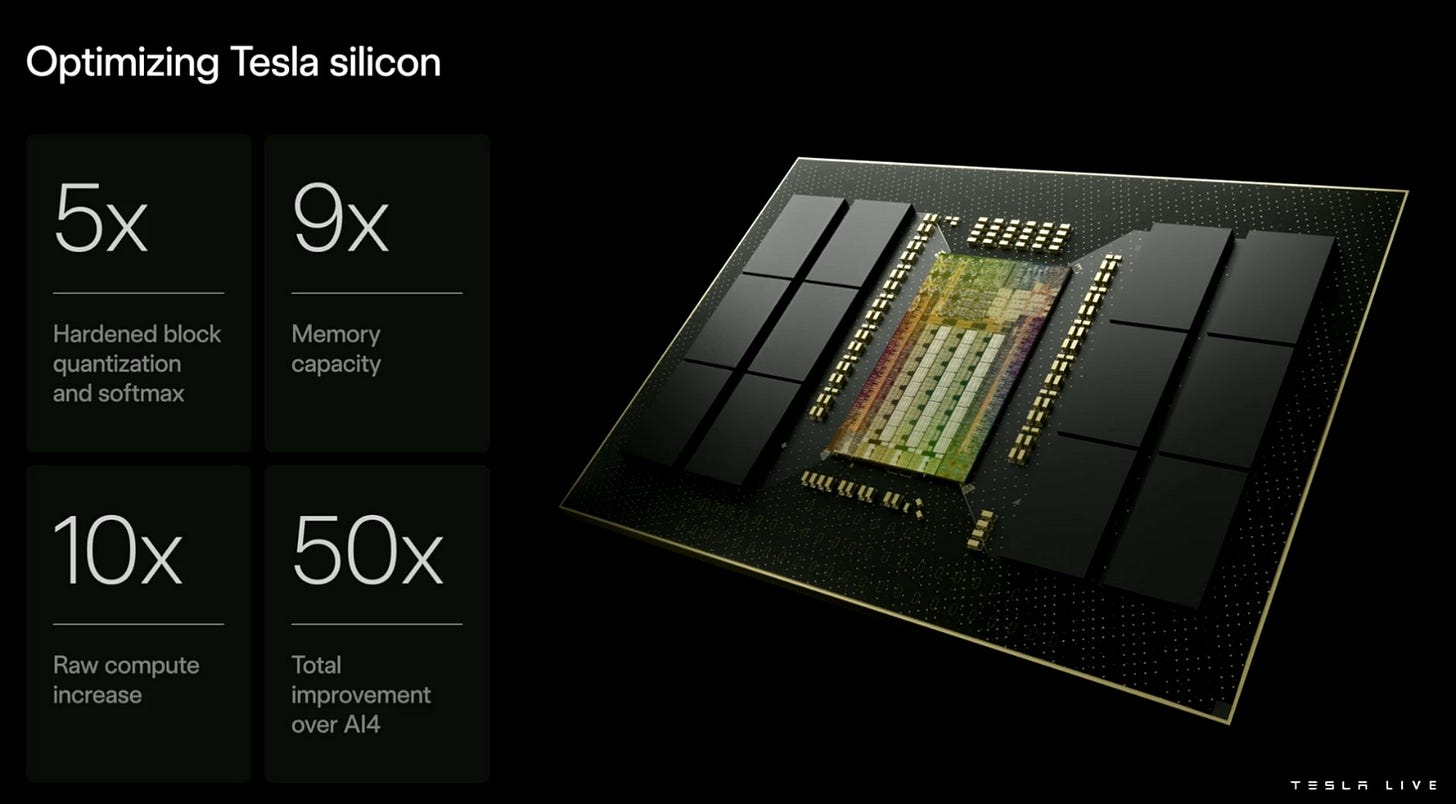
Functionally, AI5 is expected to remain the central compute engine of Tesla’s FSD system, handling real-time perception, sensor fusion, judgment, and decision-making at the vehicle level. In other words, it is the key piece of hardware that allows Tesla to embed neural network capability deeply into end products. For Tesla, the value of AI5 is not just higher compute per vehicle. The more important question is whether it can support larger and more complex models with better power efficiency and tighter system integration.
That distinction matters. As FSD evolves from conventional perception algorithms toward larger-scale edge inference, chip competition is no longer just a TOPS race. It becomes a system-level balancing act involving memory bandwidth, latency, thermal management, and stable operation under automotive constraints. If AI5 truly becomes the heart of Tesla’s next-generation AI platform, then it represents not a routine chip refresh, but a genuine leap in Tesla’s in-vehicle AI architecture.

3月11日
From FSD to Dojo to Optimus: Tesla’s Chip Strategy Is Taking Shape
At a deeper level, the timing of AI5 is particularly significant.

Tesla continues to push FSD commercialization and edge AI deployment in vehicles. At the same time, its Dojo data center training ambitions have not disappeared, while Optimus has emerged as a new strategic extension. This means Tesla’s demand for compute resources is no longer limited to a narrow question of what kind of chip should sit inside a car. The real question is what kind of compute architecture can support an entire AI ecosystem.
That is what sets Tesla apart from traditional automakers.
Most car companies still approach intelligentization by assembling existing solutions from outside vendors, combining third-party SoCs, sensors, and software platforms. Tesla is increasingly taking the opposite path. It is pulling algorithms, data, models, training infrastructure, and terminal compute hardware back under its own control.
Once that path works, chips stop being just another line item in the bill of materials. They become central to platform control.
This is why AI5’s tape-out is more than a milestone for Tesla’s automotive chip development. It suggests the company is trying to create a shared AI hardware and software foundation that can extend across multiple product lines. Today that foundation serves FSD. Tomorrow it may support robotics control. Over time, it could expand into even more terminal devices. This transition from a single-chip program to an integrated AI platform is where the market should focus its attention.

TSMC and Samsung Both Being Involved Highlights Tesla’s Dual-Source Strategy
Another highly important signal in this development is that both TSMC and Samsung have been mentioned as participants in AI5’s manufacturing plan.
This suggests Tesla is pursuing a more deliberate dual-source strategy in advanced semiconductor manufacturing. For a company rapidly expanding its AI compute footprint, this is a rational move. Once chips become strategically important, supply stability itself becomes a source of competitive advantage.
Over the past few years, the market has seen clearly how fragile advanced-node supply chains can be. Geopolitical risk, capacity constraints, yield fluctuations, and concentration at a small number of manufacturing sites can all materially affect the output of high-value AI chips. For Tesla, if AI5 is going to influence not only vehicle deliveries but also the launch tempo of robots and other AI-driven end products, then building redundancy and bargaining power into foundry sourcing becomes almost unavoidable.
But dual sourcing does not mean equal weight.
In other words, Tesla may indeed be pursuing a dual-source strategy, but once high-end AI chips move into real scale production, TSMC will most likely remain the primary manufacturing partner, while Samsung may serve as a supplementary source, backup option, or second path for selected versions. That is still an opportunity for Samsung, but it also reflects a harsh reality: in the most advanced logic market, customers are willing to give a second supplier a chance only if that supplier proves not just technical capability, but stable commercial manufacturability.
4月8日
Samsung’s Opportunity and Constraint: Advanced Nodes Are About More Than Just Process Naming
From the perspective of the Korean supply chain, AI5 is clearly a positive signal. If Samsung materially participates in production at all, it means the company still has a way into the high-performance AI chip manufacturing market.
But the market will ask the harder question: how much can Samsung really take on, and can it sustain that role over time?
The answer still comes down to yield and consistency.
At advanced nodes, per-chip manufacturing cost is already very high. If yields are weak, the problem is not limited to higher wafer cost. It can also disrupt delivery schedules, delay module integration, and ultimately weaken the competitiveness of the full system. For a company like Tesla, which values vertical integration and fast product iteration, an unstable foundry partner is not merely a supply chain issue. It can threaten the entire product roadmap.
That is why Samsung’s challenge in a program like AI5 is not simply being named as a participant. The real test is whether it can move from nominal involvement to meaningful manufacturing share by proving that its advanced-node process is not only technically achievable, but commercially dependable.
This is also why, from a capital markets perspective, the benefit to TSMC tends to look more direct, while the benefit to Samsung comes with greater uncertainty and a longer period of observation.

3月2日
ASIC Design Service Providers Such as Alchip May Become the Second Layer of Real Beneficiaries
If we shift the lens upstream from wafer fabrication, another important group comes into view: ASIC design service providers.
Based on current market interpretation, if AI5 eventually scales into larger production volumes and expands across multiple Tesla platforms, then the design services, NRE revenue, and ongoing production support behind it are unlikely to be one-off events. They could become part of a longer-duration growth cycle.
That is why companies such as Alchip are increasingly being viewed as key beneficiaries within the AI5-related supply chain. When customers are no longer developing a standard chip, but rather a highly customized high-performance processor that must be tightly coordinated with advanced foundry nodes, packaging, IP, and broader ecosystem support, design service providers become much more important.
As AI chips continue to grow in complexity, customers are not simply looking for someone to draw a chip. They need a partner who can help them manage time, cost, risk, and manufacturability simultaneously. The companies that can help customers converge designs faster, reach tape-out more efficiently, and connect smoothly into advanced-node and packaging flows are the ones most likely to expand their value in this wave of AI ASIC demand.
This point is often underestimated. The market tends to focus on foundry revenue, but when the value chain shifts forward into the design stage, NRE and customer stickiness are expanding as well.

2025年5月30日
Packaging and Testing Matter More Than Ever. AI Chip Competition Has Become a System Integration Battle
Once AI5 has taped out, the next logical question is this: who will turn it into something that can actually be manufactured at scale, delivered reliably, and integrated into real end products?
The answer is not just the wafer fab. It is also the packaging and testing ecosystem.
For high-performance AI chips, packaging is no longer a downstream afterthought. It has become one of the core determinants of system performance, power efficiency, thermal behavior, and reliability. If Tesla moves forward with both next-generation vehicle platforms and robotics applications, packaging stability and scalability become even more important. Automotive-grade requirements, thermal cycling stress, and long-term reliability standards are fundamentally different from those of ordinary consumer devices. That raises the importance of back-end partners.
This is why names such as ASE and Powertech are being discussed by the market as potential beneficiaries. Even if the exact depth of their participation remains to be seen, the direction is already clear: the value chain of high-performance AI chips is extending deeper into the back end, and packaging and testing are becoming part of the differentiation story rather than just a cost center.
This reflects one of the semiconductor industry’s deepest structural changes in recent years. In the past, most discussions about chips centered on process nodes. In the AI era, the real question is whether the entire system can work. Design, manufacturing, packaging, thermal management, and deployment all increasingly define the competitive barrier together.

2025年9月16日
Why Is the Robotics Supply Chain Also Being Mentioned So Early?
Another interesting aspect of this development is that the market is not only looking at AI5’s implications for automotive suppliers. It is also beginning to connect the story to Optimus-related supply chain names.
On the surface, that may seem premature. But from Tesla’s strategic perspective, it is not difficult to understand.
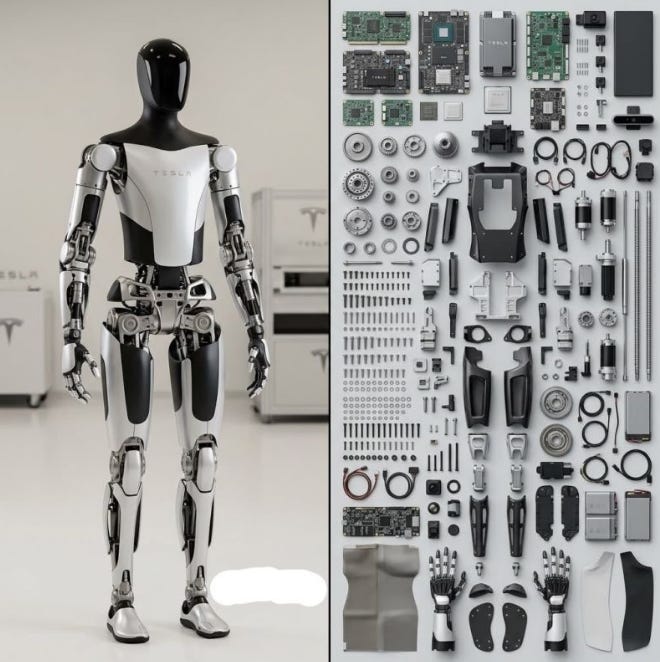
For Tesla, vehicles and robots can both be viewed as embodiments of physical AI. The application scenarios are different, but both require perception, decision-making, motion control, and a closed loop built on real-world data. If AI5 represents Tesla’s next-generation edge AI compute architecture, then the possibility that its design philosophy, or some derivative of it, will extend into robotics is far from unreasonable.
That is why the market has begun watching companies tied to robotics, automation, optics, and critical components, including Hiwin, Delta Electronics, Asia Optical, and Allied Motion…etc in the broader theme. This does not necessarily mean these companies will immediately see meaningful revenue from AI5 itself. But capital markets tend to price the direction first and wait for orders and earnings to validate the narrative later. As long as Tesla continues to release positive signals regarding Optimus commercialization, the valuation framework for related suppliers can begin to change in advance.
That said, this area remains more expectation-driven than fundamentally verified at this stage. The true issue is whether Optimus can move from demos and pilot deployments into repeatable commercial execution, and whether AI5 or its successor architecture will genuinely become a key compute platform for that transition.
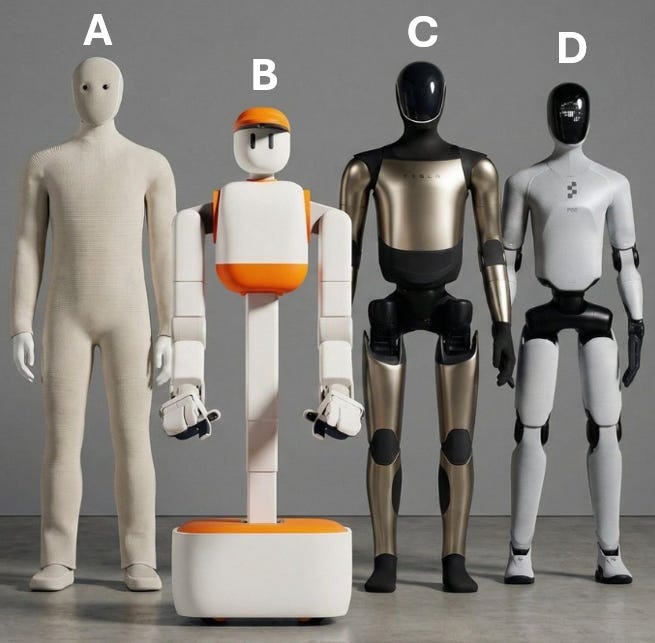
POLL
Which robot would you choose to have at home as your companion?
34 VOTES ·
Why Taiwan May Be the Largest Overall Beneficiary
If we map the full supply chain again, it becomes clear that Taiwan’s perceived advantage in this cycle is not just about TSMC.
The deeper reason is that Taiwan has the most complete, dense, and mature collaboration ecosystem for projects of this kind.
At the front end, it has advanced wafer foundry capability. In the middle, it has ASIC design service and IP integration support. At the back end, it has packaging, testing, and system integration. Beyond that, the ecosystem extends into automation, structural components, optics, power systems, and robotics-related supply chains. When a customer like Tesla is driving not a one-point procurement program but a multi-generation platform initiative, what matters is not just one supplier. It is the strength of the entire industrial cluster.
That is one of Taiwan’s most important advantages in the AI era. It is not only technical capability, but also supply chain coordination speed. For customers that need fast validation, repeated iteration, tight confidentiality, and high-yield execution, that industrial density is itself a strategic asset.
This is why AI5’s progress is not just positive for Tesla. It is also another validation of Taiwan’s central position in the global AI hardware race.

3月12日
Conclusion: The Real Meaning of AI5 Is That Tesla Is Turning AI Into Infrastructure
It would be easy to interpret this development simply as progress on Tesla’s next-generation self-driving chip. But that would underestimate its significance.
The real meaning of AI5 is that Tesla is gradually turning AI from a function into infrastructure.
It is not just about making vehicles smarter. It is about building a compute foundation that can support multiple products, multiple scenarios, and multiple generations of evolution. Once that foundation starts to take shape, the beneficiaries will not be limited to one chip. The entire supply chain organized around that platform stands to gain.
For Taiwan, this is a familiar kind of opportunity. When global system companies shift the competitive battlefield from single devices to integrated platforms, the long-term winners are often not the loudest storytellers, but the players most capable of turning technical complexity into stable execution.
And based on the current division of labor across the industry, Taiwan still occupies the most critical position in that process.

4月11日


PreviousNext
TopLatestDiscussions








See all