TSMC vs. Four Challengers: A Growing Strategic Battle in Semiconductor
TSMC vs. Four Challengers: A Growing Strategic Battle in Semiconductor
- Source: SemiVision
- Author: SEMIVISION
- Published: 2026-04-08T01:17:22+08:00
- URL: https://tspasemiconductor.substack.com/p/tsmc-vs-four-challengers-a-growing (1) TSMC vs. Four Challengers: A Growing Strategic Battle in Semiconductor


TSMC vs. Four Challengers: A Growing Strategic Battle in Semiconductor
Original Article By SemiVision Research [Reading time: 10 mins]

Apr 08, 2026
∙ Paid
Tesla, Intel, Samsung, and UMC Are All Shifting at Once—And U.S. Chip Manufacturing Is Rewriting the Power Structure of the Global Supply Chain

From March to April 2026, the U.S. semiconductor industry entered a phase that deserves far more attention than a few isolated headlines might suggest. This is no longer a story about a single company expanding capacity, one foundry competing for orders, or one customer shifting suppliers.
What is happening now is broader: system companies, foundries, advanced packaging providers, mature-node manufacturers, and geopolitical policy forces are all moving in the same direction at the same time. That direction is clear—bringing more AI chips, automotive chips, and robotics chips back to U.S. soil.
On the surface, the market may be tempted to treat the recent developments as separate stories.
One headline is Musk launching Tera Fab.
Another is Intel joining the project.
Another is Samsung’s earlier success in winning Tesla’s next-generation AI chip orders.
And another is UMC maintaining its presence through mature-node manufacturing and global expansion.

But when these signals are viewed together, what emerges is not a series of isolated business updates. It is a much bigger shift:
TSMC is no longer facing competition only in the form of “advanced process leadership.” It is increasingly being challenged by a broader ecosystem-level offensive against its central role in AI chip manufacturing.
In other words, TSMC’s future challenge is no longer just Intel or Samsung individually. It is a new competitive structure shaped collectively by Tesla’s demand pull, Intel’s manufacturing ambitions, Samsung’s customer foothold, and UMC’s role in mature-node supply support.
That is why the core question of this article is not simply who wins and who loses. The more important question is this:
Is TSMC still facing traditional foundry competition—or is it now entering a system-level war of attrition where it must effectively fight four different forces at once?
Tera Fab Is Not Just Another Factory Story—It Is Musk’s Structural Countermove in the Semiconductor Supply Chain
Let us start with the origin of the story.

In March, reports indicated that Elon Musk said Tesla and SpaceX would build two advanced chip factories in Austin, collectively referred to as Terafab, to support demand from autonomous vehicles, humanoid robots, and space-related AI computing. Then came the next development: Intel formally joined the Tera Fab project, working alongside Tesla, SpaceX, and xAI. Intel emphasized that it would contribute design, manufacturing, and packaging capabilities to help Terafab move toward its goal of producing 1 terawatt of compute per year.
The real significance here is not that Musk announced another bold industrial vision. It is that
He no longer wants to remain merely a user of AI chips—he is now moving toward the supply side of semiconductor manufacturing itself.
That is a major shift.
In the past, Tesla’s Dojo, FSD, automotive AI, and robotics AI all still relied on external semiconductor supply chains. A company could design its own chips, but manufacturing still depended on foundries. A company could build AI supercomputers, but the underlying compute still came from existing chip ecosystems. But once Musk starts talking about Terafab—and not just for Tesla, but also with SpaceX and xAI folded into the same framework—the equation changes. This suggests that what Musk sees is no longer a temporary chip shortage for one product line, but rather a future internal demand for AI compute across the Musk ecosystem large enough to justify building a new supply chain around it.

In that sense, Tera Fab is not merely a factory project.
It looks more like an attempt to build a semi-closed AI chip manufacturing system for Tesla, xAI, and SpaceX.

2月9日
Intel’s Participation Changes the Nature of the Project—This Is No Longer Just a Vision, but the Start of an Executable Strategy
If Tera Fab had remained only a Musk proposal, the market could have dismissed it as yet another grand industrial dream. But once Intel joined, the nature of the story changed completely.
Semiconductor manufacturing is not like building cars, and it is not like building rockets. It requires process know-how, equipment integration, packaging capability, yield ramping, testing, validation, and highly disciplined supply chain coordination. These are not capabilities that a systems company can simply acquire overnight through capital spending alone.

2025年5月1日
This is why Intel’s role matters.
Intel is not just contributing manufacturing technology. It is integrating its capabilities in design, fabrication, and packaging into the project. The key point is not whether Intel can instantly turn itself around because of this collaboration. The key point is that it may have found something extremely valuable:
A super-customer alliance with enormous demand, deep capital, and a willingness to commit to long-term industrial buildout.
For Intel, this is a very logical path.
The challenge Intel faces in competing directly against TSMC has never been just about technical claims. It is fundamentally about customer trust. But if Intel can enter through a highly customized, vertically integrated, politically strategic project like Terafab, then it does not need to prove to every customer in the world that it has fully caught up. It only needs to establish itself inside one critical alliance first.
Put differently, Intel’s new strategy is not necessarily to reclaim the foundry crown all at once, but to use the scale of the Musk ecosystem’s demand to push itself back into the center of the AI chip supply chain.
Samsung Is Not a Bystander—It Has Already Secured a Position Inside Tesla’s Future Chip Roadmap
If one only looks at Intel and Tera Fab, it is easy to assume that TSMC’s main competitive pressure is coming from Intel. But that is incomplete.
Samsung had already secured a position in Tesla’s next-generation AI chip supply chain earlier.
Earlier reporting indicated that Samsung won a $16.5 billion Tesla AI chip supply agreement, and Musk stated that Samsung’s plant in Taylor, Texas would manufacture Tesla’s next-generation AI6 chips. Later developments suggested that Samsung is preparing for mass production starting in late 2027, which indicates that this is not a symbolic partnership but a real production pathway.
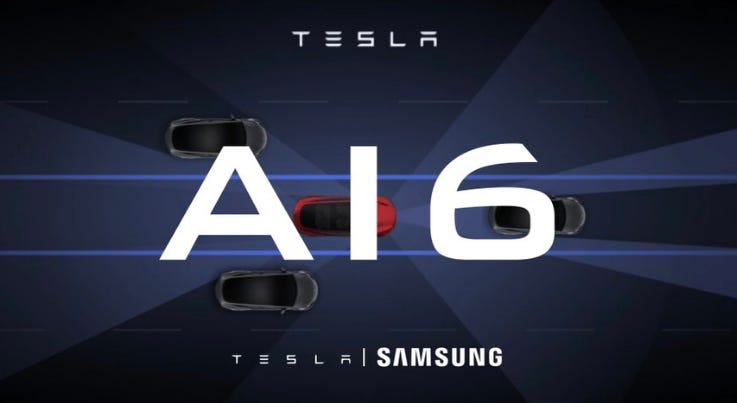
What does that tell us?
It tells us that Tesla is not placing all of its future AI chip manufacturing on a single supplier. Instead, it appears to be pursuing a multi-track strategy:
One path goes through Samsung.
Another goes through Tera Fab and Intel in pursuit of deeper manufacturing autonomy.
And it would not be surprising if Tesla preserves additional optionality elsewhere in the supply chain.
This matters for TSMC because Tesla is no longer behaving like a standard fabless customer. TSMC could once treat Tesla as one more sophisticated chip buyer. But once Tesla begins simultaneously mobilizing Samsung, Intel, and potentially its own manufacturing architecture, it ceases to be just a customer. It becomes an organizer of supply chains.
And once customers begin reorganizing their own supply chains, the issue for TSMC is no longer just price competition or process competition. It becomes a matter of customer strategic realignment.

3月2日
What About UMC? It Is Not on the Cutting Edge, but It Still Matters Structurally
Some may ask:
Does UMC really belong in this “TSMC versus four challengers” framework?
After all, it is not a player in the leading-edge AI process race.
That is true—if the discussion is limited to 2nm, 3nm, AI GPUs, and advanced packaging, UMC is not the most direct competitor. But if the discussion is broadened to supply chain completeness and the redistribution of value through mature-node manufacturing, UMC remains part of the structural pressure.

3月5日
The reason is straightforward.
The AI era and the automotive era are not built only on the most advanced chips. Entire systems also require large volumes of PMICs, MCUs, driver ICs, sensors, connectivity chips, power management devices, and many other supporting semiconductors that are not manufactured on leading-edge nodes. These components determine whether systems can actually ship, whether costs can be controlled, and whether supply chains remain stable. UMC’s relevance is not in challenging TSMC at N2. Its relevance lies in acting as a strategic alternative in mature nodes and geographic diversification.
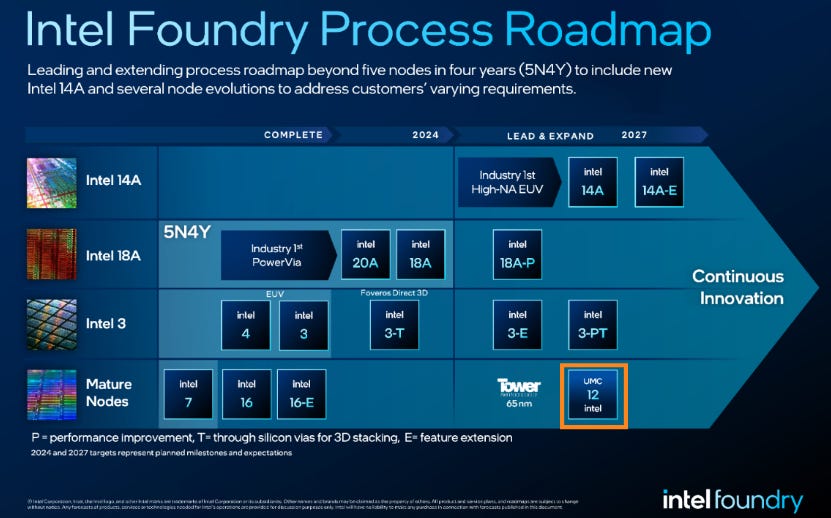
So if the question is “Who can challenge TSMC in advanced process leadership?” then UMC is not central.
But if the question is “Who helps redistribute the system-level value that TSMC once captured more centrally?” then UMC is part of that long-term pressure map.
TSMC’s Real Challenge Is Not a Single Technology Rival—It Is the Gradual Fragmentation of Supply Chain Power
This is the most important point.
TSMC remains extremely strong. There is no serious dispute about that. Whether in advanced process technology, production scale, customer trust, packaging integration, or yield execution, TSMC remains the center of the global foundry industry. That is not changing overnight.
But the issue is this:
Future competition does not require beating TSMC outright. It only requires dismantling the value chain concentration that TSMC has long enjoyed.
Tesla wants to reshape demand-side control.
Intel wants to regain an entry point through manufacturing and packaging.
Samsung wants to capture U.S.-based customers and next-generation node opportunities.
UMC offers alternatives in mature-node resilience and regional supply assurance.
None of these players alone may be able to unseat TSMC anytime soon.
But together, they are doing the same thing:
They are gradually distributing parts of the semiconductor value chain away from the extreme concentration that once sat almost entirely with TSMC.
What does that imply?
First, TSMC’s pricing power may remain strong, but it can no longer assume customers have no alternatives.
Second, U.S. domestic manufacturing may not immediately surpass Asia in efficiency, but its strategic value is clearly rising.
Third, AI chip competition is no longer just about foundries. It is now a combined contest of foundry, advanced packaging, systems integration, and geopolitical alignment.
That means TSMC is no longer defending only its technology leadership.
It is defending its position as the center of an entire supply chain system.

3月12日
Will TSMC Really Be Overwhelmed by “One Versus Four”? Not in the Short Term—But the Pressure Is Building
If I had to offer a clear conclusion, it would be this:
In the short term, TSMC is not going to lose its leadership position simply because Tesla, Intel, Samsung, and UMC are all shifting at once. But over the medium to long term, this is one of the rare moments in recent years when multiple directional pressures are clearly forming at the same time.
The reason is simple.
TSMC’s advantages are not based on one or two metrics. They are built on an entire manufacturing system: advanced process leadership, EUV integration, packaging capability, supply chain coordination, and volume production discipline. That kind of advantage does not disappear because of a few headlines.
But that does not mean there is no risk.
2月2日
The real risk is that large customers begin organizing their own alliances, U.S. industrial policy continues pushing for domestic semiconductor production, Intel finds a new entry point through packaging and manufacturing, and Samsung revives its Texas foundry story through Tesla. At that point, TSMC may gradually realize:
its greatest competitor is no longer a single foundry,
but an emergingU.S.-centered AI manufacturing coalition.
That kind of challenge is more difficult than any single rival.
Because its points of attack are broader, more distributed, and harder to answer in one move.

3月25日
The Real Battle Is Not Just About Who Makes the Chips—It Is About Who Controls the Next Industrial System of AI Chips
If we zoom out one more level, the picture becomes even clearer.
Tesla does not simply want more chips.
Intel does not only want one more foundry order.
Samsung is not just trying to fill Taylor’s capacity.
UMC is not merely defending mature nodes.
All of them are ultimately competing for the same thing:
Who will occupy an indispensable position in the next industrial chain of AI, robotics, autonomous driving, and space computing?
From that perspective, “TSMC versus four challengers” does not literally mean four companies lining up against one company. It means TSMC is facing four different categories of pressure at the same time:
Tesla: demand-side supply chain organization
Intel: U.S. domestic manufacturing and advanced packaging rebuilding
Samsung: customer capture and advanced-node catch-up
UMC: mature-node diversification and distributed supply resilience
These four vectors are not identical, and they are not perfectly coordinated. But together, they form the pressure field that TSMC will have to navigate over the coming years.
2月23日
Conclusion: TSMC’s Hardest Battle May No Longer Be About Process Technology, but About Defending Its Central Position
So the real point of this article comes down to one sentence:
TSMC’s greatest challenge in the future may not be that its technology gets surpassed, but that its once highly concentrated central position in the semiconductor supply chain is gradually being distributed across multiple players.
Terafab turns Tesla from a customer into a supply chain organizer.
Intel’s participation moves the project from vision toward execution.
Samsung has already secured a position in Tesla’s next-generation AI chip roadmap.
UMC represents the parallel loosening of single-source dependence in the mature-node world.
In the short term, TSMC is still the strongest player.
But structurally, it is no longer just “one company facing several competitors.” It is beginning to face the formation of an entirely new supply chain order.
That is what “TSMC vs. Four Challengers” really means.
It does not mean TSMC loses today.
It means that in the future, it may no longer be enough to keep winning the same way it has won in the past.


PreviousNext
TopLatestDiscussions








See all