No Contracts, No Problem: The Trust Behind NVIDIA and TSMC
No Contracts, No Problem: The Trust Behind NVIDIA and TSMC
- Source: SemiVision
- Author: SEMIVISION
- Published: 2026-03-31T15:12:51+00:00
- URL: https://tspasemiconductor.substack.com/p/no-contracts-no-problem-the-trust No Contracts, No Problem: The Trust Behind NVIDIA and TSMC


No Contracts, No Problem: The Trust Behind NVIDIA and TSMC
Original Article By SemiVision Research [Reading time: 13 mins]

Mar 31, 2026
∙ Paid
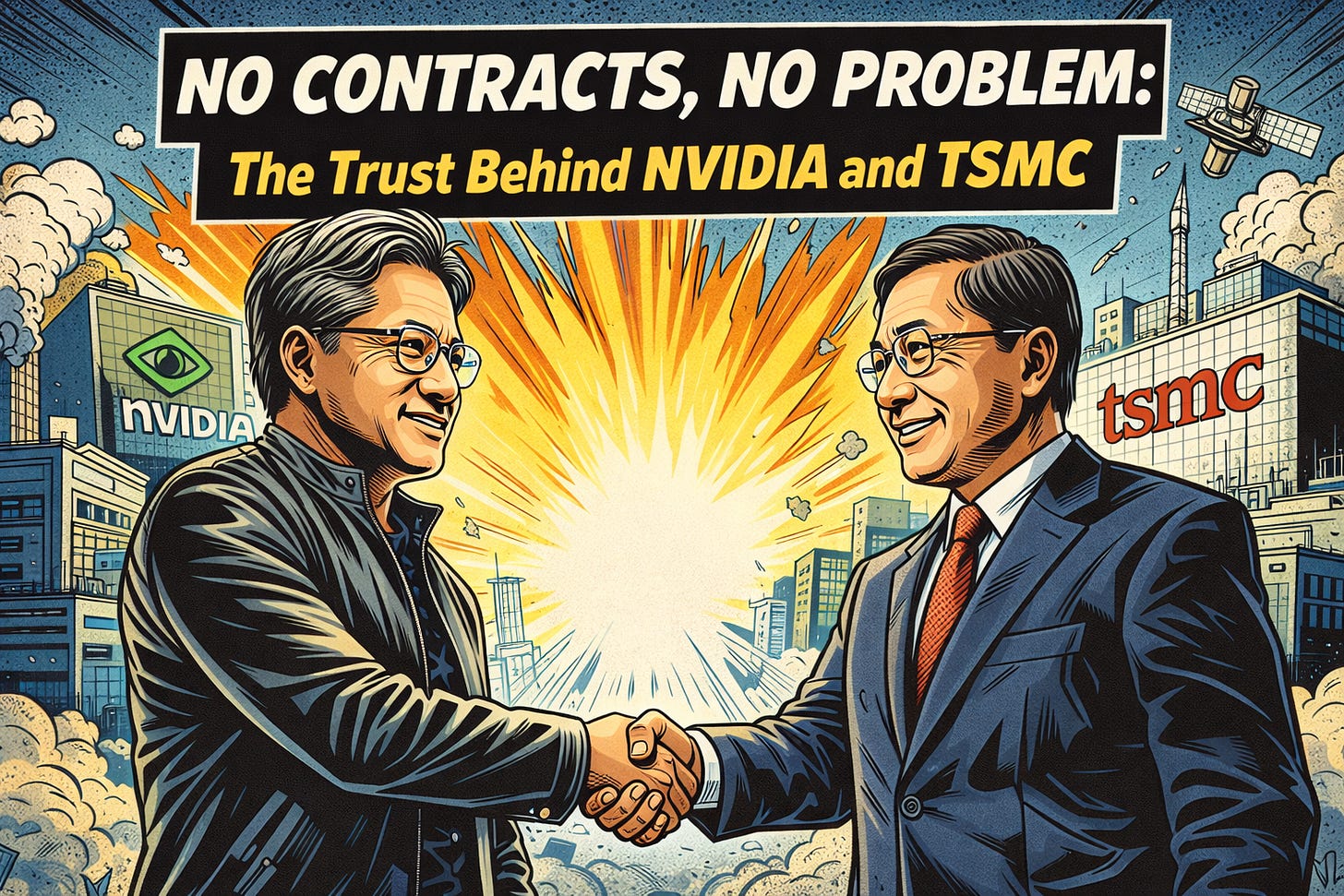
In the AI era, the deepest moat is not the transistor—it is trust, coordination, and system-level orchestration
Recently, Jensen Huang appeared on the Lex Fridman Podcast for an interview that lasted over two and a half hours. The conversation covered many familiar topics: the AI revolution, CUDA, ecosystems, co-design, future computing platforms, and even touched on China’s tech ecosystem, Elon Musk, and space-based data centers.
But if there is one statement from the entire interview that the semiconductor industry should reflect on repeatedly, it is not about whether NVIDIA will reach a $10 trillion market cap, nor about AI data centers in space. It is this:
“For thirty years, I don’t know how many hundreds of billions—or even over a trillion dollars—of business we’ve done, but we have no contract.”
He was referring to none other than TSMC.
Lex responded with just one word:Amazing!
What makes this statement truly profound is not that it sounds legendary, but that it reveals an industry reality many have failed to fully grasp:
In the AI era, what truly underpins hyperscale capacity expansion and supply chain reconfiguration is not just technology—it is trust.
More precisely, it is not merely trust, but a system-level trust structure built upon technology, execution capability, long-term delivery track record, and deep mutual confidence at the highest levels.
And this is precisely what makes TSMC so difficult to replicate.
Feb 28
The biggest misconception about TSMC: reducing it to “a company with advanced process technology”
When people think of TSMC, their first instinct is often its advanced nodes:
2nm, A14, GAA, backside power delivery, CoWoS, SoIC, silicon photonics, advanced packaging, yield, EUV capacity.
All of these are indeed important and form the foundation of TSMC’s central position in the global semiconductor supply chain.
However, in the interview, Jensen Huang pointed out a critical misconception: many outsiders assume that TSMC’s entire value lies in its technology.
As if one day, if someone builds a better transistor—or catches up at a specific node—TSMC’s advantage would begin to erode.
This view is fundamentally superficial.
Because TSMC has never been just about transistors. Its technological system encompasses metallization, process integration, advanced packaging, 3D integration, design-technology co-optimization, and increasingly, silicon photonics and heterogeneous integration.
These together form a formidable barrier.
But the real issue is this:
Even if you gradually catch up in individual technologies, it does not mean you can become TSMC.
Because TSMC’s true strength is not just in its technologies—but in its ability to embed them into a globally unmatched industrial coordination system.
That system is the real core.
September 25, 2025
TSMC’s real moat: not just making the most advanced chips, but orchestrating the world’s most complex demand
Jensen Huang highlighted two key reasons why TSMC is irreplaceable:
Its ability to manage the conflicting and constantly shifting demands of hundreds of customers at a world-class level.
Its creation of something intangible: trust.
At first glance, the first point may not seem extraordinary. But anyone familiar with the foundry business knows this is one of the hardest capabilities to replicate.
Because semiconductor manufacturing has never been as simple as “having machines, technology, and engineers equals production.”
Especially in the era of advanced nodes and AI chips, customer demand is never static:
Forecasts change.
Product specifications evolve.
Shipment schedules shift forward or backward.
Designs are revised.
Processes are migrated.
Packaging resources are reallocated.
HBM supply constraints ripple through entire system build timelines.
This is not single-product manufacturing—it is a high-stakes, multi-player scheduling game involving multiple hyperscale customers simultaneously.
In other words, what TSMC faces every day is not just:
“How do we manufacture a chip well?”
But rather:
How do we simultaneously satisfy hundreds of constantly changing and often conflicting customer demands within the world’s most expensive, complex, and sensitive manufacturing system—while maintaining high yield, high throughput, and reliable delivery?
This requires far more than R&D excellence.
It demands integrated capabilities across scheduling, supply chain management, equipment allocation, process integration, customer communication, packaging coordination, and risk management.
In that sense, TSMC is not just a manufacturing company.
It is, in many ways, a global high-precision industrial orchestration platform.
And that is why—while many see transistors—the true determinant of success is orchestration.

Mar 25
Hundreds of billions of dollars without a contract — this is not romanticism, it is the highest form of commercial credibility
This brings us to the most striking statement.
Jensen Huang said that over the past 30 years, NVIDIA and TSMC have conducted hundreds of billions—even over a trillion dollars—of business together, without a contract.
In a conventional business context, this sounds almost unreasonable. The larger the company, the more critical the supplier relationship, and the more capital-intensive and high-risk the industry, the thicker and more detailed contracts are supposed to be.
But what this statement truly conveys is not “we don’t value formal agreements.”
It expresses something deeper:
When an industrial relationship matures to a certain level, what governs both parties is no longer legal documentation—but predictability built over decades.
In other words:
They know you will deliver.
You know they will deliver.
Even when markets fluctuate, capacity tightens, schedules slip, or demand surges, both sides still trust that the other will not fail.
That is the highest level of commercial credibility.
True trust is not the absence of risk.
It is the willingness to entrust your future to the other party despite high risk.
Jensen Huang put it plainly:
“I trust them. I’m willing to put the entire company on top of them.”
That is an extraordinarily heavy statement.
Because NVIDIA today is no longer just a typical IC design company—it is one of the core platform companies underpinning global AI infrastructure. Its product cadence, supply capability, platform adoption, capital market valuation, and customer deployment timelines are all deeply dependent on whether its supply chain can execute on time.
Under such conditions, publicly stating a willingness to bet the entire company on TSMC is not merely praise—it is a strategic endorsement of the highest order.
And it implies something critical:
TSMC is not just a supplier in the global AI supply chain.
It is the platform behind the platform.
This is not competition between individual companies, but between entire supply chain ecosystems
Another number from the interview is equally revealing.
Jensen Huang noted that a single rack in the Vera Rubin generation will contain 1.5 million components sourced from 200 suppliers.
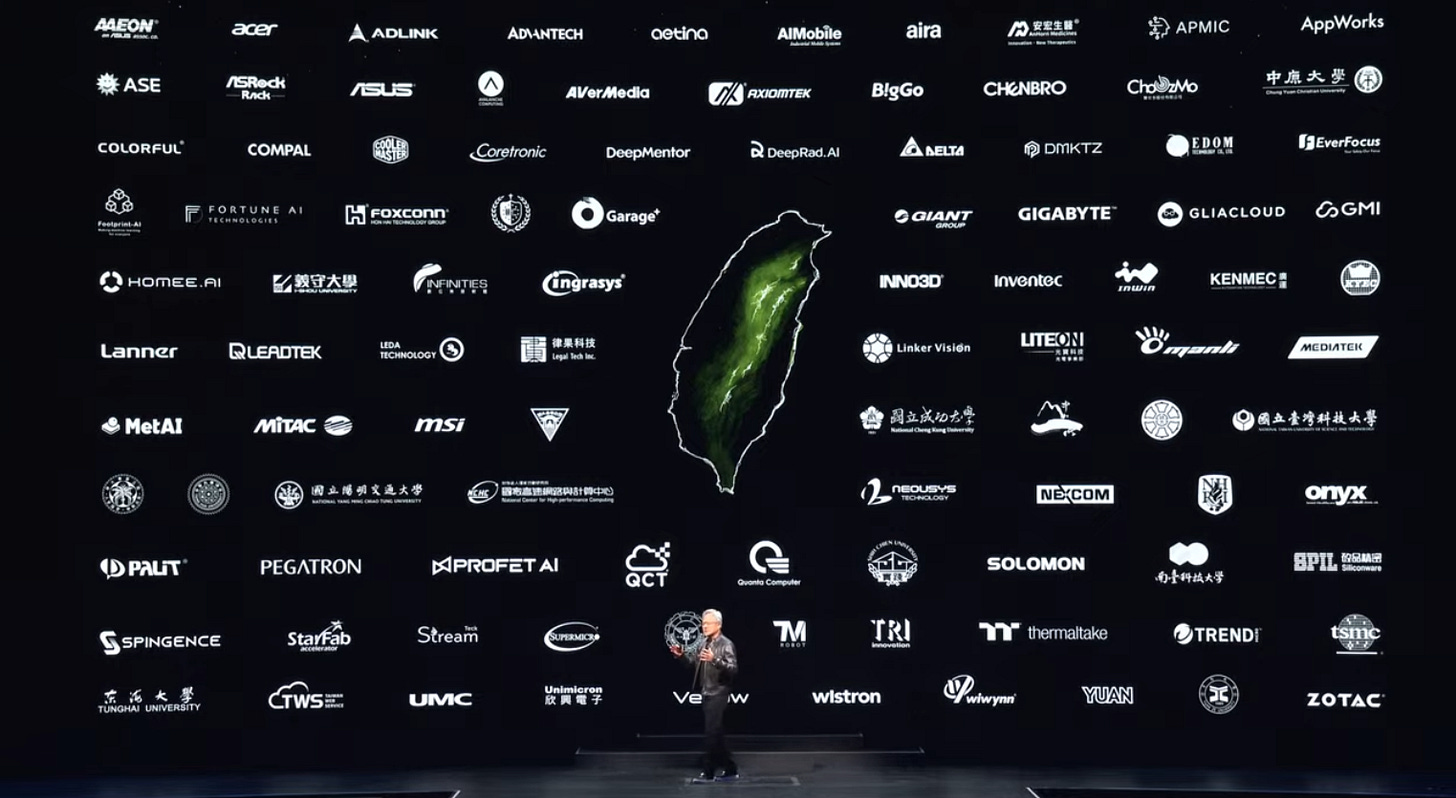
The implication is clear:
Today’s AI infrastructure is no longer a battlefield where a single company can compete alone.
From GPUs, CPUs, HBM, advanced packaging, substrates, switches, NICs, power modules, liquid cooling, racks, and connectors—to upstream equipment, materials, thermal systems, and power infrastructure—the entire AI capex chain has evolved into a true system-level engineering endeavor.
So in the future, winning will not simply be about who has the strongest chip.
It will be about who can mobilize more companies, in less time, to scale in the same direction.
This capability is, at its core, ecosystem orchestration.
And the role Jensen Huang plays, as revealed in the interview, is no longer that of a conventional “chip company CEO.”
He is closer to a chief orchestrator of the AI era.
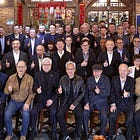
As he described it, on his right sit the CEOs of the entire upstream IT industry; on his left, the CEOs of downstream infrastructure players. This is not rhetoric—it reflects reality.
Because enabling AI factories to scale is not just about helping TSMC understand how large future demand will be. It requires memory companies, packaging firms, system integrators, power equipment providers, cooling solution vendors, and even traditional heavy industry and infrastructure players to all recognize:
This is why, when Jensen Huang speaks about the supply chain, he does not sound like a procurement executive.
He sounds like a systems architect of a new industrial era.
Jan 31
What makes Jensen Huang truly exceptional is not placing orders—but articulating the future so convincingly that others are willing to invest
There is a particularly revealing moment in the interview. Jensen Huang explains that he personally flies to suppliers, walks them through what is happening, why it is happening, and then asks them to commit billions of dollars in capital investment.
This is a remarkable statement.
Because it shows he is not negotiating short-term procurement—he is persuading partners to bet on a future that has not fully arrived yet.
These are two entirely different levels of leadership.
Most companies tell suppliers:
“We have demand—please fulfill it.”
What Jensen Huang does is closer to:
“I will explain the structural shifts of the future so clearly that you believe this is where the world is heading—and you will know what to do today.”
He also emphasizes that he gives suppliers ample opportunity to challenge him—he uses first principles, draws diagrams, and explains repeatedly until they truly understand.
This is not just charisma.
It is a form of deep structural persuasion.
Why would suppliers commit billions of dollars based on his words?
Because he is not selling a vision in the abstract. He is breaking the future down into a verifiable commercial trajectory—through product roadmaps, end-market demand, platform evolution, system architecture, and industry timing.
And at the core of all this remains one thing:
They trust him.
That is why, when asked about potential bottlenecks—such as ASML’s EUV supply or TSMC’s CoWoS capacity expansion—he can respond with such confidence.
Not because he underestimates the difficulty, but because in his worldview, once key partners understand and align around the same future, bottlenecks are no longer immovable barriers—
they are simply challenges to be overcome collectively.
CUDA is a moat—but behind CUDA lies something even larger
When people talk about NVIDIA’s moat, the first answer is usually CUDA. And that is correct.
The real value of CUDA is not just its architecture—it is the massive installed base, the mature developer toolchain, millions of developers, years of accumulated optimization, and global customer confidence that NVIDIA will continue to maintain and evolve the platform.
But this interview reveals something even more important:
CUDA is only part of NVIDIA’s moat—not the entirety.
The bigger reality is that NVIDIA has become a shared infrastructure language across industries.

It is no longer confined to the cloud, hyperscale data centers, or AI training. It is horizontally expanding into enterprise computing, networking equipment, edge inference, automotive, robotics, industrial systems—and even satellite and space-based AI, as Huang alluded to.
This means NVIDIA’s platform is no longer just a solution for a specific market.
It is increasingly becoming a civilization-scale computing foundation.
And when a company’s platform evolves into a shared dependency across industries, use cases, and geographies, its true moat is no longer just performance-per-watt or software stack advantages.
It becomes something deeper:
Whether the world believes you will still be there—continuing to build and extend that path.
At the end of the day,
this, too, is about trust.
Elon Musk, China, and space data centers may seem unrelated—but they all point to the same underlying theme
In the interview, Jensen Huang also touched on Elon Musk, China, and space-based data centers.
He spoke highly of Musk, highlighting his strengths in first-principles thinking, minimalism, and extreme hands-on execution. Musk does not operate from a distance—he transmits his sense of urgency directly across the entire supply chain, forcing execution speed and efficiency.
When discussing China, Huang pointed to its strong technological ecosystem, intensely competitive domestic environment, and rapid knowledge-sharing culture driven by open-source dynamics.
As for space data centers, he did not treat them as science fiction, but rather as a long-term direction beyond the constraints of Earth’s energy and cooling limits.
At first glance, these topics may seem scattered. But at their core, they are all addressing the same fundamental idea:
Competition in the next era will not be defined solely by technology—but by system-level organizational capability.
Whoever can more rapidly integrate technology, capital, supply chains, talent, and infrastructure will have the greatest ability to shape the future.
This is precisely why discussing AI today cannot be limited to models alone.
If you talk about models without addressing power,
power without packaging,
packaging without HBM,
or HBM without supply chain trust—
you may understand the surface,
but you will miss the underlying force that is truly driving the industry forward.
For Taiwan, the most important takeaway from this interview is not the praise—but the redefinition
For many in Taiwan, the first reaction to this interview may be a sense of pride.
That is entirely natural. After all, when the CEO of the world’s most important AI platform company publicly expresses such deep trust in TSMC, it is undoubtedly a strong affirmation of Taiwan.
But compared to being praised, what matters far more is this:
Jensen Huang is, in effect, redefining TSMC—and redefining Taiwan.
These are all true—but they do not fully capture the depth of the advantage.
A more precise framing would be:
Taiwan’s core value lies in its world-class capability for high-precision industrial coordination.
And TSMC represents the most extreme and refined embodiment of this capability.
It is not merely about producing chips.
It is about integrating technology, manufacturing, customer demand, supplier timing, packaging strategies, production schedules, and yield control into a single, coherent industrial system—one that the world’s most critical customers can rely on with confidence.
This is also why, when the world discusses geopolitical risk, the real concern is not simply the loss of a factory.
It is the potential loss of a central coordination node within the global technology system.
In other words, Taiwan’s importance has never been just about its ability to manufacture chips.
It is about its ability to ensure that the world’s most complex and advanced technological systems can operate reliably at scale.

Mar 12
Is $3 trillion in revenue possible? The real question is: how much GDP is the world willing to allocate to compute?
In the latter part of the interview, Jensen Huang was asked whether NVIDIA has a revenue ceiling. He responded directly: $3 trillion in revenue is possible.
At first glance, this sounds extreme. But the logic behind it is not casual.
His core thesis is this:
The nature of computing is fundamentally changing. Computers are no longer just passive tools for storing and retrieving information—they are becoming active engines of value creation.
If this shift holds, global demand for “compute” will not simply grow linearly—it will be structurally re-rated.
That implies that the share of global GDP allocated to compute, AI infrastructure, inference, and intelligent automation could become significantly higher than in the past.
And NVIDIA’s ambition has never been merely to become a more profitable chip supplier.
It aims to be the gateway to infrastructure in the age of intelligence.
This is why, in Jensen Huang’s view, the key constraint is not market size—but energy. Because when every industry begins redefining productivity through compute, the ultimate bottlenecks shift to power, cooling, and infrastructure.
This aligns with what SemiVision has consistently emphasized:
As the AI revolution moves into its later stages, the limiting factor will no longer be chip design alone—but the entire infrastructure system.
Trust is not soft power—it is the hardest infrastructure in the AI era
If we connect all the signals from Jensen Huang’s discussion—on TSMC, supply chains, memory, energy, capacity expansion, and future demand—a clear conclusion emerges:
The deepest moat in the AI era is not just technological leadership, but the ability to build a trust structure that enables an entire ecosystem to scale together.
TSMC’s moat is not only 2nm, nor just CoWoS.
Its deeper moat lies in decades of accumulated delivery capability, customer service, system-level coordination, and—critically—the ability to make companies like NVIDIA willing to place their future in its hands.
NVIDIA’s moat is not only CUDA.
Its larger moat is Jensen Huang’s ability to walk into the offices of 200 suppliers, explain the future through first principles, convince them to invest capital, align their execution timelines, and prioritize NVIDIA at the highest level.
So at its core, the AI revolution is not just about chips.
It is about:
Trust
Coordination
Cross-industry mobilization
The ability to make a future that has not yet arrived be executed as if it already has
Perhaps this is the most important underlying message for Taiwan:
In the next era, what determines whether a country or a company stands at the center is not just whether it possesses advanced technology—but whether the world is willing to entrust its most critical future to it.
And from Jensen Huang’s perspective, at least for now, TSMC remains one of the names the world is most willing to trust.
Thanks for reading SEMIVISION @_@! This post is public so feel free to share it.
PreviousNext
TopLatestDiscussions
No posts