50% Margin ≠ Easy Money: The Hidden Cost of Staying Competitive in IC Design
50% Margin ≠ Easy Money: The Hidden Cost of Staying Competitive in IC Design
- Source: SemiVision
- Author: SEMIVISION
- Published: 2026-03-28T09:46:30+08:00
- URL: https://tspasemiconductor.substack.com/p/50-margin-easy-money-the-hidden-cost (1) 50% Margin ≠ Easy Money: The Hidden Cost of Staying Competitive in IC Design


50% Margin ≠ Easy Money: The Hidden Cost of Staying Competitive in IC Design
Original Article By SemiVision Research [Reading time: 12 mins]

Mar 28, 2026
∙ Paid
In the capital markets,“High Gross Margin”is almost always one of the most exciting metrics.
Especially when investors look at an IC design leader like MediaTek, whose gross margin has long hovered near 50%, the immediate reaction is often: this industry must be incredibly profitable. Compared to electronics manufacturing services, where margins are typically in the single digits, IC design companies appear to occupy the most comfortable, most attractive, and seemingly most lucrative position in the value chain.

MediaTek CEO Rick Tsai made a special appearance at the opening day of the McDonald’s restaurant at the company’s Hsinchu headquarters, taking part in a flash event. Source: Mediatek FB
MediaTek is often humorously nicknamed “McDonald’s” by Taiwanese netizens due to the resemblance between its gold “M” logo and the iconic arches of McDonald’s.
Because high gross margins in IC design do not necessarily mean windfall profits. More often, they represent a structural requirement for survival.
What appears today as high margin does not imply easy money. Instead, it often signals the need for continuous, high-intensity R&D investment, increasingly complex platform integration, the adoption of more expensive advanced process nodes, and longer product development cycles.
In other words, for IC design companies, a high gross margin is not the end goal—it is the starting point.
And MediaTek is one of the most illustrative cases to unpack.

2月24日
Why does MediaTek’s high gross margin so often lead to misunderstanding in the market?
On the surface, MediaTek seems to possess all the characteristics that captivate capital markets.

It is a leading global fabless semiconductor company, with products spanning smartphone SoCs, Wi-Fi, broadband, smart devices, automotive, power management, and various edge computing platforms. Unlike foundries, it does not need to build fabs, and unlike OSAT or assembly companies, it does not bear heavy fixed capital intensity. From a financial perspective, its direct manufacturing costs are relatively straightforward—making it easier to present higher gross margins.
As a result, many people arrive at a simple conclusion:
No fabs, high margins—this must be a highly profitable business.
This statement is not entirely wrong, but it only tells half the story.
Because while the fabless model allows IC design companies to avoid the most capital-intensive burden of manufacturing, it does not shield them from another, arguably more brutal pressure:
Rapid technological obsolescence
Extremely short product life cycles
Relentless R&D demands
In other words, although IC design companies do not need to invest hundreds of billions of dollars every few years to build new fabs, they must continuously—year after year, with almost no pause—reinvest a significant portion of their gross profit back into R&D.
This is not a strategic choice. It is a condition for survival.

This is an industry where high gross margins are a prerequisite for maintaining competitiveness.
The reason is straightforward.
Chips are not products that can be sold for years without iteration. Especially today, across markets—from smartphone SoCs and Wi-Fi 7 to automotive platforms, AI edge, and custom data center ASICs—everything is evolving rapidly. Architectures are changing, process technologies are advancing, packaging is shifting, interfaces are evolving, and customer demands are constantly being redefined.
If a company fails to sustain continuous R&D investment, it may find itself without competitive products within just three years.
And in the semiconductor world, no next-generation product effectively means no next cycle of cash flow.
This is why, despite high gross margins, a significant portion of that margin in IC design companies simply flows from customers into the company—and then directly into the development budget for the next generation of chips. What ultimately remains as stable profit, shareholder return, and accumulated cash is often far more limited than outsiders assume.
In this context, high gross margins are not a luxury—they are a necessity.
Not to make companies comfortably profitable, but to ensure they remain alive in the next round of technological competition.
MediaTek as a Case Study: Gross Margin Is Not the End, but the Fuel
MediaTek is not built around a single flagship smartphone chip. Its business spans multiple domains, including:
Smartphone SoCs
Smart home and broadband communications
Wi-Fi / Bluetooth / connectivity chips
Power management ICs
Automotive electronics
Edge AI and various embedded platforms
The advantage of such a diversified portfolio is clear: risk dispersion and broader market coverage. But the trade-offs are equally significant:
larger R&D scale, deeper IP investment, more complex platform integration, and greater difficulty in synchronizing technology cycles across product lines.
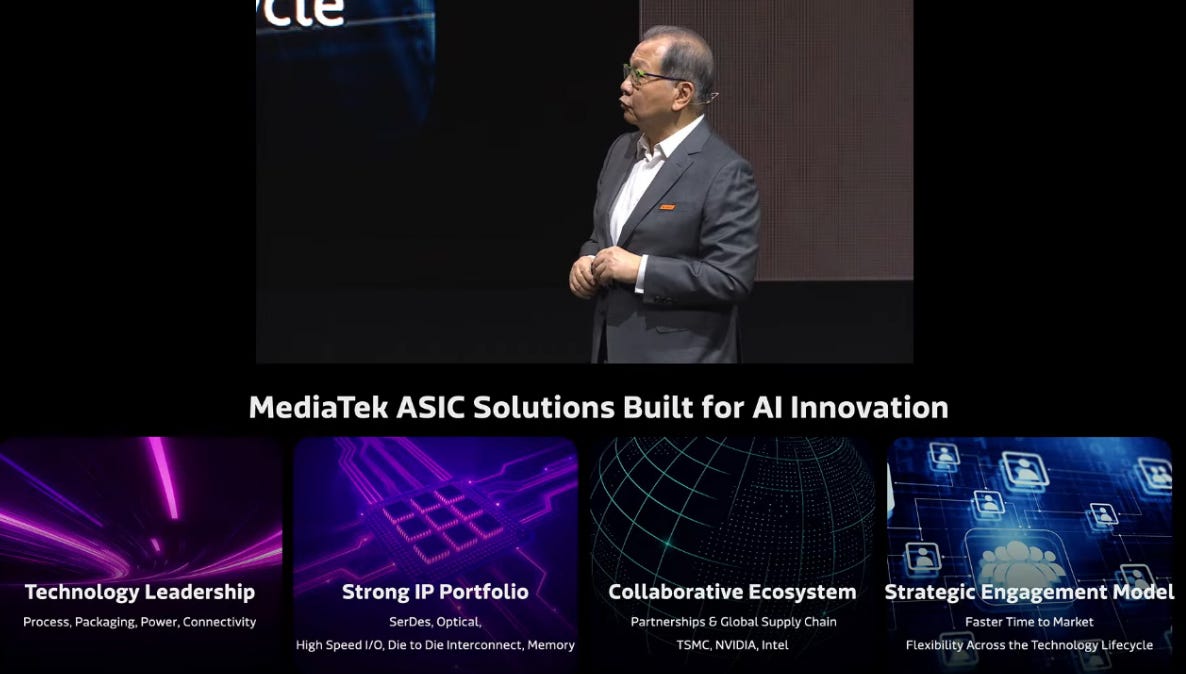
As a result, MediaTek’s high gross margin is not simply a reflection of “profitable products.” Rather, it is a structural necessity to support massive R&D spending required to sustain competitiveness across its entire product matrix.
Here is a critical point that many investors tend to overlook:
R&D in IC design companies is not just about refining existing products—it is about preventing the entire product portfolio from losing momentum at some point in the future.
A company may be competitive in smartphones today, but that does not guarantee leadership in Wi-Fi tomorrow. Automotive chips may be expanding, but without alignment in software ecosystems, functional safety, and long validation cycles, revenue conversion can lag. Edge AI may appear to be a new opportunity, but without the right compute architecture, memory configuration, power efficiency, and system integration, scaling remains difficult.
In essence, the high gross margin you see today is funding an entire pipeline of future products in reserve.
What Truly Matters Is Not How High the Gross Margin Is, but Whether It Can Sustain the R&D Structure
This is the most critical step in financial analysis.
Many people stop at gross margin when reading financial statements.
Is the company’s current gross margin sufficient to support its required R&D intensity?
If a company appears to have a healthy gross margin but also carries a very high R&D expense ratio, the operating profit it ultimately retains may not be as strong as it seems. Conversely, if an IC design company’s gross margin begins to decline while it continues to maintain high R&D spending, profitability pressure will quickly emerge. But if it chooses to cut R&D to protect EPS, its future competitiveness will start to erode.
If gross margins are not high enough, R&D cannot be sustained
If R&D is reduced, future product pipelines will weaken
Once product pipelines break, both revenue and gross margin will decline
Cutting R&D to protect short-term earnings often delays the problem rather than solving it
Therefore, when evaluating IC design companies, it is not enough to look at gross margin alone, nor is EPS sufficient.
What truly matters is whether gross margin, R&D, operating expenses, product renewal cycles, and future market positioning form a healthy, self-sustaining loop.
Why High R&D Is Not Optional, but Essential
The semiconductor industry is not like typical consumer goods, nor is it a slow-moving industrial sector.
The brutal reality of chip design competition lies in the convergence of multiple pressures:
First, short product life cycles.
A chip’s commercial lifespan is often brief—especially in smartphones, connectivity, consumer electronics, and high-performance computing. Winning today does not guarantee success in the next generation.
Second, increasing technological complexity.
It is no longer enough to simply make CPUs faster or GPUs larger. Companies must now integrate AI engines, ISPs, connectivity, memory architectures, power management, security mechanisms, software ecosystems, and system-level optimization.
Third, rising costs of advanced process nodes.
Even though fabless companies do not build fabs, moving to advanced nodes significantly increases NRE, IP licensing, EDA tools, validation, engineering manpower, and tape-out costs.
Fourth, growing platform-level customer expectations.
Customers are no longer buying standalone chips. They demand complete solutions, long-term roadmaps, hardware-software integration, and even ecosystem support.
In other words, R&D in today’s IC design companies is no longer about designing a single chip—it is about sustaining platform-level competitiveness.
This is why high R&D investment is unlikely to decrease as a norm—unless the company is willing to accept a decline in its future competitive position.

2025年6月28日
The Real Risk Is Not High R&D, but an Unnatural Decline in R&D
Many investors instinctively view high R&D spending as a sign of heavy costs or inefficiency.
But for technology companies, what should raise concern is often not excessively high R&D—but rather a sudden drop in R&D, especially when the industry is still evolving rapidly.
When profitability comes under pressure, one of the easiest levers for management to pull is adjusting the R&D budget.
In the short term, this is highly effective:
EPS improves
Operating margins increase
Cash flow pressure temporarily eases
Market sentiment may turn positive
But what is the cost?
The cost is that, two to three years later, the product pipeline may begin to break.
Therefore, for IC design companies, consistent and sustained high R&D investment is itself a core component of competitiveness.
It does not guarantee success—but without it, failure is often only a matter of time.
Why MediaTek’s High Gross Margin Does Not Guarantee Dominant ROE
Here is a perspective worth deeper reflection.
The market often equates gross margin directly with profitability. But a more complete financial question is:
How efficiently does a company ultimately generate returns for its shareholders?
In other words, you cannot look at gross margin alone. You also need to consider operating expense structure, capital efficiency, product iteration pressure, and ultimately how all of these translate into returns on equity.
On the other hand, IC design companies may display attractive gross margins, but they also carry long-term burdens: high R&D costs, expensive talent, technological risks, and highly uncertain product cycles. As a result, what ultimately flows through to shareholder returns is not always as “naturally lucrative” as gross margins might suggest.
This reflects a core principle:
Do not overemphasize a single financial metric.
What truly matters is how a company integrates gross margin, R&D, product strength, and capital efficiency into a sustainable model.
From a Value Chain Perspective: IC Design Is One of the Most Knowledge-Intensive and Fastest-Evolving Segments
Many people describe IC design as a “light-asset” business.
From an accounting perspective, this is not incorrect. But if this is interpreted as “lower pressure,” it becomes a serious misunderstanding of the industry.
Within the semiconductor value chain, IC design is one of the most knowledge-intensive, talent-intensive, high-risk, and high-velocity segments.
Because instead of bearing heavy depreciation on physical assets, it carries a different kind of hidden cost:
High-end engineering talent costs
Long-cycle architecture development investments
IP licensing and EDA tool expenses
Opportunity cost of failed products
Time-to-market risks from missing key windows
Strategic costs of failing to align with customer roadmaps
Especially in today’s era of AI, automotive, high-speed connectivity, and edge computing, IC design companies are increasingly competing at the platform level, not just at the product level.

This means R&D is not only growing—it is becoming deeper, broader, and harder to pause.
Therefore, IC design is not an easy-profit business. It is a model where high gross margins are exchanged for high R&D investment, and that R&D is then used to bet on the success of future products.
At its core, it is an industry that continuously reinvests today’s cash flow into securing tomorrow’s market position.
SemiVision Perspective: High Gross Margin Is Not Glory, but a Stress Test
From a SemiVision perspective, when evaluating companies like MediaTek, what matters is not simply that “this company has an attractive gross margin,” but rather:
Is this level of gross margin sufficient to support its technological evolution and platform expansion over the next five years?
These are fundamentally different questions.
The former is static.
The latter is dynamic.
The former looks only at financial statements.
The latter evaluates whether a company has the capability to navigate the next wave of technological transitions.
This is why SemiVision never evaluates IC design companies based on gross margin alone. Instead, we focus on four critical questions:
Can gross margin sustain R&D?
Can R&D translate into product competitiveness?
Can product strength translate into platform positioning?
Can platform positioning translate into sustainable cash flow?
The most exceptional companies are not those with the highest gross margins, but those that can close this loop.
Conclusion: Stop Translating High Gross Margin into “Windfall Profits”
What we should learn from MediaTek’s financials is not simply that its gross margin approaches 50%.
What truly matters is a deeper insight:
If you want to compete in advanced platforms, support broad product portfolios, and maintain global competitiveness, you must sustain long-term R&D investment.
If you want to sustain that level of R&D, you must first achieve sufficiently high gross margins. But if those high margins are used only to support short-term EPS rather than future product competitiveness, then they lose their real meaning.
So the next time the market highlights a “near-50% gross margin” for an IC design company, the real question should not be:
Is this a windfall profit?
But rather:
Is this level of margin sufficient to support the next cycle of R&D, the next round of platform competition, and the next phase of industry reshuffling?
Because in the semiconductor industry, those who ultimately survive are not the companies that appear to be the most profitable today—
but those that can consistently convert today’s gross margin into tomorrow’s technological position.
Thanks for reading SEMIVISION @_@! This post is public so feel free to share it.

2025年5月21日

Named Among LexisNexis “Top 100 Global Innovators” for the Fifth Time 🏅
Innovation is an endless relay race.
Since the launch of the LexisNexis awards in 2022, MediaTek has been recognized every year—reaching a new milestone in 2025 by being named among the “Top 100 Global Innovators” for the fifth time.
As a global technology leader in the semiconductor industry, MediaTek has invested over NT$300 billion in R&D over the past three years, focusing on advancing cutting-edge technologies and delivering innovative solutions from edge to cloud.
In 2025, multiple MediaTek research papers were selected for top-tier international conferences across semiconductors, artificial intelligence, and communications.
MediaTek is also the only company in Taiwan’s industry to have more than 100 papers accepted to the ISSCC for 23 consecutive years—demonstrating its deep and sustained technical strength.
Amid rapid technological evolution, MediaTek not only established internal R&D Gold Awards and Special Contribution Awards to recognize and encourage innovation within the company, but also actively participates in industry standards organizations. By collaborating with industry peers and academic institutions, MediaTek continues to stay at the forefront of emerging standards while strengthening its technology and patent portfolio.


PreviousNext
TopLatestDiscussions








See all