Why TSMC Is Scaling in Arizona—and Why Samsung Said No to Japan
Why TSMC Is Scaling in Arizona—and Why Samsung Said No to Japan
- Source: SemiVision
- Author: SEMIVISION
- Published: 2026-03-25T09:08:57+08:00
- URL: https://tspasemiconductor.substack.com/p/why-tsmc-is-scaling-in-arizonaand (1) Why TSMC Is Scaling in Arizona—and Why Samsung Said No to Japan


Why TSMC Is Scaling in Arizona—and Why Samsung Said No to Japan
Original Article By SemiVision Reserach [Reading time: 10 mins]

Mar 25, 2026
∙ Paid
The global semiconductor industry in 2026 is entering a phase that runs deeper—and is far more brutal—than a simple race of technology nodes.
On the surface, the competition appears to be about who can mass-produce 2nm first, who can advance HBM the fastest, or who can secure the most AI orders. But step back, and it becomes clear that the real determinant of success is no longer just process technology, packaging, or memory itself. Instead, it is about who can integrate manufacturing capacity, talent, energy, capital, subsidies, and geopolitics into a fully coordinated, national-level supply chain system.
Two recent developments illustrate this shift with striking clarity.
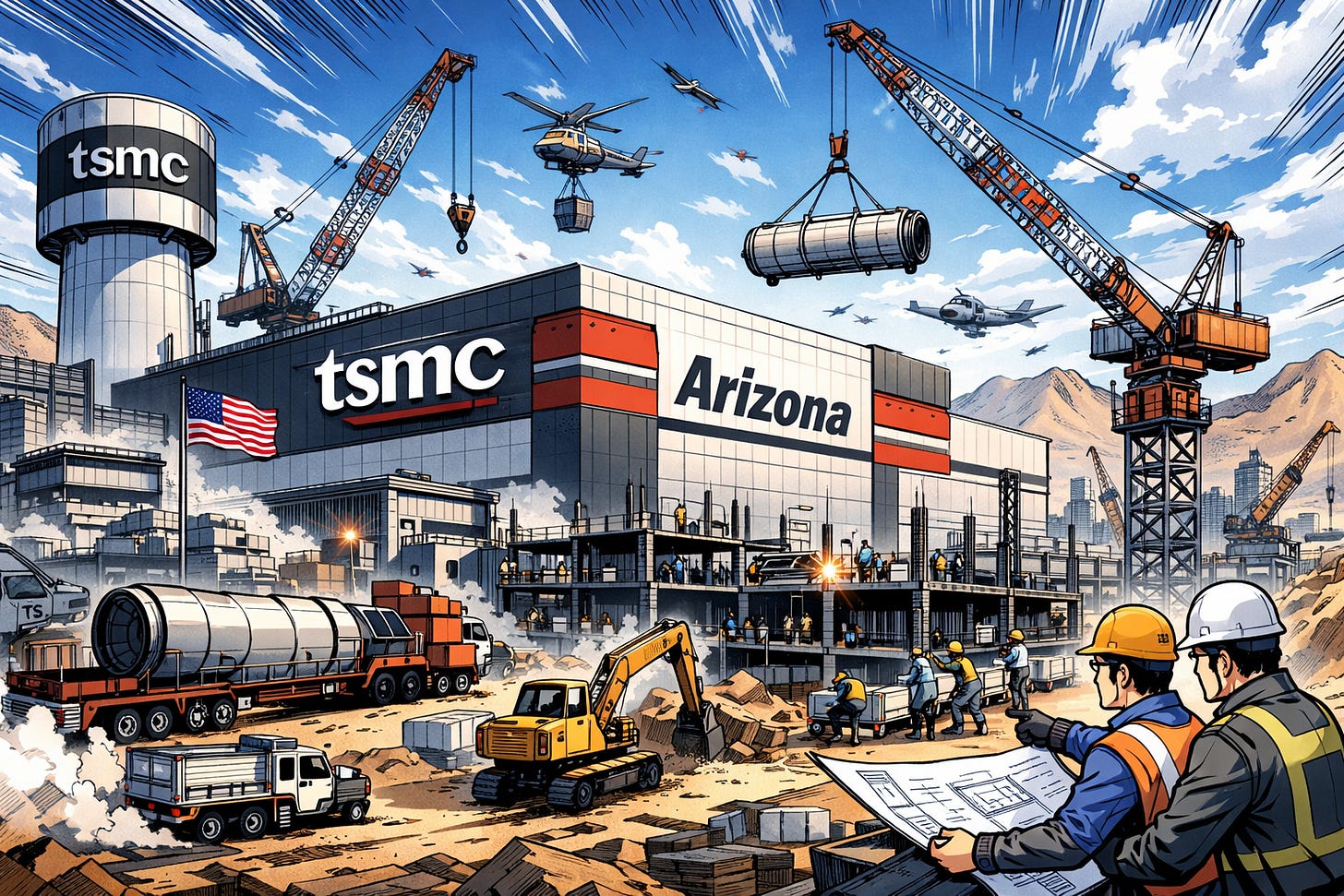
The first is the accelerated progress of TSMC’s Arizona fabs. According to supply chain sources, the follow-on phases of Fab 21 are moving faster than expected. The P2 fab is now likely to introduce 3nm production as early as the second half of 2027, while the mechanical and electrical system installation timelines for P3 and P4 have also been pulled forward. This signals that TSMC’s U.S. expansion is no longer a symbolic foothold—it is transitioning into a phase of real scale expansion.
The second development comes from Japan. In an effort to revive its semiconductor industry, the Japanese government extended highly attractive incentives to Samsung Electronics and SK hynix, including free land, infrastructure support, and a reduction in total cost of ownership (TCO) to roughly half that of Korea. The goal was to replicate the “TSMC Kumamoto model” and extend it from logic into memory. Yet the outcome was decisive: both Samsung and SK hynix declined, choosing instead to firmly maintain domestic production in Korea.
At first glance, these two events seem unrelated. In reality, they point to the same conclusion:
Semiconductors are no longer merely corporate investment decisions—they are instruments of national industrial strategy.
TSMC’s Arizona Acceleration: Not Just Faster Construction, but the Deepening of U.S. Localization
Over the past few years, there have been two prevailing interpretations of TSMC’s U.S. fabs.
One view held that these were largely political investments—responses to U.S. demands for supply chain security, with symbolic significance outweighing economic rationale. The other argued that, over time, subsidies, customer demand, and the dual pull of defense and AI would anchor TSMC into a genuinely localized manufacturing ecosystem.

Today, the latter view is increasingly proving correct.
The latest developments show that Arizona is no longer just about “building the fabs.” It has entered a far more practical phase: shortening construction cycles, accelerating tool installation, aligning suppliers, smoothing talent transitions, and ultimately bringing fabs into production readiness faster.
This distinction matters. Because the hardest part of building a fab has never been civil construction—it is the highly complex system integration that follows, including:
Cleanroom mechanical and electrical engineering
Primary and secondary utility systems
High-purity gas and chemical supply
Equipment move-in and qualification
Manufacturing execution, yield control, and supplier coordination
For advanced nodes, the real bottleneck is rarely “whether you can build it,” but whether you can assemble the entire system quickly, reliably, and with minimal errors.
The acceleration in Arizona reflects two critical shifts.
First, the engineering learning curve in the U.S. is improving.
What began as a high-cost, low-efficiency, talent-constrained environment is gradually evolving into one where construction and installation efficiency are improving, and coordination between local teams and Taiwan-based supply chains is becoming smoother.
Second, TSMC no longer views its U.S. fabs as a single outpost.
Instead, they are increasingly positioned as a key localized node for global customers—especially those in AI and high-performance computing.
This shift is driven by very clear demand signals.
Whether it is AI GPUs, AI ASICs, advanced networking chips, or certain defense and critical computing applications, the U.S. increasingly wants high-end chips to be produced domestically—or at least within “trusted regions.” This is not a short-term political slogan; it is a long-term structural policy direction.
In that sense, Arizona’s acceleration is not just about TSMC’s internal schedule.
It marks the point at which U.S. semiconductor localization strategy begins to move from policy intent to operational execution.

3月12日
Why Japan Wants to Replicate the “Kumamoto Model” in Memory
Japan understands one fundamental reality: logic alone is not enough.
If TSMC’s Arizona fabs represent the United States addressing its weakness in logic manufacturing, then Japan’s recent overtures to Samsung Electronics and SK hynix are aimed at filling its gap in memory.
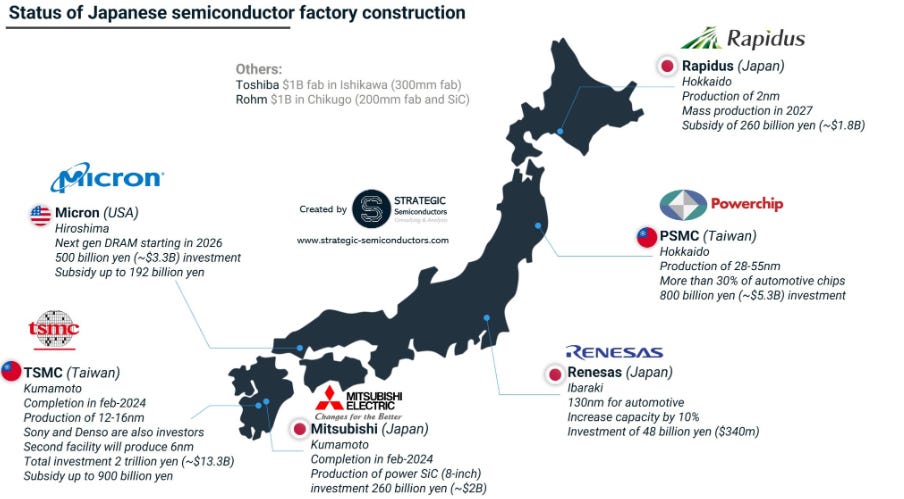
2024 Version
Over the past few years, Japan’s stance on semiconductors has become increasingly clear. It is not trying to maintain the status quo—it is aiming to re-establish itself as a major global semiconductor hub.
From TSMC’s investment in Kumamoto, to Rapidus’ push into advanced logic, to the strengthening of materials, equipment, power infrastructure, and local government coordination, Japan is executing a coherent strategy:
To use state power to rebuild a manufacturing environment capable of attracting world-class semiconductor companies.

2025年7月19日
Against this backdrop, Japan’s focus on Samsung and SK hynix is straightforward.
Because Japan clearly recognizes that in the AI era, strategic value is not limited to logic chips such as CPUs and GPUs. Memory—particularly HBM, DRAM, and NAND—has become equally critical. Among them, HBM has already emerged as one of the core bottlenecks in AI servers.
Whoever controls the HBM supply chain does not merely control a product—they secure a key position of power within the AI value chain.
If Japan were able to bring even a portion of Korean memory capacity onto its soil, it would carry three major implications:
First, it would complete Japan’s strategic positioning in the AI memory era.
Second, it would strengthen the integration of its domestic ecosystem across materials, equipment, packaging, and testing.
Third, it would further solidify Japan’s role as a high-end semiconductor hub outside of China.
This is precisely why Japan was willing to offer such aggressive incentives.
For the Japanese government, this is not a conventional investment promotion effort—it is part of a broader national industrial reconstruction strategy.

2月6日
Why Samsung and SK hynix Chose to Reject Japan’s Incentives
At first glance, Japan’s offer was highly attractive: free land, infrastructure support, significantly reduced total cost of ownership (TCO), and even an attempt to replicate the success of TSMC’s Kumamoto model through policy incentives.
Yet both Samsung and SK hynix ultimately declined. This decision was not due to a lack of sincerity from Japan, but rather because the logic of the memory industry is fundamentally different from that of the foundry business.
Memory is a national core technology for Korea—not just a corporate asset
For Korea, Samsung and SK hynix are not merely companies; they are pillars of national industry.
Memory technology encompasses advanced process nodes, stacking technologies, design capabilities, yield management, and extensive engineering know-how. Once these capabilities are relocated overseas, it is not just capital that moves—talent, suppliers, training systems, and long-term technological accumulation may follow.
For both the Korean government and its leading firms, this represents a red line that cannot be easily crossed.
In the HBM era, competition is about speed and integration—not just cost
HBM is fundamentally different from traditional commodity DRAM.
It involves advanced packaging, 3D stacking, thermal management, yield optimization, and deep co-development with GPU and AI accelerator customers. Success in this domain depends less on minimizing fab construction costs and more on whether the entire supply chain can operate with high-speed coordination.

Source: SK securities
Samsung and SK hynix have already built highly concentrated and tightly integrated ecosystems within Korea—spanning equipment, materials, components, engineering talent, and centralized decision-making.
Relocating critical capacity overseas may bring subsidies, but during the crucial early ramp-up phase, it would likely introduce additional complexity and execution risk.
Korea has already committed to massive domestic investment—it cannot undermine itself
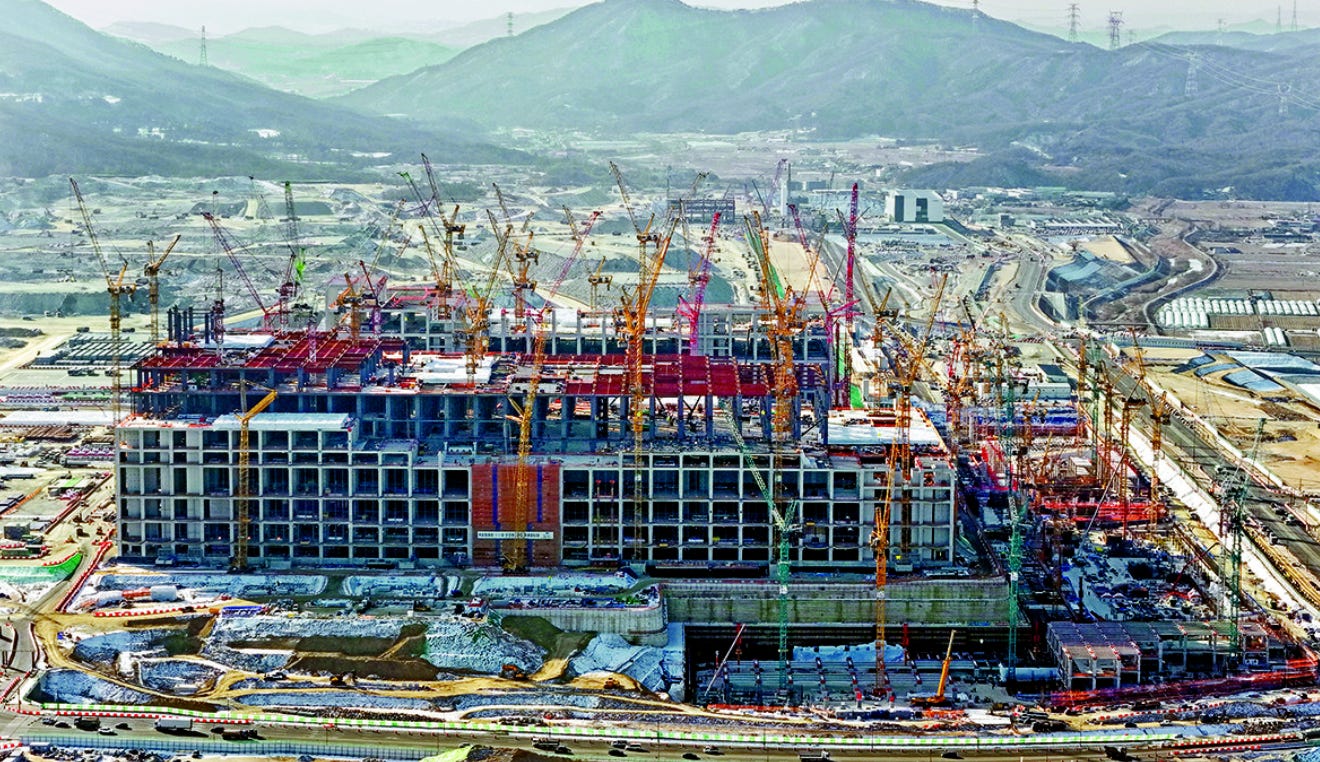
Construction site of SK hynix's Y1 chip factory located in Yongin, Gyeonggi, on Jan. 20. The fab is the first out of four factories SK hynix plans to build there.
The Yongin semiconductor cluster is not just another project—it is the core of Korea’s industrial strategy for the coming decade.
For Samsung and SK hynix, the priority is to execute these large-scale domestic investments, anchoring capacity, technology, and talent firmly within Korea, rather than diluting focus by expanding abroad at this critical juncture.

3月2日
Japan’s Pivot to Micron Signals a More Concrete U.S.–Japan Semiconductor Alliance
After Samsung and SK hynix declined, Japan quickly pivoted to partnering with Micron, backed by substantial subsidies. This clearly shows that Japan has no intention of slowing down.
What matters here is not the size of a single subsidy, but the strategic direction behind it:
Japan is positioning itself as a key manufacturing and technological extension of the U.S.-aligned semiconductor supply chain.
This positioning aligns closely with current geopolitical realities.
The United States needs trusted allies to rebuild its advanced semiconductor supply chain. Japan, in turn, seeks to leverage U.S. technology, capital, and policy alignment to reclaim a central role in the global semiconductor landscape.
As a result, Micron’s expansion of HBM and advanced memory production in Japan is not merely a corporate investment—it is a concrete manifestation of a deepening U.S.–Japan industrial alliance.
This development also serves as a signal to Korea.
As the United States, Japan, and Taiwan gradually form a more tightly integrated semiconductor division of labor, Korea—if it aims to maintain its dominance in memory—must consider how to more effectively embed itself within allied ecosystems, while still preserving its domestic manufacturing core, rather than relying solely on its existing advantages.
Four Distinct Models of National Semiconductor Strategy Are Emerging
If we step back and examine the current landscape, four major players are each pursuing fundamentally different strategic paths.
United States: Supply Chain Reshoring Driven by Markets and National Security
The U.S. holds its strongest advantages in end demand, cloud customers, AI platforms, and capital markets. Its strategy is to partially rebuild domestic manufacturing while using subsidies and policy tools to anchor allied capacity within its broader strategic framework.
Japan: Rebuilding a Manufacturing Base Through Policy and Industrial Environment
Japan may not immediately reclaim full-spectrum leadership across the semiconductor value chain, but it is positioning itself as one of the most attractive locations for advanced chip manufacturing. From Kumamoto to Rapidus, combined with strengths in materials, equipment, and coordinated government support, Japan is shaping itself into a high-reliability, high-coordination, policy-driven manufacturing hub.
Korea: Defending Memory Leadership Through Domestic Integration
Korea’s strategy is clear: keep core technologies and critical capacity at home.
In the race for HBM and advanced memory, Korea’s greatest concern is not missing out on subsidies, but losing control over industry leadership. Maintaining a tightly integrated domestic ecosystem remains its top priority.
Taiwan: Expanding Globally While Retaining the Core at Home
Taiwan has taken the most distinctive path.
On one hand, it is accelerating global expansion. On the other, the true core—manufacturing excellence, talent density, supply chain efficiency, and most importantly, advanced-node mass production—remains highly concentrated domestically. TSMC’s acceleration in Arizona is a perfect illustration of this model:Expanding outward, but not relocating the center of gravity.
2月2日
For Taiwan, the Real Question Is Not Whether to Go Global—But How to Remain the Center After Going Global
When many people see TSMC expanding into the U.S. and Japan, their first reaction is concern: will Taiwan be hollowed out?
But the more precise question is not whether hollowing out will occur. It is this:
As global manufacturing nodes become increasingly distributed, how can Taiwan remain the irreplaceable central hub?
There are at least three key factors.
- Sustaining leadership in advanced nodes and mass production efficiency
While overseas fabs can replicate portions of capacity, it is extremely difficult in the near term to replicate Taiwan’s manufacturing ecosystem—its density, efficiency, and ability to rapidly iterate and correct.
- Managing supply chain expansion without losing the system center
It is inevitable that Taiwanese suppliers will follow customers abroad. But this must not evolve into a model where “wherever the customer goes, the center of capability follows.”
What truly matters is that overseas sites act as extensions—not replacements—of the core system.
- Energy, land, and talent will determine whether Taiwan remains the core
This is the most practical constraint.
If Taiwan cannot ensure stable power supply, if labor shortages worsen, or if land and infrastructure fail to keep pace, then even with superior technology, it may be forced to cede incremental capacity in the next phase of global restructuring.
In other words, when evaluating TSMC’s acceleration in Arizona, the key question is not simply whether the U.S. fabs are moving faster—but rather:
Can Taiwan itself continue to operate as the most efficient semiconductor center in the world?

2月23日
Conclusion: Semiconductor Competition Has Escalated from Corporate Rivalry to a Civilizational Contest of Industrial Organization
Japan’s failed attempt to attract Samsung and SK hynix demonstrates one thing:
Even the most generous subsidies cannot guarantee the relocation of core technologies.
TSMC’s acceleration in Arizona demonstrates another:
When demand, policy, and supply chain alignment reach a certain threshold, overseas manufacturing can evolve from a political mandate into a genuinely scalable production strategy.
Japan’s pivot to Micron reveals a third:
The future semiconductor landscape will not be dominated by individual companies alone, but by alliances, national credibility, and industrial organizational capabilities.
This is the reality of the semiconductor industry in 2026.
The outcome will not be determined solely by who reaches 2nm first, who mass-produces HBM4 first, or who secures the most AI orders. It will depend on who can embed these capabilities into a system that is sustainable, scalable, and protected at the national level.
From this perspective, places like TSMC’s Arizona fabs, Kumamoto in Japan, Micron’s operations in Hiroshima, and Korea’s Yongin cluster are not merely factory locations.
They are coordinates on the emerging map of global semiconductor power.
And this competition has only just begun.
Thanks for reading SEMIVISION @_@! This post is public so feel free to share it.

3月19日


PreviousNext
TopLatestDiscussions








See all