Arm Is No Longer Just Selling IP — It is Stepping In to Build Chips Now
Arm Is No Longer Just Selling IP — It is Stepping In to Build Chips Now
- Source: SemiVision
- Author: SEMIVISION
- Published: 2026-03-25T13:43:45+08:00
- URL: https://tspasemiconductor.substack.com/p/arm-is-no-longer-just-selling-ip (1) Arm Is No Longer Just Selling IP — It is Stepping In to Build Chips Now


Arm Is No Longer Just Selling IP — It is Stepping In to Build Chips Now
Original Article By SemiVision Research [Reading time: 14 mins]

Mar 25, 2026
∙ Paid

As Agentic AI Repositions the CPU as the Orchestration Core of Data Centers, Arm Is Aiming for More Than Relevance — It Wants Control of AI Infrastructure
AI infrastructure is undergoing a rapid transformation.
Over the past two years, nearly all attention has been focused on GPUs, HBM, advanced packaging, liquid cooling, rack-level power density, and optical interconnects. The industry narrative has seemingly converged on a single idea:
Whoever delivers more accelerators will dominate the AI era.
But at its latest Arm Everywhere event, Arm attempted to shift the spotlight back to the CPU.
CEO Rene Haas made the argument clear:
The AI data center is not a world where CPUs are being marginalized—it is a world where the role of the CPU is being fundamentally redefined.
As AI applications evolve from single-query responses to agentic AI, the workload model of data centers is undergoing a structural shift. In this new paradigm:
accelerators generate,
GPUs compute,
but CPUs orchestrate.
CPUs are no longer just supporting actors—they are what make the entire system function.

This Is Not Just Product Positioning — It’s a Strategic Reframing
What Arm is really trying to say is:
In the AI era, the key is not just who has the most powerful accelerators,
but who controls the orchestration of the entire compute system.
And this is where things become more nuanced.
Because what Arm presented is no longer just a vision—it is a repositioning.
Arm is no longer simply an IP licensor.
It is no longer just selling blueprints.
It is increasingly positioning itself as a system-level platform player,
one that may eventually step directly into defining—or even building—chips.
This move carries significant implications.
Or it could mark the beginning of a delicate and complex restructuring of its relationships with existing customers.
The CPU Has Not Disappeared — It Has Become the Orchestration Core
In recent years, the industry’s understanding of AI infrastructure has drifted toward an extreme:
As long as you have larger GPU clusters, higher token throughput, and faster interconnects, AI will scale.
Within this narrative, the CPU appears to fade into the background—a supporting component that exists but is no longer central. The real value seems to reside in GPUs, accelerators, and massive training and inference clusters.
This is precisely the perception Arm is trying to correct.
Haas emphasized that within AI data centers, the CPU’s role has never been simply to “fill in compute.” Instead, it serves as the system-level coordinator and orchestrator.
As workloads become increasingly complex, the CPU is not being marginalized—it is becoming indispensable.
It is the core of:
traffic management
workload scheduling
memory coordination
I/O orchestration
cross-system workflow control
And This Shift Is Entirely Logical
Because AI systems are never just about matrix multiplication. Once deployed in real-world data centers, every request involves substantial work that goes far beyond GPU compute—ranging from scheduling and resource allocation, memory management and data movement, cache handling, and network packet processing, to tool invocation, workflow switching, database queries, CXL/PCIe resource coordination, and the integration of storage and communication stacks.
As AI evolves from chat-based interactions to agentic systems, the underlying system behavior fundamentally changes: instead of a simple model where a user submits a prompt and receives a response, future workloads involve agents decomposing tasks, autonomously invoking tools, querying across multiple systems, executing multi-step reasoning workflows, and operating continuously, 24/7. This transformation means that token growth is no longer limited to generation itself, but also includes the entire orchestration overhead required to support increasingly complex workflows.
As a result, the central question is no longer whether adding more GPUs will solve the problem. The real question becomes: once we have more GPUs, who manages the system? Arm’s answer is clear—the CPU.
Agentic AI Is Driving Not Just Compute Demand, but System-Level Friction
Haas pointed out that under traditional cloud architectures, a 1 GW data center typically requires around 30 million CPU cores. However, in the era of agentic AI, that number could rise to 120 million cores—a roughly 4× increase.
This estimate deserves a closer look.
Many people’s first reaction to such numbers is skepticism:
Isn’t this too aggressive?
But even without debating the absolute figures, the direction itself is fundamentally sound.
Because the essence of agentic AI is not simply that “models are getting smarter.”
It is that workflows are becoming longer, system-level friction is increasing, and the coordination overhead required to complete a task is exploding.
From Single Inference to Multi-Step Orchestration
In the past, a single query might require only one inference.
In the future, an agent-driven task could be broken down into dozens of steps:
understanding intent
retrieving information
calling external APIs
aggregating results
validating outputs
retrying
generating multiple responses
Behind every one of these steps lies CPU-driven orchestration.
Accelerators generate tokens.
But CPUs determine:
the context in which those tokens are generated
where data is fetched from
when data is moved
and when execution transitions to the next stage of the workflow

From High-Performance Compute to High-Density Workflow Execution
From a system architecture perspective, this represents a shift:
From single-point high-performance compute
to high-density, workflow-driven computation.
Haas used a simple but effective analogy:
Accelerators are like bulldozers.
CPUs are the machinery that coordinates and transports materials across the entire construction site.
The bulldozer may be powerful, but without coordination, the construction site cannot function.
A Critical Industry Shift
This analogy captures a deeper industry reality:
The bottleneck in AI is shifting—from insufficient compute
to insufficient system efficiency.
And the CPU sits at the center of that efficiency layer.
Arm Is Not Just Arguing “CPUs Still Matter”—It Is Reclaiming Data Center Influence
If this were only about reasserting the importance of CPUs, the announcement would not be particularly remarkable.
What truly matters is that Arm is using this moment of AI infrastructure restructuring to expand its influence within the data center stack.
This becomes clear from several angles.
- From IP Licensing to Platform Influence
For the past 30 years, Arm’s business model has been centered onIP licensing.
It sells:
architecture
core designs
design licenses
royalties
which customers use to build SoCs, mobile processors, embedded chips, and more recently, custom data center CPUs.
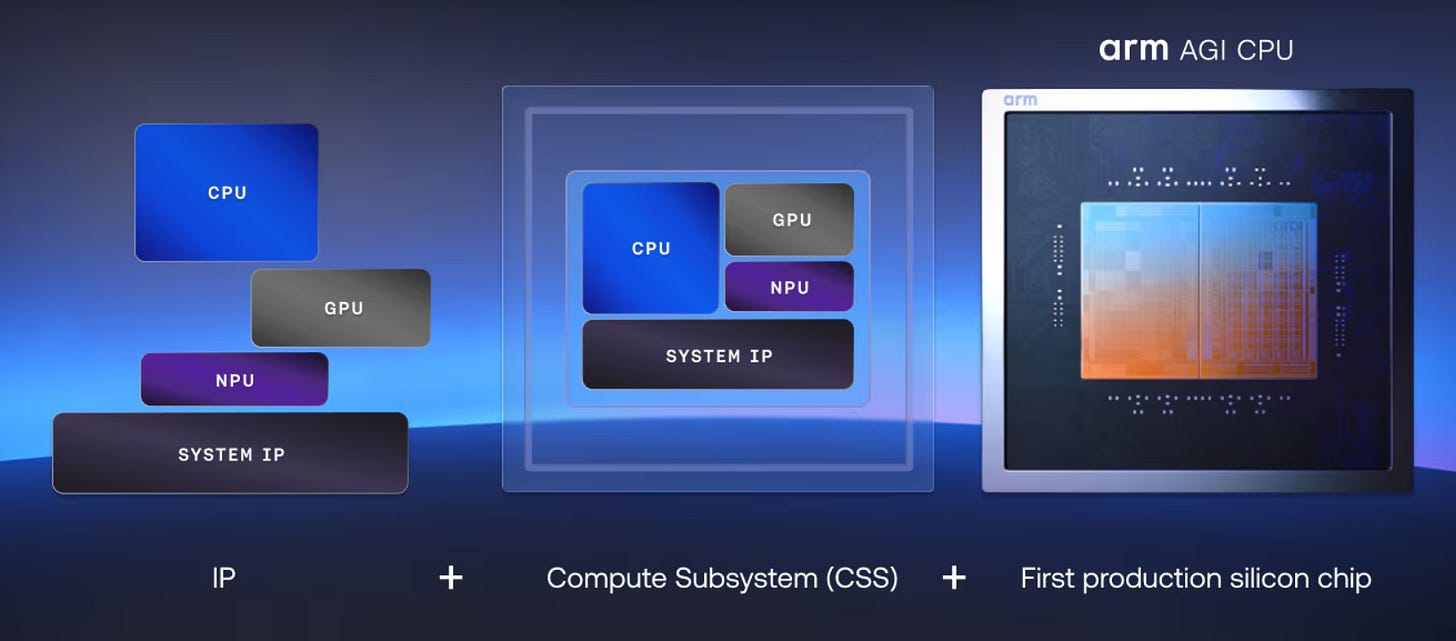
- From IP to Compute Subsystems (CSS)
In recent years, Arm has gone further.
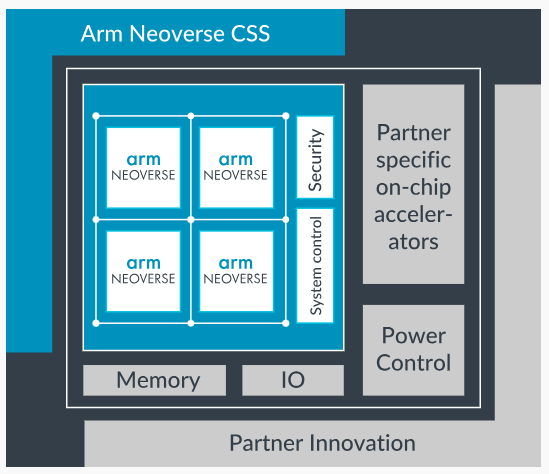
With Compute Subsystems (CSS), it integrates CPU, GPU, and system IP into more production-ready modular platforms—helping customers reduce development time and integration complexity.
- From “Building Blocks” to “Pre-Assembled Systems”
Now, the market is beginning to detect a more sensitive shift:
Arm is moving from providing building blocks
to delivering something much closer to a pre-assembled system.
This distinction is critical.
When you sell IP, customers see you as a foundational technology provider.
When you offer CSS, you are improving platform efficiency.
But when you begin defining full systems, tightly aligning with specific hyperscalers, and approaching the boundary of “self-built chips,”
It becomes a redefinition of commercial relationships.

The Core Question Emerging in the Industry
This is why a sharper question is beginning to surface:
Is Arm accelerating its customers—
or gradually positioning itself to compete with them?
Thanks for reading SEMIVISION @_@! This post is public so feel free to share it.
From the market’s perspective, the most controversial issue is not Arm’s claim that CPUs remain critical, but the signal implied by its newly introduced AGI CPU. On the surface, Arm’s positioning is carefully crafted: this CPU is neither presented as a replacement for general-purpose GPUs nor as a full-stack platform intended to compete directly with its own customers. Instead, it is framed as a CPU optimized for AI data center inference workflows and system-level orchestration roles. In other words, Arm is emphasizing that it is complementing the architecture rather than attempting to capture the entire market.
However, the market does not evaluate companies based solely on what they say today—it evaluates where they are likely heading next. And this is where concerns begin to emerge. Arm’s customer base is uniquely sensitive, including NVIDIA, Apple, Qualcomm, major hyperscalers, and data center CPU vendors, many of whom are deeply built on Arm’s licensing model. As Arm moves closer to defining end products, even if it explicitly states that it is not competing with its customers, it becomes increasingly difficult for those customers to ignore the potential implications.

The Real Issue: Blurring Boundaries
This is why the real issue behind this announcement is not just technical.
It is structural.
The boundary between Arm and its customers is beginning to blur.
And that boundary has historically been one of Arm’s greatest strategic assets.
Opportunity and Risk, at the Same Time
This shift represents both:
Arm’s most significant opportunity for strategic expansion,
and potentially its greatest source of risk.
Because stepping up the value chain means gaining influence—
but also means entering territory where trust must be renegotiated.
What Position Is This AGI CPU Really Targeting?
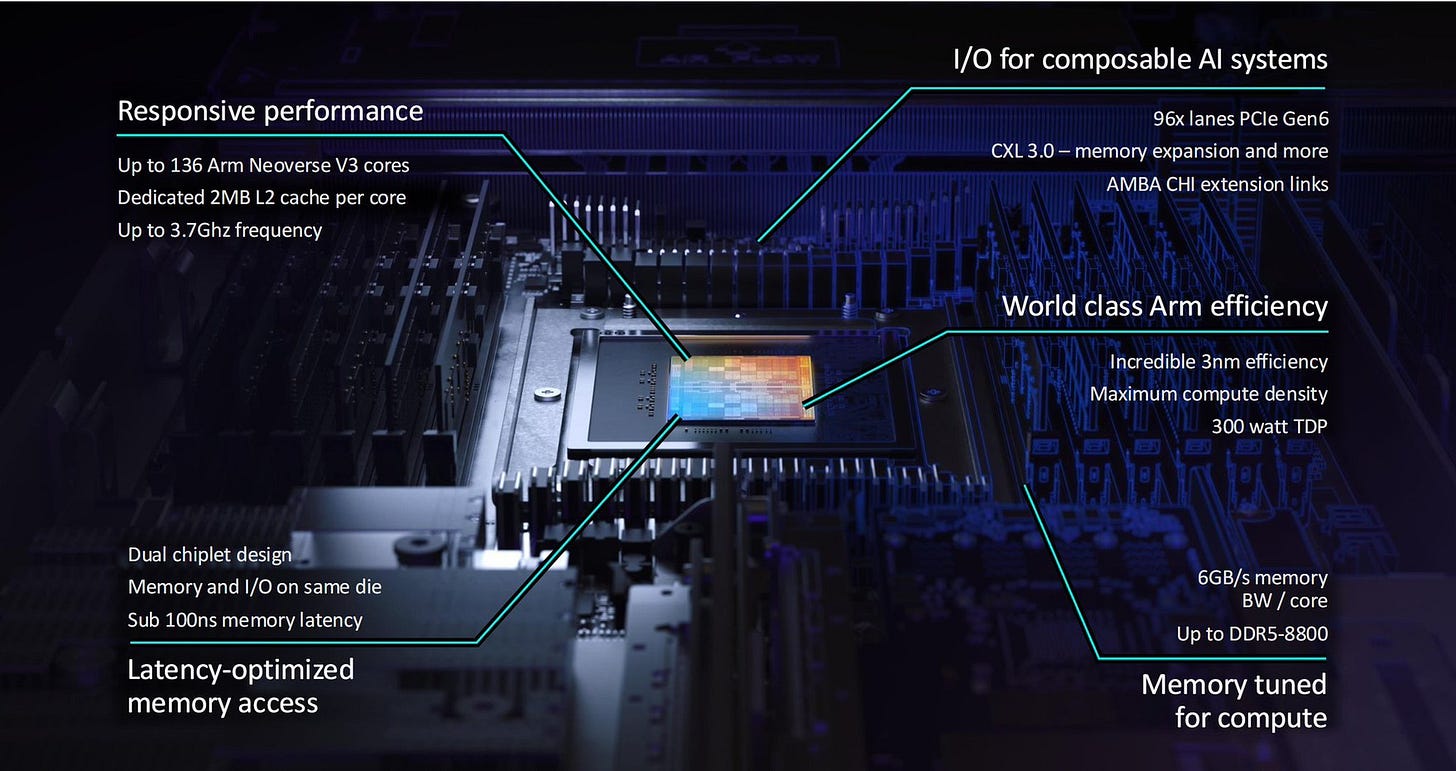
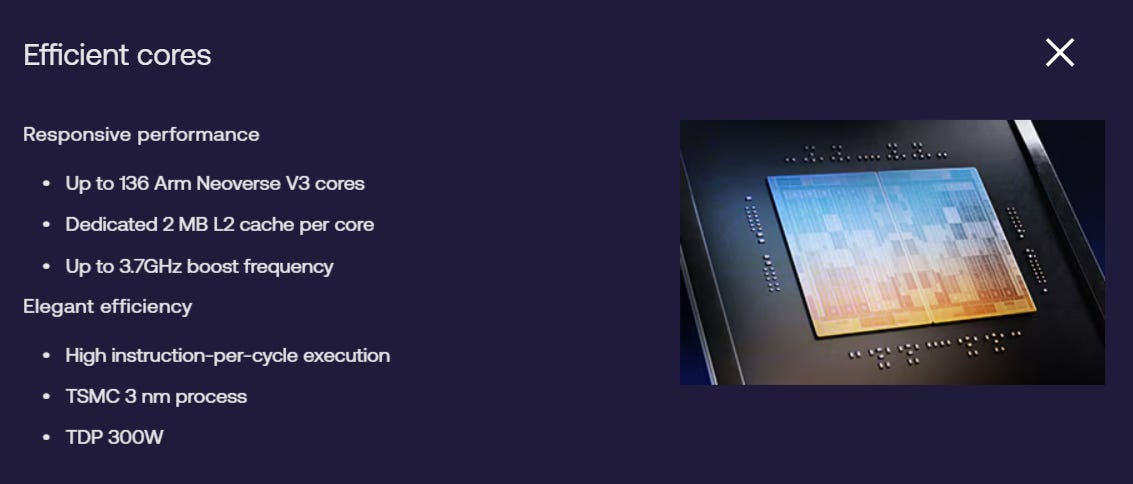
Based on publicly available information, the outline of this AGI CPU is already quite clear: it is built on Arm’s Neoverse V3 architecture, with up to 136 cores, clock speeds reaching 3.7 GHz, support for PCIe Gen6 and CXL 3.0, and memory scaling up to DDR5-8800. Its design focus is clearly centered on low-latency memory access, I/O coordination, and high-density deployment efficiency. When viewed as a whole, it becomes evident that this product is not intended to compete with GPUs in matrix computation, but rather to occupy a more specific and strategically important position—an orchestration CPU within AI data centers.
In other words, this CPU is not trying to answer how to replace accelerators, but how to enable large numbers of accelerators to operate more efficiently within increasingly complex AI workflows. This positioning is highly strategic, because in today’s large-scale AI clusters, the real cost is not only the GPUs themselves, but also the inefficiencies that arise when those GPUs are underutilized. When systems suffer from scheduling inefficiencies, memory bottlenecks, I/O stalls, or fragmented workflows, even massive GPU deployments can become constrained. Arm’s message is therefore not “we are here to compete for the most valuable accelerator market,” but rather that as AI systems grow more complex, whoever improves system-level orchestration efficiency will capture another equally critical layer of value—one that may be less visible than GPUs, but no less real.
Why This Move Reflects SoftBank’s Thinking, Not Just Haas’s Product Strategy
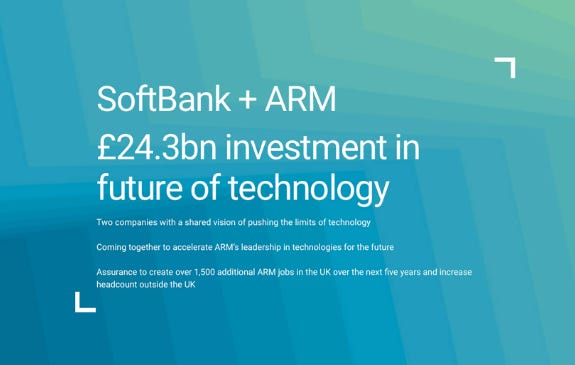
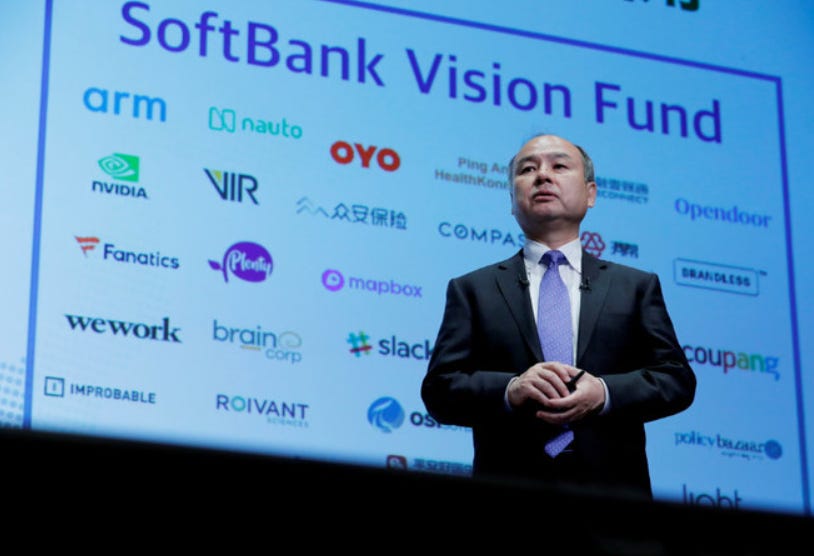
Looking at this move over a longer time horizon, it also reflects a broader strategic shift driven not just by Rene Haas, but by SoftBank’s long-term vision. Arm originally rose to dominance in the mobile era through its low-power architecture and IP licensing model, becoming one of the most successful IP companies globally. However, since its acquisition by SoftBank in 2016, the underlying strategy has evolved. SoftBank was not simply acquiring a stable royalty-generating business; it was positioning Arm as a foundational asset for the AI infrastructure era. This distinction is critical, because remaining purely an IP licensor inherently ties Arm’s growth ceiling to its customers’ product cycles, whereas expanding into data centers, automotive, edge AI, platform-level system IP, compute subsystems, and eventually closer-to-end solutions dramatically increases both its addressable market and strategic importance.
Meta’s Endorsement Matters—But Broad Cloud Adoption Is the Real Test
Meta’s endorsement is undoubtedly important, but the real test lies in whether Arm can convince a broader set of cloud customers. From current messaging and visuals, Meta is placed in a highly prominent position, signaling that Arm wants to emphasize it has already secured hyperscaler-level support. This matters because in the data center space, deployment credibility is everything—without real adoption, even the most compelling specifications remain just slides. However, one major customer adopting a solution does not automatically reassure the entire market.


2025年4月18日
One Customer Is Not the Market
This is especially true in the data center CPU space, where each hyperscaler operates under very different priorities. Some focus on cost efficiency, others on software ecosystem maturity, others on supply chain control, and still others on tight coupling with accelerators, in-house ASICs, and network architectures. Meta’s willingness to deploy can certainly be viewed as a strong validation, but the real question going forward is whether other cloud providers will be willing to adopt a CPU that Arm is more deeply involved in defining—one that increasingly signals a supplier stepping into the product domain.
If adoption broadens, Arm could successfully transition from an IP licensor to a central platform orchestrator. If not, Arm may prove its technical capability while simultaneously encouraging customers to accelerate internal development and reduce reliance on Arm at deeper layers of the stack. This is precisely what the market is watching most closely.
The Real Challenge: Rebuilding Trust at a Higher Level
Stepping back, the core issue is not whether Arm can build a capable CPU—it is whether it can establish a new layer of trust. If we set aside technical specifications and the Agentic AI narrative, Arm’s biggest challenge today is convincing the market that even after upgrading its role, it remains a trustworthy partner.
Historically, one of Arm’s most valuable assets has been not just its architecture, but its neutrality within the ecosystem. It has functioned as a foundational standard that companies are willing to rely on precisely because it did not directly compete with them at the product level.
When Boundaries Shift, Trust Gets Repriced
As Arm moves further downstream—through CSS, reference designs, system integration, or more direct productization—it inevitably faces a critical question: will customers still be willing to place their future in the hands of a supplier that is moving closer to their own competitive boundary?
Once this question emerges, it cannot be resolved through benchmarks alone. Strong performance, superior performance-per-watt, or higher rack density are all necessary—but not sufficient. If customers begin to ask, “You support me today—but will you compete with me tomorrow?” then technical advantages alone may not hold.
Beyond Chips: Building a New Trust Framework
What Arm must build next is not just a better CPU, but a new commercial trust framework—one that reassures the ecosystem that its evolution will not disrupt the balance that made it successful in the first place. And ultimately, that may prove far more difficult than designing the chip itself.
The Real Meaning of AI Infrastructure Restructuring: Value Is Shifting to the System Level
What matters most about Arm’s announcement is not just the new CPU, nor the narrative around agentic AI, but the broader industry signal it reveals:
The value distribution in AI infrastructure is shifting—from single-chip performance to overall system efficiency.
In the past, the spotlight was on who had the most powerful GPUs.
Going forward, what will determine the winners may be:
Who can keep GPUs fully utilized
Who can move data more efficiently across memory hierarchies
Who can optimize I/O and CXL architectures
Who can reduce friction in agent workflows
Who can pack more usable compute into constrained power budgets
This shift implies that CPUs will not lose relevance in the age of AI accelerators. On the contrary, as systems grow more complex, CPUs may become even more valuable.
And this is precisely what Arm is betting on.
Arm is trying to demonstrate that the future data center is not a “GPU-only world,” but one where GPUs and CPUs once again form a dual-core architecture. The difference this time is that CPUs are no longer just general-purpose processors—they become the traffic controllers of AI workflows, the orchestrators of resources, and the enforcers of system-level order.

Conclusion: Arm Is Betting on One Thing—Orchestration, Not Just Generation
At a higher level, Arm’s strategy can be distilled into a single idea:
As AI shifts from a model race to an infrastructure race, one of the most valuable capabilities will no longer be just generating tokens, but orchestrating the entire token factory.
This is why Arm is reframing the role of the CPU.
Not out of nostalgia, and not because it missed the GPU wave, but because it sees the next layer of value:
As AI systems become more complex, orchestration becomes more critical—and as orchestration becomes more critical, CPUs become indispensable.

At the same time, Arm is stepping into territory that is more sensitive than technology itself. It is evolving from everyone’s supplier into a more strategic player. This shift could elevate its position within AI infrastructure, but it may also introduce new tensions with its existing customers.
So, is this the right move for Arm?
From an industry perspective, it has clearly identified a real bottleneck:
the future of AI data centers depends not just on more accelerators, but on better orchestration.
But from a business perspective, it is also challenging its most valuable historical advantage:
its role as a neutral architecture provider trusted across the ecosystem.
Ultimately, the real test is not whether Arm can build a great CPU.
It is whether, after upgrading its role, it can still bring the ecosystem along with it.
Because in the AI era, the deepest moat is no longer just about specifications—
it is whether others are willing to place their future in your hands.


PreviousNext
TopLatestDiscussions








See all