Four Strategic Plays in AI Optical Interconnect Supercycle: From InP Substrates to Optical Switching
Four Strategic Plays in AI Optical Interconnect Supercycle: From InP Substrates to Optical Switching
- Source: SemiVision
- Author: SEMIVISION
- Published: 2026-03-14T10:56:49+08:00
- URL: https://tspasemiconductor.substack.com/p/four-strategic-plays-in-ai-optical (1) Four Strategic Plays in AI Optical Interconnect Supercycle: From InP Substrates to Optical Switching


Four Strategic Plays in AI Optical Interconnect Supercycle: From InP Substrates to Optical Switching
Original Article By SemiVision Research [Reading time: 20 mins]

Mar 14, 2026
∙ Paid
Why AI is turning optical interconnect into a strategic bottleneck

The modern AI data center is increasingly constrained not by compute alone, but by how efficiently bits move between compute nodes, racks, and rows. As cluster sizes grow, electrical links (copper traces, cables, connectors) face hard limits in reach and power at very high speeds—pushing the system toward optical links for an ever-larger share of server–switch and switch–switch connections. This is one reason why co-packaged optics (CPO)—bringing optical engines much closer to the switching/compute silicon—is widely positioned as a next architectural step to reduce electrical loss and improve power efficiency.
That shift matters because the “optics bill of materials” is not a single component. It is a multi-layer supply chain: specialized compound-semiconductor substrates (notably indium phosphide, InP), epitaxy and photonic integrated circuits (PICs), lasers and modulators (EMLs, CW lasers, photodiodes), optical engines, pluggable transceiver modules (800G and 1.6T), and increasingly system-level elements such as optical circuit switches (OCS) and CPO-enabled architectures. As demand migrates upward in bandwidth (800G → 1.6T), it can create bottlenecks in the most capacity-constrained steps—especially where manufacturing is capital-intensive, yield-sensitive, or geopolitically gated.

2月28日
Two technical “anchors” help explain why InP repeatedly shows up in AI optics discussions:
First, high-speed electro-absorption modulated lasers (EMLs) are a core light source/modulation technology in many high-speed designs. EML device structures are commonly built on InP platforms; classic device descriptions explicitly reference InP substrates, and industry technical literature similarly describes epitaxial growth on InP substrates for EMLs used in high-speed transceivers.
Second,the industry is pushing EML performance to higher baud rates and lane rates (e.g., 200G-per-lane class building blocks in some roadmaps), which raises the premium on reliable, scalable InP manufacturing and packaging, not just on “having a laser.”
This is the framing behind the four-company “stack” : an upstream materials/substrate supplier (AXT), a midstream photonics giant with deep vertical integration (Coherent), a downstream vertically integrated transceiver manufacturer with a turnaround angle (Applied Optoelectronics), and a downstream player leaning into the next system architecture layer (Lumentum via OCS and CPO). Each sits at a different choke point—and therefore deserves a different profitability and valuation lens.

A practical value-chain map: substrates to system architecture
The cleanest way to compare these businesses is not by ticker, but by where they capture value and what risks they absorb.
Upstream: compound semiconductor substrates (InP, GaAs, Ge).This is the “soil” on which the photonics device stack is built. AXT, Inc. positions itself as a material science company manufacturing compound- and single-element wafer substrates including InP, GaAs, and Ge, used when silicon substrates cannot meet device performance requirements. In AXT’s specific case, demand is being pulled by AI-related high-speed optical connectivity, but shipments are also uniquely exposed to export licensing because key manufacturing is in China via its subsidiary, which must obtain permits to ship certain controlled substrates.
Midstream: InP photonics components and vertical integration.Coherent Corp. operates at a scale that lets it internalize multiple steps of the photonics stack. In its FY2026 Q2 earnings call, management emphasized that demand in data center optics is “extraordinary,” highlighted a data center book-to-bill above 4x, and described rapid expansion of internal InP capacity driven by a ramp of 6-inch wafer production—claiming more than 4× chips per wafer at less than half the cost versus 3-inch wafers. This is not a niche lever: it is a structural attempt to turn a supply bottleneck into a cost and availability advantage.
Downstream: transceivers/modules, and the move from “module supplier” to “system influence.”Downstream is split into two very different strategic postures:
Applied Optoelectronics, Inc. is a vertically integrated optical networking products maker that explicitly frames itself as vertically integrated and highlights proprietary laser manufacturing and manufacturing sites in Sugar Land, Taipei, and Ningbo Its story is not “system architecture,” but manufacturing economics and customer-linked volume ramps—especially as 800G and 1.6T products scale.
Lumentum Holdings Inc. is explicitly positioning OCS and CPO as “substantial opportunities,” reporting that OCS demand has driven backlog “well beyond $400 million” and that it received an incremental “multi-hundred-million-dollar” CPO order deliverable in the first half of calendar 2027. That posture aims for higher strategic control: if OCS and CPO reshape topology choices, the company can capture “system premium,” not only component margin.
This mapping leads to a key investment insight: the same AI capex wave creates very different earnings profiles across the chain. Upstream can look like a “permit-gated call option.” Midstream can look like a scaling platform with a cost-down curve. Downstream can look like either (a) a manufacturing-driven turnaround or (b) a long-duration systems architecture bet.

1月29日
Below we will share:
AXT as upstream InP and GaAs substrates: the high-beta “permit-gated option”
Coherent as the “scale platform” for InP photonics: vertical integration, 6-inch economics, and order visibility
Lumentum and Applied Optoelectronics: downstream execution, system premiums, and a turnaround engine
Applied Optoelectronics as a manufacturing-driven turnaround: vertical integration and customer-linked scaling
Cross-company synthesis: how to read “competitiveness, profitability, and valuation”

2025年8月17日

3月13日
AXT as upstream InP and GaAs substrates: the high-beta “permit-gated option”
AXT’s bull case is straightforward: if AI optics demand is real and sustained, and if InP-based lasers/modules remain critical, then a supplier of InP substrates sits close to the root of the tree. AXT itself describes structural demand tied to “a multi-year growth cycle” and is funding capacity expansion with the explicit intent to increase InP substrate capacity for export in response to growing demand.
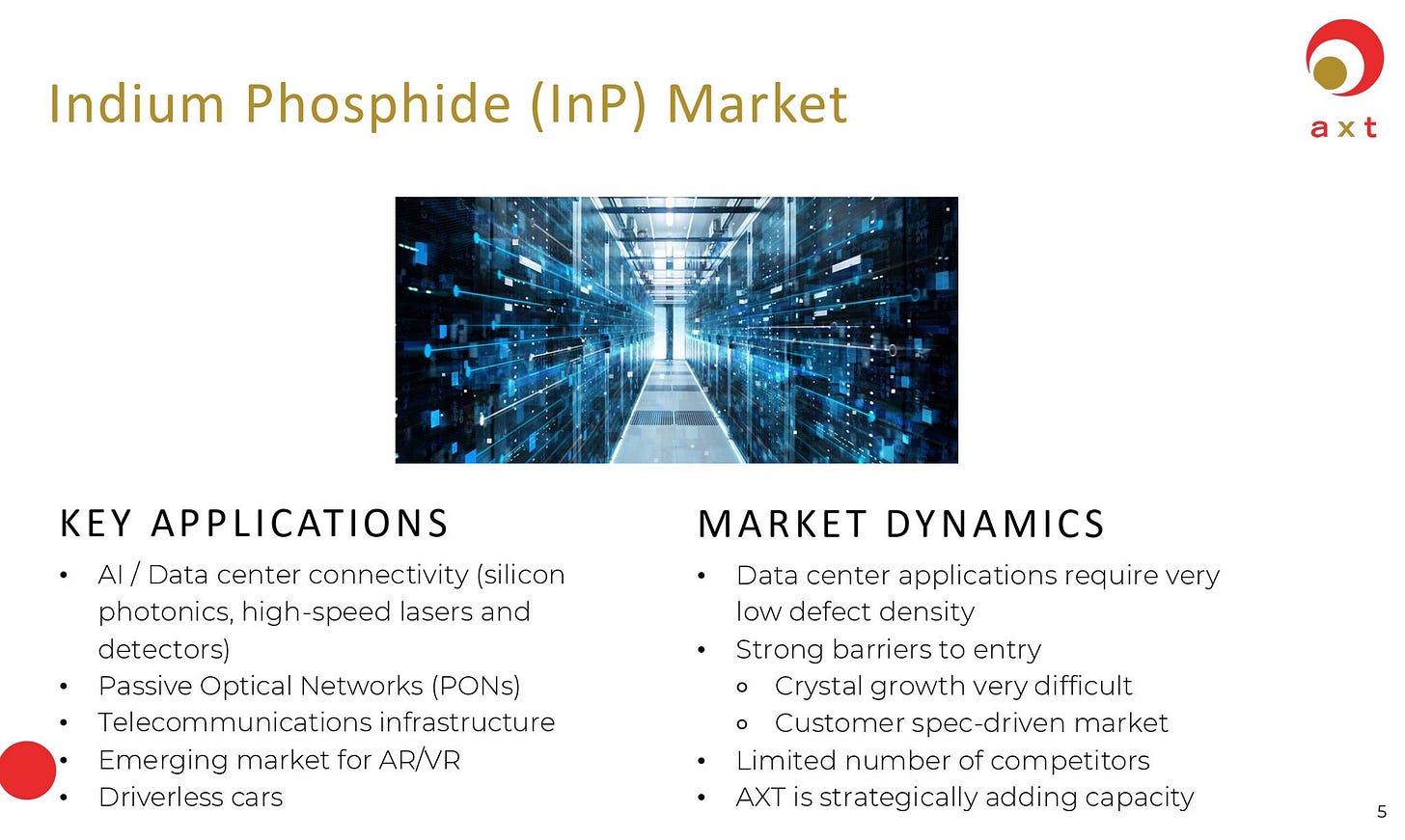
The complexity is that AXT’s business model and constraints are not purely industrial—they are also regulatory and geopolitical. In a prospectus supplement tied to its financing, AXT disclosed that China implemented export controls on gallium and germanium-related items effective August 1, 2023 (requiring permits for certain exports), and that China added indium phosphide substrates to its export control list on February 4, 2025. AXT has also publicly updated revenue expectations citing “fewer export control permits for indium phosphide being issued by China’s Ministry of Commerce than previously expected.”
That “permit gating” is not abstract. In its FY2025 Q4 earnings call, AXT’s management and executives described the permit process as non-transparent and variable, confirmed that a few permits were denied with an invitation to re-submit with additional information, and highlighted that the success and timing of export permits is “the most significant single factor” for near-term growth visibility. The same call emphasized that InP backlog reached “a new high of over $60 million,” and that customer forecasts extend “out beyond 2030,” with minimum demand requirements discussed for the next 2–3 years—yet also stated that backlog realization is “being limited by our permits at the moment.”
Competitive positioning.AXT’s moat is not a downstream brand; it is qualification status and materials process capability in a concentrated substrate market. AXT has long been described as a leading manufacturer of compound semiconductor substrates, and AXT itself emphasizes its substrate specialization (InP, GaAs, Ge) and the role of these substrates when silicon does not meet device requirements. The practical moat, however, only matters if customers can reliably receive permitted shipments and if AXT can scale yields and diameters while maintaining quality.

Capacity expansion as both catalyst and risk amplifier.AXT’s management laid out aggressive expansion. The company completed a public offering in late December 2025, stating it intended to use proceeds primarily to increase manufacturing capacity at its China subsidiary (Tongmei) to produce InP substrates for export worldwide, alongside R&D and general corporate purposes. In the FY2025 Q4 call, management stated it had already increased capacity by ~25% and expects to double capacity by end-2026, with a first-phase expansion budget “about $30 million” (enabled by brownfield capacity), and suggested potential further doubling in 2027 requiring $100–$150 million (a greenfield build).
That creates an asymmetric profile:
If permits normalize and demand remains elevated, a capacity-doubled supplier with record backlog can convert supply constraints into revenue acceleration.
If permits remain unpredictable, incremental fixed cost and working-capital intensity can worsen volatility and keep margins unstable.
Valuation logic.Because profits are negative, P/E is not the correct anchor. The market tends to value this kind of name on sales-based multiples or option-like thinking. As of late February 2026, market data shows AXT at roughly a ~$2B market cap range with very high price-to-sales ratios (around the low-20s by some data providers), which is consistent with an “AI purity + scarcity + optionality” trade rather than a traditional manufacturing multiple.
The “truth-seeking” question is not whether InP matters. It is whether the company can convert structural demand into permitted shipments at scale, with margins that rise faster than operating costs.
Coherent as the “scale platform” for InP photonics: vertical integration, 6-inch economics, and order visibility
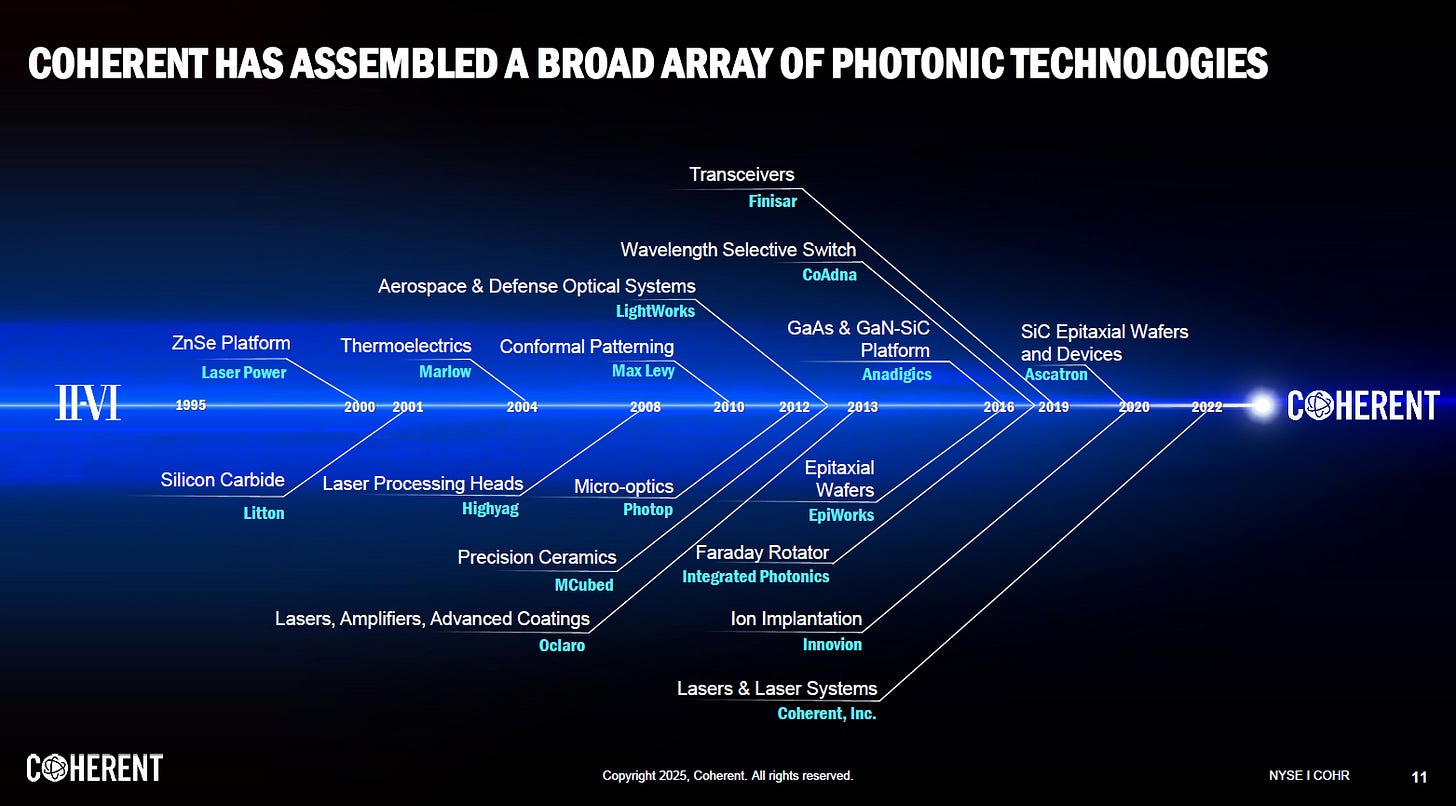
Coherent’s current narrative is a blend of demand visibility and manufacturing transformation.
On demand, management reported a “step function increase” in data center bookings and said the data center book-to-bill ratio exceeded 4x, with calendar 2026 largely booked and calendar 2027 filling quickly; the call also referenced forecasts out into calendar 2028 and an increase in long-term supply agreements (LTAs) exchanging guaranteed supply for demand commitments. That matters because it reduces a classic optics-company risk: customers can be notoriously cyclical, and visibility can evaporate quickly when inventories correct.

On technology and capacity, management described a rapid ramp of 6-inch InP wafer production as the driver of an internal capacity doubling plan. Specifically, Coherent stated it was executing on track to double internal InP production by the fourth quarter of calendar year 2026, and reiterated that a 6-inch wafer produces over four times as many chips at less than half the cost relative to 3-inch wafers. They also reported being in production on 6-inch InP with EMLs, CW lasers, and photodiodes—in multiple sites—and emphasized secured committed substrate supply from multiple suppliers to support the capacity doubling.
This manufacturing shift is not just a “nice-to-have.” InP has historically been produced in smaller diameters than silicon, making scale and die-cost reductions harder; industry commentary has discussed the yield and diameter challenges of InP platforms and the need to move to larger diameters to broaden InP’s addressable market. Coherent has long been pushing the message that 6-inch InP can change the economics. In public materials, Coherent described its Sherman, Texas and Järfälla, Sweden fabs as having 6-inch capability and claimed advantages including 4× more production capacity and 60% reduction in die costs for InP-based devices.
Competitive positioning.Coherent’s advantage is best described as compounding integration: the ability to provide multiple key transceiver components, ramp them on a cost-down curve, and support customers with both volume and roadmap continuity. In its FY2026 Q2 call, management emphasized that the bulk of the book-to-bill strength was driven by 800G and 1.6T transceiver bookings, with OCS and CPO also contributing. If those product ramps sustain, the company benefits from both higher volume and better internal cost position.
Valuation logic.Unlike AXT, Coherent can be valued on forward earnings and forward cash generation. By late February 2026, market data providers show Coherent trading with a market cap around the high-$40B range and forward P/E around ~40× (with variability depending on data source and estimate horizon). The key question is whether that multiple is “rich” or “reasonable” depends on whether you believe the 6-inch InP ramp is a durable cost moat and whether LTAs plus bookings meaningfully reduce the downside cyclicality typical in optics.
A simple reality check: Coherent itself is telling you that demand is out multiple years, that the company is signing LTAs, and that internal supply expansion is a strategic priority. The company’s earnings power in FY2027–FY2028 could look structurally different from historical optics cycles.
Lumentum and Applied Optoelectronics: downstream execution, system premiums, and a turnaround engine
Downstream is where “AI optics” starts to look like real revenue acceleration. It is also where customer concentration, qualification cycles, and yield ramps can create abrupt volatility. Lumentum and Applied Optoelectronics represent two contrasting ways to play that layer.
Lumentum as a system-premium play: OCS backlog and a visible CPO order
In fiscal Q2 2026 (quarter ended Dec 27, 2025), Lumentum reported net revenue of $665.5M, non-GAAP gross margin of 42.5%, non-GAAP operating margin of 25.2%, and non-GAAP diluted EPS of $1.67. It also guided fiscal Q3 2026 revenue of $780M–$830M and non-GAAP EPS of $2.15–$2.35, implying strong sequential growth and operating leverage.
What makes Lumentum’s story distinct in this peer set is not only the margin profile, but the explicit positioning around two architecture-shaping opportunities:
OCS:Lumentum stated it is scaling rapidly to meet “extraordinary customer demand” that drove OCS backlog “well beyond $400 million.”
CPO:It stated it received an incremental “multi-hundred-million-dollar” order deliverable in the first half of calendar 2027.
Those statements matter because OCS and CPO are not interchangeable with “selling more pluggable transceivers.” They represent a bid to shape data center fabric design.
OCS is increasingly discussed as a way to standardize and advance all-optical circuit switching as a scalable solution for next-generation data centers and AI clusters, with open specification efforts under groups like the Open Compute Project. Open Compute Project frames OCS as aligned with scalability and efficiency goals for AI clusters. If OCS adoption increases, an OCS supplier can capture value at the fabric level (potentially higher ASPs, lower substitutability, and longer design cycles).
CPO’s value proposition is also architecture-centered rather than component-centered: by bringing optics close to switching/compute ASICs, it targets bandwidth density and power/latency challenges that become severe at high speeds and longer reach. Vendor materials commonly claim large power savings from CPO relative to traditional pluggables; for example, Broadcom’s CPO materials highlight power consumption savings and cost-per-bit benefits as part of its positioning. Broadcom Inc. While vendor claims should be treated as directional rather than guaranteed outcomes, they help explain why “CPO order visibility” can command valuation premium.
Lumentum’s valuation logic.By late February 2026, market data shows Lumentum with a market cap around $50B and very elevated valuation multiples (high trailing P/E due to still-normalizing earnings, but materially lower forward P/E in the ~60× range by some providers). The valuation is best thought of as a blend of:
A high-growth optics ramp (earnings resetting upward)
A “systems option” on OCS and CPO scaling (long-duration optionality)
In that sense, Lumentum looks less like a traditional cyclical component supplier and more like a company trying to become a reference provider for the AI network’s next topology.
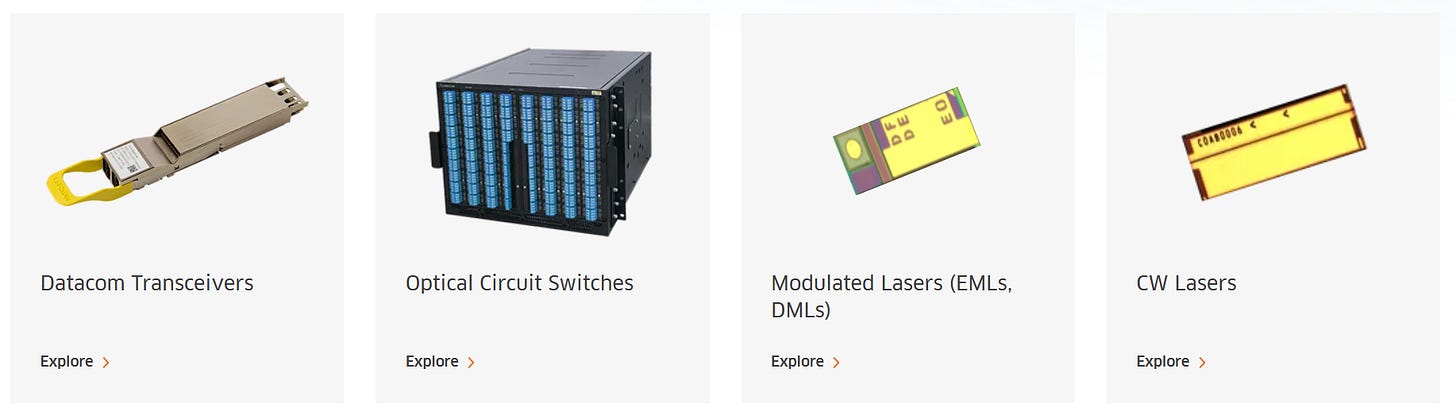
Lumentum Data Center Products
Applied Optoelectronics as a manufacturing-driven turnaround: vertical integration and customer-linked scaling
Applied Optoelectronics’ setup is different: it is less about capturing system premium and more about mastering cost, yield, and ramp execution—fast enough to satisfy hyperscale customers.
Applied Optoelectronics’ claimed edge is its vertically integrated manufacturing model and proprietary laser processes. In its 2025 10-K, it describes a “vertically integrated” design and manufacturing process spanning from laser design/fabrication to system design/assembly, and claims this model provides advantages such as rapid product development, responsiveness, and control over quality and manufacturing costs. The same 10-K details that it manufactures products in the U.S., Taiwan, and China, with laser chips manufactured in Sugar Land, Texas and transceiver manufacturing in its Taiwan and China facilities.
Customer concentration and “who is really buying.”Downstream optics often live or die by customer concentration. Applied Optoelectronics’ 2025 10-K makes the concentration explicit: in 2025, Microsoft accounted for 28.8% of revenue, and Digicomm accounted for 53.1% of revenue (with Oracle also a named significant customer in 2024). Microsoft Digicomm International Oracle This is both a risk (dependency) and a signal (these customers can validate scale and performance).
Applied Optoelectronics has also disclosed customer-linked commercial arrangements that can show up in accounting. A prior reporting cycle involved an agreement with Amazon including a warrant for shares, as reported by Investopedia based on SEC disclosures; warrant-related accounting can reduce reported revenue (“contra revenue”) depending on structure. Amazon In its Q4 2025 call transcript, management referenced revenue figures net of contra revenue tied to warrants and quantified the effect.
Applied Optoelectronics’ valuation logic.
As of late February 2026, market data shows AAOI with a market cap around the mid-single-digit billions and a price-to-sales ratio around ~14× on trailing sales, with a very high “forward P/E” depending on the earnings estimate set used—reflecting that the market is pricing a profit ramp that is not yet fully realized in reported earnings. In other words, AAOI’s valuation is a direct referendum on whether the company can convert the “over $1B revenue” ambition into shipped product with gross margins that expand toward the long-term ~40% non-GAAP gross margin goal management described.

3月4日
Valuation frameworks and the risk checkpoints that actually matter
A common mistake in “AI optics” investing is to treat all players as if they should trade on the same multiple. They should not. The right valuation anchor depends on where the company sits in the chain and whether it is in “profit harvest mode” or “optionality mode.”
Upstream substrate suppliers (AXT): the permit-gated operating leverage model.
Because AXT remains loss-making, price-to-sales and EV-to-sales are the more meaningful lenses. Market data providers show AXT trading at very high sales multiples in early 2026, consistent with narrative-driven optionality. The valuation is implicitly assuming:
Backlog converts to revenue (which AXT says is currently gated by permits)
Capacity doubling is achieved and utilized
Margins recover as utilization rises.
Therisk checkpointsfor AXT are therefore very specific and falsifiable:
Export permit throughput and predictability:management describes variability, denials, and lack of transparency, making this the key gating factor.
Evidence of sustained demand beyond preorders:backlog >$60M and forecasts beyond 2030 are bullish signals, but only if they remain firm under real shipments and if long-term supply agreements materialize.
Execution on capex and capacity:the plan implies brownfield doubling in 2026 and potential greenfield in 2027; that can amplify both upside and losses if demand or permits wobble.
Geopolitical exposure embedded in the business:China’s export control measures and licensing regime are not a tail risk; they are a core operating variable.
Midstream scaling platforms (Coherent): forward earnings with a manufacturing moat “beta.”
Coherent is increasingly valued like a scalable platform with margin expansion: LTAs and multi-year bookings reduce cyclicality, while a 6-inch InP ramp targets durable cost advantage. Here, forward P/E becomes meaningful because profitability exists and the company is guiding and executing. Market data and financial summary sites show Coherent’s forward P/E around ~40× in late February 2026, with the caveat that forward estimates can shift quickly.
Coherent’s risk checkpoints are also concrete:
Is the 6-inch ramp real at yield and volume?Management states 6-inch yields exceed 3-inch yields and that the ramp is ahead of plan.
Does internal supply actually expand gross margin durability?Management suggests internal ramp offsets higher external input costs and supports margin expansion.
Does systems optionality (OCS/CPO) contribute in time?Management positioned OCS and CPO as contributors; investors should monitor whether they materialize as revenue and gross margin rather than remaining “story.”
Downstream systems-premium (Lumentum): long-duration architecture optionality priced into the multiple.
Lumentum’s reported OCS backlog >$400M and a multi-hundred-million CPO order deliverable 1H 2027 provide unusually explicit visibility for a future architecture wave. The market is therefore willing to price a higher multiple, and market data sites show a forward P/E in the ~60× range and high sales multiples, paired with very fast revenue growth.
Its risk checkpoints are:
OCS conversion:backlog is not revenue until shipped and installed; track conversion timing and gross margin profile.
CPO commercialization risk:CPO involves packaging, thermal, reliability, and serviceability challenges; the existence of an order de-risks demand but does not eliminate execution risk.
Sustained profitability expansion:Q2 FY26 margins are strong and guidance implies further leverage; the question is whether mix and capacity keep margins elevated.
Downstream turnaround + scale ramp (Applied Optoelectronics): “Davis double” mechanics, but with concentration risk.
AAOI is the most “operationally levered” of the downstream names because it is emerging from losses and explicitly targeting a massive revenue ramp. When profits are near zero and then turn positive, valuation often shifts from sales multiples to earnings multiples—creating dramatic equity moves.
But the risk is also highest where the story is boldest:
Customer concentration:Microsoft and Digicomm are enormous contributors; a single customer’s inventory action can swing quarters.
Capacity and supply chain:management itself says 2026 revenue potential is limited by production capacity and supply chain, not demand.
Gross margin path:the company targets a return to ~40% non-GAAP gross margin over time; if product mix or yield doesn’t cooperate, the earnings ramp can underdeliver even if revenue grows.

3月10日
Cross-company synthesis: how to read “competitiveness, profitability, and valuation”
Putting the four together, a consistent logic emerges:
AXTis the highest “beta” exposure to InP scarcity and AI optics demand, but it is uniquely exposed to export permits and remains loss-making—so it trades like an option on normalization plus capacity ramp.
Coherentis the platform: it already has profit, it has exceptional booking visibility (book-to-bill >4×), and it is explicitly converting a bottleneck (InP) into a scale advantage by moving InP to 6-inch with strong cost claims and parallel site ramping.
Lumentumis the architecture premium bet: it is telling the market that OCS and CPO are not future buzzwords but current backlog/order drivers, and the market is paying for that long-duration optionality on top of already strong margins and accelerating earnings power.
Applied Optoelectronicsis the turnaround + manufacturing scale bet: vertical integration and manufacturing footprint are real, but the story is only as good as quarterly execution and the conversion of “capacity-limited demand” into shipped products with expanding gross margin.
If your goal is a rigorous “truth-finding” approach, the most important discipline is to match valuation to what is actually measurable next:
For AXT: permit cadence + shipped InP revenue + margin improvement against expanded capacity.
For Coherent: progress milestones on 6-inch wafer starts, internal-vs-external supply mix, and conversion of multi-year bookings into revenue without pricing collapse.
For Lumentum: OCS backlog conversion and any evidence that CPO is moving from “order” to “repeatable program,” with margin integrity.
For AAOI: evidence that the 2026 “over $1B” ambition is not just aspiration—i.e., quarterly ramps, qualification progress, yield, and customer delivery schedules.

3月6日


PreviousNext
TopLatestDiscussions








See all