NVIDIA Automotive: Smarter Cars, Bigger Responsibility
NVIDIA Automotive: Smarter Cars, Bigger Responsibility
- Source: SemiVision
- Author: SEMIVISION
- Published: 2026-03-11T09:40:43+08:00
- URL: https://tspasemiconductor.substack.com/p/nvidia-automotive-smarter-cars-bigger (1) NVIDIA Automotive: Smarter Cars, Bigger Responsibility


NVIDIA Automotive: Smarter Cars, Bigger Responsibility
Original Article By SemiVision Research [Reading time: 15 mins]

Mar 11, 2026
∙ Paid
Intelligent Vehicle Development Is Driving Rapid Growth Among Automotive Semiconductor Makers

As vehicles become increasingly intelligent, demand for smart cockpit and autonomous driving chips continues to rise, driving steady growth in automotive IC revenues among related suppliers. In contrast, traditional automotive semiconductor vendors have seen revenues decline in recent years due to electric vehicle penetration falling short of expectations and market share being eroded by Chinese domestic chip makers.
Vehicle intelligence is fueling strong demand for high-end automotive ICs. Nvidia and Qualcomm are the two primary beneficiaries, with their 2025 revenue growth rates significantly outperforming those of traditional automotive semiconductor peers. Currently, autonomous driving chips are predominantly based on Nvidia’s Orin platform, while Qualcomm holds around 70% market share in smart cockpit applications. This dominance is expected to continue expanding alongside the broader trend toward vehicle intelligence.

2月28日

NVIDIA Alpamayo is an open portfolio of AI models, simulation frameworks, and physical AI datasets designed to accelerate the development of safe, transparent, and reasoning-based autonomous vehicles.
Alpamayo 1, a chain-of-thought VLA model for AV researchers. The model is on Hugging Face and has a 10-billion parameter architecture. The model uses video input to reason and show its logic.
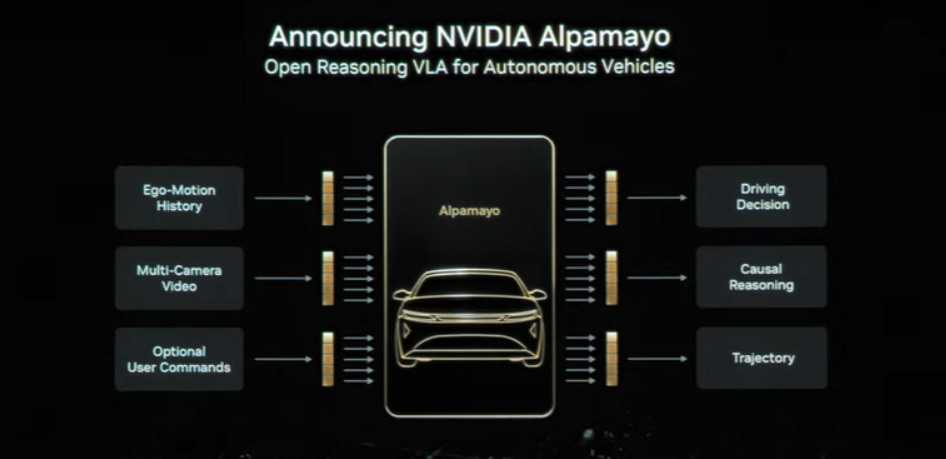
Built for Level 4 autonomy, Alpamayo lets vehicles perceive, reason, and act with human-like judgment, while providing the interpretability and openness required for safety validation and regulatory collaboration. The portfolio integrates seamlessly with the NVIDIA autonomous driving stack—from training and simulation to in-vehicle deployment—helping you move faster without building core autonomy infrastructure from scratch.
Three Core Principles for Building Safe and Scalable Autonomous Systems
As autonomous driving and AI-driven systems move from research into real-world deployment, safety can no longer be treated as a single algorithmic problem. Instead, it must be addressed as a system-level engineering challenge spanning design, deployment, and validation.

The figure illustrates three foundational principles that underpin robust autonomous vehicle (AV) and high-reliability AI systems:Diversity, Monitoring, and Evidence. Together, these principles form a layered safety framework that reduces unexpected failures and enables scalable commercialization.
- Diversity: Designing for Resilience at the System Level
The first principle, Diversity, applies primarily at the design stage. Its goal is to prevent single points of failure by ensuring that critical functions are supported by multiple, independent components.
From a systems engineering perspective, this means building architectures with overlapping responsibilities but independent sources of information and reasoning. For example, combining camera-based perception with radar or LiDAR allows the system to remain functional even if one sensing modality degrades. Similarly, mixing rule-based logic with machine learning models helps mitigate common-cause failures.
In machine learning, diversity is achieved through broad and heterogeneous training datasets. By exposing models to a wide range of scenarios during training, developers reduce the likelihood that the system will encounter unexpected or out-of-distribution (OOD) situations once deployed. The objective is not to eliminate uncertainty entirely, but to ensure the system is rarely “surprised” by real-world conditions.
- Monitoring: Maintaining Awareness During Real-World Operation
Once a system is deployed, the primary challenge becomes knowing when it is still operating safely. This is where the second principle, Monitoring, comes into play.
Monitoring operates on two levels. First, the system must continuously monitor itself. This includes health checks across the entire stack, from low-level parameters such as battery status and sensor integrity, to higher-level conditions such as computational load and human-operator availability. If abnormal conditions are detected, the system should be capable of graceful degradation or safe handover.
Second, the system must monitor its environment. This is typically done through Operational Design Domain (ODD) detection, which determines whether the current driving conditions fall within the range for which the system was designed and validated. Rather than attempting to handle every possible scenario, a well-designed autonomous system recognizes when it is outside its safe operating envelope and responds accordingly.
- Evidence: Proving Safety Through Verification and Validation
The final principle, Evidence, is critical during the validation phase and serves as the foundation for regulatory approval, large-scale deployment, and public trust.
Evidence is generated through comprehensive Verification and Validation (V&V) processes that span the full technology stack. Verification ensures that the system meets its technical specifications, while validation confirms that it behaves correctly in real-world use cases. This includes hardware, software, perception, decision-making, and system integration.
For machine learning components, evidence requires rigorous testing on carefully curated safety-focused datasets. Unlike general performance benchmarks, these datasets emphasize rare events, edge cases, and worst-case scenarios. In safety-critical systems, success is not defined by average accuracy, but by predictable behavior under extreme conditions.From Design to Deployment: A Layered Safety Strategy
The timeline at the bottom of the figure highlights an important insight: safety is not achieved at a single moment, nor by a single team.
Diversity strengthens the system at design time, Monitoring maintains safety during deployment, and Evidence enables confidence and accountability during validation.
Together, these principles reflect a broader shift in autonomous system development. Safety is no longer about building a smarter model—it is about building a system that knows its limits, monitors itself continuously, and can demonstrate, with evidence, that it deserves to operate in the real world.
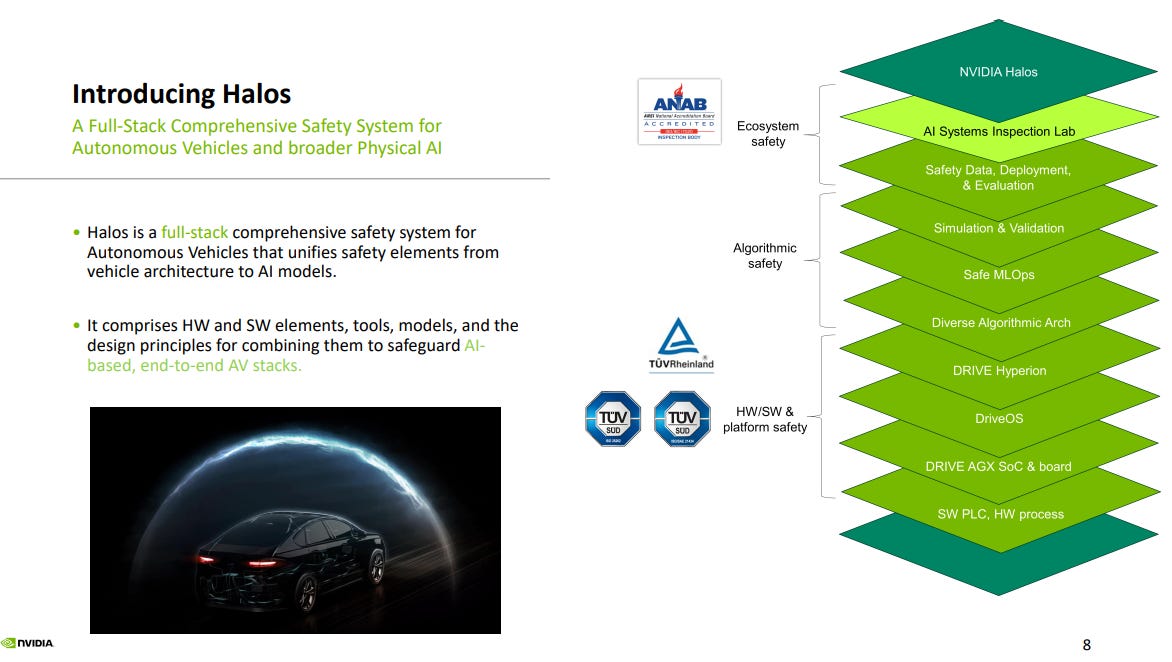
NVIDIA Halosis a comprehensive safety framework designed to support the development and deployment of autonomous vehicles and other safety-critical AI systems. Rather than focusing on a single chip or algorithm, Halos integrates hardware, software, tools, and processes across the entire automotive stack to enable end-to-end safety.
At its core, Halos combines functional safety, AI safety, and cybersecurity into a unified system approach. It spans everything from silicon-level safety features in NVIDIA automotive SoCs, to system software, simulation, validation, and large-scale verification workflows. The framework emphasizes three key principles: architectural diversity to avoid single points of failure, continuous monitoring to ensure systems operate within their designed limits, and rigorous evidence generation through verification and validation.

By aligning with global automotive safety standards such as ISO 26262 and SOTIF, NVIDIA Halos helps automakers and Tier-1 suppliers reduce development risk, accelerate certification, and scale autonomous driving technologies with higher confidence and predictability.
Autonomous Driving Enters a High-Growth AI Expansion Phase
A rapid acceleration in AI-driven autonomous driving adoption, with the total addressable market projected to grow at a 37.3% CAGR over the next six years, reaching large-scale commercialization by the early 2030s. While year-over-year growth shows short-term fluctuations, the long-term trajectory remains strongly upward as autonomous technologies move beyond pilot programs into mass deployment.
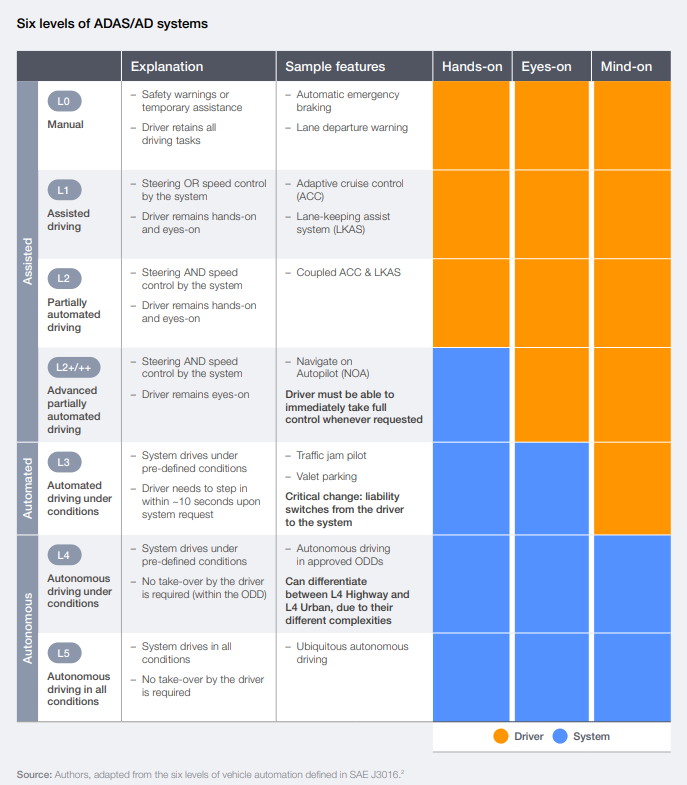
A key structural shift is the gradual transition fromL0–L2 systems toward L2+ and L3+ autonomy, as illustrated by the changing allocation of control, attention, and responsibility between the driver and the system. In the near term,L2 remains the dominant level across all regionsbecause it offers a pragmatic balance: steering and speed are automated, yet the driver retains full responsibility with hands-on and eyes-on requirements. This aligns well with current cost constraints, liability frameworks, and regulatory readiness.
The inflection point emerges atL2+ and L3, where system capability expands from simple assistance to conditional automation. L2+ introduces advanced functions such as Navigate on Autopilot, but still requires immediate driver takeover, keeping legal responsibility with the human.L3 marks a critical transition, as liability begins to shift from the driver to the system within defined operational design domains (ODDs). This step demands substantially higher compute performance, sensor redundancy, real-time monitoring, and rigorous verification and validation.
After 2028, the expansion of L3+ accelerates as AI compute, software reliability, and safety evidence mature, enabling broader regulatory acceptance and paving the way for higher levels of autonomy.
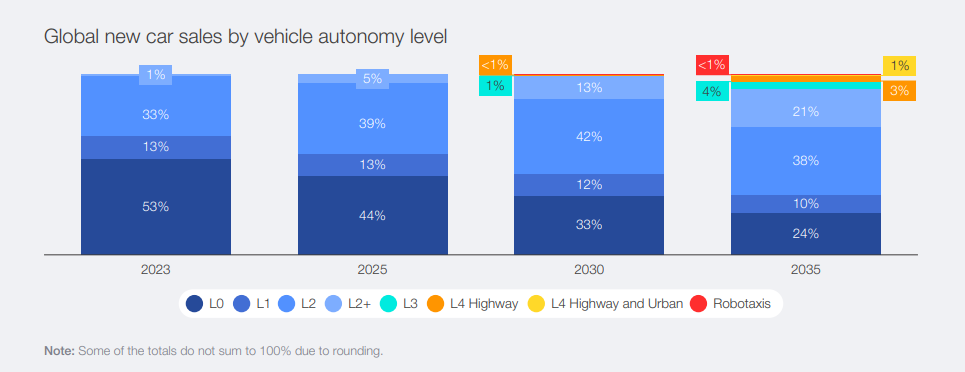
Overall, the data suggests autonomous driving is evolving from incremental feature enhancements into a full-stack AI platform opportunity, driving sustained growth across semiconductors, software, and vehicle architectures over the next decade.
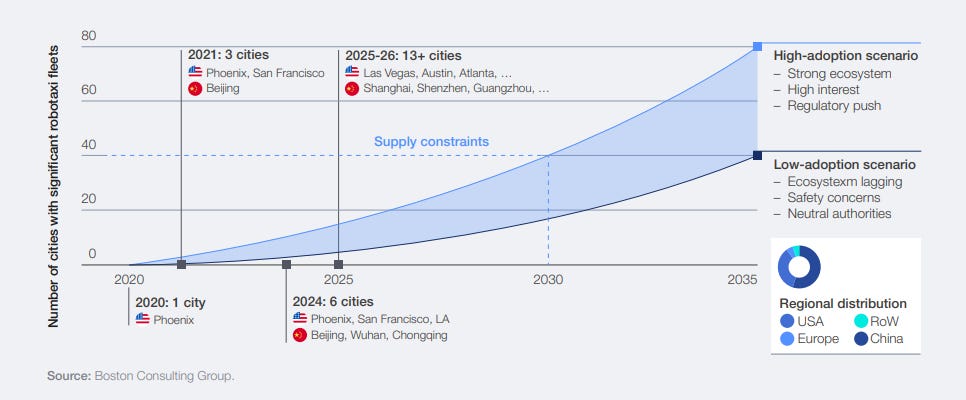
The projected global expansion of robotaxi deployments from 2020 to 2035, measured by the number of cities operating significant robotaxi fleets. Adoption begins slowly, with a single pilot city in 2020 and only three cities by 2021, reflecting early technical and regulatory constraints. By 2024–2026, deployment accelerates to more than a dozen cities, spanning the United States and China, as technology matures and commercial pilots scale.
Beyond 2025, growth diverges into two scenarios. In a high-adoption case, strong ecosystems, rising investor interest, and proactive regulatory support drive rapid expansion toward nearly 80 cities by 2035. In contrast, the low-adoption scenario assumes slower ecosystem development, lingering safety concerns, and neutral regulatory stances, resulting in roughly half that scale. Overall, the figure highlights how regulation, ecosystem readiness, and supply constraints will critically shape the pace of global robotaxi adoption.
Levels of Driving Automation and Responsibility
The six levels of driving automation, fromL1 to L5, highlighting how control and responsibility gradually shift from the driver to the system. AtL1 and L2, the vehicle provides driver assistance by controlling either one or both of steering and speed, but the driver remains fully responsible for vehicle operation at all times.L2+represents an enhanced form of partial automation, adding functions such as Navigate on Autopilot, where the system can plan routes and execute more complex maneuvers, yet legal responsibility still rests with the driver.
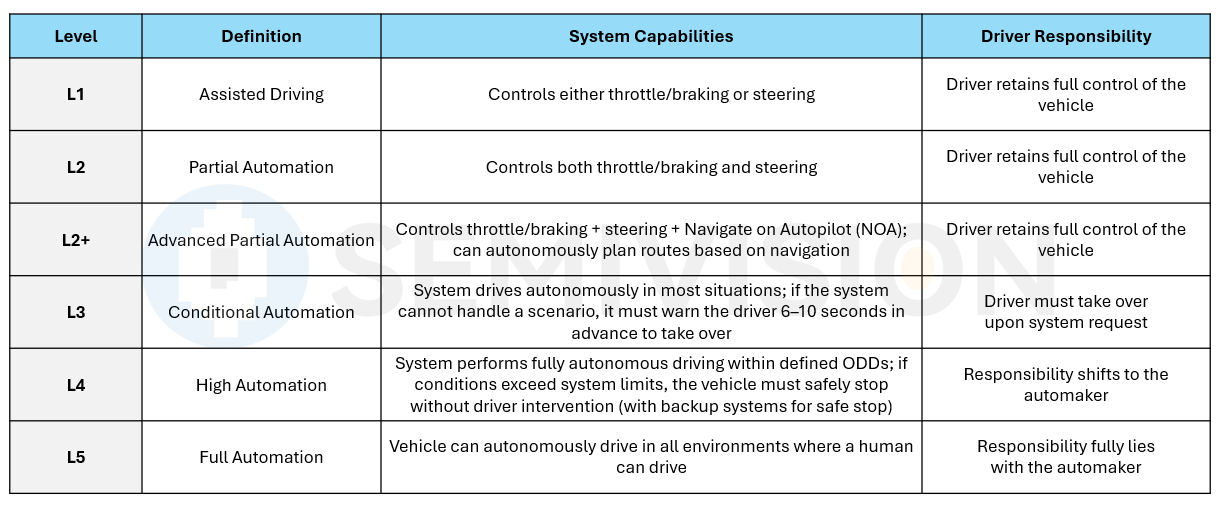
A critical transition occurs atL3, where the system can drive autonomously under defined conditions and must warn the driver in advance when human takeover is required. AtL4, the system assumes full driving responsibility within specific operational domains, including safe-stop capability without driver input.L5represents complete automation, enabling autonomous driving in all environments, with responsibility entirely borne by the automaker.
Why Liability Allocation Matters — and What to Watch Going Forward
The shift in responsibility from the driver to the system at L3 and above is one of the most critical inflection points in autonomous driving. Liability determines not only who is legally accountable after an accident, but also how systems are designed, validated, insured, and regulated. At L1–L2, responsibility remains with the driver, allowing automakers to deploy advanced assistance features without assuming full legal risk. However, once a system is authorized to drive autonomously—even under limited conditions—the burden of safety assurance increasingly shifts to the automaker and its technology partners.
This transition raises several key challenges. First, regulatory alignment remains fragmented across regions, creating uncertainty around certification, recall responsibility, and cross-border deployment. Second, insurance and risk pricing models must evolve to assess software-driven failures rather than human error. Third, system transparency and auditability become essential, as accident investigation will depend on software logs, sensor data, and decision traceability. Finally, the human–machine handover at L3 remains a high-risk zone, where delayed or inappropriate driver response can expose both legal and safety gaps. How industry and regulators resolve these issues will strongly shape the pace of L3–L5 adoption.

The Shift Toward Centralized EEA in Intelligent Vehicles
As autonomous driving and vehicle intelligence continue to advance, the limitations of traditional distributed ECU architectures are becoming increasingly evident. Legacy designs, built around dozens of low-performance ECUs dedicated to individual functions, struggle to meet the growing demands of AI computation, real-time perception, and software-defined vehicle control.
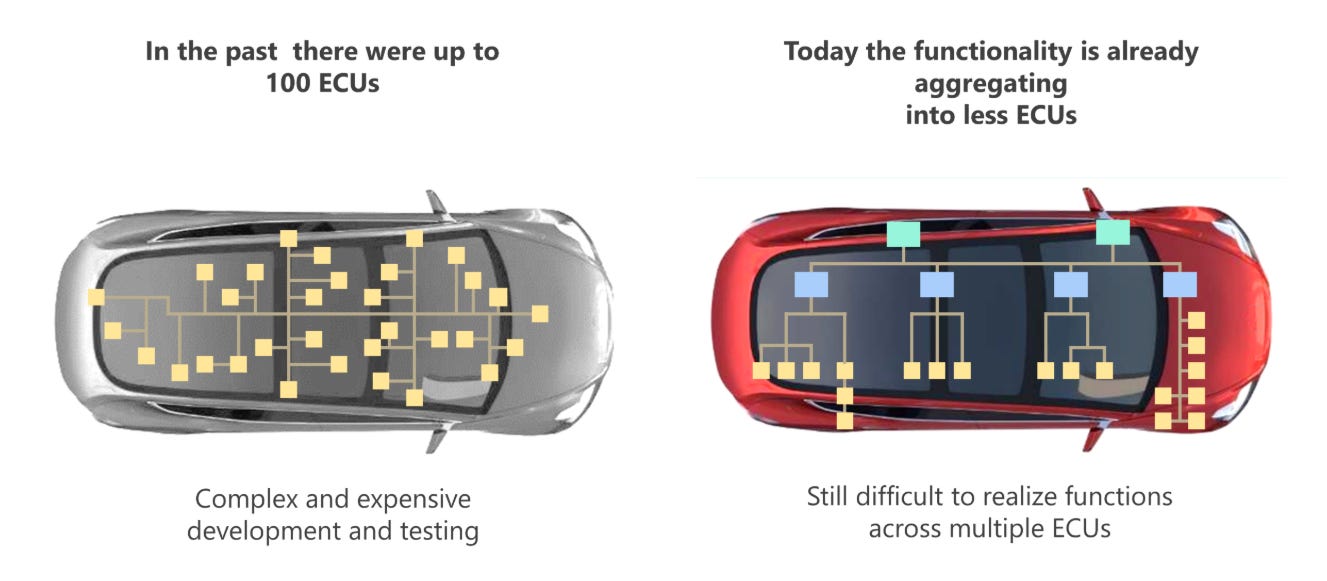
In response, the automotive Electrical/Electronic Architecture (EEA) is undergoing a structural transformation toward centralized and zonal control. Instead of deploying many weak-compute ECUs, automakers are consolidating functionality into a smaller number of high-performance SoCs acting as central or domain controllers. This shift enables a central computing platform to coordinate multiple vehicle domains—such as ADAS, powertrain, chassis, and infotainment—while significantly simplifying system integration.
Beyond compute efficiency, centralized EEA architectures dramatically reduce wiring complexity and vehicle weight. By replacing long, point-to-point harnesses with zonal controllers and high-speed backbone networks, automakers lower material costs, improve reliability, and create cleaner system layouts.
Crucially, this architectural shift also amplifies demand for high-performance chips and high-speed in-vehicle interconnects. Advanced SoCs, Ethernet backbones, and high-bandwidth signal cables become foundational to next-generation vehicles, positioning EEA evolution as a key driver of growth across automotive semiconductors and connectivity technologies.
NVIDIA Halos: A System-Level Safety Framework for Autonomous Driving

NVIDIA Halos represents aholistic, system-level safety platformdesigned to support autonomous driving across all levels of automation. Rather than treating safety as a standalone feature, Halos integrates hardware safety, software safety, and platform safety into a unified architecture spanning silicon, operating systems, middleware, AI models, and vehicle-level monitoring.
At the hardware layer, NVIDIA automotive SoCs and reference boards are built with safety mechanisms assessed across tens of billions of transistors, meeting stringent automotive functional safety requirements. On the software side, the DRIVE OS stack—covering CUDA, TensorRT, sensor abstraction, and safety services—has undergone extensive safety assessment, with millions of lines of certified code. At the platform level, thousands of safety monitors enable real-time system health checks, sensor validation, and end-to-end data integrity.
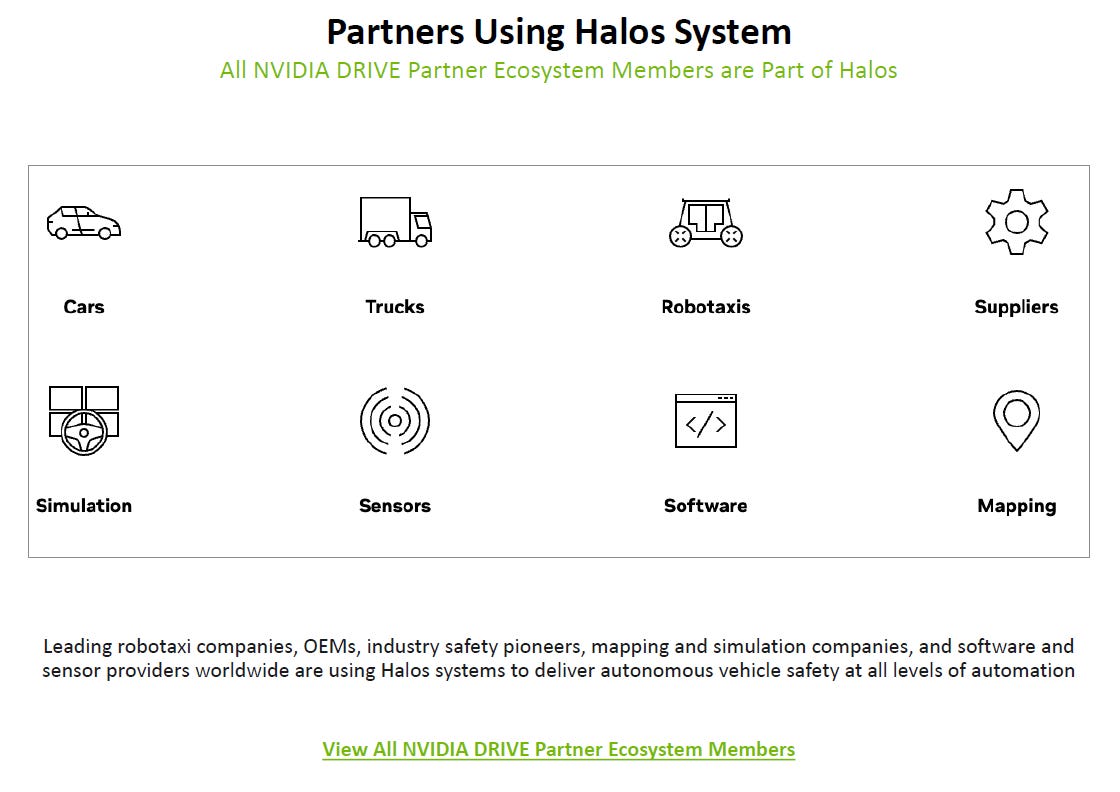
Equally important, Halos is not a closed system. It underpins a broad ecosystem that includes OEMs, robotaxi operators, trucking fleets, sensor suppliers, mapping providers, simulation companies, and software developers worldwide. By combining deep technical safety with ecosystem-scale adoption, NVIDIA Halos provides a scalable foundation for deploying autonomous vehicles with verifiable, regulator-ready safety across cars, trucks, and robotaxis.
According to NVIDIA’s Q4 FY2026 Earnings: Not all segments are created equal. NVIDIA’s Automotive segment, focused on chips for self-driving vehicles and related technologies, remains a minor player in the portfolio. Generating just a fraction of overall revenue—visibly negligible in stacked charts compared to the towering Data Center pillar—it accounts for less than 1% of the total, underscoring how automotive chips are fundamentally insignificant relative to the data center juggernaut. While automotive revenue shows modest growth, it pales in comparison to the AI-fueled data center expansion, which now dominates 91% of NVIDIA’s business.
“Perhaps this is also why so few people pay attention to NVIDIA’s chips in the automotive space.”

Mercedes-Benz Unveils New S-Class Built on NVIDIA DRIVE AV, Which Enables an L4-Ready Architecture
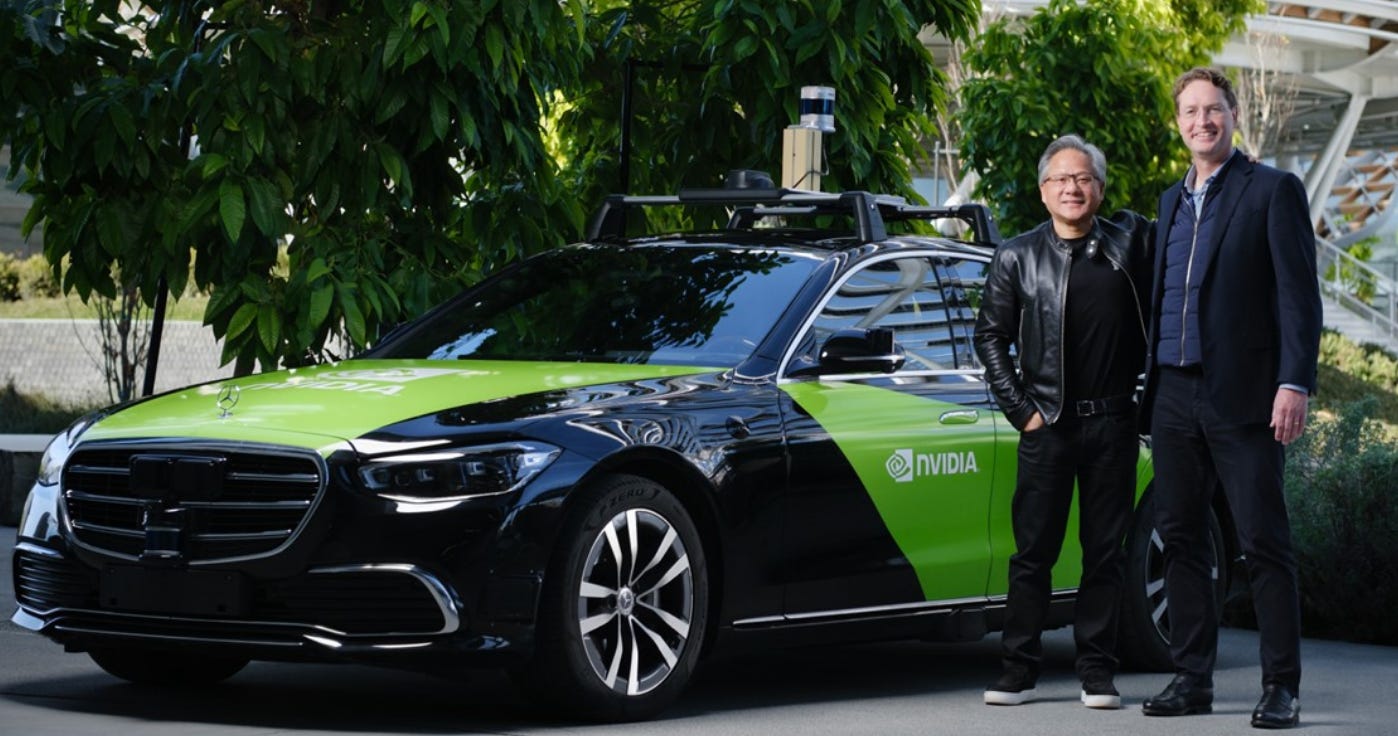
NVIDIA and Mercedes-Benz have introduced a new S-Class built on the NVIDIA DRIVE AV platform, designed to support a Level-4-ready autonomous driving architecture. The system combines Mercedes-Benz’s MB.OS vehicle software with NVIDIA’s full autonomous stack, including perception, planning, and reasoning capabilities powered by advanced AI computing. The platform is trained using large-scale data on NVIDIA DGX systems and validated through high-fidelity simulation environments, enabling the vehicle to handle complex real-world driving scenarios.
Unlike traditional rule-based systems, DRIVE AV analyzes dynamic environments and evaluates multiple options to choose the safest action in real time. The architecture also integrates NVIDIA DRIVE Hyperion hardware and a multimodal sensor suite, ensuring redundancy and safety for autonomous operation. This collaboration marks a major step toward AI-defined vehicles and future robotaxi services, while maintaining Mercedes-Benz’s focus on safety-first design and premium driving experiences.

NVIDIA’s role is to provide the full autonomous driving infrastructure stack, including the in-vehicle compute platform, software stack, sensor reference architecture, and training/simulation capability. In other words, NVIDIA is no longer just selling chips—it is building a full-stack ecosystem of hardware + software + simulation + safety framework. Its partners span multiple segments, including automakers, robotaxi developers, and commercial vehicle players.
This means NVIDIA’s advantages are:
Diversified customers and lower risk: it is not dependent on a single automaker or one robotaxi operator.
Exposure to multiple markets at once: passenger cars, trucks, and robotaxis.
A business model similar to its position in AI data centers: it does not need to operate fleets itself in order to benefit from industry-wide compute growth.
Better fit for traditional automakers, since many OEMs do not want to build a complete autonomous driving stack from scratch.
But NVIDIA’s weakness is also clear:
it does not necessarily control the end user or the fleet-level operational data, and real-world deployment of autonomous driving is often constrained by regulation, liability, and OEM adoption cycles—not just chip performance. In other words, NVIDIA is more likely to be a high-probability beneficiary, but not necessarily the company that captures the largest share of end-state profit.

Tesla is taking a completely different route. Tesla is not simply designing a self-driving chip—it is trying to build a vertically integrated autonomous mobility business. Its strength lies not in chip specifications alone, but in the fact that it controls the vehicle, software, custom silicon, data pipeline, OTA updates, and service platform.
Tesla’s biggest advantages are:
Vertical integration across the entire stack.
If Robotaxi works at scale, Tesla will not just sell cars—it can enter the much higher-margin mobility service market.
It already has a large installed base of vehicles generating real-world driving data.
Once unmanned fleet operations are mature, the business leverage could be far greater than that of a chip supplier.
But Tesla’s risks are also much higher than NVIDIA’s:
Tesla is pursuing a model that depends on actually making autonomous ride-hailing work in the real world. That means it faces much heavier pressure in regulation, liability, safety validation, city-by-city rollout, and operational complexity. So while Tesla may have the greater upside if it succeeds, it also carries much greater execution risk.


PreviousNext
TopLatestDiscussions








See all