Taiwan vs. U.S. Workplace Culture: Why the Same Playbook Breaks Down in Phoenix—and How to Fix It
Taiwan vs. U.S. Workplace Culture: Why the Same Playbook Breaks Down in Phoenix—and How to Fix It
- Source: SemiVision
- Author: SEMIVISION
- Published: 2026-03-03T12:00:43+08:00
- URL: https://tspasemiconductor.substack.com/p/taiwan-vs-us-workplace-culture-why (1) Taiwan vs. U.S. Workplace Culture: Why the Same Playbook Breaks Down in Phoenix—and How to Fix It


Taiwan vs. U.S. Workplace Culture: Why the Same Playbook Breaks Down in Phoenix—and How to Fix It
Original Article By SemiVision [Reading time: 8 mins]

Mar 03, 2026
∙ Paid

Global expansion in semiconductors is often framed as a battle of equipment uptime, yield ramps, and cost structure. But if you watch what engineers and managers actually talk about—especially in the context of overseas fabs—you’ll notice a different center of gravity:
People
Coordination
Culture
In recent weeks, social media discussions around “the desert assignment” (Phoenix) have circulated widely

—complete with unofficial “which job grades should go” charts, commentary on promotion odds, and warnings about who tends to benefit (or struggle) under different assignment structures.

Information from Social Media
These narratives can look contradictory. SemiVision’s view is that they are not.
Financials can swing quickly due to subsidies, depreciation timing, product mix, and early ramp dynamics. But an operating model—how teams communicate, decide, escalate, and retain talent—moves much more slowly. If it’s not rebuilt for the local environment, culture friction doesn’t disappear; it simply returns later as a bigger bill: attrition, longer training cycles, slower cross-functional execution, and higher quality/EHS risk.
This article focuses on one core issue: Taiwan and the U.S. run on different workplace logic. If a company treats the difference as a “soft factor,” it will become a hard constraint.
Editor’s Note
This article was developed from SemiVision’s perspective as a semiconductor industry research platform, drawing on interviews and past experiences shared by multiple semiconductor engineers across different organizations and geographies.
We use TSMC Arizona as a case study not to single out one company, but because it is currently one of the most closely watched Taiwanese enterprises on the global stage. Its expansion offers a visible and meaningful lens through which to examine broader cultural and operational dynamics.
The views expressed here reflect SemiVision’s observations on the structural differences between Taiwanese and American workplace cultures. They are not universal truths, nor are they meant to apply to every individual experience.
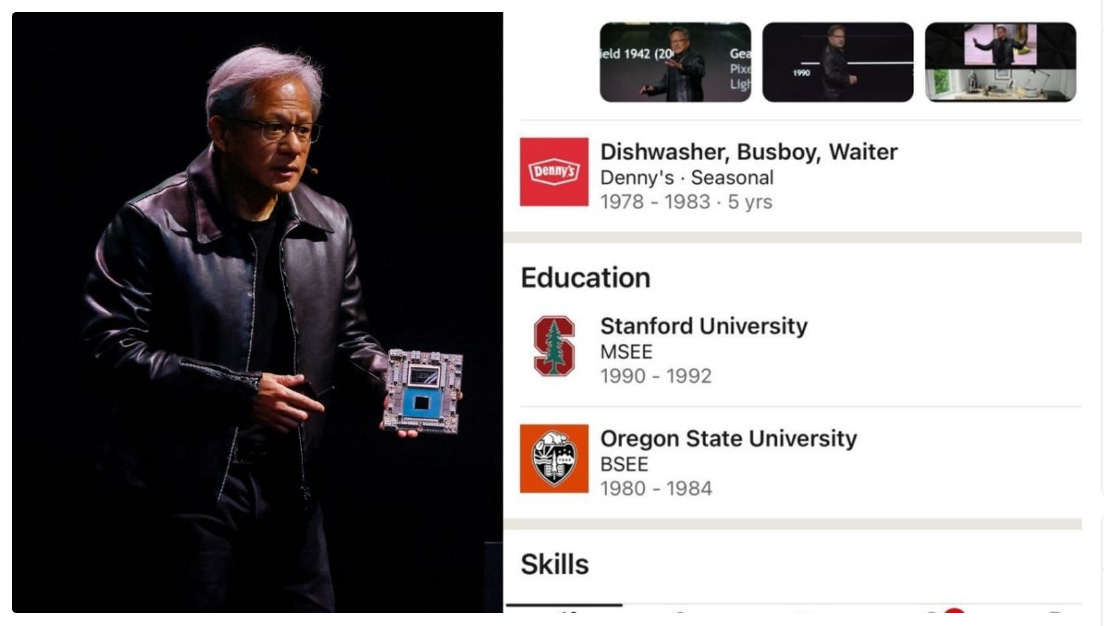
Ultimately, success is not determined solely by geography or corporate structure. As the saying goes: capable people will succeed wherever they go. It’s worth remembering that before founding NVIDIA, Jensen Huang once worked as a waiter. Talent, resilience, and continuous learning matter more than any single assignment.
SemiVision remains committed to analyzing industry evolution with objectivity, respect, and long-term perspective.
Taiwan’s High-Density Execution Culture: Fast, Tough, Flexible—Powered by Shared Context
Taiwan’s semiconductor ecosystem is optimized for speed. Many teams have internalized an operating rhythm that works extremely well under pressure:
Short decision chains: urgent problems find a decision-maker quickly
Flexible responsibility boundaries: people step across lines to save the line
High-context communication: much is implied; less needs to be spelled out
Overtime as a default lever: human time becomes a scalable resource in emergencies
This model can be brutally effective for yield learning and rapid iteration—especially in Taiwan, where the supply chain is dense, experienced talent is concentrated, and organizational “muscle memory” is shared.
But it depends on one hidden prerequisite:
Most people share the same unspoken operating language—the same assumptions about hierarchy, urgency, acceptable friction, and how far “helping” can go.
When that prerequisite disappears, the same behaviors can mutate from fast into chaotic, from flexible into exhausting.

2月18日
The U.S. Workplace Model: Slower on the Surface, More Predictable at Scale
In many U.S. engineering and manufacturing environments—especially within large, compliance-heavy organizations—the default mindset looks different:
1) Low-context communication, high explicitness
Work tends to be clarified in writing: scope, owner, timeline, risk, approvals, escalation paths.
In Taiwan, “let’s start and fix as we go” is often celebrated. In the U.S., the immediate question is:
Who signs off? Who owns the risk? Where is the record?
2) Harder boundaries around responsibility
This isn’t about refusing to help. It’s about role clarity, liability, and compliance.
In Taiwan, crossing boundaries to solve a problem can earn respect. In the U.S., the same act can create issues around accountability, safety, or labor processes.
3) Conflict is more formalized
Disagreement is normal—but it’s expected to be handled through documented processes and structured feedback.
Taiwan’s “endure quietly and resolve privately” approach can be perceived as opaque. Over time, what isn’t processed openly can become an HR issue.
4) Work-life boundaries are clearer
It’s not that people don’t work hard. It’s that long-term overload is harder to normalize as the default state.
If leadership tries to “compress time” by leaning on people indefinitely, retention becomes the bottleneck.
Why Phoenix Is More Sensitive Than Most: It’s the Hardest Type of Globalization
A semiconductor fab is not a software office. It’s a tightly coupled system:
shift operations and handoffs
equipment maintenance schedules
process controls and quality traceability
EHS and chemical management
supplier and contractor coordination
escalation discipline under time pressure
In this environment, small communication errors can amplify into real cost and risk.
Phoenix adds structural amplifiers:
Local semiconductor talent density is lower than Taiwan→ training cycles lengthen
Localization is unavoidable→ you can’t run permanently on expats
Cross-cultural mixed teams(Taiwan leadership + local engineers + vendors/contractors)
External scrutiny is intense: policy, subsidies, media, customers, investors
This is why unofficial “which grades should go” content spreads so easily. When transparency is insufficient, rumors fill the gap—and rumors directly damage trust.
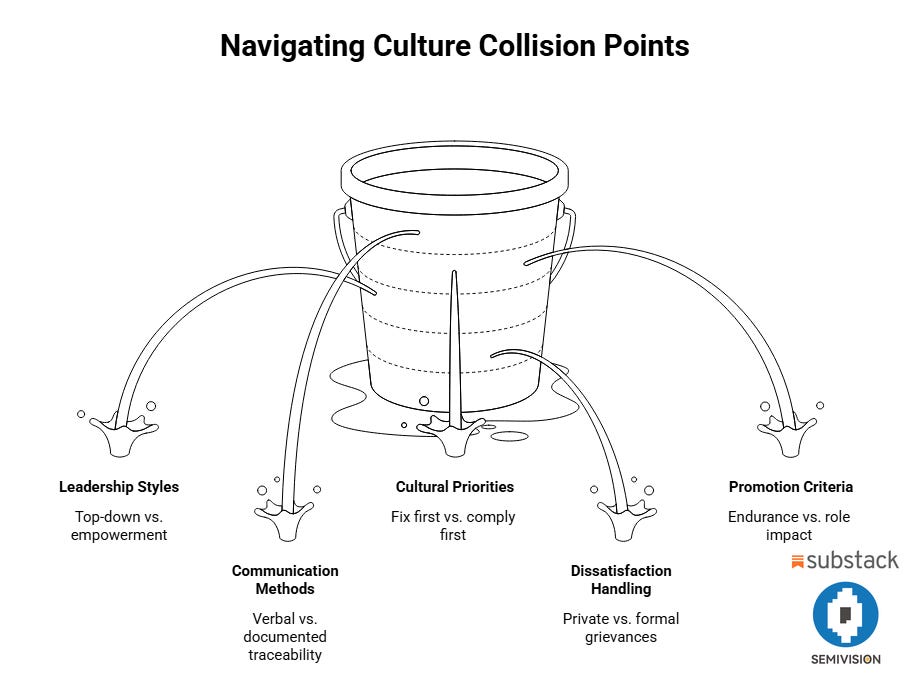
The Five Most Common Culture Collision Points
1) Command-driven leadership vs. empowerment-driven leadership
Top-down management can work in emergencies, but when used as the default in the U.S. it can lead to:
local talent feeling undervalued
middle managers afraid to own decisions without authority
everything escalating upward, slowing execution
2) Verbal alignment vs. documented traceability
Taiwan teams can run fast on shared context. U.S. operations demand written records for changes, handoffs, root causes, and sign-offs.
If teams rely too heavily on informal channels, long-term outcomes include:
broken handoffs
unclear responsibility
weaker quality traceability during incidents
3) “Fix first” culture vs. “comply first” culture
In the U.S., EHS and compliance are not optional overlays. If leadership treats them as obstacles, it creates internal resistance.
The correct approach is to treat EHS as a scalable efficiency system—a way to replicate performance safely.
4) Endurance culture vs. formal grievance systems
In Taiwan, dissatisfaction often stays private. In the U.S., dissatisfaction often becomes formal.
If leadership misreads that difference, a small issue can snowball into legal/HR risk and reputational damage.
5) Promotion by endurance vs. promotion by role impact evidence
Taiwan tends to reward “who carried the load.” The U.S. tends to reward role-based impact, leadership behaviors, cross-functional outcomes, and documented results.
If evaluation systems are not aligned, the vacuum becomes speculation: “who gets promoted” and “who benefits.”
SemiVision’s Core View: Arizona’s Challenge Has Shifted From “Can You Produce?” to “Can You Build a Replicable Operating System?”
Many people assume overseas expansion is about copying Taiwan’s process discipline. But the truth is harsher:
You can copy processes.
You cannot copy Taiwan’s ecosystem density, talent concentration, and decades of relationship-driven coordination.
Therefore, Arizona’s long-term success cannot rely on heroic expat execution. It must become a replicable operating system:
hire locally at scale
train talent into stable capability
run cross-cultural teams without constant friction
maintain speed under U.S. compliance constraints
In one sentence:
Translate Taiwan’s efficiency into U.S.-compatible scalability.
What Taiwan Company Can Do: Eight Practical, Executable Improvements
Below are recommendations designed to be operational—not inspirational.
1) Build dual-track career paths with transparent promotion standards
Clarify the growth routes for expats vs. locals, and define promotion criteria with measurable outcomes.
Transparency reduces rumor density, and rumor reduction improves retention.
2) Treat middle management as the core product
Overseas fabs fail most often in the middle layer. Invest heavily in:
leadership training
cross-cultural management
conflict handling
feedback systems
escalation discipline
Without strong middle managers, the organization becomes “top overloaded, bottom exhausted.”
3) Institutionalize documentation as part of speed
Make meeting records, change management, handoff SOPs, and traceability tools mandatory—and integrated into the workflow.
It may feel slower early. It becomes faster later because it shortens training cycles and reduces repeated mistakes.
4) Redesign the expat-to-local handoff mechanism
Expats should not be permanent firefighters. Define their mission as:
build systems
train people
transfer ownership
Set handoff KPIs: local ownership ratios, independent problem resolution capability, retention rate.
5) Increase psychological safety and structured feedback channels
Cross-cultural organizations collapse when people stop speaking honestly. Use:
anonymous feedback loops
pulse surveys
fact-based postmortems without personal blame
6) Make EHS and compliance a competitive advantage
Don’t frame compliance as cost. Frame it as the mechanism that enables safe replication and long-term stability in the U.S.
7) Establish cross-site rotations as a normal operating practice
Short-term rotations between Taiwan and the U.S. can rapidly build shared understanding:
Taiwan talent learns U.S. process logic and communication norms
U.S. talent learns Taiwan’s execution cadence and problem decomposition
Culture cannot be trained by videos. It is built through shared missions.
8) Elevate retention and training-cycle KPIs to the same level as yield
In overseas fabs, your true yield is not only on wafers—it’s also on people.
If turnover is high and training cycles stretch, execution speed will always be unstable.
Globalization Isn’t a Geographic Expansion—It’s a Rewrite of Management Language
Taiwan’s semiconductor strength is built on extreme efficiency and high-density coordination. The U.S. environment demands high transparency, high traceability, and low compliance risk.
Phoenix will not be won by choosing one model over the other.
It will be won by translation.
Speed must become order. Flexibility must become scalable discipline.
SemiVision’s Viewpoint:
TSMC Arizona has moved beyond the phase of “can the fab ramp?” into the phase of “can TSMC build an overseas operating system that is replicable, scalable, and talent-stable?”
Financials can flip in a year.
Culture and operating systems take longer—but that timeline is exactly where long-term advantage is decided.

1月16日

2月23日
2月2日


PreviousNext
TopLatestDiscussions








See all