GTC 2026 Outlook: How NVIDIA Is Redefining AI Infrastructure with LPX, CPO, and Rubin
GTC 2026 Outlook: How NVIDIA Is Redefining AI Infrastructure with LPX, CPO, and Rubin
- Source: SemiVision
- Author: SEMIVISION
- Published: 2026-02-28T10:13:11+08:00
- URL: https://tspasemiconductor.substack.com/p/gtc-2026-outlook-how-nvidia-is-redefining (1) GTC 2026 Outlook: How NVIDIA Is Redefining AI Infrastructure with LPX, CPO, and Rubin


GTC 2026 Outlook: How NVIDIA Is Redefining AI Infrastructure with LPX, CPO, and Rubin
Original Article By SemiVision Research [Reading time: 20 mins]

Feb 28, 2026
∙ Paid

Introduction: Growth Drivers of AI Factories, Inference, and Training
The rapid advancement of generative AI and large language models is forcing a fundamental redesign of data-center computing architectures. In 2024, NVIDIA introduced the Blackwell GB200 NVL72, enabling a single rack to house 72 GPUs and 36 Grace CPUs, interconnected via NVLink 6 and Quantum X800 InfiniBand / Spectrum X Ethernet to deliver 400 Gb/s scale-out networking. These innovations significantly reduced training costs and dramatically lowered the cost per million tokens for inference workloads.
However, as model parameter counts continue to grow explosively, a single architecture must now support ultra-large models—including Mixture of Experts (MoE), long-context inference, and real-time audio/video processing. In response, NVIDIA is expected to unveil further breakthroughs at GTC 2026: LPX inference racks, CPX and NVL144, Rubin Ultra NVL576 with orthogonal backplanes and CPO optical interconnects, as well as transformational changes in PCB materials, cooling, and assembly processes.
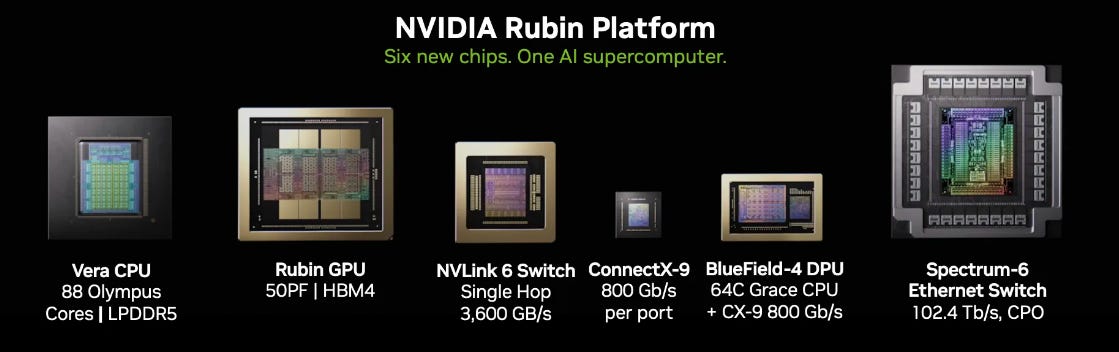
This article takes a technology-focused perspective to provide a detailed overview of these upcoming platforms, interpreting them in the context of the latest publicly available information.

2月26日
LPX Inference Racks: From LPUs to RealScale Ultra-Low-Latency Inference
LPX (Also Known as LPU): Design Philosophy
LPX is a new rack architecture designed by NVIDIA specifically for inference workloads, with its core rooted in NVIDIA’s licensing and acquisition of Groq’s LPU (Language Processing Unit) technology. Groq’s architecture places large amounts of memory directly on-chip, eliminating the bandwidth bottlenecks that traditional GPUs face when relying on external HBM or DRAM.
Groq: What is a Language Processing Unit?
Groq LPUs integrate hundreds of megabits of on-chip SRAM and exploit deterministic execution optimized for sequential inference to maximize data reuse. The compiler schedules all computation and data movement at compile time, eliminating runtime bandwidth contention and enabling extremely low-latency token generation.
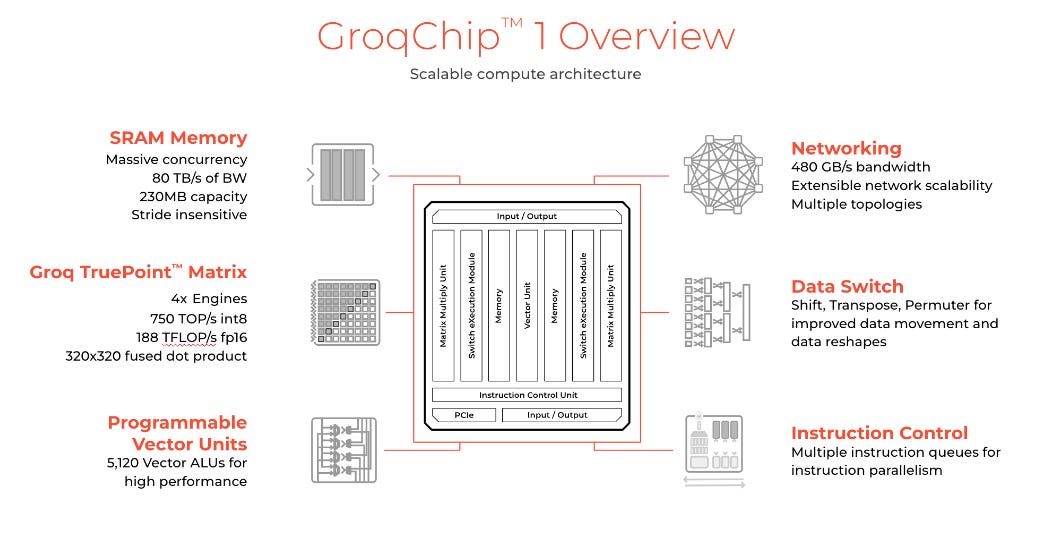
LPX extends this architecture to much larger scale. Groq’s RealScale network uses a direct, switch-less topology: each LPU connects directly to others, forming a network similar to a dragonfly-plus design. Because each LPU operates in a plesiosynchronous regime—where clock oscillators exhibit small, predictable drift—the compiler can precompute packet timing for every data transfer. As a result, 576 LPUs can operate as if they shared a single memory space. This deterministic scheduling allows near-linear scaling across multiple LPUs, making the architecture well suited for Mixture-of-Experts models and large language models with long-range dependencies.
Scaling LPX from 64 to 256 LPUs: Performance and Infrastructure Requirements
Following a licensing agreement with Groq in December 2025, NVIDIA’s initial LPX racks are expected to integrate 64 LPUs, packaged as 32 RealScale ASIC tiles. Each LPU contains hundreds of megabytes of on-chip SRAM, and when combined with RealScale’s deterministic network, the rack can generate small batches of tokens at millisecond-level latency. Groq demonstrations have shown that 10,000 “thought tokens” can be produced in roughly two seconds.
Around GTC 2026, NVIDIA plans to introduce an enhanced LPX rack featuring 256 LPUs per rack, a fourfold increase over the first generation. Paired with new 52-layer M9 Q-glass PCBs and larger on-chip memory capacity, NVIDIA aims to position LPX as a complement to Rubin GPUs in inference scenarios—covering workloads ranging from long-context reasoning to real-time speech and video generation.
M9 PCBs and 52-Layer Routing
Supporting the dense integration of 256 LPUs requires premium PCB materials. According to high-frequency PCB industry sources, NVIDIA is evaluating M9-class copper-clad laminates (M9 CCL) for the mid-plane designs of both CPX (the inference variant of Rubin) and LPX.

2025年7月6日
M9 laminates use Q-glass (high-end quartz fiber) with a dielectric constant of approximately 3.0 and a dissipation factor of 0.0007, significantly outperforming the E-glass used in conventional M8 CCLs. This enables low insertion loss at 56G–112G PAM4 and even 448G SerDes frequencies. M9 can also be hybridized with materials such as PTFE (polytetrafluoroethylene) to achieve even lower dielectric constants in selected layers.
For LPX, the 52-layer M9 PCB not only carries power and high-speed signal routing, but also integrates mounting points for liquid-cooling cold plates and RealScale connectors, ensuring tight synchronization across LPUs. The PCB value per LPU card is estimated at roughly USD 200 (not discussed further here, as this analysis focuses on technology rather than pricing). This underscores the critical role of PCB and materials suppliers in the success of LPX.

2025年10月27日
Thermal Management and Cooling
The high density of LPUs makes thermal management a key consideration. While individual Groq LPUs have relatively modest power consumption, operating 256 LPUs simultaneously can still result in tens of kilowatts per rack. Consequently, LPX adopts liquid-cooled cold plates, similar to the micro-channel cold plate (MCCP) technology used in the NVL72 VR200 platform. MCCP and related cooling innovations will be discussed in greater detail in the subsequent section on VR200.

2月10日
The Relationship Between LPX and the Rubin Platform: Completing the Inference Stack
NVIDIA is adopting a layered architecture in its data-center strategy:
Blackwell / Grace— high-throughput platforms that combine training and inference;
Vera Rubin / Grace Rubin— HBM4-based GPUs paired with Vera CPUs, optimized for long-sequence inference and high-bandwidth models;
LPX— ultra-low-latency inference built on Groq LPUs, particularly well suited for single-batch, low-batch inference and real-time control;
CPX— a GDDR7-based variant of the Rubin architecture, focused on long-context prefill computation.
The goal of LPX is not to replace GPUs, but to tier inference workloads. When model sizes are relatively small and ultra-low latency is required, LPUs leverage large on-chip SRAM for acceleration. When models demand long-range memory or large token storage, CPX and Rubin GPUs provide greater HBM4/HBM4e capacity and higher FLOPS.
The RealScale network can also be bridged with NVLink interconnects, allowing LPX systems to scale into GPU-based platforms and form hybrid AI factories. In future Mixture-of-Experts (MoE) deployments, LPUs may serve as the gating networks, while Rubin GPUs compute the experts themselves—a hybrid model that is likely to become increasingly common in inference scenarios.
Below we will share:
Vera Rubin VR200 NVL72: A New-Generation Training and Inference Platform
CPX and NVL144: Platforms for Long-Context Inference
NVL576: Rubin Ultra and the Inflection Point of Orthogonal Backplanes and CPO
Networking and Communications: NVLink, Spectrum X, and Quantum X
Outlook and Forward-Looking Perspectives
Vera Rubin VR200 NVL72: A New-Generation Training and Inference Platform
Rubin GPU and HBM4
The Rubin GPU is the successor to the Blackwell GPU. Fabricated on a 4 nm process, it integrates 336 billion transistors and is paired with eight stacks of HBM4 memory, delivering a total capacity of 288 GB and a memory bandwidth of 22 TB/s—approximately 2.75× that of HBM3E.
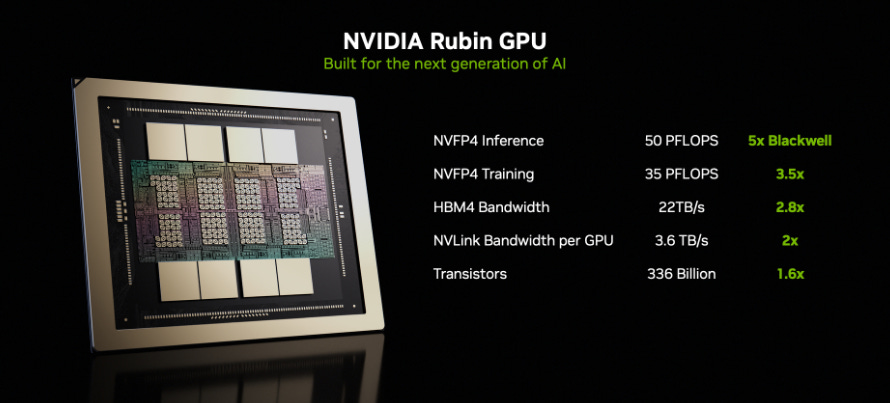
Rubin GPUs also integrate hardware-accelerated encode/decode engines, supporting multi-stream 8K video processing. Interconnect is provided by NVLink 6, offering 1.6 Tb/s per link, with backward compatibility to NVLink 5.
Vera CPU: A General-Purpose Processor Based on the Olympus Architecture
Paired with the Rubin GPU is the Vera CPU, also referred to as the Grace Rubin CPU. It is based on Arm Neoverse designs and NVIDIA’s in-house Olympus CPU microarchitecture. Each Vera CPU features 88 Olympus cores and 162 MB of L3 cache.

Every CPU supports up to 1.5 TB of LPDDR5X memory, a significant increase over the 960 GB supported by the original Grace CPU, with double the memory bandwidth. Vera CPUs connect to Rubin GPUs via NVLink 6, enabling a shared memory space in which CPU load/store operations can directly access GPU memory, reducing data movement overhead. The Vera CPU is designed to efficiently handle pre-processing, post-processing, and control logic for both inference and training workloads.
NVL72 Mechanical Design and Performance
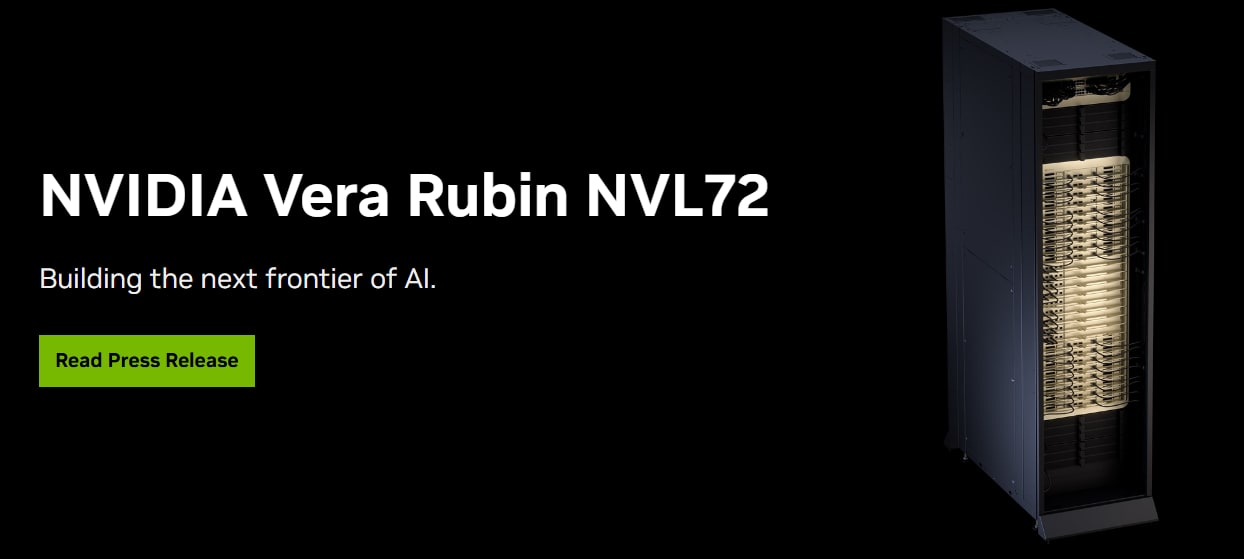
The VR200 NVL72 rack integrates 72 Rubin GPUs and 36 Vera CPUs into 36 Vera Rubin Superchips, interconnected through NVLink 6 switch trays to form a fully connected GPU fabric. The rack consists of three compute trays, each hosting 12 Superchips, along with four NVSwitch trays arranged in a mesh topology.
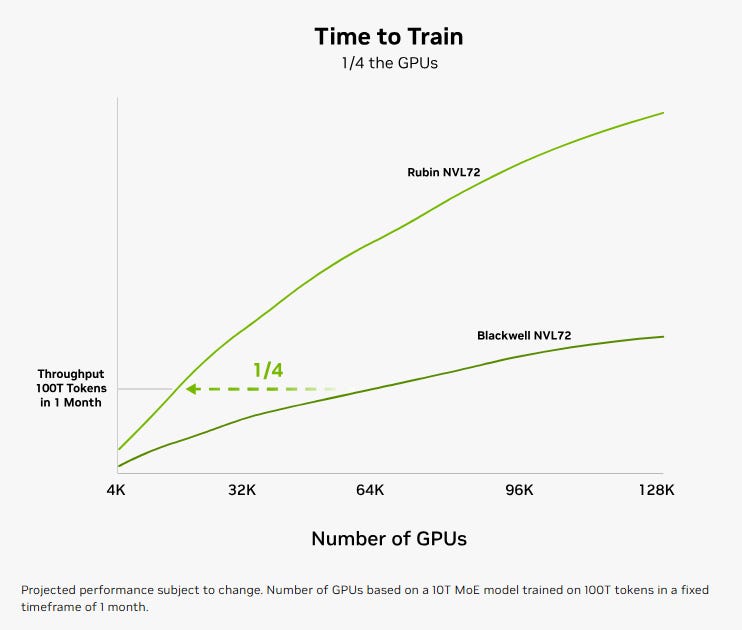
This architecture allows a single NVL72 rack to deliver 20.7 TB of HBM4 memory, 1,580 TB/s of aggregate HBM4 bandwidth, and 260 TB/s of NVLink bandwidth. Compared with the GB300 NVL72, the Rubin NVL72 achieves a 5× improvement in inference performance and a 3.5× gain in training performance, while overall power consumption increases only modestly thanks to the higher energy efficiency of HBM4.
For scale-out networking, NVL72 continues to support Quantum X800 InfiniBand or Spectrum X Ethernet. Each GPU is paired with two ConnectX-9 SuperNICs or BlueField-4 DPUs, enabling the rack to interconnect with others through 800 Gb/s aggregated links.
Power and Cooling Enhancements
According to analyst reports, the VR200 NVL72 supports two power configurations:
Max Q:GPU rated power of ~1.8 kW, with total rack power around 190 kW.
Max P:GPU power of ~2.3 kW, with total rack power around 230 kW.
Compared with the GB300 NVL72 (1.4 kW per GPU / 140 kW per rack), the Rubin NVL72 requires significantly higher-rated power delivery and cooling systems. The new power infrastructure adopts 33U, 110 kW power shelves with 3+1 redundancy, supporting hot-swappable operation during runtime.

2025年10月5日
In addition, the cold plates are attached to the GPUs at the L6 assembly stage, enabling a highly modular design: final system assembly only requires inserting the compute trays into the midplane and connecting quick-disconnect liquid cooling lines, dramatically reducing assembly time.
The new midplane uses Paladin HD2 or similar board-to-board connectors, providing low insertion loss for 100G/112G PAM4 signals, supporting PCIe Gen6, and integrating interfaces for liquid-cooling quick disconnects.
Impact of VR200 on Inference and Training
Rubin NVL72 not only increases compute density per rack, but also reshapes the cost structure of inference. Improvements in HBM4 memory and Tensor Cores reduce per-token training cost by ~3.5× and inference cost by ~5×, respectively. Advanced encode/decode engines enable support for multimedia models such as VLMs (Vision-Language Models) and other multimodal generation tasks, while the CPU-side large LPDDR5X memory capacity allows more embeddings and structured data to be stored locally.
NVIDIA positions Rubin NVL72 as a transitional architecture—both a powerful successor to GB300 and a critical bridge toward Rubin Ultra NVL576 and CPX/NVL144 platforms.
CPX and NVL144: Platforms for Long-Context Inference
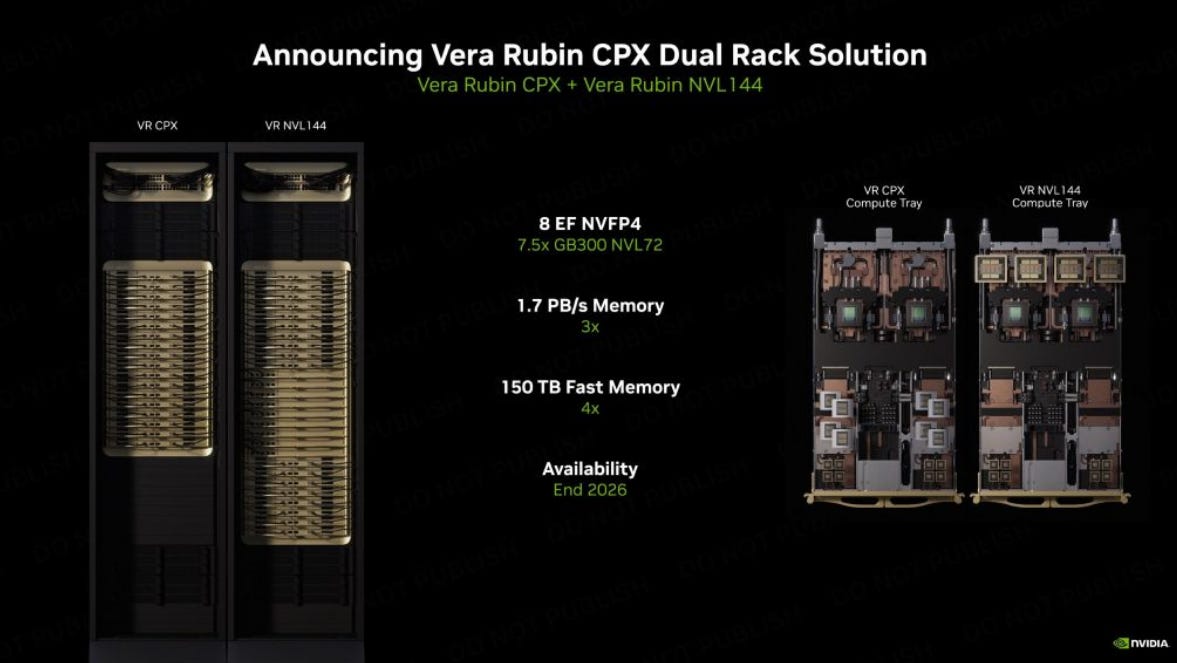
As generative AI applications expand, models increasingly require millions of tokens of context. While HBM4 offers extreme bandwidth, it comes at a high cost. To address this, NVIDIA will introduce the Rubin CPX GPU and the NVL144 CPX rack in 2026.
CPX GPU Architecture
The CPX GPU is a variant of the Rubin architecture that adopts a monolithic die paired with more cost-effective GDDR7 memory. Each GPU integrates six 32 Gb GDDR7 devices, delivering up to 96 GB capacity and 1 TB/s bandwidth. While this is far lower than HBM4’s 22 TB/s, GDDR7 offers superior scalability and lower cost, making it well suited for the prefill stage of large language models—where loading the full context and computing query–key attention dominate performance.
Reports indicate that CPX delivers 3× higher performance than GB300 NVL72 on prefill workloads and supports ultra-long token contexts.
NVL144 CPX Rack and Modular Design
The NVL144 CPX integrates 144 Rubin GPUs and 144 CPX GPUs, delivering 8 EFLOPS NVFP4 compute, 100 TB of fast memory, and 1.7 PB/s bandwidth. Unlike NVL72, NVL144 CPX adopts a cableless, modular architecture, where compute trays and switch trays connect through a large-area PCB midplane, eliminating extensive copper cabling.
The midplane uses Paladin HD2 board-to-board connectors, supporting PCIe Gen6 and CXL 3.0, while liquid cooling lines are installed via quick-disconnect connectors. As a result, total rack assembly time is reduced from ~2 hours (GB300) to ~5 minutes. This design not only simplifies system integration, but also lays the groundwork for future adoption of CPO/NPO optical connectors.
CPX and the Model Ecosystem
CPX is primarily targeted at long-sequence inference workloads, including search, long-form text generation, code completion, and multi-turn conversational AI. NVIDIA allows hybrid deployment of CPX and Rubin GPUs: CPX handles the prefill stage, while Rubin GPUs handle the decode stage, combining the cost efficiency of GDDR7 with the high bandwidth of HBM4.
In addition, CPX GPUs integrate image and video decode capabilities, enabling multimodal prefill workloads. Within NVL144 CPX systems, CPX GPUs account for half of the total GPUs, highlighting NVIDIA’s strategic shift in the inference market—from offering only flagship GPUs to delivering stage-optimized, purpose-built silicon for different phases of inference.
NVL576: Rubin Ultra and the Inflection Point of Orthogonal Backplanes and CPO

NVIDIA first unveiled Rubin Ultra NVL576, codenamedKyber, at GTC 2024, with plans to launch in the second half of 2027. Each NVL576 rack contains 576 Rubin Ultra GPUs, with total power consumption reaching 600 kW. Training performance is rated at 5 EFLOPS FP8, while inference performance reaches 15 EFLOPS NVFP4.
This ultra-scale rack far exceeds the scale of today’s NVL72 systems and adopts two interconnect approaches: Orthogonal Backplanes and CPO/NPO optical interconnects.
Orthogonal Backplane: Eliminating 20,000 Copper Cables with a 78-Layer M9/PTFE Hybrid Board
According to PCB manufacturers, this backplane uses a 78-layer structure, typically assembled from three 26-layer boards, and employs a hybrid stack of M9 and PTFE materials to reduce dielectric constant and loss. Each layer features a dielectric constant of approximately 3.0 and a dissipation factor of 0.0007, along with HVLP4 copper foil to minimize surface roughness.
A stack-up of this complexity demands extremely advanced drilling and plating processes: via diameters below 0.3 mm, depths up to 5 mm, and careful control of differential coefficients of thermal expansion across materials using prepregs. Layer alignment requires fine-grained tuning—often described as “cell nucleus–level” adjustment—to pass thermal cycling tests.
Thermal and mechanical challenges are equally significant. Due to its large area and layer count, the backplane itself is not an efficient heat-dissipation structure. NVIDIA therefore treats it as a passive component: the compute trays and switch trays on both sides continue to use micro-channel liquid cold plates, while the backplane primarily serves signal transmission. To maintain signal integrity, routing is kept away from heat sources, and suspended support structures are used to prevent board warpage. Overall, the orthogonal backplane significantly reduces installation labor and error rates per NVL576 rack, while delivering a 20–25% increase in PCB value content.

CPO/NPO Optical Interconnects: A Scaling Breakthrough from Copper to Optics
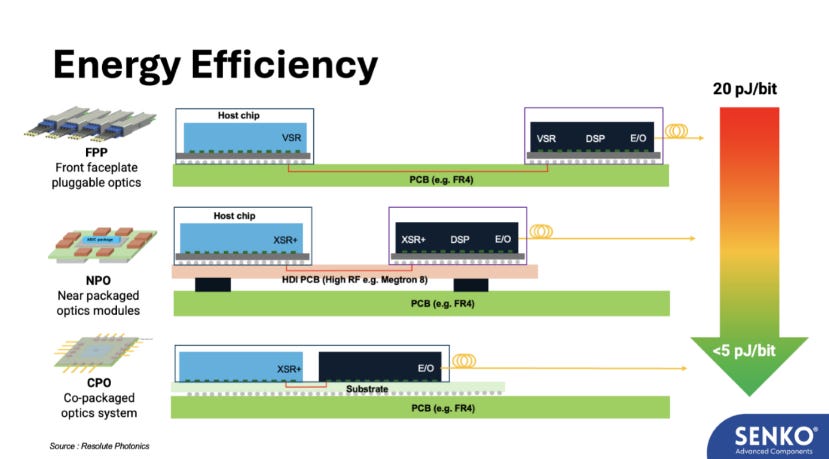
The alternative approach is Co-Packaged Optics (CPO) or its variant, Near-Packaged Optics (NPO). CPO integrates photonic engines directly with switching ASICs, converting electrical signals to optical signals over extremely short distances, thereby reducing insertion loss and power consumption. According to NVIDIA documentation, CPO can reduce the power of a 1.6T pluggable transceiver from ~30 W to ~9 W, delivering 3.5× energy efficiency, 10× reliability, and 64× signal integrity improvements over traditional optical modules.
NVIDIA has announced plans to launch Spectrum X Photonics (Ethernet CPO) and Quantum X InfiniBand CPO switches in 2H 2026. Spectrum X Photonics will offer 409.6 Tb/s bandwidth with 512 × 800 Gb/s ports, while Quantum X InfiniBand CPO will provide 115 Tb/s bandwidth with 144 × 800 Gb/s ports.
CPO Deployment in Rubin Ultra
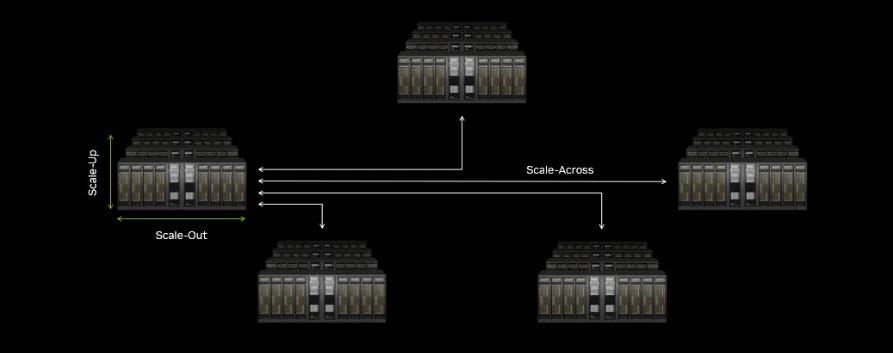
According to industry analysts, Rubin Ultra NVL576 will adopt a dual strategy combining scale-up CPO and scale-out CPO:
Scale-up CPO:
Each NVSwitch ASIC in an NVSwitch tray will be co-packaged with 4.5 units of 3.2 Tb/s photonic engines. A single NVSwitch tray contains six NVSwitch ASICs, resulting in 27 photonic engines per tray. Across the entire NVL576 rack (with 12 NVSwitch trays), this totals 648 photonic engines. These engines are interconnected via fiber to form a scale-up NVLink 7/8 network, replacing the dense copper routing used in orthogonal backplanes.
Scale-out CPO:
The CX10 NICs (next-generation ConnectX NICs) on compute trays will also be co-packaged with photonic engines to provide optical links to external racks. Analysts estimate that each GPU card in a Rubin Ultra rack will require approximately 5.5 photonic engines (including both scale-up and scale-out), bringing the total number of photonic engines per rack to roughly 792.

This CPO-centric architecture fundamentally reshapes data center networking. Optical fiber enables low-latency, high-bandwidth lateral interconnects, allowing AI factories to share parameters across dozens or even hundreds of NVL576 racks. With lower signal degradation over distance, network topologies can be simplified, eliminating the need for retimers and DSPs, and further reducing power consumption.
NPO: A Compromise Placement for Photonic Engines
In CPO, photonic engines are placed directly adjacent to ASICs, creating severe thermal challenges. NPO mitigates this by positioning photonic engines on nearby substrates or external modules, connected to the ASIC via short PCB traces or ABF substrates. While NPO slightly relaxes the ultimate efficiency gains of full CPO, it significantly reduces packaging complexity and thermal density, while still achieving lower power and latency than pluggable optics.
NVIDIA has hinted that NVL576 may be offered in both CPO and NPO variants, allowing flexibility to balance manufacturing yield, cost, and system-level trade-offs.
Trade-offs Between the Two Approaches
Both orthogonal backplanes and CPO aim to address the signal integrity and cabling challenges of NVL576, but they emphasize different priorities:
Orthogonal Backplane:
Replaces copper cables with PCB routing, simplifying assembly and maintenance;
Requires extremely high PCB layer counts and expensive materials, making manufacturing yield a key challenge;
Has limited impact on thermal design (since the backplane primarily carries signals), but increases overall weight and physical size.
CPO/NPO:
Integrates photonic engines directly with—or near—the ASICs, reducing power consumption and footprint;
Demands very advanced packaging and thermal solutions;
Introduces complexity in fiber management, including concerns around bend radius and fiber fragility.
In practice, NVIDIA is likely to evaluate both approaches in parallel. Some customers may prefer the reliability and serviceability of backplane-based designs, while others will prioritize the energy efficiency and latency advantages of CPO. Mid-tier products (such as Rubin CPX or NVL144) may adopt backplane architectures without photonic engines, while flagship systems like NVL576 are expected to transition toward CPO. GTC 2026 is anticipated to disclose further details and production timelines for these options.
Networking and Communications: NVLink, Spectrum X, and Quantum X
NVLink 5/6/7
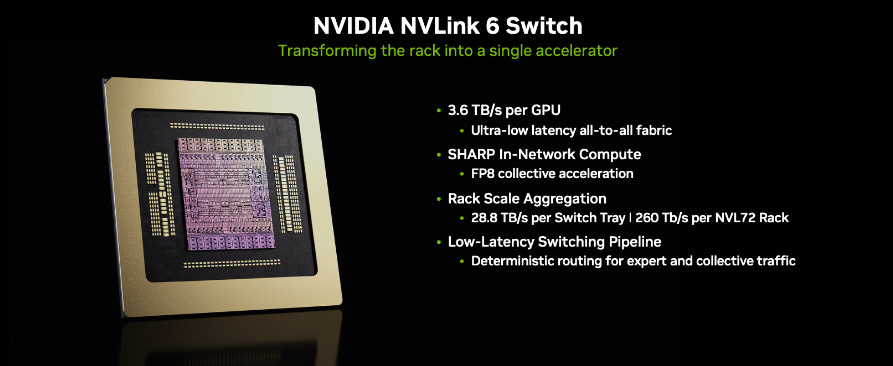
NVLink is NVIDIA’s proprietary multi-die interconnect protocol, enabling high-speed communication between GPU–CPU and GPU–GPU. From NVLink 5 (used in Blackwell) to NVLink 6 (Rubin), and onward to future NVLink 7/8, bandwidth doubles with each generation. NVLink 6 delivers 1.6 Tb/s per link, while NVLink 7 is expected to increase this to 3.2 Tb/s, with support for CPO or backplane-based architectures.
NVLink supports cache coherence, allowing CPUs and GPUs to share memory directly. This enables heterogeneous processors—such as CPX, Rubin, and LPX—to form a shared compute pool. Through NVLink Switches (NVSwitch) or RealScale, NVLink can support multi-level network topologies.
Spectrum X Ethernet Photonics
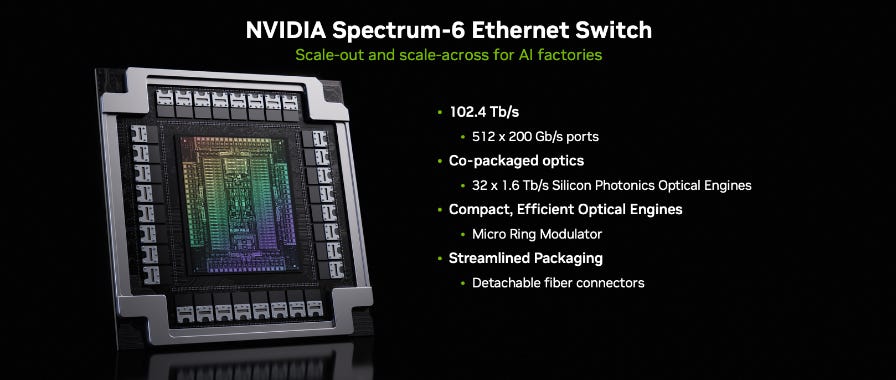
To support AI factories with tens of thousands of GPUs, NVIDIA introduced the Spectrum X Ethernet platform. Announced at GTC 2024, Spectrum X800 provides 51.2 Tb/s of bandwidth with 64 × 800 Gb/s ports, paired with BlueField-3 DPUs to enable low-latency RoCE.
At GTC 2026, NVIDIA is expected to introduce Spectrum X Photonics, the CPO-based Ethernet lineup:
Spectrum X102.4 Photonics: 102.4 Tb/s bandwidth with 128 × 800 Gb/s optical ports
Spectrum X409.6 Photonics: 409.6 Tb/s bandwidth with 512 × 800 Gb/s optical ports
These products are slated for release in 2H 2026 and are designed for Ethernet-based AI factories scaling to tens of thousands of Rubin GPUs.
Quantum X CPO InfiniBand
For HPC and deep learning training, InfiniBand continues to offer advantages in ultra-low latency and RDMA. NVIDIA plans to launch the Quantum X800 CPO InfiniBand switch in 2026, delivering 115 Tb/s of bandwidth with 144 × 800 Gb/s ports. This switch uses liquid cooling, allowing tight integration with GPU-dense racks, and can operate alongside Spectrum X Photonics in hybrid network deployments.
Paired with CX10 NICs, Quantum X800 CPO enables end-to-end optical paths that balance flexibility and energy efficiency. Looking ahead, Quantum X1600/2000 CPO platforms may exceed 230 Tb/s of bandwidth, providing the backbone networking required for NVLink 7/8 in the Rubin Ultra era.
Outlook and Forward-Looking Perspectives
Likely Announcements at GTC 2026
Detailed LPX Rack Specifications
NVIDIA is expected to disclose full specifications for the enhanced LPX racks, including on-chip memory capacity, RealScale network topology, supported model classes, and thermal designs for the 256-LPU configuration. Given the deterministic execution and ultra-low-latency characteristics of Groq LPUs, NVIDIA may position LPX as a real-time AI services platform, targeting applications such as intelligent robotics, industrial control, and voice assistants.
Official Launch of CPX and NVL144
The release of Rubin CPX will mark the first large-scale deployment of GDDR7 in data center GPUs. NVIDIA may showcase demos featuring million-token long-context generation, highlighting the advantages of hybrid operation between CPX and Rubin GPUs.
Comparative Disclosure of Rubin Ultra NVL576 Variants
NVIDIA is likely to present detailed comparisons between NVL576 configurations, including orthogonal backplane designs, CPO/NPO-based versions, performance metrics, power and thermal characteristics, as well as system-level installation and maintenance approaches. A dual-strategy may be emphasized—offering backplane-based solutions for cost-sensitive customers, and optical interconnect options for performance-driven deployments.
Spectrum X Photonics and Quantum X CPO
Commercial specifications, delivery schedules, and product readiness (pricing excluded here) are expected to be formally announced. NVIDIA may collaborate with cloud service providers to demonstrate CPO-based AI factory deployments.
AI Factory Solutions and Ecosystem Partnerships
Following early adopters such as OpenAI and Anthropic, additional startups and large enterprises may announce plans to deploy private AI factories based on Rubin and LPX. NVIDIA may also introduce inference-optimized software toolchains in partnership with software vendors, including Triton Inference Server, TensorRT-LLM, and related frameworks.
Future Challenges and Opportunities
Energy Consumption and Sustainability
Even with the energy efficiency gains enabled by CPO, a 600 kW NVL576 rack remains extremely power-intensive. Data centers will require more efficient cooling and energy management solutions, such as hybrid air/liquid cooling, waste heat recovery, and renewable energy integration. Overall carbon footprint and OPEX considerations will become decisive factors in AI factory adoption.
Software Ecosystem Evolution
LPX’s deterministic execution model demands new compilers and schedulers, requiring developers to learn the RealScale programming paradigm. NVIDIA may provide higher-level APIs or SDKs (such as GroqFlow) to lower the barrier, but ecosystem maturity will take time. CPX’s GDDR7 memory also necessitates new memory management strategies to maximize prefill efficiency.
Supply Chain Security
The supply of advanced materials such as M9 and PTFE is sensitive to geopolitical and raw material constraints. Ensuring supply stability and reducing regional dependencies will challenge vendors’ strategies. Photonic engines and lasers represent additional bottlenecks in the CPO ecosystem and will require sustained investment.
Market Competition
NVIDIA is not alone in this space. Competitors are also developing CPO/NPO solutions and inference-focused accelerators. Examples include AMD’s MI400 with Xilinx Versal integration, Intel Gaudi3, and Google TPU v6. These offerings may exert pressure on energy efficiency or cost, pushing NVIDIA to continue rapid innovation.
Industry Implications
From LPX to Rubin Ultra, NVIDIA presents a comprehensive vision for the future AI factory—spanning inference and training, electrical and optical interconnects, PCB materials, and liquid cooling systems. Several key takeaways emerge for the industry:
Cross-Domain Integration
AI servers are no longer merely chip products; they are integrated systems combining optics, materials, packaging, thermal engineering, and system design. Companies must build cross-disciplinary teams to remain competitive.
Rapid Iteration and Modularity
Ecosystem Collaboration
No single company can build this ecosystem alone. NVIDIA’s partnerships with Groq, optical communications vendors, PCB suppliers, server manufacturers, and cloud service providers illustrate the importance of broad alliances. New entrants must carefully evaluate collaboration strategies to succeed.
SemiVision Viewpoint
For technology professionals and investors alike, understanding the principles, challenges, and trajectories behind these innovations will be critical to capturing the opportunities presented by the next wave of artificial intelligence.
It All Start Heres , NVIDIA GTC 2026

2025年6月17日

2025年3月28日

2025年3月19日


PreviousNext
TopLatestDiscussions








See all