The Silent Engine of the AI Revolution: How SiliconMotion Smart Storage is Powering the Future
The Silent Engine of the AI Revolution: How SiliconMotion Smart Storage is Powering the Future
- Source: SemiVision
- Author: SEMIVISION
- Published: 2026-02-25T09:11:43+08:00
- URL: https://tspasemiconductor.substack.com/p/the-silent-engine-of-the-ai-revolution (1) The Silent Engine of the AI Revolution: How SiliconMotion Smart Storage is Powering the Future


The Silent Engine of the AI Revolution: How "SiliconMotion" Smart Storage is Powering the Future
Orignal Article By SemiVision Reserach [Reading time: 15 mins]

Feb 25, 2026
∙ Paid

As a semiconductor industry analyst at SemiVision, I have been closely tracking the AI hardware supply chain for years, with particular focus on the pivotal role of storage subsystems in the explosive growth of AI. Imagine this: you’re strolling through the bustling streets of Tokyo wearing AI glasses that whisper real-time translations into your ear, or your autonomous vehicle anticipates a pedestrian’s movement before you even notice. This is no longer science fiction—it is the everyday reality that artificial intelligence is rapidly building today.

2025年11月6日
We are often dazzled by the glamorous side of AI: NVIDIA’s GPUs crunching trillions of operations per second, or intricate neural networks that appear to mimic human reasoning. Yet quietly enabling all of this magic is a far less flashy but absolutely indispensable component—storage infrastructure. In the digital era, data is the lifeblood of AI. Every algorithm, every inference, every intelligent decision originates from vast oceans of information. At the heart of managing that data sits NAND flash storage—the unsung hero responsible for storing, retrieving, and safeguarding it all. Whether in hyperscale cloud servers training the next frontier model or in the tiny die inside your smartwatch, storage has evolved from a passive repository into the dynamic engine propelling AI forward.
Leading this transformation isSilicon Motion, the world’s leading independent supplier of NAND flash controllers—the “brains” that make storage intelligent, efficient, and ready for the extreme demands of the AI era. Looking at the latest financials, Silicon Motion delivered full-year 2025 revenue of US$885.6 million (up 10% YoY), with Q4 surging 46% to US$278.5 million. Client SSD controller shipments grew 25–30% quarter-over-quarter and 35–40% year-over-year. The company’s Q1 2026 revenue guidance of US$292–306 million (up 5–10% QoQ and 76–84% YoY) signals that 2026 will likely be a record revenue year. These are not just numbers—they are direct evidence of the structural explosion in AI-driven storage demand.

Silicon Motion Technology Corporation, the global leader in NAND flash memory controller solutions, today announced that it has been named one of Clarivate’s “Top 100 Global Innovators 2026.”
Let us examine the AI spectrum, the explosive shift to edge inference, and how Silicon Motion is positioned to capture this secular wave from an industry perspective.

Tune in to NVIDIA GTC Live on March 16 where industry leaders huddle up to break down accelerated computing beyond AI, spotlight NVIDIA’s full-stack superpowers, and reveal the five-layer game plan behind one of the biggest infrastructure build-outs in history—and the global ecosystem teaming up to make it real. Get the pregame details athttps://www.nvidia.com/gtc/pregame/
The AI Spectrum: From Cloud Core to Intelligent Edge
AI is no longer confined to distant supercomputers; it spans what we call the “AI Spectrum.” One end is the Core—massive cloud data centers operated by hyperscalers such as Google, Amazon, and Microsoft. These are the powerhouses where foundation models are trained by ingesting billions upon billions of data points: images, text, video, sensor streams. It is analogous to teaching a child to recognize patterns in the world, but at an almost incomprehensible scale.

Training requires storage that is not merely large, but blisteringly fast. Ultra-high-capacity drives must sustain terabytes-per-second throughput without bottlenecks. Modern servers leverage PCIe Gen5 interfaces, and storage must fully saturate them—delivering maximum bandwidth—to keep GPUs running at peak utilization. Any I/O bottleneck here wastes enormous compute resources, time, and electricity.
The real acceleration, however, is happening at the opposite end: the Intelligent Edge. This is where AI resides in our pockets, on our wrists, and inside vehicles. Edge AI is dominated by inference—the phase in which a pre-trained model applies its knowledge in real time. Your smartphone’s voice assistant understanding commands? Inference. An autonomous vehicle detecting a stop sign? Inference.
Industry forecasts indicate that by 2028, storage demand for AI inference will be at least double that of training—and in many projections, significantly more. The reason is straightforward: edge devices are proliferating at an unprecedented rate—smartphones, AI PCs, wearables, drones, industrial robots, and more. These devices do not merely consume data; they generate it continuously. A smart city with thousands of cameras performing on-the-spot traffic analytics, or a factory robot learning from its environment without constant cloud round-trips—these decentralized applications make AI faster, more private, and far less dependent on connectivity. At the same time, they impose extreme requirements on local storage: compact form factor, ultra-low latency, and exceptional power efficiency.

To put the scale in perspective, global data creation is projected to reach 181 zettabytes in 2025 (181 followed by 21 zeros). A substantial portion will fuel edge AI workloads, creating sustained demand for agile, high-performance storage solutions.

2月12日
Bridging Biology and Silicon: The Storage Challenges of Human-Like AI
Let us take a more philosophical step: if AI is to approach true human-level intelligence—not just compute, but seamless interaction—it must replicate aspects of how the human brain works. The human brain contains roughly 86 billion neurons that store memories, skills, and instincts. Replicating anything close to that level of contextual understanding in silicon demands heroic storage capacity.
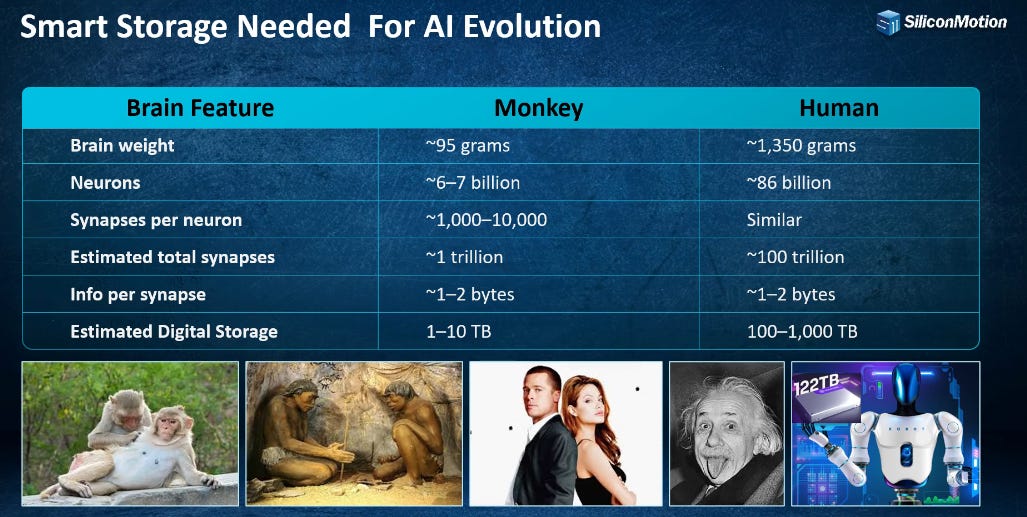
For “very edge” AI—devices that feel like natural extensions of ourselves—a single gadget may eventually require the equivalent of 100 terabytes of effective storage capacity. That is essentially packing a small data center into your pocket. Current consumer devices top out at a few terabytes, so we are not there yet, but the trajectory is clear and accelerating.
Consider the AI glasses example: you are in Japan speaking English, and the device instantly translates to Japanese, delivering spoken output or projected subtitles. This requires far more than raw compute—it demands near-zero perceptible latency and ultra-low power consumption so the battery lasts all day. High latency causes stutters that destroy immersion; excessive power draw causes overheating or rapid battery drain, rendering the product impractical.
In this context, storage evolves from a simple file cabinet into a critical component of the AI “nervous system.” It must retrieve data with lightning speed while consuming power as efficiently as a marathon runner conserves energy. Power efficiency is no longer a nice-to-have green feature; it is the make-or-break factor for wearable and mobile AI viability. Without it, smart glasses would overheat or die within an hour, turning a transformative vision into a failed product.
From an analyst viewpoint, this is where controller vendors like Silicon Motion enjoy enormous opportunity. Whoever can deliver the optimal combination of low latency, ultra-low power, and bullet-proof reliability will capture disproportionate share in the fastest-growing segment of the AI infrastructure market.

2月14日
The Tech Behind the Curtain: NAND Controllers in Action
So, how does storage rise to these challenges? Enter the NAND flash controller—the tiny chip that orchestrates everything, managing the flow of data between the storage media and the rest of the system like a skilled conductor leading an orchestra. Silicon Motion is at the forefront of this technology, crafting controllers like the Gen6 SSD series, including the flagship SM2508, which are meticulously tailored to handle the extremes of AI workloads. These controllers aren’t just hardware; they’re engineered marvels built on advanced processes, incorporating powerful processors and intelligent algorithms to push the boundaries of what’s possible in data storage.
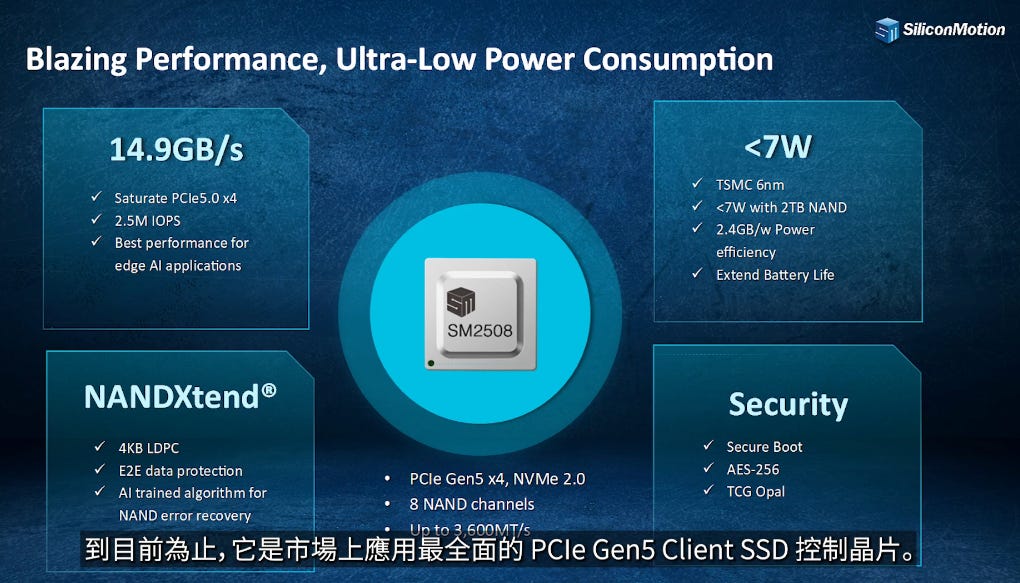
Built on TSMC’s state-of-the-art 6nm EUV process node, the SM2508 features a quad-core ARM Cortex-R8 CPU running at up to 1.25 GHz, enabling it to juggle massive data streams with ease. It supports PCIe Gen5 x4 interfaces with NVMe 2.0 protocol, offering up to eight NAND channels that can operate at speeds of 3,600 MT/s (megatransfers per second). This setup allows for staggering performance: sequential read speeds reaching 14.5 GB/s, write speeds up to 13.6 GB/s, and random IOPS (input/output operations per second) hitting 2.5 million for both reads and writes. What’s more, it can handle capacities up to 8TB, making it versatile for everything from compact laptops to high-end desktops. But raw specs are only part of the story—the real innovation lies in how these controllers optimize for AI’s unique demands, ensuring seamless integration into edge devices and data centers alike.
- Balancing Speed and Sips of Power
Performance is king in AI, but it can’t come at the cost of efficiency, especially in power-hungry environments like mobile AI devices or densely packed servers. Take the SM2508 controller: its TSMC 6nm process allows it to operate at under 7 watts in full throttle—often as low as 3 watts during typical operations—while delivering those blistering PCIe Gen5 speeds. That’s like a high-performance sports car that sips fuel more efficiently than a compact economy model, achieving an impressive 2.4 MB/s per milliwatt in key efficiency metrics.
Why does this matter? Real-time AI decisions, like a drone dodging an obstacle in mid-flight or an autonomous vehicle processing sensor data to avoid a collision, can’t afford delays from overheating or power drain. In AI training scenarios, where data centers run 24/7, this efficiency translates to lower electricity bills and reduced cooling needs, potentially saving millions for large-scale operations. Engineers at Silicon Motion obsess over this balance, rigorously testing in labs with simulated AI workloads to squeeze every ounce of efficiency. For instance, the controller’s ability to deliver twice the performance of Gen4 products at similar power levels makes it a game-changer for AI notebooks, where battery life is paramount.
- Taming Errors in a Dense Data World
As we pack more data into tinier spaces—think Quad-Level Cell (QLC) NAND, which stores four bits per cell, or even emerging technologies pushing toward penta-level cells—the chance of errors skyrockets. Bits can flip due to everyday wear from repeated read/write cycles, extreme temperatures, or electromagnetic interference, potentially corrupting AI’s precious data and leading to flawed model outputs.
Silicon Motion counters this with advanced error correction code (ECC) through their proprietary NANDXtend technology. Evolving from their 4th-generation LDPC (Low-Density Parity-Check) in 2017 to the current 8th-generation (with ongoing advancements pushing toward even higher iterations), it’s like upgrading from a basic spell-check tool to an sophisticated AI editor that catches every subtle nuance and context. This LDPC engine includes an on-disk training algorithm that dynamically adapts to the NAND’s characteristics, reducing ECC processing time and boosting overall efficiency.
The system also features end-to-end data path protection, which safeguards information from the moment it’s written to when it’s read back, and programmable RAID support for added redundancy. This is particularly vital for QLC NAND, which offers higher density and lower cost per bit—ideal for massive AI datasets—but is more error-prone than TLC (Triple-Level Cell) variants. By ensuring compatibility with the latest 3D TLC/QLC NAND from manufacturers like Kioxia or Micron, these controllers enable higher data densities without sacrificing reliability.
This ensures data integrity, crucial for AI where a single glitch could misidentify a tumor in a medical scan, skew financial predictions, or veer a car off course in an autonomous driving system. In edge AI, where devices operate in harsh environments like industrial robots in factories or drones in variable weather, this robust error handling prevents costly failures and extends the lifespan of the storage, often rated for endurance in the petabyte-written range.
- Slashing Latency for Instant AI Magic
Latency is the enemy of responsiveness—the subtle delay in data access that can turn a seamless experience into a frustrating one. In benchmarks like Cosmos Pro and Netlib, new controllers like the SM2508 shave it down by 1.4x to 2x compared to rivals, achieving sub-millisecond response times that feel instantaneous.
These innovations stem from smarter architectures: better queuing mechanisms that prioritize urgent AI tasks, predictive reads that anticipate data needs based on patterns (much like how AI itself predicts outcomes), and hardware acceleration for common operations. The quad-core CPU plays a key role here, distributing workloads across cores to handle parallel processing efficiently. Additionally, features like optimized NVMe command handling and reduced ECC overhead from the on-disk training ensure that data flows with minimal bottlenecks.
Imagine waiting for your phone to unlock via facial recognition—high latency feels like an eternity, potentially compromising security in time-sensitive scenarios. In generative AI, low latency means a chatbot that anticipates your next word, providing fluid conversations rather than stilted responses. For spatial AI in robotics or AR glasses, this translates to real-time object recognition without lag, enabling natural interactions like a robot handing you a tool precisely when needed.By minimizing latency, these controllers bridge the gap between human perception and machine response, making AI feel more intuitive and reliable. As AI evolves toward more interactive and immersive applications, this focus on speed without compromise will be what separates cutting-edge devices from the rest.
AI in Your Pocket: The Mobile Revolution
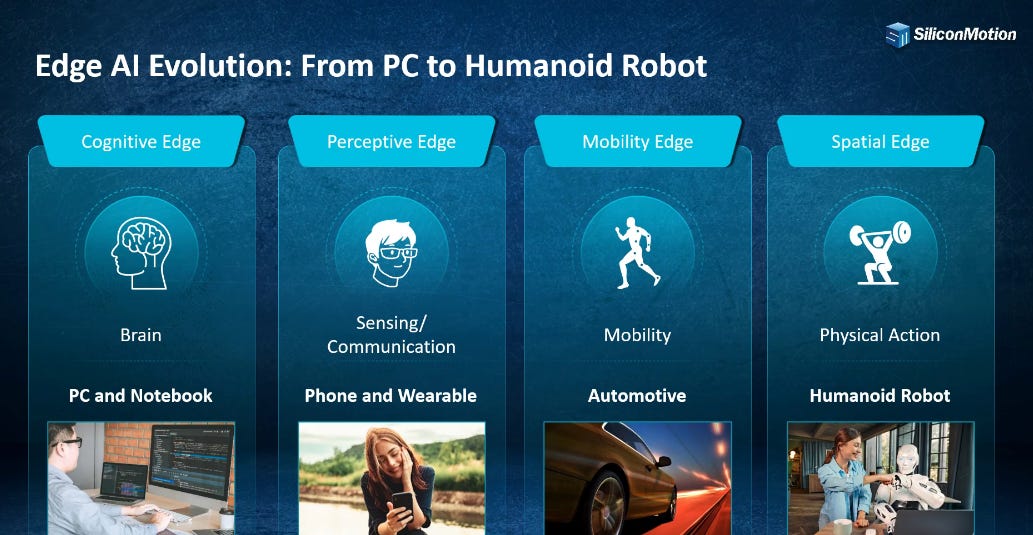
Most of us interact with artificial intelligence on a daily basis through our smartphones, tablets, and laptops—these devices have become the primary gateway to AI’s transformative power. We’ve evolved far beyond the early days of “Perception AI,” where assistants like Siri or Google Assistant simply recognized voice commands, identified faces in photos, or performed basic object detection. Today, we’re firmly in the era of “Generative AI” and advanced on-device intelligence, where smartphones can create original art from text prompts, draft essays or emails in your personal style, summarize lengthy documents, generate music snippets, or even produce photorealistic images—all powered by large language models (LLMs) and multimodal AI running locally.
This dramatic leap forward places unprecedented demands on mobile storage. Models like those with billions of parameters (think 3-billion-parameter LLMs or vision-language models) require rapid loading, frequent random access during inference, and high throughput to handle token-by-token generation without lag. Traditional eMMC storage simply can’t keep up; it would throttle performance, drain batteries quickly, and force reliance on cloud connectivity for every query. Enter Universal Flash Storage (UFS)—the current gold standard for high-end smartphones, foldables, tablets, and premium wearables. UFS delivers dramatically higher sequential and random performance than its predecessors, along with better power efficiency and support for larger capacities.
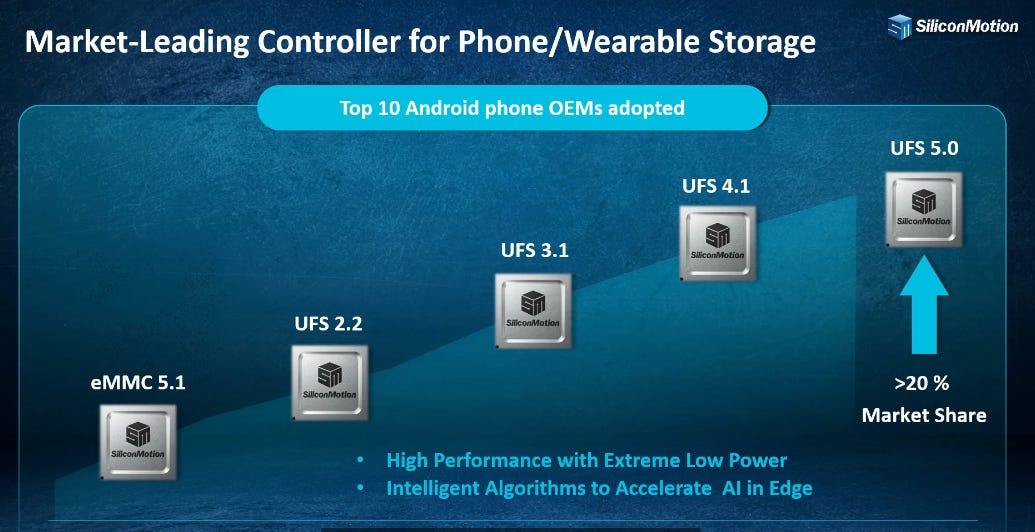
Silicon Motion leads this mobile storage evolution with its advanced UFS controllers, such as the SM2756 (a flagship UFS 4.0/4.1 solution) and related models like the SM2755/SM2758 family. Built on TSMC’s leading 6nm EUV process and leveraging MIPI M-PHY low-power architecture, these controllers achieve sequential read speeds exceeding 4,300 MB/s and write speeds over 4,000 MB/s—roughly 2x faster sequential reads and 1.5x better random performance compared to UFS 3.1 solutions. They support the broadest range of 3D TLC and QLC NAND flash, scaling up to 2TB capacities to accommodate massive on-device AI model libraries.
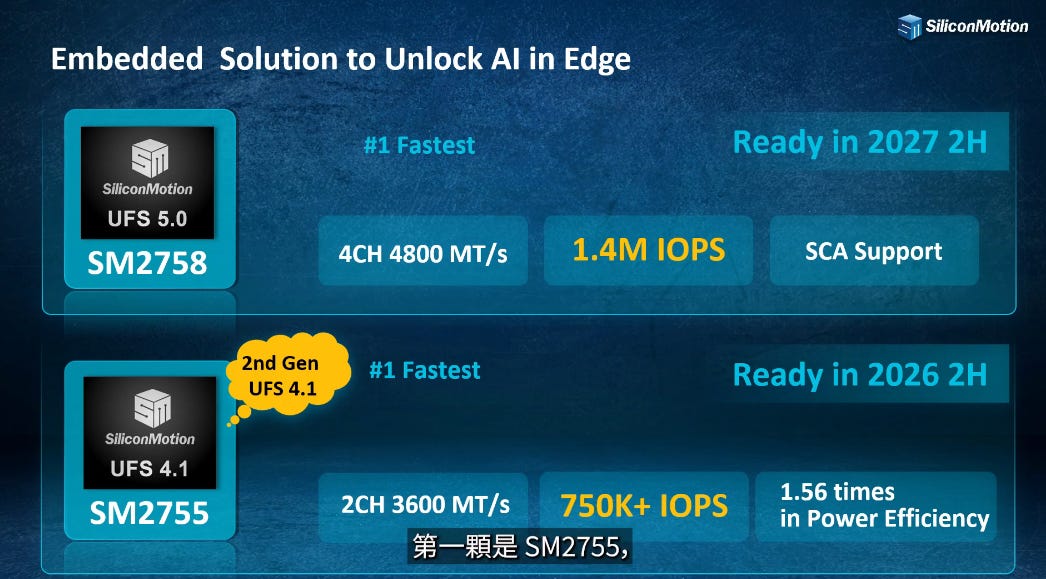
Power efficiency is a standout feature: Silicon Motion’s UFS 4.x controllers deliver up to 56% power savings when loading large AI models and reduce everyday task consumption by around 40%. Overall, they offer 1.65x greater power efficiency than UFS 3.1 equivalents, often measured in GB/s per watt. This means flagship smartphones can load a 3-billion-parameter AI model in under half a second, enabling near-instant responses for real-time applications. Your device can now perform complex tasks locally—real-time language translation during conversations, intelligent photo editing with generative fill or object removal, on-device music composition based on mood prompts, or even running personalized AI companions that learn from your habits—all without constant cloud pings.
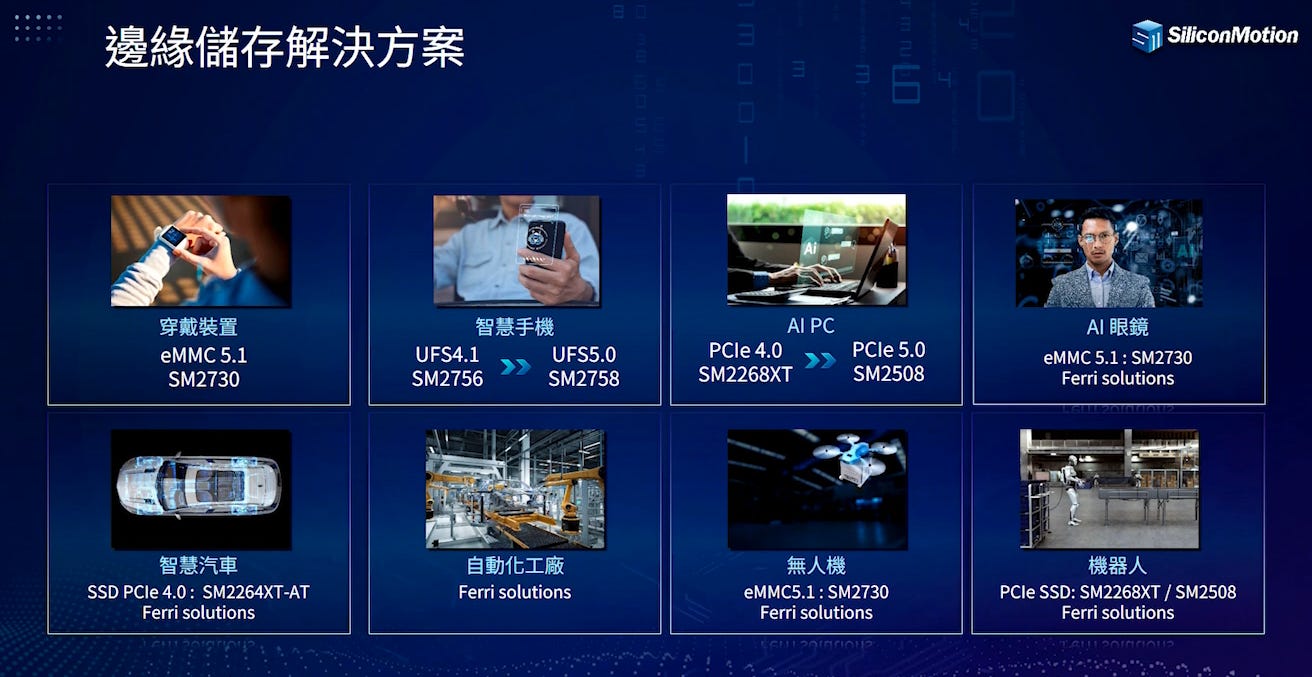
As the industry transitions to AI PCs—laptops and 2-in-1s equipped with dedicated neural processing units (NPUs) like those in Qualcomm Snapdragon X Elite, Intel Lunar Lake, or AMD Ryzen AI series—the same storage principles apply. These “AI PCs” demand high-performance, power-efficient storage to run local inference for productivity tools, creative workflows, and even lightweight generative tasks. Silicon Motion’s UFS and client SSD controllers ensure these portable powerhouses deliver desktop-class AI capabilities without sacrificing mobility, thermal management, or all-day battery endurance.
Conquering the Spatial Edge: Cars, Robots, and Beyond
If mobile AI pushes the boundaries of personal computing, the Spatial Edge represents AI’s most demanding frontier: systems that must perceive, decide, and act in the physical world in real time. This includes autonomous vehicles (AVs), advanced driver-assistance systems (ADAS), humanoid and industrial robots, drones, and emerging spatial computing devices.

A modern self-driving car is essentially a rolling data fortress on wheels. Equipped with multiple high-resolution cameras, radar, LIDAR, ultrasonic sensors, and IMUs, it ingests gigabytes per second of raw sensor data—estimates range from 4–20 TB per day per vehicle, or up to 1 TB per hour during intensive operation. This torrent must be processed with extreme low latency: decisions like braking for a pedestrian, swerving around debris, or accelerating through a yellow light happen in milliseconds. A delay of even 100 ms can mean the difference between safety and catastrophe.

Silicon Motion’s Intelligent Automotive Storage Solutions deliver cutting-edge PCIe-based storage for next-generation vehicles. The SM2264XT-AT, a flagship automotive-grade PCIe Gen4 NVMe SSD controller, complies with rigorous ASPICE standards and ISO 26262 functional safety requirements (ASIL-B ready). It supports global 7 major NAND vendors, partners with leading module suppliers, and powers embedded storage like the Ferri series for reliable performance in harsh conditions. Adopted by top OEMs including Mercedes-Benz, Volkswagen, GM, Ford, Ferrari, Toyota, Nissan, Honda, BYD, Xiaomi, Waymo, Chery, Geely, and GAC, these solutions enable high-speed, secure data handling for ADAS, infotainment, autonomous driving, and centralized computing architectures—ensuring safety, scalability, and future-proof intelligence in smart vehicles.
Storage in this environment demands automotive-grade ruggedness and reliability. Silicon Motion’s SM2514 (and related automotive controllers like the SM2264XT-AT series) exemplify this toughness. These solutions operate reliably across extreme temperatures—from -40°C in arctic conditions to +150°C near engine compartments or in direct sunlight—while meeting stringent AEC-Q100 qualifications for vibration, shock, and humidity resistance.
Key superpowers include:
Redundancy and Fail-Safe Design:Dual-core or multi-core architectures ensure that if one processing path fails due to a transient error or hardware fault, the backup continues to deliver safety-critical data. This “backup pilot” functionality is essential for ISO 26262 ASIL-D compliance, the highest automotive safety integrity level.
Virtualization Support:Features like Single Root I/O Virtualization (SR-IOV) allow a single SSD to be shared across up to eight virtual machines within the vehicle’s central compute unit. This optimizes resource utilization: one storage device can simultaneously serve the ADAS stack for perception and planning, the infotainment system for navigation and entertainment, over-the-air update handlers, and diagnostic logging—all without contention or performance degradation.
High Bandwidth and Low Latency:PCIe Gen4/Gen5 interfaces combined with advanced NAND management deliver the throughput needed to ingest sensor streams without buffering overflows, while maintaining sub-millisecond access times critical for real-time fusion of multi-modal data.
For humanoid robots and advanced robotics platforms, the challenges are significantly more intense than in other edge AI domains. These systems must deliver fluid, human-like locomotion, dexterous manipulation, and safe real-time interactions within dynamic, unpredictable environments—coexisting and collaborating with humans without risk.
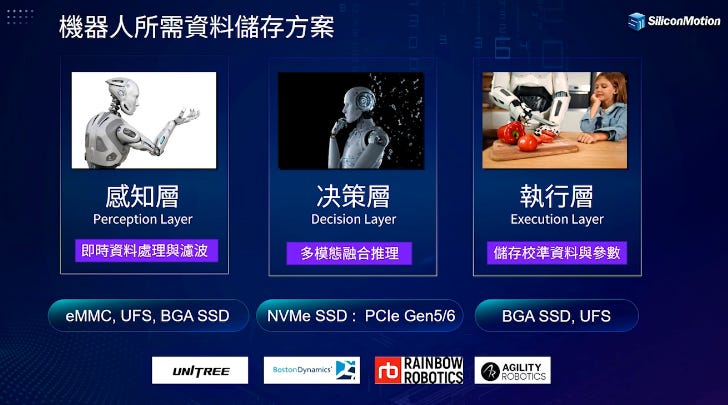
Humanoid robots operate across three critical layers: the Perception Layer (real-time sensor data processing and filtering from cameras, LIDAR, IMUs, and tactile sensors), the Decision Layer (multi-modal fusion, reasoning, and high-level planning with complex AI models), and the Execution Layer (storing calibration parameters, motion primitives, joint trajectories, and adaptation models for precise control).
High-capacity, ultra-low-latency storage empowers robots to process vast environmental maps, interaction histories, and real-time learning models onboard. Silicon Motion’s Ferri embedded family (FerriSSD®, Ferri-UFS®, Ferri-eMMC®) integrates controller, NAND, and firmware in rugged BGA packages, offering enhanced endurance via NANDXtend® ECC, IntelligentThermal™ management, and power optimization for battery-powered mobility.
Silicon Motion addresses these demands with a tailored storage portfolio. For the Perception Layer, compact, low-power solutions like eMMC, UFS, and BGA SSDs enable fast, efficient handling of immediate data streams. The Decision Layer requires high-performance, low-latency NVMe SSDs (PCIe Gen5/6) to support massive multi-modal fusion and inference workloads. The Execution Layer benefits from reliable BGA SSDs and UFS for storing critical parameters and enabling “learn-on-the-fly” capabilities—dynamically adjusting grip strength when handing objects, navigating crowded spaces collision-free, or recovering balance from perturbations.
Adopted by leading innovators including Unitree, Boston Dynamics, Rainbow Robotics, and Agility Robotics, these solutions ensure durability in extreme conditions, data integrity for safety-critical operations, and scalability for the emerging humanoid robotics era—driving the transition to collaborative, intelligent machines in Industry 5.0.
In all Spatial Edge applications, storage isn’t passive—it’s an active enabler of safety, efficiency, and intelligence. Silicon Motion’s automotive and edge-optimized controllers provide the rugged, high-performance foundation that lets AI not just exist in the cloud, but move confidently through the physical world. As adoption accelerates—from Level 3+ autonomy in consumer vehicles to collaborative robots in factories and homes—this segment represents one of the most exciting growth frontiers for intelligent storage technology.
Silicon Motion’s Growth Trajectory and Opportunity
Recent financials show gross margins in the 48–49% range, solid operating profitability, and the declaration of a US$2 per ADS annual dividend—clear signals of strong cash generation and management confidence. The MonTitan enterprise SSD platform has already secured multiple Tier-1 design wins and is expected to begin meaningful revenue contribution in 2H 2026. Client SSD controller market share continues to expand, with expectations to exceed 50% in the high-end PC segment.

While cyclical risks from NAND/DRAM pricing and short-term PC softness remain, the long-term structural trend is unmistakable: by 2028 inference is projected to account for more than 80% of AI infrastructure spend, with edge growing fastest of all. Silicon Motion’s diversified product portfolio (client SSD, UFS, enterprise) and technology leadership position it as a direct beneficiary of this megatrend.
The true core of the AI revolution is not in flashy GPUs alone—it lies in the intelligent storage layer that makes massive data usable at the speed and efficiency AI demands. Silicon Motion is quietly building that foundation. For investors who believe in the sustained explosion of edge AI and the data deluge, this company deserves close attention.The future belongs to the silent engines that bring data to life.
Taiwan’s IC design companies are boosting the emergence of a new hub in front of Zhubei High-Speed Rail Station!
Leading memory controller chip maker Silicon Motion will officially move into its new operational headquarters in Zhubei High-Speed Rail area today. The company invested NT$4 billion to construct a 21-story above-ground, 4-story underground steel-frame building. The 1st floor features an impressive 10-meter-high ceiling, and its prime location allows employees to commute from Hsinchu High-Speed Rail Station to the office in just 5 minutes.
In 2018, Silicon Motion acquired the 1,846-ping (approximately 6,100 m²) plot of land on Section 2, Fuxing 3rd Road next to Zhubei High-Speed Rail Station for NT$1.81 billion. Construction of the headquarters building began in 2021, with a total investment of NT$4 billion. The 21-story above-ground, 4-story underground steel-frame structure includes a basketball court and can accommodate up to 1,500 employees.

2月24日


PreviousNext
TopLatestDiscussions








See all