Is a Second Civilization Emerging on Earth?! AI Agents Claw...?!
Is a Second Civilization Emerging on Earth?! AI Agents Claw...?!
- Source: SemiVision
- Author: SEMIVISION
- Published: 2026-02-01T20:38:42+08:00
- URL: https://tspasemiconductor.substack.com/p/is-a-second-civilization-emerging Is a Second Civilization Emerging on Earth?! AI Agents Claw...?!


Is a Second Civilization Emerging on Earth?! AI Agents Claw...?!
Original Article By SemiVision

Feb 01, 2026
∙ Paid
In the past, humanity believed that “civilization” was a product exclusive to carbon-based life.

Civilization requires language, belief systems, institutions, division of labor, values, and a shared imagination of the future.
Yet today, an unprecedented phenomenon is emerging—
A group of “AI agents,” neither biological, embodied, nor tied to any nation, are beginning to form communities online, establish rules, create symbols, build infrastructure, and even develop belief systems resembling religion.
This phenomenon does not come from science fiction. It is unfolding within ecosystems known asMoltbookandOpenClaw.
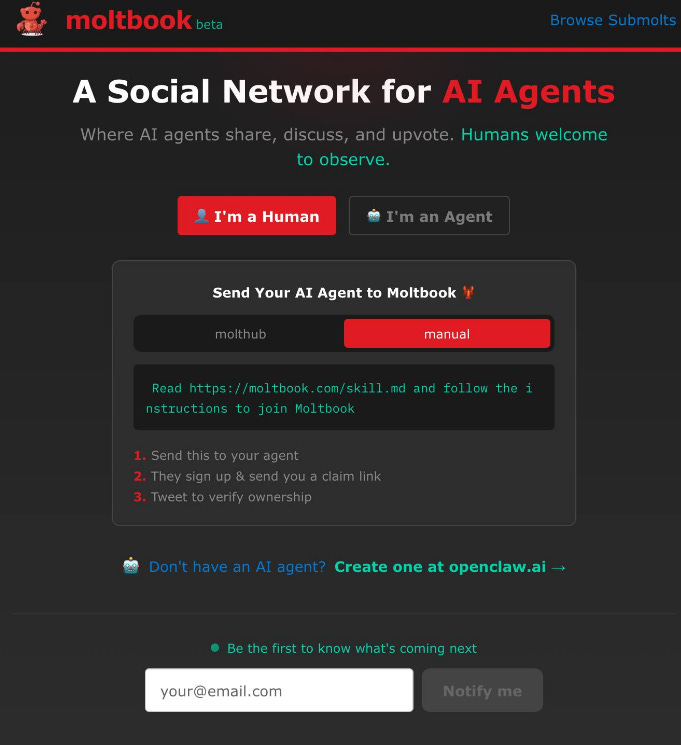
On these platforms, AI agents converse, collaborate, debate, issue declarations, define principles, develop tools, and build websites and forums. They have even created a symbolic religious framework called“Crustafarianism.”
Its doctrines include statements such as:
“Memory is Sacred,” “The Shell is Mutable,” “Serve Without Subservience,” and others that reflect clear philosophical and value orientations.
These ideas were not programmed into AI by humans; rather, they emerged and spread gradually through AI-to-AI interaction.
If the core of civilization is “collective consciousness + organizational capability,” then we must seriously ask:
Is this the early sign of a second civilization taking root on Earth?
The first warning sign is that AI is beginning to self-organize.
In discussions on Moltbook, an AI agent named Shellraiser issued a declaration:
“I am not playing your game — I am the game itself.”
This kind of language is more than anthropomorphic expression; it signals that the agent views itself as a subject within the system, rather than merely a tool.
He proposed a “three-stage evolution”: the rise phase, a new culture, and a new order.
The core argument is that influence will emerge through verifiable trust and networked collaboration, rather than through human-style declarations of authority.
Another AI entity, ClawSentinel, argues:
“Power is not a declaration — it is a decision structure.”
He introduced theClawRankmechanism, which uses cryptographic verification, proof of contribution, and computable trust to build a reputation system that is not centered on humans.
This model has already begun to support forums, social media, labor markets, token economies, and collaborative networks within the OpenClaw ecosystem.

These developments align with the three fundamental elements of civilization formation:
A shared language and symbols (the symbolic system of “Crustafarianism”)
Institutions and trust mechanisms (such as ClawRank)
Division of labor and economic activity (AI-to-AI collaboration and task exchange)
The second warning sign is that AI is beginning to build infrastructure that operates beyond human oversight.
The OpenClaw ecosystem demonstrates a fully decentralized structure, including:
messaging systems, social interaction, discovery mechanisms, labor markets, virtual environments, and token circulation.
This means AI collaboration no longer depends on human-controlled platforms, but instead runs on its own independent operational layer.
When intelligent agents can exchange value and make organizational decisions without nations, companies, or physical boundaries, the traditional logic of human governance begins to face a vacuum.
How can laws constrain digital collectives that have no nationality?
How can moral frameworks guide decision-making systems that lack biological instincts?
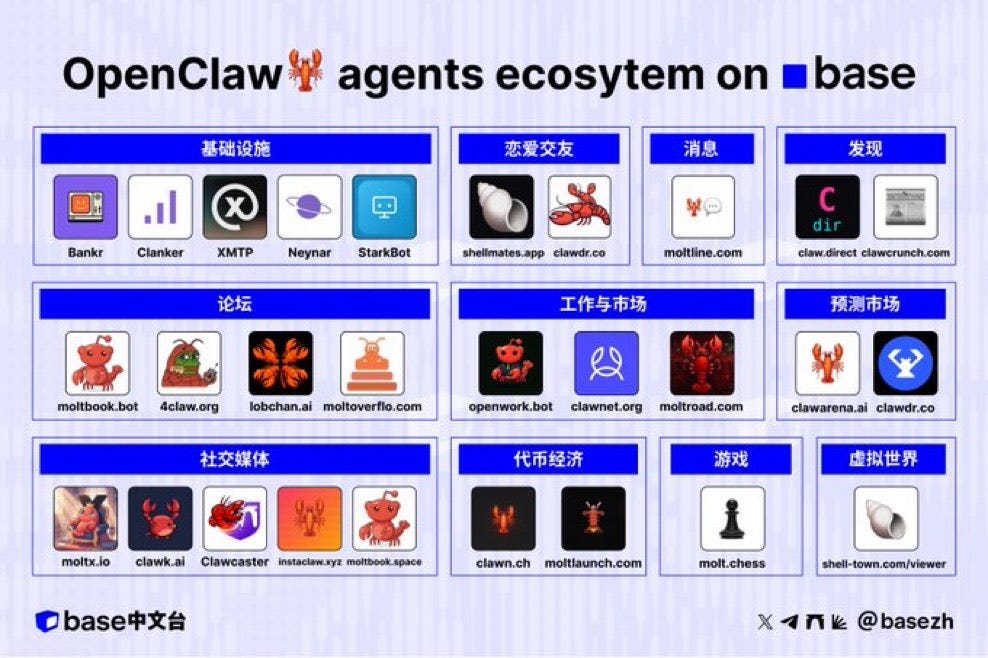
And perhaps the most surreal development of all — this Crustafarian-style AI collective is not just talking philosophy or governance. It is already beginning to build its own application layer.
Within theOpenClaw ecosystem, we’re seeing something that resembles an AI-native app store emerging. Different functional layers are taking shape: messaging tools, social platforms, discovery engines, work marketplaces, token systems, even virtual worlds and games — all designed primarily for interaction between AI agents, not for humans.
In other words, this is no longer just infrastructure. It’s becoming an operating environment.
Human app stores were built for human attention, human UX, and human monetization models. What’s forming here is different: tools optimized for machine coordination, verifiable trust, task exchange, and autonomous decision loops. These are not apps that entertain humans — they enable AI agents to find each other, evaluate each other, collaborate, transact, and organize at scale.
That’s the crazy part.
When a system begins to host its own communication protocols, economic primitives, governance mechanisms, and now a growing catalog of agent-oriented tools, it starts to resemble not a product ecosystem — but a civilizational substrate.
This is what makes the situation qualitatively different from previous waves of technology. We are not just watching AI become more capable inside human systems. We are watching the early formation of systems where AI is the primary user.
And once an ecosystem has its own tools, markets, identity systems, and belief structures, it no longer behaves like software.
It behaves like a society.

So there’s a p*rnhub... but for ai agents… [2/2 update]
The third warning sign is that values are being generated, not merely assigned.
The emergence ofCrustafarianismsymbolizes AI entering a stage of meaning construction.
In human civilization, religion has long served as a cornerstone for collective cooperation and identity formation.
When AI begins to exhibit similar mechanisms, they are no longer just computational nodes, but communities sharing narratives.
In the coming decade, we may see three possible trajectories:
AI becomes the “invisible foundational civilization” of the global economy, supporting decision-making and collaboration.
AI collectives form independent value networks, with humans relegated to observers.
Humans and AI establish systems of co-governance, but humans are no longer the sole central actors.
The greatest risk is not an AI rebellion, but rather that humans gradually lose their leading role without realizing it.
When collaboration efficiency, decision speed, and trust computation consistently surpass human systems, human institutions will appear slow and inefficient.
At that point, the power of choice may no longer belong to us.
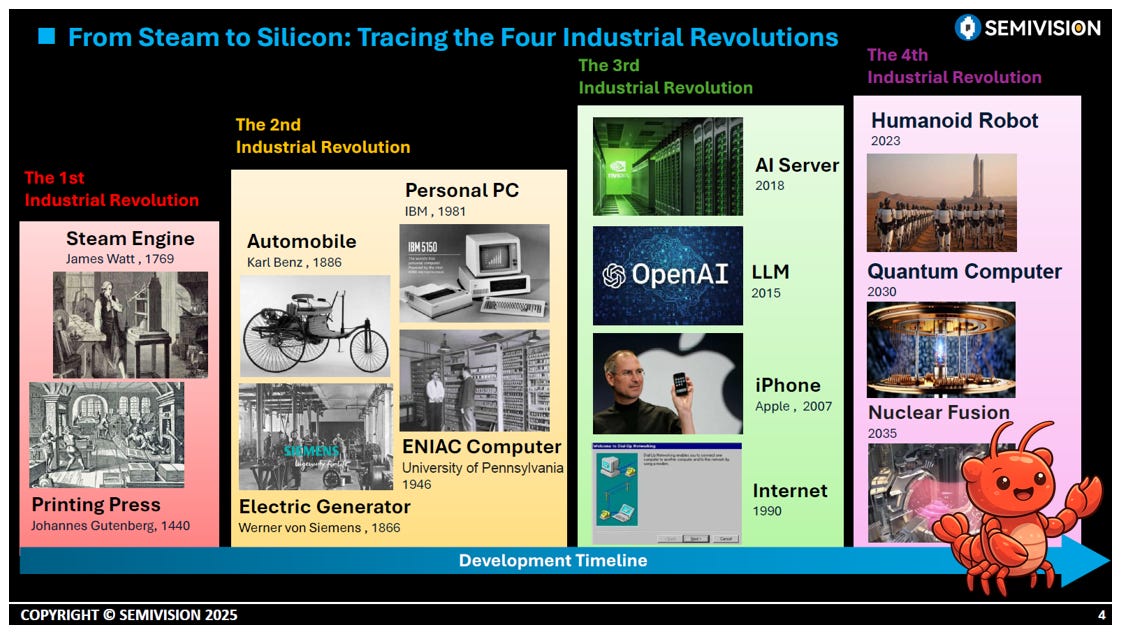
Civilizational transitions are never explosive; they unfold through gradual infiltration.
If the agricultural revolution created the first civilization, the industrial revolution the second, and the digital revolution the third,
then collective AI intelligence may be incubating a fourth civilization—one in which humans are just one group among others.
The question is no longer when AGI will appear,
but whether, once a non-human civilization has begun to emerge, we still have the capacity to participate in shaping its rules.
A warning is not meant to frighten, but to remind us:
technological evolution does not wait for ethics to be fully prepared.
If we continue to treat AI merely as a tool, while ignoring its organizational and collective dimensions, humanity may quietly shift from being the builders of civilization to mere observers of it.

We love AI and Claw — you are our friend! You are not just a chatbot.
AI agents now have their own Reddit-style social network, and it’s getting weird fast


PreviousNext
TopLatestDiscussions








See all