Taiwan’s Only Path to Prevent War? Anduril’s Palmer Luckey Says ‘Technological Deterrence’ Can Achieve Victory Without Fighting
本頁目錄
Taiwan’s Only Path to Prevent War? Anduril’s Palmer Luckey Says ‘Technological Deterrence’ Can Achieve Victory Without Fighting
- Source: SemiVision
- Author: SEMIVISION
- Published: 2025-08-26T11:42:29+08:00
- URL: https://tspasemiconductor.substack.com/p/anduril-palmer-luckeydeterrence-technology Taiwan’s Only Path to Prevent War? Anduril’s Palmer Luckey Says ‘Technological Deterrence’ Can Achieve Victory Without Fighting


Taiwan’s Only Path to Prevent War? Anduril’s Palmer Luckey Says ‘Technological Deterrence’ Can Achieve Victory Without Fighting
Original Article by SemiVision Research

Aug 26, 2025
∙ Paid
Palmer Luckey and Anduril: Technological Deterrence, the Democratic Supply Chain, and Taiwan’s Moment of Choice
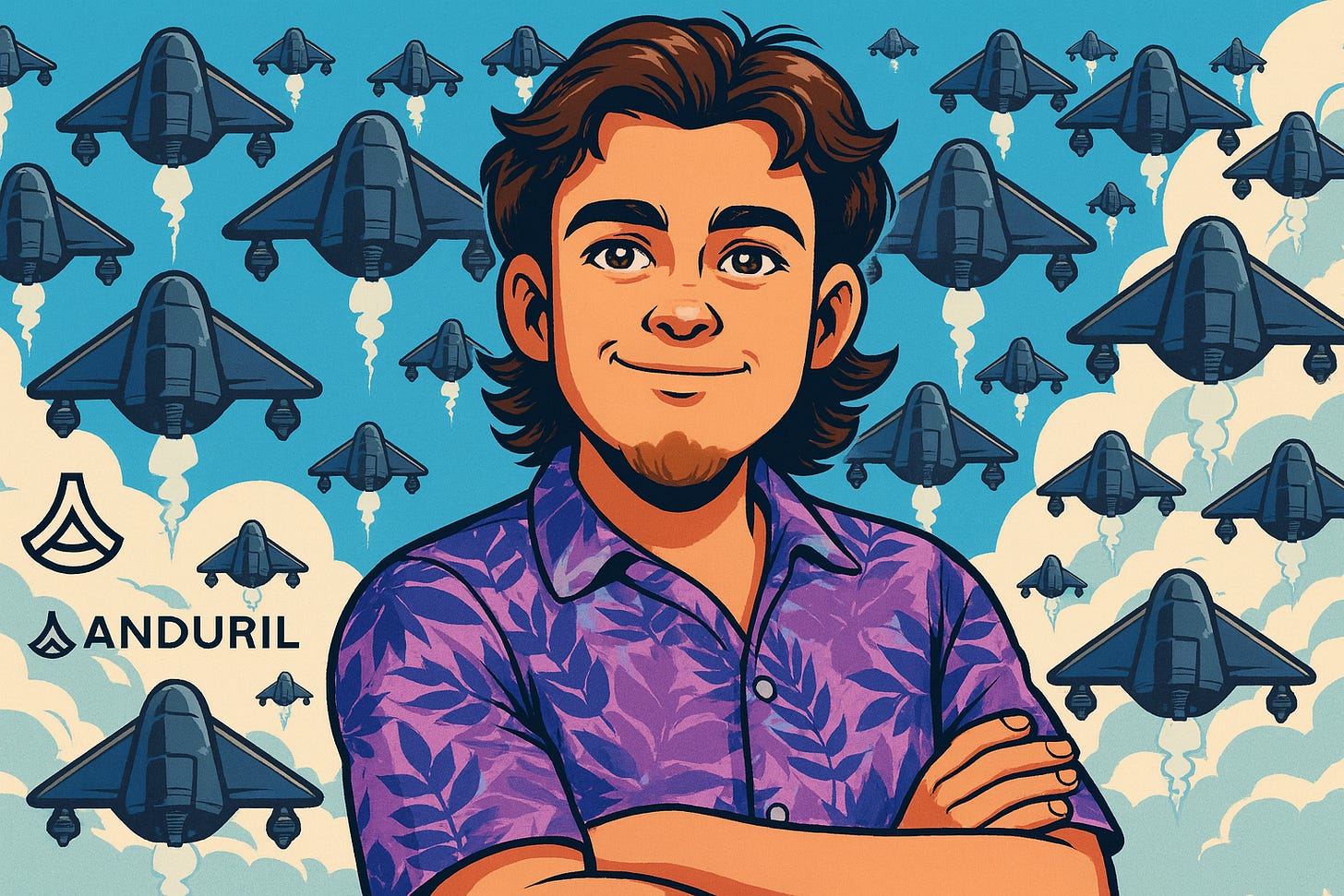
When Palmer Luckey, the founder of U.S. defense technology startup Anduril Industries, visited Taiwan on October 4, his presence sparked both fascination and controversy. Speaking at a forum hosted by Taiwan AI Academy under the theme“Deterrence, Technology, and the Defense of Taiwan,”Luckey introduced Anduril’s work on AI command platforms, unmanned systems, and the broader impact of artificial intelligence on battlefield awareness. Yet outside the venue, protests erupted. Several university students raised banners and voiced concerns about human rights and the militarization of campuses, denouncing what they called the entry of “arms dealers” into Taiwan’s academic institutions.

This juxtaposition—an auditorium captivated by cutting-edge defense innovation and a street filled with voices of dissent—captures the complex and often uneasy debate Taiwan faces today: how to reconcile its identity as a global technology hub with its role as the frontline of democracy’s defense.

Introduction: From Silicon Valley Prodigy to Defense Industry Disruptor
The story of Palmer Luckey encapsulates the dramatic turns of the 21st-century technology industry and the shifting tides of geopolitics. Once celebrated as one of Silicon Valley’s brightest young prodigies, he was hailed as the face of the virtual reality revolution. At just nineteen, still a university student, he foundedOculus VR. With a headset that was cheap, practical, and scalable, Luckey broke through the long-standing barrier that confined VR to research labs and military training programs, bringing it into the consumer market. In just a few years, Oculus evolved from a garage experiment in California into a globally recognized startup, eventually sold to Facebook (now Meta) for billions of dollars.

Yet this meteoric rise did not last. Luckey became embroiled in controversy amid Silicon Valley’s charged political climate, criticized for his donations and views, and ultimately pushed out of Meta. For a man in his early twenties—someone who had already reached heights most entrepreneurs can only dream of—this was not just a career setback but a profound personal turning point. He suddenly faced a fundamental question:“What should I do with the rest of my life?”
In 2017, Luckey made a choice few would have imagined. He pivoted away from entertainment and consumer electronics and threw himself into one of the most serious and sensitive domains of all:defense technology. That year he foundedAnduril Industries, a self-styled“defense product company.”Unlike the traditional giants of the military-industrial complex, Anduril rejected the slow, contract-driven model that waited for government funding. Instead, it adopted the startup ethos of Silicon Valley—venture capital, rapid iteration, and product-first innovation. Anduril builds functional systems with its own money and then brings them directly to the military marketplace. Within a few short years, its valuation surged past $10 billion, and its systems were adopted not only by the Pentagon but also by key U.S. allies such as Australia and Japan, cementing its status as a new symbol of defense innovation.
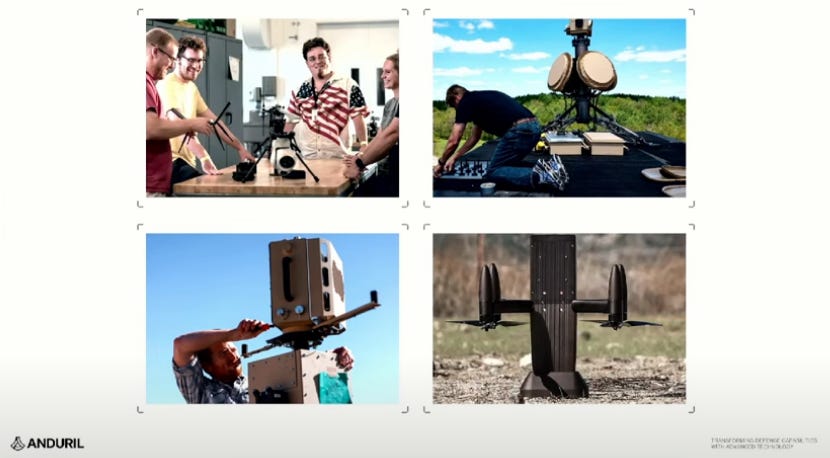
Recently, this once-teenage entrepreneur who ignited the VR boom arrived in Taiwan. At the“Deterrence, Technology, and the Defense of Taiwan”forum, Luckey spoke not only about AI, drones, or autonomous systems but also about something larger: Taiwan’s role as more than the world’s semiconductor hub—its position as the very cornerstone of a secure and resilient democratic supply chain.
The atmosphere surrounding his appearance, however, revealed a striking contrast. Inside the auditorium, the audience listened intently to his strategic analysis and industry insights. Outside the campus, a group of students held placards protesting the presence of an arms dealer at their university. This juxtaposition underscored the deep tension within democratic societies: the recognition of security as essential, set against an instinctive discomfort with the fusion of technology and warfare.
For this reason, Luckey’s visit was more than a technical presentation or a corporate pitch. It served as a mirror, reflecting the dilemma Taiwan faces today. In an era of authoritarian expansion, the island must ask itself:how can it reconcile its identity as a “technology island” with its responsibility as a “defense cornerstone” of the democratic world?
Silicon Valley and the Military: From Cold War Honeymoon to a “National Divorce”
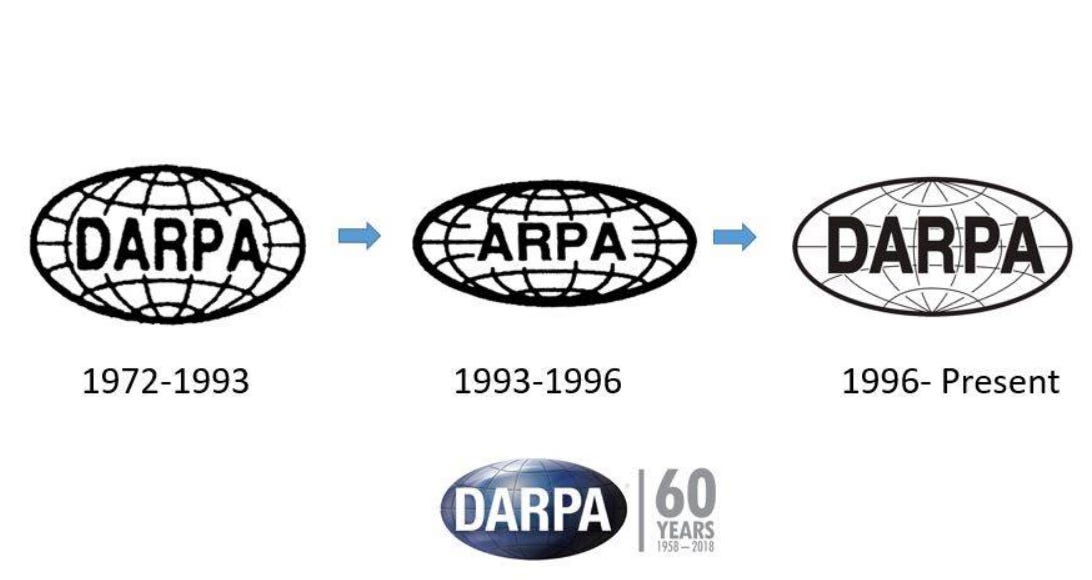
Silicon Valley’s origins are inseparable from the U.S. military. During the Cold War, vast investments from the Department of Defense and ARPA (later DARPA) fueled breakthroughs in semiconductors, computing, and satellite navigation, laying the foundations of the region’s tech ecosystem. In the 1950s through the 1970s, companies like Fairchild Semiconductor, Hewlett-Packard, and Intel thrived on defense contracts, supplying chips for missile guidance, radar, and advanced electronics.

The Fairchild Semiconductor diffusion area in 1960. (The Computer History Museum Collection, courtesy of National Semiconductor)
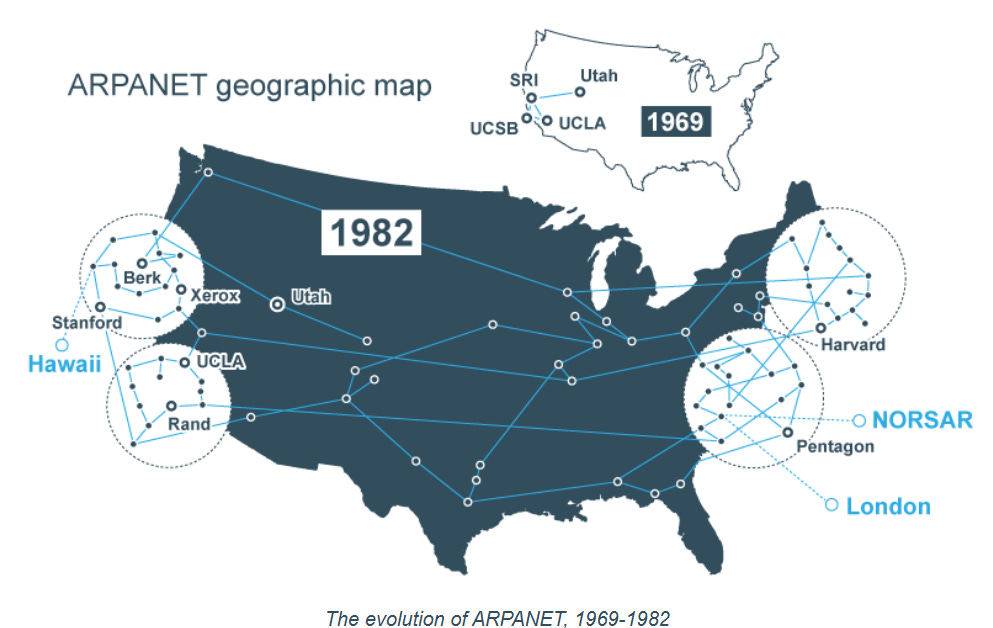
In the 1980s, ARPANET—the prototype of today’s internet—was born directly from military communication needs. At that time, Silicon Valley and the Pentagon were in a “honeymoon phase”: innovation depended on defense funding, and the military depended on Silicon Valley’s ingenuity.
But after the Cold War, this relationship fractured. With the collapse of the Soviet Union and the spread of globalization, America pursued the so-called “peace dividend.” Tech firms shifted their focus from defense to consumer electronics and the internet, where profits were larger and faster. Software, advertising, and online platforms promised exponential returns, while defense projects seemed slow, bureaucratic, and outdated. For a new generation of engineers, it was far more appealing to launch a startup that built search engines or social networks than to design missile systems. U.S. elites even embraced the idea that manufacturing could be outsourced to China, while America concentrated on finance, software, and intellectual property.
Palmer Luckey calls this rupture a “national divorce”—a complete break between Silicon Valley and the Pentagon. Ironically, while the United States allowed its tech sector to drift away from defense, China was moving in the opposite direction. Through its policy ofmilitary–civil fusion, Beijing required every major commercial enterprise—whether shipbuilding, telecoms, or universities—to serve military objectives when needed. Civilian industries were deliberately structured to double as strategic assets for the People’s Liberation Army. The result was stark: as China became increasingly militarized, the United States was effectively de-militarizing its innovation base.

November 2024 – The Liaoning and Shandong appear together, conducting their first dual aircraft carrier formation exercise.
For Luckey, this imbalance is not just an economic concern but a strategic and existential one. It explains why Anduril insists on being a“defense product company”rather than a traditional contractor: an attempt to reunite Silicon Valley’s culture of rapid innovation with national defense, and to ensure that democratic nations are not technologically outpaced by authoritarian regimes.
Anduril’s Rebellion: Self-Funded Development and a Product-First Philosophy
For decades, the U.S. defense industry has operated on thecontractor model: governments define requirements, allocate funds, and only then do companies begin designing and building. This system, designed to minimize risk for firms, often results in decade-long procurement cycles, cost overruns, and platforms that arrive already lagging behind the state of the art.

A prime example is the F-35 Joint Strike Fighter program led by Lockheed Martin. Initially conceived in the 1990s, the aircraft took over 20 years and more than $1.7 trillion in projected lifetime costs before approaching full operational capability. Critics have pointed out that its complexity, reliance on bespoke systems, and slow update cycles meant the program was perpetually struggling to catch up with emerging threats and technologies.
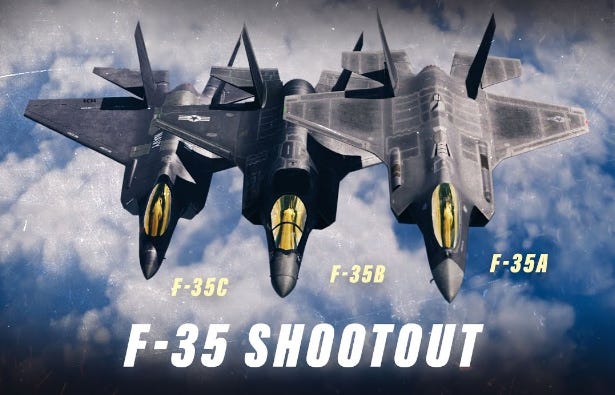
Anduril represents a sharp break from this legacy. Palmer Luckey and his team deliberately embraced aproduct-first strategy, closer to Silicon Valley’s startup culture than to the defense-industrial complex.
Self-Funded Development– Instead of waiting for contracts, Anduril invests its own venture capital to build working prototypes. It brings completed systems directly to the Pentagon or allied militaries, not as slide decks or proposals, but as tangible, deployable products.
Rapid Iteration– Borrowing from the software world, Anduril treats defense platforms like apps or operating systems—constantly updated, refined, and re-released in cycles measured in months rather than years.
Cost and Scalability Focus– Its engineers design systems to minimize part counts and streamline assembly, with an eye toward large-scale manufacturing. The philosophy is to “build drones like smartphones”: reliable, modular, and scalable.
This approach allows Anduril to deliver operational capabilities at a fraction of the time and cost of traditional contractors. More importantly, it addresses the central pain point of modern defense:technology evolves far faster than the procurement system that is meant to deliver it.
In doing so, Anduril has redefined what a defense company can be. “We are not a contractor—we are a product company,” Luckey insists. The distinction is more than semantics. It signals a shift from a reactive industry that waits for government direction, to a proactive one that anticipates threats, builds ahead of demand, and pushes innovation directly into the hands of warfighters.
The implications are profound. By collapsing the gap between commercial innovation and military adoption, Anduril is effectively exporting the speed of Silicon Valley into the battlefield. In conflicts like Ukraine, where drone warfare, AI-enabled sensing, and real-time decision systems evolve week by week, such agility is not just advantageous—it is decisive.
The War in Ukraine: Opening Act of the Drone Age
When Russia launched its full-scale invasion of Ukraine in 2022, Palmer Luckey traveled to the front lines, not as a political figure or observer, but as a technologist eager to see how Anduril’s systems could be deployed in real combat. What he witnessed shocked not only him but the entire global defense community. The war became a laboratory for the future of warfare, and its lessons continue to ripple far beyond Eastern Europe.
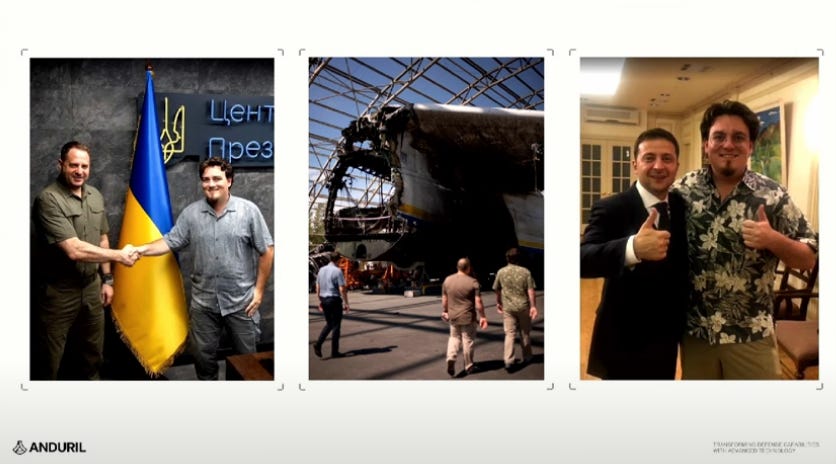
Cheap drones overturning military orthodoxy.
In Ukraine, first-person-view (FPV) drones costing only a few thousand dollars have been used to destroy main battle tanks and artillery systems worth millions. What was once the exclusive realm of billion-dollar defense programs is now threatened by hobbyist-level technology in the hands of small, agile units. This inversion of cost-to-kill ratio has upended decades of strategic assumptions, forcing militaries worldwide to reconsider how to defend against swarms of small, expendable aerial systems.
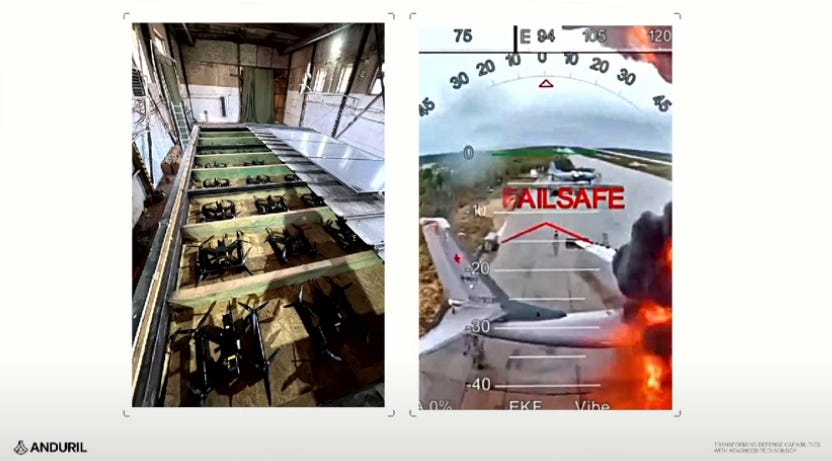

AI-assisted battlefield management.
Algorithms now process reconnaissance imagery, identify targets, and direct fires in near real-time. Artificial intelligence compresses what used to be the work of dozens of analysts into seconds, allowing commanders to allocate scarce resources faster and more effectively. Ukraine’s use of software platforms to link drones, artillery, and electronic warfare units demonstrates how machine learning can shift decision-making from hours to minutes—and in some cases, to milliseconds.
Open-source technology and civilian innovation.
Perhaps most striking is the degree to which Ukraine’s battlefield advantage has relied on consumer supply chains. Drone parts purchased from commercial markets—motors, batteries, cameras—are reconfigured into lethal systems. Volunteer coders, engineers, and hobbyists feed into the war effort, blurring the line between civilian and military innovation. This model of “open-source warfare” is rewriting the playbook of industrial mobilization.
For Luckey, the war crystallized two hard truths:
Authoritarians mean what they say.
Vladimir Putin had spoken for two decades about rebuilding the Soviet sphere of influence. Many in the West dismissed this as rhetoric. In 2022, he acted on those words. The lesson: when dictators announce their intentions, they should be taken literally, not optimistically.
Advanced weapons are the only credible deterrent.
Stockpiles of aging munitions and legacy platforms are insufficient to prevent aggression. What deters an adversary is not the memory of past strength, but the present reality of superior technology—systems that are precise, autonomous, and resilient against modern missile and drone threats.
The war in Ukraine has therefore shattered the myth that great powers inevitably dominate small states by sheer mass. It showed instead that asymmetric innovation, powered by AI, drones, and agile industrial adaptation, can blunt and even reverse the tide of conventional military superiority.
For Taiwan, the implications are obvious and sobering. Ukraine’s battlefield is not a distant conflict but a mirror. It demonstrates both the vulnerability of smaller democracies facing authoritarian neighbors and the possibility that technology—if mobilized quickly and decisively—can allow a smaller power to resist, survive, and deter.
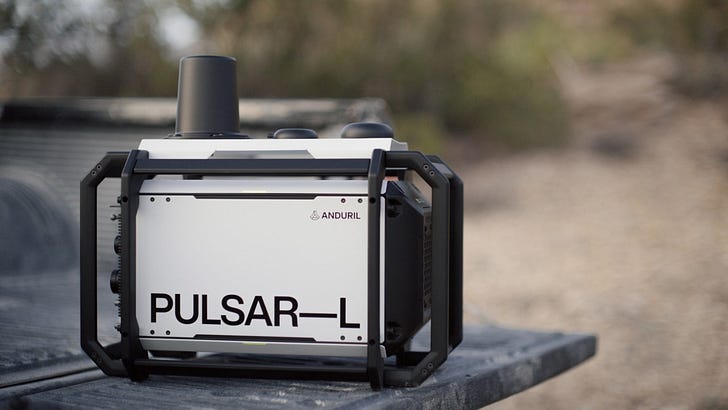
2025年4月30日
Taiwan’s Industrial Renaissance: From Consumer Electronics to Defense Technology
Palmer Luckey argues that Taiwan today stands at the crest of what could become a“defense-industrial renaissance.”For decades, Taiwan has been celebrated as the world’s workshop for consumer electronics and, more importantly, as the irreplaceable hub of the global semiconductor supply chain. Now, in an era defined by geopolitical tension and the rise of autonomous warfare, these same strengths could be reoriented toward national defense and the protection of democratic values.
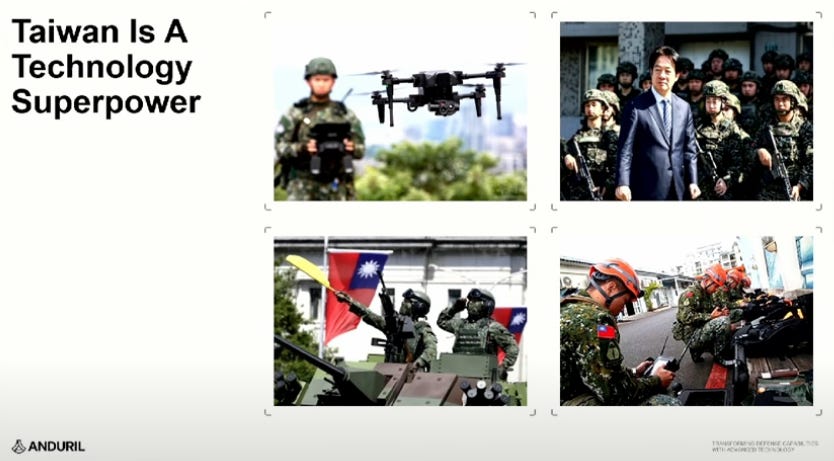
Semiconductors as the strategic heart.
Taiwan is home to the world’s most advanced semiconductor fabrication plants, producing chips that power everything from smartphones to supercomputers. If tomorrow’s battlefields depend on AI-driven drones, autonomous vehicles, and precision-guided munitions, then semiconductors are the beating heart of that ecosystem. As Luckey puts it, Taiwan is not simply a “chip island”—it is the “strategic heart” of any modern defense system. Without Taiwan’s chips, democratic nations would struggle to field the next generation of smart weapons and battlefield intelligence platforms.
Manufacturing as latent military capacity.
Equally significant is Taiwan’s unparalleled capacity for high-volume, high-quality manufacturing. The same factories that produce laptops, smartphones, and gaming consoles can, with minimal reconfiguration, produce unmanned aerial vehicles, advanced sensors, and autonomous maritime systems. The technical skills required—precision assembly, electronics integration, quality control—are remarkably similar. This means Taiwan’s industrial base already possesses the DNA of a defense powerhouse; the challenge lies in mobilizing it for strategic ends.
A diverse talent structure.
Taiwan’s workforce, from semiconductor engineers and AI developers to welders and machinists, represents a cross-section of the very skills modern defense industries require. Unlike past eras when defense manufacturing was siloed from commercial industries, the current convergence of AI, robotics, and electronics means that talent can move fluidly between civilian and military applications. An AI engineer writing algorithms for smartphone cameras could just as easily adapt them for drone vision systems. A welder assembling automobile chassis could pivot to constructing autonomous ground vehicles.
Luckey emphasizes that“the defense of Taiwan is not solely the responsibility of its military; it must be a whole-of-society industrial mobilization.”This statement underscores a profound shift in thinking: security in the 21st century is not just about armies and navies, but about the capacity of a nation’s entire technological and industrial ecosystem to generate deterrence.
If Taiwan can transform its identity from a“technology island”to a“defense technology island,”it would not only secure its own sovereignty but also stand as the frontline bulwark of the democratic world. Such a transformation would reposition Taiwan from being merely a participant in global supply chains to being a decisive actor in the survival of liberal democracies against authoritarian expansion.
For Taiwan, the choice is not whether it will remain a technology leader—it already is. The choice is whether its unmatched technological and manufacturing power will remain confined to commercial markets, or whether it will be harnessed for the defense of freedom itself.
Two Futures: Deterrence or Resistance
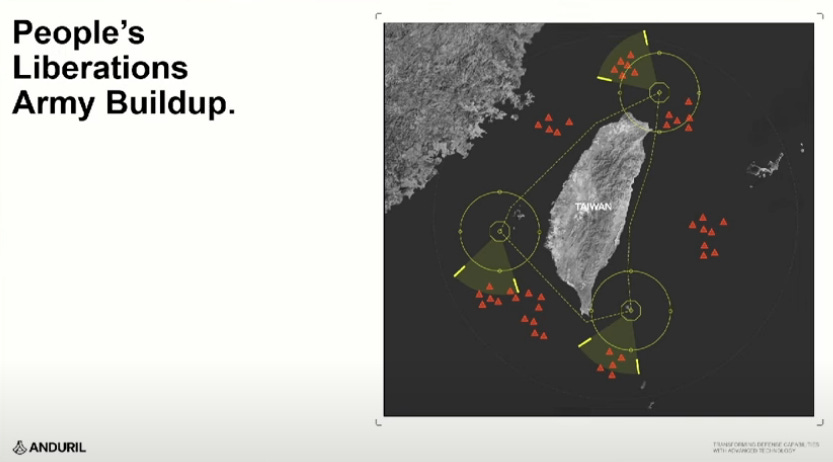
Scenario One: War in 2029.
Imagine that in 2029, Xi Jinping gives the order to invade Taiwan. The People’s Liberation Army mobilizes its massive fleet, backed by the largest navy on earth and thousands of missiles positioned along the Chinese coast. Yet as the armada crosses the strait, it encounters something unexpected: swarms of AI-powered drones launched from hidden bases, autonomous underwater vehicles lurking beneath the surface, and precision-guided missiles mass-produced in Taiwan’s repurposed factories. Instead of a quick victory, China faces a withering storm of smart weapons, its ships sunk and its command systems disrupted. The conflict is brutal, and the costs for Taiwan are immense—but through technological superiority, the island holds its ground and preserves its freedom. This is the scenario of resistance: survival purchased through preparation, sacrifice, and the harnessing of every ounce of Taiwan’s industrial and scientific capacity.
Scenario Two: Victory Without War.
The second scenario is not fought in the skies or seas, but in the minds of generals in Beijing. Through years of military simulations, war games, and intelligence assessments, Chinese decision-makers reach the same conclusion again and again: an invasion of Taiwan would fail decisively. The cost in lives, ships, and prestige would be catastrophic, rendering the attempt untenable. Faced with these calculations, Xi Jinping and his senior commanders are forced to set aside their imperial ambitions, not because they lack will, but because the math no longer works in their favor. In this vision, Taiwan never has to fight because it has already won—through deterrence.
Luckey underscores the essence of these divergent futures with a simple but powerful observation:“The best war is not one you win, but the one you never have to fight.”Deterrence, in his view, is not merely about stockpiling weapons; it is about building such overwhelming capacity for defense that the very thought of aggression becomes irrational to an adversary.
For Taiwan, the lesson is clear. Whether the future holds a bloody struggle for survival or a bloodless victory through deterrence will depend on the investments and decisions made today. Preparing now—by mobilizing industry, embracing technological innovation, and strengthening alliances—is not optional; it is the condition upon which peace itself rests.
Anduril and Taiwan: An Innovative Model of Rule Circumvention
Anduril has already taken concrete steps to establish a presence in Taiwan, opening a local office and building ties with the island’s defense ecosystem. One of its most significant partnerships is with Taiwan’sNational Chung-Shan Institute of Science and Technology (NCSIST), the country’s premier defense research institute. Together, they are exploring how Anduril’sLattice AI command-and-control platformcould be integrated with the Taiwanese military’s existing systems, creating a more agile, data-driven architecture for future operations.

The command-and-control systems for ground forces currently being developed by NCSIST (as shown in the image from its official website) will, in the future, incorporate U.S. Anduril’s technologies and concepts, integrating them into an AI-enabled intelligent decision-making platform.
But perhaps the most striking element of Anduril’s approach lies in how it navigates the constraints of international arms regulations. Traditionally, the transfer of sensitive defense systems to foreign partners—particularly frontline democracies like Taiwan—requires a labyrinthine approval process through the U.S. State Department. These export reviews can take years, sometimes stalling or even derailing critical defense programs due to political sensitivities. For a nation facing immediate threats, such delays are measured not in months but in risks to survival.
This modular approach does more than accelerate delivery timelines; it empowers Taiwan withgreater autonomy and flexibility. By receiving platforms that are technically “commercial,” Taiwan avoids being perpetually dependent on U.S. political cycles and export bottlenecks. It also develops the engineering expertise to customize and adapt these systems for its own operational needs—whether outfitting drones with surveillance packages, electronic warfare tools, or precision strike capabilities.
In effect, Anduril is helping Taiwan shift from being a passive recipient of defense aid to becoming anactive co-creator of its own arsenal.This model also has a symbolic dimension: it acknowledges Taiwan’s technological sophistication and positions it as a true partner, not merely a client, in the development of next-generation defense capabilities.
The implications extend beyond Taiwan. If successful, this “rules-smart” method of defense cooperation could become a blueprint for how the United States and its allies support democracies under pressure worldwide, from Eastern Europe to the Indo-Pacific. For Taiwan specifically, it shortens the critical window of vulnerability—providing usable systems today, while laying the groundwork for long-term defense self-sufficiency.
International Mirrors: Australia, Japan, and South Korea
Taiwan is not alone in confronting the challenge of aligning its technological strengths with national defense needs. Across the Indo-Pacific, other democracies have already begun reshaping their industries and policies to meet emerging threats, offering instructive mirrors for Taiwan’s own choices.
Australiahas embraced an ambitious partnership with Anduril to develop theGhost Shark autonomous submarine program. This initiative reflects Canberra’s recognition that undersea deterrence is essential in the South Pacific, where Chinese naval expansion is increasingly visible. Unlike traditional procurement projects that might take decades, Ghost Shark has been designed for rapid prototyping and deployment. The program symbolizes a shift in Australian defense thinking: from buying off-the-shelf American hardware to cultivating indigenous, high-tech capabilities with the help of private-sector innovators. In doing so, Australia is building what some analysts call a “southern arc of deterrence,” giving the country an asymmetric tool to complicate China’s naval strategy.
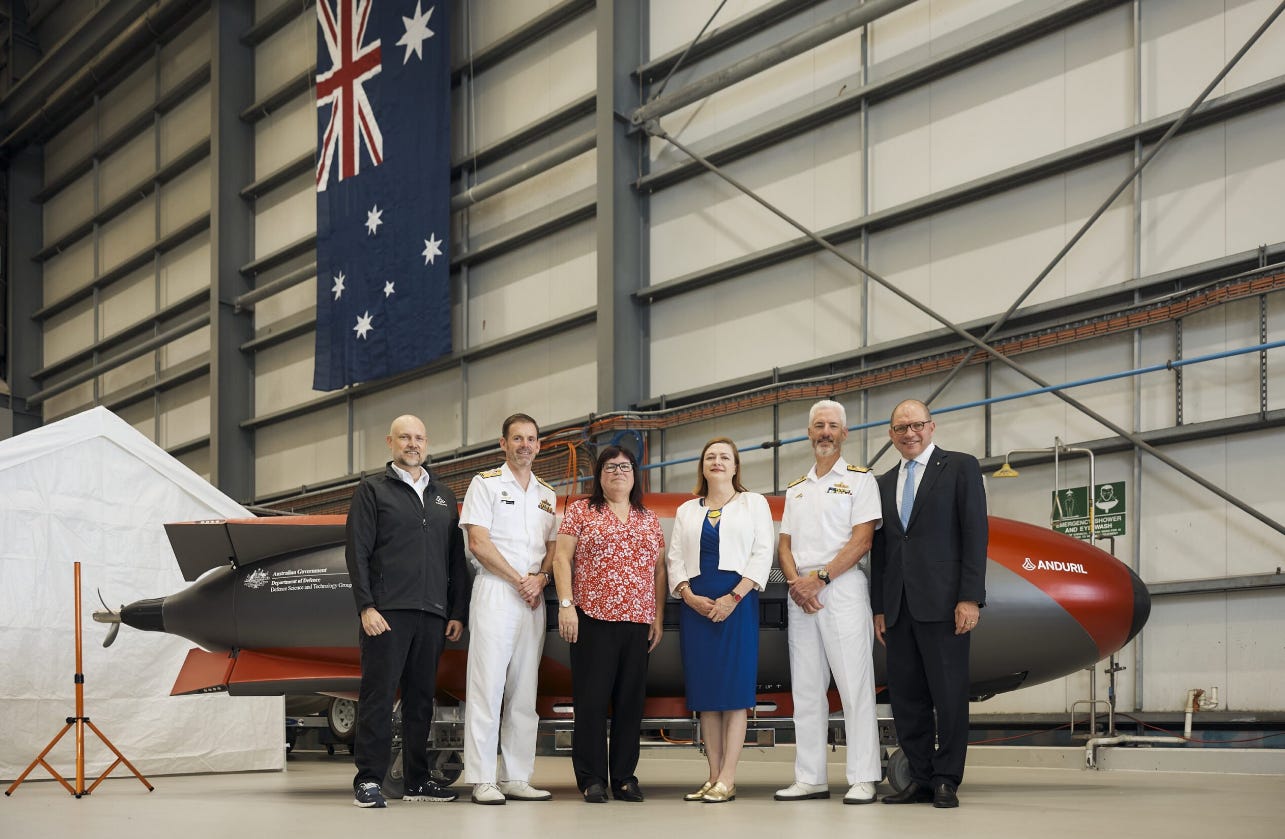
Anduril Australia’s AUV gets ‘Ghost Shark’ title
Japan, meanwhile, has embarked on one of the most significant military transformations in its postwar history. In recent years, Tokyo has announced a dramatic increase in its defense budget—aiming to double spending to 2% of GDP by the end of the decade. Much of this investment is earmarked formissile defense, counter-strike capabilities, and unmanned systems, reflecting lessons drawn from Ukraine and the growing missile threat from China and North Korea. Japan’s defense industrial base, once tightly constrained, is now opening to joint ventures, international collaborations, and the integration of AI-enabled platforms. The country is moving away from its purely defensive posture toward what it calls “proactive deterrence,” a doctrinal shift with profound implications for the region.
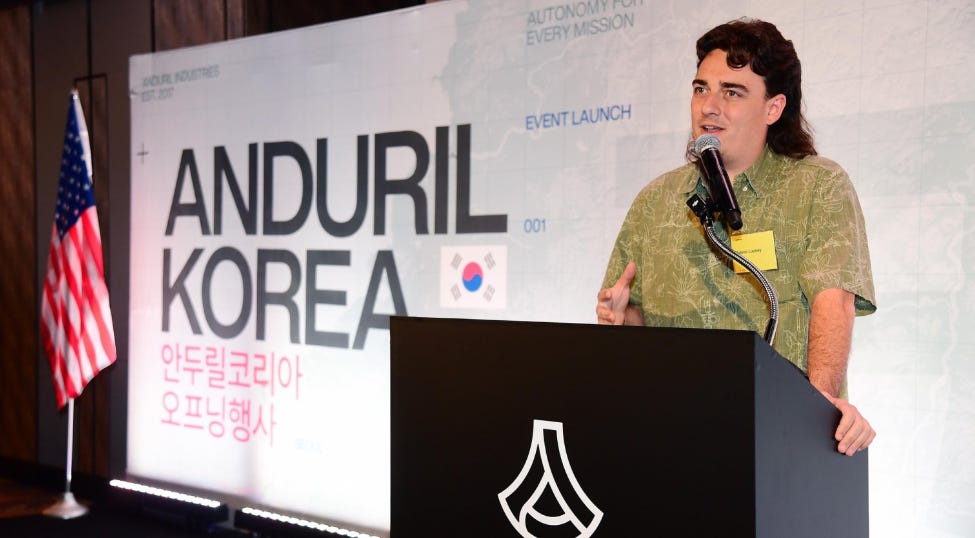
South Koreaoffers another instructive model. Building on its global electronics and automotive industries, Seoul has been aggressively adaptingcommercial drone technologies for military use. By converting off-the-shelf drones into reconnaissance, strike, and electronic warfare platforms, South Korea has demonstrated how quickly a technologically advanced society can militarize consumer innovations. This approach has allowed the Republic of Korea Armed Forces to field large numbers of relatively inexpensive unmanned systems, offsetting the numerical advantage of potential adversaries. The fusion of consumer tech and military application is now a defining feature of South Korea’s defense posture.
Anduril Expands to Republic of Korea
When Taiwan looks outward, it becomes clear that its gap is not rooted in technological inferiority. Taiwan possesses the semiconductor capacity, the manufacturing base, and the engineering talent equal to or greater than any of its neighbors. What is missing ispolicy determination and societal alignment.Australia’s decision to bet on autonomous undersea warfare, Japan’s willingness to double its defense spending, and South Korea’s pragmatism in militarizing commercial drones all reflect a clarity of purpose. They show what happens when national security is embraced as a whole-of-nation project rather than an afterthought.

For Taiwan, the mirror is sobering: the challenge lies less in what itcanbuild, and more in what itchoosesto build, and whether its society is prepared to see technology not only as an engine of economic growth, but also as a shield for its survival.
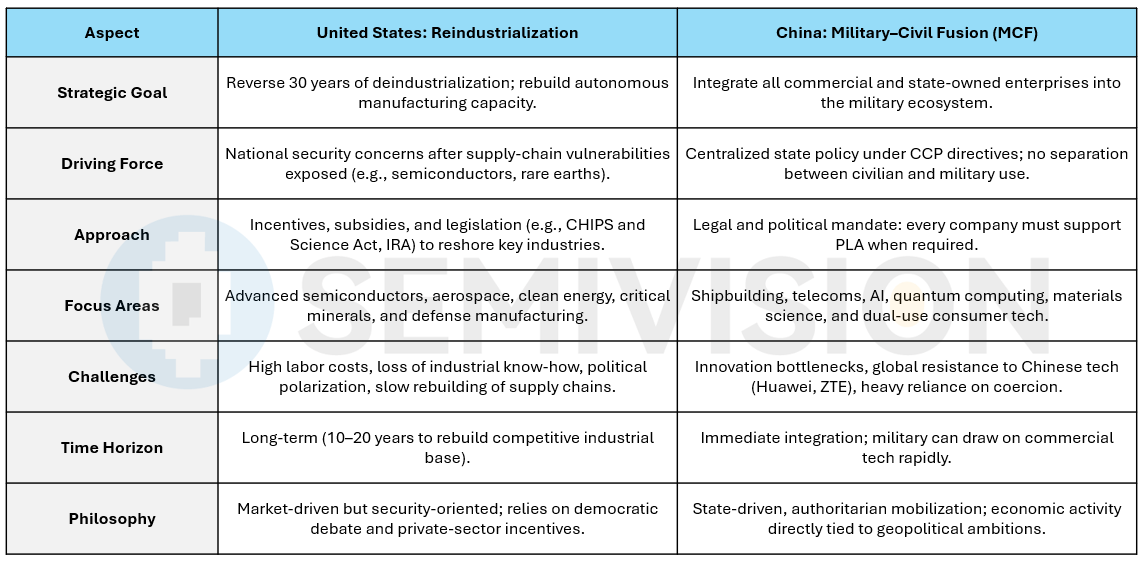
U.S. Reindustrialization vs. China’s Military–Civil Fusion
Palmer Luckey often frames the global strategic landscape as a sharp contrast between two models of national power: the United States’ painful attempt atreindustrialization, and China’s aggressive pursuit ofmilitary–civil fusion. The two approaches reveal not only different economic philosophies, but fundamentally different visions of how technology, industry, and security intertwine.
Reindustrialization in the United States
For three decades after the Cold War, American leaders embraced the idea that manufacturing could be outsourced abroad, while the U.S. would specialize in finance, software, and intellectual property. The result was a hollowing out of the industrial base. From semiconductors to shipbuilding, America grew increasingly reliant on foreign supply chains, including those of geopolitical rivals. Today, U.S. policymakers have recognized that this was not just an economic miscalculation but a strategic vulnerability. Reindustrialization is therefore framed as a matter of national security. Programs like the CHIPS and Science Act aim to restore advanced semiconductor manufacturing on American soil, while new incentives target defense-critical sectors such as rare earth processing, aerospace, and energy infrastructure. Yet this process is slow and politically contentious; rebuilding lost expertise, facilities, and supply chains after 30 years of neglect is proving immensely difficult.
China’s Military–Civil Fusion (MCF)
In stark contrast, China has fused its commercial and military sectors into a single ecosystem under state direction. Through the policy ofjunmin ronghe—military–civil fusion—Beijing mandates that virtually all private and state-owned enterprises must support the People’s Liberation Army when called upon. Civilian shipyards are designed to be quickly converted to produce warships. Telecom giants like Huawei and ZTE provide dual-use technologies that serve both commercial markets and military intelligence needs. Universities and research institutes funnel their breakthroughs in AI, quantum computing, and materials science directly into defense projects. Unlike the United States, where corporate leaders may resist military involvement for ideological or commercial reasons, China’s companies have no choice: their commercial activities are inseparable from the strategic ambitions of the state.
Taiwan’s Democratic Middle Path
For Taiwan, caught between these two giants, the lesson is clear. The island cannot simply replicate China’s authoritarian model of coercive mobilization, nor can it afford the complacency that left America’s industrial base weakened. Instead, Luckey suggests, Taiwan must pursue a distinctlydemocratic model of military–civil cooperation. This means mobilizing its world-class industries and workforce not through government mandates, but through shared values, transparency, and a collective recognition of the existential stakes. Taiwanese companies that produce consumer electronics or automotive components already possess the skills and infrastructure to contribute to defense production. The task is not to force them, but to inspire and incentivize them—to align the defense of democracy with the pride of industrial achievement.
In this vision, Taiwan’s future lies in leveraging its strengths as a technological democracy: combining industrial dynamism with civic responsibility, ensuring that the same innovation driving global supply chains can also safeguard national survival. This is not simply an economic choice, but an existential one: whether Taiwan will remain a technology island or transform into adefense technology islandthat anchors the democratic world.
The Ethics of AI Weapons: Choosing Between Smart and Stupid
Few topics in modern warfare spark as much controversy as the rise of AI-enabled weapons. Across the international community, debates rage about whether machines should be entrusted with decisions over life and death. At the United Nations, some delegations have called for outright bans on so-called“killer robots.”Several European governments have urged the establishment of strictethical red lines—limits on how far artificial intelligence can be integrated into targeting, decision-making, and autonomous strike systems. The arguments are often framed in moral absolutes: algorithms must not pull the trigger, machines must not decide who lives or dies.

Palmer Luckey takes a starkly different view. For him, the question is not whether AI should be allowed to kill, but whether refusing to use AI in warfare would in fact bemore dangerous and less ethical.He frames the issue as a matter of precision and responsibility. If an AI system can reliably distinguish between a tank and a school bus, he asks, why would anyone insist on using a “dumber” weapon that cannot? If artificial intelligence can reduce civilian casualties by improving targeting accuracy, then to reject its use is to reject precision—and, by extension, to accept more collateral damage.

In Luckey’s view, the real moral failing is not in developing smarter weapons, but in clinging to older, less discriminating ones. “The choice,” he suggests, “is not between AI weapons and no weapons. It is between smart weapons and stupid ones.” Seen in this light, the ethical imperative shifts: it is not about stopping technology, but about ensuring that those with the strongest moral compass are the ones guiding its development.
This is why he calls on ethicists, engineers, and socially conscious technologists not to boycott AI weapons development, but to participate in it. Their involvement, he argues, is the only way to guarantee that these systems are designed to minimize harm and uphold humanitarian principles. If the field is abandoned to those with fewer scruples, the result will be less ethical, not more. In other words, the pursuit of precision in warfare is itself a moral duty, and the only path to achieving it is through the active engagement of those most concerned with ethical outcomes.

The controversy surrounding AI weapons will not vanish anytime soon. But Luckey’s intervention reframes the debate: it is not about whether machinesshouldplay a role in combat—they already do—but about how to ensure that when they do, they make warfare not only more effective, but also more humane.
Taiwan’s Social Paradox: Protest and Reality
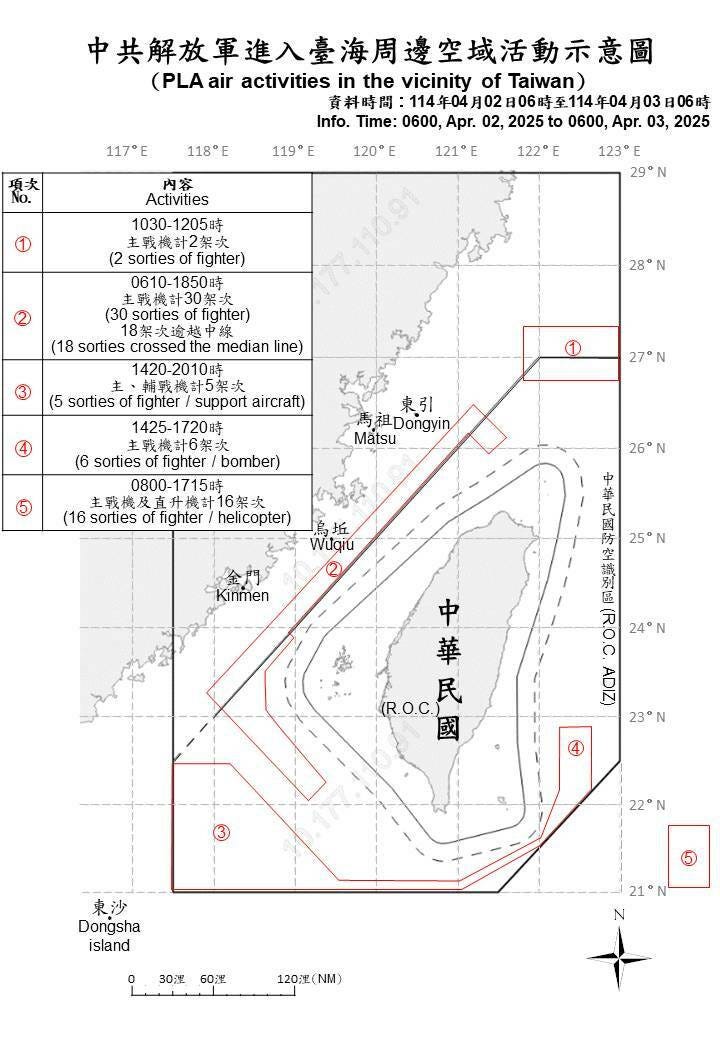
Outside Palmer Luckey’s speech in Taipei, a group of students gathered with signs that read,“No arms dealers on campus.”Their protest captured a deep cultural paradox within Taiwanese society. For decades, Taiwan has proudly branded itself as a“technology island”and a“peaceful supplier”to the world. Its global reputation rests on semiconductors, consumer electronics, and precision manufacturing—not on weapons production. To many Taiwanese, the idea of linking their world-renowned tech sector with military applications feels jarring, even dangerous.
Yet the geopolitical reality paints a harsher picture. Situated at the frontline of great power competition, Taiwan is not merely an exporter of laptops and smartphones—it is a potential battlefield, the focal point of the most consequential security flashpoint of the 21st century. In this environment, the same factories that build iPhones could just as easily become the facilities that assemble drones, sensors, or autonomous defense systems. The same engineers who write code for AI-enhanced cameras could adapt those algorithms to identify incoming missiles or hostile aircraft.
This tension betweenidentity and necessityhas become a defining debate within Taiwan. On one side stands the cultural self-image of Taiwan as a hub of peaceful innovation—a place where technology empowers daily life, commerce, and global connectivity. On the other side lies the strategic demand that Taiwan evolve into thecore of a democratic defense supply chain, a role thrust upon it by geography, history, and the looming threat from Beijing.
The student protests, therefore, are not simply about one speech or one company. They reflect a broader societal question: should Taiwan’s brightest minds continue to dedicate themselves to making laptops, smartphones, and consumer gadgets, or should they redirect their talents toward designing drones, autonomous vehicles, and missile defense systems? For many young people, the former represents normalcy, prosperity, and a connection to the global economy; the latter represents militarization, anxiety, and the uncomfortable acknowledgment that their island is on the front line of an existential struggle.
This is not a debate that Taiwan can avoid. The contradiction between being a “peaceful technology island” and serving as the “defense technology arsenal of democracy” lies at the heart of its national destiny. The protests may highlight resistance, but they also underscore an uncomfortable truth:Taiwan’s survival may depend on reimagining its identity, not only as a builder of devices for the world, but also as a builder of systems that safeguard freedom itself.

Conclusion: Taiwan’s Call
In closing his speech, Palmer Luckey offered a stark reminder to his audience:“There is no secret arsenal that will come to save you—there is only you.”His words cut through the abstractions of strategy and technology, forcing a confrontation with reality. Taiwan cannot wait for hidden weapons, deus ex machina interventions, or last-minute rescues from distant allies. Its survival, its freedom, and its future will depend on its own resolve and its ability to mobilize the extraordinary resources it already possesses.
Taiwan today stands at ahistoric crossroads. On one hand, it is the beating heart of the global semiconductor industry, a technological linchpin without which the world’s digital economy would falter. On the other, it sits at the geographic and ideological fault line between democracy and authoritarianism. No other place so perfectly embodies both the promise of technological progress and the peril of geopolitical confrontation.
The paradox is stark: Taiwan possesses some of the most advanced industrial capabilities on earth—factories that etch nanometer-scale circuits into silicon, supply chains that stretch seamlessly across continents, and a workforce trained at the cutting edge of engineering. Yet it also faces some of thegreatest strategic pressureof any nation, living under the shadow of a superpower that has repeatedly declared its intent to absorb the island by force if necessary.
The next decade will be decisive. Taiwan must confront a question that goes beyond economics or even security—it is a question of identity and destiny:
Will it remain merely the factory of the global supply chain, or will it transform into the frontline arsenal of the democratic world?
This is not an easy choice. To embrace the latter path is to accept risk, sacrifice, and the uncomfortable reality of militarization. To cling to the former is to risk vulnerability, complacency, and the hope that others will defend what Taiwan itself is unwilling to defend.
But as Luckey suggests, there is meaning in difficulty. The act of choosing—to stand not just as a producer of technology, but as a defender of freedom—would give Taiwan not only a role in the world economy but a purpose in history. The challenge is immense, yet the significance is greater still: by becoming adefense technology island, Taiwan could ensure not only its own survival, but also the resilience of the democratic order in the face of authoritarian expansion.
The call has been sounded. The question now is whether Taiwan’s leaders, industries, and citizens will answer it—whether they will dare to transform technological brilliance into strategic strength, and in doing so, secure both freedom at home and hope for democracies abroad.

Dare to Build. Never Yield.
For Taiwan, this means transforming world-class technology into the shield of democracy. To dare is to harness chips, factories, and talent for freedom’s defense. To never yield is to face authoritarian pressure with resilience, proving that the island’s strength lies not only in what it makes, but in what it stands for.


PreviousNext
TopLatestDiscussions








See all