2025 OCP APAC: Taiwan Sets Sail to Connect Asia’s AI Silicon Ecosystem
2025 OCP APAC: Taiwan Sets Sail to Connect Asia’s AI Silicon Ecosystem
- Source: SemiVision
- Author: SEMIVISION
- Published: 2025-08-07T11:16:28+08:00
- URL: https://tspasemiconductor.substack.com/p/2025-ocp-apac-taiwan-sets-sail-to 2025 OCP APAC: Taiwan Sets Sail to Connect Asia’s AI Silicon Ecosystem


2025 OCP APAC: Taiwan Sets Sail to Connect Asia’s AI Silicon Ecosystem
Original Articles By SemiVision Research (TSMC ,Broadcom , ASE ,Oriole Networks, iPronics, LightSphere X ,Castrol ,Flex ,Astera Labs ,NTT)

Aug 07, 2025
∙ Paid
OCP APAC 2025: Taiwan Takes the Stage as the Heart of Asia’s AI Ecosystem
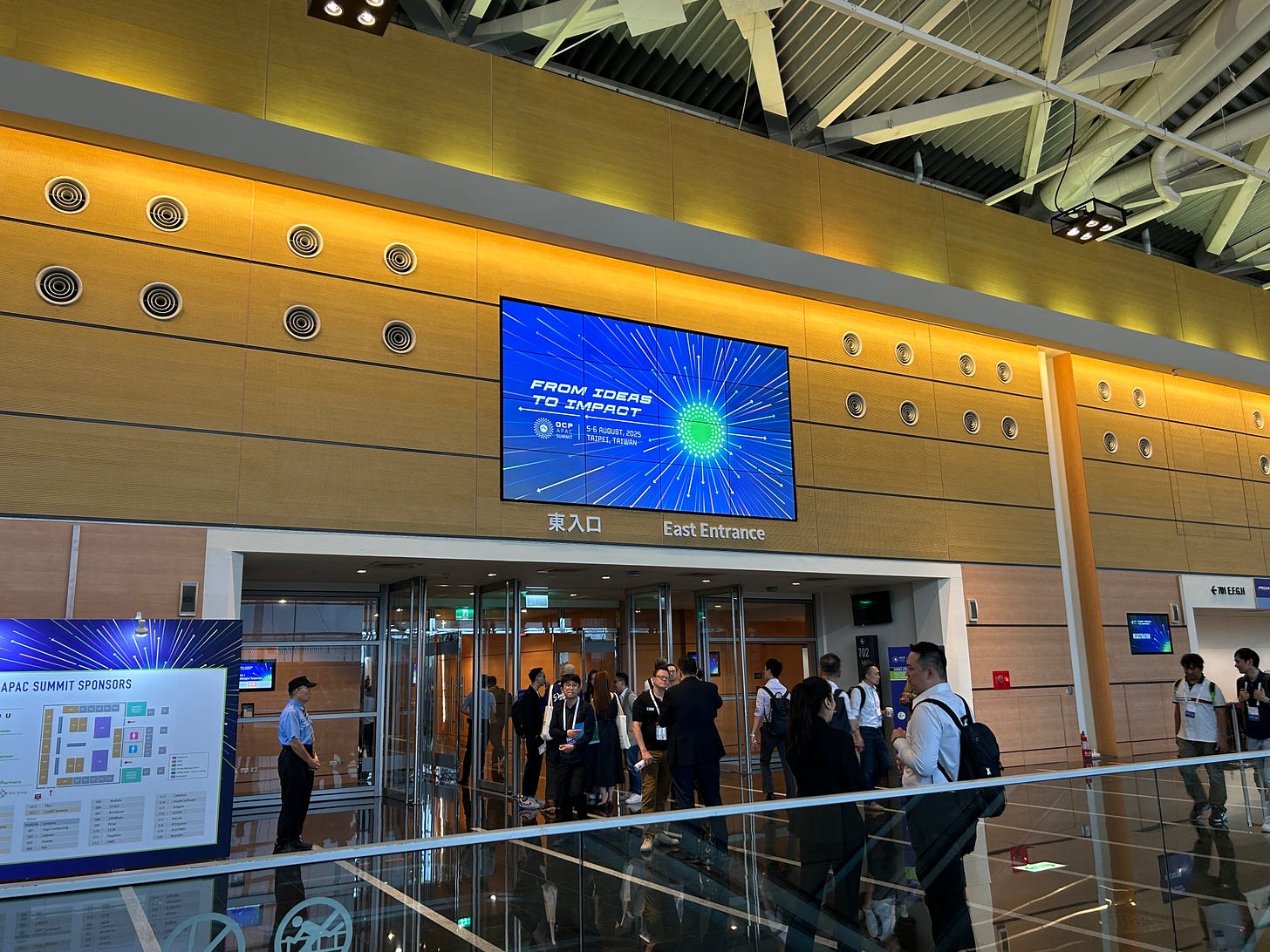
For the first time, the Open Compute Project (OCP) has brought its APAC Summit to Taiwan — a strategic decision that reflects the island’s growing prominence in the global AI and semiconductor value chain. Held at the Taipei Nangang Exhibition Center, this year’s summit theme,“From Ideas to Impact,”feels especially fitting for a region that’s turning innovation into infrastructure at record speed.
Taiwan is more than just a manufacturing hub; it’s the world’s most complete AI silicon supply chain. From foundries and IC design houses to advanced packaging, OSAT, and system integrators, Taiwan is home to nearly every link in the chain — including key players in AI accelerators, server ODMs, edge computing platforms, and next-gen cooling solutions. The ecosystem also includes global leaders in high-performance memory, substrate technologies, photonics, and glass-based interposers.
Beyond hardware, Taiwan has become a collaborative hotspot where U.S. and Japanese giants converge with local talent to develop AI datacenter infrastructure, co-packaged optics, and next-gen edge devices. Its geographic location, geopolitical relevance, and engineering workforce make Taiwan the launchpad for Asia’s AI ambitions.
By choosing Taiwan as the 2025 host, OCP is not only acknowledging Taiwan’s pivotal role in global computing infrastructure — it is also planting the seeds for deeper regional collaboration in open, efficient, and scalable AI platform development.

2025年7月10日

2025年5月14日

2025年5月13日

2025年5月24日
Origin and Mission of OCP
The Open Compute Project (OCP) was initiated by Facebook (now Meta) in 2011 with the goal of promoting open, standardized, and highly efficient designs for data center infrastructure. Its core philosophies include:
Open Hardware Design:
Sharing server, storage, networking, rack, and power system designs to reduce cost and improve efficiency.
Community-Driven Innovation:
A collaborative ecosystem involving hyperscalers, chipmakers, OEMs, ODMs, software developers, and system integrators.
High Performance, Low Power, and Scalability:
Addressing power and thermal challenges posed by rapidly growing cloud and AI workloads.
Today, OCP has evolved into the world’s leading collaborative platform for open hardware in data centers, with participation from major global players including Google, Microsoft, Meta, Amazon, Intel, NVIDIA, AMD, Broadcom, Delta Electronics, Quanta, and Inventec, among others.

Foundation (Global OCP Support Structure):
OCP Experience Centers: Physical or virtual hubs where participants can explore and engage with OCP technologies.
Alliances & Partnerships: Strategic collaborations across companies and organizations to drive open innovation.
Marketplace: A platform for commercializing OCP-compliant products and solutions.
Startup Companies & Future Technologies: Support for early-stage companies and cutting-edge technologies aligned with OCP’s mission.
APAC (Regional Community Engagement):
Equipment Vendors: Encouraging local hardware and infrastructure providers to align with OCP standards.
Industry Associations: Collaborating with trade and standards organizations to expand regional influence.
System Integrators: Enabling integration of open hardware solutions tailored to local needs.
Emerging Product: Supporting the development and regional deployment of next-gen technologies.
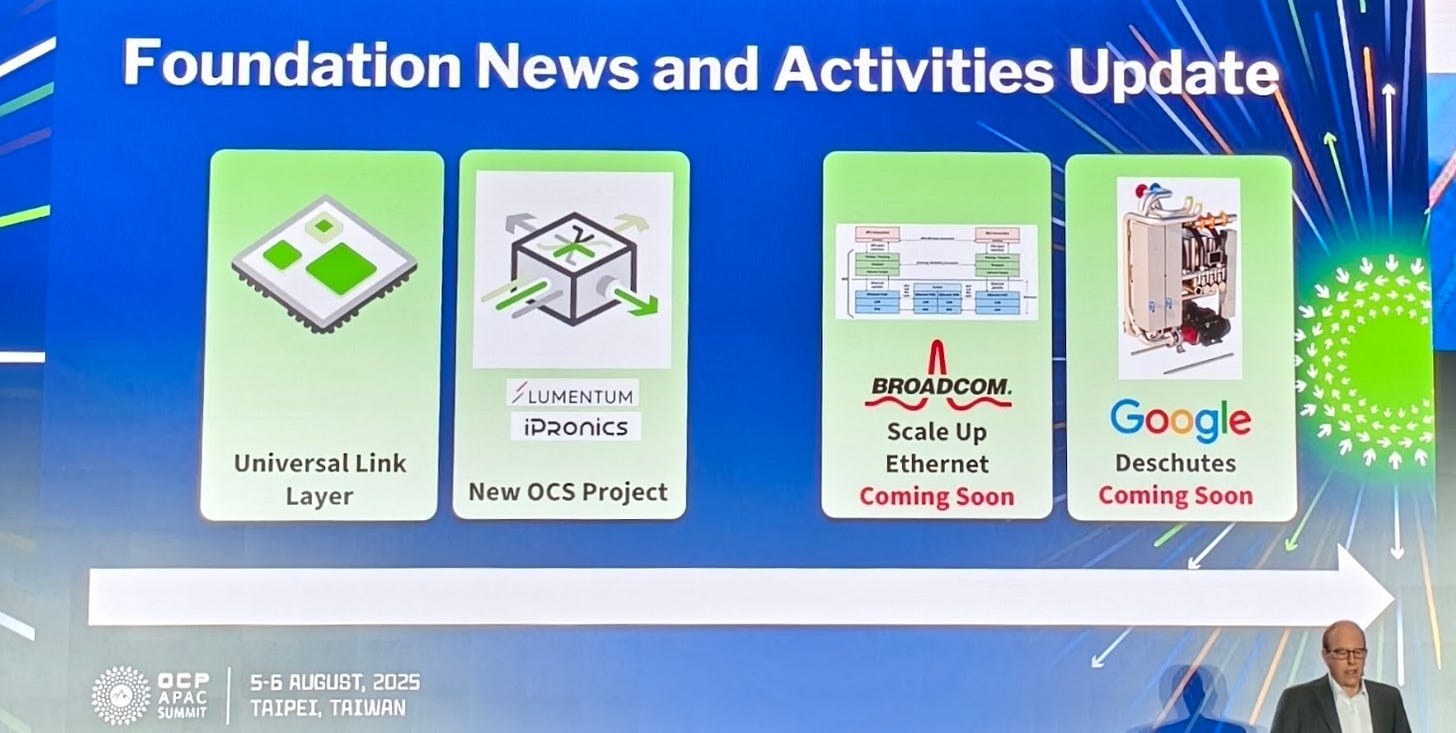
Universal Link Layer
A newindustry-wide effortto standardize the link layer across different compute and networking platforms.
Aims to simplify interconnect compatibility and enhance scalability across heterogeneous systems.
New OCS Project – Lumentum & iPronics
This marks the launch of anew Open Compute Server (OCS) project, with contributions from:
Lumentum– a leader in optical networking solutions, VCSELs, and photonics technologies.
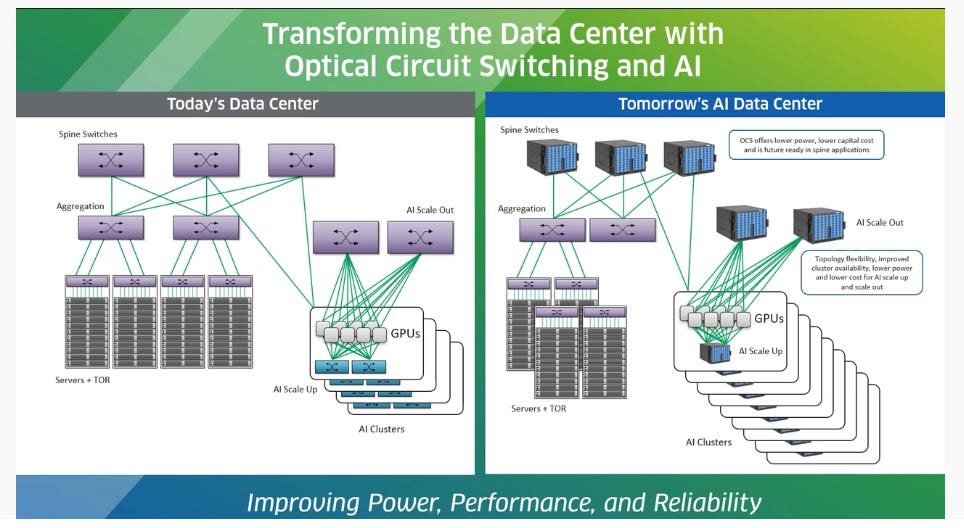
Revolutionizing Optical Switching: Lumentum's New OCS
iPronics– Optical Networking Engine, ONE-32, the world’s first Optical Circuit Switch (OCS) product based on silicon photonics. Tailored for AI workloads and energy-efficient cloud infrastructure, the ONE-32 delivers ultra-low latency, massive scalability, and groundbreaking cost efficiency, transforming data center networking. Targeting both scale up and scale out applications for AI clusters and high-performance computing data centers, ONE-32 enables failure-resilient interconnects and programmable Layer 1 topologies. With AI driving data rates to double annually, traditional electrical packet switches (EPS) falter, burdened by power-intensive optical-electrical-optical conversions and rigid designs.
The ONE-32, a 32-port OCS, leverages a CMOS- silicon photonics platform to eliminate these inefficiencies, cutting switch power consumption by up to 50% by halving the quantity of transceivers required compared to EPS. It offers a flat O-band response, near-zero latency, and rapid reconfiguration.
The project likely focuses onoptical connectivity and photonic integrationfor next-generation modular servers.
Scale Up Ethernet – Broadcom (Coming Soon)
A forthcoming initiative led byBroadcom, one of the largest fabless semiconductor companies, known for itsEthernet, networking, and AI infrastructure chips.
The project likely targetshigh-bandwidth, low-latency Ethernetsolutions to scale open compute architectures in AI and hyperscale data centers.
Deschutes – Google (Coming Soon)
A new initiative byGoogle, the global tech giant and hyperscaler, named “Deschutes.”
Although details are not revealed, it may relate tocooling innovations, rack design, or new AI-centric server architecture, as suggested by the image.
Google has been a major OCP contributor, especially in areas such asTPUs, AI infrastructure, and data center sustainability.
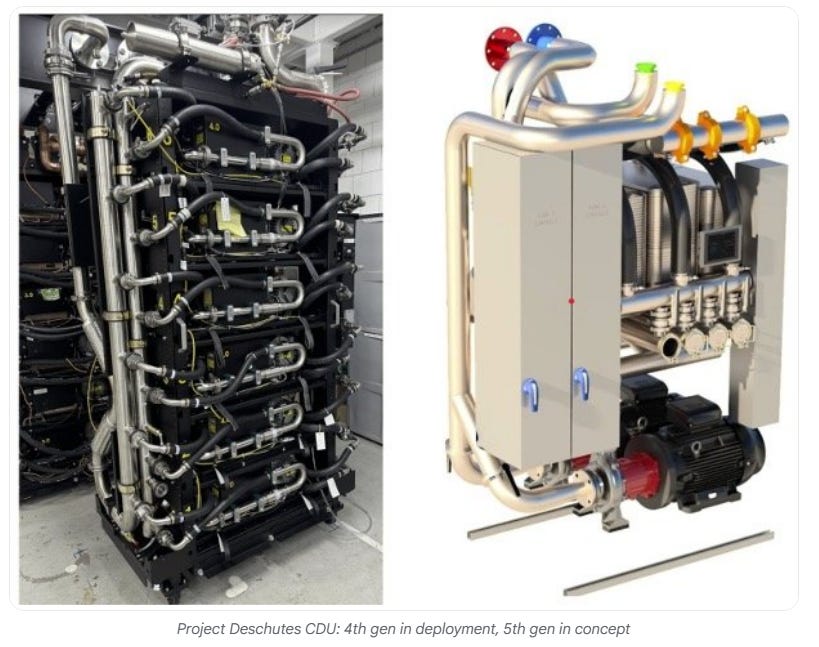
AI infrastructure is hot. New power distribution and liquid cooling infrastructure can help
OCP’s Key Focus Areas and Technology Directions

The Open Compute Project (OCP) drives full-stack innovation for data centers — from racks to chips — across the following domains:
Server & Compute Architecture
Supports high-density integration of CPUs, GPUs, and accelerators
Modular chassis and rack designs (e.g.,OCP Rack,Open Rack V3)
Storage & Networking Systems
High-bandwidth Ethernet (200G / 400G / 800G / 1.6T)
Open switch and optical module standards (supportingLPO,CPO, andOIOtechnologies)
Power & Thermal Management
High-voltage direct current (HVDC) andliquid coolingtechnologies
Power shelves, battery backup units (BBU), andcapacitor backup units (CBU)design
Chip & Packaging Ecosystem
Open Accelerator Module (OAI) andCXL-based memory expansion
SupportsCo-Packaged Optics (CPO)andSilicon Photonicsintegration
Explores the impact of advanced packaging (such asCoWoS,FOPLP, andglass substrates) on data center infrastructure

The Role and Characteristics of OCP Taiwan

OCP Taiwanserves as a strategic hub for the global OCP community in Asia, playing a vital role in connecting Taiwan’s semiconductor and server supply chains:
Manufacturing Strength in Asia
Taiwan is home to the world’s leading server and data center ODMs/OEMs, such asQuanta,Wistron,Inventec, andCompal.
Semiconductor leaders and advanced packaging providers (includingTSMC,ASE, andPTI) are essential to enabling AI chip deployment within the OCP ecosystem.
Optical Interconnect & Thermal Ecosystem
Taiwanese companies are actively developingoptical communication modules (CPO/LPO)andliquid cooling solutions, aligning with OCP’s requirements for high-power AI training clusters.
Collaboration & Ecosystem Integration
OCP Taiwanfosters co-innovation between global cloud service providers and Taiwan’s hardware manufacturers, material suppliers, and equipment vendors.
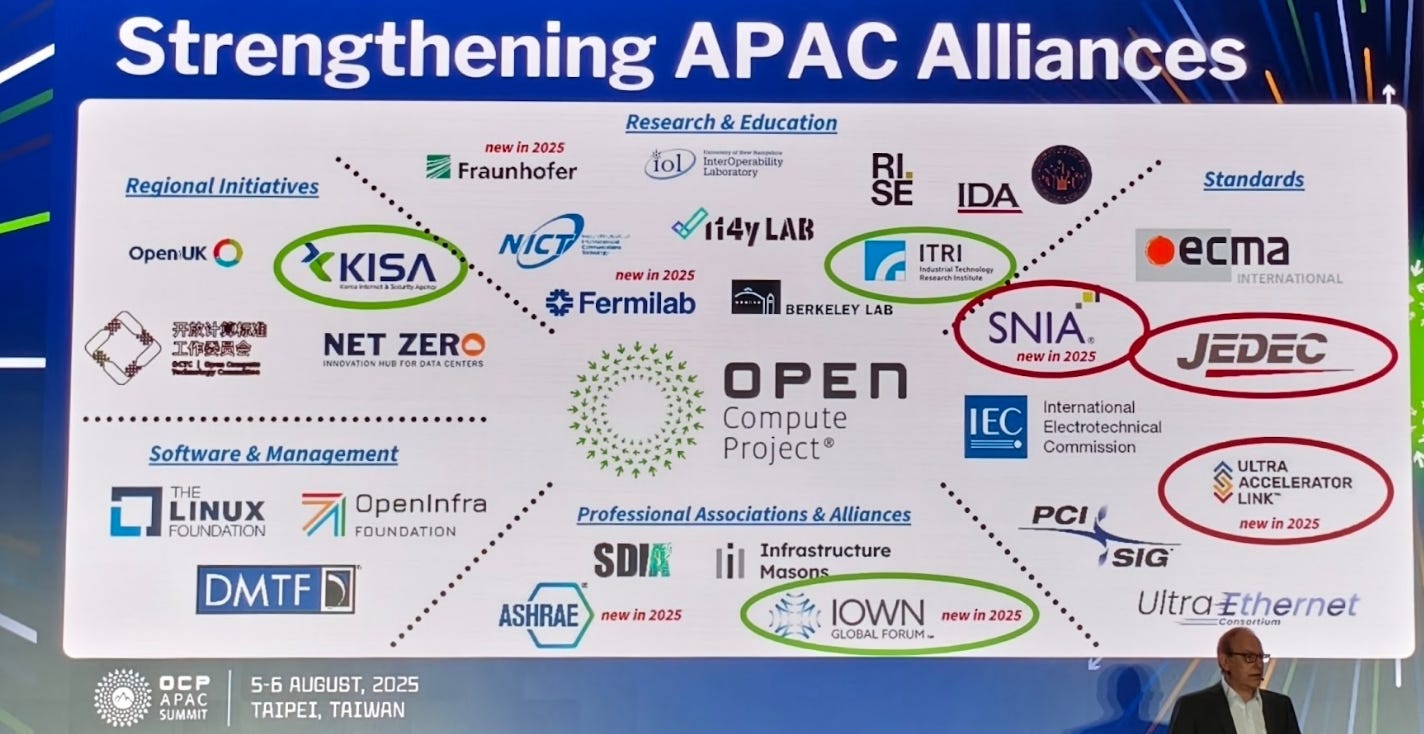

Expanding OCP Marketplace Footprint in APAC
As OCP expands its global ecosystem, Asia-Pacific (APAC) has emerged as a key growth engine. Three core programs are helping accelerate OCP’s adoption in the region:
OCP Solution Provider
OCP Solution Providers are vetted companies that deliver end-to-end open hardware-based solutions, including servers, storage, and rack infrastructure.
Over130 providersglobally
Majority based in APAC, reflecting the region’s strong manufacturing and integration capabilities
Enable enterprises and cloud builders to deploy OCP-compliant designs more efficiently
OCP Experience Center
These are collaborative physical labs that offer hands-on access to OCP hardware and technologies.
25 centers worldwide, with7 located in APAC
Serve as training grounds and demo sites for hyperscalers, system integrators, and end-users
Promote community engagement and accelerate the adoption of open hardware in the region
OCP Ready Facility
This certification program identifies data centers that are optimized for OCP hardware deployments.
Facilities meet key infrastructure criteria such as power, cooling, and rack compatibility
26 certified sites worldwide, with10 in APAC
Reduces deployment risks for OCP adopters, offering trusted environments for scalable rollouts
These programs underline OCP’s commitment to localize its global vision and empower the growing AI and data center ecosystem across Asia.

Key Trends at 2025 OCP Taiwan: Driving the Next Wave of AI and Cloud Infrastructure
The 2025 OCP Taiwan Summit marks a pivotal moment in the evolution of open computing, spotlighting critical technologies that are reshaping global data center infrastructure. This year’s key focus areas include:
1.AI Supercomputing & Co-Packaged Optics (CPO)
OCP Taiwan 2025 is addressing the growing demand for high-performance interconnect solutions to support next-generation AI chips such as NVIDIA Rubin, AMD Instinct, and AWS Trainium. With these AI GPUs and ASICs pushing power envelopes higher than ever, the industry is turning to:
800G / 1.6T optical modules
Co-Packaged Optics (CPO)
Photonic-electronic integrated packaging
These technologies are essential to maintain bandwidth density and energy efficiency in large-scale AI training clusters.
2.Advanced Power and Thermal Solutions
Power and heat management are key to sustainable AI infrastructure. OCP Taiwan is exploring:
800V High-Voltage Direct Current (HVDC)rack power architectures
Cabinet-level liquid cooling and immersion cooling
Supercapacitor-based energy management systems
These solutions aim to reduce energy consumption, improve PUE (Power Usage Effectiveness), and ensure thermal reliability in high-density compute environments.
3.Open Server and Storage Standardization
To reduce costs and enhance modularity, OCP promotes open standards across compute and storage. Taiwan plays a vital role in enabling:
Modular server platforms
Open GPU enclosures for AI workloads
CXL-based memory pooling technologies
This standardization enables hyperscalers and enterprises to optimize cloud operations and minimize energy and CapEx overheads.
4.Taiwan's Strategic Value in the Global OCP Ecosystem
Taiwan continues to serve as a critical hub for the OCP movement, thanks to its strengths in:
Silicon photonics R&D
Advanced packaging (CoWoS, FOPLP, glass substrates)
Server design and high-volume manufacturing
With a dense concentration of ODMs, semiconductor fabs, and optoelectronics suppliers, Taiwan is uniquely positioned to commercialize next-generation AI and cloud infrastructure.
- OCP Taiwan as a Gateway to Asia’s Next-Gen Infrastructure
More than just a regional conference,OCP Taiwan 2025represents:
Astrategic bridgefor Taiwan’s semiconductor and server supply chains into the global AI infrastructure ecosystem
Alaunchpadfor critical technologies like CPO, liquid cooling, and HVDC to enter mainstream deployment
Akey nodein the expansion of the open compute ecosystem throughout Asia, enabling collaborative innovation between global cloud players and local hardware leaders
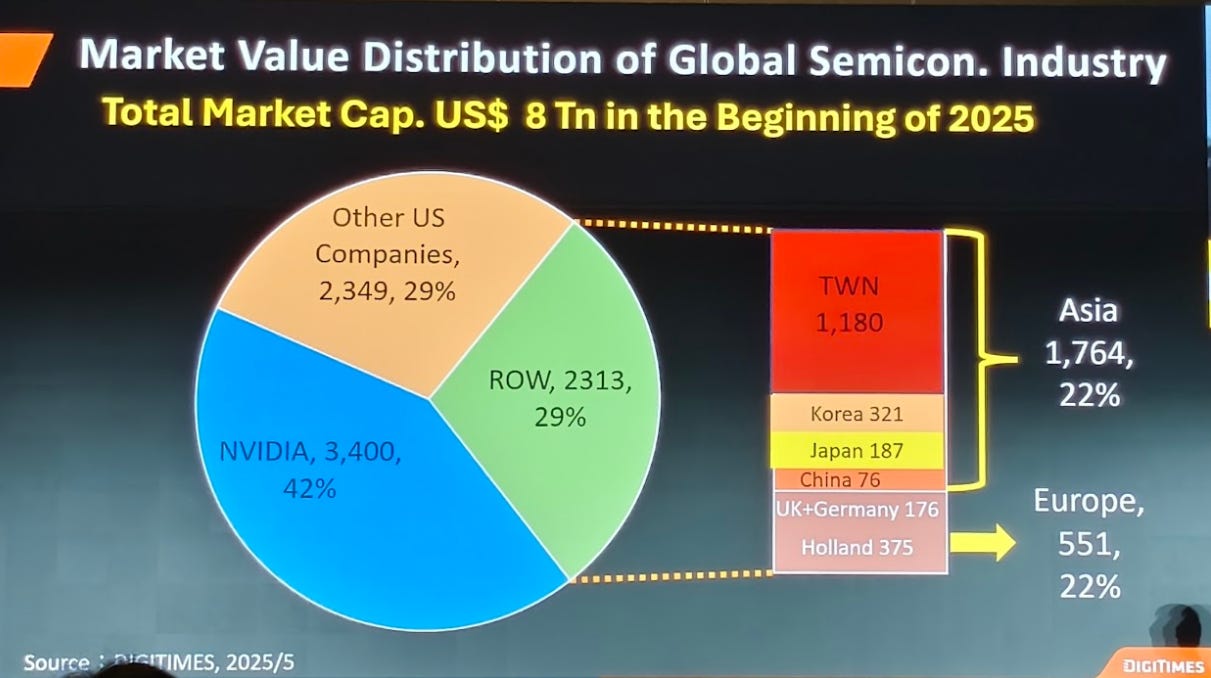
Dominance of NVIDIA
NVIDIA alone accounts for $3.4 trillion, which is42%of the entire global semiconductor market cap.
This highlights the enormous surge in valuation driven by theAI boom, where NVIDIA’s GPU dominance and platform ecosystem are central to both training and inference workloads.
NVIDIA's valuation surpasses the entire market cap of some regions, underlining its leadership in the AI semiconductor cycle.
Other U.S. Semiconductor Companies
Other U.S. firms collectively contribute $2.35 trillion, or29%, emphasizing the U.S.'s continued leadership in fabless design, EDA tools, and advanced computing.
Together with NVIDIA,the U.S. accounts for over 70%of global semiconductor market capitalization.
Rest of the World (ROW)
Countries outside the top clusters (U.S., Taiwan, Korea, Japan, Europe, China) contribute$2.31 trillion(29%) to the global total.
This shows arelatively balanced distribution outside of the U.S., indicating significant contributions from countries like Singapore, Israel, and others with niche semiconductor capabilities.
Asia’s Position – Strong Manufacturing Base
Asia holds a22% share ($1.76T), with the largest contribution from:
Taiwan (TWN): $1.18 trillion – a reflection of its leadership in foundry (TSMC) and advanced packaging.
Korea: $321 billion – driven by memory giants and fab capacity.
Japan: $187 billion – still influential in equipment and materials.
China: $76 billion – relatively small given its size, due to geopolitical constraints and limited high-end IP.
Europe’s Contribution – Also 22%, but Fragmented
Europe contributes$551 billion, also 22% of the total:
Netherland ($375B)stands out, largely thanks to ASML’s monopoly in EUV lithography.
UK + Germany ($176B)– representing strength in analog/mixed-signal, automotive, and RF.
2025 OCP Taiwan – Taiwan Sets Sail to Connect Asia’s AI Silicon Ecosystem
The Open Compute Project (OCP) continues to redefine the future of data center and AI infrastructure. In 2025, as AI workloads surge and hyperscale computing becomes the backbone of innovation, OCP Taiwan invites the global community to explore cutting-edge technologies, open collaboration, and real-world deployments. This year’s conference will highlight transformative topics spanning AI clusters, chiplets and advanced packaging, photonics, energy-efficient data centers, and next-generation open hardware.
Currently, in the field of AI development, the focus is on the following topics. These are all highly popular and trending subjects.
- AI Clusters
AI workloads are growing at an unprecedented pace, and scaling AI clusters efficiently is now mission critical. We are looking for presentations that cover:
Use Cases and Adoption: Successful deployments of AI clusters in hyperscale and enterprise environments, demonstrating real-world efficiency and cost benefits.
New System Architectures: Innovative designs for AI servers, racks, and clusters to support the next generation of large-scale training and inference workloads.
Data Formats for Deep Learning: Approaches that accelerate AI model development, optimize training pipelines, and improve interoperability.
Special Focus: End-to-end strategies for scaling AI clusters, including interconnect topologies, power delivery, and thermal management.
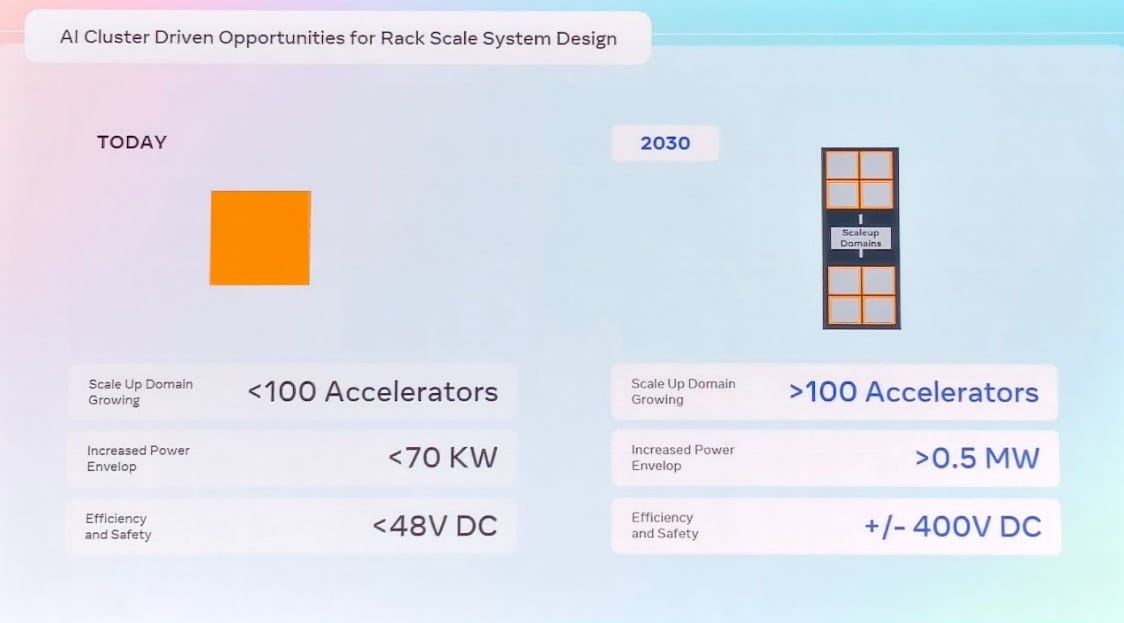
Source: Meta
- Chiplets, Advanced Packaging, and Photonics
Chiplet-based architectures and co-packaged photonics are revolutionizing how we build high-performance, energy-efficient compute platforms. We invite contributions on:
Open Chiplet Supply Chain: Efforts to create an open, stand-alone ecosystem for chiplet silicon manufacturing and integration.
SiP & 3D Packaging: Innovations in System-in-Package (SiP) assembly, 3D integration, test, and verification methodologies.
Open Standards: Descriptions and adoption of open D2D (Die-to-Die) interfaces and chiplet design automation workflows.
Photonics & Optical I/O: Integrating CPO/LPO technologies to break bandwidth and energy efficiency barriers for AI and data center applications.

- Adoption of OCP-Recognized Equipment & Facilities
Discover how organizations acrossAPACare deployingOCP solutionsto improveefficiency, sustainability, and scalability. Presentations should focus on:
Open Rack V3 (ORV3) Adoption: Real-world deployments and operational insights.
Liquid Cooling Innovations: Addressing the challenges of high-density AI accelerators in diverse regional climates.
Colocation Optimization: How APAC data centers are designing facilities around OCP standards for power and cooling efficiency.

- Future Technologies Symposium
This track explores innovations3–5 years ahead of mainstream adoption, targeting academic, research, startup, and venture communities. Topics include:
AI & HPC for Next-Gen Systems: Architectures and algorithms enabling future AI acceleration.
Data Center Sustainability: Novel approaches to reduce carbon footprint and energy consumption.
Cooling Innovations: Hybrid cooling for tropical and urban APAC environments, including waste heat recovery and next-gen cold plate/immersion solutions.

- Optical Communication Networks
Optical networking underpins thescale-out era of AI and cloud computing. We are looking for insights on:
Architectures for AI Clusters and Modern Data Centers
Data Center Interconnect (DCI) & Edge-to-Cloud Optical Networking
Advances in LPO, CPO, and Energy-Efficient Optical Interfaces
- Server, Networking, Storage, Rack & Power
OCP drives open innovation across the data center stack:
Servers: Modular hardware, composable memory, and disaggregated architectures to boost efficiency.
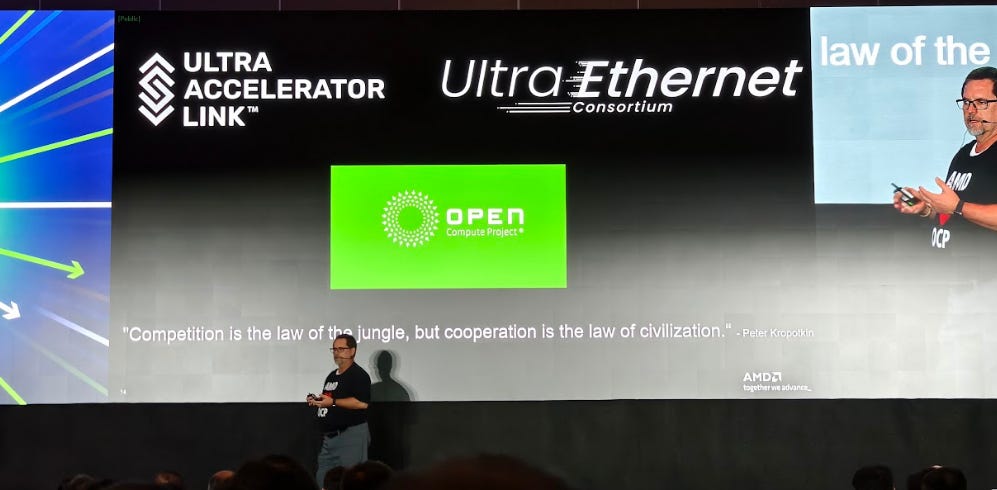
Networking: Scale-up and scale-out Ethernet (UEC/UALink), NIC acceleration, NetOps automation, and power/cooling optimization.
Storage: Computational storage for AI/ML, flash scaling strategies, disaggregated architectures, and energy-efficient edge solutions.
Rack & Power: Open Rack designs, advanced PDUs, and real-time energy monitoring for sustainable data center operations.
- Why Present at OCP Taiwan 2025?
OCP Taiwan isthe bridge between global cloud and AI leaders and APAC’s world-class supply chain. Presenters will gain exposure to:
A diverse audience ofhyperscalers, semiconductor innovators, and leading ODM/OEMs
Opportunities toshape open standards and future AI infrastructure
A platform to showcasesolutions driving the next generation of efficiency, scalability, and sustainability
Core Topics and Industrial Relevance
The 2025 OCP APAC Taiwan Summit has transformed from its traditional focus on Rack/Server architecture into a comprehensive high-level forum for the Silicon Ecosystem. The event now fully integrates semiconductor design, advanced packaging, photonic interconnects, thermal management, and system integration, mirroring the end-to-end evolution driven by the needs of AI data centers.
- Reshaping the AI Supply Chain
The supply chain is extending from traditional server OEM/ODMs to include chip design, advanced packaging, silicon photonics, optical modules, and liquid cooling materials.
OCP has become a platform for collaborative supply chain innovation and global standardization, strengthening cooperation between multinational CSPs and Taiwan/APAC industrial players.
- Cross-Regional AI Training Network Architectures
Focused on synchronizing AI training data across continents and minimizing latency through optical interconnects and Optical Circuit Switching (OCS) deployments.
NTT's IOWN/All-Optical Network is viewed as a future foundation for hyperscale AI training infrastructure.
- Next-Gen CPO and CoWoS Integration
Co-Packaged Optics (CPO) is being combined with CoWoS/COUPE packaging technologies to reduce SerDes transmission power.
Direct integration of optical modules into HBM + AI chips supports ultra-high bandwidth interconnects (1.6T and beyond).
- AI Storage Interface Advancements
Covers PCIe 7.0, CXL 4.0, UCIe, and SSD interface collaboration.
Targets high IOPS and ultra-low latency for large-scale generative AI workloads.
- Liquid Cooling and Thermal Management TCO
Liquid cooling (Direct-to-Chip, Immersion) is essential for improving data center energy efficiency.
Comparative TCO analysis versus air cooling includes electricity, maintenance, and equipment lifespan.
- System Security and Resilience
Multi-level security from chip to module to rack level, ensuring sustainable operation of CSP AI clusters.
Highlights deployment of OpenBMC, Secure Boot, and OCP S.A.F.E. initiatives.
Vendor and Technology Highlights
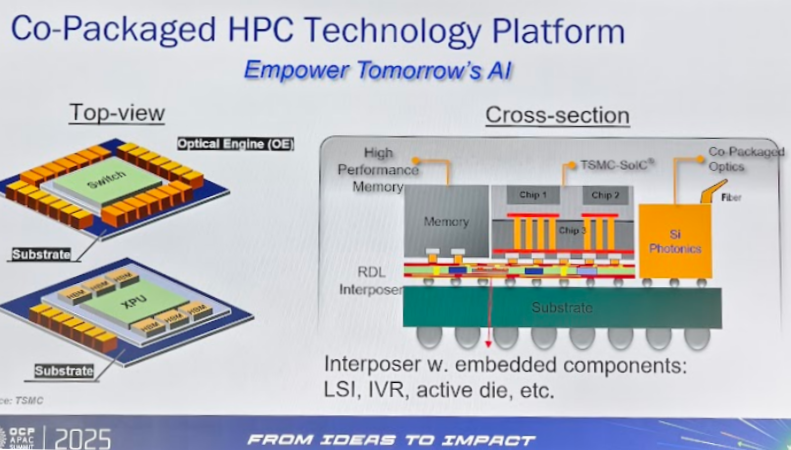
TSMC
Introduced CPO + CoWoS integration.
Presented COUPE silicon photonic interposer technology and showcased CoWoS-S and CoWoS-L performance and energy efficiency in HPC/AI chips.
Discussed ecosystem support for customers like NVIDIA, Broadcom, and AMD.
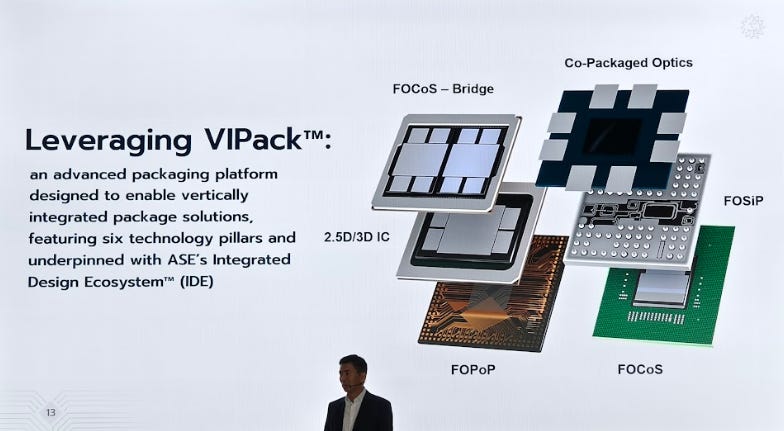
ASE (Advanced Semiconductor Engineering)
Shared insights into advanced packaging driven by AI.
Discussed PLP (Panel Level Package) and FOPLP production plans.
Proposed CoPoS (Co-Packaged on Substrate) as a cost-effective solution.
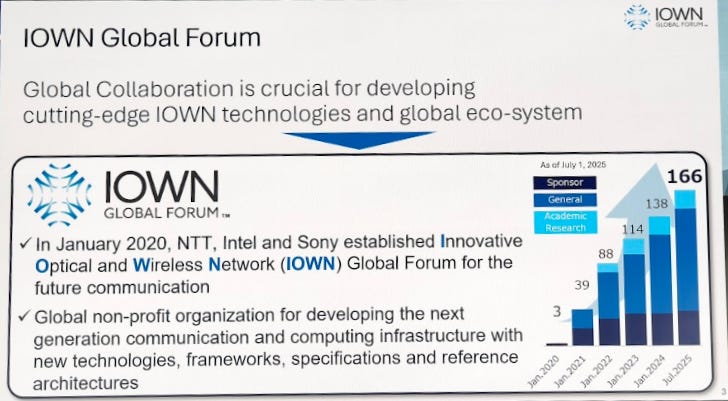
NTT
Promoted IOWN/All-Optical Network.
Demonstrated end-to-end optical network deployment for ultra-low latency across data centers.
Supports flexible OCS and CPO deployment for global AI clusters.
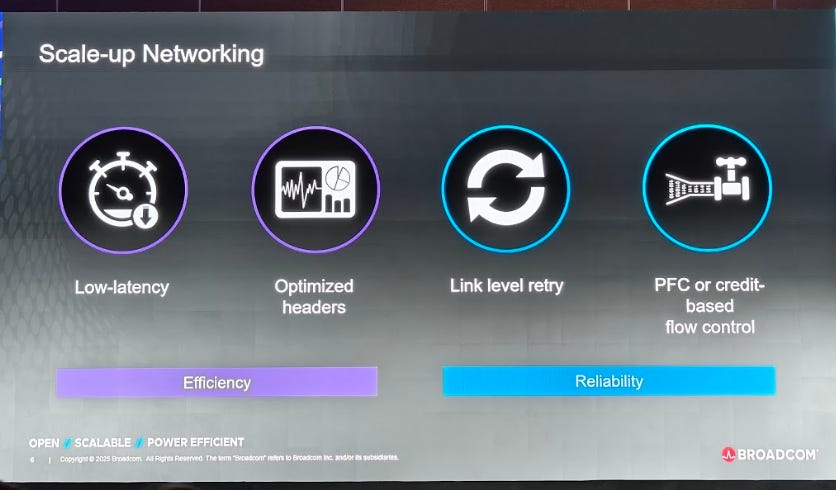
Broadcom
Unveiled Tomahawk Ultra / TH6 switch chips.
Emphasized scalability for AI training/inference clusters.
Supports 1.6T / 3.2T SerDes interconnect for both CPO and pluggable optics.

2025年6月4日

2025年4月26日
2025年7月8日
iPronics
Leading OCS standardization and programmable photonic switching.
Introduced dynamic optical switching for more flexible and energy-efficient AI data centers.

Astera Labs
Presented views on Scale-Up and UALink / NVLink Fusion.
Targeted multi-node GPU/XPU interconnect, reducing SerDes latency.
Enabled large-scale memory sharing through CXL 4.0 and PCIe 7.0.

Showcased VBP (Vertical Busbar Power) infrastructure.
Supports 800V AI rack power delivery and reduces cable loss and energy waste.

Castrol
Announced comprehensive entry into liquid cooling.
Collaborates with global CSPs and Taiwanese manufacturers.
Aims to make Taiwan a hub for APAC's liquid cooling ecosystem.

GIGABYTE
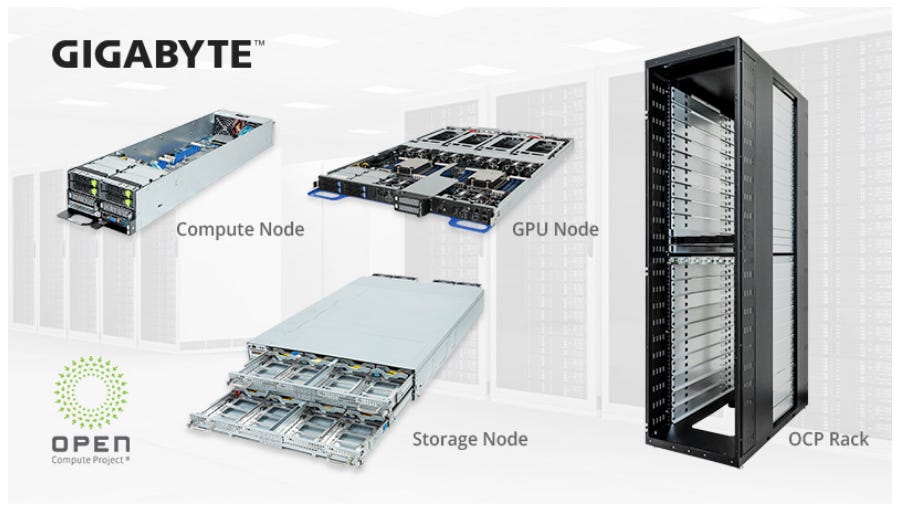
Unveiled OCP ORV3 standard server solutions:
TO86-ZX1-AA03: integrates latest AMD CPUs/GPUs.
TO25-ZU4/TO25-ZU5 compute nodes: supports multiple storage configurations.
Showcased full range of cooling (air, liquid, immersion) and AI acceleration solutions.

OCP 21-Inch Rack
As leading tech companies move forward with net-zero carbon initiatives and set corporate sustainability goals, many small and medium-sized enterprises are also beginning to assess their own capabilities and invest in green transformation. The latest Open Compute Project (OCP) rack standards have successfully reduced current and conduction losses.
In the first version of the Open Rack standard (ORv1), power distribution relied on three 12V busbars. This design was simplified in the second version (ORv2), which adopted a single 12V busbar. More recently, rising concerns around rack power density in data centers have driven the transition to a single 48V busbar power solution per rack—now the latest standard.
Leveraging this advancement,[Company Name]introduced the GIGABYTE DO22-ST0 42OU rack, compliant with the ORv3 specification. It features enhanced compatibility and system integration while eliminating the need for a separate 1U power shelf. The rack offers a flexible design with up to 18OU or 20OU of usable rack space.
The DO22-ST0 also supports a 15kW 5+1 redundant power supply configuration, and includes three network switch bays to streamline network communication and management across devices.
Industry Trends and Strategic Impact
OCP Expanding Beyond Racks to Full Silicon Ecosystem
Now spans chip design, packaging, photonic interconnect, liquid cooling, firmware, and system-level security.
AI Driving Innovation in Packaging and Cooling
CoWoS, COUPE, CPO, and liquid cooling are becoming foundational for next-gen AI data centers.
APAC as a Growth Engine
Taiwan's strengths in chip manufacturing, OSAT, and server design make it a critical OCP ecosystem hub.
Optical Interconnects, Supernodes, and AI Cost Efficiency
As AI model training and inference scale, supernode architectures are key to enhancing performance and reducing costs. While NVIDIA’s NVL72 dominates with powerful, high-density clusters, Chinese GPUs still lag behind in process node, memory, and bandwidth.
This forces Chinese deployments to scale via massive GPU counts and higher power densities (20kW to 100kW per rack), increasing the reliance on optical interconnects. While copper cables struggle at 112G beyond a few meters, optical fiber enables flexible, scalable, and longer-distance connections.
Challenges of Optical Interconnect:
High power consumption.
Increased cost.
Reliability issues due to component count (e.g., Huawei CloudMatrix requires 3000+ fibers and 6000+ modules).
CPO and Distributed OCS as Solutions
Co-Packaged Optics reduces power and improves reliability by tightly integrating optics with chip packages.
Broadcom and NVIDIA are commercializing CPO switches.
Distributed OCS (dOCS) enables fault isolation and dynamic reconfigurability without full node redundancy.
Leading Players in Optical Switching
Early adopter of OCS in its AI data centers.
Coherent & Lumentum
Leading optical component firms developing OCS-compatible solutions.
China’s AI Cluster Push
Developing full-stack optical interconnect ecosystems domestically.
LightSphere X - A WAIC-Awarded Solution
Developed by Shanghai Instrument, Biren Technology, iPronics, and ZTE.
Combines dOCS chips, AI GPUs with liquid cooling, and fully integrated domestic AI servers.
Spotlight on iPronics and Oriole Networks

iPronics
Spain-based, focused on software-defined photonics.
Launched ONE-32: a 32-port nanosecond-class OCS built on silicon photonics.
Latency: <30ns.
Reconfiguration: ~300μs.
Reduces power and cost by halving the number of optical transceivers.
Offers ultra-low-latency, software-defined, and scalable photonic networks ideal for AI cluster deployment.

Oriole Networks
UK-based startup (founded 2023), developing the PRISM architecture for optical circuit switching.
Uses AWGR-based nanosecond switching with plug-and-play scalability.
Aims to replace electronic switches and enable million-GPU AI clusters with lower energy use.
Although Oriole has innovative concepts, OCP has chosen iPronics as the lead vendor to push OCS commercialization across its ecosystem, making them a pivotal player in the future of optical switching in AI infrastructure.


PreviousNext
TopLatestDiscussions








See all