Quantum Convergence: Bridging Academia and Industry between BC and Taiwan
Quantum Convergence: Bridging Academia and Industry between BC and Taiwan
- Source: SemiVision
- Author: SEMIVISION
- Published: 2025-07-11T23:04:49+08:00
- URL: https://tspasemiconductor.substack.com/p/quantum-convergence-bridging-academia Quantum Convergence: Bridging Academia and Industry between BC and Taiwan


Quantum Convergence: Bridging Academia and Industry between BC and Taiwan
Original Articles By SemiVision Research & British Columbia Taiwan Office

Jul 11, 2025
∙ Paid

【Unlocking Quantum Opportunities】
British Columbia × Taiwan: A New Chapter for Quantum Innovation and Collaboration

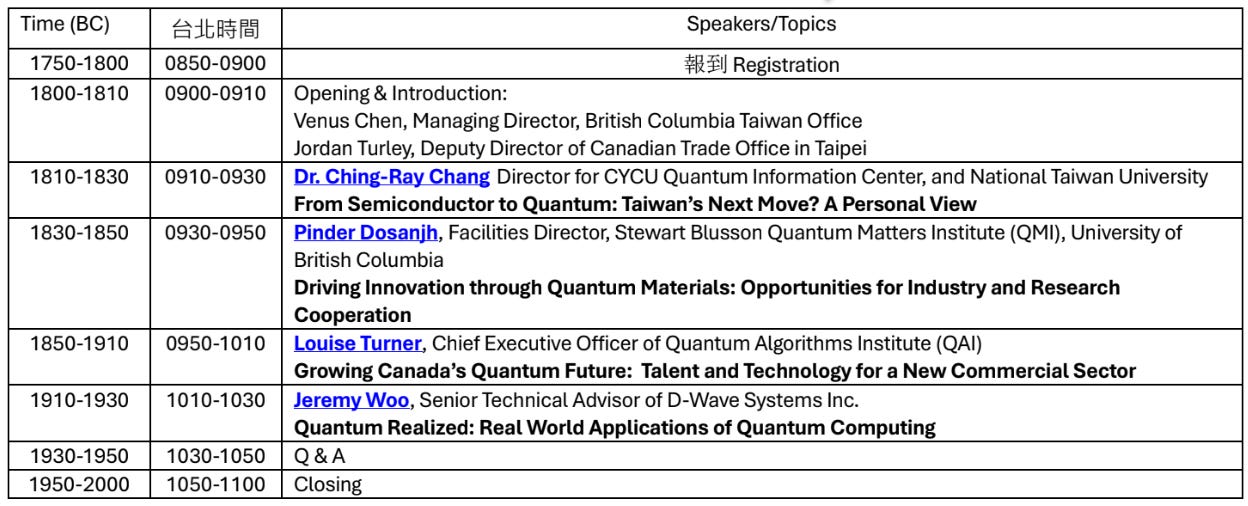
Event Date & Time:July 30, 2025 (Vancouver time) July 31, 2025 (Taipei time)

What is Quantum Computing?
Quantum computing is a fundamentally new computing architecture based on the principles of quantum mechanics. Unlike traditional binary logic (0 and 1), quantum bits (qubits) can exist in a superposition of both "0" and "1" simultaneously and can perform ultra-high parallel computations through quantum effects such as entanglement and interference.
This means that quantum computers can demonstrate exponential computational advantages in specific problems such as factorization, chemical reaction simulations, combinatorial optimization, and machine learning model training. Although quantum computers have not yet fully replaced classical supercomputers, they are poised to play a critical role in solving currently "infeasible" or "computationally expensive" problems in the future.
Quantum Technology Development in Taiwan
Since 2021, Taiwan has launched the "Quantum Technology Innovation Program" led by the National Science and Technology Council (NSTC), in collaboration withAcademia Sinica, national universities, and the Industrial Technology Research Institute (ITRI). It focuses on three main areas:
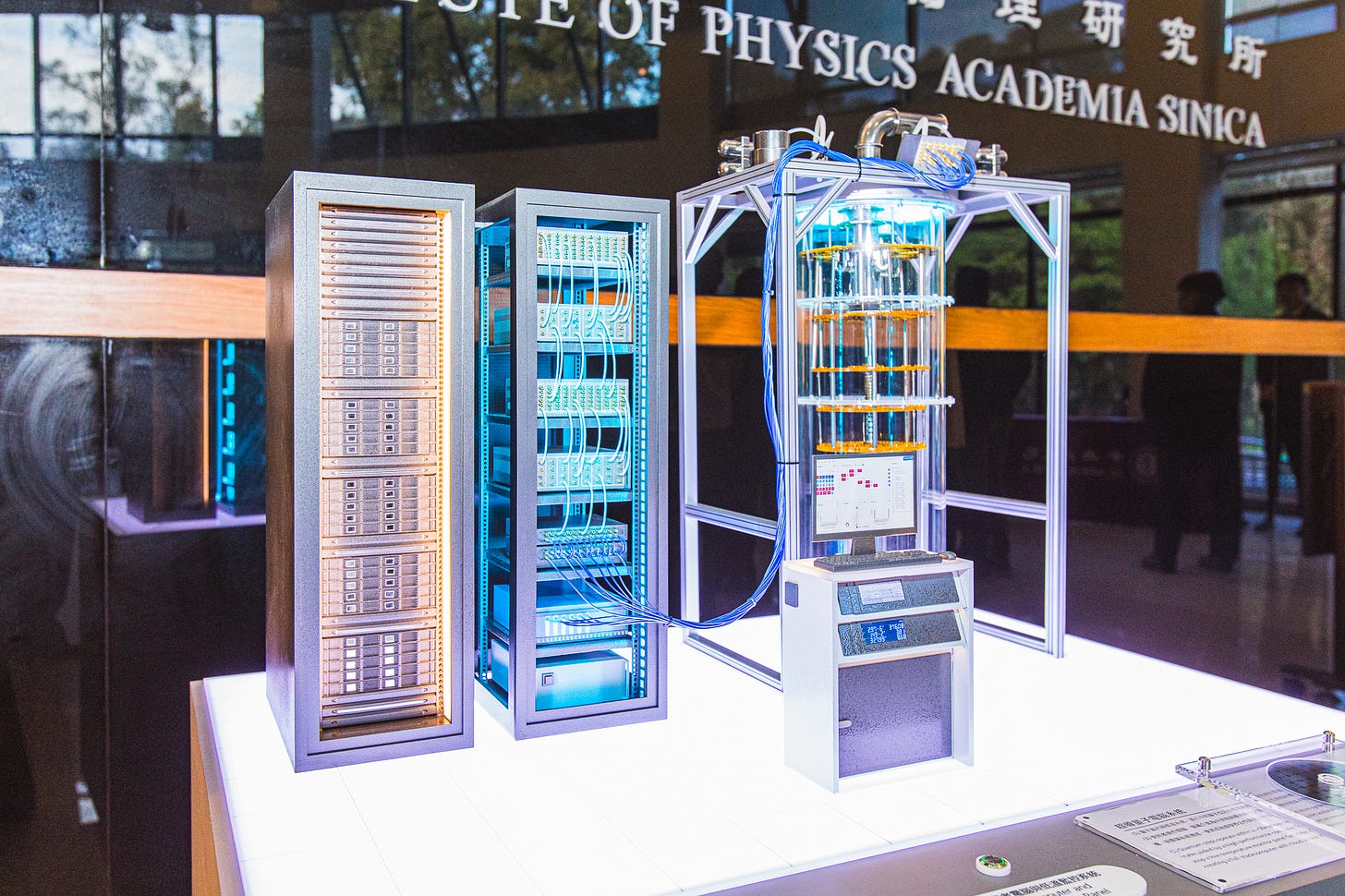
Quantum Computing and Algorithm Development
Focuses on various technical approaches such as superconducting qubits, ion traps, and photonic platforms. Supports the development of prototype systems and algorithm R&D in university quantum labs. Academia Sinica and National Tsing Hua University are currently developing superconducting and photonic platforms respectively.
Quantum Communication and Security
Establishes a Quantum Key Distribution (QKD) test network via the National Center for High-performance Computing (NCHC), and conducts cross-border collaboration tests with other Asia-Pacific countries.
Quantum Talent Cultivation and Industry Alignment
Universities like NTU, NCTU, and NCKU offer quantum information programs and encourage partnerships with companies like TSMC, MediaTek, and Foxconn to bridge academia and industry.
ITRI and the Ministry of Economic Affairs are also planning quantum device production platforms and domestic supply chain development to enhance system integration from materials and measurement to manufacturing and applications.
Future Opportunities in Quantum Technology
Pharmaceuticals and Chemical Simulation: Simulating molecular structures and reactions tens of thousands of times faster than classical models, aiding drug development and material innovation.
Financial Risk Modeling and Portfolio Optimization: Quantum algorithms can improve efficiency in high-dimensional optimization problems.
Machine Learning and Data Analysis: Quantum-accelerated model training and feature search may lead to breakthroughs in big data scenarios.
Quantum Communication and Cybersecurity: Unbreakable quantum encryption technologies can secure future 5G and 6G networks.
AI Acceleration and Hybrid Computing Architectures: Quantum+AI heterogeneous collaboration could be a critical path for future supercomputing.
NVIDIA's View and Role in Quantum Computing
While NVIDIA does not develop quantum hardware, it is highly engaged in the field through:
Simulation Platforms and Hybrid Architecture Support
Launched the "cuQuantum" framework to simulate qubit operations using GPUs, enabling algorithm development in the absence of scalable qubit hardware.
Promoting Hybrid Quantum-Classical Platforms
Believes quantum processors (QPUs) will work alongside GPUs and CPUs in hybrid systems optimized for specific workloads.
Partnerships with Quantum Startups
Collaborates with IonQ, Pasqal, Classiq, and others to provide software acceleration and facilitate integration of CUDA/GPU architecture into quantum controllers and simulators.
AI and Quantum Integration
NVIDIA forecasts that AI will enhance quantum control, error correction, and code optimization. Quantum computing may assist in structure search and solution space exploration in AI model development.
Although still maturing, quantum computing is quickly moving from theory to practical use, becoming a potential foundation for AI, HPC, communications, and cybersecurity. Taiwan, with its strong semiconductor foundation and software talent, has an opportunity to secure a prominent role in this emerging field through collaboration with global platforms like NVIDIA, D-Wave, IBM, and QAI.
Foxconn Research Institute's Quantum Strategy: From Theoretical Breakthroughs to Industrial Applications

As countries and corporations compete in next-generation computing, quantum computing has become central to technology policy and corporate R&D. Foxconn, a global manufacturing and tech leader, has joined the quantum race through itsFoxconn Research Institute, establishing itself in both Taiwan and the international quantum community through a dual focus on theoretical and application-driven initiatives.
International Breakthrough in Quantum Cryptography
In 2025,Foxconn Research Instituteproposed the first encryption structure not dependent on one-way functions, based on meta-complexity, laying the foundation for a new quantum-safe architecture. This work was accepted by Crypto, a top-tier cryptography conference, highlightingFoxconn Research Institute’s global academic recognition.
Beyond academic innovation, this reflectsFoxconn Research Institute's foresight in future quantum networking and security challenges, such as unbreakable encryption and quantum random number generation.
Proof of Quantum Circuit Advantage
In early 2025,Foxconn Research Institutepublished a key paper inNature Communications, demonstrating that shallow quantum circuits outperform classical ones in specific tasks without relying on complex assumptions. Led by Prof. Hsieh Ming-Hsiu, this work affirms Taiwan's capabilities in quantum supremacy.
This forms a foundation for future development of practical quantum algorithms and acceleration modules.
Resource Optimization for Fault-Tolerant Quantum Computing
At QIP 2025,Foxconn Research Institutepresented a breakthrough showing that resource redundancy in fault-tolerant systems does not scale linearly with system size, reducing the threshold for building large-scale quantum computers.
The research received the QIP Best Student Paper Award, affirming the strength ofFoxconn Research Institute’s young research team.
Application-Driven Strategy: Integrating Foxconn's Core Businesses
Foxconn Research Institutefocuses on industrial scenarios, applying quantum algorithms to:
Explore new material properties in EV and battery R&D.
Predict complex molecular structures in smart healthcare and drug design using quantum ML.
Integrate with AI, HPC, and cybersecurity departments to build hybrid quantum computing platforms.
This strategy exemplifies HHRI’s approach to technology translation, leveraging Foxconn's manufacturing and system integration capabilities.
Building R&D Infrastructure: Ion Trap Labs and Academia-Industry Partnerships
In 2023,Foxconn Research Instituteestablished an ion-trap quantum lab focused on advanced measurements, control technologies, and component verification. It also collaborates with top universities like NTHU, NYCU, and Academia Sinica to build a full pipeline from quantum devices and control theory to commercial applications.

From Taiwan to the Global Quantum Ecosystem
Foxconn Research Institute's quantum roadmap reflects a transition from academic innovation to industrial translation, signaling quantum technology's commercial and industrial potential. With breakthroughs in cryptography, algorithmic superiority, fault-tolerant architecture, and practical integration, HHRI is outlining a path for Taiwan to lead in quantum transformation. This journey deserves the attention and participation of industry, academia, and policymakers alike.


【Unlocking Quantum Opportunities】British Columbia × Taiwan: A New Chapter for Quantum Innovation and Collaboration
As quantum technology transitions from theory to real-world applications, global leaders are racing to build the future of quantum computing, communication, and materials. Among them,British Columbia (BC), Canada, is rapidly emerging as a hub of quantum innovation in North America, whileTaiwanis advancing its own national quantum strategy through policy, research, and talent development. The two regions bring highly complementary strengths—from hardware and algorithms to education and commercialization—offering rich potential for collaboration.
To catalyze cross-border dialogue and uncover partnership opportunities, we warmly invite you to join theBC–Taiwan Quantum Technology & Business Opportunities Webinar, where academic and industry experts from both regions will share frontier insights and breakthroughs.

Event Date & Time
•July 30, 2025 (Vancouver time)
•July 31, 2025 (Taipei time)
Scan to join

Format
Online. The meeting link will be provided upon successful registration.
Why You Should Attend
Gain First-Hand Insights: Learn how British Columbia is building a quantum innovation ecosystem through academia-industry-government collaboration.
Explore Taiwan’s Quantum Vision: Understand Taiwan’s strategic direction in quantum communication, computing, and workforce development.
Connect Globally: Discover academic and commercial opportunities for joint development, investment, and technology transfer between Taiwan and Canada.
Featured Speakers

Prof. Ching-Ray Chang|Academician, Academia Sinica; Former Vice President, National Taiwan University
A leading figure in Taiwan’s quantum research community, Prof. Chang specializes in quantum information theory, photonic quantum technologies, and quantum-secure communication. He will share the latest progress in Taiwan’s national quantum initiative and the challenges of translating research into industry applications.

Dr. Alan Baratz|President & CEO, D-Wave Quantum Inc.
D-Wave is the world’s first company to commercialize quantum computing systems, focusing on quantum annealing and applied quantum solutions for logistics, finance, healthcare, and more. Dr. Baratz will present D-Wave’s recent developments in real-world quantum applications.

Dr. Phil Barker|Executive Director, Quantum Algorithms Institute (QAI)
Founded by the BC government, QAI fosters quantum algorithm development and connects researchers, startups, and corporations. Dr. Barker will introduce QAI’s initiatives for industry engagement, workforce training, and ecosystem scaling.

Dr. Mohammad Mohseni|Director, Quantum Devices Lab, University of British Columbia (UBC)
UBC is a leading institution in quantum materials and superconducting circuits. Dr. Mohseni will highlight cutting-edge research from his lab and discuss collaborative models between academia and industry within the Canadian quantum landscape.
From Materials and Algorithms to Commercialization — Seize the Moment for Quantum Collaboration
This webinar is more than a showcase—it’s an invitation to co-create the future of quantum science and technology. Whether you’re a researcher, entrepreneur, policymaker, or investor, this is your chance to gain global insights, forge meaningful connections, and explore new frontiers in quantum innovation.
For inquiries, please feel free to contact the organizers.
British Columbia Taiwan Office - Joanne Tsai : 02-8723-3037/ TAPEI-BC@international.gc.ca


PreviousNext
TopLatestDiscussions








See all