Beyond NVLink: Celestial AI’s Photonic Interconnect Leadership and Capital Strategy in the Trillion-Parameter AI Era
Beyond NVLink: Celestial AI’s Photonic Interconnect Leadership and Capital Strategy in the Trillion-Parameter AI Era
- Source: SemiVision
- Author: SEMIVISION
- Published: 2025-07-04T10:04:37+08:00
- URL: https://tspasemiconductor.substack.com/p/beyond-nvlink-celestial-ais-photonic Beyond NVLink: Celestial AI’s Photonic Interconnect Leadership and Capital Strategy in the Trillion-Parameter AI Era


Beyond NVLink: Celestial AI’s Photonic Interconnect Leadership and Capital Strategy in the Trillion-Parameter AI Era
Original Articles By SemiVision Research (Celestial AI, Nvidia ,TSMC)

Jul 04, 2025
∙ Paid

Celestial AI is a Silicon Valley startup based in Santa Clara, California, dedicated to developing Photonic Fabric—a breakthrough optical interconnect platform designed to address the "memory wall" bottleneck in today’s AI computing architectures. By leveraging optical interconnects, Celestial AI delivers high bandwidth, low latency, and low power solutions that support AI accelerator scaling from intra-chip to multi-rack deployments.

In current architectures for generative AI and large model inference, the “memory wall” has emerged as a critical barrier to system performance scaling. This phenomenon arises from a severe mismatch between the data access speed of compute units (such as GPUs) and memory modules. As model sizes have ballooned from billions to tens of trillions of parameters, the GPU’s immense computing power is often underutilized, constrained by insufficient memory bandwidth and latency bottlenecks—leading to a paradox of idle compute and memory starvation.
As of 2025, Celestial AI has successfully completed multiple funding rounds, raising over $515 million in total. Its investor base includes some of the world’s leading tech companies, venture capital firms, and strategic partners—underscoring strong industry confidence in its photonic interconnect technology.

Key investors include:
Fidelity Management & Research Company: Led the$250 million Series C1round in March 2025, bringing Celestial AI’s valuation to$2.5 billion.
BlackRock: One of the world’s largest asset managers; participated in the Series C1 round.
Maverick Silicon: A firm focused on advanced semiconductor technologies; joined the C1 round.
Tiger Global Management: A globally recognized investment firm; part of the C1 round.
Lip-Bu Tan: Former CEO of Cadence and current Intel CEO ; participated personally in the C1 round.
AMD Ventures: AMD’s corporate venture arm; has been a consistent backer of Celestial AI.
Koch Disruptive Technologies (KDT): The innovation investment division of Koch Industries; joined multiple rounds.
Temasek Holdingsand its subsidiaryXora Innovation: Singapore’s sovereign wealth fund and its innovation arm; participated in multiple rounds.
Porsche Automobil Holding SE: The German automotive giant; invested across multiple rounds.
The Engine Ventures: A venture firm incubated by MIT; participated in multiple rounds.
Samsung Catalyst Fund: Samsung’s innovation investment unit; joined multiple rounds.
M Ventures: The venture arm of Merck Group; an active investor in multiple rounds.
Tyche Partners: A VC firm specializing in deep tech; took part in multiple rounds.
These investors have contributed not only capital but also valuable strategic resources and industry connections, accelerating Celestial AI’s innovation and commercialization in photonic interconnect technologies.
Celestial AI is quickly positioning itself as the defining force behind next-generation AI datacenter interconnect and memory architectures. Rather than being simply another Co-Packaged Optics (CPO) solution, Photonic Fabric represents a full-stack optical platform purpose-built for the future of AI systems. Its strengths in energy efficiency, scalability, modular design, and support for large-scale AI inference give it the potential to reshape the industry landscape.
CEO David Lazovsky – Key Commentary
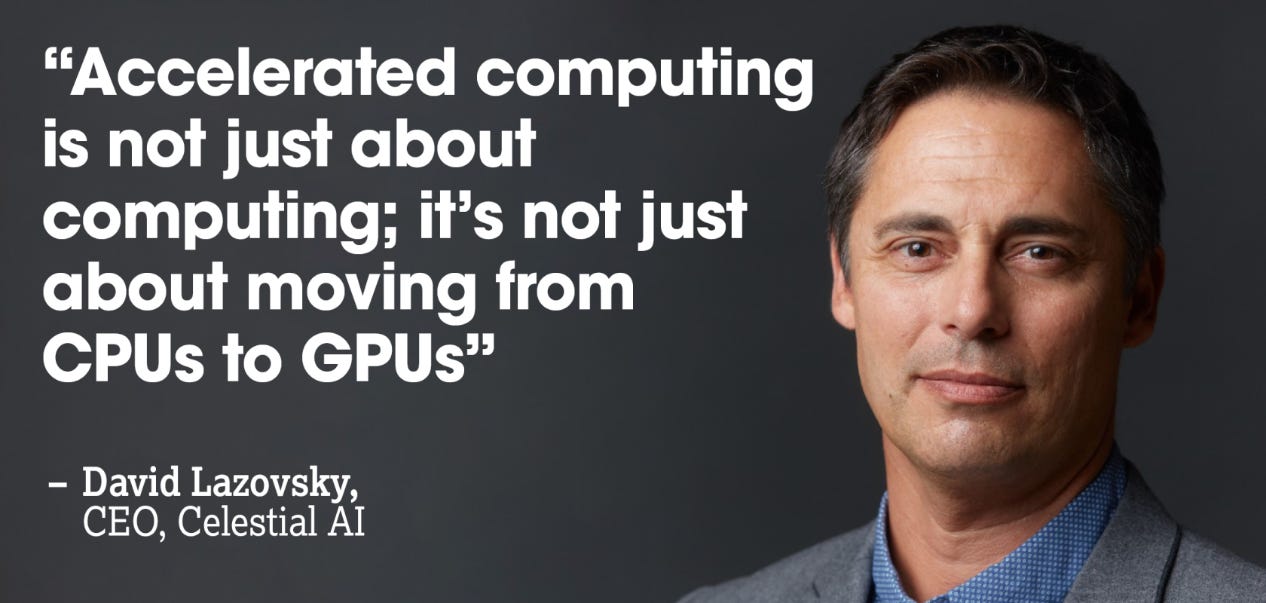
“AI infrastructure is evolving from single XPUs to thousands of interconnected processors across racks. Traditional interconnect architectures have become bottlenecks. Photonic Fabric is the only full-stack platform capable of simultaneously solving bandwidth, latency, energy efficiency, and total cost of ownership (TCO) challenges.”
Investor & Partner Endorsements
BlackRock: In the midst of explosive AI growth, Celestial AI holds a “unique advantage.”
Maverick Silicon: Its terabit-per-second interconnect and in-network compute capabilities are reshaping AI infrastructure.
Diane Bryant (Board Member, Broadcom): The company’s technology delivers "unmatched performance and energy efficiency," and is transforming AI networking and memory architecture.
Where Is Celestial AI Heading?
Celestial AI is rapidly becoming the defining force in next-generation AI data center interconnect and memory architecture. Rather than being just another Co-Packaged Optics (CPO) solution, Photonic Fabric is a full-stack optical platform purpose-built for the architectures of future AI systems. Its potential to disrupt the industry lies in its superior energy efficiency, scalability, modular design, and ability to support massive model inference workloads.

For Paid Members , SemiVision will discuss topics on
Driving AI Architecture Transformation Through Optical Interconnect
Celestial AI’s EAM Modulator Technology and Industry Challenges
Three Key Symptoms of the Memory Wall
The Solution: Decoupling Compute from Memory + Optical Interconnect Architecture
Key Advantages of Celestial AI’s Solution:
Celestial AI and the Next Generation of Optical I/O: Breaking the Memory Wall and Scaling Future AI Inference Infrastructure
HBM + DDR5: An Integrated Optical Interconnect Architecture
Photonic Fabric IP and Technology Integration
SemiVision’s Summary of Celestial AI’s Four Core Technologies: Building the Next-Gen Optical Interconnect Infrastructure
① Thermally Stable GeSi Electro-Absorption Modulators (EAMs)
② Advanced Packaging Integration (in collaboration with TSMC, 2.5D/3D platforms)
③ DSP-Free Direct Drive Architecture
④ Full-Stack Electro-Optical Protocol Optimization (Gearbox-free, Channel-Level Architecture)
Celestial AI Product Architecture: The Three Core Offerings Built on Photonic Fabric Technology
①. PFLink™: Optical Interconnect Between XPUs
② . PFSwitch™: Low-Latency, High-Bandwidth Optical Switch
③. OMIB™: Optical Multi-die Interconnect Bridge
Why Is Celestial AI’s Photonic Fabric the Next "NVLink Replacement" for AI Infrastructure?
A Three-Layer Deconstruction of Celestial AI’s Optical Interconnect Architecture Shift
Driving AI Architecture Transformation Through Optical Interconnect
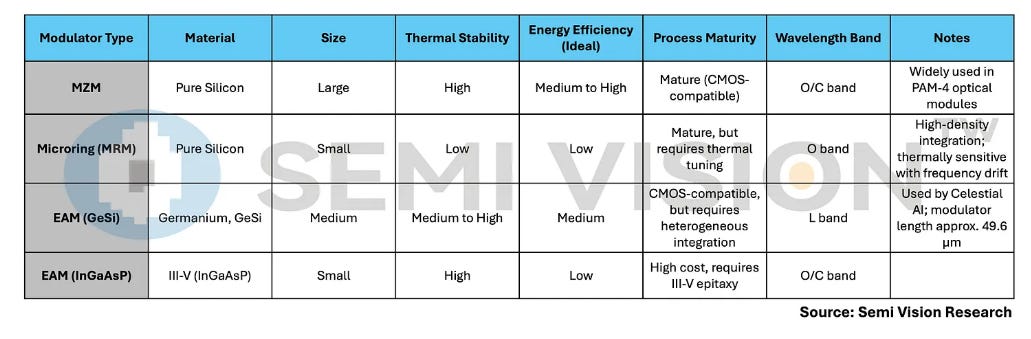
At OFC 2024, Celestial AI unveiled its Photonic Fabric platform, positioning it as a comprehensive optical interconnect solution supporting both chip-to-chip and compute-to-memory communication. The platform leverages germanium-silicon (GeSi) electro-absorption modulators (EAMs)—a distinct alternative to mainstream silicon photonics modulation approaches such as Mach-Zehnder Modulators (MZMs) and microring resonators (MRMs).
Celestial AI’s EAM Modulator Technology and Industry Challenges
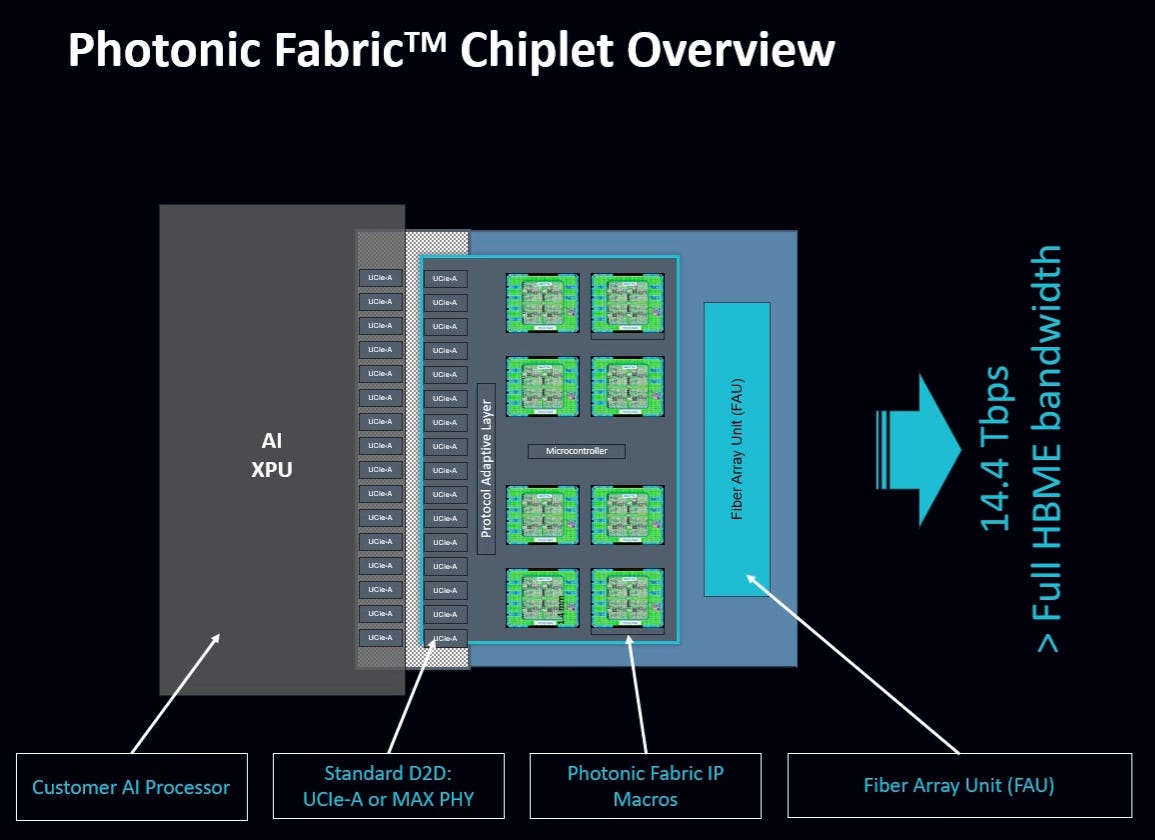
Celestial AI is the world’s first company to launch a Photonic Interconnect Chip, known as the Photonic Fabric Appliance (PFA). By leveraging its proprietary germanium-silicon (GeSi) electro-absorption modulators (EAMs) and advanced high thermal stability packaging, the company has achieved an industry-leading 14.4 Tbps chiplet-to-chiplet bandwidth—vastly surpassing conventional NVLink or PCIe architectures. This platform not only enables massive-scale expansion across thousands of XPUs, but also integrates HBM3e and DDR5 to form a shared memory pool of up to 32 TB, effectively decoupling compute from memory and breaking through the physical limitations of traditional data center memory configurations.
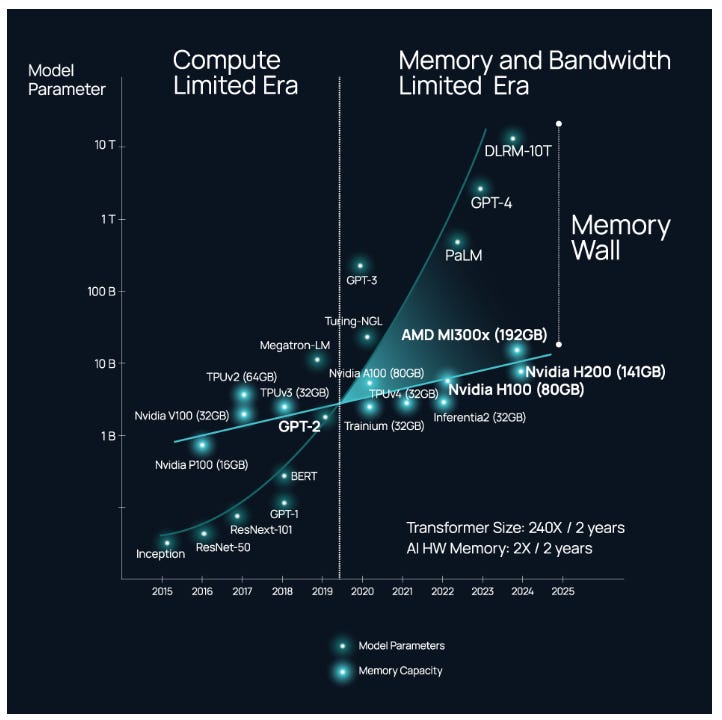
In current architectures for generative AI and large model inference, the “memory wall” has emerged as a critical barrier to system performance scaling. This phenomenon arises from a severe mismatch between the data access speed of compute units (such as GPUs) and memory modules. As model sizes have ballooned from billions to tens of trillions of parameters, the GPU’s immense computing power is often underutilized, constrained by insufficient memory bandwidth and latency bottlenecks—leading to a paradox of idle compute and memory starvation.
Three Key Symptoms of the Memory Wall
High Data Movement Costs
During AI model inference, parameters and activation values must be frequently exchanged between GPUs. The bandwidth and latency limitations of NVLink or PCIe interconnects fail to keep up with these demands.
Limited Available Memory
Even with GPUs equipped with HBM3e, the memory per card is constrained by packaging limits (typically around 80–100 GB), making it difficult to load terabyte-scale models in real time.
Rising TCO for Training and Inference
To accommodate large models and datasets, more GPUs must be deployed—driving up resource utilization and total cost of ownership (TCO).
The Solution: Decoupling Compute from Memory + Optical Interconnect Architecture
To overcome the limitations of the memory wall, Celestial AI has introduced a groundbreaking solution:
Through its Photonic Fabric technology, Celestial AI decouples memory from compute units, reshaping the architecture of AI systems:
Decoupling memory from GPU packaging constraints: No longer limited by the HBM capacity on a single GPU card, Photonic Fabric enables GPUs to interconnect with external shared HBM clusters—building a shared memory pool of up to 32TB.
Ultra-high-speed optical interconnects (PFLink / PFSwitch): Supporting 28.8 TB/s per channel bandwidth, far exceeding NVLink or PCIe, while dramatically reducing latency to the 150-nanosecond range.
Dynamic resource scheduling and memory virtualization: Allows XPU clusters to access remote memory in real time, greatly improving resource utilization efficiency.
Key Advantages of Celestial AI’s Solution:
Off-package bandwidth is 30× greater than mainstream interconnect technologies
Latency and power consumption are reduced by a factor of 10×
Exceptional thermal stability, enabling deployment on high-TDP ASICs without the need for DSPs
Fully compatible with current 2.5D/3D packaging processes and standard interconnect protocols such as CXL and PCIe
With strategic partners such as AMD, Broadcom, and Samsung, Celestial AI is more than a leader in photonic interconnect—it is a blueprint architect for the future of AI infrastructure. As Intel board member and former Cadence CEO Lip-Bu Tan stated: “The transformation enabled by Photonic Fabric will be as profound for infrastructure as GPT has been for AI models.”

Celestial AI and the Next Generation of Optical I/O: Breaking the Memory Wall and Scaling Future AI Inference Infrastructure
As Large Language Models (LLMs) and Deep Recommendation Models (DRMs) continue to scale into the tens of trillions of parameters, today’s memory architectures—centered around HBM (High Bandwidth Memory)—are reaching their physical and economic limits. While traditional GPUs couple compute and memory tightly to deliver high bandwidth, this architecture runs into a major constraint: the memory wall, where limited memory capacity becomes the key bottleneck for efficient AI training and inference at the terabyte scale.
Celestial AI’s Photonic Fabric Appliance (PFA) is a revolutionary solution purpose-built to address this challenge. By leveraging optical interconnects, PFA effectively decouples compute (XPU) from memory (HBM/DDR), creating a new architectural path for scalable and efficient AI inference infrastructure.

Core Technical Highlights
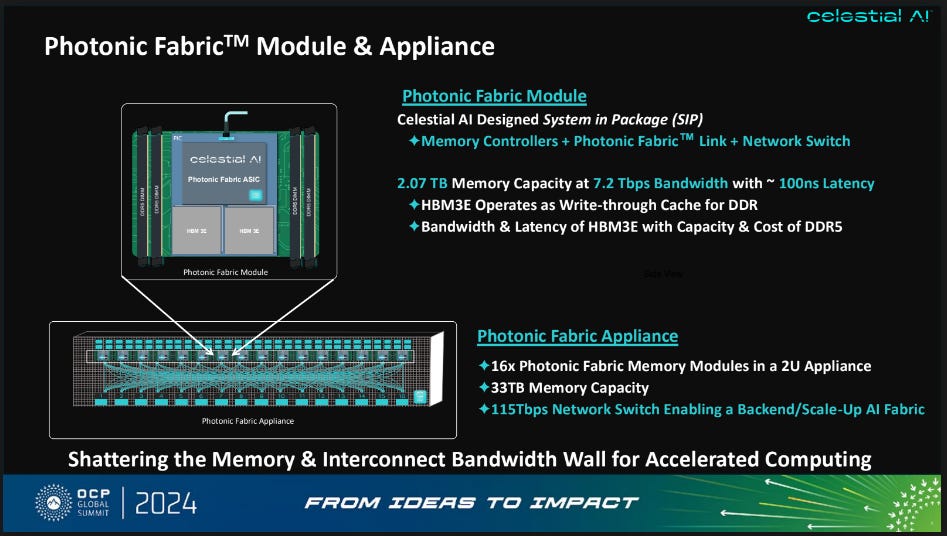
Each PFA module integrates two HBM3e stacks with a high-bandwidth photonic interconnect system, featuring an 8 Tbps switching capacity.
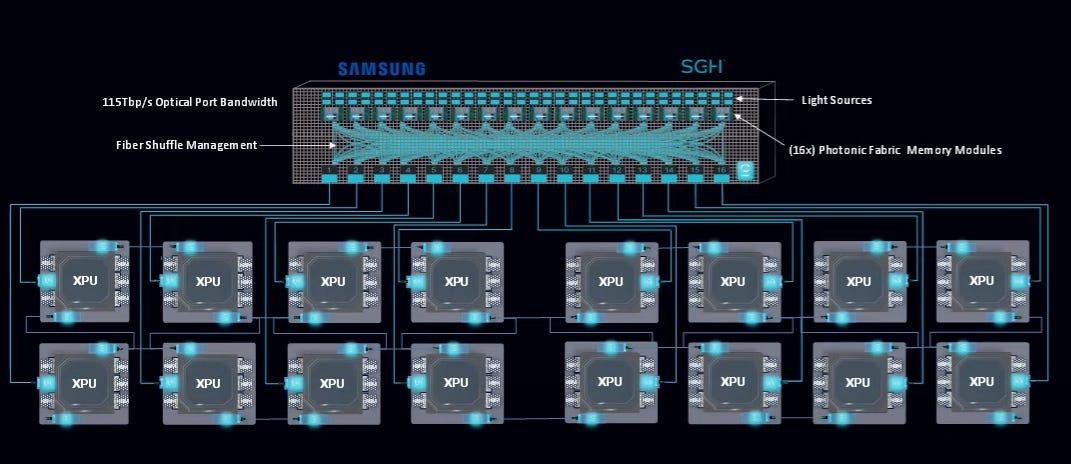
16 PFM (Photonic Fabric Modules) form a complete PFA, delivering a 32TB shared memory pool and 256 photonic interconnect ports to XPU clusters.
Powered by GeSi electro-absorption modulators (EAMs), PFA achieves 56 Gbps NRZ signaling with 1.8 Vpp drive, combining high bandwidth density with excellent thermal stability and low power consumption.
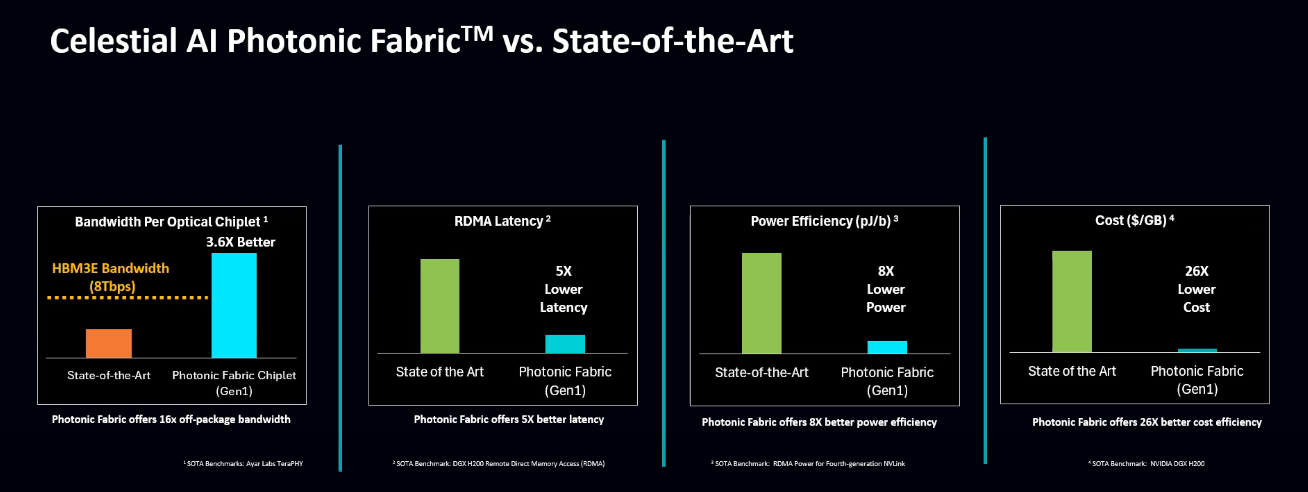
Each module offers 150 ns low-latency transmission, with energy efficiency down to a few picojoules per bit (pJ/bit). Real-world benchmarks show over 22× inference throughput compared to GPU systems using NVLink.

HBM + DDR5: An Integrated Optical Interconnect Architecture
While HBM has traditionally been viewed as the gold standard for AI memory, Celestial AI challenges this notion:
HBM faces physical limitationsin stack height and package area, restricting linear capacity scaling.
HBM is expensive, with much higher per-GB cost than DDR5, making it difficult to optimize system scale and total cost of ownership (TCO).
Celestial AI’s Solution: Hybrid HBM + DDR5 Pooling
Celestial AI introduces anovel hybrid memory pooling architecture:
Each PFM module contains two HBM3e stacks and four DDR5 DIMM channels, connected via the Photonic Fabric to a separate pool of XPUs.
This architecture creates a high-bandwidth, high-capacity, and cost-effective memory pool, enabling fast data loading and large-model inference.
Celestial AI calls this: “A Boosted Grace-Hopper without the system tax” —
an architecture that is more flexible and cost-effective than NVIDIA’s Grace-Hopper, without the burden of complex system integration.
Celestial AI’s Photonic Fabric technology not only addresses the bandwidth and latency bottlenecks of traditional packaging and memory architectures, but also lays the groundwork for the trillion-parameter AI era through several architectural breakthroughs. These include decoupling XPUs from HBM/DDR memory resources, implementing optical interconnects, and introducing multi-tier connectivity and distributed memory pooling.
This paradigm-shifting approach has the potential to redefine the architecture of tomorrow’s AI compute centers.
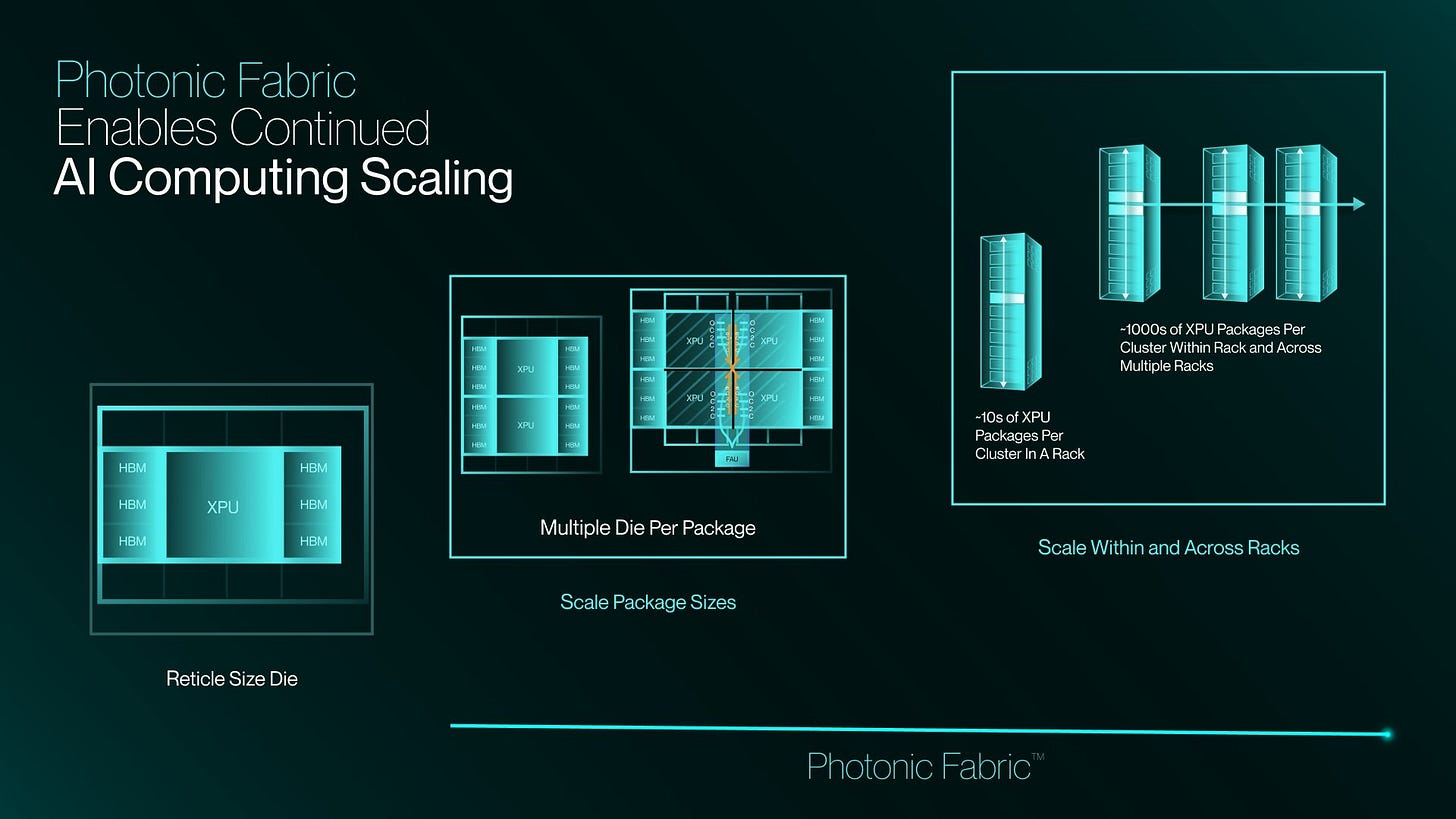
Currently, the main types of modulators in silicon photonics include Mach-Zehnder Modulators (MZM), Microring Resonators (MRM), and Electro-Absorption Modulators (EAM).

One of Celestial AI’s core technologies is its GeSi (germanium-silicon) electro-absorption modulator (EAM)-based photonic interconnect solution, which plays a pivotal role in its Photonic Fabric platform. By integrating EAMs with photonic integrated circuits (PICs), Celestial AI enables high-bandwidth, low-latency, and thermally stable optical interconnects tailored to the demanding requirements of high-performance computing (HPC) and AI data centers.
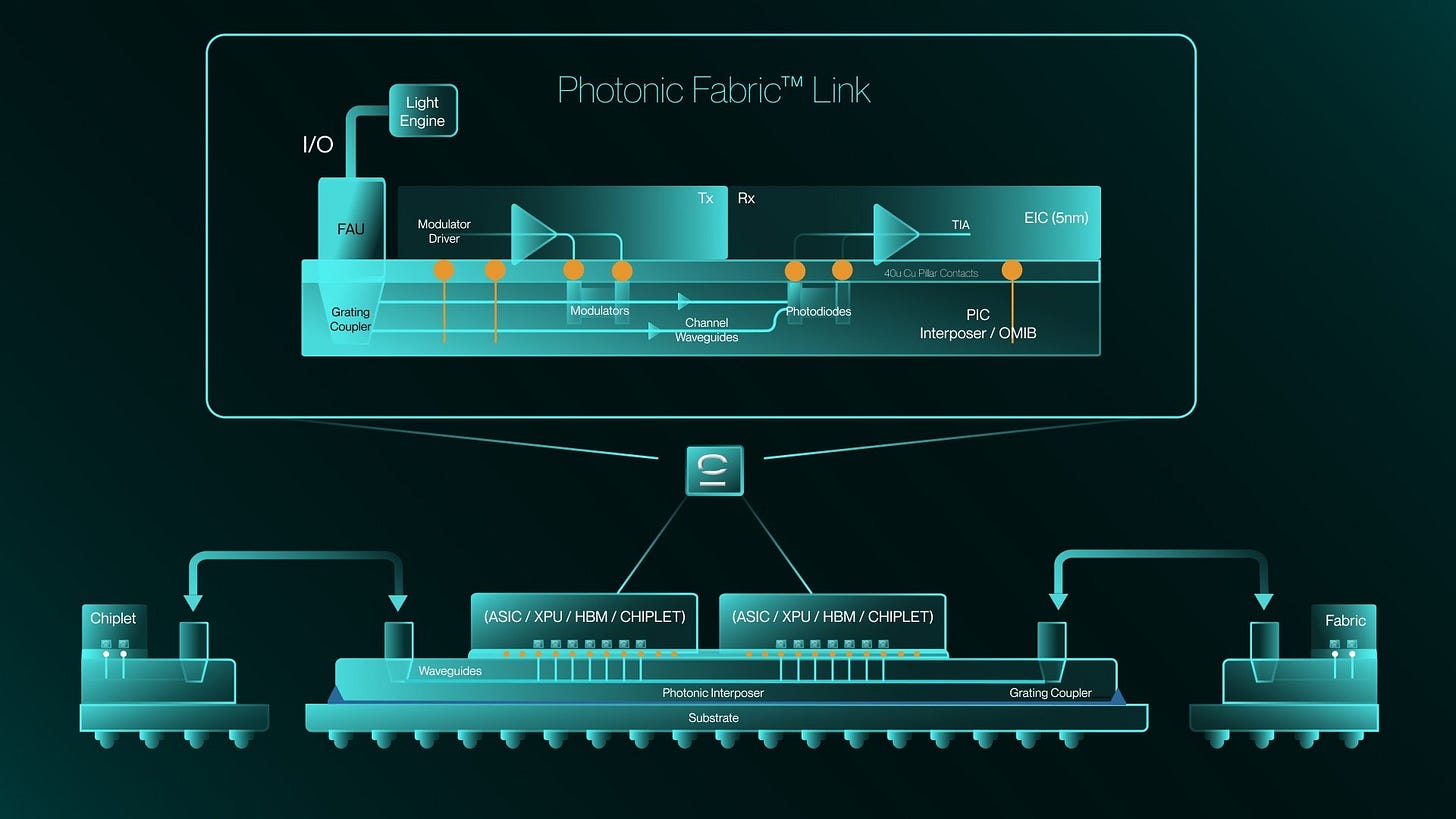
Key Features of Celestial AI’s GeSi EAM Technology:
High Bandwidth Transmission:
Celestial AI’s EAM technology supports up to 56 Gbps non-return-to-zero (NRZ) signaling and has demonstrated per-wavelength transmission speeds exceeding 300 Gbps in experimental settings, making it highly suitable for next-generation high-speed data applications.
Thermal Stability & Compact Size:
Built with GeSi materials, EAMs offer excellent thermal stability, operating reliably in high-TDP ASIC environments. With a footprint of less than 100 microns, the modulators are ideal for high-density packaging, enabling greater system-level bandwidth density.
Low Power & Low Latency:
Designed to operate with a low 1.8 Vpp drive voltage, EAMs deliver latency as low as 150 nanoseconds and ultra-low energy consumption of just a few picojoules per bit (pJ/bit), significantly reducing total system power draw.
Not only does Celestial AI possess advanced photonic IP technology, it has also taken significant steps to enhance and integrate its Photonic Fabric IP portfolio.
Photonic Fabric IP and Technology Integration
To strengthen its photonic interconnect capabilities, Celestial AI acquired the silicon photonics intellectual property of Rockley Photonics in 2024. This acquisition brought in over 200 global patents covering fields such as optoelectronic system packaging, electro-absorption modulators (EAMs), and photonic switching technologies. By integrating this IP, Celestial AI has solidified its leadership position in optical computing interconnects, accelerating the commercialization of its Photonic Fabric platform across AI data center infrastructure.
In addition, the Photonic Fabric technology platform supports a range of product formats, including:
PFLink™: chiplet-to-chiplet interconnect
PFSwitch™: low-latency, high-bandwidth optical expansion switches
OMIB™: photonic-based optical multi-chip interconnect bridges
Together, these technologies form a comprehensive optical interconnect solution, built to meet the scalability and efficiency demands of next-generation AI compute and memory systems.
Through these innovations, Celestial AI is targeting the fundamental limitations of traditional electronic interconnects—namely, bandwidth, latency, and energy consumption—offering a high-performance, scalable optical interconnect solution for future AI infrastructure.
Proven Performance Gains
According to internal testing by Celestial AI, the Photonic Fabric architecture delivers over 20× improvement in inference throughput on large-scale DLRM (Deep Learning Recommendation Models) compared to traditional architectures. These gains are achieved under the same power envelope, resulting in significantly higher performance density.
This optical interconnect-driven decoupled architecture not only serves as a key enabler in overcoming the memory wall, but also stands to become the cornerstone of next-generation AI super-infrastructure.
SemiVision’s Summary of Celestial AI’s Four Core Technologies: Building the Next-Gen Optical Interconnect Infrastructure
To address the growing challenges of the “memory wall” and interconnect bottlenecks in AI computing, Celestial AI has developed a full-stack solution encompassing silicon photonics, advanced packaging, module design, and system-level protocols. Its core technology can be summarized into four key capabilities:

① Thermally Stable GeSi Electro-Absorption Modulators (EAMs)
Celestial AI adopts Electro-Absorption Modulation (EAM) to replace traditional Mach-Zehnder Modulators (MZMs). The key advantages include:
Non-interferometric architecture, inherently insensitive to temperature fluctuations, offering exceptional thermal stability.
Direct proximity integration with high-thermal-density ASICs (e.g., XPUs exceeding 100W TDP).
Operates in the L-band, rather than the O-band, making it more suitable for long-distance and multi-wavelength data center interconnects.
② Advanced Packaging Integration (in collaboration with TSMC, 2.5D/3D platforms)
Celestial AI works closely with TSMC on process and packaging innovations:
Utilizes TSMC’s 4nm/5nm CMOS process nodes to fabricate drivers and transimpedance amplifiers (TIAs).
Implements CoWoS-S and CoWoS-L platforms for high-density optoelectronic integration.
Achieves 2.5D and 3D integration between electronic ICs (EIC) and photonic ICs (PIC), improving packaging bandwidth density while reducing form factor constraints.
③ DSP-Free Direct Drive Architecture
Celestial AI’s Direct Drive architecture sends electrical signals directly to the optical modulator, eliminating the need for a digital signal processor (DSP):
Avoids the power and latency overhead introduced by DSPs.
Leverages short RF links to improve signal-to-noise ratio (SNR) and reduce bit error rate (BER).
Supports high-speed, low-power, low-latency operation—ideal for multi-module coordination in AI workloads.
④ Full-Stack Electro-Optical Protocol Optimization (Gearbox-free, Channel-Level Architecture)
Celestial AI redefines channel design with deepprotocol-layer optimization, offering:
Elimination of Gearboxes, which typically introduce energy and latency overhead for speed translation.
Support for UCIe 16G/32G electrical inputs, outputting a standardized 56G optical signal.
Built-in protocol logic includes:
FEC (Forward Error Correction)for link stability and reliability.
CRC (Cyclic Redundancy Check)for data integrity.
FLIT Replayfor fault tolerance and retransmission control.
Celestial AI is not merely a photonics company—it is a vertically integrated electro-optical platform provider, bridging everything from modulator materials to protocol logic, from packaging to interconnect architecture. With these four core innovations, its Photonic Fabric technology overcomes traditional thermal, bandwidth, and distance limitations—laying a scalable and sustainable foundation for the future of AI infrastructure.
Celestial AI Product Architecture: The Three Core Offerings Built on Photonic Fabric Technology
①. PFLink™: Optical Interconnect Between XPUs
PFLink is Celestial AI’s core optical interconnect product, enabling high-speed chip-to-chip (XPU-to-XPU) connections. It supports multiple interfaces, including UCIe, AXI, UAL, and proprietary protocols. Available as either a chiplet or licensed IP, the first-generation PFLink delivers up to 14.4 Tbps per die and supports distances of over 50 meters across multi-rack clusters.
To overcome this, Celestial AI developed the Photonic Fabric Appliance (PFA) platform, which decouples compute from memory via optical interconnects. A PFA comprises 16 Photonic Fabric Modules (PFMs), each integrating two HBM3e stacks, an 8 Tbps optical switch (2.5D package), and an active optical bridge co-designed with ASICs. This configuration enables up to 32TB of shared memory, full HBM3e bandwidth, latency as low as 100ns, and power consumption of only 2.4 pJ/bit—significantly outperforming NVLink or PCIe.
The second generation of Photonic Fabric further improves bandwidth density by upgrading SerDes from 56 Gbps NRZ to 112 Gbps PAM4 and doubling the channel count from 4 to 8, pushing per-die bandwidth to 28.8 Tbps and density to 1.8 Tbps/mm².
② . PFSwitch™: Low-Latency, High-Bandwidth Optical Switch
PFSwitch™ is a critical optical switching module tailored for next-generation AI supercomputing infrastructure. It is a system-in-package (SiP) solution under the Photonic Fabric architecture. Integrating high-speed optical switching cores, scalable port configurations, and low-latency forwarding engines, PFSwitch enables full optical interconnect among thousands of heterogeneous compute units (e.g., GPUs, ASICs, AI accelerators).
Delivering tens of Tbps total switching capacity, each PFSwitch channel supports 56 to 112 Gbps, with typical end-to-end latency around 150 ns under full load—vastly outperforming electronic switching systems like NVSwitch. By utilizing optical links, PFSwitch avoids signal degradation and power bottlenecks at high frequencies. It also employs DSP-free operation via GeSi modulators and low-power receiver architectures.
Its scalable network topologies support 16x16, 32x32, and even larger Clos/Fat Tree/Banyan networks. Each node can link to a dedicated PFM and XPU group, enabling a "virtual super XPU" capable of cooperative distributed training and inference.
PFSwitch features dynamic bandwidth allocation, optical path selection, and integrated synchronization mechanisms, with support for industry-standard interfaces like CXL, UCIe, and PCIe. This ensures seamless integration into existing data center environments.
Collaborations with CSPs and AI platform providers are ongoing, with commercial deployment expected between 2026 and 2027.
③. OMIB™: Optical Multi-die Interconnect Bridge
OMIB™ is Celestial AI’s advanced solution for overcoming bandwidth and thermal challenges in heterogeneous chiplet-based packages. Compared to traditional electronic interconnects like EMIB or, OMIB offers superior performance and flexibility.
It integrates GeSi electro-absorption modulators (EAMs) and low-power receiver circuits (including TIA and analog front-end equalizers), delivering over 14.4 Tbps total die-to-die bandwidth, with individual lanes supporting 56 to 112 Gbps using NRZ or PAM4 signaling. Its optical links require no thermal tuning and can operate in high-TDP ASIC packages, offering advantages over thermally sensitive MRM modulators.
OMIB is fully compatible with standard 2.5D/3D packaging, including interposer, RDL, wafer-level packaging, and TSMC CoWoS, InFO, and SoIC flows. A single OMIB module can connect 4–8 logic or memory dies (e.g., XPU, HBM, switch dies), ideal for chiplet-based AI modules, memory pooling, and high-speed switching.
It can also be integrated into the PFA platform, linking AI accelerators and memory clusters within a single package. OMIB supports CXL/PCIe standards, enabling flexible memory disaggregation in data center architectures.
Integrated Platform: Photonic Fabric Appliance (PFA)
The PFA is Celestial AI’s all-in-one platform, combining PFLink, PFSwitch, and OMIB into a unified solution that delivers 32TB of shared memory and supports interconnect across 16 XPUs—ideal for large-scale AI inference systems.
Celestial AI has secured partnerships with major hyperscale data center operators and is actively collaborating with companies like Broadcom and Samsung to accelerate infrastructure transformation.
Future Roadmap: Scaling with Wavelength Division Multiplexing (WDM)
Currently, Celestial AI uses 4 wavelengths per fiber. According to its roadmap, future products will scale to 8 wavelengths per fiber using WDM, significantly increasing bandwidth and transmission capacity.
This multi-wavelength architecture boosts data throughput while lowering latency and power, meeting the high-performance demands of next-gen AI systems.
Photonic Fabric remains compatible with existing standards such as UCIe, CXL, and PCIe and integrates with advanced CMOS and packaging technologies from TSMC (4nm/5nm), ensuring scalability and real-world applicability.
In summary, Celestial AI is pushing the boundaries of AI infrastructure through a vertically integrated, wavelength-scalable photonic interconnect solution that enables high-efficiency, low-latency communication for trillion-parameter AI workloads.
Why Is Celestial AI’s Photonic Fabric the Next "NVLink Replacement" for AI Infrastructure?
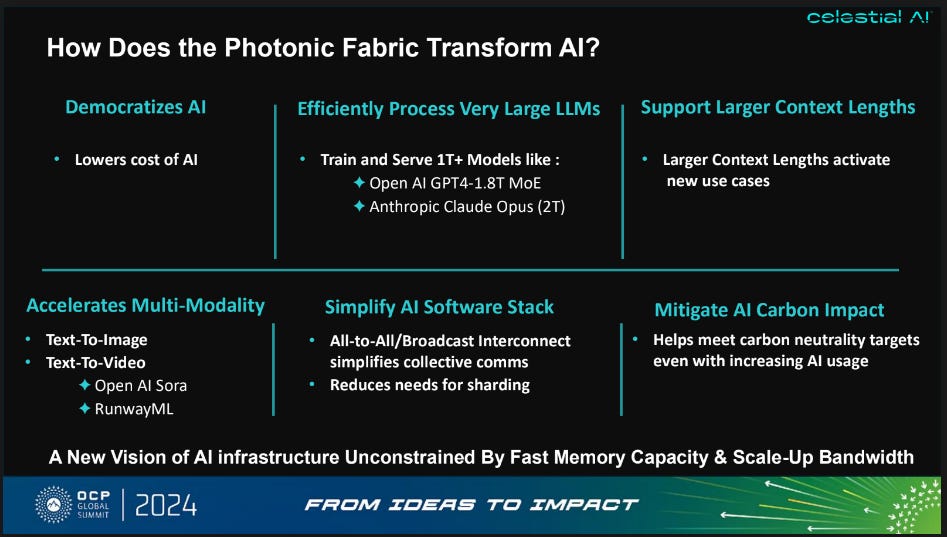
As AI models continue to grow in scale and inference becomes the primary battleground for compute performance, Celestial AI proposes a transformative architecture based on optical interconnects—Photonic Fabric™—to redefine the coupling between memory and compute units. It aims to overcome the bottlenecks of traditional electronic interconnects like NVLink/NVSwitch, particularly in latency, power consumption, and scalability.
A Three-Layer Deconstruction of Celestial AI’s Optical Interconnect Architecture Shift
① System Bottleneck Diagnosis: Tightly Coupled Compute and Memory Leads to Resource Waste
The traditional GPU + HBM tightly bound architecture lacks flexibility in memory scaling.
A Microsoft report reveals that, on average, 25% of memory in AI compute centers is idle, leading to up to 5% cost waste.
Root cause: insufficient interconnect bandwidth between cards results in "compute waiting on memory" and "memory waiting on compute."
② Technical Solution Construction: PFLink + PFSwitch Builds a Decoupled Optical Interconnect Network

PFLink & PFSwitch: The Backbone of Optical Interconnect for AI
PFLink: High-speedpoint-to-point interconnectfor direct card-to-card communication.
PFSwitch: Aglobal switching fabricthat enables cross-rack interconnects, supporting thousands of XPUs in a horizontally scalable architecture.
③ Building an Industrial Ecosystem: From Productization to Capital Alliance
Technology Leaders:
Phil Winterbottom(Former Bell Labs architect)
David Lazovsky(30-year semiconductor industry veteran)
Investor Lineup:
Fidelity, BlackRock, AMD, Samsung, IMEC, The Engine (MIT),
and Lip-Bu Tan (Current Intel Board Member & former Cadence CEO)
Strategic Partnerships:
Collaborations with Broadcom and Samsung on ASICs, advanced packaging, and memory integration.
Commercialization Timeline:
Expected to enter volume production in 2027.


PreviousNext
TopLatestDiscussions








See all