A Day in the Life of a Foundry Engineer – Presented by SemiVision Research
A Day in the Life of a Foundry Engineer – Presented by SemiVision Research
- Source: SemiVision
- Author: SEMIVISION
- Published: 2025-03-25T09:24:10+08:00
- URL: https://tspasemiconductor.substack.com/p/a-day-in-the-life-of-a-foundry-engineer (1) A Day in the Life of a Foundry Engineer – Presented by SemiVision Research


A Day in the Life of a Foundry Engineer – Presented by SemiVision Research
Media Review by SemiVision Research

Mar 25, 2025
∙ Paid
A Day in the Life of a Foundry Engineer – Presented by SemiVision Research
Get an inside look at the daily routine of a foundry engineer. From the moment they step into the fab to the detailed problem-solving they tackle across process integration, yield analysis, and customer collaboration, you’ll gain a clearer understanding of the critical role they play in the semiconductor manufacturing ecosystem.
This feature bySemiVision Researchwalks you through the real-world challenges, workflows, and mindset of engineers who ensure wafers move through hundreds of steps flawlessly — bridging design and production.
Whether you’re a student exploring careers in semiconductors or an industry veteran curious about fab-side operations, this deep dive offers valuable insights into one of the most demanding and important engineering roles in the chip world.
SemiVision Researchwill soon launch a series of articles focusing on life inside the foundry industry. These articles will explore how academic background and degree choices can directly influence your career opportunities within the semiconductor sector. Once you enter the industry, the nature of your job can greatly affect your long-term development. Semiconductor careers are not only about technical expertise — they also require strong communication skills, teamwork, and cross-disciplinary learning. In this sense, it’s an industry that demands continuous growth and lifelong learning.

In addition, we will launch a special feature on Taiwan’s semiconductor talent mobility. Every June marks the graduation season for Taiwanese graduate students, and it’s also a key hiring window for local tech companies competing for top talent. We’ll provide in-depth coverage on how companies are positioning themselves to attract the next generation of semiconductor professionals — and what this means for Taiwan’s tech workforce landscape.
Thanks to Taiwan’s media outlet for covering SemiVision Research’s article. The piece also mentioned Japanese media’s interest in Taiwan’s semiconductor industry — and for good reason. The Japanese government is actively pushing to rebuild its domestic semiconductor capability, with a major focus on investing in Rapidus, aiming to develop 2nm process technology.
However, it’s important to understand that 2nm nodes are incredibly complex, involving more than 2,000 process steps, and requiring the use of cutting-edge EUV lithography. As we’ve previously emphasized, 2nm adopts the GAA (Gate-All-Around) structure — also known as Nanosheet. This structure adds significant fabrication complexity. In the future, we plan to provide a detailed breakdown of how nanosheet structures are manufactured and the equipment required for each step.
One piece of news that SemiVision Research believes is worth watching closely is the evolving geopolitical migration of Taiwan’s semiconductor industry. With the United States emphasizing semiconductor self-sufficiency, TSMC is accelerating its expansion in Arizona (AZ). This long-term trend and its implications for the global semiconductor landscape will be a critical focus going forward.
SemiVision Research– Interpreting the Cover ofNikkei Business: Taiwan at the Heart of the Digital Era
The cover ofNikkei Businessfeatures a visually striking image combining the map of Taiwan with a semiconductor chip and a fingertip touch, symbolizing Taiwan’s central role in the global digital technology landscape. This image opens up multiple discussion angles related to technology, industry, geopolitics, innovation, and resilience. Below are several topic directions proposed by SemiVision Research, each with a brief explanation. We will delve deeper into these themes in future articles.
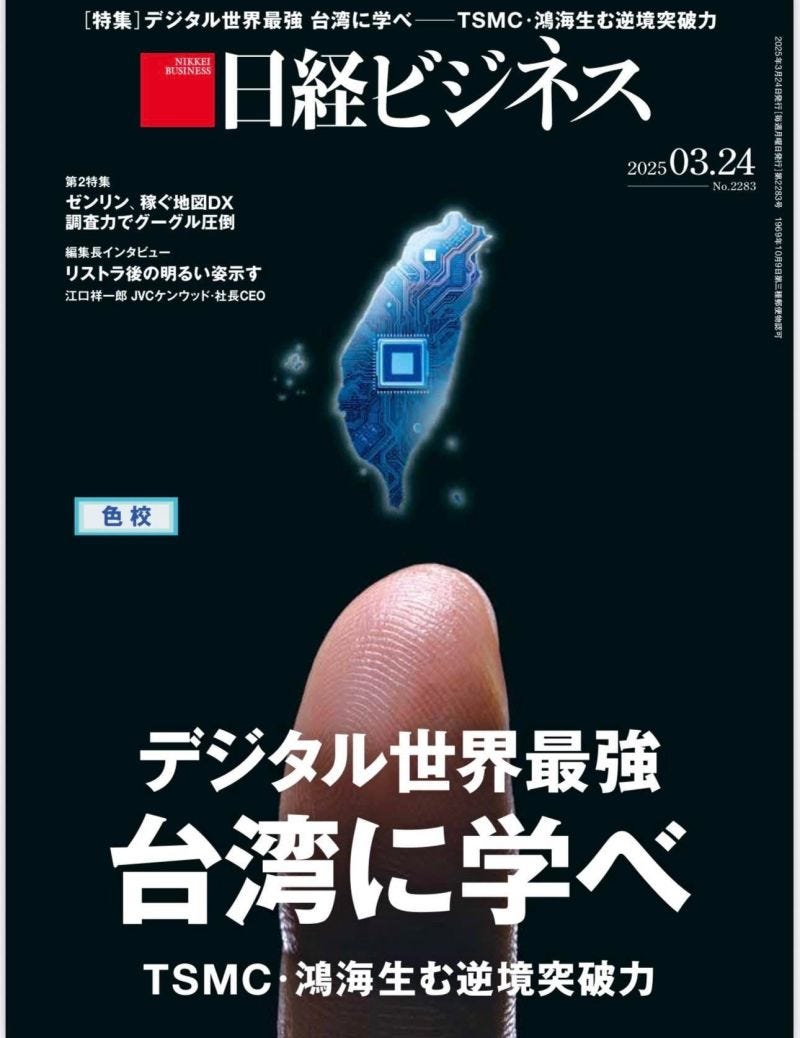
Topic 1: “Taiwan: The Fingerprint of the Digital World”
Reading the chip-map as a metaphor for global supply chain centrality
Discussion Points:
• Taiwan’s pivotal role in the global semiconductor supply chain (especially TSMC)
• “Fingerprint” as a symbol of irreplaceability, uniqueness, and security
• Geopolitical tensions and the world’s dependency on Taiwan’s chip production
TSMC alone holds over 60% of the global foundry market share, making Taiwan an irreplaceable “fingerprint” in the digital economy. Taiwan’s chips power not just consumer electronics, but also AI, automotive, defense, and healthcare systems. This chip-map visual highlights Taiwan’s indispensable role in tech and raises questions about supply chain security. As nations pursue tech sovereignty and risk diversification, how will they balance dependency with resilience?

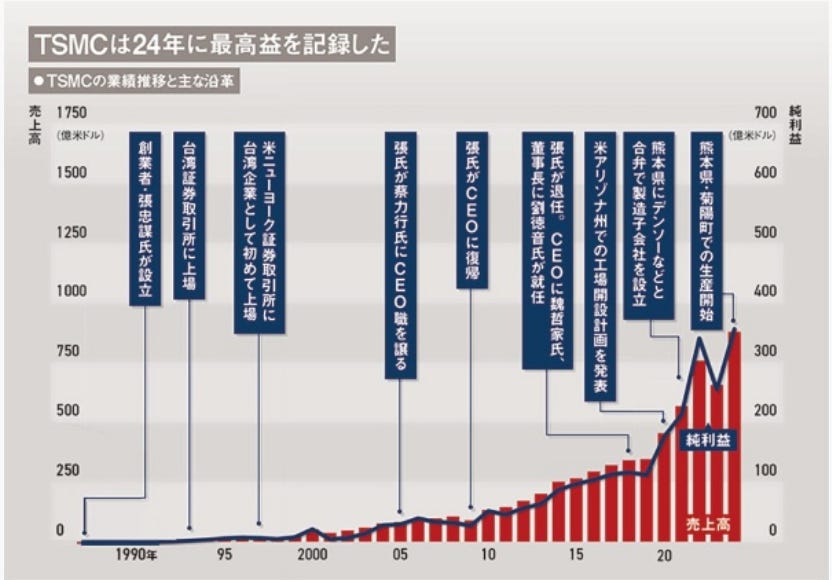
Topic 2: “Touching the Future”
How Taiwan’s tech industry powers global digitalization
Discussion Points:
• The finger symbolizes the ignition of future technologies
• TSMC and Foxconn as global enablers of key innovations
• Taiwan’s manufacturing driving AI, 5G, autonomous vehicles, and digital ecosystems
Taiwan’s unique industrial ecosystem — led by TSMC and Foxconn — supports the global wave of digital transformation. The finger in the image can be seen as Taiwan triggering the future of technology. How does Taiwan enable the rapid development of AI, IoT, cloud computing, and self-driving cars? And what must it do in the next decade to maintain its edge and deepen its innovation capacity?


Summary of the six main business groups ofFoxconn group.

Topic 3: “Resilience of the Silicon Island”
How Taiwan overcomes adversity to achieve global breakthroughs
Discussion Points:
• Inspired by the headline “TSMC and Foxconn’s Power to Overcome Adversity”
• How Taiwanese companies survive geopolitical tensions, earthquakes, and industrial overcapacity
• The cultural mindset of agility, crisis response, and innovation
Despite challenges such as U.S.-China rivalry, seismic risks, and global macro uncertainty, Taiwan’s semiconductor sector continues to thrive. Companies like TSMC and Foxconn have demonstrated exceptional resilience. How do they transform crises into strategic opportunities? For example, how does TSMC manage geopolitical risks while strengthening leadership? How does Foxconn shift from contract manufacturing to EV innovation? These case studies offer valuable lessons for industries worldwide.

Taiwan's Ministry of Economic Affairs promotes aglobal democratic semiconductor supply chainto strengthen resilience and AI chip development. Taiwan aims to lead in advanced manufacturing and IC packaging, enhance R&D capabilities, and collaborate globally to build a secure, efficient, and comprehensive supply network.
Topic 4: “Taiwan’s Tech Miracle Through Japanese Eyes”
Interpreting global perception via Nikkei’s feature
Discussion Points:
• Why didNikkei Businessdedicate its cover to “Learning from Taiwan”?
• Japan’s increasing attention to Taiwan’s tech rise
• The complementary and competitive relationship between Japan and Taiwan
The cover story titled “Learning from Taiwan” underscores how Taiwan’s tech ascent has influenced Japan and the broader world. How does Japan view Taiwan’s rise in semiconductors and electronics? What collaboration opportunities or competitive dynamics exist between the two? This image sets the stage for a broader discussion on how global observers are studying Taiwan’s model of innovation, resilience, and industrial strategy.
Topic 5: “The Silicon Shield in the Tech Cold War”
Taiwan’s strategic value and the coming challenges
Discussion Points:
• Taiwan as the “ultimate silicon shield” in the digital world
• Semiconductors at the center of U.S.–China tech rivalry
• Taiwan’s response to China’s catch-up and America’s de-risking strategies
As the tech cold war intensifies, semiconductors are the battlefield—and Taiwan is the frontline shield. The world depends on Taiwan’s semiconductor prowess, but this also raises concerns over concentration risks. How should Taiwan’s industry respond to such challenges? What strategic measures should its government and companies adopt to reduce geopolitical exposure and ensure sustainable industrial development? These are pressing questions worth deep exploration.

Source: US Defense Department
Taiwan’s location within the First Island Chain is strategically important for the global semiconductor industry. It offers geopolitical leverage and a frontline position in the Indo-Pacific supply network. This enhances Taiwan's role as a secure and stable hub for advanced chip manufacturing, particularly in times of regional tension. Its proximity to key markets like Japan, South Korea, and Southeast Asia also supports efficient logistics and supply chain coordination.
However, as critical semiconductor technologies begin to flow overseas, Taiwan’s so-called “silicon shield” is at risk of losing its strategic value. The outsourcing of advanced manufacturing and the global diversification of chip production could weaken Taiwan’s unique position and reduce its geopolitical leverage in the semiconductor industry.


PreviousNext
TopLatestDiscussions








See all